Author Archives: asher
Lake CX-211 Shoes
My bike rides are rarely preceded by a swim or followed by a run (though sometimes a ride is followed by a lazy, just-for-fun kind of swim!), but I decided to roll the dice and purchase a pair of Lake’s CX-211 Triathlon shoes.
Thus far, I’m really enjoying them. They offer a nice balance between price and performance — important on a college student’s budget.
Here’s what I like about the CX-211s:
1. Incredibly well ventilated!
I took these out for an interval workout yesterday in 97F/36C temps. I expected my feet to boil. They didn’t, which was awesome. My feet were comfortable, which let me focus on my ride.
2. Reasonably Light
My old road shoes were ancient clunkers that my better half snagged at a thrift store. I used them as long as they survived. They were bricks with straps and cleats. These are much, much lighter. Are they lighter than comparable shoes? I’m not sure. Their reported weight was lower than some, but this is only my second pair of road shoes.
3. Comfortable
The design of the footbed, insole, and upper on these shoes is great. I haven’t had any difficulties with hot spots, numbness, rubbing, or discomfort (and I walked a good mile or so in these today at a family event because I forgot to send my street shoes ahead!). I would call them “cushy,” but that might imply that they’re not stiff enough. They’ve got stiffness in spades. Speaking of which…
4. Stiff
Did I mention that these shoe are stiff? They are. Throughput on the pedal stroke is excellent. They’re also well-balanced.
So what don’t I like?
To be honest, I don’t know yet. Maybe they’ll prove to have a weakness in longevity or something. I’ll check back in on that. Right now, this is a four-star review because I can’t comment on durability, which I think is important.
A note about fit:
I would say that these shoes run maybe a quarter to half size large (I wear a 41 or 42 depending on make, so I ordered a 41; fit is great) and a bit on the wide side.
Since I have narrow feet and a high instep, this works well for me — I crank the toe strap all the way down, adjust the upper strap comfortably, and my toes have plenty of wiggle room. I’ll be able to wear heavy socks with these once temperatures drop which, coupled with shoe covers, should make for comfortable riding through late fall.

The Raccoon of Flanders: because Bike Commuters ride in all kinds of conditions.
For what it’s worth, walking in these is also a bit easier than in my old shoes. I still sound ridiculous, of course, and they’re quite slippery on laminate flooring.
One more thing: the silver skin makes them eye-catchers. I have never had so many comments (mostly from non-cyclists, who want to know what kind of shoes they are) on any pair of bike shoes! We’ve nicknamed them the “Official David Bowie Fan Club Cycling Shoes.”
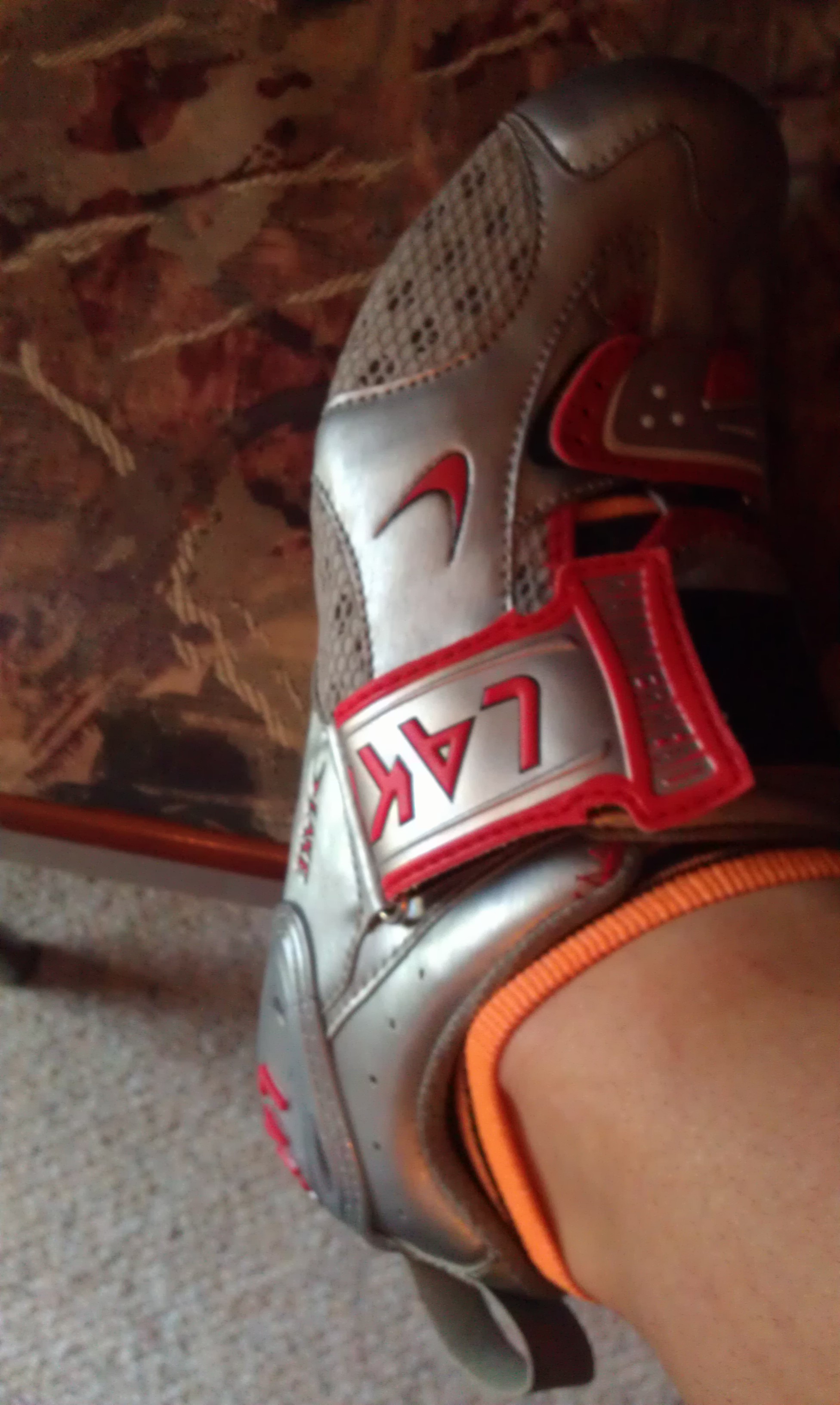
There’s a Star Man waiting for these shoes. This was prior to adjusting the straps for fit; both are looser than I would normally wear them. (PS: My ankles really aren’t that huge, I swear.)
Two thumbs up for the CX-211s, and chapeau to Lake for another great product.
2013 Mayor’s Healthy Hometown Hike, Bike, ‘N’ Paddle – Memorial Day Edition
The “Hike-n-Bike,” as I still insist upon calling it (though it now includes canoes, kayaks, and so forth as well), is actually one of my very favorite recurring rides.
Twice a year, about 6,000 folks on spokes gather on the waterfront to go for a ride together (the hikers and paddlers take different routes). The route runs about sixteen to twenty miles (there are a couple of different variations) and welcomes all comers, from carbon-jockeys in full team kit to grandmas on cruisers towing trail-a-bikes … even family trains (I saw one consisting of a workmanlike road bike, a trail-a-bike, and not one, but, two baby trailers!). If you want to ride fast, you can ride fast … and if you want to tootle along, that’s fine, too. If you want to battle it out at the front of the (enormous) pack, you can. If you just want to cruise along and see the sights, there’s room for that.
 |
| From 2013-Hike-Bike-N-Paddle |
The good folk of Louisville lining up at the Bike Doctor’s Bike Check tent
This past weekend, I was delighted to make it out to the Hike-n-Bike. Last year, I missed the Memorial Day ride (we miss the Labor Day ride every year — that’s when we’re out in the desert). In 2011, I rode it with Denis. In 2010, I did the Labor Day version (I wasn’t doing Burning Man yet, then), and turned out one of the flat-out fastest rides I’ve done in my entire life, banging out the twentyish-mile route in about an hour.
 |
| Quicksilver… |
at the 2010 Labor Day Hike-n-Bike.
This year, Denis wasn’t feeling it, so I went alone again. That meant I got to roll out at the front and hammer like it counted … and that, in turn, meant I belted out a moving average of 18 MPH over the 16.4 mile course on the Tricross.
 |
| A view of the pack… |
rarin’ to go (and, in one case, apparently phoning in last wishes, just in case). There’s a tandem with a dog riding in a rear carrier in this shot, but it might be too small to see.
 |
| My view of the Start line. |
 |
| Me at the start… |
…sweaty enough that I look like I should be at the finish.
On the back half of the outbound leg, I fell into a group that was attempting to work in a paceline (which is somewhat difficult when the group in question frequently encounters riders that have decided to slow down a bit). I tried to put in a few pulls. That was pretty nice. I haven’t ridden in a group in a while now (my best intentions in the direction of the regular Friday ride out my way have thus far been eclipsed by the need to catch up the housework left over from the rest of the week — summer classes are tough!), and I had forgotten how cool it is.
My group broke up at the climb into Iroquois Park (which, deceptively, is the toughest part of the Iroquois climb altogether). I kept it in the big ring and wound up pulling ahead of a number of guys, then stopped for some fresh water. Between getting ahead of the other guys who stopped for water and behind the ones who didn’t, I lost the group pretty much entirely. I basically rode solo for the whole of the return leg.
Towards the end of the outbound leg, I formulated a goal: keep the moving average at 17 MPH. It seemed attainable, and like a step in the right direction after months of not trying very hard. Nearing the home stretch, I realized I had a shot at keeping it above 17.5, and kept the engine revving … but it wasn’t until I got home and uploaded my data to Strava that I realized I’d actually pulled down 18 MPH. My ride time was around 54 minutes or so, including the water break.
This ride puts me really close to one of my long-standing cycling goals: maintaining a moving average of 20 MPH for an hour. It also, however, demonstrated something much more important: something that I guess I’d somehow forgotten.
It reminded me of precisely how much cycling is a mental game.
At no point in Monday’s ride did I feel like I was killing myself, burning too many matches, or working at maximum capacity. Instead, I was riding a pace I could have ridden for a lot longer — maybe not all day, but certainly for a couple of hours or more. I finished the race without burning all my matches, or even I think, half of them. Only on the climb into Iroquois did I ever feel like I was making a challenging effort, and that was mostly a question of accelerating around other riders (I spent much of that little climb out of the saddle). After the ride, I snagged a quick bite to eat, then rode home.
In short, even though I turned out the fastest ride I’ve managed in about two years, I had a lot more left in me … and that tells me two things.
First, I could work a lot harder on the bike than I do.
Second, I underestimate my own capacity. Drastically.
I suspect that’s true of a lot of us, especially those of us who ride solo a whole lot (and especially, especially those of us who ride solo in the city most of the time, and rarely get to really open up that throttle for long enough to see what they’ve got).
When you ride alone, you only tend to go as hard and as fast as you think you can. Put yourself in a group, and often that self-limiting tendency falls by the wayside. Put yourself in a big group that’s riding hard, and throw in that element of competition (with yourself and/or others) that tends to arise from such situations, and it’s almost guaranteed to vanish.
Suddenly, you’re sailing over those cracks in the pavement that you thought were ravines.
If we want to get better and faster, it seems like it’s probably important to get out and ride with other riders. I suppose every guide for would-be racers out there says the same thing: to get faster, get out there, ride with people faster than yourself. Go hit up the fast club rides and get dropped. Do it enough, and eventually you’ll be able to hang with the pack. Keep doing it, and you might someday find yourself at the front of the pack.
To get fast, you have to go fast — and every time you go fast, “fast” will get a little faster. The best way to train for racing is to race. Et cetera.
Oddly, I don’t know if I would’ve done anything anywhere near as impressive in an actual race.
Yesterday, I was only racing myself (okay, and all the guys around me, and especially everyone I passed ^-^). I wasn’t worried about killing myself and having to drop out or about being too slow (I was worried, very briefly, that I’d forgotten how to corner in a pack: I hadn’t). There was no “too slow.” There was just the group with which I was riding and the pace we were riding, a pace I felt like I could maintain.
This ride left me thinking that maybe I will try a few crits after all (it’ll probably have to wait ’til next spring, when our local crit series starts up again) … and maybe this fall, in addition to my gravelicious ambitious, I’ll hit up a couple of ‘cross races for real. For any number of reasons, I don’t expect to win any ‘cross battles, but my unvoiced fear that I didn’t have the capacity to go hard for anywhere long enough has evaporated.
I feel like my big goal is in sight. If I can do eighteen for almost an hour, soon I’ll be able to pull down nineteen for an hour. Soon after that, I’ll get my twenty-for-twenty (20 MPH for 20 miles).
…Or, rather, I will if I don’t let myself get lazy again.
I think it’s time to get back on this (race)horse and see where things go. After all, it’s only six months ’til Gravel Grovel!
…PS: Pictures are forthcoming. I seem to be having upload issues. All fixed!
<9 Death March 2013: In Which The Streams Are Crossed* And Training Pays Off!!!
*No, not like that. No legions of ectoplasmic beings were released in the making of this post.
In 2012, I didn’t finish a single race.
Not one.
Okay, so I only had two starts, and I did finish the four-day, three-night 280-mile Tour of Hilly Places In A Flat State (not a race, but a whole lot of riding nonetheless) back in July — but my racing record was 100% DNF. In March, Timothy and I started the Death March, got lost, and DNFed after 42 miles in the wilderness; in November, I made it to the first turnaround in the Gravel Grovel before mechanical problems forced me to throw in the towel.
This year, I’m 1-for-1 thus far: one start, one finish. The Death March is behind us, and we finished, and — perhaps surprisingly — we finished pretty well!
In contrast to 2012’s grey and dreary Death March, 2013’s took place in glorious weather: though the few weeks before the race were so rainy that the bridge at the start location (provided by our gracious hosts, Midwest Trail Ride) washed out, on race day a bright late-winter sun consented to come out and play.
My day began with a kit decision (thermal jersey, or Gore Phantom jacket? — I went with the Phantom) and a solid breakfast at the Comfort Inn in Bedford, Indiana, where I kitted up and treated myself to a DIY Belgian waffle (as well as a couple oranges, a biscuit-and-egg sandwich, a banana, and tea) at 6:30 in the morning.
I figured a fairly sizeable breakfast wouldn’t kill me, since I had plenty of time to digest before the start at 9:00 AM.
Because the bridge was out at the MTR camp, Blackwell Limestone kindly provided parking for those of us whose vehicles were unlikely to make the creek crossing. Timothy met Denis and I there, then Team River City Cycling Society rode over to the MTR camp. Denis followed in the truck to see if he could find closer parking on the road.
I had to admit that, in that first few minutes, I had my doubts. As we cruised the mile or so up to the camp, I felt a little sluggish on the long-but-shallow climb. Timothy, too, was less than sure about our potential for the day. We were both recovering from illness-related training setbacks.
That said, the sun was shining and the temperature was cool, but comfortable. Soon, we reached the creek crossing where the bridge had been. For me, it would be the deepest and widest water crossing I’d ridden thus far. We had to ride it twice to start — once to get into camp; once to get back out.
I’ve always believed that the best way to face potentially-daunting obstacles is to charge straight at them (or, in this case, diagonally, since the crossing in question is diagonal), and that’s exactly what we did. It turned out the line we picked rolled straight through the deepest part, so my feet were soaked, but we both made it across without a spill.
At the check-in, I resisted the urge to introduce ourselves as “Team 184**” (our number from last year!). Soon, we had our race numbers, trail passes, and commemorative Death March 2013 t-shirts in hand. We weren’t entirely sure what to do with the T-shirts, so when we got back outside I stuck them in my trunk bag.
We hit the head one last time, then headed out to the start. I was pleased to see that the field was pretty large even given the situation with the bridge (or lack thereof). I was a little worried that only the really seasoned, intrepid riders would actually show up under the circumstances. Instead, 150 teams (300 riders!) lined (or, more accurately, bunched) up at the start.
Next came the most nerve-wracking part of the day: the wait for the drawing of the last two mandatory stops. Along with everyone else, we were hoping that Gorbetts cemetery would not be drawn, since it was way out on the other side of creation and up a long climb.
Fortunately, Gorbetts did not make the cut. Instead, Houston and Robertson — both conveniently located near other cemeteries already on our planned route — were called. This meant that we could ultimately shave about 10 miles and at least one wicked climb off our ride.
Relieved, we briefly consulted and decided on a strategy of waiting patiently at the back of the pack during the start. With 300 riders trying to cross one creek, a hurry-up-and-wait strategy that would allow us to cross in the clear seemed well advised.
We made the second stream crossing without incident, though we both forgot to gear down and had to practice our cyclocross dismounts as we rolled up the steep, slick bank on the far side.
There, we hung a right and briefly hooked up with Denis, who collected our T-shirts. We debated changing our socks, but decided against it (in fact, though they got wet a few times, my feet remained comfortable throughout the day) and headed for our first stop.
Predictably, our day began with a climb. It wasn’t a hard climb, though — just long and shallow, and we set ourselves an easy pace. At one point, due to the lay of the land, we appeared to be rolling on a slight descent and were mystified briefly by the fact that we still had to work to maintain speed. Then Timothy noticed that his Garmin indicated that we were, in fact, still climbing: we had encountered one of those pesky optical-illusions, a true false flat!
Soon, we turned left and headed down an actual descent (which was quite fun) to bag our first cemetery for the day.
To Team RCCS (AKA Team 144, AKA Former Team 184**), this was a pretty big deal. You see, in 2012, it took us a full hour and a half to bag our first check point. In 2013, we had our first within a half an hour.
In the next hour, we snagged two more checkpoints. We thought about doing the Fire Tower, but ultimately decided against it (in retrospect, a wise decision; I don’t think we would’ve gained as much time as it would’ve taken us to get up there, wait for everyone else to finish taking pictures, get our pictures, and get back down). Maybe next year.
Thus far, we’d ridden mostly on a combination of paved surfaces and really nice “strada bianca”-style terrain. Last year, the Powers That Be had dumped fresh, enormous, chunky, horrible gravel right before the race; this year, they hadn’t. This made for much smoother (though sometimes also much slicker) sailing. It was in the wettest spots that I realized the brilliance of Maxxis’ Raze tires: they’re fast on the road, but on the slick stuff, they have just enough texture to keep things rubber-side down.
Moreover, I quickly realized that the Tricross is a straight-up mountain goat. It climbs beautifully, handles with sure-footed ease on all kinds of stuff, and feels nice and stable on the descents. I was able to really let ‘er fly even on some of the non-paved descents (though I was still summarily dropped by a few much-more-confident descenders). As in 2012, I generally stayed ahead on the climbs, but this time I didn’t drop so far back on the descents as to lose sight of my partner.
After a beautiful stretch of rolling climbs and descents and a nice, flat road parallel to a creek, we rounded a corner and came at last to the start of Combes Road. We rolled off the pavement and onto some more lovely lightly-graveled clay surface. A little ways on, I paused to swap out my gloves and remove my jacket’s sleeves. The winter gloves and the sleeves went into the trunk bag; I proceeded in arm warmers and my light long-fingered gloves for the rest of the race.
This year, I knew what to expect from Combes Road. Because of that, I was probably feeling a little more cautious than I did the year before.
In retrospect, I shouldn’t have worried — once passed beyond the famous gate, the Tricross just rolled on like a tank.
Through streams, mud, rocks, roots, and countless creek crossings, I was able to remain mounted with a few exceptions. There was one turn sharp enough that I can’t imagine any bike making it (with a fallen tree on one side and a drop-off on the other, for good measure!); the rest of the dismounts were mostly tree-in-trail related. Even on the dreaded Combes Road Climb, I dismounted only for a few yards, where the terrain was both steepest and slickest. (For what it’s worth, I still hate pushing my bike.)
Soon, we had bagged Elkinsville Cemetery. By this point, I was starting to feel pretty giddy. A non-DNF finish was in sight, and with Gortbetts off the table, the only remaining serious challenge was Callahan, which involved the longest true off-road stretch I’ve ridden to date (as far as I can recall, anyway).
Leaving Elkinsville, we hit a steep climb — the kind, as I said to Timothy, that I’d power up if it was July — and we both dismounted and pushed for a bit. We then proceeded to bag a few more checkpoints and grind up a long, steep climb that beat the crap out of me last year. This year, I rode most of it.
At the top of that climb, a wild SAG wagon appeared! We were completely stoked, having failed to find a SAG stop even once last year (Death March features roving SAG stops). This one couldn’t have come at a better time and place; I had just emptied my Camelbak and was definitely ready for some serious snacks. The SAG wagon offered water, another beverage choice, and an array of delicious comestibles. I snagged a bag of BBQ potato chips, some pretzel rods, a Mandarin, and some more pretzel rods, all of which were the most delicious thing I’d ever tasted right at that particular moment.
For a little while, we hung out and chatted with our fellow SAG-stoppers and the SAG-driver. Then, refueled and feeling optimistic, we rolled out.
…Or tried to. It was as he attempted to clip back in that Timothy realized he’d lost a cleat. We realized that, while both of us have bags of extra cleats and bolts at home, neither of us had possessed the foresight to bring so much as a single extra SPD cleat. Um. Oops?
To our defense, neither of us had ever lost a cleat mid-ride before — or, rather, I had, but it was because I hadn’t screwed it in well enough in the first place, and it has never happened since. While my pedals offered a flat side as well as an SPD-compatible side (which came in handy, by the way, whenever my cleats were chock full of clay and I couldn’t clip in), we didn’t have a wrench on hand that would let us swap pedals out, and Timothy didn’t think his carbon-soled shoes would pay nicely with the flat pedals anyway.
In the end, we decided to simply roll on as we were. For Timothy, this meant riding the last 18 miles with only one cleat!
At the bottom of the descent, I overshot Thompson (or was it Todd? I’m always getting them confused) Cemetery by a few meters; fortunately, Timothy stopped in time. We snagged a picture, then rolled on to …. er, the one cemetery at the Callahan trailhead and to Callahan, our final checkpoint for the day.
I don’t even know how to describe the experience of riding to Callahan. We took our final on-road cemetery picture, then descended into the trees. Sometimes — read, any time we were actually able to ride our bikes — it was wildly fun. Sometimes — read, any time we were pushing our bikes up ridiculous, clay-slicked ascents — it was horrible. Have I mentioned that I hate pushing my bike?
For the most part, I enjoyed the ride out to Callahan. At one point, as I gave the Tricross free rein on a bumpy descent, I said out loud, “This is just like riding hunters!” I was glad for the years of horseback riding experience that taught me to balance with my legs and core while my arms did something else entirely. I was grateful for the gift of what horse people call “following contact” and the “automatic release.”
The woods en route to Callahan offered one more major water crossing; one we would ride twice. It was at the bottom of a steep and rather wicked hill; a climb (largely unrideable) on the way out and a descent (totally rideable, though I also totally unclipped and stuck my feet out at the steepest point) on the return leg.
The outbound leg constituted the single worst bout of pushing-the-bike on the ride, though not the worst I’ve ever encountered (pushing Denis’ 60-pound folding mountain bike up loose scree on a ridiculous incline at Hippie Camp in 2011 was a thousand times worse than anything Death March dished out this year). That said, I got back on and rode as soon as it was humanly possible (I’m happy to say that Death March has made me much more confident off-road and also taught me how to get the bike going again when remounting on a gravel, loose-surface, or mud climb.)
For Timothy, there was an extra helping of horrible. With only one cleat, he lost a significant degree of mechanical advantage on the climbs and much of the finesse required for off-road riding in sloppy conditions. I was able to ride climbs where his mechanical limitation required a dismount-and-push approach.
Even so, I was now starting to feel tired, hungry, and cranky, and after our stop to snag our final checkpoint photo, I was often annoyed with myself for churning out a neck-breaking speed of approximately 1.7 miles per hour on long stretches of the trail. I can honestly say that I don’t think I’ve ever ridden so slowly for so long: the trail surface continued to be wet, often gnarly, and strewn with occasional obstacles that required a dismount-and-lift approach.
Soon, though, Timothy announced that we were two tenths of a mile from the road!
Okay, so I’ll admit that I didn’t quite believe him at first, since it took bloody long enough to get there — but, in fact, he was right. Abruptly, after rounding a long bend, the trail dumped us out at the base of one last wicked gravel climb. We both wound up walking part of that one.
With that bastard behind us, though, we were home free. Suddenly we were sailing along at speeds upwards of fifteen miles per hour, often hovering around nineteen. I couldn’t help but think back to the awful start of last year’s Gravel Grovel, when I watched the field ride away from me as I fought my bike with everything I had to crank out a measly 16 MPH.
Soon, we were returning to camp. Because my shoulder was not cooperating, Timothy lifted the Tricross over the barriers on the closed bridge we had to cross. We spanked along at a nice clip, and soon we came to the parked cars lining the bank opposite the MTR camp.
Denis was waiting at the spot where the end of the bridge would be. We waved to him as we passed and dove into the creek crossing. Just as we began the descent, someone zoomed up on my left side and took the line I was heading for without so much as an “On your left!” I was a bit nonplussed, but this last-minute passing attempt apparently didn’t work out for the rider in question.
Without losing another spot, we rolled up the far side (I nearly rammed Timothy from behind as his cleatlessness caused some climbing difficulty, but managed to get around without killing anyone), hung a right, and rolled through the finish line. I’m pretty sure we were both elated that we’d finished.
Our finishing time was 4:08, and we were told we could feel free to kick back and stuff our faces and take our time; the checkpoint check-in desk was in no hurry.
Inside, I crammed a Naked Burrito, a cookie, and a glass of lemonade down my gullet as fast as I could (thanks, QDoba!), then we checked in our pictures. At last, I bade Timothy good-bye, noting that I might be back if Denis wanted to cross the water, but wasn’t thinking that seemed likely.
Back at the truck, I managed to load the bike and my stuff without dropping dead; Denis observed that he thought we’d placed pretty well. On the road, we saw a good number of other racers still out plying their routes; some of them looked completely bushwhacked. Denis was optimistic about our standing in the GC; I was simply elated that we’d finished. For me, finishing the Death March marks the beginning of a new era in my racing life; one in which I plan to finish a lot more races and to finish decently well.
Today, Timothy discovered that, in fact, we did finish pretty well — 52nd out of 110 in the mens’ division; 75th out of 150 overall! Since our goal was to place in the top half of the field, we’re both pretty excited. In fact, I believe the word for what I’m feeling is “stoked!”
Anyway, that’s it for this year’s ride report. I took exactly no pictures and apparently somehow killed my Garmin out there (update: the Garmin is not dead, but it also failed somehow to record Saturday’s miles and lost a bunch of data somewhere; I’ve reset it and it seems to be functioning again), so I will have to gank pix from Timothy’s blog when he posts them.
I was planning on hitting the hills today, but I’m feeling iffy about it. Tomorrow, I will probably do the full commute to school for the first time in a number of weeks. Spring is near and my racing season is off to a great start. I’m looking forward to more of the same, with more racing opportunities this year than I’ve had before. There’s even a new team adventure race up in Hoosier National Forest in September — more on that soon!
Keep the rubber side down!
Notes
** I just noticed that I was totally wrong about this. We were Team 182 last year.
Woohoo! We Got An F*!
*That’s as opposed to a DNF, by the way.
I haven’t had a chance to upload my Strava data yet, and I don’t know what our exact standing in the rankings was, but Timothy and I finished Death March this time. w00t!
This is a nice way to start off this year’s racing season, after last year’s ignominious collection of DNFs.
It was a tough ride, with more off-road action than I’ve ever done in my entire life (one of the off-road cemeteries was a mandatory control), but I had a fantastic time. My bike handling skills really surprised me, and the Tricross really proved itself capable in the rough stuff (even with 35s on; I had hoped to acquire some slightly fatter tires, but never got around to it). The trails were muddy and sloppy. I rode stuff I definitely would’ve walked last year and powered across creek crossings that I’ve previously approached with trepidation.
As far as I’m concerned, that’s a win for me. We kicked last-year usses’ butts, and as Denis pointed out, in the end, your most important competitor is yourself.
All told, it was a rewarding experience — a fun day in the saddle with plenty of bike-nerd camaraderie, and a chance to see to training we’ve put in starting to pay off.
I intend to write a slightly-more-complete ride report, but right now I’m ready to pass out. Tomorrow morning I need to haul my bacon outta bed early and ring bells, then get over to New Albany to visit a friend, then finish a project.
Keep the rubber side down!
More of the Same: Reflections on Bernuth & Williamson’s “Perceptions and Possibilities” Study
Recently, the League of American Bicyclists commissioned a study (through consulting firm Bernuth & Williamson) about bike advocacy that was presented at the National Bike Summit. You can find it here (PDF; opens in new tab/window).
The findings are interesting, I’ll grant that. There’s also a lot of good stuff in this report — it does look like the opinions of policy-makers are slowly shifting in favor of bikes as a transit modality; it does recommend an advocacy strategy that involves using anecdotes about the success of cities and towns that have implemented bike-friendly changes.
However, an underlying current suggest that perhaps policymakers A) aren’t listening very well and B) don’t know what they’re talking about.
Major unifying threads include, “Stop being anti-car bike-evangelists and present your message in terms of multi-modal transit systems that benefit everyone, not just cyclists” (a solid message, but there’s a problem there) and “Bicycle people aren’t paying in to the system” (a persistent and troubling fallacy).
To address the first problem: unless there’s a huge disconnect between the bike-advocacy community as I know it and cycling advocates in DC (which is possible, but I know an awful lot of DC bike people: most of them also own cars and none of them represent the extremist point of view), the bike-advocacy community, with few exceptions, is already not anti-car and very vocally supports cycling as part of a flexible, multimodal transit system.
The vast majority of us would love to see better bus and train systems (I love trains, in fact!); we would also love to see better, more human-centric public space designs that put people first — which means employing human-scale development and small-but-important touches like installing a bench every so many meters so people with limited mobility can sit down and rest. Most of the cycling-advocacy blogs I read on a regular basis are as giddy about trains, trams, and buses as I am. We don’t want to run cars off the road; we just want to make it possible for more people to get around without relying on them.
Yes, there are some loud ‘n’ proud “bike supremacists” in the advocacy community who only seem concerned with bikes getting their fair share and who don’t seem to grasp the importance of other modalities. Here’s the thing, though: there are also tons of loud ‘n’ proud “automobile supremacists,” and some of them have high-paying jobs on Capitol Hill as auto-industry lobbyists.
Because they represent the dominant paradigm in this country, the auto-supremacists’ attitude is considered normal and acceptable, just as racist attitudes among whites were considered acceptable until only a few decades ago (for that matter, they still are, to an extent); just as homophobic attitudes among heterosexuals still allow people to believe that gay marriage is somehow a threat to the concept of heterosexual marriage.
In short, someone who claims that bikes should be banned from the roadways is perceived as a normal human being expressing her opinion, while someone who claims that cars should be banned from the roadways is perceived as a dangerous wacko with an anti-car (rather than a pro-bike or pro-flexible transit or pro-people) agenda.
It’s also considered acceptable to imagine bike advocates as a bunch of stinky, unwashed, raving, anti-car zealots. There are a few of those out there — I’m not denying that. The thing is, they’re a tiny sliver of the actual bike-advocacy community. Unfortunately, however, they’re the ones who get noticed: they’re the squeaky wheels, the sliver in the side of the auto-centric world, and — more importantly — they’re visibly and vocally out there. That’s how the human mind works. We’re wired to notice anything weird and fear it.
Unfortunately, we’re also wired to oppress out-groups and their members, which is to say that we’re programmed to defend our interests and our “turf.” This is less problematic when both out-group and in-group are tribes of roughly equal size using neolithic technologies to defend their hunting grounds. It becomes much, much more problematic when the in-group is enormous, the out-group is tiny, twenty-first century technologies are involved, and the very concept of “turf” is more philosophical than literal.
Moreover, the more normative-appearing bike advocates are essentially invisible. Simply put, we don’t think of the perfectly-respectable ladies and gentlemen over in Software Development or Rocket Surgery or the Mail Room who ride their bikes to work as cycling advocates. We don’t know them in that capacity. Thus, when we think “bicycle advocate,” we think “sweaty-toothed madman,” not “Jane, from Accounting.”
Thus, Jane-from-Accounting, Steve-from-the-Mail-Room, Betty-from-Surgery, and everyone else who advocates sensibly for a sane, multi-modal approach to transportation fades into the background, and Joe-the-Crazy-Bike-Dude comes to represent the entire bike advocacy world in the minds of those who aren’t already on the bus (so to speak).
Meanwhile, apparently, well-educated drivers who work in government still somehow believe that bike people aren’t paying into the system. To this, I can only say, “WTF?”
First: most cyclists also drive. Most of us own cars. Heck, my household has two! Most of us use gasoline. From what I understand, gasoline taxes do (in part, albeit possibly a large part) fund federal highways. Okay, fine: when I’m on a bike, I’m not paying for the Eisenhower Interestate system.
You know what, though?
I’m also not riding on it.
With very few exceptions, the high-speed roads of the Eisenhower Interstate system are explicitly closed to bikes, farm machinery, scooters, mopeds, “animals on foot” — basically, anything that can’t clock 55 MPH or better.
You know what else?
I’m perfectly fine with that. The Interstates were intended to be dedicated point-to-point roads for longer-distance travel. That’s not what most of us do on our bikes, and when we do, we tend to call it “Touring” and do it at a fairly relaxed pace.
Local roads, meanwhile, are mostly paid for out of general funds — and while state or local gas taxes may or may not toss a little into that hat, general funds largely derive from property taxes, payroll taxes, and the like. This is a big part of the reason that the roads in my neighborhood look worse than the ones in Beirut, while the roads in posh east Louisville neighborhoods are often like velvet carpets that beckon with their siren songs to the wandering wheels of the bike-riding public.
Here’s the thing: my household makes a lot more than the average household in my neighborhood. That means we pay a lot more in taxes than most of the people living here (indeed, we pay more than many of the people living in the aforementioned posh east-end neighborhoods). Properties on our little cul-de-sac also happen to be appraised at significantly higher values than most of the surrounding neighborhood, which again means we pay more in taxes. (For that matter, since Denis’ job means he drives all over creation all the ding-dang-darn time, we pay a heck of a lot more than average in gas taxes.)
Does this mean that I get to demand that all the people who live here whose taxes are not as high as ours pull over and get out of the way when I’m driving around with Denis or riding my bike? Does it mean I get to ticket them for parking on the street?
Um, no.
That’s not how taxes work. Taxes pay for public infrastructure. That means I have no more (or less!) right to it than the next guy.
So, basically, most bike people pay taxes. Most of us have jobs, and many of us have very good jobs (perhaps because the same character traits that make us willing to ride bikes in such a car-centric culture — confidence, self-reliance, relative fearlessness — tend to funnel us into leadership positions in our careers). We own property at the usual rates, pay property taxes at the usual rates, and so forth.
Moreover, by reducing wear-and-tear on roadways, we extend their lives, reducing their cost per unit of use. Since we can lock up our bikes just about anywhere, we also save money on the installation of parking meters and the building of parking lots and structures. We could argue, then, that not only do we pay into the system, but our dollars go further than average. We’re helping to keep costs down.
What troubles me is the persistence of the idea that the bike-riding public doesn’t “pay in.” We not only pay in, but reduce costs — so, no, we shouldn’t be subjected to “user fees.” We’re already paying them. They’re called “taxes.”
(Note: I wouldn’t object to occasional “user fees” for new bike- and pedestian-specific infrastructure — we use that approach to build bridges and roads all the time, only in that case we call the fee a “toll” — as long as the new infrastructure in question is actually useful, and not more recreational horse-hockey.)
In short, I don’t think the challenge, in reality, is one of toning down our evangelism or “paying in.” It’s figuring out how to exist in the mainstream without disappearing. Much as drivers in car-bike collisions tend to claim that they didn’t see the person on the bike, car-oriented people simply don’t see bike advocates unless they’re noticeable enough to seem weird.
Meanwhile, most of us in the bike-advocacy world aren’t about “critical mass and kicking ass” (except in races; those of us who race totally want to kick ass, even if it’s only our own asses). Most of us are about sensible plans that make things better for everyone. We get concerned about funding because, quite frankly, when it comes down to a decision between funding unnecessary, redundant, poorly-planned car infrastructure that causes more problems than it solves or funding useful, innovative bike or transit infrastructure, the car-oriented infrastructure tends to win automatically simply because the people making decisions are more likely to drive cars than to ride bikes (meanwhile, useful local roads that serve both bikes and cars quite well fall into disrepair through budgetary neglect).
I am, I suppose, cautiously optimistic about the future of cycling and transit in the US. Frankly, rising gas prices mean that drivers will feel the pinch sooner or later; meanwhile, we younger types are trending towards urbanism and choosing to eschew car ownership and surprising rates. Bike advocates are well aware that these changes have little to do with our efforts, but we’re grateful for them.
I, for one, would love to see better mass transit; things like high-speed trains (or any trains, honestly) for long-distance travel; trams and electric buses at local levels. My feelings about dedicated bike infrastructure, meanwhile, are mixed — I think well-designed roads are very capable of serving bikes and cars at the same time without everyone jockeying for space. I also think better enforcement of traffic laws — with fair-but-certain penalties — for both drivers and cyclists is a critical piece of the puzzle — and I really think those laws need to acknowledge that cars don’t maim and kill people, reckless drivers do (right now, reckless driving is under-penalized in part because we don’t blame drivers; we blame cars).
At the end of the day, the same people who kvetch about spending money on bike infrastructure are the people who whine about job creation: well, building infrastructure creates jobs. So does building a police force capable of actually enforcing traffic laws.
So, for that matter, does commissioning studies. I’m glad that the LAB funded this one. It’s important, if a bit discouraging, to know what people think.
Yes, we need to find a better way to communicate: we need to find a way to make Jane-from-Accounting, not the “sweaty-toothed madman,” the symbol of bicycle advocacy.
I guess that’s it for now. Race day tomorrow! Woot!
Winter Kit Reviews!
Okay, so all of my new winter kit has now been out in reasonably-chilly (sub-freezing) weather at least once, and it’s time for a thorough collection of reviews.
First, the number one find for this year: Louis Garneau’s Gel Ex winter glove!
I’m one of those people with icy hands. Every part of me stays perfectly comfortable in most temperatures as long as I’m decently dressed — every part except, that is, my hands. My hands freeze.
I’ve tried all manner of gloves (though, admittedly, none of the ones that cost $50 – $100). Winter cycling gloves, ski gloves, layers of non-sport-specific gloves, work gloves… For the most part, they’ve … well … left me cold (you see what I did there?). The exception — ski gloves or mittens — always leave me feeling like I’m swimming in a sea of batting, groping for the levers.
Moreover, most seem to suffer some from fit problem or another (of note, this is in part due to the fact that I have small palms and long, slender fingers and except for my pinkies and thumbs, which are short and slender (my size 7 wedding ring is loose) — apparently the short pinkies and thumbs is some kind of genetic pattern).
So, in short, I’m a serious problem child where gloves are concerned.
Enter the LG Gel Ex. I paid $30 for these at Bicycle Sport, about twelve miles from my house as the bike flies, a shop in Saint Matthew’s which is fast becoming a favorite of mine. There were no size small gloves in the men’s section, so I wandered over to the women’s side of the shop and found these hanging on the wall.
I would be remiss if I didn’t mention that I had my doubts — I didn’t feel terribly confident in what appeared to basically be a souped-up fleece glove. My previous fleece-glove experiences had been less than stellar (even with so-called “windblocker” fleece). However, the fit was perfect, and I figured that these gloves coupled with liners would probably be survivable, at any rate. Besides, nothing else in the shop fit.
Well, rest assured that the LG Gel Ex gloves have now put my fears to rest. I wore these to the Gravel Grovel with liners, and two miles after the sub-freezing start, my hands were soaked in sweat and I had to take the liners out. When I headed out on today’s outbound commute, the temperature was just below freezing, so I packed the liners in my backpack just in case. Turned out I could have left them at home.
These haven’t seen use in a hard rain yet, but they did hold up to a light sprinkle with no problem. They also seem to breathe fairly well and stay warm even when they’re a little damp inside. Cool beans!
(Here they are on Bicycle Sport’s website.)
I suspect that these gloves will be perfectly functional in temperatures significantly cooler than those they’ve seen thus far. The one thing I’d change is the very limited reflective trim — and I can, in fact, change that by adding a little iron-on reflective stuff.
Meanwhile, just in case it gets really, really cold out, I’ve got these babies:
Seirus Dynamax Men’s Glove Liner (Dick’s Sporting Goods). In the small/medium size, they fit perfectly inside my LGs.
I suspect that, combined with the LG Gel Ex gloves, these will keep me comfortable well into the single digits and below.
To keep my core warm, I sprang for Gore Bike Wear “Phantom” jacket. I got mine on sale, and I want to say I paid around $60 for it.
The Phantom is exactly what it says it is: a windproof jacket that turns into a “jersey” (it’s really more of a wind vest-with-sleeves) via a few extra zippers. It’s also highly water-resistant. Again, I haven’t worn it in a soaking downpour, but I have been out in some not-insignificant rain in this thing and it has kept me nice and dry. A warm core, by the way, keeps your extremities warmer.
To keep my legs toasty, I’ve got an array of options.
For extra, extra-cold days, I’ve got these: Gore Bike Wear Contest bib tights. They are chamois-free, so you pop them over whatever you’ve got that has the chamois in. They also double as excellent running tights.
Layered on
Bellwether’s ThermoDry bib knicker, they’ll probably let you ride well into Arctic midwinter.
As for the Bellwether knicks … you know those wonderful fuzzy pajamas you loved as a kid (maybe)? Well, these are like those, only the fuzzy part is on the inside. Oh, and they block the wind. And they have a nice chamois. And you wear them on your bike, not in bed. Unless, you know, you’re into that kind of thing.
Bike Nashbar has had a pretty great price on these for the past few months running. I keep toying with the idea of ordering a second pair. They’re worth it. Heck, they’re worth ordering a second pair at full price. I have effectively not worn anything else since it got cool enough to start wearing these.
Here’s the best part: I’ve worn these in temperatures from around 65F to below freezing and been perfectly comfortable. Above 65F (or above 60F, if you’re making a hard effort), they can actually be a tad on the warm side.
Of course, neither tights nor knickers keep your feet warm — and that’s where an array of winter footwear stuff comes in.
On the recommendation of two friends, I picked up a pair of LG’s Neo-Protect Booties (also from Bicycle Sport). For around $25, they extend the season of your favorite cycling shoes into … well, pretty much anything*. Throw a good pair of warm socks under, and you’re good to go. I couldn’t find them on the Bicycle Sport website, but of course they’re also available from Nashbar (which may be more convenient for you, if you don’t live in the Louisville metro area).
Apparently, LG’s Neo-Protect Booties manage the perfect balance between price and performance. My non-scientific survey determined that something like 75% of the Gravel Grovel field was wearing them.
I’m not going to go into my sock choices at any great length, mainly because I have no idea who made most of the socks I own. I recently ordered a three pack of J.B. Field’s -3-Icelandic socks, and they appear to be verifiably Iceland-ready. My feet were excessively warm in them at the Grovel, and coupled with my Merrel Winter Mocs they are like little furnaces. I may, in fact, not live in a cold enough climate to ever really get much use out of these, though they’ll be great for wearing in the sleeping bag during mid-winter bike camping trips. They are, simply put, the warmest socks I have ever owned, ever.
Oh — one more thing. I love the fact that J.B. Field’s socks come in different sizes. Frankly, I have pretty small feet (size 8 – 8.5, depending; Euro 41.5 – 42). Often, mens’ socks are simply ridiculously large (they’re all sized for people who wear shoes sizes 9 through gazillion). The fact that I could order these in “medium” (which, I think, is what they call “small” so guys won’t feel self-conscious about ordering them) made my day. Denis is happy about that too (we can share shoes, isn’t that cute?).
In the “Arm Warmers” department, meanwhile, I have an array of three different options in three different weights: a lightweight Saucony set intended for runners, a mid-weight set by Cannondale, and this pair, Pearl iZUMi’s Thermal Lite Warm Warmer in the “Rob White” pattern (I’m lusting after the Retro Spin in pink as well). They’ve got a fun design, and they’re the warmest warmers I own; so warm that I left them at home come Grovel Time. I am forever having to peel these off mid-ride, which would’ve been difficult without wrestling free of my other clothes. Instead, I wore the Sauconys, which are easier to remove. I still wound up removing them.
I now feel confident that I am well-prepared for just about any weather (except, perhaps, the kind that requires ice tires). Of course, once I’ve layered all this winter crap on, I am basically unrecognizable as a human being … but not as much as I would be, I guess, in a puffy parka and moon boots.
I’ll try to get some pictures of all this stuff up.
Notes
*While neoprene is water-resistant, however, I wouldn’t recommend these if you’re going to be wading in ankle-deep icy water — for that, you’ll want something like the Lake shoes I bought back in February. They served admirably on the very-damp Sub 9 Death March.
Sunny Solo Rambling Ride
On Friday, I ordered a new stem for the Moto, but somehow the next-day-delivery request didn’t go through, so I didn’t ride yesterday. Today, I decided to ride anyway, even though the Moto’s new bars are skinnier than the old ones and thus are currently shimmed with a really squirrely DIY jobber. I just needed some time in the saddle.
I set out to get a couple hours in. I wound up a little less than nine minutes shy of two hours, so that’s not too bad, especially given that I sort of took a half an hour break to eat lunch.
All told, it was a nice ride. I just took it easy on the roads, mostly rolling along at a pretty easy pace, but I still managed one personal second best and one personal third best on established Strava segments, as well as a 17th out of 106 on a stretch of road where I apparently haven’t ridden since someone added a segment there. Not too shabby, for an easy day!
The highlight of my day, however, came during my lunch break. I paused at Home Run Burger at Cardinal Towne and locked my bike next to a lone mountain bike. When I emerged from my lunch break, the rack was full! …And not only was it full, but the next rack down had a bike in it, the one beyond that had two, and another just around the corner was nearly full!

It’s good to see so many bikes out and about. There was a group of about four riders in varying degrees of lycra-cladding who were obviously stopping for lunch together as well; the others, I’m guessing, were just people out doing their thing on a lovely Sunday afternoon (or working at the various shops in Cardinal Towne).
I also managed to get a “Panda Portrait” (no, I don’t have the foggiest idea why they’re called that) on Adams Street. Playing with my phone while riding isn’t something I normally do, but there was essentially no traffic (some walkers and eventually another bike on the other side of the road) and I slowed waaaaaay down. The problem is, I think I kinda look like a young George “Dubya” Bush in pictures like this one:

…So to make up for it, I caught this spooky and atmospheric shot of an old warehouse at the corner of Swan and Kentucky:

…which is also the location of locavore-specialist retailer The Root Cellar‘s new shop, their second:

If you’re in town, you should check it out. The Root Cellar has two missions: first, to provide locally-grown, fresh-off-the-farm produce (as well as other products) to the greater Louisville community; second, to supply fresh, healthful food in an area of Old Louisville that has historically been very much a food desert. You can find hours and directions posted on the website listed above.
One last bit: one of the little bike-wrenching jobs I find that I do often is swapping out pedals. Inevitably, friends and relatives buy new bikes that come with boring, vanilla stock pedals and decide they want something more exciting (or the boring stock pedals eventually break and need to be replaced; it sorta depends).
In the process of doing a bunch of such pedal swaps over the past few months, I’ve been convinced that bike shops throughout the country are secretly part of an experimental government program intended to help deinstitutionalize gorillas (presumably because they’re capable of learning basic sign language and they have thumbs and good self-awareness and possibly even creative ideas, which probably makes them at least as skilled as most of us are, especially before our morning coffee). We’ll call it “gorilla workfare” (not to be confused with “guerilla warfare,” which is something else entirely).
I say this because Every. Single. Fresh-from-the-Shop Pedal. requires the application of our one-meter torque pipe. There are essentially no exceptions to this rule. Even when I worked in a bike shop, we were forever applying our torque bar to pedals installed at other shops. At this point, I just keep the torque pipe in the front of the garage, in case I should need to perform a random pedal swap at any moment. (Some pedals, such as the set I swapped out tonight, also require extremely creative crank-immobilization techniques.)
I guess I’m glad that gorillas out there are finding jobs in bike shops. Even though I’m a roadie, on the other hand, I really hope they don’t start shaving their legs.
That would just look weird.
My New Secret Weapon: Desi Chana
The other day, I went to the grocery store to look for chana dal — desi chickpeas in their split state.
Sadly, I was unable to find any. I did find the split version of the better-known Kabuli chickpea (more commonly called ‘Garbanzo beans’ in the United States) — but in the smaller, darker, and lower-GI desi, or kala chana, specification, I found only whole chickpeas. They were small and green. I was planning to make hummus from them, and wasn’t sure about the green color: which is to say, I wouldn’t mind, but Denis might.
Not to be deterred, I stood in the aisle at ValuMarket for some time, thinking it over. I like Kabuli chickpeas, but their glycemic index is higher than that of their country cousins, the Desi peas.
Finally, I decided that if Denis couldn’t eat green hummus, he’d just have to starve … or something like that (I wasn’t planning on feeding him nothing but hummus all week anyway). I seized upon a bag of the desi chickpeas and headed to the checkout (okay, I might’ve picked up a couple other things as well).
Boy, am I ever glad I did.
The same day, I put a cup of the desi chickpeas in to soak, so I could make hummus the day after. In the morning, I discovered that upon soaking they darkened from their dry olive green to nearly black! That gave me the germ of an idea.
I made my hummus. Even without tahini (and with lime juice in place of half the lemon juice, because I thought we had more lemon juice than we did), it proved itself quite flavorful indeed — and also great for breakfast. I enjoyed my hummus … but deep in the folds of my brain, the germ of an idea from the other night was sprouting.
You see, I planned on serving tacos for dinner one night last week — and everyone (okay, well, everyone in my house!) knows that tacos are greatly improved by the inclusion of black beans. …And my desi chickpeas were sort of beans, and sort of black.
…So what would happen, I wondered, if I used them in tacos?
Deliciousness, that’s what.
On Wednesday evening, I whipped up a batch of tacos, complete with desi chickpeas boiled in taco seasoning. I had been concerned that if Denis realized they weren’t really black beans, he might dislike them on sight — but in fact it turned out that he liked them enough to mention them specifically.
It turned out that I liked them enough to feature them as the star ingredient in my lunch on Thursday and again today (taco-seasoned Desi chickpeas with corn cakes, sour cream, and salsa). In fact, I liked them so much that, now that I’m out of them, I think I’m going to whip up another batch.
David Mendosa maintains an excellent resource site for folks with diabetes and others who pay close attention to glycemic indices, and he writes of chana dal — the split version of desi chickpeas, remember — that it’s very similar to Garbanzo beans, but “younger, smaller, split, sweeter, and has a much lower glycemic index.” He notes that you can substitute it just about anywhere you’d use garbanzos.
The Desi chickpea and the familiar Garbanzo, it turns out, are simply different cultivars one species — but the glycemic index of the desi strain is much lower. Just as Delicious and Granny Smith apples are cultivars of the same species with some very different characteristics, desi chickpeas and Garbanzos are “one, but they’re not the same” (with apologies to U2).
Mr. Mendosa provides a rather comprehensive list of recipes using chana dal. I imagine that un-split desi chickpeas will work just fine in most of them, given a little extra time to prepare (like split and unsplit dry lentils or peas, split desi chickpeas — that is, chana dal — will cook faster than unsplit).
It turns out there’s also a flour made by grinding desi chickpeas, and I’m intrigued by the possibilities there.
Desi chickpeas seem to offer an excellent glycemic index-to-performance ratio. In other words, they’re great bike fuel: filling, slow-burning, and tasty (you can even make them into crackers to bring with you for on-bike snacking, if you’re feeling ambitious).
Unfortunately, I failed to take a picture of the desi chickpeas I made the other night, so you’ll just have to make do with this shot of the dried chickpeas in their bag:

In Which Your Humble Blogger Admits That He Is Wrong
Last night our housemate, M, turned me on to a blog called Dances With Fat, written by the amazing, talented Ragen Chastain.
Go there right now, scroll down a little (past the picture of Ms. Chastain executing the challenging standing-split pose whose name I forget; past her Top 50 Self-Acceptance Blogger Award) to the video in which she and a former dance partner perform a beautiful two-step routine.
Seriously, go watch the video. I’ll wait.
In fact, here’s a direct link.
Did you see it?
Yes?
Good, because it’s important to a whole bunch of stuff I’m about to say.
So here’s the deal: I’m a cyclist (as you probably know, if you’re reading this blog in the first place). Cycling is a sport in which weight sometimes seems like everything. If you go to a bike race, you’ll notice that — for the most part — the racers get skinnier as the categories get higher.
If you go out on a fast club ride, most of the guys who drop you like you’re hot will be skinny.
In fact, being skinny is so much a part of bike-racing culture that a veteran of the venerable Bike Forums website once quipped, “Cycling isn’t a sport. It’s more like a very, very expensive eating disorder,” and is now quoted all over the innertubes (even here).
Being skinny is so much a part of bike-racing culture that a lot of people think that if you’re not skinny, you shouldn’t even try.
The thing is, they say the same thing about dance.
In America, we conceive of fat people as clumsy, graceless oxen who probably ought to just sit down when the dance music starts.
The truth is, some of them are: but so are some skinny people (including, no doubt, some very good bike racers) — and nobody has the gall to suggest that they’re clumsy because they’re skinny.
When we imagine dancers, we imagine graceful little light-footed gazelles. We imagine that their grace and lightness of foot derive from their slender bodies.
We are wrong.
Watch Ms. Chastain dancing. Watch how she carries herself. Watch as she skims across the dance floor with that apparently-effortless grace, as she and her partner whirl like leaves in the wind, as they glide through moves that, frankly, most of us only wish we could do.
Then tell me fat people are clumsy.
Watch them execute a routine that would get most hearts a-hammering without even breaking a sweat.
Then tell me fat people aren’t fit.
I’ll admit it. I ought to know better — I’ve grown up with a sister who is both big and beautiful, who is above average both in girth and in grace.
I also studied ballet and gymnastics, and I ought to know that grace and lightness of foot don’t come from being small; they come from something else entirely (for some of us, by nature; for others, as learned skills mastered through hard work).
I ought to know that people can be healthy at many different sizes — that weight alone isn’t the problem. I have been desperately unhealthy with a Body Mass Index of 14.4, rock-solid with a BMI of 20.5, desperately unhealthy with a BMI of 19.9, desperately unhealthy with a BMI of 32.5, jubilantly healthy with a BMI of 26.6, and I have been all over the map with a BMI between 15 and 22. Now I am sometimes healthy and sometimes unhealthy with a BMI of 24.8.
Through all of these variations, however, my blood pressure and heart rate — popular indicators of fitness — have always been low to normal.
Yet, even with the weight (no pun intended) of experience on my side, I continue to be wrong.
I continue to assume that lean equals healthy — or, rather, that only lean people who look unhealthy are unhealthy, whereas bigger people are always unhealthy.
I should be ashamed.
In her blog (and in her dancing), Ms. Chastain gives the lie to that notion.
I am wrong. Ms. Chastain is right.
A couple months ago, on the night before my wedding, my Mom and I stood in her kitchen, having the kind of heart-to-heart talk I’ve always wanted to be able to have. At one point, I said, “I still really struggle with my body image.”
Mom answered, quietly, “So do I.”
Somehow, until then, I’d never put two and two together. Looking back, it’s crystal clear that Mom struggled through much of my childhood with body image issues — and that a lot of my sister’s struggles, especially, arose directly from those issues.
We wound up talking about my sister, as well — about our mutual worries about her health. She’s been struggling with some serious health problems of late.
The thing is, at the time, my response was not to think, “My sister is struggling with her health right now. How can I help her be healthier?”
Rather, it was to think, “My sister is struggling with her health right now. She needs to lose weight so she can be healthier.”
That’s the wrong way to think. Period.
I will state for the record that I’m one of Ms. Chastain’s cited 5% who manages to lose weight and keep it off. I will also state that it is probably a question of my particular genetic endowment (just like my freakishly enormous calf muscles): I have, for the vast majority of my life, been not only lean, but very lean. I’m not back there yet, but my body is trending that way — and, to be honest, it’s pretty much doing so of its own accord, with very little help from me, sometimes more in spite of than because of my efforts.
Chances are very good that I will wind up looking very much like most other competitive cyclists — not, mind you, because I train hard and somehow ‘deserve’ to be that mystical thing we imagine as ‘lean and fit,’ but because that’s pretty much how G-d put me together. Wiry is my native tendency.
Chances are good that people around me will assume that it’s all a question of hard work; that I put in the time and effort to whittle my body down to what, to them, will look pretty lean and mean.
It is a nigh certainty that I will still struggle with my body image. In some ways (beyond the obsession with getting and staying lean), anorexia is a lot like cycling: “you stop when the gorilla gets tired.”
Only the gorilla — that is, the little voice in your head that says you’re fat even when you’re walking around with a BMI of 14, or the hill you’re climbing on the bike — never gets tired.
Ragen Chastain has done me a profound and invaluable service. She’s awakened me to my own hypocrisy; revealed to me the preconceptions I failed to see before.
So to return to a previous point: I mentioned in the beginning that if you go out on a fast club ride, most of the guys who drop you will be skinny.
I didn’t say not all. In fact, though, that’s the truth. I know guys who are heavier than I am and who are better cyclists by leagues: faster on the flats, faster on the climbs, and a whole heck of a lot faster on the descents (I am often a painfully slow descender on the road, though pretty confident in the grass).
These guys work every bit as hard as I do. In fact, the fact that they outperform me tells me they’re working harder: training more, riding more, tweaking their technique more.
They’re not bigger because they’re not trying. They’re just bigger because they’re bigger: for the same reason that some people are taller and some are shorter.
They’re also more fit than I am.
The fact is, weight is a huge deal in cycling because human power tends to have limits, and when we’ve trained our bodies to reach their maximum potential (or, at lower levels, when we’re riding at our current limits), the only handy solution is to reduce the load.
You can only take so much weight off the bike before you start to compromise its integrity, so instead the answer is to trim weight off the rider (maybe we should start handicapping skinny riders, instead — if everyone had to race at a standardized weight of 220 pounds, I’d be toast).
It appears that, for the most part, I lose weight pretty easily. This means I can increase my weight-to-power ratio without greatly increasing my fitness. It also doesn’t hurt that I’m small and fine-boned and that a really ridiculous percentage of my muscle mass is concentrated in my legs. There simply isn’t as much upper body for my legs to carry around as there might be for other guys.
In short, I should, really, climb like a goat and generally ride like a bat out of hell. The fact that I don’t says I’m not actually all that fit (caveat: I should probably point out that I am still a respectable climber and decently fast all around, but nowhere near where I “should” be, given my genetic endowment).
Bigger riders, meanwhile, have to be a hell of a lot more fit than smaller riders to dial up the speed — especially on the climbs. The thing is, getting fit doesn’t necessarily equate to getting lean.
The human body likes to maintain its current specification (we call this tendency homeostasis). Therefore, it makes sense that someone who is “built for comfort,” when working to achieve speed, might gain immensely in fitness without necessarily becoming much, if any, slimmer.
Moreover, I harbor a pet theory that every human body has a sort of ‘sweet spot’ — a place, in terms of anatomy and physiology, where it wants to be, where it’s happiest. A spot where it functions optimally. For some of us, it’s probably that the ‘sweet spot’ is rounder than for others. Given the amazing range of human diversity, that only makes sense.
I have blown skinnier people than myself out of the water on club rides. In turn, I have been smoked by people fatter than I am. I have been dropped on the climbs by guys one and a half times my current size; guys twice my historical average.
All this points to the fact that, when she talks about Health At Any Size, Ragen Chastain is really on to something.
I’ve often given lip service to the idea of the potential to be both big and healthy, but I haven’t really believed it, as my words and actions have shown.
So, in the long and short of things, what I’m trying to say is this:
I’m wrong.
I’m part of the problem.
But I don’t have to be. I can choose to see things from a different angle. I can choose to see Ragen Chastain as the real Normal, instead of as an outlier who happens to be healthy, fit, and graceful in spite of her weight.
I can choose to understand that as someone who was always lean, then gained a bunch of weight, then lost it again, I am the outlier, and that I have no business trying to make myself out as anything else.
I can, as Ms. Chastain suggests, be the boss of my own underpants. I can occupy my own underpants and stay the heck out of other peoples’.
And I can say that I do want to help my sister be healthier, but that weight isn’t the problem.
A world that makes weight the problem, however, is — or is, at least, a big part of the problem.
And I’m not going to be part of that problem anymore.
…
Here, I’m done with this soap box now.
Nashbar Sandals FTW
I got a late start this morning and didn’t actually make it out the door ’til about 10:30 (mostly because, though I was awake by around 8 AM, I became engrossed in a fascinating book about Chicago).
That meant a sticky ride — though not an unreasonably hot one, at sub-90F for much of the distance. It’s interesting how hot 87F can feel when it’s really muggy out (I guess that’s one of those obvious facts that still somehow seems surprising in practice).
Fortunately, my feet remained happy and comfortable due to the recent arrival of a pair of Nashbar’s “Ragster” sandals.
I felt pretty confident about purchasing the Ragsters, as they get good reviews and they’re pretty popular in my cycling circles. Turns out that their good reviews and popularity are well-warranted: the Ragsters are comfortable, practical, and surprisingly walkable even with the cleats installed. That comes in handy when you stop off to grab a drink or pick up a spare tube!
Cleat installation went according to the standard SPD/Crank Brothers’ process, with one caveat: you have to cut out the cleat-hole cover with a sharp knife (on many bike shoes, it comes as a separate piece). That seems like a small price to pay for a solid-quality SPD sandal at a good value ($50 US).
Yesterday, before I cut the cleat covers out, I walked around in my Ragsters for quite a while. I found them to be exceptionally comfortable off the bike — so much so that I’m giving serious thought to ordering a second pair to be used as regular sandals (though the footbeds may be a bit inflexible for that end).
Fit may be just a hair big relative to size — I normally wear a size 42 (Euro) in bike shoes, and I ordered my Ragsters in 41/42, and the fit is very good, with just a bit of extra ‘breathing room.’ In point of fact, I ordered the women’s version, both because they were out of the men’s in 41/42 and because my feet are unusually narrow, so I thought the women’s might fit nicely (I am not too proud to cross-dress if it means my kit fits better :D). The width is spot-on out of the box. I don’t have to crank the velcro down beyond all reason, then install additional velcro to make everything work right. The men’s version might have run a bit wide for me.
I have seen Ragsters live and in person before, so I fully expected to like the overall design. I wasn’t sure about the purple thread accents on the women’s version, but they actually look pretty cool (never mind that they throw off the matchy-matchy factor WRT my overall kit). If I do decide I don’t like the purple thread, I have plenty of black Sharpies that can un-purpleize it. Right now, though, I think it’s rather fun, and that I might even look into getting some kit that matches it.
It was really nice not to have to wear socks on such a sticky day (not that I always did, even with my mountain bike shoes). My feet tend to get ridiculously hot on summer rides, so I was more than willing to trade a little Roadie Cred for sockless, air-cooled footwear.
Some people might think it’s a little Fredly, but since those people will be the people I’m dropping on the climbs because their feet have overheated and they just can’t handle it, I’m not too worried! IMO, Fredly kit and equipment is simply an incentive to get stronger, so you can embarrass the bejeezus out of that sub-species of Roadie that has no sense of humor when you obliterate them on the road while wearing your sandals.
I’m looking forward to seeing how these perform on the kind of gravely, stream-crossingy rides that RCCS likes to put on. In fact, I’m looking forward to a solid summer of enjoying the heck out of my new favorite footwear.
Bonus: if you install the cleats right, they don’t really touch the ground when you’re walking — so when you stop for lunch on your blistering-hot century, you won’t fall over due to slippery cleats. (You also won’t sound like you’re going to break into a tap-dance routine at any moment.)
I haven’t taken pictures of my sandals yet. I plan to later today, so once I’ve got ’em, I’ll get ’em posted up here.
Nashbar Ragster Sandals Breakdown:
Pros
- Good fit
- Easy adjustment
- Deeply-recessed cleats (ideal for touring!)
- Highly breathable (obviously)
Cons
- Some people may find the footbeds too hard (I didn’t)
- May run slightly larger than true-to-size
- No nifty tap-dance sound-effects 😉
Summary: Buy them. You won’t regret it.
PS: I paid full price for these Sandals. Nashbar doesn’t know me from Adam.


 danseur ignoble