Category Archives: weight
Danseur Ignoble: Back to the Doctor
…Sadly, there’s no DeLorean involved.
I’ll have to preface this with an, “I’m not dead yet! … I’m feeling much better.” (Apologies to the Python.)
That said, I still have the world’s most annoying cough and (as a result) can’t sleep for more than a couple hours at a stretch, both of which are interfering quite seriously with my ability to dance.
Denis, of course, can’t sleep either: it is hard to sleep next to someone who sounds like a robotic sea lion. I offered to sleep in the guest room until this blows over, but he told me that he would rather have me right next to him so he knows what’s going on with me.
He has been incredibly sweet and forebearing every time my cough has awakened him. Instead of being all GRAAAAAR GO SLEEP IN THE GARAGE OR SOMETHING FFS, he’s like, “I’m so sorry, baby, that sounds like it hurts.” (He described the sound of my cough as “mechanical” and, at one point, “like glass breaking,” which suggests that it sounds much worse than it feels.)
Meanwhile, I am more worried by the precipitous drop in my weight — 2+ pounds since Wednesday in addition to the 2 pounds in the previous few days.
This wouldn’t worry me if it had been preceded by an uptick; my weight fluctuates like that all the time. In fact, it has been known to fluctuate by as much as six pounds after century rides as I regain equilibrium — but always in an up-then-down pattern.
The fact that I’ve dropped four pounds below my previous “floor” is the worrisome part. The last time I lost weight this fast, it turned out that I had pneumonia. I also felt a thousand times worse than I do now, though, so I don’t think I actually do have pneumonia. It just makes me nervous.
Denis told me this morning to call our doc and get them to fit me in, and since he rarely gives me a direct order, I gathered that he was quite worried.
Needless to say, I am going to see our regular doc today at 2:30. (Ironically, Denis called them for me because I finally feel asleep around 8:15 AM and turned off my alarm at 9:00 AM without properly waking up. ._.)
In other news, I came up with two dances for the audition, one of which is a serious ballet and one of which pokes fun at the seriousness of ballet.
I asked Denis if he’d like to do the second piece with me (it requires one fairly skilled dancer and one dancer who’s willing to camp it up and clown around, but doesn’t have to be all that great at actual ballet), and though I assumed he’d say no, he agreed rather enthusiastically. Have I mentioned that I adore this man?
I can’t wait to get a video of the dance in question; I think it’s going to be pretty great. The music for the piece is the second movement to Beethoven’s Piano Sonota Number 8 in C minor — that is to say, the adagio cantabile from the “Pathétique.”
Go listen to it and then try to tell me there isn’t a built-in Charlie Chaplain Does Ballet thing going on! (Here’s a link: https://youtu.be/yyelz5Q0Z9w)
Denis is going to wear his fabulous tutu costume; for the performance, I’ll have to come up with a Serious Ballet Is Serious costume. I haven’t decided whether to go with the traditional “Ballet Prince ” look or an Austere Contemporary Ballet ensemble.
Perhaps I should take a poll! (HINT, HINT.)
So that’s a go, and we’ll be rehearsing the choreography starting next week, provided that I do not, in fact, have pneumonia (which I’m quite sure that I don’t) and can get some sleep between now and then.
In still other news, this post was supposed to be short. Ha! Will I never learn?
Danseur Ignoble: The Elephant in the Room — On (Not) Talking About Diet In Ballet
First, though, a quick question for my fellow bloggies:
How do you manage ideas? Like, when you come up with a good idea for a post, and you really want to write about it, but you don’t have time to address it just now, what do you do with it? Do you add it to a list? Start a new post, pop your idea in there, and save it as a draft?
In short, right now, I’ve got lots of ideas, but also a rather strangely large number of things to accomplish, and I’m not sure I’ve hit on a good idea-management strategy. Right now, I seem to be using the “start a draft” approach, but I’m not sure whether that’s wise. For whatever reason, my list of unfinished drafts actually sort of fills me with dread. Go figure.
~~~~~
Okay, now for the sensitive stuff.
In the Default World, as it were, there’s an ongoing conversation about body size and weight, about food as a source of pleasure and as a source of fuel — and while it’s still largely dominated by voices of what one might imagine as the Body Establishment, we’re starting to hear a lot more from other corners — for example, from fat activists like Ragen Chastain at Dances with Fat and Kath at Fat Heffalump, from members of the medical community who are saying, “Hold on, maybe we’re looking at the wrong parameter; maybe we can’t directly measure health by measuring body size,” and even from plain old regular people who are tired of all the hoopla and just want to figure out how to enjoy their lives and be as happy and healthy as they can.
However, in the Ballet World, we’re still not really talking about it much, and we’re really, really not talking about food.
I should stipulate: professional companies tend to have advisors that address these issues, as do pre-pro schools. However, those of us in the Adult Amateur Ballet Community At Large, the area — especially where diet is concerned — is still largely Verboten. Like, we all acknowledge that, in ballet, Body Size is A Thing, but we also don’t want to give anyone a complex about it; meanwhile, we’re terrified that any specific thoughts we share about eating will spawn a rash of anorexia diagnoses.
We’re all very aware of some of the problems that can and do arise around the question of weight in the Ballet World. We’re all very aware that, for whatever reason, the modern Western world doesn’t beget too many people who fit the current Classical Ballet Body Type mold. We’re all very aware of the temptation to use drastic means to squeeze into that mold. We’re all afraid of accidentally pushing vulnerable people over the line and into those drastic means.
And yet, as a result, we also find it difficult to discuss the very measures that might, for a great many of us, act as prophylaxis against resorting to drastic measures: we find it difficult to discuss fueling strategies, difficult to discuss the challenges that different body types bring to the studio or the stage (and I’d argue that there are unique challenges associated with almost any body type, including the one currently enshrined as the Classical Ballet Ideal), and difficult to discuss how to cope with those challenges (whether they be joint strain, risk of osteoporosis, or just possessing a set of knobtastic knees that sometimes seem like they won’t get out of the freaking way — oh, wait, I might be projecting, there).
I suspect that we’ve developed a sense that acknowledging the challenges unique to a given body type sort of delegitimizes that body type as a vehicle for dance. There are too many stories out there of people being told they should simply quit dance because they weren’t blessed with the right body for it — people who loved dancing, who wanted to keep dancing, but who too often weren’t able to find a place where they could continue.
We’re all afraid, I think, of touching those nerves. For adults, ballet is already a counter-cultural pursuit. It’s neither “useful” in the purely-practical “this is going to make me lots of money” sense (though, in fact, ballet offers immense health benefits for dancers of any shape), nor is it casual (with rare exceptions). It tends to turn into a life-consuming passion, one for which non-dancers kind of look at us askance. Somehow, to them, watching TV for ten hours a week doesn’t seem strange, but dancing for ten hours a week does.
To be fair, part of the argument in favor of TV is that you can do it at home with your family at relatively little expense — I get that. But the long and short of it is that, as adult dancers, a lot of us already feel like we’re always fighting an uphill battle to prove to the universe that we have a right to belly up to the barre.
When we start addressing some of the problems of body type, we’re already coming from a defensive posture. We’re already fighting against a societal claim of illegitimacy — one that comes from both outside the studio and sometimes from within, as well.
On one hand, from the outside, we get the message that we have no business dancing at our age, whether that age is 19 or 95, unless we’re professionals. On the other, from the inside, sometimes we get the whole “you’re not a real dancer” thing — especially if we’re truly raw beginners with absolutely no experience or if we diverge too widely from the standard Classical Ballet Body Type. This makes the whole idea of saying, “Hey, I have this body type, and I’ve noticed that people with my body type have this specific challenge in the studio…” exceedingly uncomfortable. It’s just a shade too close to that old message, “People who are built like me shouldn’t dance.”
~
Bike racing shares a few characteristics with ballet.
First, if you do it as a hobby, people think you’re nuts. To be fair, this is a label that most serious bike racers pretty much embrace publicly in a way that amateur dancers often don’t (though we do, within the confines of the Ballet World, acknowldge at regular intervals that We’re All Mad Here).
I suspect that, in the US at least, that particular flavor of Crazy is more broadly accepted if it involves competitive sports. While cycling isn’t as warmly embraced in the US as it is in much of the world at large, it’s still clearly a competitive sport, one with well-defined competition opportunities for people of all ages (and one in which people in the higher age brackets are often formidable competitors). Nonetheless, cycling as a sport is still fringe-y enough in the US that people are shocked to learn that you spend twenty hours a week like, you know, riding a bicycle? And you don’t get paid for it?
A few years ago, people felt similarly awkward around amateur MMA or Muay Thai enthusiasts (I know, because I was one at the time; I loved Muay Thai and wouldn’t mind taking it up again, if the day were only, like, six hours longer); now that everyone’s doing P90x (which seems to be somehow loosely associated with the world of combat sports), tough mudders, and so forth, a fanatical embrace of combat sports has gained a kind of legitimacy.
It doesn’t hurt that it’s something you do in a community: we learn MMA and Muay Thai skills in classes at organized schools, and the best part is that we can usually bring our spouses and kids along for their own classes. Like cycling, meanwhile, combat sports also offers plenty of competition opportunity for adult amateurs. Sure, it’s expensive and time-consuming: but you can win, like, a trophy or a belt buckle or something! To the American mind, that kind of makes it all make sense, I suspect.
Meanwhile, ballet is fringe-y without offering any overarching structure by which adult amateurs can measure our achievements. We don’t have our own Prix de LAAusanne (see what I did there? AA for Adult Amateur?). We don’t even have the equivalent of the weird competition-dance circuit that those of us in the High Art World of Ballet (myself included) kind of love to hate. We might walk away from our hours in the studio with exceptional poise and grace, and sometimes even with very lean and fluid bodies — but we don’t get “ripped” in the way that people who go to the gym and lift weights for fun do.
And, just like in cycling, we spend what the rest of the world perceives as an inordinate amount of time in the studio. Ballet is a harsh mistress, but we love her so. That’s suspiciously close to the way cycling aficionados tend to describe their bikes.
Second, cycling culture has powerful, deeply-ingrained standards about body type. Professional cylicsts, like professional dancers, tend to be extremely lean. Amateur cyclists — racers especially, but also those who don’t race — are subject to a sort of inherited pressure to be lean.
Seriously, in no other American sub-culture are you likely to hear someone kvetching about his arms being too muscular. The demands of training at anything beyond the entry-level both select for and produce lean bodies; in very competitive areas, even the most rank Cat 5 amateurs tend to be far leaner than their non-cyclist peers (seriously; hit up a cyclocross race in the freakishly competitive Ohio Valley Cyclocross Series, and you’ll see what I mean).
Combat sports enthusiasts, meanwhile, don’t have quite the same problem: yes, weight is a legitimate concern (since competitions are organized by weight category), but the hard-and-fast upper limits are still very much in line with people of average build, and how your body’s shaped matters a whole lot less in the gym than how much ass you can kick with the body in question. Or, at least, that was my experience.
Meanwhile, competitive bike racers really are kind of expected to cap out at around 170 – 180 pounds, and the selection pressures only increase as you progress through the ranks. A lot of high-end racing equipment isn’t designed to handle riders heavier than that. The idea is that the lighter the total weight of bike, rider, water bottles, kit, and whatever else you might need to have on hand, the easier your job as a racing cyclist will be. Moreover, the slighter you are, the less wind resistance you’re going to create — and simply pushing through the air is actually where you do the vast majority of your work as a cyclist.
Third, bike racing culture is a niche culture within a niche culture: just as there’s dance culture, and then there’s ballet culture, so there’s cyclist culture, and then within it, racer culture. A lot of non-racing cyclists think all racers are arrogant, jerk-faced wankers (to be fair, some racers regard all randonneurs as grade-A weirdopaths and all commuters as dirt); some non-ballet dancers seem to think all ballet dancers are uptight, arrogant, jerk-faced wankers (to be fair, some ballet dancers regard those ballroom-dance types as plebian socializers and all modern-dance aficionados as wannabes whose technique couldn’t cut it in ballet).
In short, to the outside world, both amateur bike racers and amateur dancers are the Weird of Weirds. You’re not just weird, you’re an especially devoted, obsessive flavor of weird that owns a lot of suspiciously fancy stuff and uses a lot of foreign words. Mon dieu!
Lastly, both cycling and ballet share high energy demands and a history of disordered relationships with food.
The major difference, as far as I’ve seen, is that bike racing culture is really pretty free to discuss food and diet, and does so constantly, sometimes in nauseating detail. There is, perhaps, less sense of illegitimacy imposed upon individual riders — and, as such, less risk of being cast out of the circle if one admits that one is a few pounds (or even many pounds) heavier than one would like to be, or that one resents one’s muscular arms. The discussion of how best to fuel for training, for performance, for recovery, for the off-season, for the pre-ride, for the post-ride — that discussion never, ever, ever, ever ends. Food may be the only thing cyclists talk about more often than bikes.
Dancers, meanwhile, also need to think about how best to fuel their bodies — but forums for discussing how to do so are almost impossible to find. Some of the best online communities for adult amateur dancers have explicit rules against talking about diet, for fear that the discussions in question will devolve into “How To Starve Yourself And Still Keep Dancing.” The standard answer is more or less, “Eat a balanced diet and bring your specific concerns to your health-care providers.”
That’s a very legitimate approach, I think, to dealing with nutritional questions from adolescents in pre-pro programs. In short, the nutritional needs of growing dancers are immensely complex, and most of us have no business trying to advice them; likewise, adolescent dancers are just as subject to the immense pressures to maintain the Classical Ideal as adult dancers, but generally less-equipped to cope with those pressures. They are more likely to lack the resources and experience to make well-informed decisions about whose advice to follow; they may not yet have acquired the critical-thinking skills that will later help them distinguish between a sustainable plan for healthy eating and what amounts to a quack diet, but they are more likely to have people in their lives to help them with these decisions.
Meanwhile, amateur adult dancers (who my very unscientific analysis suggests tend to be self-possessed individuals with pretty good minds) are less likely to have people in their immediate lives who have both the time and expertise to offer any kind of insight into fueling their bodies, but are more likely to have critical thinking skills to help them distinguish between sound fueling strategies and wacky starvation plans.
Perhaps part of the problem is that ballet is an art first, an athletic endeavour second. As an erstwhile half-baked bike racer, I’d go so far as to say that bike racing is an art, but I’d be remiss if I failed to state plainly that it’s an athletic endeavour first. Dancers are encouraged to think of themselves as artists; cyclists as athletes.
Athletes are free to regard their bodies as machines and to think about them accordingly.
Artists? Well, maybe not so much. We are invited to transcend the limitations of our mortal frames: but we are not explicitly invited to examine those limitations, especially not as adult amateurs who must already combat the idea that we’re not “real dancers,” and therefore not “real artists.”
Perhaps it follows from there that we can’t freely discuss what is, ultimately, an immensely important topic: what kind of fueling strategy will help us feel the best in the studio, on the stage (if we’re so lucky), or after class? What works? What doesn’t work? What works for some, but not others? Flatly put, how much should we be eating, anyway, when we’re dancing six or ten or sixteen hours each week?
Inevitably, some of us will want to trim down a bit; others might want to build some muscle or fill out our curves. It would be good if we could talk to each-other about these things: in part because sometimes it’s that very possibility that allows people who are slipping in to the realm of Drastic Means — of disordered eating — to get help before the problem gets out of hand.
It would be good to know that there was a forum where we could ask what might seem like stupid food questions (“Okay, I just did two hours of class. It really is okay for me to have an ice cream cone, right?”) and ask about other dancers’ strategies (“Guys, do you find you get less sore if you eat after class?”) or even to figure out who to talk to about specific questions that might need input from a professional (“As a male dancer who spends two hours a day dancing and does a fair bit of throwing other dancers around, who do I ask about making sure I’m getting enough protein? Dietitian? Family doc? Personal trainer? Wizard?”).
One of the strengths of the bike-racing community is the way it handles questions like these. There’s a huge aggregated knowledge-base out there pertaining to fueling strategies for racers at all levels, and bike racers are free to talk about it all they want. They even talk about eating disorders (which kind of makes sense in a sport that has itself more than once been described as “a very expensive eating disorder”) and reach out to help members of the community who struggle.
I think we, as adult amateur dancers, are mature and wise enough to do that for each-other. True, dance-specific nutritional strategies are less broadly-studied than sport-specific nutritional strategies — but a lot of us in the Adult Amateur Ballet World are pretty good researchers. We are capable of putting our peer-reviewed journals where our mouths are (though, guys, just so you know: there are better fueling strategies than eating peer-reviewed journals, and besides, they tend to be kinda dry and dense).
The question is, where do we start talking about this, and how?
Ballet Squid Chronicles: On Poor Choices and Owning Them
A while ago, I wrote about returning to class after my extended winter break (link to come). Among other things, I said that I felt like a pudgy dancer.
I realized at the time that “pudgy” was the wrong word for a number of reasons.
First, it wasn’t the word I wanted, and didn’t actually convey the concept I hoped to express, but I wracked my brain and couldn’t come up with the word I knew I was looking for. Like autocorrupt on crack, my brain kept suggesting “pudgy.” Finally, I gave up and used it. Twice.
Second, it’s a loaded word. Like “chubby,” it’s one of those words that means “adorably chunky” when we’re describing puppies or baby elephants or cartoon orcas or toddlers or what have you, but something else entirely when applied to human adults (never mind that some of us, myself included, like how “pudgy” looks on other people; I married a slim guy, but I’ve always preferred big guys — pudgy guys, in fact). So it’s a word that implies a kind of judgment I try not to make, and also reveals the double standard by which I judge myself. “Pudgy,” in short, is a word that can hurt.
Third, the dance world is full of implicit (and, sometimes, explicit) judgments about body size. I’ve written about this a couple of times (again, links to follow). I try not to participate in this particular hegemony: I think dancers of all sizes can be beautiful. That doesn’t mean I’m not affected by it, though. I am both human enough to admit that I do experience reflexive moments of size-ist thinking, and to say that those moments are often concurrent with their opposites: one part of my mind will be thinking, “Wow, that one dude in the corps is pretty hefty,” while another part of thinks, “He looks really great up there.”
The difference is that the first of these thoughts is a conditioned reflex; the second is a feeling. So while my conditioned thoughts — the ones influenced by cultural dictates — are busy being jerks, my actual gut feelings are appreciating what I’m seeing. It’s weird, uncomfortable, and cognitively dissonant.
And when I use words like “pudgy” in contexts where they mean something bad (in this case, the word I really wanted was “clumsy”), I reinforce the cultural dictate that says dancers need to be shaped a certain way — even if that’s not what I believe, feel, or mean to convey.
Even if I really genuinely believe (and I do) that dancers actually need to be shaped all kinds of ways, my intentions don’t matter in a static context that doesn’t convey them. What matters is what I actually write.
Lastly, there’s a part of me that still genuinely believes that everyone else can be great and look great at whatever size but I need to be, in a word, skinny. That voice is always there. It was there when my BMI was 14.5. It was there when my BMI was 30. It is still there now, when my BMI is 24.
Every time I make a disparaging remark about my own weight, I reinforce that voice. Yes, I need to talk about that voice, and to acknowledge what it says (ignoring it sure as heck doesn’t make it go away) — but I need to do so in a way that reduces, rather than increases, its power.
I need to do that for me, and I need to do that for everyone else who has that voice (which, to a greater or lesser degree, is everyone).
~~~
I thought long and hard about whether to write this at all. I’m just going to go ahead and admit that, in short, I was debating whether or not to stick my head in the sand and hope nobody noticed my apparent act of woeful hypocrisy.
I was being a coward, but I guess I was also thinking about what I said (“pudgy”) and why (because my language co-processor was on the fritz, but also probably because I was having a exceptionally poor body image day) and what to write about it (this, it turns out).
I’m glad I did: that is to say, glad I tool some time to think about it, and also glad I took some time to write about it.
If my choice of words hurt you, please know that I’m sorry. Nobody deserves to be hurt (except maybe masochists who have been really good and done all their chores ;)). And I guess I should apologize to myself as well, because I am a dick to myself way too often.
For what it’s worth, I really do mean what I say: there’s room in dance for all kinds of bodies, all colors and sizes and shapes and abilities. All of those different bodies are valid and valuable — and just as painters have expanded their palettes as new media have emerged, it behooves those of us with choreographic ambitions to expand our palettes to include all kinds of bodies (“Oh, brave new world that has such creatures in it!”).
I’m hoping that, having written this, I’ll think of more to say on the topic. For now, this is it.
Go forth and be pudgy and proud, or svelte and sublime, or medium and miraculous: no matter your shape, dancers of the world, the things your bodies can do are amazing.
The Problem of Privilege
I should be doing my Exercise Science Homework right now. Instead, I’m ruminating on the idea of privilege.
It’s something I’ve thought about a lot lately, mostly as a function of losing weight.
Thin privilege is huge in the gay male universe and in the dance world. It’s something I’ve enjoyed most of my life. It’s also something I didn’t have for a while, and which now — as someone who is once again pretty lean in a way that’s fairly typically dancer-ish — I have again. I feel very, very differently about it now than I did before I lost it for a while.
It’s not specifically thin privilege I want to talk about, though (don’t worry, I’m working up a whole post on that; it’s just going to take a while to write, because it’s a sensitive topic for everybody). What I want to talk about here, now, is the problem with being a person who has privilege.
The problem is, succinctly, that if you have a certain kind of privilege, you probably don’t know it exists, even if you’ve heard of it. You may have rational knowledge of it, but in some sense, it’s probably not real to you — kind of like you’ve probably heard of Montréal, but if you haven’t been there, it might not be really real to you.
Growing up as a skinny kid with a fat sister, I knew that my sister got picked on and stuff about her weight, but I didn’t know there were what one might think of as systemic forces involved. I got picked on about other things entirely, so getting picked on just seemed like a normal part of life as a kid. It didn’t occur to me that the bullying my sister experienced was an ugly manifestation of a socially-acceptable norm.
Likewise, I knew my sister had kind of a hard time finding clothes, but I didn’t know that the selection of clothes available to her was in any way different than that available to other kids. (To be fair, as a kid, I hated shopping for clothes — which struck me as irretrievably boring — with a fiery, burning passion, and avoided all involvement therewith.) I think I figured she was just picky. She was into fashion, after all.
I knew my sister got bronchitis every single year (we both have seasonal allergies, and they weren’t treated when we were kids). I didn’t know that her doctor blamed it (and basically everything else, apparently) on her weight.
Nor did I know her doctor assumed that she was lazy and self-indulgent just because she was bigger than some kids. My sister was no lazier or more self-indulgent than any other kid — having me as a sibling kept her pretty active, in fact, and she was stuck eating the same selection of salads, terrible baked chicken, and so forth that I ate (in fact, we often picked violets together to toss in the salad).
I didn’t know that she felt squeezed out of things she loved doing, like dancing, because there just wasn’t a place for bigger people in ballet. Being both a skinny kid and pretty oblivious, I didn’t really notice, at the time, how the bigger kids sort of faded out as we progressed. I never really thought about it (oblivious, much?), but if I had, I probably would’ve assumed — just like everyone else did — that they dropped out because they were lazy (and also that they were fat for the same reason). From what I’ve seen, that couldn’t be further from the truth.
Being a skinny kid, I didn’t notice that images out there in the world didn’t reflect my sister’s existence. In TV shows and movies, fat boys could at least be sidekicks; fat girls? If they showed up at all, they were uncool objects of derision: the kids it was okay to hate. Nobody ever rooted for the fat girls.
Meanwhile, I got to keep dancing. I got to ride bikes, ice skate, ski, do gymnastics, ride horses, swim in public. I could identify with the weird kids who are often the heroes in kids’ books and movies, because I was weird. I could crush on the fat-boy sidekicks in movies because they were there to crush on, because it was okay for boys to be fat, up to a point (as long as they were okay with being sidekicks, I guess).
No matter how much I hated it, I could buy clothes wherever I wanted (mostly: I remember kvetching about not being able to find a size that was small enough at PacSun when I was 19 and weighed about 120 pounds, but that’s a different problem entirely).
I didn’t recognize any of that stuff as privilege. To me, it was just, you know, life. I didn’t feel marginalized by the lack of fat girls in the media, because I wasn’t a fat girl. I didn’t notice whether or not there were cool jeans for fat boys, because I wasn’t a fat boy (not that I would have noticed, anyway, because I also wasn’t cool).
I didn’t feel alienated by the lack of fat kids in ballet class (or the lack of fat dancers on the stage) because I wasn’t a fat kid. I never realized that my pediatrician was kind of a fat-shaming dick about fat kids. I was a skinny kid. I was the default. I never noticed the pieces that were missing.
Flash forward to now. I can eat French fries at Burger King or buy sundae cones at the supermarket and nobody looks at me funny. I rock tights and a t-shirt in ballet class and out, and maybe people might look at me funny because they don’t expect dudes in tights, but nobody says a word about my size. I can go to the doctor’s office and kvetch about my asthma or whatever and nobody assumes that I’m sick because of my weight.
If I hadn’t been fat for a while, I wouldn’t recognize all that as privilege. In fact, I wouldn’t know most of it was happening.
A similar thing happens when white people think non-white people are being histrionic when they talk about experiencing racism. White people say, “I’ve never seen that happen.”
Of course we haven’t. Unless it happens really obviously, and right in front of us, we don’t know it happens at all — because it doesn’t happen to us. It’s hard for us to quite conceptualize what it’s like to be treated poorly because you’re a shade or two darker or a few kilos bigger than the next person.
Discrimination isn’t always super-obvious. In fact, it doesn’t usually come with a big, flashing neon sign. Privilege works the same way, only it’s even harder for us to imagine, because those of us who are on the “right” side of privilege benefit from it. Those benefits just seem normal, to us, so we figure everyone must get them.
Not everyone does.
Too few fat people have access to fun outfits for the weekend or stylish officewear (and that’s more important than it sounds), or health care without conclusion-jumping (my sister’s recurrent bronchitis has never been a function of her weight), or the chance to just freaking enjoy a meal out without being judged by everyone in sight (and, yes, praising someone for choosing the salad still really kind of implies judgment, especially when you’re scarfing down the fish and chips).
Too few women have their opinions taken seriously in business meetings or in academic settings.
Too few Muslims get to walk out their front doors without having to steel themselves against unwarranted comments.
I don’t think I would have ever really seen what thin privilege looks like if I hadn’t been, well, not-thin for a while. Surprisingly, I feel like it would be pretty easy to lose sight of it again (especially in the current cultural climate in the US, which is totally into making people who do lose weight feel pretty good about themselves).
I hope I won’t forget what it looks like, now.
A Conversation From Last Night
Last night I met Jim, one of the men who does the Beginner/Intermediate class on Monday nights. He is a charming older fellow; one of the folks who throws out little improvised dances while Brienne listens to the music and decides how best to torture us next. I do this, too, so I liked him immediately.
After class, as we put our Normal People Clothes back on, he commented on how hard Brienne works us. I emphatically agreed. Then he said something about how ballet training has changed since he was young (I would guess he’s in his seventies) – how there is less focus now on endurance because they don’t want us to wind up with enormous thighs. He said, “Nijinsky had huge legs.”
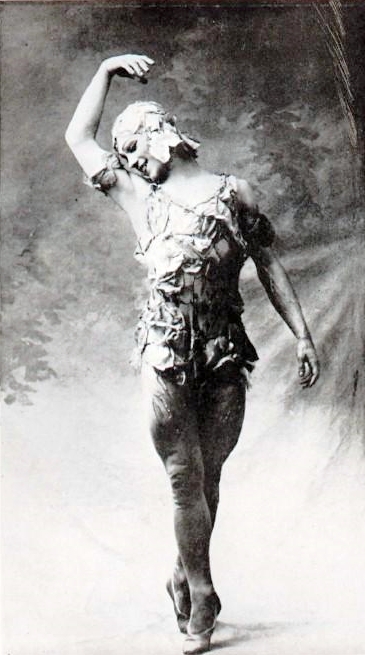
Check out those hams. Nijinsky in Le Spectre de la Rose (image via Wikimedia Commons; public domain in US).
This is true. Pictures of Nijinsky show not a graceful sylph of a man but a solid little acrobat with legs even bigger than mine. Standing still, Nijinsky defied modern expectations about how dancers should look. In action, he was such a glory that he is still – at least among dancers – a household name.
“When he jumped, he just seemed to float,” Jim commented, “It was because of those enormous legs.”
So maybe I should take a moment to appreciate my own enormous legs, my legs-that-get-in-their-own-way-in-fifth-sometimes, my legs that force me to have suit pants specially tailored, which are also the same legs that lend me high, powerful leaps in the studio and sharp acceleration on the bike (and, not coincidentally, also the same legs that made Denis follow me all the way up a major local climb on the day we met).
I guess most of us hate some or another part of our bodies. We dancers and cyclists can be especially hard on ourselves — we spend hours upon hours dressed in skintight super-suits and, in the case of dancers, starting into mirrors. Our passions make stunning demands on our bodies and literally reshape them (as a dancer-from-childhood, I am blessed with funky hip sockets; as a cyclist, with Achilles’ tendons you could use to string a crossbow). I am no exception. I stare at myself in the studio mirrors and I think, Egads, are my legs really that big?
I have been learning to live with my legs, in part because returning to ballet has made a start at refining them (some days I’m like, “OMG, I have ankles!”). Maybe someday I could even learn to love them?
Maybe I am not the next Nijinsky, and my name will never become part of the saintly canon recited by dancers everywhere.
That doesn’t mean I can’t learn to appreciate the power implicit in these gigantic quads and wholly-unreasonable calves … does it?
Using My Words: The Other, Other Side of the Great Weight Debate
Part the First
Let me open by saying that I really like the concept of Health At Any Size, and that people are finally saying, “Screw you, ridiculous cultural norms, I’m this size and I’m happy and this is me and it’s fine.”
Let me also state that I realize that, at times, some of what I talk about here — particularly about my particular weight-loss goals — might appear to conflict with that concept, and might even lead to some people feeling bad about themselves sometimes.
I try to choose my phrasing carefully, and I try to frame my thoughts on the topic in “I language,” since they’re specific to me — but if some of what I say comes across as hurtful, I apologize, and I will work harder to make sure my language conveys what it’s supposed to convey and doesn’t inadvertently convey hurtful messages. Nobody needs that crap.
It’s a fact that there are people who are bigger than me who ride and dance better than I do (all the people bigger than I am who out-rode me on this year’s Death March and the amazing Ragen Chastain come to mind!).
It’s a fact that merely losing weight won’t automagically improve my performance or anyone else’s in any discipline.
Practice improves performance; cardiovascular, flexibility, and strength gains improve performance; skills acquisition improves performance.
Weight loss, meanwhile, is sometimes incidental to the process that lead to gains in athletic disciplines (including ballet, which is both a sport and an art), but it’s not the end-all be all. In cycling, it can improve weight-to-strength ratio; in ballet, it reduces joint strain and can make some movements easier to do.
This doesn’t mean you can’t be a powerful cyclist or a beautiful dancer just because you’re bigger than some (or even all!) of your peers.
Likewise, too much weight loss will make you weaker on the bike and more prone to ballet injuries. Bike-wise, people with a lot of muscle mass can sometimes eke out some gains on the climbs by losing a little muscle, but beyond that, all you’re doing is taking ammo out of your own aresenal. In ballet, fatigue — which can result from undereating — is a huge contributor to injury.
Likewise, if your body is cannabilizing itself to stay alive, you aren’t going to be a fierce rider or a strong and graceful dancer for long. This is why the weights of pro bike racers vary pretty widely across the course of the year (and why coaches of amateur racers say it’s okay to gain a bit of weight during the off-season); this is also one of the contributors to career-ending injuries in ballet.
That said, I don’t want to be the size I am now — and I think that’s okay, too. I don’t feel guilty or ashamed or whatever, it’s just not how I envision my own body. I’m working on putting my body back together the way I like it, and I’m succeeding, and I’m pretty happy about that, and I enjoy talking about my process. I just want to do it in ways that don’t hurt people’s feelings.
So, basically, I guess what I’m saying is that I’m pro-Health At Any Size, which includes being pro-supporting people who want to be smaller (or bigger) for healthy reasons (that is, reasons that don’t stem from shame or guilt). I’m totally anti-fat shaming, because fat shaming is both wrong and dumb.
Shame is an ineffective “tool” that does harm and does not do good. I don’t think real, long-lasting change ever comes from feeling ashamed. Nor do I think “real, long-lasting change” should be synonymous with “weight loss.”
“Real, long-lasting change” should mean moving from being unhappy to being less unhappy to being happy to being ZOMG REALLY HAPPY! Everyone deserves to roll that way, no matter what size they are or whether they want to be a different size. “Real, long-lasting change” should mean a life spent being the best you that you can be, social norms be damned — and that definitely doesn’t have to mean being the smallest you that you can be.
So, good people of the Innertubes, here’s my question:
What is the best way for people like me to talk about our journeys without contributing to the pain of others? When I talk about my weight-loss process, am I succeeding in doing so in ways that don’t sound judgmental?
And here’s one for myself, for reflection:
Am I in fact succeeding in doing what I’m doing in spite of, and not because of our unhealthy cultural relationship with weight and fat and all that jazz?
That’s one I’m going to have to think about. A lot.
Part the Second
I’ve been meaning to write about this for a while, and I will do so at greater length later. I feel like now’s a good time to touch on it, though.
In light of a lot of the hard science out there, I’m inclined to say that my success in losing the weight I’ve gained isn’t all, or even mostly, the result of hard work and dedication.
There’s sound reason to believe that a good part of it is the result of genetics and the fact that I was a skinny kid and a skinny teenager and a skinny young adult for the vast majority of my life — not just average, skinny.
Sure, will and effort have a role, here — but part of the reason that my effort succeeds is that it’s easier for me. In short, I have a genetic and experiential head start in the race. It would not be fair for me to look at my own journey, my own success, and say, “You people should all be able to do this just as easily as I have.” (Feel free to imagine my Curmudgeonly Voice if you’ve heard me doing my Curmudgeon Impression.)
That would be both untrue and unfair. Moreover, it misses the point. People can be bigger than me and still be healthy. People can be less healthy than I am and more happy. People can be skinnier than I am and much, much less happy.
People can be any kind of size and be happier and healthier than I am — and the goal should be, first and foremost, to be happy. We are built for joy, and maximizing joy is probably the best thing we can do for the world.
On Ballet! — Saturday Class Notes
First note: if you travel to class with your partner, always bring your partner’s dance belt (or shoes), even when he claims he isn’t going to dance. Denis thought he didn’t want to dance today but I had all of his stuff except for his dance belt, and when we got to LBS, he decided that maybe he might be able to dance after all.
I didn’t want to seem pushy, so I had left his dance belt at home (even though all of his other stuff was already packed in our mutual dance bag). On the other hand, he did get an opportunity to pick up a few pair of jeans to replace those recently lost to attrition. Since he wears jeans to work, an adequate supply makes a huge difference.
Anyway, Denis will be back in class with me on Monday (I already promised our teacher he would ^-^).
Onward!
So today I felt like my arms were much better, probably because I have spent the past four days thinking about them and working on trying to make them move gracefully and attempting to remember which arm positions go with which foot positions.
For some reason, my core felt kind of wiggly today. It did funny things to my sous-sus, which is a wee bit half-baked anyway because “huge cycling quads + still kinda fat for a dancer = fugly sous-sus.”
Seriously, I thought cycling provided reason enough to trim down, but I’m lean enough that I’m not in my own way on the bike. In the ballet studio, my thigh chubs are still, you know, kind of intrusive.
Beyond that, though, barre went fairly well, except for the bit where I got behind the count during degages and made this rather hilarious attempt to catch up. SOME DAY I WILL LEARN TO COUNT. Thouh, by that time, I will most likely be back in a place where I’m comfortable enough with what I’m doing that I sort of auto-count.
Oh, and the part where for some reason my upper body decided to do first arabesque left while my lower body did first arabesque right. Evidently, the small brain that is supposed to relay information from my head area to the end of my tail wasn’t — oh, wait, I am not actually a stegosaurus, even if I dance like once sometimes.
I enjoyed a little chasse-saute exercise we did across the floor, and felt like I kind of almost actually looked like a dancer finally, instead of a big sack of awkward in a dance belt and expensive slippers (or a dancing stegosaurus).
On the other hand, my jetes were terrible. I felt like a baby deer trying to learn how to lope along on big ol’ gangly limbs. I sounded like an elephant (or maybe a stegosaurus). At least I didn’t fall on my face, though.
This is particularly frustrating in light of the fact that I used to love all flavors of jete, especially tour jete, and right now I can’t seem to get my arms and legs to work together in a plain ol’ vanilla chassez-chassez-brushthroughleap combo.
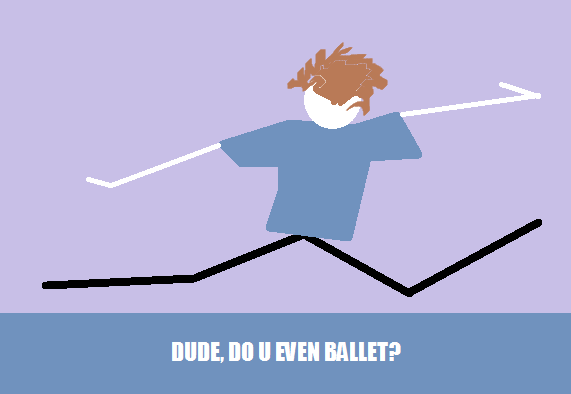
It was at least this bad. Probably worse.
So I shall spend this week firming up my chaines turns and remembering how to jete (I think I’ve sorted myself now; on the way home from class, I realized I was doing some kind of chasse-gallope-jete crap). (Edit: I decided to mark my jetes this afternoon in order to get my arms coordinated with my legs. It seems to have helped, and my arms got all dancer-y, which was kind of exciting in its own way — they were like, “Oh, you mean we’re doing this! We remember this!”. I will have to open up and try jetes for reals downstairs in a bit. We totally do not have a jete-way in our upstairs right now.)
Got a few useful corrections, which was cool. I like our ballet teacher.
In other news, next Saturday I definitely need to eat a better breakfast (Today’s breakfast? ONE LITTLE APPLE. Because in the morning, I can be kind of dumb.) and pack a lunch. I definitely found myself in Food Crisis Mode during the epic shopping trip that followed class this morning. I had to tell myself out loud and repeatedly that I did not need an entire 1-pound bag of M&Ms. I did make it home and we had leftover spaghetti for lunch, so that worked out okay.
That’s it for now. Keep the leather side down.
In Which Your Humble Blogger Admits That He Is Wrong
Last night our housemate, M, turned me on to a blog called Dances With Fat, written by the amazing, talented Ragen Chastain.
Go there right now, scroll down a little (past the picture of Ms. Chastain executing the challenging standing-split pose whose name I forget; past her Top 50 Self-Acceptance Blogger Award) to the video in which she and a former dance partner perform a beautiful two-step routine.
Seriously, go watch the video. I’ll wait.
In fact, here’s a direct link.
Did you see it?
Yes?
Good, because it’s important to a whole bunch of stuff I’m about to say.
So here’s the deal: I’m a cyclist (as you probably know, if you’re reading this blog in the first place). Cycling is a sport in which weight sometimes seems like everything. If you go to a bike race, you’ll notice that — for the most part — the racers get skinnier as the categories get higher.
If you go out on a fast club ride, most of the guys who drop you like you’re hot will be skinny.
In fact, being skinny is so much a part of bike-racing culture that a veteran of the venerable Bike Forums website once quipped, “Cycling isn’t a sport. It’s more like a very, very expensive eating disorder,” and is now quoted all over the innertubes (even here).
Being skinny is so much a part of bike-racing culture that a lot of people think that if you’re not skinny, you shouldn’t even try.
The thing is, they say the same thing about dance.
In America, we conceive of fat people as clumsy, graceless oxen who probably ought to just sit down when the dance music starts.
The truth is, some of them are: but so are some skinny people (including, no doubt, some very good bike racers) — and nobody has the gall to suggest that they’re clumsy because they’re skinny.
When we imagine dancers, we imagine graceful little light-footed gazelles. We imagine that their grace and lightness of foot derive from their slender bodies.
We are wrong.
Watch Ms. Chastain dancing. Watch how she carries herself. Watch as she skims across the dance floor with that apparently-effortless grace, as she and her partner whirl like leaves in the wind, as they glide through moves that, frankly, most of us only wish we could do.
Then tell me fat people are clumsy.
Watch them execute a routine that would get most hearts a-hammering without even breaking a sweat.
Then tell me fat people aren’t fit.
I’ll admit it. I ought to know better — I’ve grown up with a sister who is both big and beautiful, who is above average both in girth and in grace.
I also studied ballet and gymnastics, and I ought to know that grace and lightness of foot don’t come from being small; they come from something else entirely (for some of us, by nature; for others, as learned skills mastered through hard work).
I ought to know that people can be healthy at many different sizes — that weight alone isn’t the problem. I have been desperately unhealthy with a Body Mass Index of 14.4, rock-solid with a BMI of 20.5, desperately unhealthy with a BMI of 19.9, desperately unhealthy with a BMI of 32.5, jubilantly healthy with a BMI of 26.6, and I have been all over the map with a BMI between 15 and 22. Now I am sometimes healthy and sometimes unhealthy with a BMI of 24.8.
Through all of these variations, however, my blood pressure and heart rate — popular indicators of fitness — have always been low to normal.
Yet, even with the weight (no pun intended) of experience on my side, I continue to be wrong.
I continue to assume that lean equals healthy — or, rather, that only lean people who look unhealthy are unhealthy, whereas bigger people are always unhealthy.
I should be ashamed.
In her blog (and in her dancing), Ms. Chastain gives the lie to that notion.
I am wrong. Ms. Chastain is right.
A couple months ago, on the night before my wedding, my Mom and I stood in her kitchen, having the kind of heart-to-heart talk I’ve always wanted to be able to have. At one point, I said, “I still really struggle with my body image.”
Mom answered, quietly, “So do I.”
Somehow, until then, I’d never put two and two together. Looking back, it’s crystal clear that Mom struggled through much of my childhood with body image issues — and that a lot of my sister’s struggles, especially, arose directly from those issues.
We wound up talking about my sister, as well — about our mutual worries about her health. She’s been struggling with some serious health problems of late.
The thing is, at the time, my response was not to think, “My sister is struggling with her health right now. How can I help her be healthier?”
Rather, it was to think, “My sister is struggling with her health right now. She needs to lose weight so she can be healthier.”
That’s the wrong way to think. Period.
I will state for the record that I’m one of Ms. Chastain’s cited 5% who manages to lose weight and keep it off. I will also state that it is probably a question of my particular genetic endowment (just like my freakishly enormous calf muscles): I have, for the vast majority of my life, been not only lean, but very lean. I’m not back there yet, but my body is trending that way — and, to be honest, it’s pretty much doing so of its own accord, with very little help from me, sometimes more in spite of than because of my efforts.
Chances are very good that I will wind up looking very much like most other competitive cyclists — not, mind you, because I train hard and somehow ‘deserve’ to be that mystical thing we imagine as ‘lean and fit,’ but because that’s pretty much how G-d put me together. Wiry is my native tendency.
Chances are good that people around me will assume that it’s all a question of hard work; that I put in the time and effort to whittle my body down to what, to them, will look pretty lean and mean.
It is a nigh certainty that I will still struggle with my body image. In some ways (beyond the obsession with getting and staying lean), anorexia is a lot like cycling: “you stop when the gorilla gets tired.”
Only the gorilla — that is, the little voice in your head that says you’re fat even when you’re walking around with a BMI of 14, or the hill you’re climbing on the bike — never gets tired.
Ragen Chastain has done me a profound and invaluable service. She’s awakened me to my own hypocrisy; revealed to me the preconceptions I failed to see before.
So to return to a previous point: I mentioned in the beginning that if you go out on a fast club ride, most of the guys who drop you will be skinny.
I didn’t say not all. In fact, though, that’s the truth. I know guys who are heavier than I am and who are better cyclists by leagues: faster on the flats, faster on the climbs, and a whole heck of a lot faster on the descents (I am often a painfully slow descender on the road, though pretty confident in the grass).
These guys work every bit as hard as I do. In fact, the fact that they outperform me tells me they’re working harder: training more, riding more, tweaking their technique more.
They’re not bigger because they’re not trying. They’re just bigger because they’re bigger: for the same reason that some people are taller and some are shorter.
They’re also more fit than I am.
The fact is, weight is a huge deal in cycling because human power tends to have limits, and when we’ve trained our bodies to reach their maximum potential (or, at lower levels, when we’re riding at our current limits), the only handy solution is to reduce the load.
You can only take so much weight off the bike before you start to compromise its integrity, so instead the answer is to trim weight off the rider (maybe we should start handicapping skinny riders, instead — if everyone had to race at a standardized weight of 220 pounds, I’d be toast).
It appears that, for the most part, I lose weight pretty easily. This means I can increase my weight-to-power ratio without greatly increasing my fitness. It also doesn’t hurt that I’m small and fine-boned and that a really ridiculous percentage of my muscle mass is concentrated in my legs. There simply isn’t as much upper body for my legs to carry around as there might be for other guys.
In short, I should, really, climb like a goat and generally ride like a bat out of hell. The fact that I don’t says I’m not actually all that fit (caveat: I should probably point out that I am still a respectable climber and decently fast all around, but nowhere near where I “should” be, given my genetic endowment).
Bigger riders, meanwhile, have to be a hell of a lot more fit than smaller riders to dial up the speed — especially on the climbs. The thing is, getting fit doesn’t necessarily equate to getting lean.
The human body likes to maintain its current specification (we call this tendency homeostasis). Therefore, it makes sense that someone who is “built for comfort,” when working to achieve speed, might gain immensely in fitness without necessarily becoming much, if any, slimmer.
Moreover, I harbor a pet theory that every human body has a sort of ‘sweet spot’ — a place, in terms of anatomy and physiology, where it wants to be, where it’s happiest. A spot where it functions optimally. For some of us, it’s probably that the ‘sweet spot’ is rounder than for others. Given the amazing range of human diversity, that only makes sense.
I have blown skinnier people than myself out of the water on club rides. In turn, I have been smoked by people fatter than I am. I have been dropped on the climbs by guys one and a half times my current size; guys twice my historical average.
All this points to the fact that, when she talks about Health At Any Size, Ragen Chastain is really on to something.
I’ve often given lip service to the idea of the potential to be both big and healthy, but I haven’t really believed it, as my words and actions have shown.
So, in the long and short of things, what I’m trying to say is this:
I’m wrong.
I’m part of the problem.
But I don’t have to be. I can choose to see things from a different angle. I can choose to see Ragen Chastain as the real Normal, instead of as an outlier who happens to be healthy, fit, and graceful in spite of her weight.
I can choose to understand that as someone who was always lean, then gained a bunch of weight, then lost it again, I am the outlier, and that I have no business trying to make myself out as anything else.
I can, as Ms. Chastain suggests, be the boss of my own underpants. I can occupy my own underpants and stay the heck out of other peoples’.
And I can say that I do want to help my sister be healthier, but that weight isn’t the problem.
A world that makes weight the problem, however, is — or is, at least, a big part of the problem.
And I’m not going to be part of that problem anymore.
…
Here, I’m done with this soap box now.


 danseur ignoble