Author Archives: asher
Product Review – Boudreaux’s Butt Paste – All Natural: The Cure for All Human Suffering
Recently, I joined the RCCS crew on a 230–mile tour.
On the tour in question, I made two very, very stupid decisions: first, I chose to bring along a gel saddle pad, basically in case anyone ran into the kind of saddle discomfort it might alleviate (I should’ve left the d***ned thing at home). Second, I failed to actually pack it, so I just said, “Meh, it’ll be alright,” and strapped it on to my saddle.
You know, my saddle. My completely padding-free Arione. The saddle that I love so very much in part because there is essentially no squishy-factor. The saddle that I chose because my previous saddle was too squishy.
Say it with me: “What was I thinking?!”
I also wore a pair of bibs the second day out that proved to be … errr … less than suitable for a 70-mile day. In fact, they proved as grossly unsuitable for that kind of distance as is humanly possible. The chamois is a little wide, which means that A) the chamois-seams rub on the insides of my thighs and B) certain parts (AHEM!) with loosish skin get pinched like nobody’s business.
Have I mentioned that, while I laugh in the face of vast oceans of pain, I cannot handle being pinched*?
Have I mentioned that being pinched makes me want to cry like a little girl who just lost her puppy? Or like a little gamer geek who just got pwned in Diablo II? Or like a little wanna-be architect who just lost all his nifty Sims 2 neighborhoods in a HDD meltdown?
‘Nuff said.
The result?
Chafing.
Horrible, horrible, horrible chafing. Not so much the dreaded ‘taintal’ chafing that is common to the cycling world, but rather chafing of areas even more sensitive. The kind of chafing a man experiences in his nightmares. Possibly the kind of chafing that only happens to intersexed boys who ride bikes for 70 miles while wearing inappropriate bibs and riding on inappropriate saddle pads.
The kind of chafing that had me stopping periodically to slather Carmex on my nether regions because that was all I had to mitigate the pain (it actually worked rather nicely — for a while).
Needless to say, even though I finally got ’round to packing up the stupid gel saddle thingy and opted to wash-and-wear my other bibs (an awesome pair of Fox Evolution “liners,” which are plenty opaque to wear on their own) on days 3 and 4 rather than alternating as I had planned, by the time I got home my loins were more or less drenched in flaming misery.
Yes, that’s right. I said DRENCHED IN FLAMING misery, which doesn’t even make sense, because it hurt so badly it didn’t even make sense. It hurt so badly I didn’t even want to ride my bike (at least, not very far) — and that *really* doesn’t make sense.
A day or two after our triumphant return from the Tour, my friend Michelle and I took a brief trip to Target. There, I discovered the cure for all human suffering (or at least for the horribly-chafed nether regions of touring cyclists): All Natural Boudreaux’s Butt Paste.
I got the “All Natural” variety for two reasons: first, after reading up on some of the effects of pthalates and similar substances, I’ve decided I really need to reduce my exposure. Second, it contains ‘Peruvian Balsam,’ which sounded inherently soothing (yeah, I’m occasionally a sucker for that sort of thing).
The active ingredient in Boudreaux’s All-Natural is 16% zinc oxide (also found in mineral sunscreens). Inactive ingredients (direct from the manufacturer’s website) are: Aloe Vera, Beeswax, Carnauba Wax, Castor Oil, Citric Acid, Hydrogenated Castor Oil, and Peruvian Balsam Oil.
I brought my Butt Paste home, slathered it on my furious bits (the package says it goes on clear; in fact, it goes on just a bit whitish, but really — who cares?), sat back, and said, “Ahhh.”
I don’t know if the chafing healed faster because I used the Butt Paste — frankly, I’ve never had this kind of chafing before. I do know it felt much less miserable, and in fact things progressed quickly from ‘intolerable’ to ‘tolerable’ to ‘slightly less comfortable than normal.’
Flash forward a couple weeks, and I’ve discovered another use for my All Natural Butt Paste: mitigating the effects of co-trimoxazole.
In addition to oral thrush, co-trimoxazole left me with a blistering rash in a very, very, very, very sensitive place. The kind of blistering rash that makes you ‘hold it’ for totally unreasonable durations because you have come to associate having a whizz with howling, burning pain. A bit of Boudreaux’s All Natural Butt Paste (GENTLY!!! applied) has once again saved my skin (perhaps literally).
Because I have no shame, I have even applied it to the terrible, itchy peeling spots beside my mouth (thanks, co-trimoxazole!). Helps there, too. If I could apply it inside my mouth, I would, but it’s not intended for internal use.
It’s worth noting that a little of this stuff goes a long way. You don’t need oceans of it.
As you’ve probably guessed, this stuff has the soothing. While the only listed active ingredient is Zinc Oxide (16%), I am quite certain that is only because they forgot to print ‘Awesome Sauce’ on the label. I’m sure they’ll rectify this in the future.
So, anyway, in case you were wondering: The Buddha taught the Noble Eight-Fold Path as the answer to human suffering. Personally, I’m willing to roll my bike down that road, but only if I can pack my Boudreaux’s Butt Paste**.
Summary:
Try Boudreaux’s Butt Paste All Natural: It will save your butt.
Literally.
Notes
*I also can’t handle being tickled. Sadly, I have just revealed to the world my personal kryptonite(s). Just so you know, if I see you coming at me with a feather duster or an angry crayfish in the middle of a race some day, I will not hesitate to go all Indiana Jones on you, grab the nearest stick, and jam it through your front spokes. Nothing personal, I just really can’t stand being tickled or pinched.
**I paid the full retail price for this product, and am in no way affiliated with the manufacturer (unless you consider the bonds of eternal gratitude to be a form of affiliation, in which case, yes, I am very much affiliated).
More Cycling Sub-Types!
Way back on Monday, I wrote a post detailing the composition of a few major cycling subtypes.
After some reflection, however, I realized I’d completely overlooked a few important groups (see, I told you I’m a roadie).
In the interest of cycling-world unity, then, I shall now attempt to rectify my egregious oversight.
Of course, in the process, I might just make things worse.
So, without further ado…
More Cycling Sub-Types!
In our last installment, we touched on a growing Cycling Sub-Type: the Die Hard Commuter. It so happens that the Die Hard Commuter has a close cousin in the cycling world — a cousin we might call the Utility Cyclist.

The Utility Cyclist: Cargo Bike, Kids, Bungees — these are the heavy lifters of the cycling world. When it comes to the Utility Cyclist, there is no load too large or too small.
The Utility Cyclist is like the Die Hard Commuter on steroids (though some of them don’t ride in bad weather). Need a refrigerator moved? Call a Utility Cyclist. Chances are they’ll have the bike and trailer to do the job.
No one can argue that Utility Cyclists don’t get things done. Heck, that’s the whole point. However, if you’re looking for a cyclist who knows how to relax, look no further — ahem, down here! — than the low-slung figure of the Recumbent Pilot.

Some cyclists distrust the mysterious ways of the Recumbent Pilot. However, the Recumbent Pilot — with his comfortable footwear, relaxed ride position, and terrifying speed on descents — doesn’t actually care what a bunch of tap-shoe wearing pajama-mavens think. The Recumbent Pilot is secure in his (or her) unique being, and also in his (or … well, probably not her) abundant beard*.
It is possible that the Recumbent Pilot reaches his pinnacle in the figure of the Tandem Recumbent Team — a veritable phenomenon that probably requires its own essay. However, most Tandem Teams share a few characteristics: a bicycle built for two (or sometimes more than two), matching jerseys, and the ability to argue over directions as if they were riding in a car.
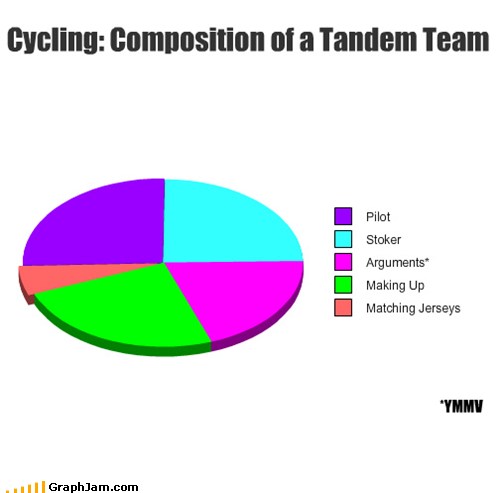
The Tandem Team: part pilot, part stoker, part annoying backseat-driver who thinks you should’ve brought the GPS, or at least printed a cue sheet. Good times, good times.
It’s possible, of course, that Tandem Teams never argue. It’s hard to really be all that upset when you’re on a bike — and, frankly, any time I’ve encountered a Tandem Team on a group ride, they were smugly grinning in their own repleteness. Who needs a group ride, after all, when you’ve got your group right there?
Then, who needs a group in the first place? Some of us are entirely secure in ourselves. Some of us don’t need group rides, or even two riders. Heck, some of us don’t even need two wheels.
Yes, sisters and brothers: that’s right. I invoke, then, the name of the true iconoclast of the cycling world. You may meet her on road or off, or even on stage: an obligate fixed-gear phenomenon; a master of balance and sublime concentration; utterly unscathed by the opinions of others.
We may not readily admit it, but come on: in those lonely moments surfing the web late at night, who hasn’t come across a picture of this true Lone Wolf of the cycling world and experienced a flash of envy at his freedom, his balance … his sheer elan?
You know, my friends, of whom I speak: wrapped in a cloak of her own inscrutable iconoclasm cometh…
…THE UNICYCLIST.

The Unicyclist: Master of the One True Wheel
I think that’s about all that can be said.
Notes
*Perhaps a bit ironically (given the fact that Cycling Lore causes one to expect all recumbent pilots to resemble Jerry Garcia), the sole recumbent pilot I know personally goes beardless. He knows there are many paths up the mountain, and that even if it takes ‘bents a little longer to reach the top, they will go screaming down the other side, terrifying roadies all the way.
P.S. I’m a-leavin’ … on a jet plane! …So I’m not entirely sure when I’ll make my next post. Don’t worry, though — I’m not dead, I’m just getting married.
Cycling Sub-Types: Roadies, Retrogrouches, and Beyond
As you may know, I am both a cyclist and an opinionated person.
I also belong (depending on to whom you pose the question) to a few different cycling sub-cultures: I shave my legs, race, and ride a fast road bike, so you could call me a Roadie (or a proto-roadie, anyway). I also commute by bike year ’round in all kinds of weather and traffic conditions, so you could call me a Die Hard Commuter. I’ve done one overnight bike camping trip and I seem to have another one coming up very soon, so you could say that I’m also a Cyclotourist.
Now, if you’re new to the cycling community, you may find yourself mystified by the distinctions within it. At first, perhaps, you decide there are two types of cyclists: Roadies and Mountain Bikers. Soon, however, you realize that the mere fact that someone rides a road bike doesn’t actually mean that person is a roadie. Likewise, there are plenty of Mountain Bikers who also ride road bikes … and then there are all those people tooling around on hybrids, Dutch bikes, bakfietsen…
Needless to say, the work of cycling can be a strange and confusing place.
Relax: I’m here to help. You see, I’ve created a few easy pie charts to help you classify both yourself and your bike buddies in just seconds. Just refer to the helpful graphs below and figure out where you fit.
Let’s start with Roadies!

Roadies: They’re part lycra, part carbon fiber, a big part opinions, and no part leg hair.
The ‘Roadie’ segment may be the most visible part of the cycling community, if only because they (should I say ‘we?’) are often dressed in bright colors and tend to travel in packs.
Though both subgroups ride road bikes, they are fundamentally different from the Retrogrouch segment:

Retrogrouches are to steel and wool (but no so much steel-wool) as Roadies are to Lycra and Carbon Fiber. Like Roadies, they come with a lot of grit and strong opinions.
Retrogrouches and Roadies don’t always get along. Some Roadies think all Retrogrouches are sluggish sticks-in-the-mud who live in the past; meanwhile, some Retrogrouches think all Roadies are lightweight, smooth-legged poofters who like to run around in their Underoos.
Hm.
Actually, ‘lightweight, smooth-legged poofter who likes to run around in his Underoos’ is a pretty good description of your friendly author.
Both Retrogrouches and Roadies, however, may do time as Die-Hard Commuters. Die-Hard Commuters are like the Sherman tanks of the cycling world: unstoppable forces of human-and-machine power that laugh in the face of danger (or at least in the face of nasty weather).
Some Die-Hard Commuters, however, would consider themselves neither Roadies nor Retrogrouches.
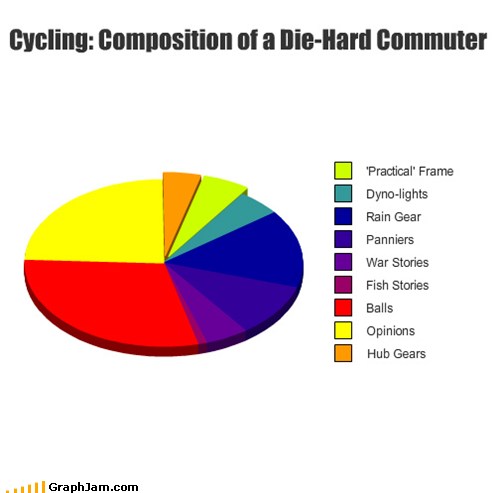
Panniers, rain gear, practical bikes with upright positioning: the Die Hard Commuter will rock anything that makes sense on the trip from Point A to Point B.
Die Hard commuters can, in fact, belong to any subset of the cycling community. They know the rules of the road and are pretty much universally respected for their brass balls and unflappable commitment to riding the bike whenever and wherever it is even marginally possible to do so.
Some of us have even considered whether pedal-boating across the river can be considered a valid ‘bike commute’ phase. I’ll allow it.
Naturally — they already own the equipment, after all — there’s some overlap between the ‘Die-Hard Commuter’ and the ‘Cyclotourist’ community. Cyclotourists are those of us who take vacations on our bikes, rather than taking our bikes on vacation. You will know them by their enormous panniers, increasingly-wild facial (or leg) hair, and strong opinions on camping equipment.
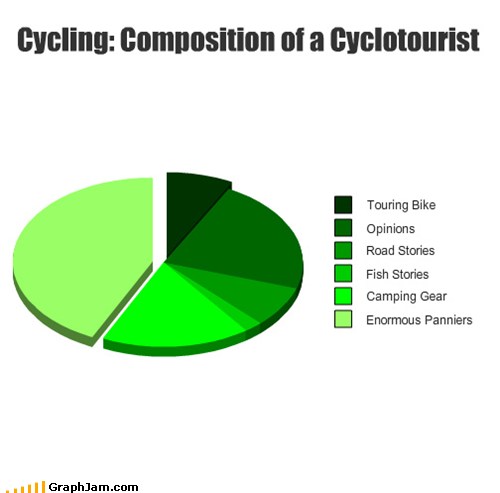
Cyclotourists: known for their enormous panniers and arcane knowledge of camping equipment, the Cyclotourist often gets along well with the Retrogrouch.
Meanwhile, Mountain Bikers are also often (but not always) Die-Hard Commuters or Cyclotourists. Their familiarity with rough terrain and various weather conditions — coupled with their taste for adrenaline — gives them a natural advantage in entering either of these sub-groups. However, some of them have little or no road-riding experience, and riding on the road is fairly essential to the Die Hard Commuter or Cyclotourist.
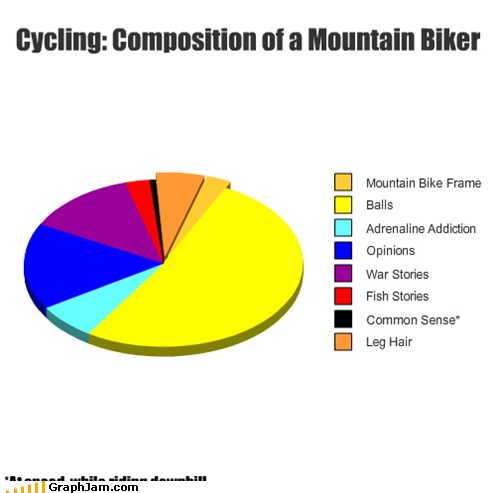
Adrenaline addiction, balls of brass, and (of course) mountain bikes: the Mountain Biker in her natural habitat is easy to spot, if not always to catch.
There are even some amphibious roadie/mountain biker hybrids who do very well either on road or off — and especially on the Cyclocross course, where their excellent bike-handling skills and aerobic aplomb allow them to dominate would-be ‘crossers who have only trained on the road.
It is fairly safe to say that none of these groups is particularly fond of a subset of the bike world known as the ‘fixter*.’ These are the folks who have bought into the recent trend for skinny jeans, messenger bags, and fixed-gear bikes, but who haven’t actually bothered to learn to ride them.
I actually have no problem with people who choose to wear skinny jeans and ride fixed. I know quite a few of these folks, including some who are entirely capable of getting out their geared road ride and smoking my bacon. Likewise, if you work at a place that lets you wear jeans and you commute by bike, it makes perfect sense to wear skinny jeans rather than roll them up or use pants clips. Heck, when I wear jeans, I wear ’em skinny — mainly because I’m so used to my all-Lycra-all-the-time lifestyle at this point that wearing regular pants just feels weird.
It’s the folks riding flashy new fixies on the sidewalk, mowing down pedestrians left and right because they lack brakes, that I generally want to strangle.
And so, last and least, one more pie chart, so you will know if you are a fixter and will be able to hit your local League of American Bicyclists training course and gain some bike-handling skills:

Fixters: Scourge of the Sidewalk; Paraiah of the Pedestrians. If you recognize yourself in this pie, well … I’m glad you’ve bought a bike. Now all you need to do is learn how to ride it!
I hope these pie charts will assist us all in better understanding the subcultures within the cycling world, that we may more effectively classify ourselves and deride those unlike us — errr, or classify ourselves and reach out to cyclists of other ‘cycle-ways.’
Notes
*I believe this term was coined by that arbiter of cycling-culture taste, BikeSnobNYC. I hope he doesn’t mind me borrowing it.
DIY Chocolate Energy Gel
Let’s face it: energy gels are expensive.
Whether you go for PowerGel, Gu, Hammer Gel, or one of the myriad similar products on the market, you’re looking at $1.50 a pop or more (unless you can swing a really big bulk purchase, or you have the Bike Industry’s Writ of Indenture — err, a shop discount).
On a long, hard ride, you might go through three gels or more — and every one of those gels comes with trash attached.
To cut down on waste, you can order bulk-packaged gels from companies like Hammer Nutrition and something like a Hammer Flask. But the bulk gel still runs about $1 an ounce on Amazon (before shipping).
The ready-made stuff is perfectly good — I have absolutely nothing against it. That said, you can cut the cost in half (or better) by making your own.
I will state for the record, up front, that as a member of a food co-op, I am able to buy organic cocoa powder at phenomenal price. That said, any cocoa powder will do the trick, and you don’t need much per batch.
I recommend using dutch-processed cocoa powder: it has a smoother, milder flavor that will make for a more enjoyable gel. Most grocery stores carry it, and a standard-sized package should only run you about $5 or so. Better still, you can also make awesome hot cocoa from it!
Important Note: Make sure you get cocoa powder, not cocoa mix. Cocoa mix is just fine for making hot chocolate, but if you use it to make the gel, it will be too sweet.
Here are the ingredients that went into my gel recipe:
Per serving:
- 2 tablespoons ‘Agave in the Raw’ agave nectar
- 1 tablespoon Dutch-processed cocoa powder
- .5 teaspoon Vanilla extract
- .25 teaspoon corn starch (optional)
- one pinch Morton’s Lite Salt
I found the agave nectar at Kroger in the baking aisle. You can also get it in their organic food section, but it’s more expensive there, and the stuff in the baking aisle is also organic, etc. I paid about $5.50 for 18 ounces.
I already had the rest of the ingredients on hand. To buy all of them might cost you as much as buying 20 ounces of Hammer Gel on Amazon, but except for the agave nectar, you’ll get more than 20 ounces’ worth of gel out of the rest of the ingredients, and buying additional agave should only cost you about $6 or so.
Here’s how it all goes together:
- Measure out Agave nectar.
Depending on how much I’m making, I measure mine directly into a quarter or half-cup measure marked for tablespoon divisions. However, if you can remember that half a cup equals eight tablespoons and a quarter cup equals four, you can do it easily enough with any measuring cup of appropriate size. - Add the cocoa powder. If you’re making more than one serving, I definitely suggest adding one tablespoon at a time; it’s easier to mix in that way.
- When the cocoa powder is well blended with the nectar, add the vanilla extract and stir well.
- Next, stir in the salt. Morton’s Lite Salt is a good electrolyte blend that includes potassium and magnesium as well as sodium. You can also use it to make DIY sports drinks.
- Finally, if you want to, add the corn starch. It’ll thicken the gel a bit and make the flavor a bit less intensely sweet.
If you plan to use a flask with a bite valve to hold your gel, though, you might want to skip the cornstarch — my batch of gel was too thick to make it through my flask’s bite valve, so I had to pop the cap off and just slurp it out of the container, which was a bit messy.
This recipe is pretty flexible — you can add mint or orange extract to mix things up a bit, or swap the cocoa powder for carob powder or another primary flavoring. You can also add instant coffee crystals to the mix for a little extra caffeine kick. Maybe next time I’ll try adding a little prepared coffee to thin the gel a bit.
I used a Hydrapak Softflask for my gel; it was perfect except for the fact that the gel didn’t want to go through the bite valve.
A Hammer Flask might have been a better choice.
I’m going to see if I can get a pop-up valve (like the one on the Hammer Flask) for the Softflask that might be a little more cooperative. Adding a little water to the gel might also help.
My cost for this gel is less than $0.50 per serving — a major savings versus the ready-made stuff — and I can customize it to my needs.
As for the flavor? It’s great — like chocolate pudding, exactly what I was aiming for. It kept me going strong during the Death March.
Lake LX140 Shoe: First Impressions
So, yes, these aren’t the newest bike shoes on the market.
However, they’re the newest bike shoes that I, personally, happen to own, and there don’t seem to be many reviews out there, so I figured I’d help fill the gap.
Read the whole review below, or you can jump right to the Short Order synopsis.
I bought these shoes for one purpose, more or less: to keep my feet warm and dry in nasty weather or during soggy sessions on the ‘cross course. Unfortunately, I’ve yet to secure an opportunity to try them out in that capacity. I’ll toss out an update once I can get out in the wet stuff with these shoes. Update: I wore these guys out in wet, chilly conditions on Wednesday this week. My feet not only stayed warm (even with only one pair of socks on), but dry! Admittedly, I wasn’t exactly slogging in the mud or dancing in ankle-deep puddles. When I get a chance, I’ll update on those features as well.
When I pulled them out of the box, I was delighted to discover that they’re strewn with handy little reflective dots. I’m not sure the dots are all that useful — but it’s nice to know they’re there. Heel reflectors complete the package.
The closure system on this particular model consists of three hook-and-loop straps in front (one over the ball of the foot, one at arch-level, and one at the ankle), one in the back, and a rear zipper. I’ve inherited my Mom’s ridonculous arches (thanks, Mom!) and was concerned that the arch strap might cause me trouble, but I’ve found it adjusts quite well and feels great on the bike. I was also worried that the rear strap or heel cup might dig into my achilles tendon, but that concern also proved unfounded.
 |
 |
| Lake LX140: Side view of hook-and-loop closures. | Lake LX140: Rear view of closures. |
Today, my new LX140s got their first official ‘dry run.’ When I left home this morning, temperatures in the 30s (Fahrenheit) would’ve made for frozen feet in my ancient Answer shoes even with double socks. They’re great summer shoes; they don’t block wind, they invite it in. The LX140s, on the other hand, keep my toes nice and toasty throughout my thirty-three minute seven-mile trek to the bus stop with only one pair of socks inside.
Given this morning’s conditions, I can vouch both for the breathability of the ‘eVent’ fabric and for the windproof outer skin: my feet neither felt like they were hanging in the breeze nor like they were steaming in the swamps. Even during long hours in warm classrooms, my feet never felt sweaty or damp (even when my arms did, before my long-sleeved black base-layer shirt had time to dry completely).
You may be wondering why it took me thirty-three minutes to bang out a mere seven miles (I did the full 35-mile round trip yesterday; today I only planned on 14 miles, and that’s what I did). Good question! That brings me to point two: when you install your cleats on these guys, you really need to crank ’em down. The cleat plates seem to be a bit harder than the ones in my Answers or my old Shimano shoes, so make sure to torque those cleats in hard so they can bite into the plates.
After I clipped out once and clipped back in, my left cleat got stuck. Not to say I couldn’t move my foot at all — quite the opposite. I had like 320 degrees of float (OMG!). The cleat was shifting around on its screws, remaining engaged in the pedal instead of clipping out as its maker intended.
Needless to say, being semi-permanently affixed to my bike made me a touch nervous. I also didn’t want to get stuck on the right side as well. I didn’t have time to roll back home and fix things, so I stayed in the little ring, spinning like a madman with my toes on the right pedal. It was, in a word, awkward.
Nonetheless, taking it slow and easy gave me plenty of time to discover the best quality inherent in the LX140s: specifically, they’re roughly as comfortable as your favorite house slippers. Much stiffer, of course — but the fit is close and cozy. Once you’ve adjusted the hook-and-loop closures suitably, they’re really a delight to wear.
When I arrived at the bus stop, I had to remove my shoe to free it from the pedal. Lesson learned: torque ’em down, boys and girls! (I have a history of being too ginger with mechanical things. I’m afraid I’ll break them; in fact, it’s quite hard to break bike things, unless they’re delicate carbon bike things — and even those are hardier than they might appear.) Crisis averted. For the remainder of the day, I made a point of keeping my cleats out of the clips — but I did engage the left one by mistake, and the cleat — which had further loosened over the course of the day — let go somewhere between my final turn and the garage. Who knows, I may find it tomorrow. If not, I suppose I’ll need to buy a replacement pair (I still can’t find my spare cleats).
A word to the wise: these shoes are built for a narrow foot. Riders with wider feet probably won’t find them ideal.
Likewise, true weight-weenies may be initially shocked by the sheer mass of these nimble clodhoppers. In fact, I (who am only a quasi-weight weenie) was really a bit surprised at how darned heavy the things are. That said, once they were on my feet, I ceased to really notice. It’s possible you might really feel that weight after 60 miles on the bike or 45 minutes going flat-out on the ‘cross course, but thus far I can’t say that riding in them felt much, if at all, different from riding my lightweight Answers. Of course, I don’t own carbon-footed SIDIs (yet), so YMMV.
Off the bike, deeply-recessed cleats make walking comfortable and surprisingly quiet. The LX140s proved themselves perfectly able for wandering around campus. Grippy soles feel secure on pavement, grass, and even on the notoriously-slippery stairs in the Ogle Center (home of the art and music departments).
I’m not anywhere near as quiet in these as I am in my favorite Merrels , of course, but they’re a thousand times quieter than my tap shoes Answer shoes. The stiffness of the soles lends a distinct ‘ker-clunk’ rhythm to your step, but at least you don’t sound like a herd of beginning tap dancers. If you, like I, carry organ shoes in your backpack and really don’t want to also lug a spare pair of kicks, or if you’re on and off the bike enough throughout the day to warrant keeping your bike kit on, you’ll probably find that the LX140s are up to the task. That makes them a solid option for commuting students, couriers, and similar bike-and-foot ‘multimodal’ types.
I wouldn’t choose these as hiking shoes, of course — and neither would I choose them for sitting-around-in-class shoes, as the hook side of the hook-and-loop closures faces out and as such sticks to your pants and prickles your legs if you don’t yank it all the way tight. That said, the LX140s are a solid value for a warm, comfortable on-the-bike shoe.
Pros
- Breathable, windproof uppers
- Dexterous rubber outsole
- Highly adjustable closure system
- Heel reflectors
- Comfortable footbed
- Walking-friendly
- Warm
- Keeps your feet dry on wet roads or in the rain
Cons
- Narrow width (not a problem for me, but could be for many guys)
- Snaggy hook-side-on-the-bottom closures
- Potentially heavy on long or intense rides
Not Tested Yet
WaterproofnessTested!Sub-freezing temperature suitabilityTested!- Suitability for
wadingcyclocross - Suitability for temps above 65F
Overall, I’d rate these shoes four out of five stars. True perfection is a rarity — but four out of five is pretty darned good.
My Review of RideLit
Originally submitted at Nite Ize

See more styles The RideLit L.E.D. provides clear, obvious visibility for people who cycle at night. Its adjustable elastic band attaches to your ankle to create a moving circle of light or can be attached to the handlebar or bike seat post. Other online retailers PRODUCT INFORMATION Cyclists who r…
Awesome Helmet Light
Pros: Weatherproof, Adjustable, Bright
Cons: Hard to activate
Best Uses: Bike Taillight, Helmet light rear, Backpack light
I ride my bike to university — a trip of 20 miles (32 km) each way — and almost everywhere else. I also race and ride recreationally, which means lots of hours in the saddle. That sometimes means riding in the dark.
My bike is decked out with an array of lights, but I prefer to use a helmet light as well — and with my current helmet, it was really hard to find a light that would fit.
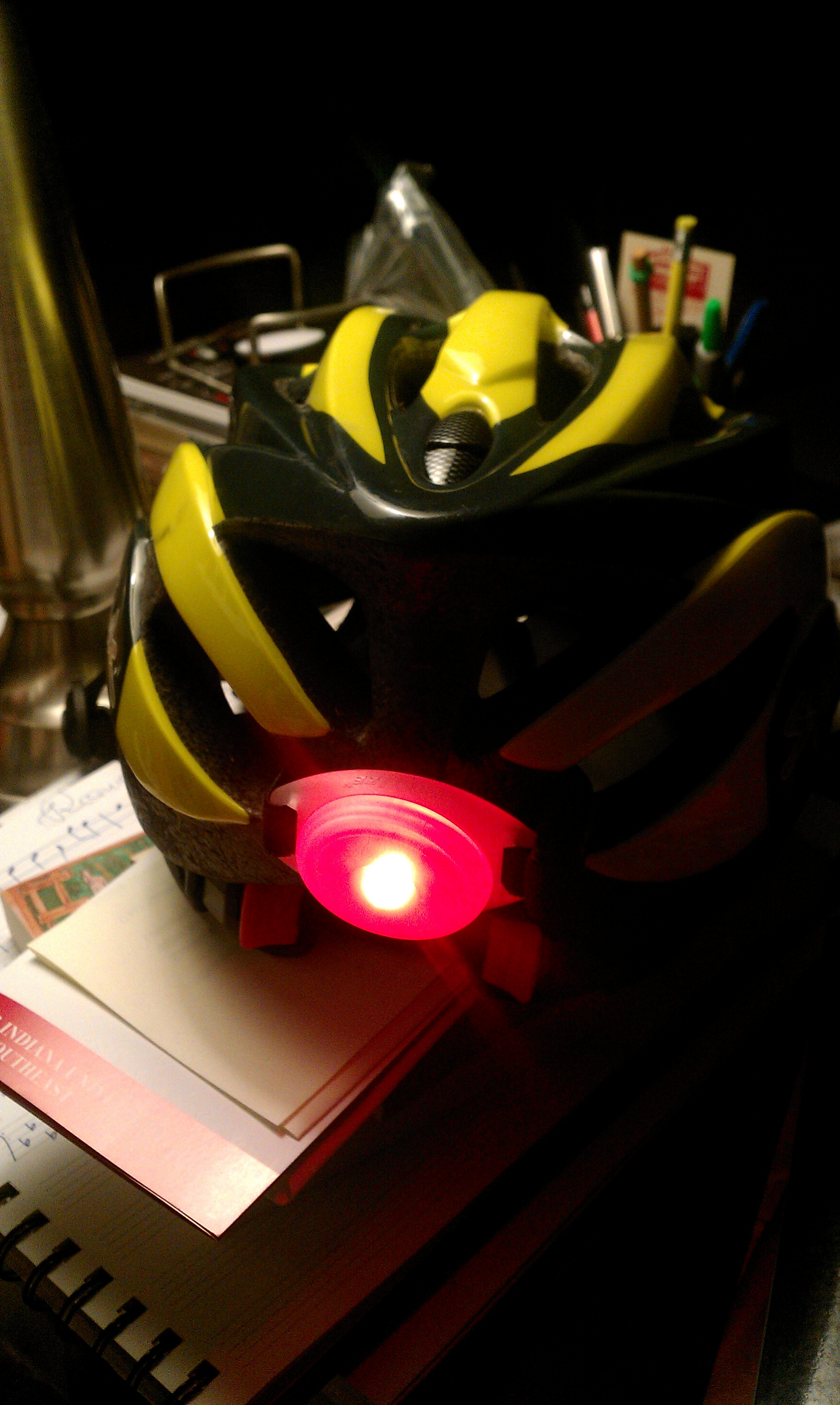
Enter the Nite Ize RideLit: I can run its stretchy, adjustable strap through my helmet’s rear vents no problem. The clip that keeps it closed stays out of the way, tucked into a vent. Problem solved!
The light itself is highly visible. I run it in blink mode whenever I’m out on the bike — it helps drivers see me in the dark, in overcast conditions, or sailing through underpasses. It also seems to be impervious to rain, a real bonus for year-round riders.
Battery life is quite long. I’ve had it for several months, running up to four hours at a stretch on long rides — it finally ran out after I inadvertently left it on all night.
I have only one complaint: you really have to squeeze this puppy to light it up, and that makes it really tough to turn on when you’re wearing winter gloves. However, that also means it doesn’t accidentally activate when you stow your helmet or bump it on something.
I’m very satisfied with this product. It’s effective, economical, and sturdy — an excellent companion for anyone who spends a lot of time on the bike.
Well done, Nite Ize!
Nite Ize RideLit mounted on Spiuk Zirion helmet
Tags: RideLit, Helmet Light, Picture of Product
(legalese)


 danseur ignoble