Author Archives: asher

Iron Cross is SRS BZNS!

I’m having WP issues this week. I wrote a dance-related post on Monday, but the editor kept locking up, and I got frustrated and never finished it — so I’m behind on that.

As you can see, I’m something like back in action, though not completely. I did make it all the way through Modern T’s class, which was a little less athletic than the previous two classes (probably because Modern T is also recovering from the Great Plague of 2016).

Today I made it most of the way through Ms. B’s Killer Class, though I had to bow out of medium and grand allegro, because I was too wheezy by the time I finished (or, well, sort of finished) petit allegro. C’est la vie, n’est-ce pas?

This made me sad, because our grand allegro combination was flat-out awesome — so Ms. B let me video it so we can do it at our next class after Spring Break. Yaaaay! (I don’t have permissions from my classmates to share that video, so apologies for that. Also, the camera work sucks :D)

I opted only to do trapeze tonight, and I think that was the right call.

Context Is Everything

Okay.

So sometimes in the world of dance (and aerials), we say or do things that might, upon reflection, sound (or feel) a little creepy.

Like saying to the New Girl ,”OMG, you have such amazing feet!”

Or sticking dowels down the back of everyone’s shirt. (You guys! This is the best for helping people feel vertical alignment! Just make sure your dowels are, like, sanded smooth and treated with a little linseed oil first.)

Or poking people in the butt to tell them which muscles to engage (I haven’t tried this one yet; I’m only a wee apprentice, after all!).

Or talking about Steve’s recurring problem with dead birds, or how great Mary is at lame ducks.

Or waxing on and on about everyone’s feet. And legs. And necks. And then trading horror stories about foot injuries.

At the end of the day, though, these are the things that bring us together and set us apart.

We just need to remember, sometimes, to make it clear that we’re not actually creeping on the New Girl, for example, and to leave a good tip for the poor soul that has to put up with two hours of sweaty dancers trading pointe-shoe blood-blister stories at brunch while eating everything that holds still long enough.

And, of course, to save the poking for the studio. We don’t want to completely scandalise the normals 😉

Friday Morning Variables; A Really Good Contact Form Tutorial

First, the ballet:

Today, I finally got back to class. I was again assisting in Friday class, and we had one brand-new student. He let us know that he was uncomfortable with any kind of hands-on correction, so I spent much of the class contemplating best practices for verbally imparting elements of basic placement and so forth that are easiest to demonstrate by physically placing someone’s arms or what have you.

I’ll be thinking about this for quite a while, I suspect.

In other news, I’m building a PHP-driven contact form for Denis’ website, and being as my PHP skillz are more than tad rusty, I decided to play it safe and hunt up a tutorial (especially since I’ve never hand-coded PHP into a WordPress-driven site before).

I found a great one — it’s going gangbusters, thus far, so unless I hose something up (in which case I’ll just say, “Screw this,” and copy the code from the thoughtfully-provided repository ;)), I think it’ll work.

The best part is that it’s well-written: clear, concise, and direct.

Here’s a link, if you’re into this kind of stuff:

https://premium.wpmudev.org/blog/how-to-build-your-own-wordpress-contact-form-and-why/

I initially started doing this the e my WP install is wonky and I can’t actually install plugins, but since I prefer actually doing many things by hand, this appeals to my  crankety old-fashioned tastes.

I cut my teeth on old-skool HTML as a kid before WYSIWIG editors were really a thing (and definitely before good ones that didn’t produce code that looked like something a cat might disgorge after a hard night on the town), and developed my initial abilities the same way everyone did back then, through the magic of View Source. This fostered in me a deep appreciation for clean, well-commented code, and the tutorial above is a fantastic example of what that should look like.

For maximum laziness irony, of course, I am writing this entry in the WP’s “Visual” editor.

Anyway, that’s it for now. Oh, or, well — I have a research idea percolating for my ballet peeps, but I’ll get to that in another post. This is mostly a reminder to myself, so there we go. STICKY NOTE!!!!

À bientôt, mes amis!


Maybe I Just Have Nothing To Say

Once, in middle school (this must have been in 7th grade; in 8th grade, suddenly everyone was a bit frightened of me because I wore black all the time, heh), some kid was picking on me for being quiet and some other kid said, “Maybe he just doesn’t have anything to say.”

I’m still not sure whether this intended as an insult (I mean, you know, 7th grade, here) or a defense — regardless, the kid who made the latter statement went on later to become one of the few that, by the end of 8th grade, was somewhat friendly, so who knows?

But, anyway, there are times that I notice I’m being quiet because something in my brain feels like I don’t have anything worth saying. (Coincidentally, I didn’t feel like that in middle school; I just didn’t know how to talk to strange humans, and I didn’t really know anyone at school.)

It’s a weird feeling. It’s not fear that other people will reject my words, just some kind of insufferable internal krampus shouting on about how all my thoughts are so much dreck.

I’ve noticed that I get a lot more of this when I’m feeling uncertain about things.

I’ve been sick for the past week, again. A bit longer than that, probably, but I was in denial until Thursday, when I basically didn’t get out of bed till 3 PM and was asleep again by 9:30 PM. Prior to that I just thought I was, you know, legitimately tired — more tired than I expected to be perhaps, but nothing to, like, skip ballet class over (when you’re a dancer, it always comes back to a question of class, doesn’t it). I was also hella cranky, so I’d you’re one of the people I yelled at, apologies.

Friday and Saturday, I did nothing but sleep, consume entire packages of Pine Brothers throat drops, watch both Ghostbusters movies back to back, and have bizarre fever dreams. Sunday I was at least able to read and so forth. Monday I started feeling better but also started having miniature nosebleeds and coughing. Balls.

So basically this is the same thing I’ve had every few weeks for the entire year — starts out with mono-like symptoms (sore throat; fever; swollen glands; spectacular, crushing fatigue), then turns into a sinus infection just when I think I’m getting better.

I suspect that when I say “turns into,” what I’m really describing is the usual way I develop sinus infections — inflammation prevents drainage, bacteria get happy, voilà! Sinus infection.

Anyway, all of this precipitated a massive spell of self-doubt.

There was my internal krampus shouting, “This is why you never make progress! This is why you’re never going to get anywhere! Accept it, you have no business being a dancer, going to grad school, being anything! What do you think you’re trying to do, huh? You think the world is going to accommodate this kind of stuff? Why do you even wanna try, you dumb schmuck?!”

This is Jack’s Imposter Syndrome, eh?

I’m trying to learn to let the krampus have his little fits without buying into them. I was raised to be relentlessly positive in a skin-of-the-teeth kind of way: not to be all chirpy and what have you, but to refuse to accept defeat. That’s not a bad lesson, but I spun it into refusing to acknowledge my fears — and so, krampus.

Krampi gonna kramp. The challenge is letting them kramp, sitting with the krampus-ness and honoring it, then going, “Okay, that was a thing,” and continuing on, rather than being bogged (or bogan-ed?) down and stuck in the krampus’ feelings. (Sometimes, mental illness makes it impossible not to, but not always.)

The challenge is learning from, even honoring the Inner Krampus, while continuing to remain awake and aware, insofar as I’ve learned to be awake and aware at all.

It is possible that, because of some foolish choices when rolling up a character for this life (yeah, maybe I shouldn’t have used CONST as my dump stat*) I will never get anywhere as a dancer, a choreographer, a writer, an artist.

*If this makes sense to you, give yourself like 100 XP.

But that’s only one possibility.

It’s also possible that I’ll learn how to work around this limitation. (Okay, it would really help if I knew what, exactly, this limitation was — like, am I one of those unlucky bastards who actually do have chronic mono that recurs in periods of physical stress? Or did I really just lose in the immune-system lottery?).

It’s possible that I’ll learn how to work with this limitation (assignment: create a dance about being unable to dance).

So, anyway, this is all the stuff I’ve had to say but haven’t said yet. It’s a weird and prickly thing, admitting to the universe what amounts to this gigantic vulnerability. Prickly in particular because I’m allergic to pity and therefore afraid of inadvertently evoking it. I had to let this percolate.

In a way, devolving upon the metaphor of creating a D&D character makes a lot of sense — sometimes it’s worth it to burn up all your points in INT, DEX, and so forth. Sometimes it’s interesting to play a character with a significant weakness. When you’re playing a rôle-playing game, you don’t kvetch about your character having a weak constitution — you know it’s there, and you play accordingly. You regard it as a limitation, yes, but also as a challenge that forces you to play creatively.

To be fair, rolling up a dancer/aerialist character and then giving him a weak constitution might not make a lot of sense, on the surface. But that seems to be what I am right now.

Perhaps it’s about time I started considering that fact and living accordingly.

A while back, I discovered that I’m sort of a virtue ethicist by nature. In short, that means that I’m all about being the best Thing I Am Made To Be that I can; I measure myself by a standard of excellence — a chief virtue; a system of virtues — that governs what I am and what I do.

Take, as an example, Achilles: by other measures, Achilles might seem like, you know, kind of a jerk — but he strives to become the best Achilles-qua-Achilles, rather than the best human being or demigod by some more general measure. Heis maximally ferocious because ferocity is a quale inherent to his being; he chooses glory and an early death over a long and peaceful life because one reflects his essential nature and the other does not. Being a nice person was not central to Achilles’ system of virtues; being a fearsome warrior was (as were, one might add, loyalty and fidelity).

So in my quest to be the best DanseurIgnoble I can become, this — my not-so-great constitution — is a part of my nature I must recognize and account for (my Achilles’ heel, if you will). I don’t think this is necessarily the best way to live, but it seems to be how I’m wired. As such, I should probably think about how to live according to my ethos while still recognizing that limitation, the rôle it plays in my life, and what hidden lessons it might have to teach me.

In other news, as I wrote to my friend B., at least all this lying around has granted me plenty of time to read. So that is its own kind of good, even if it’s not the good that I wanted.
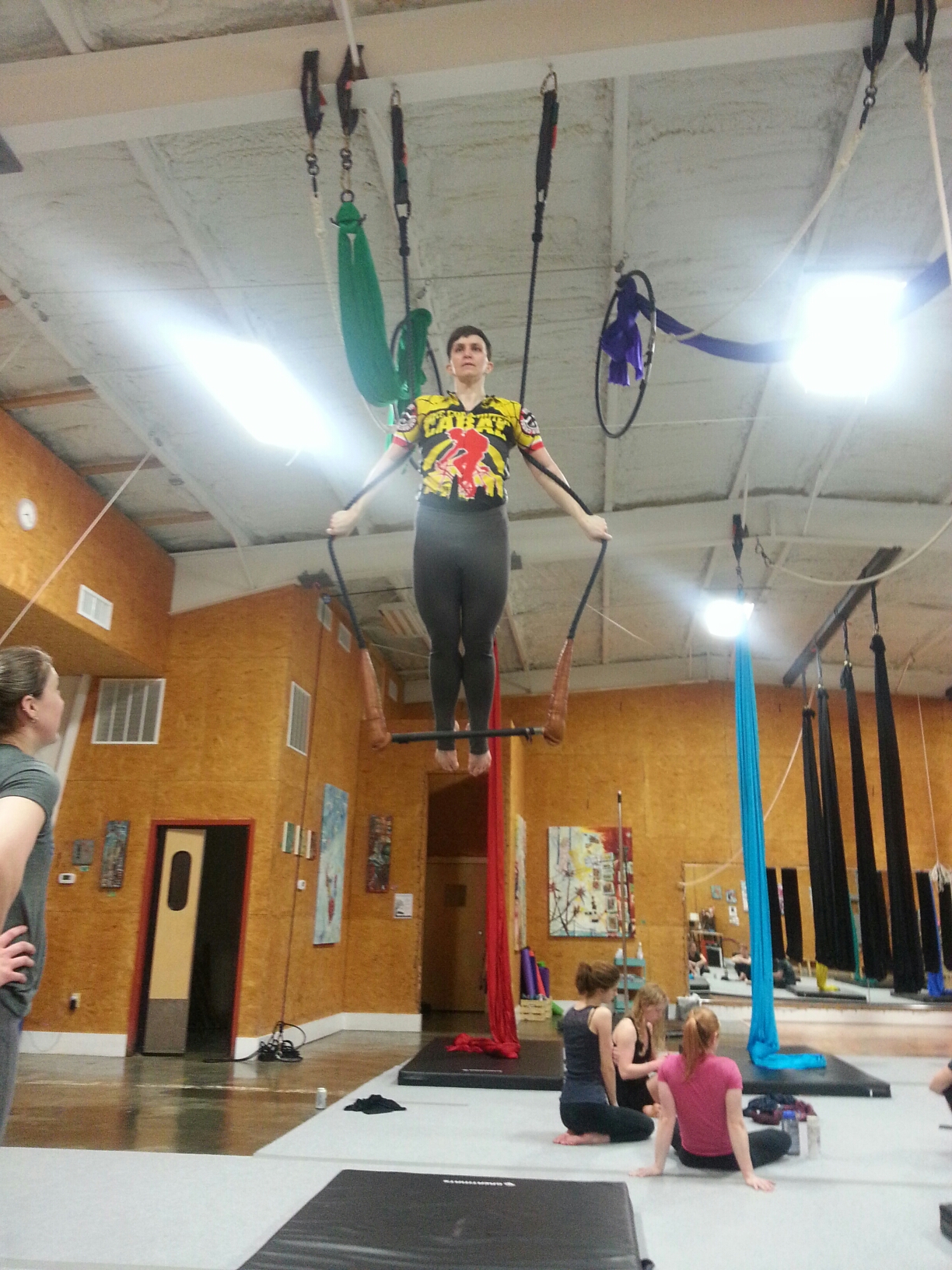
Aerials: Iron Cross is My Jam

I got Iron Cross on the silks this weekend, so now I’m all about doing it all the darn time, because, quite frankly, I didn’t expect to be able to pwn iron cross this early in the game.

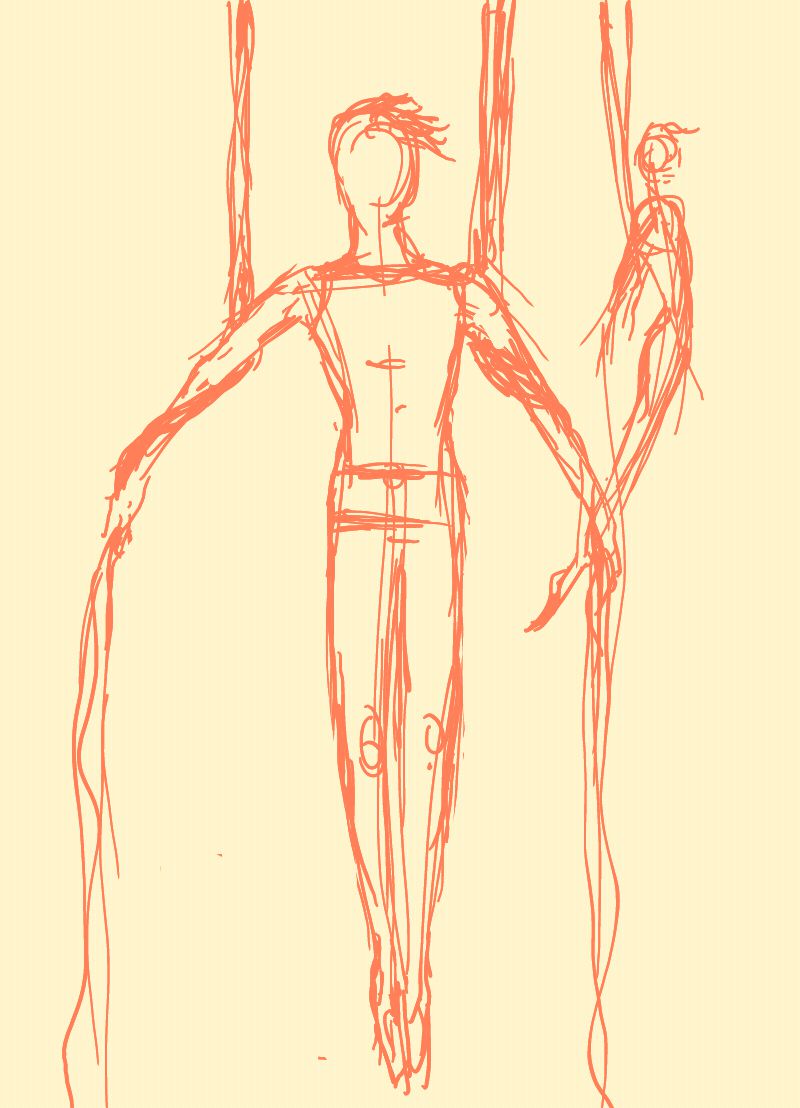
I’m case you’re wondering, Iron Cross is this:

image

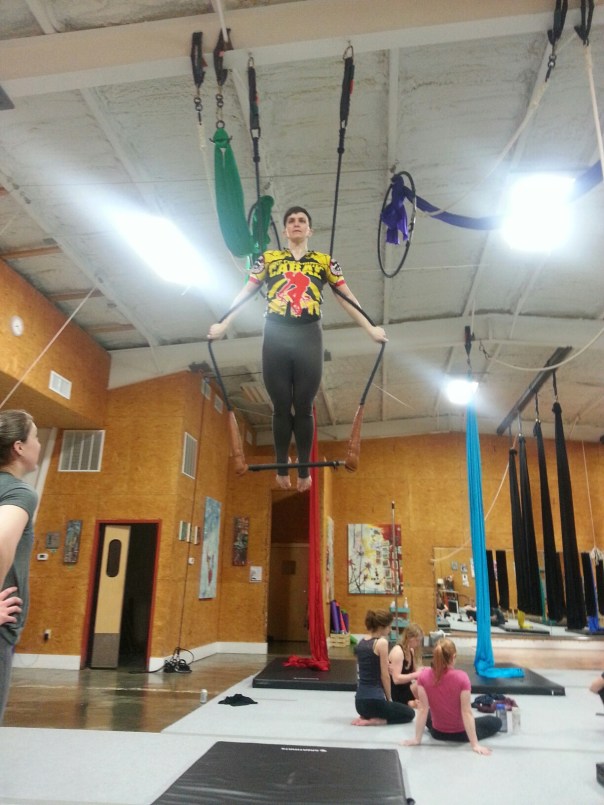
The smaller image gives you a sense of the lines from the side.

I didn’t want to just steal someone’s actual photo and couldn’t find any public domain ones, so I hope this quick sketch gives you the basic idea.

It looks fabulous on silks or trapeze — I think it’s harder to “get” on trapeze, but once you know how to do it (and have sufficient strength), it feels very doable on either.

Today I tried it on trap again and was able to do it well. I’ll have to see if I can get a picture tonight.

Anyway, that’s what I’m obsessed with right now 🙂

Modern Mondays, Class 2: Coupé Jeté en Tournant

Last week, Modern T’s lesson in bone-stacking (and cantilevering) for balance improved my balance in ballet.

This week, a clear and simple explanation sorted my coupé jeté.

Or, well — started sorting it, anyway.

Like, in the past, they’ve cropped up in choreography, and I’ve been like, “Well, here goes!” and occasionally, by way of random divine intervention, I would carry one off. Like, basically, if I did the rest of the choreography right (which is, at times, a miracle in and of itself) it would carry me into (and through) the coupé jeté.

Today, thanks to Modern T’s explanation, I managed to do one, like, intentionally, without an entire combination to carry me into it. More than one, in fact. In both directions, even!

We were using it in a combo, but I kept missing it; hence the explanation. Isolating it worked (as did explaining it in ballet terms and “factoring” it).

Coupé jeté is one of my big goals for this semester, so I am, in short, totally stoked.

The thing that I get now is that there are, in effect, two turns involved: a tombé  piqué — AKA “lame duck” — to coupé, which provides the momentum for the  turn that happens in the second jump.

I’m still not sure how to explain where the impulse for lift-off happens. I’ll have to work through it about a dozen more times before I reach a point at which I can put that into words.

Modern dance makes it easier for me to understand how I learn dance (and dances). There’s definitely a lot of kinetic sequencing that happens; if I can remember the first step in a bit of choreography, I can usually get through all of it; if I can’t remember how it starts, I get stuck.

My primary “backup” takes the form of 3D movies in my head, but if I’m missing a piece of the movie, I can get stuck that way, too.

My secondary backup is verbal: in ballet, reciting the names of the movements can help me if I get stuck; it doesn’t always work, since I’m not awesome at verbal learning, but it’s still useful. When I don’t have names for things in modern, I don’t have that extra backup.

So, basically, my dance-learning hierarchy goes:
Kinetic (which includes rhythmic/pulse sense)
Visual
Verbal

…And when all three systems somehow fail to store a piece of the choreography, I get stuck and the sequence freezes.

This is more likely to happen in modern dance because it’s less familiar and often less verbal, so I need to work on making sure my kinetic and visual maps are really solid so I am less likely to need that verbal backup plan. I suppose it’s also totally valid to do what I do when my name-recalling software fails in ballet, and just give things temporary names.

I can’t tell you how often I wind up substituting “… and then thing, and swirly thing, and that other thing, and then thing again,” in my verbal ballet maps!

I think that I can improve this in both ballet and modern contexts by creating mental “hooks” in the choreography — like the thing I mentioned a few days back about knowing all of that one combination from the entrelacé, but not the beginning of the combination in question. I love entrelacé, so it becomes a “hook” really easily.

The other thing I learned is that, where large tombés are concerned, I compulsively tombé with both legs bent, even when I’m supposed to be falling with a bend only in the leg that’s receiving my weight, except on those occasions that the trailing leg leaves the floor. It’s like I’m always preparing to do some huge turn or something.

That made the beginning of one of today’s combinations quite a bit harder than was actually necessary until I figured what the heck I was doing!

Okay, that’s it for now. I should probably go do some work 🙂

À bientôt, mes amis !

Again!

It’s almost 11PM. Hello again, Choreographic Muse.

(In other news, amazing day today. In ballet, Ms. T spent basically the whole class working on me, which is both great and a little disconcerting — like, I don’t want other people to feel neglected. I also nailed the longest attitude balance en rèlevé. It just went on forever. At one point I realized I totally pwning the balance, started to wobbly, and corrected myself. WTF, you guys, when did I learn to balance like — oh, yeah, on Monday in Modern T’s amazing class.

At Suspend, awesome Silks class — I did Iron Cross and it was awesome and then I used it at the end of a combo even though it was the harder option — followed by a great conditioning class and an awesome workshop. So there you go.)

Ballet Lessons: Don’t Neglect the Transitional Steps

When I talk about transitional steps, I often devolve upon the example of the floor exercise in women’s competitive gymnastics.

It’s a handy example, because most of us have watched gymnastics at one point or another (even if only in the heat of Olympic fever) and floor exercise is, in some regards, the easiest apparatus for the uninitiated observer to understand.

What isn’t as easy for the uninitiated observer (or even for many experienced observers and extensively-trained gymnasts) to understand is why some gymnasts just look so much better than others — so much smoother and more polished.

More often than not, the secret is in the transitional steps.

Historically, American gymnastics training programs have focused on training skills and little else. The skills themselves may be brilliantly executed, technically precise, and powerful: but technically perfect skills alone do not make a beautiful, exceptional routine.

For beautiful, exceptional routines, the Russians tend to lead the world: and there’s a reason for that.

The Russians train the bejeezus out of the skills, but they also dance.

When you watch a top-notch Russian gymnast doing her floor exercise, it isn’t a series of tumbling runs, balances, and isolated skills loosely linked by half-hearted shimmies. It’s a single, coherent entity from start to finish: a choreographed dance that happens to feature explosive, difficult, highly-technical gymnastics skills.

The difference, in short, is the linking steps: all of those apparently non-essential moments that take the gymnast, judges, and audience from Point A through Point Z.

Even in moments of stillness, the best Russian gymnasts continue to dance — just as ballet dancers are dancing even when they’re standing in B-plus for fifteen minutes while Odette gets her swan on.

So much of ballet happens in the transitional steps: the ones that carry the dancers from pique arabesque to entrelacé, or from tour lent to dèveloppé ecarté avant.

For the dancer (or gymnast), transitional steps serve important preparatory roles: think of precipité and failli, which essentially never appear on their own outside of the lesson, but which precede so many important moments in performances.

For the audience, transitional steps serve as the visual links that join the more dramatic steps of the dance into a cohesive whole.

As such, they’re extremely important: but often, as dancers, we neglect them in preparation.

One of the reasons — in fact, I would argue, the main reason — that great Russian gymnasts’ floor exercise routines look so beautiful is that they don’t neglect the transitional steps.

Russian trainers don’t treat dance as an afterthought; they school their charges in using transitional steps and maintaining line throughout their movements. As a result, the Russians’ floor exercises continue to be gorgeous (and they essentially own the sport of Rhythmic Gymnastics, which depends even more heavily on dance than does floor exercise in Artistic Gymnastics).

One of the reasons that American gymnasts’ floor exercises, even when technically perfect, are rarely as beautiful is that American trainers do tend to treat dance as an afterthought. Many gyms, in fact, don’t actually teach dance as a discrete element at all. Instead, they do their best to “work it in” when teaching routines.

As a result, their gymnasts’ performance suffers.

The same goes for dancers: so often we devote all our time to learning what we think of as the big, important steps — at the expense of the transitional steps that link everything together into dance.

We do this in life, too.

So often, we’re so eager to get on to the Next Big Thing that we fail to adequately prepare. With our eyes on the far horizon and our feet moving forward in the now, we stumble over pebbles and fumble through our preparations.

Often, the Next Big Thing suffers as a result — it may succeed, but perhaps not as well a it would have if we had paid attention to our preparation; if we had learned the transitional steps and used them well.

As dancers, when we learn choreography, we do well to focus on ingesting and interpolating that transitional steps — not only will they allow us to execute our big, technical steps with elan, but they help us remember the dance. Each transitional step becomes a cue; common transitional phrases (tombe-pas de bourreé-glissade…, for example) become “hooks” we can use to get ourselves back into the dance if we get lost.

A good glissade or chassé allows us to gather momentum, place ourselves, and load our springs (via plie) in order to execute those high, brilliant, explosive jumps we all love.*

*Worth noting: Sometimes, choreography starts with transitional steps.
The past two weeks, we’ve been working a combination in Ms. B’s Killer Class that nominally starts with temps de flèche, but really starts with a coupé tombé that transfers the weight and loads the springs, allowing us to blast the temps de flèche off like we were launching from Cape Canaveral.

An effective tombé to fourth or second makes a square, quiet place from which to launch a turn, or three turns, or five turns.

These are basic steps, mostly learned in the first year of class: but, like everything else, they are critical, essential, and never perfected.

Wise dancers continue to work on transitional steps as long as they continue to dance.

We can all take a page from that book: the same principle applies to life in general. We should pay attention to our transitions; work on them; prepare them.

In the end, they’ll make our big moves smoother, cleaner, and more brilliant.

~

Today’s post is inspired in part by my own tendency to neglect the transitional steps in favor of the big ones, my attendant quest to freaking well stop doing that, and the fact that I’ve realized I’m in a transitional period in my own life right now and should be paying attention to the transitional steps instead of just going, “Man, when do I get to the part where I get to do coupe jeté en tournant en menage?”

Or, you know. The life-outside-ballet equivalent.

A Long Day’s Journey Into Trapeze

Wednesday Class this morning was, as ever, a challenge: a greater challenge, in fact, than is entirely usual.

In short, I was extra tired this morning, possibly due to the extra aerial technique class yesterday. Oh, well — to this I say (addressing myself, of course), “Suck it up, Buttercup.” My brain and legs were apparently not on speaking terms. Even when my body had a given combination right, my brain would occasionally butt in to say, “Wait, are you sure that’s right? Because it could have been—“ and finish with some different version that, no, it couldn’t have been. Ugh.

I was comforted by the fact that various company dancers and one of the former pre-pro girls, back on spring break and freshly accepted to IU’s excellent dance program, were also struggling at times. This is why we all love Mme.B’s class: she stretches us, and then when we think we’ve been stretched to the breaking point, she shows us that, no, we’ve got a little more.

I was, nonetheless, sufficiently awake by the end of barre to deport myself quite respectably during adagio, which was a beautiful combination carried over from last week. My tours lent, in particular, we’re accomplished without flailing in both directions.

Turns, too, were acceptable, as was the terre à terre or whatever the correct name is for that bit.

But not petit allegro. We did last week’s combination again, there, and while it went well last time, neither my legs nor my brain were having any of it today.

As for grand allegro … Eh. It began with temps de flèche, which I kept screwing up by starting on the wrong foot. But the last two thirds (from a direction change to entrelacé through another direction change and a bunch of other stuff), I had. There was a really cool part with a giant pas de chat that became part of a directional change. I’ll have to try to describe it better when I’m, like, awake.

I asked M. B. for guidance on temps de flèche after class, and I think I’m on top of it now.

The day ended with an excellent conditioning class followed by an awesome trapeze class. I heart trapeze so much at the end of a day of fumbling through Killer Ballet class (“Hard Mode” just doesn’t always catch it). We did, among other things, pike beats, which I looooove.

That’s it for now. Chores, Web work, bells, and acro tomorrow.

À bientôt, mes amis.

Snapshots

As homework for my apprentice teaching gig, I am Reading All The Books.

Conveniently, all the books Anne wants me to read were already on my Choreography, Teaching, & Technique reading list.

Anyway, on the way over to Mixed Apparatus at noon today, I found myself contemplating some of the Improvs in Blom and Chapin’s The Intimate Act of Choreography (ISBN: 0-8229-5342-0 … and, look, it’s available in electronic format!) and, simultaneously, thinking about the problem of shaping proprioception, which is a huge part of teaching dance.

As a quick illustration, one of the things we’re focusing on is making a graceful line through the arms. That’s one of the most challenging things to do for a number of reasons, but not least of all because what we think or feel our arms are doing and what they are doing are often, in short, quite different.

For example, I had no earthly idea how strongly I tended to break my wrists until I saw a picture of myself playing around on the trapeze (or was it the lyra?) the first time we went to PlayThink (I though I had it in my WP media files, but evidently I don’t, so I’m going to have to add it in later).

The difference between what I felt like I was doing and what I was doing was so stark and so shocking that it produced a powerful mental image; one I was able to use to very consciously correct the carriage of my wrists (and, over time, my port de bras in general).

Anyway, all of this led me to think of a potentially-useful little improv game that could, potentially, be useful for improving proprioception (which, like other forms of perception, is malleable through training).

I’m calling it “Snapshots,” though part of me was tempted to call it “Selfies,” since I am a spectacular selfie-junkie (actually, I love taking pictures of people in general; it just happens that I’m always there when I need a subject). The choice of names relates partly to the greater historical strength of the word “snapshots” and also to the fact that selfies are often (perforce, because one’s arms are only so long and we don’t all own selfie-sticks) taken at weird angles.

Chances are someone else has already invented this game, but that’s one of the cool things about good ideas. So, in short, if you’ve already invented this game, please know that I’m not intentionally stealing your thunder.

Here’s how it works:

  1. Get yourself into a neutral position in a room or studio with a good mirror. (If you’re in a large class, make sure everyone has a good “window.”)
  2. Close your eyes and think of a position, pose, or phase in a movement (perhaps that moment in renverse when you begin to transition from arabesque to attitude? …Only on the flat, so you have a better chance of remaining upright) that you can reach and hold for a little while.

    Consider starting with an isolated zone or part of the body: just the arms, just the foot, just the right leg.

  3. Find your way into that position, pose, or phase-of-movement. Work slowly: without your eyes, this is going to be a bit more challenging than it usually is.
  4. Once you’re “there,” open your eyes. Get a good sense of what your execution actually looks like.
  5. Compare and contrast the image of yourself executing your chosen position/pose/whatever with your mental picture (you can close your eyes again if it helps; likewise, you can probably stop holding the pose in question now, if you need to).

    Ask yourself: in what ways do I “match” what I envisioned? In what ways don’t I match? What looks better than what I envisioned? What doesn’t look as good? Why? What might I need to adjust? What should I leave alone?

  6. Edit: I left out the last step!

  7. While looking at yourself in the mirror, slowly move the parts of your body you need to move to match your original mental image, giving yourself time to know what it feels like to get there.

Over time, the second-to-last and last steps can help your mind’s eye and your proprioception (in short, the sense that tells you where you body parts are in relation to one-another) work better together. At least, they do for me.

I haven’t tried this yet with dancers other than myself, but I plan to deploy it on my dear, patient husband and anyone else who’s willing to be a test subject and see how it works for them. It works well for me, but that isn’t always a great indicator of … well, anything, really.

So that’s it for now. Today we did lyra and silks in Mixed Apparatus, but none of us took any pictures. There were only three of us in class (the lovely advantage of daytime classes — often, they’re quite small!), so there was no one waiting for an apparatus while someone else worked.