Category Archives: review
Review: Nashbar S2 Bib Shorts
In mid-July, I ordered a pair of Nashbar’s S2 bibs, thinking that I’d round out my collection a bit.
Instead, I am now forced to replace all my other regular bib shorts with these! Curse you, Nashbar!
One might ask, “Well, what’s so great about the S2 bibs that you’re going to have to swap out everything in your wardrobe?”
First, the fit. Supportive, but not constrictive. I’m 5’8″ and 166 lbs, thighs top out at around 24″, waist 32″ or 33″ (seems to vary, or maybe I suck at measuring), so I threw a dart and ordered size medium. It’s perfect.
Second, the chamois. It’s awesome. I realize that chamois preferences are highly individual — so if you like a thicker chamois, these may not be the bibs for you. For me, however, this chamois is perfect. Enough 3D relief to keep the air flowing, enough padding to prevent one’s ischia from drilling holes in one’s saddle during more-upright moments, but thin enough to forget about and small enough that it doesn’t bunch up.
Third, no leg grippers! To be honest, it’s possible that I’d buy another two pair of these for that feature alone.
I have another pair of shorts from another manufacturer (which shall remain nameless) that are also size medium. The fit is great *except* for the leg grippers, which were clearly intended for someone with much smaller thighs than mine. They apply a fearsome death grip to my quads, and it is not comfortable.
As result, I now often order my shorts a size up, but that can create problems with excessively long straps (I am short-coupled) or, worse, over-large chamois. Nashbar’s gipper-less design means I can now order a size that fits and not worry about my lower legs dropping off mid-ride from lack of blood flow.
Other strong points:
In short, since these arrived, my other bibs have lingered neglected in a drawer, all but forgotten, like dreams of overlarge chamois that have vanished in the morning light.
I’ve effectively worn, washed, and dried these every day since I bought them. They’re holding up beautifully.
The contrast stitching looks sharp.
I like the little isthmus that connects the bib straps in the back.
Overall, exceptionally thoughtful design and a great product at a great price.
Now I just have to find room in my budget to replace all my other bibs!
…
Oh.
One last tidbit that I didn’t include in my review as submitted to the Bar of Nash: these shorts make my butt look great.
Just sayin’.
(Pictures forthcoming.)
Edit: I forgot the disclaimer. I paid for my Nashbar S2 bibs myself (I used a discount code, so I didn’t exactly pay full price, but close enough); Nashbar, meanwhile — except for the fact that I order stuff from them a few times a year — doesn’t know me from Adam.
Nashbar S2 Bib Short: A Quick First Look
Ironically, though I’m calling this post “A Quick First Look,” I didn’t think to take a picture of these bibs. D’oh. We’ll just have to do without for now.
After much debate (I have probably by now far and away blitzed my cycling budget for about the next three years), I decided recently to snag a third pair of bibs. My Fox bibs are starting to show some wear, and my Pearl Izumi bibs are less than ideal for rides over 20 miles (mainly because they’re too big).
I really wanted to try Pearl Izumi’s P.R.O. shorts with the Super-Awesomeness Transfer Fabric that magically makes you feel like you’re riding your bike amid mint-flavored glaciers, but I could only find them either at full price — so not doable right now, since I am in the process of replacing the drive train on the Fearsome Fuji starting with its crankset — or in a small (not even gonna try) or an X-large (which would be fine if I wanted to have plenty of room to carry 47 water bottles in my shorts).
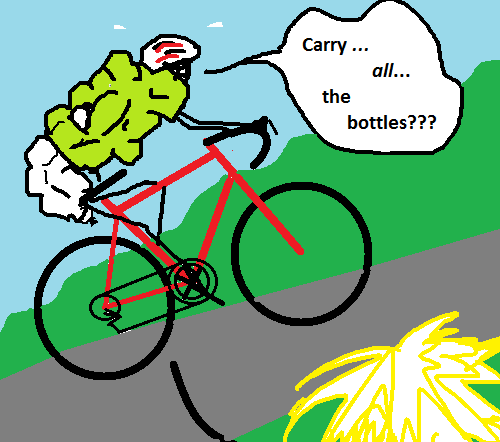
Here is a high-quality graphical rendering, replete with cheering fan, to help you visualize this concept.
As such, I decided to back down from the high-performance fabrics tree and poke around out there to see what’s available.
Among the options in my price range, Nashbar’s S2 bib proved a standout for two reasons: first, it had promising reviews; second, there were no leg grippers. I figured that last bit could be either great or terrible: like, “OMG I AM FIFTY MILES FROM HOME AND MY SHORTS ARE IN A GIANT WAD,” terrible.
Reviews reassured me of the unlikeliness of the latter outcome, so I bit the bullet and ordered a pair in a size medium.
It turns out that the lack of leg grippers is, in fact, great. My thighs are kind of epic. Not quite German-track-racer epic, but pretty freaking big. Even when I weighed 135 lbs, they were big. At 166, they’re even bigger. I don’t feel self-conscious about them — they’re mostly solid muscle, and they get me up the hills — but the leg-grippers on the only other pair of size-medium shorts I own are, well, a little restrictive.
The Nashbar shorts don’t squeeze my legs like they’re attempting to make sausage links from them. Nor do they ride up. In fact, they stay nicely in place and look pretty darned sharp. I can go for that.
Edit! Pix are in! (Clicky to enlarge.)

Front View!

Side view!
The best part, though, is the chamois.
In the end, it is the chamois that makes or breaks a pair of shorts. It either works for you or it doesn’t.
The chamois in Nashbar’s S2 bibs is about ideal — not too wide (probably because I didn’t order a size up to avoid overly enthusiastic leg grippers) nor too narrow; neither too “bumpy” nor too flat. It offers a couple of nicely-placed pads for the ischial tuberosities and a bunch of other lower-relief 3D elements to channel sweat and to help … erm … keep, um, everything … well, you know, in its place.
The Nashbar S2 bibs’ chamois handles this latter job quite well even for an intersexed guy of what one might call, um, tastefully restrained proportions. In fact, it is the first one that has worked perfectly for me. To be fair, I can’t really directly assess how they’d do for someone with, um, the opposite situation. I suspect, though, that they’d do well thanks to their supportive fabric and supple chamois.
I can say that the S2 bibs are great for hot weather. I gave them their inaugural trial run in 97F heat and full sun and felt quite comfortable all the while.
Moreover, today’s ride involved tarmac, gravel, dirt, and grass, so I feel pretty comfortable stating that these shorts are suitable for any terrain. It also involved McDonald’s bar-height stools, for which they proved a bit slippery. Good to know. Ladies and gentlemen, when you don your Nashbar S2 bibs, make sure that you launch yourself onto potentially-slippery furniture gently.
I would go so far as to say that these are the sharpest-looking shorts I currently own. The contrast stitching is a nice touch.
Obviously, I can’t comment on durability yet. I’ll keep y’all posted. So far, though, Nashbar’s S2 shorts are winners.
That’s it for now.
Rubber side down!
Review: Pearl Izumi Sun Sleeves (White); Headsweats Spin Cap revisited
This afternoon, with sixteen miles or so to ride in the sun-baked July heat, I decided to try out the white Pearl Izumi Sun Sleeves that I ordered in anticipation of the Boston-Munfordville-Boston century (during which they remained neatly tucked in my bar bag).
I figured that, at worst, they’d annoy the fire out of me and I’d skin ’em off en route like I do with my arm warmers in the spring. At best, they’d offer the ideal combination of sun protection and cooling.
The reviewers who liked them best all said essentially the same thing: if it’s going to be hot — like, 80F+ — douse them in water. Thus, dutifully, I applied my fresh, white armskins inside and took the hose to them outside.
The cooling effect, believe it or not, was both immediate and pronounced.
Standing in the shadow of the house, my arms actually felt chilled. While riding, I’m not going to say that my arms were cold — but they remained quite comfortably cool as I banged out a reasonably-fast 8.3 miles in 93F heat with a heat index of around 100F.
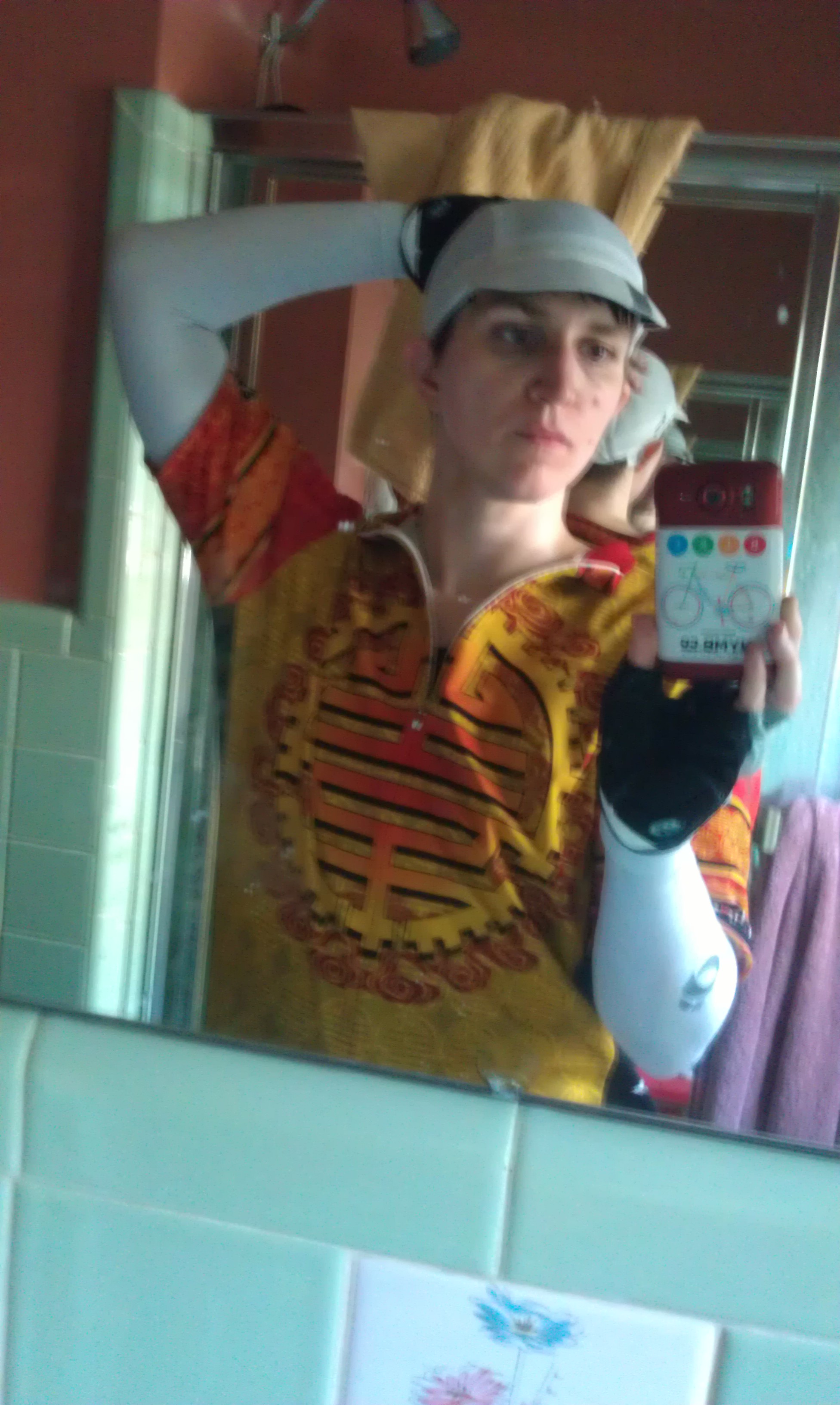
I took this ridiculous picture so you could see what these guys look like and so I could say, “I am a model, if you know what I mean…”
This is certainly the kind of heat that can become uncomfortable. Coupled with the humidity, it can be quite uncomfortable indeed. With the IP arm-coolers on, it was actually very tolerable — even comfortable — so much so that I found myself wishing for an entire summer riding wardrobe made from this miraculous cooling fabric.
As the armskins dried, the cooling effect diminished somewhat, but my arms still remained cooler than they would have been without. Moreover, the armskins kept the sun at bay — a great bonus right there. I did apply sunblock before I decided to ride with them, but I’m pretty sure I could have left it off. After my therapy appointment was over, I re-soaked my sleeves and rode home in even hotter weather. PI’s Sun Sleeves continued to do their job. Awesome!
One note: usually, I think it’s ridiculous that armskins are labeled “left” and “right,” since normally they’re just basically tubes of fabric. The Sun Sleeves actually employ a different texture on their inner surfaces — a sort of dimpled effect that I suspect is designed to afford better evaporation near large veins close to the surface, thus improving the cooling effect. Thus, in this case, it’s probably worth paying attention to the “left” and “right” labels when donning your armskins.
In related news, since it was blistering hot and I know myself well enough to know that I was not going to really take it easy on this particular ride (I ride this route all the time and it involves one of my favorite flats and a “testing tree” climb), I figured it would be a good time to see how Headsweats’ “Spin” cycling cap held up under demanding heat. I gave it the same treatment the armskins received, soaking it thoroughly (though I soaked it in the sink instead of putting it on and soaking it under the hose).
I’m pleased to report that it performed admirably (once the bill stopped dripping); my head stayed cool and comfortable under my primary helmet (which is well ventilated). I fully expected to take the cap off halfway through the ride or less, so this was a nice surprise.
The only flaw in the cap’s design is the same one I complained about before — its bill is quite long. This proved pretty annoying on stretches with a lot of stop lights and/or traffic. I was finally able to adjust the bill so I didn’t feel quite so much like I was straining my neck to peer out from under it, but I also found myself contemplating whether I might be able to trim the bill down.
For what it’s worth, the bill would be a non-issue on a more-upright bike: in fact, when I find the perfect road-bike cap, this one will probably find itself relegated to Tricross and MTB duty, where it will perform admirably, I’m sure. (Sidebar: since I swapped out the Tricross’ seatpost for a zero-offset model, its riding position on the hoods is much more upright — which is fine by me, since I can still get down in the drops and get my aero on. For races, though, I will probably scoot the saddle back a smidge.)
In summary:
Pearl Izumis’ Sun Sleeves are worth the purchase price, especially if you frequently ride in the hot sun.
Soak them with water, and if you’re going to be out for a long ride in the head, consider bringing extra water to re-soak them (it actually doesn’t take much; I dribbled a little water from my bottle on them en route home). The water you use to soak the armskins doesn’t even have to be cold; the stuff from my hose was, in fact, quite warm indeed.
Fit is spot on for cyclists; I ordered a Medium pair for my increasingly-scrawny and climber-esque arms and they’re perfect.
Headsweats’ “Spin” cycling cap is also pretty darned great. Like the IP Sun Sleeves, it does a fantastic job keeping you cool on hot rides if you douse it with water.
The bill is a bit long to be entirely perfect on any bike that puts you in an aggressive position. For relaxed bikes, touring, and commuting, however, that same long bill offers exceptionally good rain protection, so it’s well worth the price for those purposes.
Full disclosure: I am nobody special and paid full price for both these products. That said, I would do it again! YOU’LL HAVE TO PRY THEM FROM MY COLD (AND I MEAN COLD!) DEAD ARMS!
I mean.
Erm.
Ahem.
What came over me just now?
Review: Headsweats “Spin” Cycling Cap
Once upon a time, in a kingdom far, far away bike shop downtown, my boss gave me a Colnago cycling cap. The point was actually to keep my bangs out of my eyes when I was working in the shop — a task at which it performed admirably.
Soon, I discovered another purpose for my cycling cap: keeping the rain off my glasses (cycling caps do this job especially well, by the way, when paired with helmet visors). This worked brilliantly throughout the cool rains of the short Kentucky spring.
Soon, however, I found that my beloved Colnago cap had a major weakness.
It didn’t.
Breathe.
At.
All.
I mentioned, didn’t I, that Kentucky springs are short?
Soon after that first delightful cap-shielded spring, I discovered that it still rains in summer, and sometimes when it rains in summer, it’s hot. In fact, “hot” is pretty much the norm in Kentucky from roughly the end of April through the beginning of November (this year, we’ve had it easy).
And I, for one, do not ride well when my brains are boiling.
With a probably-wet century looming on the 4th day of what’s normally the hottest month of the year — July — I decided it was time for a change.
Enter Headsweats’ “Spin” cycling cap, which blends fairly traditional cycling cap styling with breathable Coolmax™ polyester.
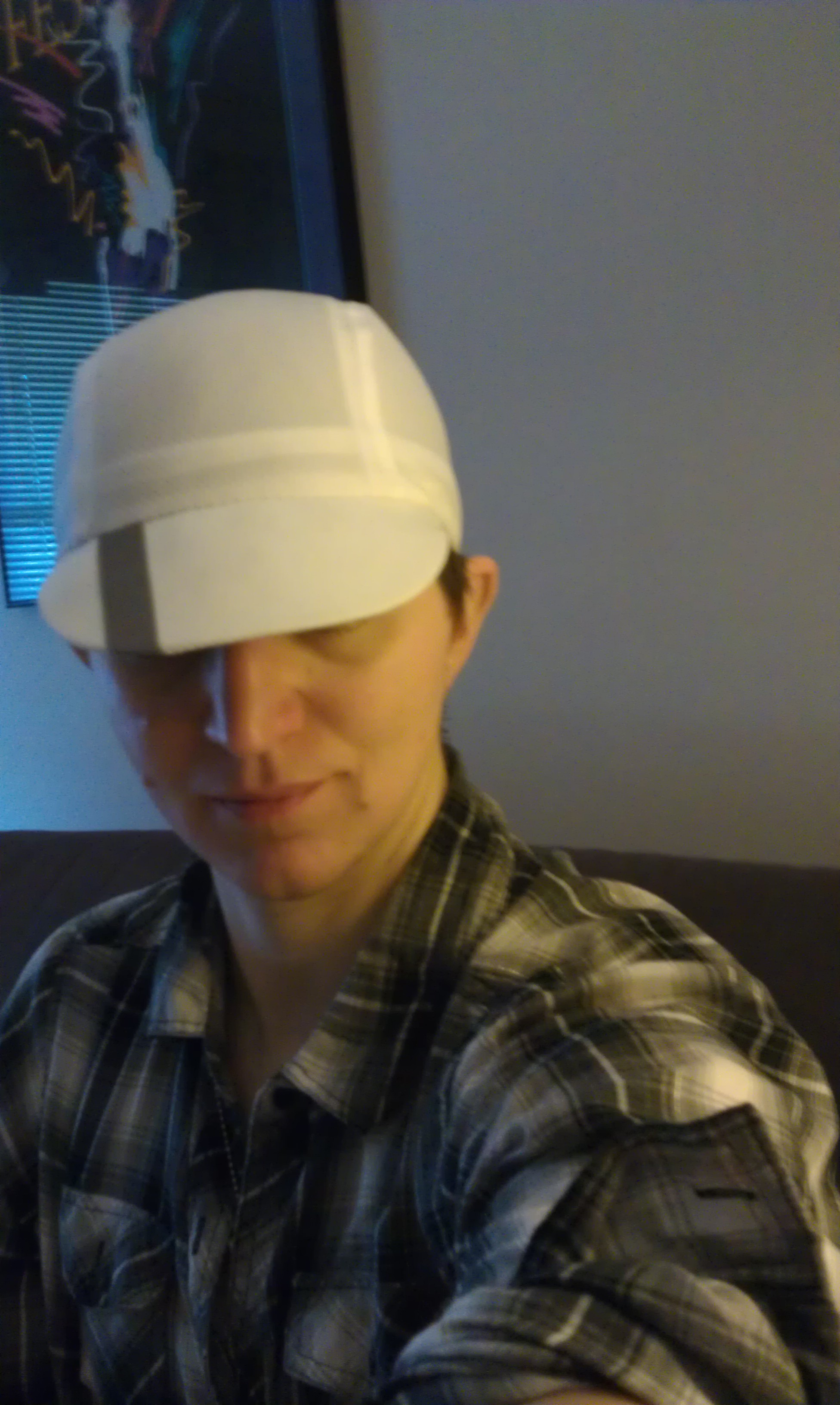
Three panels? Check. Curvilinear seams? Check. Close, unconstructed fit? Check.
Design
Let’s start with styling. I say that the Spin cap is fairly traditional. What I mean is that it takes the basic “cycling cap” design — three panels, curvilinear seams, and a close and unstructured fit — and builds from there. It’s lightweight and small enough to carry easily in a jersey pocket.
That said, Headsweats adds a couple of touches that one might not quite consider traditional.
First, instead of a single, centered racing stripe — a popular design for cycling caps — it features a very bright, off-center reflective strip. The strip is placed to the right; I’m not sure if that’s a function of aiming for a global market or not, but if I were designing a cap primarily for the American market, I would place that same strip on the left to increase the likelihood that oncoming headlights would pick it out.
That said, it is superbly bright and probably just fine as a sort of “backup” device (I don’t believe it’s ever a good idea to rely solely on reflective materials for visibility).
Next, the designers at Headsweats made a smart move in covering the inside of the Spin cap’s bill with black fabric instead of white. This means that reflected glare is never a problem. Oddly, this feature wasn’t mentioned in Amazon’s ad for the cap: I rolled the dice and ordered it anyway. I’m not sure why this important and useful touch was overlooked.
Lastly, the bill on this cap is quite a bit longer than usual.
The drawback, here, is that if you flip the bill up — as we cyclists are wont to do when we want to get in the drops and be able to see more than three feet ahead — it both looks kind of ridiculous and bumps into your helmet. If you don’t flip it up, can significantly restrict your view from the drops.

That’s me, always flashin’ the big bills.
The benefit, on the other hand, is that the bill in question does a great job keeping the rain at bay when you’re riding on the hoods (which is how I roll most of the time during low-intensity rides). More on that later.
Fit
Like most cycling caps, Headsweats’ “Spin” cap fits close. Unlike some, it also sports a really powerful elastic grip. My head is not enormous by any stretch of the imagination — if anything, I’d say the circumference of my skull is on the small side for a male. Those with heads larger than mine might find the elastic in question uncomfortable. However, for me, it wasn’t uncomfortably tight (I have, in fact, encountered helmet liners with uncomfortably-powerful elastics).
The close fit meant that my cap stayed in place throughout the course of the day, even when I took my helmet off. It also fits nicely under both the spare helmet I used on the Boston-Munfordville-Boston ride and under my regular helmet.
Function
This year’s Independence Day century proved very, very damp. It was not raining during approximately five minutes of the ride. The rest of the time, it was at very least drizzling; sometimes — at one point, for a good half an hour or so at a stretch — it simply poured.
At no point did the rain falling from the sky interfere with my glasses (FTR, I use photochromatic lenses so I don’t have to swap ’em out when it gets dark). I can’t say the same for the spray thrown up by the wheels of Timothy’s trike*, but unless I decide to start wearing a Cone of Shame on rides — and, let’s face it, that wouldn’t be aero at all — spray from the road will always be a possibility.
Without the cap, I would have been unable to see through my glasses throughout much of the ride. Headsweats’ Spin cap did a great job keeping the rain off my glasses.
But how well, you might be wondering, did it breathe?
Well, it’s a little difficult to say. I believe the high temperature during our July 4th century might have been about 75 degree Fahrenheit — not cold by any stretch of the imagination, but not hot either. During much of the day, it was cooler still.
At no point did I feel as if my brains were boiling. My head remained comfortably cool even in my spare helmet, which doesn’t exactly measure up to my usual aiflow standards (though it does have cool grey curlicue designs all over it). When I wandered into our lunch stop with helmet off and cap on, my head definitely felt cooler, not warmer, than expected. That bodes well for the cap in question, even with my thick hair.
I was able to test it very briefly today in warmer temperatures — about ten degrees warmer, in fact. Thus far, the Coolmax™ fabric continues to live up to its name.
I can’t yet say whether it would do the job at higher intensity over the course of a longer (or much-longer) ride, but so far it seems pretty effective. I’ll report back soon on how it performs under more challenging conditions.
Durability
Doing fine after 108 miles. Once again, I’ll update this category at a later point.
Conclusion
Headsweats’ “Spin” cycling cap seems to achieve a nice balance of features at a sound price-point. Standouts include the reflective strip and, especially, the black underbrim. Coolmax™ fabric appears to perform in accordance with claims, though further testing will provide better data. Fit might be a bit tight for larger heads, but is fine for those of us with medium or small brain-cases.
I paid about $15 for my Headsweats Spin cap through Amazon Prime, which is within the expected price range for comparable caps online and in area shops. The cap has already proven itself well worth the price. I look forward to further road-testing, and it looks like I’ll have plenty of opportunity.
_______________________________
*Don’t hold this against Timothy, by the way. He runs fenders on his usual bikes when rain is expected; the trike is a loaner that he’s using while he recovers from the effects of a bulging disc that has greatly limited the functionality of his right arm. It would probably be possible to acquire fenders for it, but they’d be expensive and hard to procure on short notice.
Lake CX-211 Shoes
My bike rides are rarely preceded by a swim or followed by a run (though sometimes a ride is followed by a lazy, just-for-fun kind of swim!), but I decided to roll the dice and purchase a pair of Lake’s CX-211 Triathlon shoes.
Thus far, I’m really enjoying them. They offer a nice balance between price and performance — important on a college student’s budget.
Here’s what I like about the CX-211s:
1. Incredibly well ventilated!
I took these out for an interval workout yesterday in 97F/36C temps. I expected my feet to boil. They didn’t, which was awesome. My feet were comfortable, which let me focus on my ride.
2. Reasonably Light
My old road shoes were ancient clunkers that my better half snagged at a thrift store. I used them as long as they survived. They were bricks with straps and cleats. These are much, much lighter. Are they lighter than comparable shoes? I’m not sure. Their reported weight was lower than some, but this is only my second pair of road shoes.
3. Comfortable
The design of the footbed, insole, and upper on these shoes is great. I haven’t had any difficulties with hot spots, numbness, rubbing, or discomfort (and I walked a good mile or so in these today at a family event because I forgot to send my street shoes ahead!). I would call them “cushy,” but that might imply that they’re not stiff enough. They’ve got stiffness in spades. Speaking of which…
4. Stiff
Did I mention that these shoe are stiff? They are. Throughput on the pedal stroke is excellent. They’re also well-balanced.
So what don’t I like?
To be honest, I don’t know yet. Maybe they’ll prove to have a weakness in longevity or something. I’ll check back in on that. Right now, this is a four-star review because I can’t comment on durability, which I think is important.
A note about fit:
I would say that these shoes run maybe a quarter to half size large (I wear a 41 or 42 depending on make, so I ordered a 41; fit is great) and a bit on the wide side.
Since I have narrow feet and a high instep, this works well for me — I crank the toe strap all the way down, adjust the upper strap comfortably, and my toes have plenty of wiggle room. I’ll be able to wear heavy socks with these once temperatures drop which, coupled with shoe covers, should make for comfortable riding through late fall.

The Raccoon of Flanders: because Bike Commuters ride in all kinds of conditions.
For what it’s worth, walking in these is also a bit easier than in my old shoes. I still sound ridiculous, of course, and they’re quite slippery on laminate flooring.
One more thing: the silver skin makes them eye-catchers. I have never had so many comments (mostly from non-cyclists, who want to know what kind of shoes they are) on any pair of bike shoes! We’ve nicknamed them the “Official David Bowie Fan Club Cycling Shoes.”
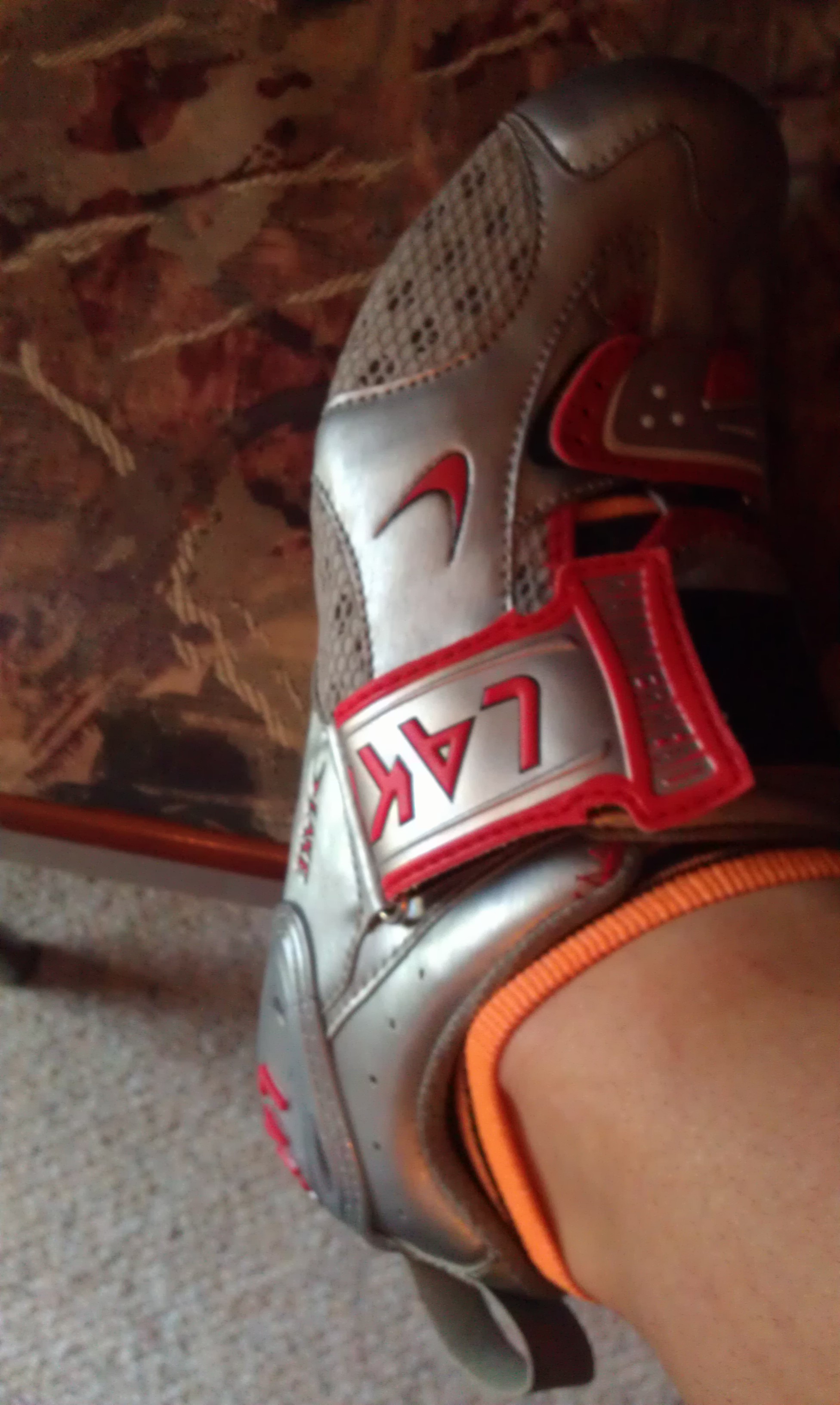
There’s a Star Man waiting for these shoes. This was prior to adjusting the straps for fit; both are looser than I would normally wear them. (PS: My ankles really aren’t that huge, I swear.)
Two thumbs up for the CX-211s, and chapeau to Lake for another great product.
Winter Kit Reviews!
Okay, so all of my new winter kit has now been out in reasonably-chilly (sub-freezing) weather at least once, and it’s time for a thorough collection of reviews.
First, the number one find for this year: Louis Garneau’s Gel Ex winter glove!
I’m one of those people with icy hands. Every part of me stays perfectly comfortable in most temperatures as long as I’m decently dressed — every part except, that is, my hands. My hands freeze.
I’ve tried all manner of gloves (though, admittedly, none of the ones that cost $50 – $100). Winter cycling gloves, ski gloves, layers of non-sport-specific gloves, work gloves… For the most part, they’ve … well … left me cold (you see what I did there?). The exception — ski gloves or mittens — always leave me feeling like I’m swimming in a sea of batting, groping for the levers.
Moreover, most seem to suffer some from fit problem or another (of note, this is in part due to the fact that I have small palms and long, slender fingers and except for my pinkies and thumbs, which are short and slender (my size 7 wedding ring is loose) — apparently the short pinkies and thumbs is some kind of genetic pattern).
So, in short, I’m a serious problem child where gloves are concerned.
Enter the LG Gel Ex. I paid $30 for these at Bicycle Sport, about twelve miles from my house as the bike flies, a shop in Saint Matthew’s which is fast becoming a favorite of mine. There were no size small gloves in the men’s section, so I wandered over to the women’s side of the shop and found these hanging on the wall.
I would be remiss if I didn’t mention that I had my doubts — I didn’t feel terribly confident in what appeared to basically be a souped-up fleece glove. My previous fleece-glove experiences had been less than stellar (even with so-called “windblocker” fleece). However, the fit was perfect, and I figured that these gloves coupled with liners would probably be survivable, at any rate. Besides, nothing else in the shop fit.
Well, rest assured that the LG Gel Ex gloves have now put my fears to rest. I wore these to the Gravel Grovel with liners, and two miles after the sub-freezing start, my hands were soaked in sweat and I had to take the liners out. When I headed out on today’s outbound commute, the temperature was just below freezing, so I packed the liners in my backpack just in case. Turned out I could have left them at home.
These haven’t seen use in a hard rain yet, but they did hold up to a light sprinkle with no problem. They also seem to breathe fairly well and stay warm even when they’re a little damp inside. Cool beans!
(Here they are on Bicycle Sport’s website.)
I suspect that these gloves will be perfectly functional in temperatures significantly cooler than those they’ve seen thus far. The one thing I’d change is the very limited reflective trim — and I can, in fact, change that by adding a little iron-on reflective stuff.
Meanwhile, just in case it gets really, really cold out, I’ve got these babies:
Seirus Dynamax Men’s Glove Liner (Dick’s Sporting Goods). In the small/medium size, they fit perfectly inside my LGs.
I suspect that, combined with the LG Gel Ex gloves, these will keep me comfortable well into the single digits and below.
To keep my core warm, I sprang for Gore Bike Wear “Phantom” jacket. I got mine on sale, and I want to say I paid around $60 for it.
The Phantom is exactly what it says it is: a windproof jacket that turns into a “jersey” (it’s really more of a wind vest-with-sleeves) via a few extra zippers. It’s also highly water-resistant. Again, I haven’t worn it in a soaking downpour, but I have been out in some not-insignificant rain in this thing and it has kept me nice and dry. A warm core, by the way, keeps your extremities warmer.
To keep my legs toasty, I’ve got an array of options.
For extra, extra-cold days, I’ve got these: Gore Bike Wear Contest bib tights. They are chamois-free, so you pop them over whatever you’ve got that has the chamois in. They also double as excellent running tights.
Layered on
Bellwether’s ThermoDry bib knicker, they’ll probably let you ride well into Arctic midwinter.
As for the Bellwether knicks … you know those wonderful fuzzy pajamas you loved as a kid (maybe)? Well, these are like those, only the fuzzy part is on the inside. Oh, and they block the wind. And they have a nice chamois. And you wear them on your bike, not in bed. Unless, you know, you’re into that kind of thing.
Bike Nashbar has had a pretty great price on these for the past few months running. I keep toying with the idea of ordering a second pair. They’re worth it. Heck, they’re worth ordering a second pair at full price. I have effectively not worn anything else since it got cool enough to start wearing these.
Here’s the best part: I’ve worn these in temperatures from around 65F to below freezing and been perfectly comfortable. Above 65F (or above 60F, if you’re making a hard effort), they can actually be a tad on the warm side.
Of course, neither tights nor knickers keep your feet warm — and that’s where an array of winter footwear stuff comes in.
On the recommendation of two friends, I picked up a pair of LG’s Neo-Protect Booties (also from Bicycle Sport). For around $25, they extend the season of your favorite cycling shoes into … well, pretty much anything*. Throw a good pair of warm socks under, and you’re good to go. I couldn’t find them on the Bicycle Sport website, but of course they’re also available from Nashbar (which may be more convenient for you, if you don’t live in the Louisville metro area).
Apparently, LG’s Neo-Protect Booties manage the perfect balance between price and performance. My non-scientific survey determined that something like 75% of the Gravel Grovel field was wearing them.
I’m not going to go into my sock choices at any great length, mainly because I have no idea who made most of the socks I own. I recently ordered a three pack of J.B. Field’s -3-Icelandic socks, and they appear to be verifiably Iceland-ready. My feet were excessively warm in them at the Grovel, and coupled with my Merrel Winter Mocs they are like little furnaces. I may, in fact, not live in a cold enough climate to ever really get much use out of these, though they’ll be great for wearing in the sleeping bag during mid-winter bike camping trips. They are, simply put, the warmest socks I have ever owned, ever.
Oh — one more thing. I love the fact that J.B. Field’s socks come in different sizes. Frankly, I have pretty small feet (size 8 – 8.5, depending; Euro 41.5 – 42). Often, mens’ socks are simply ridiculously large (they’re all sized for people who wear shoes sizes 9 through gazillion). The fact that I could order these in “medium” (which, I think, is what they call “small” so guys won’t feel self-conscious about ordering them) made my day. Denis is happy about that too (we can share shoes, isn’t that cute?).
In the “Arm Warmers” department, meanwhile, I have an array of three different options in three different weights: a lightweight Saucony set intended for runners, a mid-weight set by Cannondale, and this pair, Pearl iZUMi’s Thermal Lite Warm Warmer in the “Rob White” pattern (I’m lusting after the Retro Spin in pink as well). They’ve got a fun design, and they’re the warmest warmers I own; so warm that I left them at home come Grovel Time. I am forever having to peel these off mid-ride, which would’ve been difficult without wrestling free of my other clothes. Instead, I wore the Sauconys, which are easier to remove. I still wound up removing them.
I now feel confident that I am well-prepared for just about any weather (except, perhaps, the kind that requires ice tires). Of course, once I’ve layered all this winter crap on, I am basically unrecognizable as a human being … but not as much as I would be, I guess, in a puffy parka and moon boots.
I’ll try to get some pictures of all this stuff up.
Notes
*While neoprene is water-resistant, however, I wouldn’t recommend these if you’re going to be wading in ankle-deep icy water — for that, you’ll want something like the Lake shoes I bought back in February. They served admirably on the very-damp Sub 9 Death March.
Nashbar Sandals FTW
I got a late start this morning and didn’t actually make it out the door ’til about 10:30 (mostly because, though I was awake by around 8 AM, I became engrossed in a fascinating book about Chicago).
That meant a sticky ride — though not an unreasonably hot one, at sub-90F for much of the distance. It’s interesting how hot 87F can feel when it’s really muggy out (I guess that’s one of those obvious facts that still somehow seems surprising in practice).
Fortunately, my feet remained happy and comfortable due to the recent arrival of a pair of Nashbar’s “Ragster” sandals.
I felt pretty confident about purchasing the Ragsters, as they get good reviews and they’re pretty popular in my cycling circles. Turns out that their good reviews and popularity are well-warranted: the Ragsters are comfortable, practical, and surprisingly walkable even with the cleats installed. That comes in handy when you stop off to grab a drink or pick up a spare tube!
Cleat installation went according to the standard SPD/Crank Brothers’ process, with one caveat: you have to cut out the cleat-hole cover with a sharp knife (on many bike shoes, it comes as a separate piece). That seems like a small price to pay for a solid-quality SPD sandal at a good value ($50 US).
Yesterday, before I cut the cleat covers out, I walked around in my Ragsters for quite a while. I found them to be exceptionally comfortable off the bike — so much so that I’m giving serious thought to ordering a second pair to be used as regular sandals (though the footbeds may be a bit inflexible for that end).
Fit may be just a hair big relative to size — I normally wear a size 42 (Euro) in bike shoes, and I ordered my Ragsters in 41/42, and the fit is very good, with just a bit of extra ‘breathing room.’ In point of fact, I ordered the women’s version, both because they were out of the men’s in 41/42 and because my feet are unusually narrow, so I thought the women’s might fit nicely (I am not too proud to cross-dress if it means my kit fits better :D). The width is spot-on out of the box. I don’t have to crank the velcro down beyond all reason, then install additional velcro to make everything work right. The men’s version might have run a bit wide for me.
I have seen Ragsters live and in person before, so I fully expected to like the overall design. I wasn’t sure about the purple thread accents on the women’s version, but they actually look pretty cool (never mind that they throw off the matchy-matchy factor WRT my overall kit). If I do decide I don’t like the purple thread, I have plenty of black Sharpies that can un-purpleize it. Right now, though, I think it’s rather fun, and that I might even look into getting some kit that matches it.
It was really nice not to have to wear socks on such a sticky day (not that I always did, even with my mountain bike shoes). My feet tend to get ridiculously hot on summer rides, so I was more than willing to trade a little Roadie Cred for sockless, air-cooled footwear.
Some people might think it’s a little Fredly, but since those people will be the people I’m dropping on the climbs because their feet have overheated and they just can’t handle it, I’m not too worried! IMO, Fredly kit and equipment is simply an incentive to get stronger, so you can embarrass the bejeezus out of that sub-species of Roadie that has no sense of humor when you obliterate them on the road while wearing your sandals.
I’m looking forward to seeing how these perform on the kind of gravely, stream-crossingy rides that RCCS likes to put on. In fact, I’m looking forward to a solid summer of enjoying the heck out of my new favorite footwear.
Bonus: if you install the cleats right, they don’t really touch the ground when you’re walking — so when you stop for lunch on your blistering-hot century, you won’t fall over due to slippery cleats. (You also won’t sound like you’re going to break into a tap-dance routine at any moment.)
I haven’t taken pictures of my sandals yet. I plan to later today, so once I’ve got ’em, I’ll get ’em posted up here.
Nashbar Ragster Sandals Breakdown:
Pros
- Good fit
- Easy adjustment
- Deeply-recessed cleats (ideal for touring!)
- Highly breathable (obviously)
Cons
- Some people may find the footbeds too hard (I didn’t)
- May run slightly larger than true-to-size
- No nifty tap-dance sound-effects 😉
Summary: Buy them. You won’t regret it.
PS: I paid full price for these Sandals. Nashbar doesn’t know me from Adam.
Product Review – Boudreaux’s Butt Paste – All Natural: The Cure for All Human Suffering
Recently, I joined the RCCS crew on a 230–mile tour.
On the tour in question, I made two very, very stupid decisions: first, I chose to bring along a gel saddle pad, basically in case anyone ran into the kind of saddle discomfort it might alleviate (I should’ve left the d***ned thing at home). Second, I failed to actually pack it, so I just said, “Meh, it’ll be alright,” and strapped it on to my saddle.
You know, my saddle. My completely padding-free Arione. The saddle that I love so very much in part because there is essentially no squishy-factor. The saddle that I chose because my previous saddle was too squishy.
Say it with me: “What was I thinking?!”
I also wore a pair of bibs the second day out that proved to be … errr … less than suitable for a 70-mile day. In fact, they proved as grossly unsuitable for that kind of distance as is humanly possible. The chamois is a little wide, which means that A) the chamois-seams rub on the insides of my thighs and B) certain parts (AHEM!) with loosish skin get pinched like nobody’s business.
Have I mentioned that, while I laugh in the face of vast oceans of pain, I cannot handle being pinched*?
Have I mentioned that being pinched makes me want to cry like a little girl who just lost her puppy? Or like a little gamer geek who just got pwned in Diablo II? Or like a little wanna-be architect who just lost all his nifty Sims 2 neighborhoods in a HDD meltdown?
‘Nuff said.
The result?
Chafing.
Horrible, horrible, horrible chafing. Not so much the dreaded ‘taintal’ chafing that is common to the cycling world, but rather chafing of areas even more sensitive. The kind of chafing a man experiences in his nightmares. Possibly the kind of chafing that only happens to intersexed boys who ride bikes for 70 miles while wearing inappropriate bibs and riding on inappropriate saddle pads.
The kind of chafing that had me stopping periodically to slather Carmex on my nether regions because that was all I had to mitigate the pain (it actually worked rather nicely — for a while).
Needless to say, even though I finally got ’round to packing up the stupid gel saddle thingy and opted to wash-and-wear my other bibs (an awesome pair of Fox Evolution “liners,” which are plenty opaque to wear on their own) on days 3 and 4 rather than alternating as I had planned, by the time I got home my loins were more or less drenched in flaming misery.
Yes, that’s right. I said DRENCHED IN FLAMING misery, which doesn’t even make sense, because it hurt so badly it didn’t even make sense. It hurt so badly I didn’t even want to ride my bike (at least, not very far) — and that *really* doesn’t make sense.
A day or two after our triumphant return from the Tour, my friend Michelle and I took a brief trip to Target. There, I discovered the cure for all human suffering (or at least for the horribly-chafed nether regions of touring cyclists): All Natural Boudreaux’s Butt Paste.
I got the “All Natural” variety for two reasons: first, after reading up on some of the effects of pthalates and similar substances, I’ve decided I really need to reduce my exposure. Second, it contains ‘Peruvian Balsam,’ which sounded inherently soothing (yeah, I’m occasionally a sucker for that sort of thing).
The active ingredient in Boudreaux’s All-Natural is 16% zinc oxide (also found in mineral sunscreens). Inactive ingredients (direct from the manufacturer’s website) are: Aloe Vera, Beeswax, Carnauba Wax, Castor Oil, Citric Acid, Hydrogenated Castor Oil, and Peruvian Balsam Oil.
I brought my Butt Paste home, slathered it on my furious bits (the package says it goes on clear; in fact, it goes on just a bit whitish, but really — who cares?), sat back, and said, “Ahhh.”
I don’t know if the chafing healed faster because I used the Butt Paste — frankly, I’ve never had this kind of chafing before. I do know it felt much less miserable, and in fact things progressed quickly from ‘intolerable’ to ‘tolerable’ to ‘slightly less comfortable than normal.’
Flash forward a couple weeks, and I’ve discovered another use for my All Natural Butt Paste: mitigating the effects of co-trimoxazole.
In addition to oral thrush, co-trimoxazole left me with a blistering rash in a very, very, very, very sensitive place. The kind of blistering rash that makes you ‘hold it’ for totally unreasonable durations because you have come to associate having a whizz with howling, burning pain. A bit of Boudreaux’s All Natural Butt Paste (GENTLY!!! applied) has once again saved my skin (perhaps literally).
Because I have no shame, I have even applied it to the terrible, itchy peeling spots beside my mouth (thanks, co-trimoxazole!). Helps there, too. If I could apply it inside my mouth, I would, but it’s not intended for internal use.
It’s worth noting that a little of this stuff goes a long way. You don’t need oceans of it.
As you’ve probably guessed, this stuff has the soothing. While the only listed active ingredient is Zinc Oxide (16%), I am quite certain that is only because they forgot to print ‘Awesome Sauce’ on the label. I’m sure they’ll rectify this in the future.
So, anyway, in case you were wondering: The Buddha taught the Noble Eight-Fold Path as the answer to human suffering. Personally, I’m willing to roll my bike down that road, but only if I can pack my Boudreaux’s Butt Paste**.
Summary:
Try Boudreaux’s Butt Paste All Natural: It will save your butt.
Literally.
Notes
*I also can’t handle being tickled. Sadly, I have just revealed to the world my personal kryptonite(s). Just so you know, if I see you coming at me with a feather duster or an angry crayfish in the middle of a race some day, I will not hesitate to go all Indiana Jones on you, grab the nearest stick, and jam it through your front spokes. Nothing personal, I just really can’t stand being tickled or pinched.
**I paid the full retail price for this product, and am in no way affiliated with the manufacturer (unless you consider the bonds of eternal gratitude to be a form of affiliation, in which case, yes, I am very much affiliated).
Lake LX140 Shoe: First Impressions
So, yes, these aren’t the newest bike shoes on the market.
However, they’re the newest bike shoes that I, personally, happen to own, and there don’t seem to be many reviews out there, so I figured I’d help fill the gap.
Read the whole review below, or you can jump right to the Short Order synopsis.
I bought these shoes for one purpose, more or less: to keep my feet warm and dry in nasty weather or during soggy sessions on the ‘cross course. Unfortunately, I’ve yet to secure an opportunity to try them out in that capacity. I’ll toss out an update once I can get out in the wet stuff with these shoes. Update: I wore these guys out in wet, chilly conditions on Wednesday this week. My feet not only stayed warm (even with only one pair of socks on), but dry! Admittedly, I wasn’t exactly slogging in the mud or dancing in ankle-deep puddles. When I get a chance, I’ll update on those features as well.
When I pulled them out of the box, I was delighted to discover that they’re strewn with handy little reflective dots. I’m not sure the dots are all that useful — but it’s nice to know they’re there. Heel reflectors complete the package.
The closure system on this particular model consists of three hook-and-loop straps in front (one over the ball of the foot, one at arch-level, and one at the ankle), one in the back, and a rear zipper. I’ve inherited my Mom’s ridonculous arches (thanks, Mom!) and was concerned that the arch strap might cause me trouble, but I’ve found it adjusts quite well and feels great on the bike. I was also worried that the rear strap or heel cup might dig into my achilles tendon, but that concern also proved unfounded.
 |
 |
| Lake LX140: Side view of hook-and-loop closures. | Lake LX140: Rear view of closures. |
Today, my new LX140s got their first official ‘dry run.’ When I left home this morning, temperatures in the 30s (Fahrenheit) would’ve made for frozen feet in my ancient Answer shoes even with double socks. They’re great summer shoes; they don’t block wind, they invite it in. The LX140s, on the other hand, keep my toes nice and toasty throughout my thirty-three minute seven-mile trek to the bus stop with only one pair of socks inside.
Given this morning’s conditions, I can vouch both for the breathability of the ‘eVent’ fabric and for the windproof outer skin: my feet neither felt like they were hanging in the breeze nor like they were steaming in the swamps. Even during long hours in warm classrooms, my feet never felt sweaty or damp (even when my arms did, before my long-sleeved black base-layer shirt had time to dry completely).
You may be wondering why it took me thirty-three minutes to bang out a mere seven miles (I did the full 35-mile round trip yesterday; today I only planned on 14 miles, and that’s what I did). Good question! That brings me to point two: when you install your cleats on these guys, you really need to crank ’em down. The cleat plates seem to be a bit harder than the ones in my Answers or my old Shimano shoes, so make sure to torque those cleats in hard so they can bite into the plates.
After I clipped out once and clipped back in, my left cleat got stuck. Not to say I couldn’t move my foot at all — quite the opposite. I had like 320 degrees of float (OMG!). The cleat was shifting around on its screws, remaining engaged in the pedal instead of clipping out as its maker intended.
Needless to say, being semi-permanently affixed to my bike made me a touch nervous. I also didn’t want to get stuck on the right side as well. I didn’t have time to roll back home and fix things, so I stayed in the little ring, spinning like a madman with my toes on the right pedal. It was, in a word, awkward.
Nonetheless, taking it slow and easy gave me plenty of time to discover the best quality inherent in the LX140s: specifically, they’re roughly as comfortable as your favorite house slippers. Much stiffer, of course — but the fit is close and cozy. Once you’ve adjusted the hook-and-loop closures suitably, they’re really a delight to wear.
When I arrived at the bus stop, I had to remove my shoe to free it from the pedal. Lesson learned: torque ’em down, boys and girls! (I have a history of being too ginger with mechanical things. I’m afraid I’ll break them; in fact, it’s quite hard to break bike things, unless they’re delicate carbon bike things — and even those are hardier than they might appear.) Crisis averted. For the remainder of the day, I made a point of keeping my cleats out of the clips — but I did engage the left one by mistake, and the cleat — which had further loosened over the course of the day — let go somewhere between my final turn and the garage. Who knows, I may find it tomorrow. If not, I suppose I’ll need to buy a replacement pair (I still can’t find my spare cleats).
A word to the wise: these shoes are built for a narrow foot. Riders with wider feet probably won’t find them ideal.
Likewise, true weight-weenies may be initially shocked by the sheer mass of these nimble clodhoppers. In fact, I (who am only a quasi-weight weenie) was really a bit surprised at how darned heavy the things are. That said, once they were on my feet, I ceased to really notice. It’s possible you might really feel that weight after 60 miles on the bike or 45 minutes going flat-out on the ‘cross course, but thus far I can’t say that riding in them felt much, if at all, different from riding my lightweight Answers. Of course, I don’t own carbon-footed SIDIs (yet), so YMMV.
Off the bike, deeply-recessed cleats make walking comfortable and surprisingly quiet. The LX140s proved themselves perfectly able for wandering around campus. Grippy soles feel secure on pavement, grass, and even on the notoriously-slippery stairs in the Ogle Center (home of the art and music departments).
I’m not anywhere near as quiet in these as I am in my favorite Merrels , of course, but they’re a thousand times quieter than my tap shoes Answer shoes. The stiffness of the soles lends a distinct ‘ker-clunk’ rhythm to your step, but at least you don’t sound like a herd of beginning tap dancers. If you, like I, carry organ shoes in your backpack and really don’t want to also lug a spare pair of kicks, or if you’re on and off the bike enough throughout the day to warrant keeping your bike kit on, you’ll probably find that the LX140s are up to the task. That makes them a solid option for commuting students, couriers, and similar bike-and-foot ‘multimodal’ types.
I wouldn’t choose these as hiking shoes, of course — and neither would I choose them for sitting-around-in-class shoes, as the hook side of the hook-and-loop closures faces out and as such sticks to your pants and prickles your legs if you don’t yank it all the way tight. That said, the LX140s are a solid value for a warm, comfortable on-the-bike shoe.
Pros
- Breathable, windproof uppers
- Dexterous rubber outsole
- Highly adjustable closure system
- Heel reflectors
- Comfortable footbed
- Walking-friendly
- Warm
- Keeps your feet dry on wet roads or in the rain
Cons
- Narrow width (not a problem for me, but could be for many guys)
- Snaggy hook-side-on-the-bottom closures
- Potentially heavy on long or intense rides
Not Tested Yet
WaterproofnessTested!Sub-freezing temperature suitabilityTested!- Suitability for
wadingcyclocross - Suitability for temps above 65F
Overall, I’d rate these shoes four out of five stars. True perfection is a rarity — but four out of five is pretty darned good.
My Review of RideLit
Originally submitted at Nite Ize

See more styles The RideLit L.E.D. provides clear, obvious visibility for people who cycle at night. Its adjustable elastic band attaches to your ankle to create a moving circle of light or can be attached to the handlebar or bike seat post. Other online retailers PRODUCT INFORMATION Cyclists who r…
Awesome Helmet Light
Pros: Weatherproof, Adjustable, Bright
Cons: Hard to activate
Best Uses: Bike Taillight, Helmet light rear, Backpack light
I ride my bike to university — a trip of 20 miles (32 km) each way — and almost everywhere else. I also race and ride recreationally, which means lots of hours in the saddle. That sometimes means riding in the dark.
My bike is decked out with an array of lights, but I prefer to use a helmet light as well — and with my current helmet, it was really hard to find a light that would fit.
Enter the Nite Ize RideLit: I can run its stretchy, adjustable strap through my helmet’s rear vents no problem. The clip that keeps it closed stays out of the way, tucked into a vent. Problem solved!
The light itself is highly visible. I run it in blink mode whenever I’m out on the bike — it helps drivers see me in the dark, in overcast conditions, or sailing through underpasses. It also seems to be impervious to rain, a real bonus for year-round riders.
Battery life is quite long. I’ve had it for several months, running up to four hours at a stretch on long rides — it finally ran out after I inadvertently left it on all night.
I have only one complaint: you really have to squeeze this puppy to light it up, and that makes it really tough to turn on when you’re wearing winter gloves. However, that also means it doesn’t accidentally activate when you stow your helmet or bump it on something.
I’m very satisfied with this product. It’s effective, economical, and sturdy — an excellent companion for anyone who spends a lot of time on the bike.
Well done, Nite Ize!
Nite Ize RideLit mounted on Spiuk Zirion helmet
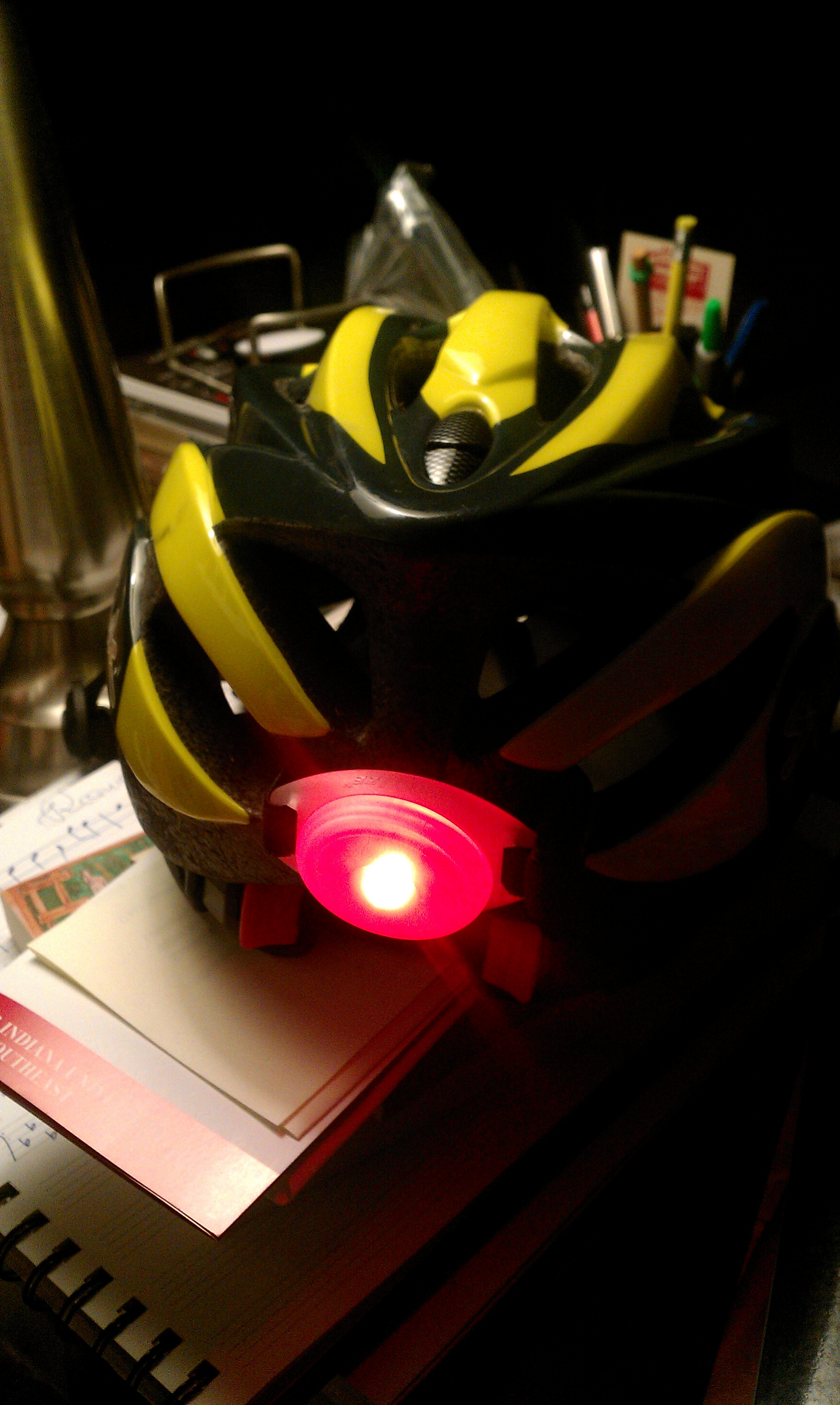
Tags: RideLit, Helmet Light, Picture of Product
(legalese)


 danseur ignoble