Blog Archives

Tours De Farce
Modern was rather great today. I figured out how to do it without annoying my foot. I’ve discovered that the only thing that makes it hurt is putting even a little pressure directly on the outside of the joint, which happens with alarming frequency in modern dance. I simply faked my way through anything that involved that (safety releases, etc) and things went fine.
I’m still fairly terrible at remembering modern combinations, but that’s nothing new. It is slowly improving.
BW’s class tonight, meanwhile, was quite good once my body decided to wake up and participate. I think it was feeling sluggish because I’d just subjected it to a rehearsal followed by no stretching and a 20-minute drive. I suppose it was within its rights to feel grumpy about that.
Anyway, we did all the jumps today: so much petit allegro, followed by one grand allegro exercise.
One of the petit allegro exercises involved temps de cuisse, which I’ve been erroneously calling temps de puisse ever since I for some reason decided it was, in fact, power-step and not thigh-step. But I was right the first time, which is funny for the very specific reason that I initially thought it was really neat that the step was named after a piece of armor, then disappointed that it wasn’t … but I was wrong, and it really is named after the piece of armor!
…Which is pretty cool, though POWER STEP!!!!!111oneoneone1one1onewon is also a pretty cool name for anything in ballet.
Anyway, turns out temps de cuisse is supposed to be done upstage to effacé. Also turns out that when you do it that way rather than trying to do it en face, it’s a hell of a lot easier.
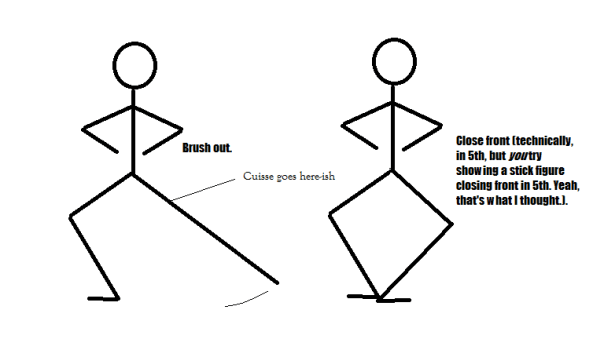
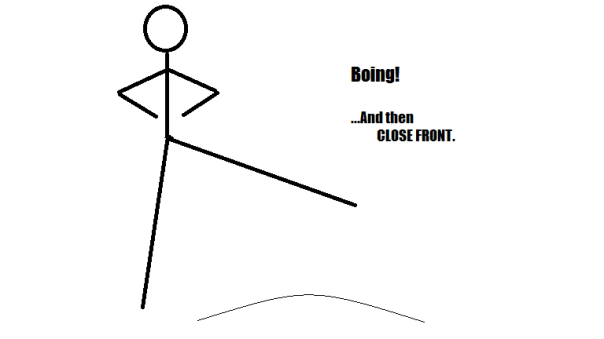
Oh, and remember that you “BOING!” upstage to efface, which I completely failed to indicate here because laziness.
The weirdest bit is that I remember looking this up, but maybe that happened in a very vivid dream, and I can file it away with BW’s choreographic advice about rotting fruit?
This is the most important thing I’ve ever learned about ballet, and in fact about dance in general: with few exceptions, things are largely easier when you do them correctly.
In fact, I would almost go so far as to say that this is pretty legit advice for life in general.
I don’t actually remember the rest of that combination at the moment, though I know involved entrechats, because I had done fugly entrechats in the second petit allegro exercise and was startled that they miraculously just plain worked in this one (probably because I was busy thinking about temps de cuisse instead).
Anyway, for grand allegro, BW gave me the choice of various species of jetés across the floor or tours. I said, “Tours, because I never get to do them in any other class,” which met with approval 🙂
Anyway, BW gave me a little combination that went something like:
tombé
pas de bou-chasséi(1)
plié fifth(2)
tour
- This is that kind of hybrid step in which you begin to pas de bourré, but instead of simply going back-side-front to fifth, you go back-side-front straight to fourth through a kind of flying chassé.
- In this case, you’re practically doing a petit assemblé that lands fifth. It spring-loads the legs. Oy vey, does it ever.
I tried this a couple of times and alarmed myself by doing 1.5 tours instead of proper singles … and then I ran the combination again, got off a nice single, and promptly fell the feck over. Like three times.
BW said he’d had the same experience, and once in fact left class in tears because he couldn’t stop falling over. He also pointed out that falling over means you’re trying really freaking hard. Which, in fact, was true.
I’ve had a bad habit of doing itty-bitty little cautious tours, which probably have their place somewhere in the great universe of ballet, but honestly aren’t very interesting. I’ve decided that I’m going to launch all my jumps into space all the time (okay, okay, exept when we’re doing petit allegro), in the interest of actually A) being an interesting dancer and B) making the best possible use these giant slabs of ham with which the Universe has for some reason seem fit to favor me instead of normal human legs.
Anyway, after falling over backwards a few times, I decided to switch sides, and except for the part where my brain insisted the first time on doing the right-side variation anyway, the left side came off without any falling over. I then tried the right again, almost fell over but caught myself, and realized that a part of the problem was simply that I was instinctively trying to avoid putting my right foot down.
You can do tours to a single foot if you’re doing actually doing tour-to-the-knee, but you have to do it on purpose(1). Otherwise, you half-ass things and fall right the heck over.
- Even then, you do it by bringing the front leg to passé after lift-off, which neatly shoots it out the back because Physics, and then you land in an awesome-looking lungy-kneely thing so you can look all romantic and impressive and princely.
So now I know two different ways to fall over doing tours.
A. Forget to change your feet.
The first thing you do in a tour (well, after lift-off) is change your feet. If I remember correctly, not everyone does it this way, but it’s the standard, and the guys who change the feet last are stylistic mavericks. Anyway, I once tried doing a tour without changing my feet just to see what would happen. I managed to stay upright, but just barely; if I’d put any real force into it, I would’ve been flat on my tuchas in a heartbeat.
B. Change your feet, but then fail to actually put the one that started in front down all the way.
In a tour, your feet act as a kind of braking system. You load up a metric shed-ton of momentum, and changing your feet and sticking both of them on the ground allows you to oppose that momentum in a meaningful way so you don’t fall on your butt and roll, which seems like it might actually be a valid way to end a tour if you’re dancing a role in which that’s how you die, but probably should otherwise be avoided.

Artist’s depiction of how not to land tours. Any resemblance to Kokopelli experiencing wind turbulence is entirely coincidental.
Anyway, the falling-over-backwards bit was pretty hilarious, mainly because it was a complete surprise Every. Single. Time … at least until I figured out why I was doing it.
By then, it was just after 8 PM anyway, and we’d been working for more than 90 minutes, so we called it a night.
Sadly, I won’t have class with BW next week because of rehearsal, but he is coming to see us dance that Saturday.
This Saturday is our final fitting, and I finally get to find out what I’m wearing in the performance other than white socks and white shoes (SPOILER ALERT: YES, there is a shirt).
Tomorrow, we have Awesome Acro Workshops, followed by a weekend of madness and final costume fittings and a rehearsal on Monday.
Next week, I am taking Tuesday OFFFFFF.
Advanced Class: Temps Lie, Turns, and Transitional Steps
None of the above-mentioned things, of course, are specific to advanced ballet studies. Dancers begin to learn all three almost from the beginning.
However, they’re all examples of skills that, as a dancer, you never stop honing.
Today, we touched on all three.
At barre, we used temps lié in several combinations; we came back to it in our adagio at center, then again in our pirouette combination. At barre, we were reminded to really work through the whole of each foot in order to keep our turnout; at center, we were encouraged to make our temps lié bigger (without losing our turnout or letting our cores fall apart).
Curiously, our turns themselves garnered little correction today — really, we just got a note about using a better coupe-piqué into our sus-sous turns. The idea was to make it sharper and cleaner; a clear, unambiguous step rather than a sort of blurry pivot.
We repeated everything up to the pirouette combination, making subtle but transformative changes. My favorite involved one of the really common transitional steps, faillé — Ms. T asked us to really make something of it; to carry our arms and shoulders through along the diagonal and make it beautiful. This is something I’ve been working on, and I feel like I really nailed it down pretty well today.
Not perfectly, but pretty well. Better than it has been so far.
On Wednesday, Mme B noted that I was doing a weird thing with my arms in turns from fourth and sorted them for me — so turns today were also much better than they’ve been for a while.
During petit allegro, I finally got my temps de cuisse sorted again, which is comforting. For a while, I kept stepping on my own foot during the shift between the posé phase and the sisson fermé phase. I suspect that may have been a function of not engaging my lower core, and thus losing my turnout on the back leg.
In case you’re unfamiliar with temps de cuisse, it’s a handy little jump that combines a coupé with a sisson fermé.
I still screwed up the combination a bit, though — I kept forgetting that there was a pas de bourree in there and also a second set of entrechats, so I kept going, “Oh!” and winding up a quarter-beat or so behind. Not the end of the world, but not ideal.
We ended with a simple zig-zag grand allegro, one at a time (with the next dancer starting as the previous one zigged for the first time, since there were a million of us in class today).
It went, simply:
tombé à droit
pas de bourrée
glissade
saut de chat
tombé à gauche
pas de bourrée
glissade
saut de chat
…twice, for a total for four diagonal passes.
Not difficult in terms of steps, but very exposed and timing-critical.
I think my tombés were probably terrible, but it’s also the first time since I received clearance to dance that I’ve done grand allegro (okay, except in Essentials, which almost doesn’t count).
On the other hand, my sautes de chat were pretty decent.
Anyway, I must go do a bunch of cleaning and make a portable dinner for tonight. We’re going to have a picnic with B and N and then go watch U of L’s spring dance gala.
That’s it for now.
À bientôt, mes amis!


 danseur ignoble