Category Archives: balllet

Whoa, This Summer Is Going To Be Intens(iv)e!
I’m not going to any intensives on other continents this summer because, in short, I’m not even sure right now that I’ll be able to afford the ones I’ve planned on this continent (for positive reasons, though, which I won’t be discussing in this particular post because #ToKnowToWillToDareToKeepSilent).
That said, in case you’re looking for dance intensives all over the planet, HERE THEY ARE. You can basically go anywhere and dance this summer (I know someone who’s going to the Canary Islands! #envy).
It would take me all week to check all of these out and write them up on my Intensives page, so I’ll just add the link later on and call it good.
BTW, I happened upon this link via Dancing Opportunities (@dancingopps) on the Tweeters, which which highly recommend following if you’re of dancing persuasion.

It’s a dance world, after all! [(c) Dancing Opportunities, via The Tweeters]
So there you have it. Intensives for everyone!!! Huzzah!

Want Guys In Your Class? Make It Clear.
I would be remiss if I didn’t mention from the word “Go” that the place where I take most of my classes is a lot better than many about making it clear that boys and men are welcome.
I take most of my classes at a pre-pro school attached to a company with a complement of fine danseurs, which certainly helps. Moreover, our website isn’t festooned with pink curlicues[1], the posted dress code explicitly includes male students, and a glance at the faculty roster reveals that both women and men are represented.
- Not that guys should be allergic to pink curlicues: the fact that so many of us are tells us how far we still need to come as a culture. But, that said, at this particular cultural moment, a website festooned in femininity does little to combat the idea that boys don’t belong in ballet. Even as a dude who has been known to embrace the Pink Side (In case you’re wondering? Yes, they do have cookies!), I tend to hesitate if a school’s website leaves me with a impression that they aren’t aware that male dancers exist. I find myself thinking, “Haven’t you at least seen The Nutcracker? That one is crammed with dudes!”
I’m luckier than many. In most ways, my school is getting it right—making it clear that there’s room at the barre for boys and men.
That said, even they miss something now and then.
Take, for example, the master-class series they’re doing this summer. The only specific skill prerequisite listed is, “At least one year en pointe,” though the course description goes on to note that classes will be taken on flat.
As a male student, it’s not clear to me at all whether this intended as a baseline to imply a certain prerequisite level of expertise or whether the series is even open to boys and men. The course description doesn’t specify.
If I was less pushy and obnoxious confident, I’d probably just hang back and grumble internally about feeling overlooked and about how annoying it is that the dance community spends so much time worrying about its dearth of male dancers, then fails to actually make it clear when we are and are not welcome.
Of course, I’m me, so I just shot a message to our administrator this morning to ask.
This doesn’t mean, of course, that every ballet school’s website should be wallpapered in blue and/or feature pictures of monster trucks (note to self: choreograph a story ballet based on the tragic life of a bush-league pro wrestler…). Rather, if we want guys in dance, we should double-check the language we use, just to make sure we’re not creating the appearance of gender-restricted spaces where no such restrictions exist.
We should make sure that dress codes address male and female students, or at least be phrased neutrally (“Students the Open Division should wear fitted athletic wear or dancewear of their choice, unless otherwise directed in course descriptions.”). Course descriptions should use pointe as a prerequisite only when it’s actually relevant to the course material (hard to do the hops on pointe bits of Giselle, for example, without prior pointe training!) or, at very least, include a phrase like, “…or equivalent experience in men’s technique.”
Explicit gender[2] restrictions should be just that: explicit (“open to ladies at least 16 years of age by permission of instructor,” for example).
- I’m using gender rather than sex intentionally. As an intersex person and someone who has good friends who are transfolk, I feel like there’s a distinction there that’s not without weight.
Plenty of guys do pointe (Hello, Trocks!), so pointe itself does not an explicit gender restriction make.
Women can do men’s technique, too, though since we don’t really have another name for the subset of ballet that comprises men’s technique, if ladies are welcome, it would help to say so explicitly in the class description. And though it may comprise Balletic Heresy to say so, I’m all for letting the girls play with the boys, at least in the adult open division. The key thing is just putting “men’s technique” on the Open Division schedule in the first place.
Basically, I suspect that implementing a men’s technique class—even one that’s open to anyone of any gender who wants to take it (assuming that they meet the skill prerequisites)—would be a good way to tell male students that we’re welcome and wanted.
The usual model seems to be to preemptively conclude, “We don’t have enough men in the program for a men’s class.”
While that’s probably true in many Open Division programs (and, sadly, in not a few pre-pro program), it’s also probably not going to change if we don’t try doing something a little daring and different.
I suspect that Field of Dreams might have a thing or two to teach us, here: put together a class that teaches men’s technique, put on the calendar, and you might get mostly ladies going, “Hell, yeah! I’ve always wanted to learn double tours!” (which, IMO, could be great) but you might just succeed in bringing in the guys.

This is relevant to my interests.
For what it’s worth, there’s a lesson here for guys, as well.
It can be hard to overcome even unintentional verbal barrier in a place where an invisible-but-real social barrier already exists. It takes uncommon courage and the support of understanding friends and family to step beyond those invisible barriers.
The thing is, hosts of brave women still find themselves climbing over invisible barriers every day—and not just in the STEM fields, where their historical and current contributions are routinely overlooked.
In the arts, we still tend to picture everyone from choreographers, conductors, and composers to painters, poets, and playwrights as men (usually, if we’re frank, white men).
We guys can learn a thing or two from our experiences as the cherished-yet-overlooked red-headed stepchildren of the dance community: what it’s like, for example, not to be the default gender, and what it’s like to have to plead a case for greater inclusion before the powers that be.
We can learn that just using a blanket statement isn’t always enough: that we can and should look a little deeper if we want to help create real change.
~
Edited for clarity, autocorrupt, and that weird thing where SwiftKey decides to delete entire words.
Advanced Class: Armed And Dangerous
…to myself.
Class was mostly okay this morning. The brain was a tad slow getting started, but once it got up to speed it basically did its job.
My arms, on the other hand (no pun intended, but jeez), were just … Argh. You know that one correction I get all the time about arabesques?
The one where everyone be like: ASHER YOUR ARM IS BEHIND YOUR SHOULDER WTF
And I’m like: Is this better? ____0____
And they be like: NO THAT’S EXACTLY SAME
… So, yeah.
No wonder tours lent were so freaking hard today 
Skipped jumps, but then realized I’m up to jumping every other day now, which is good progress.

Thursday: He Who Fondus, Endures(1); Friday: Grand Allegro For The Perplexed (2)
- This is probably sufficiently obscure to require some explanation. Basically, it’s a play on a translation of the motto on the Great Seal of the State of Connecticut, which translates literally to “He who transplanted sustains,” but “endures” is close enough).
- Maimonides didn’t write this, but maybe he should have.
I started a post about last night’s class, well, last night, and then I got too tired to finish it, so it’s currently a draft on my tablet and I don’t feel like going to get my tablet.
Anyway.
Last night turned into another Private Men’s Technique Class, during which I summarily discovered that one does not, in fact, have to do grand allegro to be completely exhausted at the end of Men’s Tech. BW’s gloriously murderous barre is quite demanding enough to do the job.
In a nutshell, classical men’s technique is essentially about two things: power and endurance. It can be summed up via the famous equation:
bravura=endurance*power(technique)
…What do you mean that isn’t a famous equation?
Power allows you to do the grand allegro pyrotechnics that pretty much define the vast majority of men’s variations in the classical repertoire. Your grand jeté entrelacé isn’t going to look anywhere near as impressive if it doesn’t get off the ground, and as for double tours, you can’t even do them if you don’t basically launch yourself into space. You won’t have time. Disaster (or at least an ungraceful exit) will ensue.
Endurance allows you to get though demanding variations without A) dying or B) flopping around like a distressed fish wrapped in a damp rag (you guys, this is NOT a valid way even to do fish jump). It allows you to still not drop lift your partner in the next bit of the grand pas de deux and to not collapse under your combined weight.

You guys, why does this show up when I google “fish jump ballet?” It wasn’t even in the first page on just plain “fish jump.” WTF. And you guess what didn’t make the first page for “fish jump ballet?” THE EFFING FISH JUMP, FOR FRACK’S SAKE. Come on, Google. You had ONE job.
Power requires strength. BG mentioned to us today that we’re sort of designed around gravity, so even though the idea in classical ballet is to look like you’re defying gravity, you do it by employing gravity. Still, if you’re going to launch yourself off the floor, you need power to do it.
Your plié is all about giving yourself to gravity; loading the springs. Your launch is all about pushing down through the floor, right to the center of the earth, fir(ing) all of your guns at once (to) explode into spaaaaaaaaaaaaaaaaaaace.

Heavy Metal Thunder, via Pinterest. (And of course it’s Nureyev. What did you expect, the Spanish inquisition?)
Endurance requires … erm … endurance. Right. Just pretend I wrote something more intelligent than “x = x.” Move along. Nothing to see here.
What I mean, really, by “endurance requires endurance” is that endurance itself is a pretty complex entity.
First, there’s cardiovascular endurance: no point in being strong enough to do all the things in the Slave variation (or Albrecht’s, or Bluebird, or…) if your heart literally explodes halfway through, or if you can’t get through it without puking because you can’t breathe.
Next, there’s muscular endurance, which I’m sure has some fancy technical name that I can’t recall right now. Basically, that’s the kind of endurance that surrounds the question, “How many times can you launch and catch your own weight (multiplied, as needed, by whatever forces apply at various points) before you have to lie down for a while?”
This is the kind of endurance that you can think of in terms of “reps to exhaustion” or “reps to failure.”
This second kind of endurance depends quite a bit on power: like, really, you need to be flat-out strong enough that the variation you’re doing doesn’t lead to failure—indeed, you may very well need to be strong enough to manage it in the context of an entire ballet.
This is, in a way, kind of like riding a mountain stage in the Tour de France. Mountains have this annoying way of being multiple kilometers in height, and involving multiple climbs, and you don’t get to stop at the top of a given climb.
The race keeps going, and so do you, until you get to the end of the stage (or until you spectacularly crash your bike and are summarily scraped into the team car). Until you get to the end of the stage, you have to keep stomping those pedals, or at any rate turning the cranks.
Most full-length classical ballets are only 2 to 3 hours long, and not a Tour-stage-esque 6 hours long (though nobody ever suggested a mere 6-hour cap to the Sun King). On the other hand, ballet never lets you sit in the peloton and just turn the cranks and recover. Not even when you’re in the corps.
Power alone will get you through a single run of a variation in isolation, but add the rest of a 2-hour ballet, and unless you have some serious endurance, you’re seriously fecked.
Last night was more about endurance than about power, though it was also about power, because holy fondu, Batman. Mostly, it was about the “reps to exhaustion” kind of endurance and the “attitude devant for a million counts” kind of endurance.
(It was also about TOES, because BW’s class is always about my toes.)
It was a “stretch your leg up to your ear, hold, fondu the supporting leg, hold, stretch, hold, drop your arm and see if you can maintain the extension for an additional million counts” kind of day(3).
- Regarding which, you guys: this was an exercise in “well, hey, THERE’S a thing I need to fix.” Because, seriously, I haven’t figured out how to do antigravity above about 100 degrees a côte, even though my range of motion theoretically allows for it.
My foot got achy before we made it to jumps, so we called it a night and did a stretch-n-kvetch session in which I learned that, like me, BW really can’t use cycling to cross-train for cardio. Like mine, his quads go crazy too easily.
I know I’ve said this before, but this is one of the reasons he’s such an effective teacher for me: we share some of the same Ballet Problems. One of them is being the elusive kind of unicorn that actually does pile on the muscle rather too easily.
Today, I managed to haul my hinder out of bed and make it to BG’s 10 AM class, where I found my body surprisingly willing to do things, possibly because last night we skipped jumps and stretched instead.
Because BW’s barre is usually even harder than Killer B’s barre, barre didn’t feel difficult(4). Last night we did circular port de bras in sus-sous, so when I opted to do a straight forward-then-back port de bras in sus-sous, it really didn’t feel like much of a challenge.
- Except for the part where I failed to acquire a significant portion of one combination because I was busy reflecting on body mechanics, and then the whole class had to start over. Sorry, guys.
This time, possibly because I didn’t take modern class in the morning first, my foot agreed to make it through the little jumps to a very nice grand allegro. That makes twice in one week, which is great.
That said, I found myself overthinking one of the transitions and, as such, screwed things up completely going left.
I did it three times to the left, though, and eventually got it more or less sorted.
Regardless, it was very much a case of, “What do I do with all these legs? Aaaaaugh!”
In fact, though, I think the combination I liked best today was a weird little petit-allegro brain-teaser that went something like:
sissone
sissone
coupé to slidey thing avant
assemblé
…and continued around the points of the compass counter-clockwise, though the slidey thing never traveled backwards (so I guess it skipped “south,” and just went “north-east-west-north”). The main challenge is remembering which way you did the slidey thing most recently, so you don’t do the slidey thing in the same direction twice and cause a traffic accident.
I’m sure there’s a name for the “slidey thing” somewhere in the great lexicon of ballet, as it’s a thing that occurs in choreography, but I don’t know what to call it, so my apologies there. It’s sort of a coupé-tombé to second or fourth with the trailing toe gliding across the floor. Hard to describe, easy to do(5), and really quite pretty.
- YMMV. I also think renversé is easy, and apparently people disagree in droves about that. That said, I didn’t always think reversé was easy, but once I got it, I got it.
Anyway, that was class today. Very-nice-but-perplexing grand allegro; unusual and satisfying petit allegro.
Oh, also, I keep forgetting to post this video. I think I keep looking a little lost (which is terrible, given that it’s my own freaking choreography >_<), but given that I had a fever, it could have been a lot worse.
Also, that weird sort of attitude balance near the end? That is HELLA HARD on crash mats, y'all.
Killer Class: Foggy
I think I’ve figured out the source of my pervasive brain fog.
Spring is upon us, with all the flowers in bloom, and as such I’ve been taking loratadine for my allergies. I haven’t taken it in a long time, but if I remember correctly, it definitely made me feel foggy in the past (which, of course, is probably why I haven’t taken it in a long time >_<).
Anyway, I made it through Killer Class, but it took me until Grand Allegro to feel like I had any brain at all. During Grand Allegro, I managed to do Bournonville jetés without winding up on the wrong leg every damned time, so that was a big step (leap, actually … womp womp woooooommmmmmmmp) in the right direction.
I have to dash off for our Dance Team rehearsal, but figure I’d post this before I forget, because frankly right now I am forgetting ERRRTHANG.
No more Claritin for me.

In Which We Make A Spectacle Of Ourselves
You guys! We have graphics (stolen from the Facebook event) and everything!

I’m in this, and stuff? (Poster design by Erik Underwood.)
…Here’s a plain text linky, too:
https://www.facebook.com/events/715635038638570/?ti=as
In other news, D and I started working on our PlayThink piece this weekend. I might have forgotten that he’s not accustomed to basing fish-hooks with danseurs who got dat grand allegro booty. I kept discombobulating him and, as such, he kept dropping me :O
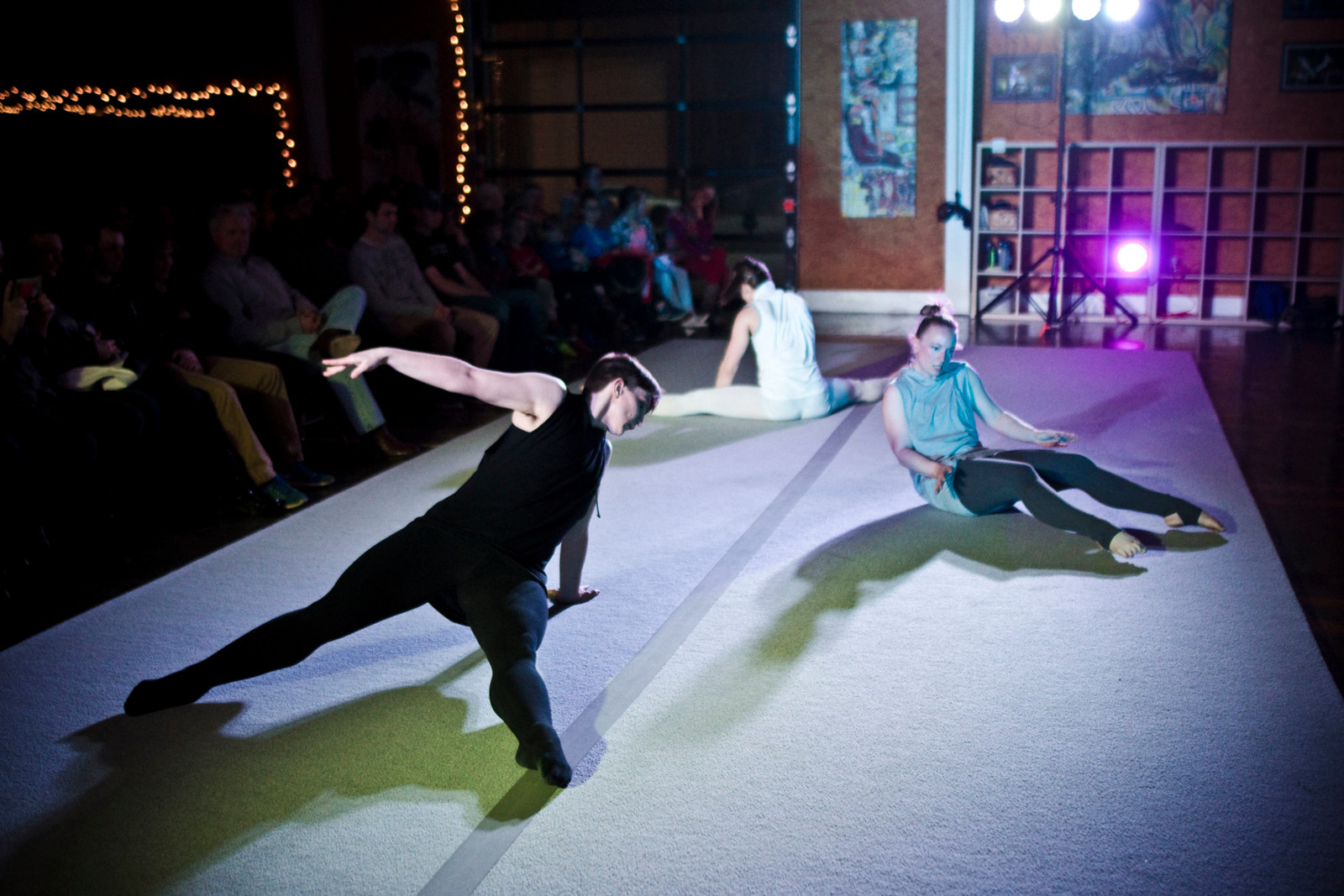
Kevin Spalding has officially documented the heck out of my thunderous grand allegro-enabling hindquarters. These legs got powerrrrrrrrr. Also, people look hella weird in modern-dance freeze-frames.
Regardless, we got the first two verses sketched out. I just need to resurrect the ballet choreography from whatever room corner of my mental Dance Attic it’s crammed into.
I promise that this act is all kinds of silly and definitely not knock-you-on-the-head-political like “Fade to White.” Instead, it’s fun and light-hearted, and if you’re in the area you should to PlayThink and see it.
But mostly you should to PlayThink because it’s like everything you secretly hoped adulthood be like when you were 5, and that’s amazing.

Memories … In the Corners of My Mind
Here’s how I memorize ballet:
- The Mark: Okay. Okay. Oh, crap! Wait, what? Okay. Maybe this? Okay. And okay!
- The First Run:Okay. Okay. Okay. Wait, what? Okay. Maybe this? Okay. And okay!
- The Second Run: Okay. Okay. Okay. Wait, what? Okay. Okay. Okay. And okay!
- The Third Run: Like a Boss, Like a Boss, Like a Boss, Like a Boss, etc.
- Next Rehearsal:Like a Boss, Like a Boss, Like a Boss, Like a Boss, etc.
Here’s how I memorize modern*:
- The Mark: WTF, even how, but what, can I just-, where do I, how do I, what do I, WTF
- The First Run: okay, even how, but what, can I just-, where do I, okay, what do I, WTF
- The Second Run: WTF, okay, but what, can I just-, okay, how do I, what do I, okay
- The Third Run: okay, okay, can I just-, where do I, okay, what do I, okay
- The Next Rehearsal: okay, okay, okay, where do I, okay, what do I, okay
- The Rehearsal After That: “Are we sure we learned this dance already?”
Modern: the struggle is real.
(Also: Autocorrect: the struggle Isreal.)

“And then she was like, ‘No, it’s up, flick down, swirly, and contract!’ and I was like, ‘I can’t even remember my own name right now.'”
*Okay, so I’ll own up to a little hyperbole, here.
Wednesday Class: Add X
Don’t worry, I’m not going to make you do algebra, even though I love algebra.
I’m talking about a different kind of “adding X.” Specifically, adding X-rolls—the modern dance kind—to improve your ballet.
Today, BG substituted for Killer B because it’s Spring Break. The unofficial topic-of-the-day was using contralateral diagonal connections to drive movement in ballet: like, thinking of your tendu front on the right beginning, more or less, from your left shoulder.
If you’re familiar with X-rolls in modern dance, this will feel very familiar.
If you’re not, here’s a nice little introduction:
Really, contralateral connectivity should feel familiar to everyone in ballet, since it’s basically just a different way of explaining ballet technique … but since nobody ever said to to me in quite that way before, I never made the (AHEM) connection, so I never really thought about it before.
X-rolls and their relatives are great for learning to feel connections between, say, the right toes and the left fingertips via the core and limbs.
When I thought about it that way at center, my tendus and turns suddenly looked lovely: present (if that makes sense), intentional, and clean. Also, my arms were far less inclined to be lazy and/or stupid.
The difference was subtle: my tendus don’t normally look bad. They just looked better. More alive. My turns, meanwhile, are usually a mixed bag: sometimes they’re beautiful; sometimes they’re just giant whirling handbaskets of WTF. Thinking about this kind of diagonal engagement made them reliably look (and feel) nice.
I’m going to have to keep working on this. I suspect that it is, for me, one of those “version update” things: an element that will move my technique from Ballet 2.0 to Ballet 3.0, or whatever I’m on now (honestly, I really wish I’d thought of this metaphor right at the start, so I could use it more effectively >.<).
I’ll also have to bring this with me to BW’s class next week (we don’t have class this week because of Spring Break).
Last week, he analyzed my turns via an exercise that went: tendu, fourth, plié, double from fourth, finish to lunge in fourth, rélèvé, plié, double from fourth, finish to lunge in fourth, rélèvé, plié, double from fourth, finish to lunge in fourth, rélèvé, plié, and so on and so fourth forth and sorted some of the other stupid things I do when doing turns from fourth.
Stupid things like finishing in a freaking enormous lunge(1), then not bothering to pull it in a little before launching the next turn, so I’m basically forcing myself to either jump into my turn or, like, climb into my turn.
- My fourth likes to be a borderline lunge all the time, if it can get away with it. I have heard the phrase, “Maybe a slightly smaller fourth,” sooooooo many times…
The purpose of the rélèvé was, of course, to force me to pull myself back in. A couple of times, I just did this crazy lunge-en-rélèvé instead. What even is that?
I’m afraid that this is really why my demi-pointe is crazy strong(2). I am constantly doing insane things with it. If I stop doing them, I hope my feet won’t be like, “Oh, cool, we can relax now.”
- Okay, not really. What makes my demi-pointe strong is a combination of mobility and, like, actual strength. My ankles and feet are incredibly mobile, which makes it possible to get up into a super-high demi-point. The downside, of course, is that I never, ever, ever get away with half-assing my demi-point(3), even when everyone else in class does.
- This also goes for just straight up pointing my toes. Amongst the many reverse-printed t-shirts I need to make, there is definitely going to be one that just says TOES! I can’t get away with half-assing that, either. My point is fierce, and every single one of my teachers knows that and corrects accordingly. There are days that counts for Thursday class basically go, “And one and TOES and three and TOES and five and TOES…”(4)
- Come to think of it, I am officially setting a goal for myself: get through one entire class without half-assing my toe-point so BW does not develop nightmares about desperately shouting “TOES!” into a cold and uncaring universe.
This week, then, is all about the x-connection, overhead pull-downs to get the lats back in order (because my right shoulder has been all creepin’ on my ear when working left at barre lately), keeping the sternum up and the transversus abdominis engaged, and … hell, I don’t even know. That’s enough to worry about for one week.
I realized today that some of the things I’ve been working on with BW are quickly becoming habits. I think that’s the upside of doing class several times per week. I don’t have time to forget the important corrections from the previous class, and each class involves practicing them countless times.
That means—whether for better or for worse—that habits build quickly.
So there we go. For better ballet, add X.
On Learning To Be Serious
Sometimes, in the process of navigating your life, you look up and realize you’ve passed a bunch of waypoints without even really noticing.
I’ve been thinking about this a lot lately: I realized that I needed to update my dance resumé, which pretty much made me laugh out loud, because I’ve come a really long way in less than one year, and I totally failed to notice.
In short: this year, my life has suddenly taken off.
Or … well. It feels sudden, but when I think about it, it really isn’t.
(moar behind the cut; it’s long)
The Fundamental Weirdness of Performing Your Own Work
In my head, I don’t necessarily choreograph for myself, but in reality, I often choreograph on myself.
As an artist, you kind of tend to work with the materials at hand—and as a dancer, the materials at hand are, more often than not, you.
Even if you have access to an entire dance company, they eventually get hungry and tired and cranky and want to go home: so, at the end of the day, at least 33% of the time (assuming the normal “8 hours for work, 8 hours for rest, 8 hours for what you will,” which is admittedly a really bold assumption, given that apparently even semi-professional dancers have completely insane schedules) it’s just you(1,2).
- And your kitchen, or possibly your living room, or maybe (if you’re lucky) the spare bedroom in which you’ve opted for an inflatable bed over a regular guest bed so you’ll have room to dance. As LF said once, “I suspect that my dances are basically always shaped more or less like my living room.”
- Possibly also your cat. Cats love to help with things like yoga and modern dance, especially if there’s floorwork. They’re generally more ambivalent about ballet. Thus, if you’re a Crazy Cat Person, I highly recommend choosing ballet as your choreographic discipline. Extra points if you actually succeed in training your cats to dance the corps parts. Mine only does floorwork. His primary and secondary curves, though? Legit.
Likewise, when you put your work out there as someone who’s just starting out in choreography, chances are good that you’re also going to find yourself performing it.
As it turns out, that’s surprisingly weird.
I’m sure I’ve mentioned my greatest asset as a performer: that wild (if momentary) overconfidence that makes me unafraid to get up in front of an audience and make a complete ass out of myself dance like nobody’s watching. To be honest, that same wild overconfidence is one of my greatest assets, period: I have no fear of public speaking, for example, and I come off pretty well in job interviews as long as I’m prepared(2).
- The same can’t be said for ordinary conversations: they always veer off into unexpected territory, which makes it bleeding hard to study for them. If everyone would just stop going off script all the time, I’d be fine.
This weekend I discovered that my Magical Wild Overconfidence does not extend to performing my own choreography.
The nice part about being the choreographer is that when performance time rolls around, you can always just shut your eyes or spend the whole performance locked in a stall in the restroom, then slap yourself across the face a couple of times and come out looking fresh and rosy if and when you’re called upon to take a bow.
If you’re both the choreographer and one of the dancers, however, you lose that luxury. You have to go out there and do the thing, even if at the last minute you realize that the thing in question is terrible and that you’ve done something completely stupid with that entire passage from 01:34 – 2:39 (MORE THAN A MINUTE OF ABJECT STUPIDITY!!! OH G-D)(4).
- Don’t worry. This is not, in fact, an actual example from my own life. There are a couple of moments in which I wish I’d made different decisions because our rehearsal floor and our performance space were shaped just differently enough to turn circles into narrow lozenges, which sometimes made things weird momentarily, but nothing was that bad for that long.
Anyway, it seems that, when I’m performing my own choreography, I worry no more than usual about how well I’ll dance. The trajectory of my ability as a dancer seems to be pretty steadily upward, and I know what kind of mistakes I tend to make and how to counteract them (and that I do so with increasing success every time I learn a new piece).
Instead, impostor syndrome rears its ugly head and reminds me that, as a choreographer, I have no idea what I’m doing. And no qualifications. Like, none whatsoever(5).
- Except, you know, a lifetime of watching dance, something like ten years of actually dancing, and the fact that someone who has seen my choreographic ideas invited me to choreograph this piece. But, honestly, that doesn’t feel like much.
So, basically, part of me is like, “Here’s this idea, I hope you guys like it, please don’t throw rotten tomatoes if it’s terrible because I really can’t afford the cleaning bill.”
None of this was, in any way, ameliorated by the fact that I invited BW and his boyfriend to come and see my choreographic debut, heh. I also conveniently managed to acquire a nasty cold of some sort that cropped up around Thursday and was at its worst on Sunday morning, which didn’t help me feel any more secure.
As such, I was in fact hella nervous on Saturday evening: but we got through it and nobody died, and in truth I think it went pretty well.
Anyway, the “official” video’s up, and I got to see it today. It’s not public yet, as not everyone has chimed in with permission to make it so, but I don’t think that’ll be a problem.
It looks better than it felt, which is comforting. I felt like I was way ahead and screwing everything up the whole time. In fact, in the video, I’m mostly on point timing-wise (including the little bits that fall into a brief canon), not as awkward as I felt by half, and only the off-kilter extension a la seconde early on looks particularly meh. That was the cold’s doing, as it affected my balance.
There are a couple of moments in which I clearly didn’t think about what to do with my arms during a transition. If I get a chance to stage this dance again, I’ll program something in to fix that.
This is one of the challenges in working in a stream of dance other than ballet: you have to think about all that stuff. In ballet—particularly classical ballet—what you do with your arms is largely a foregone conclusion. The technique offers only so many options, and “forget to use your arms entirely” is essentially never one of them.
There are also some spaces that feel kind of blank: like, the action in this dance happens in flurries, and I don’t know that I’ve joined those flurries together terribly well. Those are things I’ll revisit somewhere down the line.
In the end, nobody died, and my piece was rather delightfully well-received. As a first effort, I’m pretty happy with it. The human origami bits (which, sadly, didn’t work as smoothly on the mats as they did on the dance floor) are my favorite parts, and I suspect that sort of thing will appear in my future efforts.
I don’t know if performing my own choreography will get any less weird as time goes by. I guess I’ll find out!
I feel like it might be less weird if the piece in question was strictly a ballet piece, because I feel more at home in the medium of ballet.
Obviously, all my thoughts on this aren’t terribly well organized.
I am, at least, getting over the cold now, which is good (although at yesterday’s rehearsal, our script-writer described my voice as “Totally Metal!” which was kind of awesome in its own way :D).
…And, of course, I’m already thinking about the Next Big Thing—which, in this case, Orpheus (not my choreography, but I’m dancing all the things), followed by PlayThink, where I’m performing a ballet-and-acro piece with Denis. Can’t wait!
~
Tiny update: just looked at a video of the second dance we’ve learned for Orpheus, and holy cow, it looks really amazing already! Can’t share that one because Orpheus is still in rehearsals, but I’m stoked.


 danseur ignoble