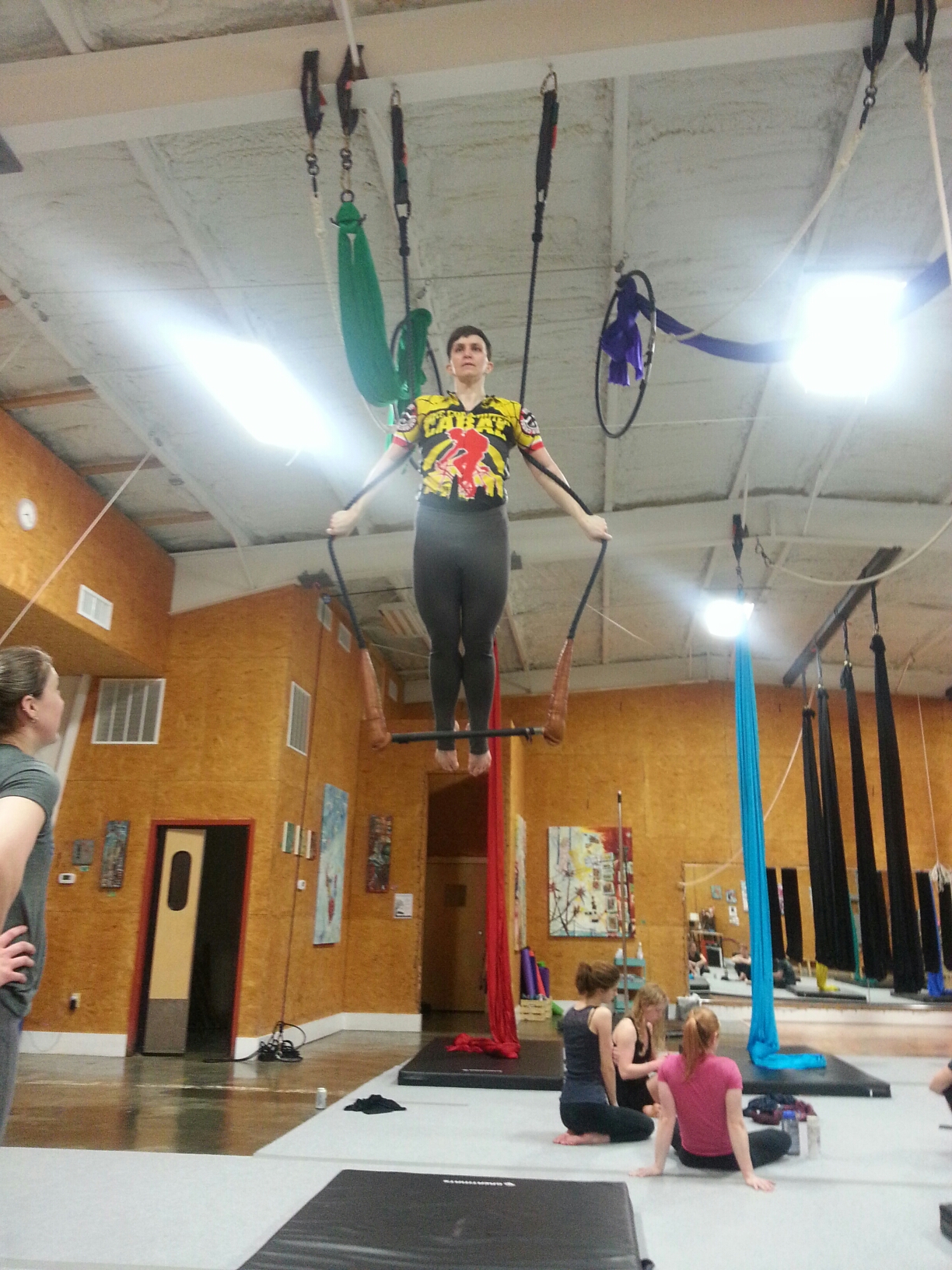
In terms of ballet and in terms of aerials, 2016 has been a good year.
I am a far better dancer now than I was at this time last year. In fact, I’m a far better dancer than I was six months or so back, when I auditioned a piece for a show in Cincinnati. It wasn’t accepted* but the act of auditioning changed how I thought about myself as a dancer and a choreographer: which is to say that without even realizing it I began to think of myself, unequivocally, as a dancer, and as someone who works in the ephemeral medium of dance. It made me buckle down and really focus on learning my craft.
*Which is fine: looking back on it, now, I can see that it was deeply unready, and while it would’ve probably been a decent piece by February, it wouldn’t have been the piece it should be; more on that later.
The hard thing, the really hard thing, is that life being a thousand times better than it once was — while it helps — doesn’t stop bipolar disorder in its tracks.
Mania still leans on the throttle, sending the whole thing charging wildly into the unknown, fired by over-stoked engines.
Depression still roars out of the night and crushes me under its wheels. I still live a life in which, at times — more times than I care to admit — I’m clinging by the skin of my teeth; by the tattering shreds of my nails.
There are still too many days on which getting out of bed seems unthinkable; on which feeding myself is a chore I’d rather not bother with; on which even going to class (the one thing that I know will reliably lift me into the light, if only for a little while) is almost unbearable.
In some ways, I think of this in the same terms that I think of ballet.
Ballet is like bike racing: it doesn’t really get easier. You learn more and more steps; they become part of you — but the physical demand increases apace with your command of the physical vocabulary of ballet and your ability to use that vocabulary beautifully and expressively.
Just as the rigors of bike racing are absolutely, irrefutably worth it when you’re descending a gravel track at 30+ miles per hour with the wind in your teeth and no hope of any victory except the one over the voice that has so often told you, “You can’t,” the rigors of ballet are absolutely, irrefutably worth it for those moments when everything comes together, when the steps and the music and the soul all move as one, and suddenly you are the music and you can fly.
I do not expect ballet to get easier, so I’m not disappointed when it doesn’t. Like most dancers, I find a specific thrill in tackling challenging steps and I revel in hard classes; even spectacular failure in the service of attempting something difficult has its own charms.
Bipolar isn’t quite the same — I suppose there’s something to admire in the tenacity with which all of us, medicated or un-, hang on through its fits and starts, in the face of its slings and arrows, but there isn’t some beautiful craft to master at the end of it all (except insofar as the craft is life: but that’s a thing we all share, bipolar or not).
But it is hard; sometimes, in long stretches, unstintingly hard. And while the manias can hard — particularly the black, dysphoric ones — the depressions are probably harder.
So I write from the rails of a depression in which I am suddenly paralyzed by potent self-doubt; suddenly more than half convinced that I have no business pursuing the calling of my heart, that I am a deluded try-hard who will never do anything meaningful (even noting that I apply the term “meaningful” on a scale that has nothing to do with money or fame), and that I should just lie down and die.
I write from beneath the wheels of a freight train that, for reasons beyond understanding, wants to undo me — or perhaps simply from the wheels of one that has lost its brakes. Again.
I write not to ask for sympathy (which I usually find kind of annoying) or to fling my misery out into the world so others can be just as miserable as I am, but because sometimes the most powerful response I have found to just this thing is the act of naming it, writing it down, looking it in the face.
Later, when I’m recovering, I’ll come back and look at these words and wonder, How could I ever have thought that? (Just as I wonder now, about my own right to regard myself as an artist, How could I ever have thoughtthat?)
I will try to remember what it felt like to hurt so much for no reason; to not even be sure that “hurt” is the right word, not because of the magnitude of the pain, but because it is so very sourceless and alien — and I will not be able to summon the feeling.
But I will understand why I wrote this: to say, This is what is now, at this moment, and to do so clearly and publicly, to stop it rattling around in my head, so I can go outside and plant a redbud tree that my friend B. brought me from an Arbor Day celebration.
So I can get up and go to conditioning class tonight.
So I can finish cleaning the kitchen, or at least do as much as I can (thinking all the while, “For the love of all that is holy, how long can it take to wash a few dishes?!”).
So I can collect the tatters of my soul and get back to weaving dances with them.
So I can get back to dreaming.
Honesty is the first tool when depression comes thundering in. So this is my honesty. This is my island of grace. This is my song and my banner, though I try, now, not to see any of this as a battle.
But we go into the mission field, too, with a song and a banner, don’t we, to tend to the sick and the wounded.



 danseur ignoble