Blog Archives
A Conversation From Last Night
Last night I met Jim, one of the men who does the Beginner/Intermediate class on Monday nights. He is a charming older fellow; one of the folks who throws out little improvised dances while Brienne listens to the music and decides how best to torture us next. I do this, too, so I liked him immediately.
After class, as we put our Normal People Clothes back on, he commented on how hard Brienne works us. I emphatically agreed. Then he said something about how ballet training has changed since he was young (I would guess he’s in his seventies) – how there is less focus now on endurance because they don’t want us to wind up with enormous thighs. He said, “Nijinsky had huge legs.”
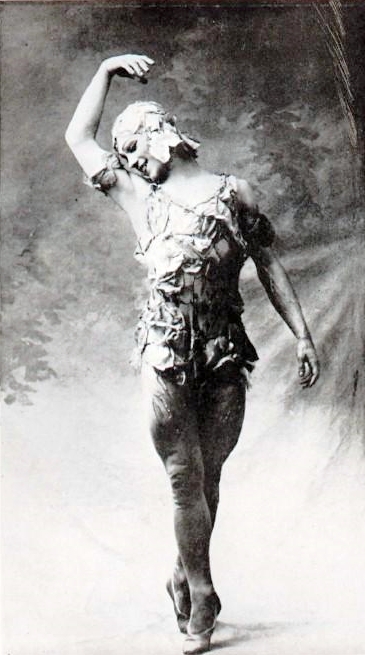
Check out those hams. Nijinsky in Le Spectre de la Rose (image via Wikimedia Commons; public domain in US).
This is true. Pictures of Nijinsky show not a graceful sylph of a man but a solid little acrobat with legs even bigger than mine. Standing still, Nijinsky defied modern expectations about how dancers should look. In action, he was such a glory that he is still – at least among dancers – a household name.
“When he jumped, he just seemed to float,” Jim commented, “It was because of those enormous legs.”
So maybe I should take a moment to appreciate my own enormous legs, my legs-that-get-in-their-own-way-in-fifth-sometimes, my legs that force me to have suit pants specially tailored, which are also the same legs that lend me high, powerful leaps in the studio and sharp acceleration on the bike (and, not coincidentally, also the same legs that made Denis follow me all the way up a major local climb on the day we met).
I guess most of us hate some or another part of our bodies. We dancers and cyclists can be especially hard on ourselves — we spend hours upon hours dressed in skintight super-suits and, in the case of dancers, starting into mirrors. Our passions make stunning demands on our bodies and literally reshape them (as a dancer-from-childhood, I am blessed with funky hip sockets; as a cyclist, with Achilles’ tendons you could use to string a crossbow). I am no exception. I stare at myself in the studio mirrors and I think, Egads, are my legs really that big?
I have been learning to live with my legs, in part because returning to ballet has made a start at refining them (some days I’m like, “OMG, I have ankles!”). Maybe someday I could even learn to love them?
Maybe I am not the next Nijinsky, and my name will never become part of the saintly canon recited by dancers everywhere.
That doesn’t mean I can’t learn to appreciate the power implicit in these gigantic quads and wholly-unreasonable calves … does it?
Monday Class Notes, Some Other Stuff
Tonight I was having issues with my knees. Specifically, they did not want to be straight. Something to think about.
Brienne taught tonight, with her famous athletically – demanding barre. Four men in class (including me) and ten or more women. We were a big group!
Brienne roams and corrects during barre. I got a million corrections tonight; I was a bit of a mess. Also got a compliment on a self-correction, which was nice. Praise is always good, but really good when it’s for fixing yourself.
Our adage really felt like dancing, and I think I did it well the first couple of times. I am finding it much easier to remember choreography now. Still got lost in the count in petit allegro, though. I love little jumps and get carried away.
Evidently, from outside the room we sounded like elephants.
My left gastrocnemius (that big calf muscle), which I injured somehow last week, held up fine today. I think it is basically healed (thanks in part to a certain physiotherapist!).
Next time I’ll try to write down our choreography … speaking of which, I have decided to go with Satie, pending opinions from people who know stuff.
Leather side down!
2 AM. Can’t Sleep: Choreography.
I realized this evening that I will have to make an audition video for the graduate programs in Dance/Movement Therapy.
I kind of knew this anyway – it just hadn’t sunken in yet.
Tonight, in bed, I found myself percolating choreography. This is new – mostly I percolate writing. But it suddenly occurred to me that here I have this awesome chance to do something cool; make a dance and perform it and film it.
I am thinking about using either one of Eric Satie’s gymnopedies (three, maybe?) or a selection from Holst’s The Planets (Mercury, perhaps?). Very different pieces, but both ones I’ve loved so long that they’re in my bones. When we were little, my sister and I created epic ballets to The Planets every chance we got.
So now I can’t sleep because my brain won’t quit dancing. I guess I should apply the brakes to avoid mania, but this creative force feels really good.
Now if I can just master grand jete en tournant (or, as my phone would have it, en gourmand) by November………..
Ballet Lessons: Fear of Falling
At LBS, I have the privilege of working with a number of really good teachers. Even though we’re doing the same basic stuff (it’s all ballet, after all), they all teach a little differently, and that means that their classes amplify one-another.
Recently, I had a class with Claire — the same really sharp teacher who stuck a finger in the middle of my chest and said, “Lift this up and forward!” and sort of instantaneously corrected a major postural fault. That solved a lot of problems for me, though I still have to work on it consciously all the time, and sometimes I even over-correct.
Somewhere around the middle of the class, after we finished a bit of across-the-flooring with a turn, Claire said to another student, “You almost went for a double there, didn’t you?” The student in question agreed that, yes, she had.
Claire then said something very much like, “You guys should always go for the double, if you feel like it. The worst thing that’s going to happen is maybe you fall over. You can either be careful and go for the single, or take a risk and go for the double and you might fall — but you might hit the double! Or, you know, you might miss it a thousand times, but then you’ll get it, and you’ll have it.”
I wish I could remember her words more exactly. The point she was making is that you’re never going to do a double pirouette until you try to do a double pirouette — and that falling isn’t that big a deal.
No matter how badly you want to do something, you’ll never succeed until you try — and you can’t let fear get in the way.
This isn’t to say that you can’t be afraid. Bravery isn’t the absence of fear — it’s being afraid and taking the leap anyway.
In the ballet studio, as in life, people fall down sometimes when they try new things. Injuries occur once in a while, but almost anything worth doing involves some degree of risk — and as far as I know, none of us have died of humiliation yet. At least not in class.
In real life, I guess people do sometimes seriously get hurt or die as the result of actual falls. However, I think the fear of falling itself does a lot more damage — the fear that makes us not get up and do the things we dream about doing.
In ballet, we address this possibility by reaching for moves that are just beyond our grasp: once we have a single pirouette nailed, we reach for a double instead of shooting for 32 fouettés right away!
The student who almost did a double pirouette in our combination went on to hit several as class continued. She looked thrilled for herself, and I think we were all thrilled for her.
In real life, we can do the same thing. If we can set aside the fear of falling, we can stretch our comfort zones a little at a time, and if we do, sometimes we’ll find that they grow by leaps and bounds.
On Ballet! – Wednesday Class Notes
First, it was Open House night, so class was freeeee! Woohoo!!!! Free ballet class is like the best thing EVAR.
It was also packed. I think there were about fifteen of — four on each barre, except my barre, which had three.
Second, Brienne’s class is officially one heck of a workout. Not counting hot rides on the bike, I haven’t sweated like this since Muay Thai. Seriously. And it’s every. Single. Class. By the end of barre, I was soaked, flat out dripping, like I’d just stepped out of the shower (you know, assuming I had, like, showered in my ballet clothes — which I mostly try to avoid, though I did accidentally run my canvas shoes through the wash).
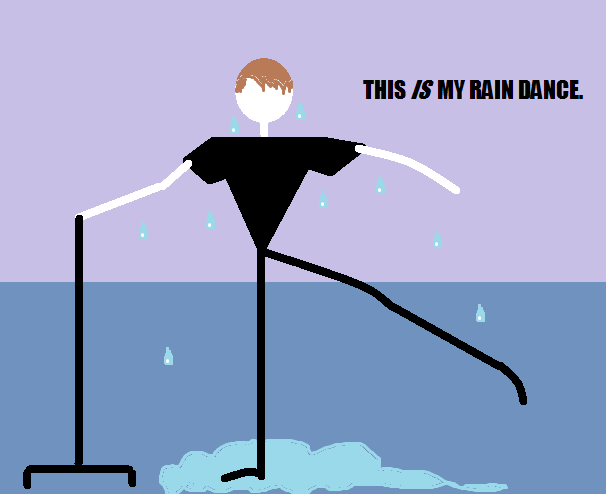
Row, row, row your barre,
Gently down the sweat…
I was like jelly again today during grand battement, so I hung out after class and asked Brienne for some pointers on how to fix that. I think she has me sorted. Now I will practicepracticepractice until I nail that down.
In case you’re wondering: think about driving the weight down through the supporting leg while the imaginary string that always pulls you up keeps pulling. This is what I’m doing when it works, I think; obviously, this is what I’m not doing when it’s a hot mess.
I suspect I also do better when I can’t see myself in the mirror. I get distracted. More stuff to think about and work on and stuff.
In other news, I am beginning to think that all this ballet is actually really going to make me rather a better cyclist.
First of all, it makes weighing less a huge freaking deal. You know how much of a pain it is to haul extra weight up a hill on a bike? That same extra weight makes everything you do in ballet class that much harder. By the end of Brienne’s barre, I feel every single extra ounce.
For the record, I really have to be motivated to ride so hard my legs burn. Give me someone to chase up a climb, and I’ll make my quads scream. Beyond that, I tend to be like, “Meh, I’m going fast enough right now. I don’t need to go faster than 20MPH max speed on this ride. I can afford to average 14 (or 12, or whatever). I’m good.”
In ballet class, I don’t get that luxury. I get Brienne going, “…And now we’re gonna do it again!” Which she totally does every time we finish a combination that makes us all look like we’re about to cry, but we’re keeping it all inside because there’s no crying in ballet class (say that in your best Tom-Hanks-in-A-League-of-Their-Own voice). And because I find group class settings highly motivating, I keep pushing.
For the record, my thighs feel really different than they did, what, five? weeks ago? Six? You know, back when I bit the bullet and got back into teh ballets. They look kinda different, too.
Which brings me back to point two: I am stronger than I was before I got back in the studio. My core is stronger. My legs are stronger. The balance between my quads and all the stuff that opposes them is better. My butt, people, is like cold blue steel. Okay, so actually kinda warmish peachy steel with a nice layer of foam on top, but steel, kay? Like if I was standing in a parking lot, and you backed your car into my butt, I would dent your car.
All of that makes me a wee bit faster on the bike.
As for center work: There were no “Fosse! Fosse! Fosse!” moments during petit allegro . Just me losing count occasionally, but mostly doing okay. Once, during our nice little adagio thing, I realized my arabesque looked more like an ar-embarrassment, and fixed it without falling over. I’m gonna blame that on being super hungry by then, though … yeah. It was totally the result of low blood sugar. Ballet bonk. (FWIW, I was a tad cranky on the way home.)
Anyway.
It wasn’t my prettiest class ever, but I can tell I’m making progress, and that’s what counts.
That’s it for now.
Leather side down!
On Ballet! – Quick Monday Class Notes
Strengths Today:
Barre work was pretty okay, though I got lost in a couple of long combinations (mainly because I can’t think and count at the same time, apparently).
l am, however, getting better at remembering combinations in general, so there’s hope!
My back is improving. I spend less time each class going, “Fosse! Fosse! Fosse!” and not keeping it all inside.
Also, surprised myself with a decent pirouette in a combination (decent is relative, here, probably?). Huh. So that’s that.
Weaknesses Today:
I have some kind of mental block about following a glissade with an assemble. Since this is like the most common sub-combo in the history of ballet … Erm. Yeah.
Frustratingly, I can glissade and I can assemble … as long as they’re separate.
Together? Well, I could do this when I was seven. It’ll come.
Edit: PS, I pulled a muscle in my calf but was able to finish class. Because that’s how cyclists ballet, y’all.
Ballet Lessons
Lesson One: Everyone Starts At The Beginning
There’s a famous saying in cycling circles attributed to Greg Lemond: “It never gets easier, you just go faster.”
It reminds me of something my ballet teachers say: “In ballet, you keep doing the same basic things. You just get better at them.”
Many adult beginners (and probably some child beginners) walk into the studio carrying a load of worry about being beginners. Adult re-beginners often walk into the studio carrying a load of worry about how much they’ve lost in the year or ten years or more that have elapsed since last they slipped on their slippers and danced ballet.
Yet, just as basic elements of cycling remain the same no matter how long you ride — you turn the cranks and balance; that’s basically it — the basic elements of ballet never change. Like cycling technique, ballet technique elaborates upon itself.
The five basic positions (of which you will mostly never use one — the third — unless you can’t get into fifth for some reason) never change.
Everything begins and ends with turnout and plié.
Tendu leads to dégagé. Dégagé leads to grand battement. Grand battement leads to jeté. Jeté leads to tour jeté. Tour jeté, for what it’s worth, looks really impressive.
You learn tombé and fondu at the barre; later they become connecting steps that you will use all day, every day, at center and eventually on the stage.
And still everything will begin and end with turnout and plié.
When we first began class, Denis worried about how polished many of our classmates seemed. Now, he is beginning to show a little polish of his own. He began at the beginning — all the way at the beginning, having never set foot in a ballet studio before.
Last Saturday, at the Joffrey, the population of our class ranged from newbies even less polished than Denis to one guy who danced with a degree of refinement that suggested he was at very least an advanced student who was either filling in a class due to a scheduling issue or possibly working back from an injury.
We all did the same things. Nobody judged anyone else.
We were all true beginners once. Every principal dancer commanding the stage; every top racer commanding the mountain — they, too, were beginners once. They, too, start every single day — every class, every workout — with the same basic things we do. They have simply been doing them longer.
So beginning is important — and not just important. It’s good. If no one was ever a beginner, we would not have the David Hallbergs and Jens Voigts of the world; the Natalia Osipovas and Marianne Voses of the world.
I’m not going to say we shouldn’t worry about being beginners. To worry is human. What we shouldn’t do is let that worry stop us from beginning.
Everyone starts at the beginning … and once we start, we often learn that the little elemental skills we learn at first lie at the heart of something beautiful; that the beginning is, in fact, the most important part.
On Ballet! — Wednesday Class Notes!
I know, I know — I’m messing up the routine, everybody! But it’s okay. It’s summer break. The goal is to hit ballet class three days per week.
We missed Monday’s class: first, Denis was held hostage (well, not really, but it sounds more exciting that way!) by his dentist, who was fixing a tooth that Denis somehow broke in Chicago and we didn’t make it to the 6:15 class. Then we didn’t quite make it to the 7:15 class after picking up the truck from our awesome mechanic’s place. C’est la vie.
Today I did my first Wednesday class under the tutelage of Brienne, who runs a very athletically-demanding class. There is nothing like a good run of slow fondus to make the muscles wake up and sing.
I was a total mess for much of the class. My head wasn’t entirely in the game. The Wednesday class is in a different studio, which for some reason I wasn’t expecting, and I think it threw me for a loop. Somehow, at the Joffrey — where I expected a new studio full of new people — this wasn’t a problem. It’s all about the interplay between expectation and reality. No biggie: I need to learn to adapt more readily, and this sort of thing provides ample opportunity for practice.
This isn’t to say that I didn’t do anything right. I’m sure at least one or two counts of the grand battement were good, and while I didn’t execute our combinations at center all that brilliantly well, I did at least remember them.
I think the highlight of the class, though, was that slow-burning fondu exercise. It was demanding, it was even (at moments) painful — but it provided an exceptionally good opportunity to really focus on feeling which muscles were supposed to be working and making them work … even if I only managed to do it right for a few seconds at a time.
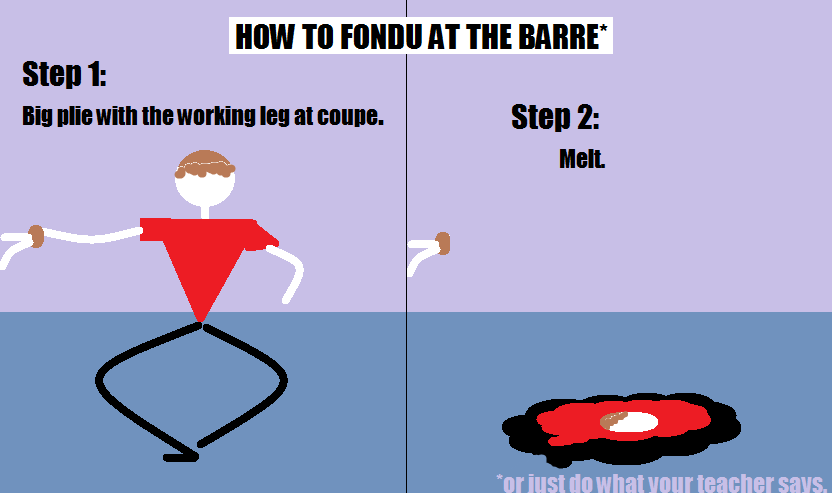
The rest of the time, I kinda looked like this.
I’ve learned that I really like having the opportunity to work with different teachers. I think I touched on this in my last post. Over the summer, it looks like I might routinely have classes with all three of the teachers I’ve met at LBS, which is pretty awesome. I’m collecting useful instructions and corrections — Margie’s commentary on using the first position port de bras as a gateway; Claire’s correction for my back; Lynne’s explanation about maintaining turnout through rond de jambe; Brienne’s very effective advice for finding and using the muscles that maintain turnout (and also for not slamming one’s heels together during dégagés).
Perhaps I should start posting a weekly list of useful instructions and corrections?
I’m looking forward to more classes with Brienne, Claire, and Margie (in alphabetical order), and to further re-creating myself as a dancer.
That’s it for now.
Leather side down 🙂
Various Thoughts About Chicago, and a little On Ballet!
I am fond of Louisville. There’s a fair bit to like about it, excepting its landlocked location in this oft-sweltering cauldron of concentrated air quality problems known as the Ohio Valley. It’s too far from the ocean, but it’s got friendly people and great cycling and a nice ballet company with a good school and some of the most beautiful domestic architecture around. Where parks are concerned, it has few, if any, rivals in the United States.
Seriously. Name another US city this size with nineteen graceful parks bearing the unmistakable stamp of Frederick Law Olmstead’s trail-blazing vision; with this much space set aside to be green and a little wild sometimes and beautiful so the people who live here can get away from the bustle of urban life for a bit any time they so please. I have lived in quiet rural and suburban places and in busy urban places and I have concluded that it’s best to be able to experience both; one makes you appreciate the other more. Here, you can do that without leaving town.
I say this because I don’t want you to think I’m dissing the city where I live. There’s a lot to like, even love, about Louisville.
The thing is, I think I like Chicago even more.
I suppose Chicago has some unfair advantages.
First, Chicago has trains. I love trains. I love trains for themselves, for the feeling of riding them, and for what they mean. In Louisville, people like me, who don’t drive, can escape from the city by riding bicycles or getting on the bus and then riding bicycles or walking. In Chicago, it is possible to get on a train and go. It’s easier. You can take your not-so-athletic friends along. You can even get a ticket on the South Shore Line and ride all the way to Michigan (the first time I visited Chicago, it was by South Shore Line from Michigan City, Indiana, which is practically in Michigan).
Moreover, the trains form the core of a transit system that moves a lot of people. Here, people still mostly seem to regard public transit as a stopgap measure for people who can’t afford to drive — which is, quite frankly, a pretty backwards way of looking at things (this isn’t to say that it’s not getting better, but that’s still the prevailing sentiment). Chicagoans drive more than New Yorkers, but don’t seem to regard public transit as an embarrassment. They cram onto the trains and busses in their legions and go to work, to concerts, to clubs, to the ballet, to restaurants. Many of them don’t drive a whole lot or at all, and because of this Chicago is full of vibrant, walkable neighborhoods where there are people out getting dinner, retrieving groceries, going to bookstores, whatever. The trains, in their way, have helped keep the city operating on a human scale.
I grew up in a small town, but it was (and still is) a small town where you could walk to dinner, to the grocery store, to a good ice-cream place, and so forth. I loved that and had no idea how precious it was.
The thing I dislike about my current neighborhood is that it’s the kind of place the vast majority of people would consider unwalkable. Places you might want to go are a mile away or more. Sidewalks, where they’ve been included, are inadequate. There’s a big, beautiful park practically in my backyard — literally about a block over — but the neighborhood (built long after the park) is designed in such a way that you either have to travel two miles to get there or trespass on private property. Nobody thought to include, for example, a path. If you do choose to get to the park by cutting through people’s yards, you then have to either climb over or tunnel under a big fence, which is (of course) meant to prevent people from cutting through private yards going to and from the park.
It is this way because my current neighborhood was designed for people who drive cars, by people who regarded diving as the wave of the future; as a new convenience that would save us all so much time. They meant well, but these are the people you can thank the next time you’re sitting in a traffic jam, because these are the people who designed so much of America as we know it today. These were not, for the most part, the people who planned and designed the neighborhoods in Chicago.
Second, Chicago is several times the size of Louisville. A few years ago, even a year ago, I wouldn’t have identified that as an advantage. It’s still not something I would automatically point out as an advantage. Like, I enjoy New York and Washington, D.C., immensely, but I wouldn’t describe their sheer size as an advantage, necessarily. In Chicago, though, the scale of the city lets it breathe in a way which neither NY or DC can do, being situated where they are. Yes, downtown Chicago is dominated by giant buildings — but they stand far apart, across broad streets, and you don’t feel like you’re in a cramped, narrow canyon.
Chicago can do this because it’s in the big, flat heart of the Midwest on the shore of a lake so huge that people who know things about bodies of water classify it and its sisters as a series of freshwater inland seas. Perhaps because of the trains, though, Chicago doesn’t seem like a collection of unrelated cities jammed together. Different neighborhoods feel distinctly different, but they’re all connected by the same circulatory system; they’re all part of the same organism.
Third — well, did I mention the lake?
The city of Chicago is sliced up by rivers and canals flowing up towards the lake. Maybe that should be Lake, with a capital “L.”
I’m an ocean junkie. I grew up on the Sound and the Cape and the Atlantic. The first time I felt the thrill of real, mortal fear, it was in the waves of the Atlantic on the windward shore of Block Island. The first time I felt the unspeakable power of the numinous, it was watching the moon rise over the ocean from the peak of Mount Desert Island. My people have never lived far from the ocean. I joke that you’ll find members of my family everywhere, but in truth I don’t think very many of us can be found very far from the coast, or not for long. I miss the ocean keenly and powerfully, and that particular flavor of homesickness never seems to fade.
So the lake isn’t an ocean. But it’s still pretty good. It’s a proper inland sea — it’s Big Water. It has moods and waves and a bit of the terrifying power that makes the ocean so compelling. It has sandy beaches and a far, blank horizon. I can look at that horizon and feel something of the same thrill that I feel when I gaze out over the Atlantic.
So it seems inevitable that I, who so love trains and variety and, above all, Big Water, should like Chicago an awful lot. Don’t think I’m some kind of rosy-glassed pushover about it — I know it has its own problems; its own quirks I would probably come to resent if I lived there, the same way I resent the highways here that cut entire swathes of the city off from each-other and disrupt the flow of what could be a pretty cool urban lifescape, so to speak. Nonetheless, I really like Chicago. I think I could be really happy there.
Now for the ballet part. On Saturday, we got up and ate breakfast and made our way up to the Joffrey Tower for class. The Joffrey’s adult open division Ballet Basics class is 1.5 hours long. I wasn’t 100% sure Denis would make it all the way through. I didn’t know what to expect (one never knows what to expect when one starts a new class, though).
What we got as an awesome and really pretty enormous class. I think there were about sixteen of us; about half of us were men (our teacher, Lynne, exclaimed, “Oh my gosh, there are never this many men! We’re doing pas de deux today! …Just kidding.”). The barre work was athletic and demanding (for what it’s worth, I don’t think I’ve ever done attitude en cloche at the barre before), which I definitely appreciated.
I found that after exercising my brain trying to memorize long combinations at the barre, it was surprisingly easy to memorize the combinations when we worked in the center … though also surprisingly easy to get mesmerized while doing changements and forget to move on to the next sequence. This, however, is not a problem that is specific to ballet. When counting repetitions, I tend to forget to stop. The effect wears off once I know the pattern and stop counting (in this case, on the first repeat, when we reversed the direction of the combination).
Lynne did a brilliant job explaining how to stop your circular port de bras from looking like some kind of fit or an attempt to deflect a missile (though she didn’t put it quite that way). She also sorted our promenades, which I deeply appreciated, as I think promenades look a wee bit silly to begin with much of the time, and look even sillier when I’m sort of f(l)ailing my way through them. By which I mean that she sorted my promenade. Everyone else’s looked pretty okay. I feel like mine is uniformly terrible, though once in a while on Saturday I caught sight of myself in the mirror and realized I looked better than I expected to look.
We did a nice reverence, though I tangled my legs a couple of times.
So that was class at the Joffrey. It was excellent. I would say “Excellent, as expected,” but I didn’t know what to expect.
I’ve found that what people say is true: it’s good to take classes from different teachers, as long as they’re good teachers, because every teacher explains things a little differently, focuses on different refinements, and so forth. Just as Claire’s correction for my back has really helped me get my turns and stuff sorted, Lynne’s explanation of circular port de bras and a number of other things clarified stuff I’ve probably been doing wrong for a while now, if not since, like, first grade.
It’s weird how you can take this long, long journey of digression in your life, go wandering about in the wilderness, and then find your way back to the track you started out on, and realize it was the right one in the first place. I sort of stumbled out of ballet class in middle school — not because I didn’t love ballet, but because my life was pretty crushingly depressing and I stopped doing almost everything. In high school I did modern dance for a couple of years (as a non-major) at an arts magnet, and I loved it, but I lost the thread again after I graduated. Then for a few years I entered a kind of wilderness in my own life. I don’t quite understand why it took me so long to find this shimmering thread again.
I guess clarity just comes when it’s ready to come. We don’t have the privilege of divine insight, so we make mistakes and discard things we should keep and sometimes don’t get back to where we should be for a long, long time.
I feel like I’m finally returning to the self I was intended from the beginning to be: ballet, in a sense, is an expression of that. I suppose I had to learn how to identify and to be that self. I am sure there are still plenty of things I’m missing.
It is very much like re-learning ballet. You attempt some bit of technique you once had down cold years ago and it doesn’t come, and doesn’t come, though you can sort of see it, if you will, “as through a glass, darkly.”
Then, as if from nowhere, you hit it, and it’s like the fire of memory enlivens every nerve.
P.S. If you happen to be in Chicago and you’ve always wanted to dance, give the Joffrey’s adult open division a try. You won’t regret it.
P.P.S. Denis survived and then went on to also survive a walk and a visit to the Art Institute of Chicago and another walk (to the bus). He is coming to class this evening, the first time he has done a Saturday and a Monday class in the same week.
On Ballet! – Monday Class Notes
You may recall that, on Saturday, I received a really great correction about my tendency to sort of lean back when I think I’m pulled up straight.
As such, I went into today’s class feeling rather more confident about things: suddenly, I understood why some of the things that had proven difficult for me had done so, and had a notion as to how to fix them.
I say “had a notion,” because thought does not always translate directly to action. There were still times that I was a bit Pisa-esque, a little lean-y. However, when I was able to keep everything pulled together, my balance was much better, my turns were better, and I generally felt better.
Of course, that didn’t prevent me from developing an entirely new problem. No, as usual, in an effort to overcome a different (but related) existing problem — that of throwing my arms too far back, which also screws up your balance — I over-corrected, as always.
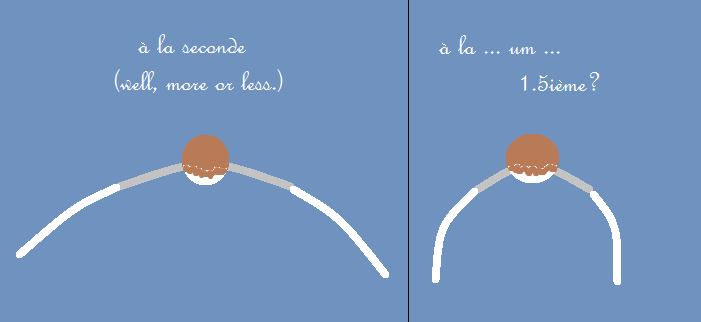
So, ummm, yeah. About that second position…
Fortunately, The Divine Ms. Margie caught it and corrected it before it could get, well, out of hand.
I also had some instances of the weird leg malfunction wherein, for whatever reason, my left leg goes instead of my right, or whatever, and then I do all kinds of crazy catch-up maneuvers. At least this only happened during petit allegro this time, and not at the bar (though I did, somehow, totally hose up one of the sequences at the bar anyway, for no good reason).
Something I’m trying to keep in mind: in ballet class, as in life, you shouldn’t focus on your msitakes. You should make note of them and correct them, of course, but if you find yourself thinking, “Oh, no, this is where I got the combo wrong before,” you’re almost certain to get it wrong again and in the same way.
Of course, when I figure out how to note my mistakes and correct them without focusing on them in that way, I’ll be sure to let you know.


 danseur ignoble