Author Archives: asher
Monday Class: We Got The Beats (Again)
Here’s a little petit allegro combination:
A
[Brush (back foot) to coté
Sous-sus
Brush plié second
Entrachat trois]
Repeat A two more times
Sisson simple
Chassé
Assemblée
Other side.
This was the final combination today— we didn’t do grand allegro because we ran out of time.
For some reason, I had difficulty getting the changes on this (I kept changing the back foot instead of the front), but once attained it was really nice. Very dance-y.
Prior to that we did royales; like a zillion of them, to make them very clean.
Across-the-floor went:
Pique fouetté
Balancé
Pique fouetté
Balancé turn
Pas de bourré-fifth
Chassé fourth
Double turn
Detourné
Plié fourth
Attitude turn to arabesque
Run away*!
*The studio isn’t big enough to do this twice through with any conviction.
I loved this one, once I stopped thinking and just danced.
Pirouette combinations involved a Vaganova thing with turns from second and a brute-force thing with eight repetitions of [plié, turn from fifth].
I managed to do half the turns the wrong way because for some reason I was convinced they were supposed to be en dedans. My brain loves en dedans.
Barre was strange (in a good way), interesting, and full of brain-teasers. Mr. Beastie was very much on form today (in the sense that his combinations were excellent; physically, he’s recovering from a wee hernia).
Both my turnout and my core are holding together better, which makes for better extensions, though my legs were tight today.
I would like to say that I’ll continue to write down the combinations like this, but I can’t always recall them this well.
So that was class. An excellent Monday. I hate my arms less and less each week; little by little, I look less like a big ropy cephalopod and more like a danseur.
Cirque du So Far, So Good
Today was Shiny Tights Day … At least, it was for me.
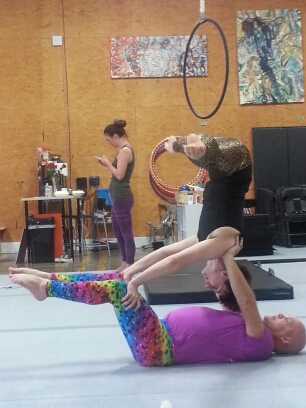
Candlestick in a straddle with no feets. No big deal.
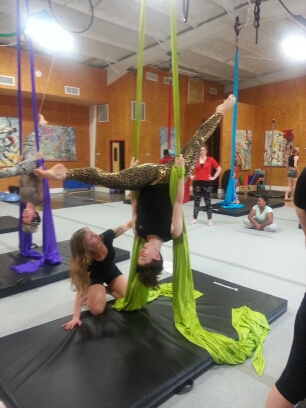
Just, like, hanging out with our instructor, Ms. C(1). (There were two Cs today.)

A little Archer’s Pose (this was actually part of the dismount).
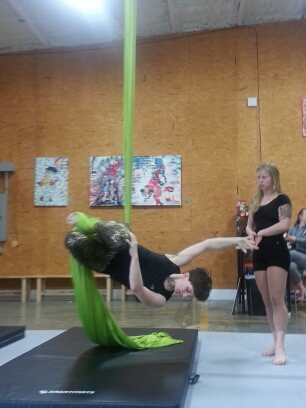
“Squatty hip lean,” and probably the nicest picture of me going. Also, I haz a pasty. Wow.
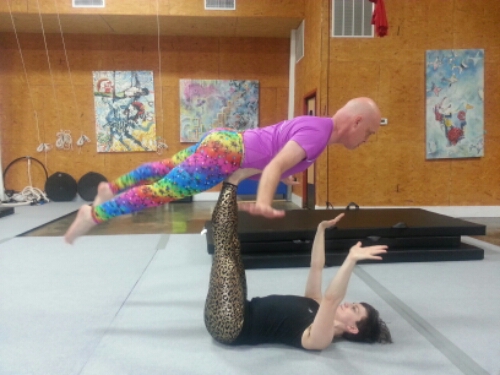
Finally flying Denis in foot-bird!
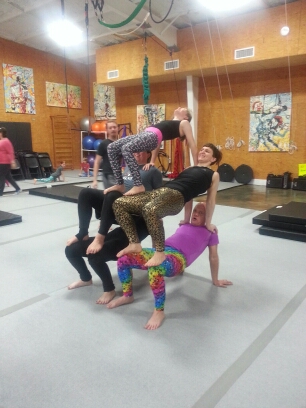
The highlight of acro-balancing, in which we built a mighty wall of tabletops.
I. DID. A. TRIPLE.
OMG OMG OMG.
You guys!.
It wasn’t the world’s best triple, but it…
was…
a triple!
Yasssssss!
If nothing else had gone right in class today (which, btw, almost everything went very well), I could still basically die happy right now.
Also, JP taught, and we got to do brisées, of which I did some correctly.
That’s all for now.
À bientôt.
Dance Cognition: Echo Without* Delay
*Or Almost Without…
I bought a book, The Neurocognition of Dance, of which I’ve read only dribs and drabs, and which I’ve lent to my friend B. (not Ms. B or Mr. B — Blogging-By-Initials gets confusing sometimes), and I’m burningly curious right now about whether any of the chapters within touch on this. I’ll have to find out when she’s done with it.
Anyway!
As dancers, we learn to mirror or echo the actions of other dancers extremely well.
When we’re learning a combination, we mimic right along as it’s handed out — abetted, no doubt, by whatever formal vocabulary of movement (and its associated shorthand) is appropriate to the context, but in a way that’s still rather remarkable for its almost complete lack of delay.
I’m sure that there is a delay — some fraction of a second that passes between the action of instructor or repetiteur or choreographer or group leader or what-have-you and its echo by the rest of the dancers.
It must be eerie to watch this as it happens: to someone on the outside — especially, perhaps, to an observer who is not a dancer — it must look for all the world as if the congregation of dancers, rapt in its attention, is a kind of hive-mind.
In a way, maybe it is.
There is an element of “mind-reading,” of highly-educated guessing, involved in this process. I say that because once in a while we get it wrong: what looks like it will be tendu turns out to be jeté (a distinction so slight, when indicated with hand gestures, as to be essentially invisible to the untrained eye), or the anticipated turn is sublimated into a kind of caesura followed by a contretemps. Sometimes, this happens, and someone, unconscious of his own voice, says, “Oh!” even as he adapts on the fly; even as he continues to absorb the combination by that strange combination of habit and apparent clairvoyance.
But mostly, eerily, uncannily, we get it right.
At barre, we stand there in our array, watching with the unblinking eyes of gun dog or panther, flapping our hands or our feet in synchrony with the hands and/or feet of our leader.
Mostly, the human eye does not perceive any delay.
I found myself thinking about this yesterday while we were all absorbing one of Ms. B’s long and complex barre combinations. There was a moment during which I was participating in this process and glanced back to make sure that I wasn’t blocking the view of anyone on the wall barre behind me (I was on a wobbly center barre) and noticed that we were all like live wires of attention, all in perfect sync, and that we all appeared to be silently performing some kind of well-rehearsed ritual or carrying out a program.
Only we weren’t. We were learning a new combination, one made up of elements we all knew, but combined in a novel way.
Very cool stuff, there.
Once again, I have more thoughts, but I’m tired. I woke up this morning (morning? I mean afternoon, feh) after another thirteen-hour sleepathon with a sinus headache, a sore throat, and a general feeling of mild malaise, so I decided to give myself a day off. Rest day FTW! Tomorrow, we have a conditioning class in the morning, then I’m going to a semiotics workshop in the afternoon, which should be awesome.
I’ll try to assemble my More Coherent Thoughts on all this soon.
For now, though, I’m going to take a bath, finish reading the article for tomorrow’s workshop, and then go to bed.
À bientôt, mes amis!
Hard, But Not So Hard
This describes both class and life, today.
After the second or third class in a row thinking, “Ms. B. didn’t work us too hard today,” I’ve realized it’s not her — it’s me. The extra work at Suspend, the extra challenge of Advanced Class: these things are paying off. I no longer want to die halfway through barre, and I was even together enough to catch the medium and grand allegro combinations today. In the past, I’ve often not really been firing on all 3.5 cylinders by the last combination or two.
That said, my knee objected stridently to frappés (apparently, I lock my hyperextensions during frappé: oops). It also haaaaaaated promenade and did not love the slow attitude turn, but I endeavoured to execute our adage with all the aplomb I possess all the same. It was too nice not to.
The knee also still wasn’t so happy about some fast-traveling turns (right-working-leg en dedans from fourth, especially), which I find distracting enough that I hosed up the pirouette combination going left and made myself do it over. Twice.
Medium allegro was a brain-teaser:
Part A
little Sissone to coupé avant right
little tombe back to fifth, plié
coupé temps levée arrière left
assemblé-glissade-assemblé, maybe? (I don’t remember what exactly happened here, though I succeeded in doing it right at the time.)
…And then Part B:
sauté to first
plié
sauté in first
plié
sauté
sauté
sauté
plié
échappé
plié
sauté in second
changement
changement
changement
plié
soubresaut
plié
soubresaut
plié
soubresaut x3
…and then repeat Side A on the opposite leg.
Or, well, something very much like that. No difficult steps (at least, not now that my legs have remembered how to Sissone yet again), but a test of dexterity. The weight shifts constantly; the bit in the middle (and again at the
end) feels delightfully simple, but you must pay attention to your changes of foot, lest you start the second pass through Part A on the wrong leg. The tempo’s too fast for that, and next week, when we do it again, it will be twice as fast.
We didn’t do beaten jumps, but that’s fine. I did better beaten jumps on Monday than I’ve done in years: quick, crisp, and articulate.
Our grand allegro started out simply, but included a transitional mind-screw of epic proportions.
It went:
Temps levée arabesque
Temps levée passé
temps levée arabesque
Failli
Glissade
Assemblé
PAS DE CHAT FROM THE FRONT FOOT OMG!
directional change via pas de bourée
temps levée arabesque, etc.
First, my body really wanted to insert an extra temps levée passe.
Second, none of us — NONE! — could convince our legs while marking that it was okay to pas de chat from the front, even though that happens sometimes even in Real Ballet. If you do it from the back leg in this combination, you have to adjust a bunch of stuff on the fly. Some of us did succeed in nailing it on the first run, but by then least one of us (I mean, of course, your humble Danseur Ignoble) had discovered a creative way to screw things up anyway.
You see, I apparently blinked or was pouring water into my mouth or something and missed the part of the demo that made it perfectly clear to everyone else that the PDB was the directional change. Instead, I must have decided it was supposed to be Bizarro-World PDB (front-side-back) or something like that, since we were already doing Bizarro-World PDC.
I don’t know what I did while marking; I may have just left it out because how can you screw up pas de bourré, right?
But screw it up, I did: having decided that the directional change came after the PDB, I passed the cat (ha), then despaired over what to do with my legs and sort of faked my way into the next part. I can’t, at this point, really fathom what I must have been thinking, because once I realized my mistake it was so obvious.
I got it down on the second run, though my brain stubbornly tried to insert an extra temps levée passé on the left side, so once again I made myself do an extra repeat.
On the upside, my old difficulty in getting from temps levée arabesque through failli to glissade did not resurface, so there’s that, and once I had all the parts in place, the combination was buoyant and pretty and fun.
I wound up walking a lot after class, and by the time I got home I was cooked and my knee was sore, so I opted out of class at Suspend. Tomorrow, it’s once more unto the breach, etc., but tonight, the knee has earned a break*. I went straight to bed with an ice pack, a book (on my tablet), and my cat, who is now applying his vibrating massage feature to said knee.
*NOT THAT KIND OF BREAK, Knee, so don’t go getting any ideas!
There was more I wanted to write, but it turns out that I’m exhausted. I still haven’t been sleeping well: I got 13 hours on Monday night, but probably fewer than 5 hours last night. I kept waking up and lying there in that suspended-but-not-asleep state in which Bad Thoughts have me at their mercy. It’s not quite sleep paralysis, but it’s close; I can operate my body after a fashion, but can’t steer my brain at all. This morning, I never got back to sleep after Denis’ first alarm, and thus missed an hour of sleep that I could really have used by then.
Thus, I’m going to read for a bit longer, and maybe then I’ll sleep again (thanks to the power of Twilight, which makes reading on my tablet less wakefulness-inducing than reading a regular book by my bedside lamp).
I think I am going to survive this week. I think maybe I am learning to talk to people, though still not yet apparently before I find myself in a crisis. I’ll work on that next week, I guess.
À bientôt, mes amis.
Writing Problems: On Killing Your Darlings
First, though, a couple of updates:
- First, I’m feeling a little better than I did yesterday, in part because I finally slept last night (for thirteen hours, in fact) and in part because B. and I went to an evening ballet class.
- Second, I started writing up class notes, but haven’t finished them, so I may or may not get around to posting them. It’s funny — long ago, when this was mostly a bike blog, I used to feel intense misgivings about going off-piste like that. I suppose it was, in reality, mostly because I was still running from my own mental illness and from my own past. That’s an interesting thing to think about.
Okay, so: on to writing.
There’s a certain incantation well-known to writers, central to the craft of writing, attributed to everyone under the sun (though apparently it originated with Arthur Quiller-Couch), and apparently the title of a movie that I’ve never seen: “Kill your darlings.”
I’m not going to try to explain what it means. Other people have done that fast better than I could right now, and it seems likely that some of them are out there on the innertubes somewhere. (Google amongst yourselves; I’m feeling a little verklempt.)
Instead, I’m going to kvetch about the difficulty I’m having with it right now.
Back in November, I made a huge foray into the complicated waters of Strangers In The Land — and then I got stuck.
The work started to feel unwieldy, like an oversized chainsaw, and I couldn’t figure out why.
Just as it’s a good idea, when a chainsaw feels unwieldy, to perhaps put it down for a while, it can be good to walk away from a piece of fiction for a time when it gets really, really impassible.
This is one of the reasons I’m working on more than one project most of the time — at the moment, Strangers, which has proven to be much, much harder to write than I imagined, and a fantasy trilogy, which has proven to be much, much easier than I imagined even though it involves a very long story arc and a whole lot of world-building and mythopoetic creativity and so forth*.
*To be honest, I think those things make it easier, since they feel like a game — it’s all a giant game of make-believe set in a world that I have come to love intimately and tenderly even as I continue to do terrible things to it and its inhabitants. The biggest challenge is just figuring out what to include in the final work and what to leave on the cutting room floor.
The fantasy work, which bears the sad overall working title of The Tales of Kirnan, though the individual elements have less-awful ones (Calderon, A Song In Time Of War, A Far Green Country), is easy to tell because, for all the complexity of its setting, it’s a fairly simple story about a war.
For the most part, it hews (intentionally) to the conventions of the genre: indeed, it evolved out of a kind of joking attempt to put my love of really complex, layered stories aside and write a simple good-versus-evil, swords-and-sorcery romp. It has grown since then (apparently, I can’t keep myself from badding up at least some of my good guys or exploring the motivations of my bad guys at least a bit), but it’s still reasonably straightforward, all things considered.
Strangers, meanwhile, is not. It’s set in the real world, which is messy, and involves characters with more or less ordinary problems, which are also messy.
That in and of itself perhaps isn’t a huge challenge. I mean, I just described every work of realistic fiction ever, yes?
The problem is figuring out how to tell the story, which cuts, in some ways, very close to the bone.
And this is where killing my darlings comes in.
I love Phineas (Narrator Number 2 in this tangled skein of words). I love writing as Phineas, probably because in many ways Phineas — an effusive, restless dancer; wildly impractical; essentially romantic — is a lot like the parts of me I like best. I love his voice and his energy — and yet, the more I’ve tried to work my way out of this Gordian Knot of my own creation, the more I’ve come to feel like I can’t use him as a narrator to tell this story.
He is critical to the story itself — the story is, in part, his story — but trying to tell it in his voice isn’t working. Increasingly, it seems like the answer is to cut the knot: return to my original approach, in which Toby — far more sober and uncertain — tells the story for both of them.
This is hard.
~
First, as I said, I love writing as Phineas. It is often effortless, and an unalloyed pleasure — but characters have lives of their own, and Phineas refuses to approach the darkness at the heart of his own story. When I try to take him there, the wellspring of his voice runs dry.
For a while, I saw that as a failure of craft; since then, I’ve realized it’s not. It’s a central part of his character. He has spent nearly half his life doing everything in his power to avoid thinking about What Happened, and while he’s arguably the more successful of the two main characters in the world’s narrow sense, he’s also the more troubled, even though I didn’t want him to be**.
**I really wanted to shake up that convention, because in some ways it’s all too much like a romance novel — this story too easily could turn into “beautiful, feminine, troubled ballet dancer is rescued from his demons by ordinary, conventionally-masculine, brooding Knight in Flannel Trousers.” Then again, that’s very nearly the story of my own life, and besides, the rescuing is mutual.
I suppose that, because he’s in some ways a transcription of myself, I wanted him to be unbroken, resilient, in a way that I haven’t been.
Maybe it’s more honest to write him as he apparently is; as he has created himself: resilient in so many senses of the word, strong in so many senses, but ultimately brittle and fragile in critical ways and rushing headlong towards a crash.
~
Second, excising Phineas as a narrator means leaving some of the best writing I’ve done in years on the cutting-room floor.
That’s hard. People who don’t write think writing is easy, but good writing is hard. Good writing forces us to ruthlessly destroy things of great beauty when they don’t ultimately serve the purpose of the work. Forget the moon — the pen’s a harsh mistress.
I effing love the passages where Phineas rambles about dancing; I love his exchanges with the irrepressible and abrasive Antonio Garibaldi (who reminds him, at one point, that, “…There’s more than one way to work on your turnout.”). I kind of love how unaware he sometimes is of his own vulnerability: but that’s part of what makes him so freaking hard to write, when it comes down to brass tacks. He is unaware of his own vulnerability because he’s willfully blind to it, which means I can’t get his voice around the hard parts.
If I can’t make him do that, he can’t narrate, no matter how much he wants to talk about Company Class or the dynamics of I Travesti or anything else. If I was a better writer, I might be able to do it: to somehow justify the lacuna that must inevitably surround that revelation; to let Toby enter and pass through that purifying fire before Phineas recounts his end in things.
I don’t think I’m up to that task yet, though. Writing this kind of novel is hard, y’all.
Dropping Phineas’ narration also means losing almost half the content of the novel as it stands and relying on a narrator who is more consistent but also, frankly, not very exciting. Good narrators, of course, don’t have to be exciting — in fact, sometimes the best narrators are those who are more or less observers in their own stories … something that Toby certainly is at first.
It’s just harder to write an interesting story about a boring guy; about someone whose life is so neatly circumscribed. Phineas becomes a catalyst in Toby’s carefully-constructed world of placid certainty, but anyone who has watched a chemical reaction knows that the part before you add the catalyst can be pretty boring.
Phineas is a character whose life is full of tangible things happening; Toby’s life is far more internal. Generally, Phineas makes things happen, while things happen to Toby (a dilemma that is reflected in their ways of dealing with the same trauma: Phineas runs — a strategy reflected even in his career with a dance company that spends much of its time, more than half of every year, on tour — while Toby stands still; Phineas uses all his power never to think of it while Toby ponders it endlessly, but can’t seem to work it out).
In the past, I haven’t often found this hard to do — heck, I’ve all but written out the original main character of Kirnan because he was, frankly, kind of a boring one-dimensional goody-goody — but this time I’m really struggling with it.
Which, I suppose, is probably evidence in favor of the decision. I love Phineas too much and stand too close to him to really use him well as a narrator. He can’t tell his own story in his own voice. Not yet.
So there you have it. Phineas (as a narrator) must die so that Phineas (as a character) can live. Feh.
Anyway, that’s it for now. Having made this decision, I’m starting to see my way clear plot-wise, so I guess I’ll go strike while the iron is hot.
À bientôt, mes amis.
This Time of Year Again
I hold these truths to be self-evident:
First, that anything so preposterously introduced must, unless it’s the founding document of a nation, be either at least partly false or too frightening to face without a little bombast and a little irony.
Second, that winter is a stone-cold bitch, in both the best and the worst senses that phrase can possibly convey, and I — although I was born in the dead of winter, in the Month of Fevers — don’t really know how many more winters I can take.
Third, that I have been, as usual, wrestling internally and exalting externally; hanging on with a bloody-knuckled death grip and the skin of my teeth. I felt excellent (which, by now, I should know means at a minimum “hypomanic”) and then the edges, as they do, began to fray. My soul feels rope-burned.
Fourth, that against the best advice of husband and therapist I have been Doing Too Much again, but feeling trapped by it, and wanting to be at home, until now I just want to crawl under a rock.
Fifth, that bipolar alone is not enough; that the battle against my own feelings is one I’m losing. One I should lose — I wrote to Denis this morning that it’s like keeping a spring under tension; eventually, the spring has to be released or it will collapse — but one I’m still not sure I’ll survive losing.
I tell myself that memories and feelings themselves can’t kill me, but that overlooks the glittering irrationality of mixed states, of dysphoric manias, in which the part of me that feels trapped, backed against a wall, increasingly sees death as preferable to … what, surrender? Imprisonment?
The eternal strain either of living the life I do — one in which I work desperately to keep even the merest whiff of my own internal struggle from all but a few, even when it drains everything I have — or the life I should, in which I would simply be and devil take the hindmost… Either flavor of strain, over the long run, seems untenable.
I know the answer is to Be Here Now, but sometimes I can’t do that, either. Zen, mindfulness — these are excellent tools, but I don’t know that they can rein in madness.
This time of year, I find myself cracking, wondering how much further I can carry this. I know I probably don’t have to, but I don’t seem to know how to make myself stop. All the plans I’m making, the dreams I’m dreaming, seem hollow now; built upon the wind.
I write this here, I suppose, partly because I suspect that many of you will understand, but perhaps mostly because I have to put it somewhere. So I ask forgiveness for this burden, which you did not ask to carry, and hope that it might, at least, be a familiar echo that gives comfort even if it also stings.
Cold, Comfort
This morning, we were alllllll cold.
Mr. B. gave us a slow, full-body warm-up, which made a world of difference, and class as a whole was pretty good. I fell apart disastrously going across the floor, but it was my own fault: somehow, I put myself in the second group and found myself in Advanced Class mode — which is to say that I came in on the second phrase of the music, and my intrepid partner jumped right in with me, and we promptly became incredibly confused because Mr. B. was calling out the combination to the first group.
Today I Learned that it’s actually quite hard to complete the first phrase of the combination while someone is shouting the second phrase at the top of his lungs. Go figure.
I eventually reined it back in, but for a while there it was hilariously bad.
At least there were double turns today?
Anyway, you know it’s cold when the whole class starts out wearing warm-up trousers and leg warmers and hoodies and three shirts and everything else. Today, it never got warm enough for any of us to strip all the way down to tights and leos only. We debated closing the studio door towards the end of barre, but opted against, because it gets so, so hot in there with the door closed; like, people passing out on the floor hot.
B. drove me home and we worked on Super Secret Plan B, which is now fairly concrete. It may or may not pan out, but at least it’s a plan! 😀
After, I crawled into the tub and read for a long time. These days, I spend a lot of time re-heating my body when it’s cold, because even though I was once a hardy, northern-bred boy, I am now a complete hothouse flower because ballet*.
*To whit: the human body doesn’t really do all that much to adapt to cold, but it adapts to heat like crazy. When you spend oceans of time sweating your butt off in a very warm dance studio, you tend to develop excellent adaptations for heat, but when you walk out the door at it’s -5 C and your body has lovingly prepared itself for Miami in July, you freeze your huevos off.
Better winter clothes would help, but we don’t get that many days that are really, really cold.
This evening, Denis and I tried the Fitness & Flexibility class, which combined challenging conditioning exercises (try hanging upside-down with your legs pointing straight up, then touch your toes as many times as you can in a minute**) with stretches that were adaptable even to ridiculous noodle people like myself.
With the supervision of a qualified instructor, of course.
I actually managed to get my butt off the lyra while doing “baby pull-ups” (ha!), so I’m definitely making progress***.
***Sadly, this means I will lose the Very Best Excuse Ever: “Sorry, I have basically no upper body strength, I can’t help move that fridge/bath tub/sofa.”
Last week I just, like, engaged all the muscles and … nothing. I just sat there straining and contemplating my place in the universe (which, at the time, seemed to be, “Right here, with my butt on this lyra.”). This week, I managed to do 11 “baby pull-ps” on the first round and 13 on the second round (F&F, like Conditioning, uses a circuit-based approach).
I noticed that staying warm in F&F was more challenging than in ballet — in part, because it’s colder in the aerials studio than in the ballet studio (except maybe in Studio 5, which gets COLD), but there were also a couple of other factors.
First, the aerial apparati…es? really work better when you’re not wearing a bunch of warm-ups.
Second, ballet simply generates more heat — though possibly not more than the stuff the more advanced aerialists are doing, which involves more constant motion.
I get really hot in the ballet studio in part because the muscles in my legs are fairly enormous. They’re constantly in use and they generate a lot of heat, so I get really warm.
So, anyway, there you have it. This week is all about figuring out how to stay comfortable in the cold while being an admitted hothouse flower (or tomato, as B. put it this afternoon).
More to come.
À bientôt, mes amis!
PS: We have some good new pictures of Denis from Sunday, but he didn’t take any of me.
Wednesday Class: Less Tired This Time
Barre today was challenging: Brienne stepped things up a notch, bringing in changes of body direction in long combinations. I got many, but not all, of them.
I continue to try to focus on using my inner thighs, though it’s a greater challenge while also trying to remember the direction changes and whether to go en croix and trying not to kick the taller of the two new guys, who stood beside me today.
I’m really glad they came back to class. I feel like their presence enriches the class; they’re both good dancers who work hard. Taller Guy* has impressive splits!
*For the record, they’re both taller than I am, maybe even just plain tall — but I’m right on the borderline between average and miniature. Still, I don’t know their names, so for now they’re going to be Taller Guy and Smaller Guy.
At center, we did a pretty, but hard, adagio with … erm, fondu devisé? Something devisé, (edit: turns out it’s divisé — divisé en quarts) short for anyway (edit: also, I have no idea what I was trying to type here; autocorrupt was cray this afternoon). My phone is being weird, so I’ll have to look it up when I get home.
Turns were better. I had doubles from fourth, though not as consistently as I’d like.
Our grand allegro combination was fun — Glissade, jeté, glissade, jeté, step-grand jeté, step-grand jeté.
I did it well enough at first, but as I got tired my legs kept wanting to put extra glissades in after the second jeté.
Still, I was less tired today than I was last Wednesday — much less tired, in fact – and I felt stronger last night in aerials class. My tuck dismount on trapeze and silks is no longer just an uncontrolled unfurling 🙂

I think I will be able to adapt to this training schedule, and since I wasn’t sure, I feel good about that.
There are more days in my life now on which I look at myself as I undress at the end of the day and I think this part or that part of my body is beautiful. Rarely, I even think the whole thing is pretty decent.
This is a huge step forward: I never used to have any of those days. I used to pretty much hate my body all the time.
Ballet and aerials are changing that in a way I never expected. I used to hate it — and, honestly, I often still do – when people would respond to my feelings about my body, which were the irrational result of deep-seated dysphoria, with so much pablum about how much my body could do.
I don’t think being reminded of that on a rational level helps any more than does telling someone with depression to buck up because at least they don’t live in a Siberian prison camp. That’s not, as it were, how any of this works.
But doing amazing things with this body, and discovering it to be strong and graceful and capable, has really helped — as has exposure to the wild array of beautiful male dancers’ bodies, into which my own body increasingly fits.
In short, ballet and aerials have altered the scope of my inner sense of how my body should look (a concept that’s more complicated and less rational than it sounds). Constant exposure to my own reflection, meanwhile, has adjusted my sense of how my body does look.
I suspect that I still often literally see a distorted version of myself, but the maybe the distortion isn’t as bad as it once was.
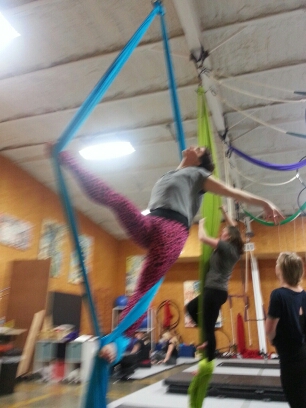
So that’s it, today. I’m going to go home, take a hot bath (in which I will read La Dame aux Camélias in the original, maybe), foam-roll my legs until they fall off, and then do some work stuff.
I used to think that my body dysphoria and anorexic thought patterns would never, ever, ever change. Now I’m not so sure, and that feels like a good thing.
À bientôt, mes amis!
Edit: PS, my ear behaved itself today. Woot!
The Show Goes On
Last night, I wrote about how sometimes living with bipolar feels like walking a tightrope; how the only way to survive is to keep your eyes up and keep moving forward.
Ballet is the thing that makes me able to do that.
This morning, getting up was a complicated, but I did get up, and I made it to class.
..And I’m glad we did, as we had four new dancers (new to class, not new to ballet), all of whom were quite good, and two of whom were guys.
Barre went well except for the double-rond-de-jambe-and-frappe combination, which went badly at first because I apparently brain-dumped it right at the start. I remembered it before we started the second side, though.
I also miraculously remembered how to sissone (though my turns … oy vey … my turns) and did the assemblé-sissone-chassé-jeté combination fairly well (after the first time, during which I failed to put my working foot down between the sissone and the chassé and turned it into some kind of awkward saut de chat).
In case you’re wondering, by the way, I think the entirety of that combination went:
assemblé (à droit, R foot back, no change)
sissone (avant)
chassé
jeté
assemblé (à gauche, L foot back, no change)
sissone (avant)
chassé
jeté
assemblé (à droit)
jeté
jeté
jeté
assemblé (à gauche)
jeté
jeté
jeté
…though I may be combining it with the other petit allegro combination we did (glissade-assemblé-jeté-hold; glissade-assemblé-jeté-hold; etc) come to think of it. Regardless, it was something very much like that.
In short: not difficult, but a mild brain teaser, since you have to get the directions of your feet right and there’s a little change of direction entailed in the sissone. It was also a nice-looking combination, and one of the new girls did lovely little battus on all the jetés on our first run.
It no longer feels weird to start a combination with assemblé
There is definitely a part of me that likes to show off or something in the presence of other male dancers (particularly when they are not so much better at dancing than I am as to make me look patently ridiculous). Today, it worked — my dancing was better overall than it was at any point last week, and although my turns were a tad wild and sloppy, they weren’t as horrible as they might have been.
It’s weird (if unsurprising) how much what’s going on in your head can influence your dancing. Saturday, even before the disaster with my ear, I was tired and achy and didn’t feel like I was going to acquit myself respectably, so I didn’t.
Today, I wasn’t thinking about any of that. Instead, it was like I had a little Japanese grade-school kid from some monster-battle anime series in my head saying, “Let’s do our best!” (“Jeté battu, I choose you!”)
Bizarrely, that worked. And we got to do saut de basques, which I lurve. And my assemblé looked good — high and suspended and not afflicted with horrible kraken arms or an unnecessarily curvilinear torso. So, huzzah. I suppose once I’ve had that nailed down for a couple of weeks, I should tried to put a beat back into it.
Because we do oceans of beats in advanced class, I’m really focused on using my inner thighs during barre, closing every tendu, degagé, and jeté by pulling the inner thigh muscles together instead of pushing in with the quadriceps (as if I was pedaling a bike or something).
When one uses the inner-thigh muscles, one tends to automatically engage both, maintaining alignment and placement; likewise, getting to a solid fifth between jumps is much easier.
Think: glissade to fifth, giant plié, brush out from plié, grand assemblé, for example. The working leg is carried by the momentum of the initiating brush, then the quadriceps (and some other muscles) in the supporting leg provide the spring; both legs are collected inward by the engagement of the inner thighs; the plié tension-loads the spring again; then a second brush (from the bottom of the plié) carries the working leg out and up, the quads (and related muscles) in the supporting leg push through to activate the spring; and the inner thigh brings the second leg up to meet the working leg.
Without the collecting movement from the inner thighs, a solid fifth position is unlikely; without a solid fifth, the grand assemblé is unlikely to be as … well … grand.
When one uses the quads, the body tends to shift towards the working leg, which pulls the balance away from the ball of the supporting foot. “Things fall apart, the center cannot hold,” &c.
As in cycling, the quads should be used mostly for pushing down; you need them to give you explosive power during jumps. When you pull in, you use the inner thighs; when you lift into passé, the impulsion comes from under the thigh and buttock. Incidentally, this also prevents that thing where your leg grips itself into a horrible spasm as you développé.
All this actually makes it much easier both to keep my knees straight and to maintain my turnout. It also makes maintaining balance and placement easier. I did the first set of fast degagés sans barre (7 each way x2; then pliés to relevé), though I did take the barre for the second set, which was really, really fast.
I guess I also need to get back to focusing on carrying my upper body directly atop my hips. This really imparts a surprising amount of lightness. I found myself doing this today as a function of not trying to look like a dork in front of the new dancers, and as a result, my work at center and going across the floor looked pretty good.
Aerials should help with that, as part of the problem is an imbalance between my back muscles (those “arabesque muscles” again) which are ridiculously strong (because I have spent a ridiculous amount of time cultivating a beautiful arabesque and a lovely, controlled penché), and my core muscles, which are not as strong (because I am lazy).
In short, this is what happens when we focus more on our strengths than our weaknesses … the weaknesses get weaker. Because I’m flexible and can get into a really nice arabesque as a result, I seize every single opportunity to use my arabesque.
Need a teacup on a high shelf? Arabesque. Need to hand something to Denis when he’s standing a half-meter or so away? Arabesque. Collecting Denis’ empty glass when he’s sitting on the sofa? Arabesque penché.
But do I work my core muscles anywhere near as much?
Hahaha. No.
Aerials are all about the core, though, so that will get fixed.
In other news, on the way home from class, I learned that David Bowie had died.
It was startling, in a way, because I was just listening to some of his stuff from Blackstar last night and thinking about how cool it is that he’s still creating and innovating in his late 60s.
Bowie contributed a great deal to the cultivation of popular music, and it says a great deal about his work that he will be sorely missed across several generations.
I don’t have much more to say about that right now, though. What do you say when an icon falls?
Someone I know on facebook said it best: Imagine the ticket lines in Heaven for the Bowie-Mercury reunion show!


 danseur ignoble