http://www.oursuperadventure.com/comic/21st-february-2017/
(In case you’re wondering, though, my cat sounds like he’s full of doves, not bees, so I assume he’s potentially less explosive.)

Wait, I thought that was “developpé,” not “cheesy taco pasta?”
That must be what they call it in Spaghetti technique…
http://www.oursuperadventure.com/comic/21st-february-2017/
(In case you’re wondering, though, my cat sounds like he’s full of doves, not bees, so I assume he’s potentially less explosive.)
I got cast! (And not the broken-bone kind 😁)
Next audition on my radar is ballet-related, but I’m not sure when it is. Dates haven’t been posted yet.
Today’s Notes from AOV BOLLET
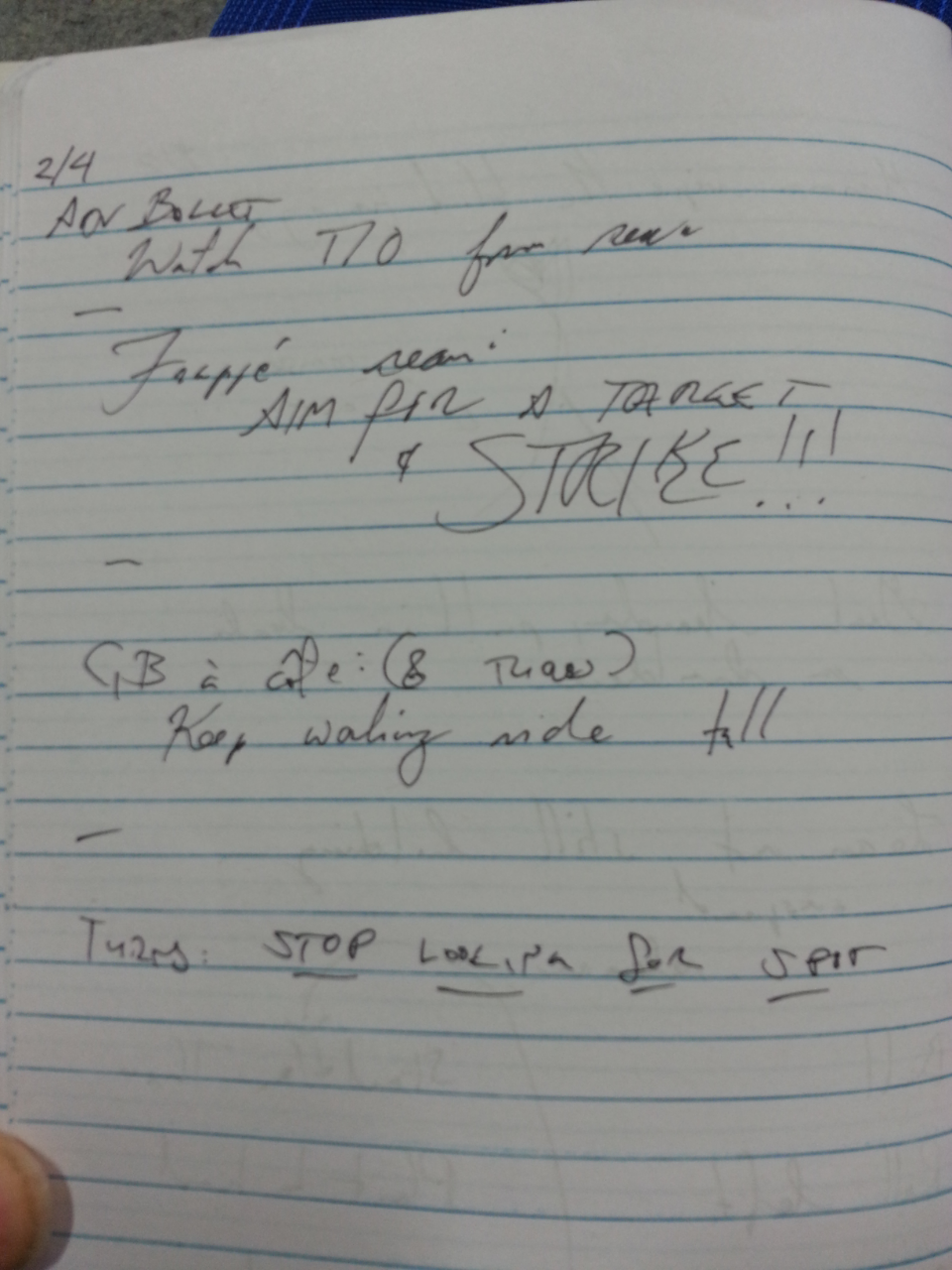
Yup. Makes perfect sense to me…
(The saddest part: this is more legible than usual. #FML)

The second in a series of posts on the details of technique that focuses primarily on steps I’m struggling with. Take it with a grain of salt.
I find it helpful to write things out in an effort to get a grip on them. These aren’t so much instructions (though if they work for you, awesome!) as observations.
Hi. My name is Asher, and I’m a baby-flinger.
Wait, wait, wait! I don’t mean it like that.
I have never literally flung a baby. Hell, I’ve (still) never even held a baby. Those things are terrifying. I reserve my child-handling efforts for those at least one year of age, and by then, they’re toddlers already.
What I mean is that I do crazy stuff with my arms when I’m doing turns. Sometimes, anyway.
And this isn’t your standard crazy stuff, like the traditional “winding up for the fast-ball pitch” method or the beginners’ special “just not even having any idea what to do with the arms in the first place” method. I’ve (mostly) overcome the fast-ball method and I don’t think I ever suffered from the “not having any idea” method(1).
No, this is something else. Something, erm, special.
So here’s the thing:
When you do turns, your supporting-side arm opens in preparation, then closes as you initiate the turn.
Your shoulders and hips stay together.
Your working-side arm does not then lead the supporting-side arm in a breakaway that basically resembles attempting to rock-a-bye baby right into space.
Me? I’m a baby-flinger.
Apparently, just as I get excited about piqué turns and sometimes wind up doing them as if they were some kind of insane piqué-jeté en tournant, I get excited about pirouettes and try to launch babies into orbit.

Clearly, they don’t need my help(2).
My supporting-side arm closes to meet the working-side arm, and then they both continue merrily along on a trajectory that throws the whole thing off kilter(3).
Obviously, this is a problem—and it’s one I never noticed before JP subbed for advanced class (because Nutcracker) and called me out on it.
Oddly enough, when I control it, turns are so much easier.
Now, if I was a Real Grown-Up™, I might just remember that my arms should stay with my body and not go sailing off on their own mission.
But I’m not. So instead, when it’s time for turns, I tell myself:
Don’t fling the baby!
It’s probably worth noting that I do a lot more of this when I’m turning from fourth or second. Why? Because those are POWER TURNS!!!!!!!!1111oneoneone1one
And apparently I am maddened by power. But with great power comes great responsibility—specifically, the more powerful the turn, the more responsible you are for NOT FLINGING THE BABY, for goodness’ sake.
If you’re having trouble with turns and you’ve already checked and found that you’re:
consider asking yourself, “Am I flinging the baby?”
Parents everywhere will thank you.
Or maybe they won’t, as previously noted:babies—those things are terrifying(4).
I forgot to note that, on Saturday, I finally got the thing where you tour lent/promenade just by scooting the heel.
Seriously, I thought I had this, but evidently I didn’t. When you’re doing it right, you really don’t have to bounce up onto semi-demi point.
On the other hand, you do have to engage the living daylights out of your turnouts and keep everything square.
Obviously, this is a topic for another post, but I thought I’d write myself (and you) a note about it so I don’t forget.
Florida’s Gulf Coast is home to numerous bird species, and the southwestern tip of the state is no exception.
An excursion by boat through the mangroves at the edge of the everglades reveals many species of long-necked wading birds.
For example:

The Roseate Spoonbill, a year-round resident that, like the pink flamingo, takes its color from small crustaceans in its diet.

The great white egret, an elegant shoreline bird that often appears as a solitary, ghostly figure in the marsh.

And whatever the hell this thing is.
The final specimen in today’s brief collection of wading birds may be the Lesser Dancing Nincompoop, a migratory fowl often found in non-linear disarray.
The Lesser Dancing Nincompoop spends most of its time in the American Southern Northern Eastern Midwest, but regularly ranges as far north as Chicago, Illinois, as far west as Nevada, and as far south as southwestern Florida.
Interestingly, though it is a non-native species introduced from the southern New England coastal corridor, it has not proven invasive. It has adapted reasonably well to life in the interior, though ornithologists suspect that its migratory habits reflect a yearning for salt water, open skies, and critical dietary elements like really good bagels and legit New York-style pizza.
Ornithologists also suspect that, like the Spoonbill and the flamingo, its color may be dietary in origin, and that it derives its pasty hue from the exoskeleton of one of its preferred prey species, the Lesser North American Baguette (a distant relative of the European variety endemic to France).
PS: These shots were all taken on a really cool 2-hour Everglades Eco-Tours boat tour this morning. We had a great time and learned a lot 🙂


YouTube: BOSU Balance Series



 danseur ignoble