Author Archives: asher
So, I Didn’t Miss NaNoWriMo After All
For some reason, I imagined NaNoWriMo was in October.
It’s not, so I’m going to attempt to finally finish the first draft of Strangers In The Land, which is the more strictly literary of the projects I’ve got going right now.
This will take some doing, as I’m wrestling right now with how exactly to tell the story in the first place (and with Not Going All Epic Ballet Fanboy, since one of my characters is a dancer).
The novel explores themes of love, betrayal, loss, and forgiveness (which is to say, I guess, the same themes as every novel, ever — sigh) … as well, I guess, as the concept of the ways one can respond to tragedy.
I’m debating whether to post it here as it progresses. Any thoughts?
Quick Update:
After today’s writing and revisions to existing material, I’m starting with a whopping 18,676 words behind me already.
Wow. o.O’
I do think I’ll post my work-in-progress here, but I’m going to give it its own category and page so it doesn’t clutter up the rest of my blog so much.
Ballets Tropicanos de Louiscarlo
First up, finally back in class … again. I’m going to Chicago this week, so I’ll be doing Wednesday Class at home, then classes at the Joffrey on Friday, Sunday, and Monday (and possibly Saturday, depending on plans).
Today we used contretemps (which is a fun little transitional step) for directional changes in a zigzaggy combination. I got the contretemps down beforehand, but didn’t nail it in the combination (I was, predictably, overthinking it).
I worked it out in the grocery store after. The lady who was stocking the drinks aisle probably thinks I’m crazy, but, you know: priorities.
In other news, we wore our tutu outfits for Hallowe’en, because why not? We also wore them around to the Hallowe’en parties at the various day centers where Denis sees his clients and brought much joy to all and sundry 🙂
One of Denis’ friends from work finally got a decent full-length shot of us, as well, so here you go:
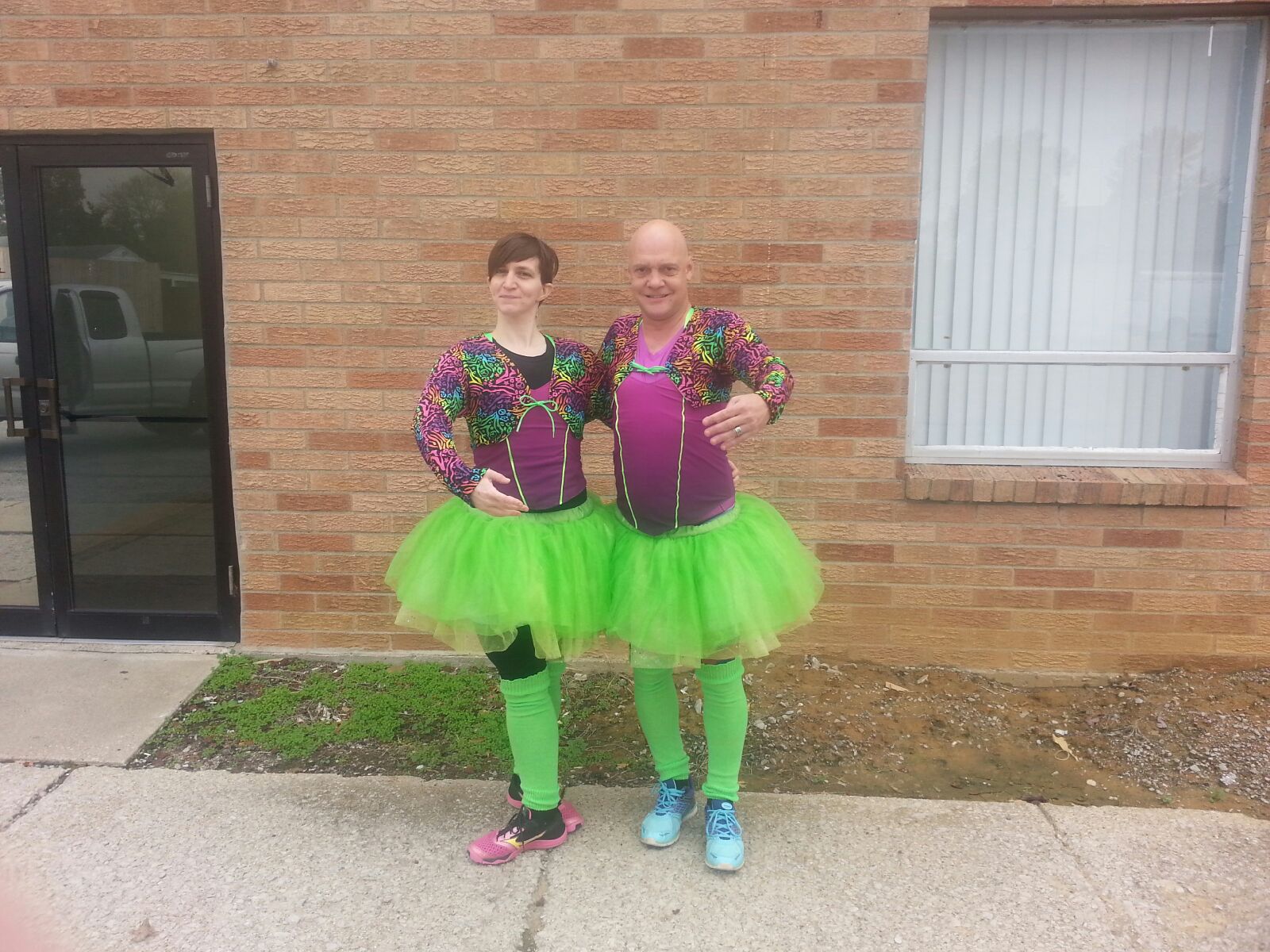
Our tribute to the Trocks!
I’ve dubbed us “Ballets Tropicanos de Louiscarlo.”
Please forgive my deplorable fifth 🙂
I feel like I should’ve gone all-out and done my makeup as well, but I didn’t know I was going til the last possible second, so I skipped it to save time.
In other news, I need a haircut, y’all. And Denis needs to get his shoulders down.
PS: The bodice, bolero, and tutu were all hand-made by Denis’ mom, Phyllis, and his aunt, Beverly.
They said that if anyone ever asks of they’d be willing to make another set, we should “tell them those ladies are dead.”
So mad props to all you costumery types out there who make (and maintain and repair) these for a living, because evidently tutus are a giant PITA.
Good Therapy, Bad Therapy (Maybe Part I)
I’ve had a bunch of both, and therefore I feel fairly qualified to say a few things about them, though I’m not going to try to claim that my experiences will resemble anyone else’s or that the lessons I’ve gleaned from them are universal.
But, you know. Just because my experiences are guaranteed not to be universal doesn’t mean that they might not be helpful to someone else.
So here goes:
- There’s therapy that’s actually going to fix things on a long-term basis, and then there’s therapy that’s basically Field Medicine — trying to keep you in one piece so it’s possible to get back out there and fight another day. Or another hour, or week, or whatever.
They’re very different things: which is to say that they might look exactly alike, and involve the same methods and techniques, but in the long run, they play roles as disparate as military field medicine and civilian obstetrics.
My first therapist, who was very gifted and who I adored, was stuck in the unenviable position of practicing Field Medicine Therapy. Maybe she couldn’t get me off the battlefield, so to speak, but she kept me patched up well enough to keep me going during that time. That was important work, back then.
When you’re stuck in a high-stress situation but are lucky enough to have good therapy, it often functions as Field Medicine Therapy. That means you might still need therapy (maybe totally different therapy) afterwards, and that’s okay.
Then again, you might not, and that’s okay, too.
- Some of the worst therapy I’ve had has been provided by PhDs (which doesn’t mean all PhDs are bad therapists; read on). Also some of the best.
Some of the best therapy I’ve had has been provided by people with Master’s degrees — and, in particular, by my current therapist, a great lady with a Master’s in Education (which is actually a reasonably common therapy credential in Kentucky due to our state licensure system).
It’s worth remembering that a PhD, at least in the United States, is a research-based, academically-oriented degree, and few US PhD programs in Psychology are actually aimed at producing therapists. Many are aimed at producing clinicians who are also academics, but not necessarily clinicians who practice psychotherapy.
PsyD programs, meanwhile, tend to be more practice oriented, but they also aren’t necessarily geared towards producing better therapists. Unfortunately, I don’t know a heck of a lot else about them, except the fact that they’re generally less oriented towards an academic career track and more towards a practice-oriented, clinical one.
So a PhD-level therapist isn’t necessarily going to be a better therapist than a Master’s-level therapist — which isn’t to say that PhD- or PsyD-credentialed practitioners can’t be awesome.
Just that you’re not getting short-changed if your therapist doesn’t hold a doctorate of some kind.
- Some of the worst therapy I’ve had has been provided by very good people with the very best of intentions.
I was really pretty angry for a long time at some of the practitioners who were responsible for my care when I was in high school.
It’s been long enough now that I’m comfortable stepping back and recognizing that, while at least one of them was a complete dick (who was asked to resign from her position after an episode of particular dickishness), most were good people doing the best they could with what they had. They were also unwittingly practicing field medicine; sending me back every time I walked out the door into a situation that, at the time, was pretty harmful (though the worst part was behind me by then and, ironically, took place in a gap between therapists).
That didn’t make it easier to cope with at the time, but it does make it easier to forgive them now.
As does, I suppose, knowing that whatever damage might have been done by therapeutic decisions that led to unforeseen consequences (hellooooo, meds), I do to a great extent owe my life to the people who did their best to take care of me when I was in high school.
But it was still terrible therapy … and they were still good people.
- The best therapist for you might not be the best therapist for someone else.
The best therapy for you might not be the best therapy for someone else.
Heck, sometimes, it may not even be possible to delineate what’s therapeutic about the best therapy: while my current, brilliant therapist is influenced by the classical talk-therapy school, including the practical (but not the weird theoretical) ideas of Freud, I’d describe her style as eclectic.
Often, we just Talk About Stuff — but somehow the Stuff we talk about is real stuff even when I manage to walk into a session manic as a crack-addled ferret and convinced that Everything Is Just Fine.
And, while I couldn’t outline exactly how she’s done it, D. has operated as a mirror of fresh insight in a way that has been transformative for me in a way that no other therapist has (in part because even my best prior therapist, who I adored, was practicing field medicine).
And this is a lady with a Master’s in Education, so once again, if you’re worried about credentials … sometimes the best credential is a jillion years of experience and a recommendation from someone you, the patient, trust.
- Like school, therapy is something you pay for.
That means that if your therapy isn’t working for you, you’re totally allowed to speak up about it.
And if your therapist is a jerk, you’re allowed to fire him (or her; jerky therapists come in all sexes, sizes, etc). You’re even allowed to fire your therapist (and, one hopes, find a new one) if your therapist just isn’t a good fit for you. Sometimes that happens.
True, as with school, therapy is something that isn’t going to work as well if you don’t do your end of things.
That said, as with school, if you’re not doing your end of things, you might be over-faced — and it’s okay to say, “I’m not ready for this level yet; I need to step back to therapy without fractions and work on the basics some more.” I have totally done that, and my therapist totally did not kill me.
Also as with school, you’re not doing your end of things just because, you’re screwing yourself outta money! Why you wanna do that?!
But if you’re doing what you can and it’s not working, it’s okay to speak up.
- Therapy doesn’t have to be forever, but it doesn’t have to not be, either.
It’s okay to stop, then start up again, or cut back, then step it up again. It’s a service.
If it helps, you can compare it to physical therapy: you might start physical therapy to address some kind of longstanding muscle imbalance, get that sorted over the course of therapy, be fine for a while, then end up with an injury (maybe even one that causes the old problem to re-surface) and need another course of therapy.
That doesn’t mean that the original course of therapy didn’t work, or that you don’t deserve the new course of therapy.
Likewise, sometimes you might get assigned a course of physical therapy and not actually do the exercises for whatever reason (which as TOTALLY NEVER HAPPENED TO ME, okay? I am the BEST PHYSICAL THERAPY PATIENT. …Um, is my husband looking?). So that therapy might not work as well as it could have, and you might need to try again later. Your physical therapist might be all, “Did you do your exercises?” … but she’s not actually going to kill you, and if she’s really good at her job, she probably won’t guilt-trip you, either.
Good psychotherapists kind of work the same way. They don’t guilt trip you about not doing those million leg lifts, or whatever their psychotherapeutic equivalent is, between back when you finished your last course of therapy and now. They just help you get down to work.
- Lastly, good therapy is not always easy to find.
People can be really judgmental if you’re not in therapy and maybe you should be.
Those people are jerks, and you can tell them I said so.
Even though I just said bad therapy was nonetheless partly responsible for saving my life, bad therapy can also be worse than no therapy (you could make a physical therapy analogy here, too: a bad physical therapist, especially one who’s heavily invested in some trendy new modality, can seriously hurt you and leave you needing way more physical therapy than you did when you started).
Sometimes you just kind of have to do what you can and forego therapy until you find a good therapist.
And that’s okay, too.
You gotta do what you gotta do.
So that’s all for now.
Again, your mileage may vary (and, in fact, it may vary enormously, which is also totally okay) … but I hope some of it might be useful to somebody, somewhere.
Touching Back on a Point About Bipolar
Recently, another blogger linked to my post, “Bipolar As Unexpected Gift?”
I haven’t read the linked post yet; I’m not in a great place for dealing with controversy (of which there may not be any).
That said, there are a couple of points that I think are really missed in my post — for a couple of reasons.
First, I didn’t invest a great deal of clarity in them, because the post in question was never meant to be anything but a reflection on a very surprising experience of mine (that of finding that there were good outcomes in my life — especially my marriage — that stem from the effects of Bipolar disorder on my decisions and experiences).
Second, the title is unfortunately close to the kind of thing that apparently gets out there a lot — happy-clappy New Age bull about accepting and making the most of mental illness or whatever cross one bears in life; seeing it as a gift and not as a tragedy.
I wasn’t aware of those articles when I wrote my post.
Anyway, the points in question are these:
First, when I used the word “as” in the title, I didn’t mean “as only” — quite the opposite. I had been struggling with a lot of bitterness; a lot of pain about the things Bipolar had taken from me. I can’t remember now what led me to realize that there were also things it had given to me. So the word “as” in the title doesn’t mean “as this and nothing else.” Not at all. It means “as this, surprisingly enough, along with all the other stuff it is.”
Western culture likes things to be black and white, either or: thus, if any one of us points out a way in which Bipolar has been beneficial, there are many outside the Bipolar community who will choose to see only that. “If it can ever be good, it can’t be bad, right?”
But that’s not how life works. Sometimes an ocean of bad manages to bring along with it a teaspoon of good. No, the good doesn’t invalidate the bad — not by any means. But neither does the bad invalidate the good — and hanging on to the good is one of my survival strategies.
Which brings me to the second point I rather failed to address back then: in this battle, there’s no One True Way. My experience with Bipolar Disorder is, by necessity, different from yours, and yours from mine. What works for me might not work for you.
So when I comment on the surprising experience of finding that there are good things in my life that wouldn’t have been without Bipolar Disorder, know that I don’t expect you to feel the same, or judge you in any way for however you do feel (okay, full honesty: if you regard your Bipolar Disorder as an unequivocal good and insist that others should do the same, I’m going to at very least shoot you a long, stern, professorial look with bristly eyebrows — feel how you feel, but don’t tell other people how they should feel; that is so not cool).
So there you have it.
I don’t see Bipolar as only or even as mostly a gift, and however you see your Bipolar, I honor that, too.
Grand Allegr… Oh.
Today, we had a sub whose name I didn’t catch, but I really enjoyed her class.
Especially the part where she asked us if we wanted to repeat the adagio, and I said, “Yes, because adagio is what I’m worst at.”
… And then did the adagio pretty well, actually, but totally hosed up half of the grand allegro (because I discovered, as we began, that I’d completely blanked on the first two steps of the combination).
Oops.
Oh, well.
I did, in fact, enjoy the class immensely, though.
We did jeté battu, which I did right once or twice and wrong, um, once or twice. Totally had one of those moments in which upon finishing the combination I turned around to trot over to my water bottle and the girl behind me caught my eye and we both kind of made faces and laughed at ourselves. I am going to have to work on jeté battu. It’s really not hard, you just have to convince your “supporting leg” (which is, of course, in the air at the time) to stay still. Only the working leg beats. This is not brisé volé.
This was the first class in a while that I’ve done without Adderall (forgot to take it, because ADHD + depression), and it was really interesting. My mind wanders a lot more without Adderall, which makes it harder to catch combinations when the person giving them talks slowly. Likewise, my language processing seems more likely to take a backseat, which probably doesn’t help.
The final combination joined Sissones and grand allegro, and I was able to remember that there were two “vanilla” Sissones fermées followed by a Sissone changé (AKA the coolest Sissone) to attitude, then tombé, pas de bouree, glissade, pas de chat; then a directional change into tombé, pas de bourée, glissade, saut de chat, but couldn’t for the life of me remember whether it began with Sissone avant or arrière, and I still don’t know. I just flailed my way through, as per SOP.
All of my pas de chats looked good, though, because evidently I am the king of pas de chat.
Also, we all managed to be together on every. single. pas de chat. Which, if you ask me, looks impressive. To be fair, by this time, we were down to three dancers, so not quite as impressive as if we’d still had eight pas-de-chat-ing in perfect synchrony.
But impressive enough. More so because we were also all on the music (my flailings notwithstanding), so we all launched and landed exactly together.
Magic, people — magic!
(Today’s lesson: if you must flail, try to flail on the music, so when you get to the bit you remember, you’ll be ready.)
My turns, on the other hand, were mediocre, including one highly mediocre double (but a double nonetheless). I basically left all my thoughts about Balanchine technique at home.
Incremental gains, I guess.
Dancing always does a great deal to improve my mood, and so it was today. I’m feeling a lot better than I did yesterday.
Also got a new shirt for class, and it’s perfect. w00t.
So that’s it for now.
Keep dancing, dancers.
Getting By: Food
Occasional forays into the world of fast food notwithstanding, most of the time, I eat pretty well — blah blah, varied diet, lots of fruits and vegetables, lean proteins, cook from scratch, etc. I can’t really gloat about that, by the way; it just happens that if you made a Venn diagram in which one circle represented “foods I really like” and the other “foods I find easy to prepare” basically includes all that stuff. I am lazy; I like leaves, therefore, salad.
I don’t bother my pretty head about the hot micro- or macronutrient of the moment, I don’t place anything off limits (except walnuts and their relatives, because I’m deathly allergic); there are just some things I eat less often and/or in smaller portions. If I want to eat steak, I eat steak; if I want to eat cake, I eat cake (isn’t that a Cat Stevens song?). Consistently excellent basic health indices — blood pressure, pulse, cholesterol, triglycerides, etc — confirm that this strategy works just fine for me.
When I’m struggling with Bipolar crap, though, sometimes that goes out the window. Depressions represent the tanking of, among other things, dopamine levels and the attendant ability to perceive pleasure. Manias represent … jeez, who even knows, let’s call it wild over-activation of so many systems … but they obliterate the small capacity for planning and patience required by my normal diet.
What this boils down to is that, sometimes, I more or less live on bread and butter for days. Denis is my saving grace; usually, I have to feed him at least once a day, so I generally manage to feed myself as well … though sometimes what I feed us is macaroni and cheese from a box, because that only requires one pan and, like, twelve minutes.
Meanwhile, I find baking bread pretty therapeutic. It’s one of the few things I can reliably do during depressions and manic episodes — there’s a lot more stomping and cursing involved during mixed manias, but even then it still gets done almost every day. I’ve baked enough bread now that it’s essentially an automatic process (though when I tried to bake bread while still fighting off the dregs of my most recent illness, I was sufficiently out of it that I forgot to add yeast).
A few minutes ago I was “woefully wonder(ing) why, my dear” (because depression) I have abandoned actually eating real food in favor of sort of grazing on bread… and then I realized, “Oh, right. Depression.”
And then it occurred to me that, while it’s not an ideal solution, it’s one that gets me by, and I guess that’s okay.
Depression can be reductive like that.
Personally, I don’t believe that worrying about what you “should” or “shouldn’t” eat is a very effective strategy in the first place — it’s much better to work your way in, cultivate a taste for a group of more health-sustaining foods, and allow yourself room for foods that other people might call “bad,” but less often and perhaps in smaller portions, if you find they’re affecting your health. Arbitrarily declaring foods to be “bad” and “off-limits” is far too often a recipe for cravings and disaster.
The acute phase of any depression, meanwhile, renders the whole point moot. If you’re someone who just plain can’t eat anything except bread (or chocolate, or boxed mac-and-cheese, or things prepared by other people, or curry takeaways) during the worst parts of your depressions, there’s a good deal of sense in doing so.
Better to eat a ridiculous, unbalanced diet for a few weeks (or even for years) than to starve to death — especially if something within that ridiculous, unbalanced diet grants you even a little pleasure.
Every drop of pleasure counts when you’re fighting a tidal wave of depressive anhedonia (in short, because neuroscience). That argument breaks down a bit when you’re talking about things that can swiftly create much worse problems — acquiring an addiction to a substance that can wreck your health overnight probably isn’t really going to help, for example, so it might not hurt to try to avoid doing that, if possible … though it’s not always possible; it’s not always as simple as “just saying no” when you’re trying to reach the other end of the tunnel alive.
Which, I guess, is kind of what I’m saying. Like physical illness, acute episodes of mental illness take the niceties of life off the table. The idea is to survive; you can sort the collateral damage later on.
So if you’ll excuse me, I’m going to go eat some bread and creep one day closer to the light at the end of my tunnel,which I hope won’t turn out to be an oncoming train.
Some Days, Bipolar Wins*
Monday was kind of, in many ways, one of those days for me. Yesterday was also kind of one of those days, though it was exacerbated by the fact that I couldn’t sleep on Monday night, took a sleeping pill at 3 AM, and woke up … um, kinda late.
Today started out feeling like a Bipolar Wins kind of day: I woke up at 8 AM, said, “F*** a bunch of life right now,” and went back to sleep, which is uncharacteristic.
Later (at 9:30, when it was too late to leave on time), I woke up again and berated myself about how I could have and should have gone to Wednesday class, and how I am never going to accomplish anything I am trying to accomplish because I’m apparently constitutionally incapable of being consistent, &c.
And then I read for a while (because that’s one of the things I can do even when I’m depressed) and then I got out of bed and took a bath and read in the bath for a while (because that’s another thing I can do even when I’m depressed) and then I decided to shove myself out the door and finish up the yard work that we started working on this weekend.
That felt like a small victory. When you’re really, really depressed, you can’t even shove yourself out the door. Sometimes, you can’t even shove yourself out of bed.
Anyway, while I was out there in the yard, chopping and bundling bits of the trees that Denis cut down because they were growing too close to the house and feeling sorry for or maybe about myself, something occurred to me:
Some days, Bipolar Wins, and that just kind of how it is, and that’s okay.
Right now, my goals feel a billion miles away. I’m not making it to ballet class on the schedule I “should” be. I’m only writing intermittently (but, on the other hand, wow, have I made some progress in the past month). I’m only sort of on top of the housework, which I guess is progress, actually?
A lot of the time, I wake up and think, “What’s the point?”
A lot of the time, I don’t want to go out into the world because my social persona is so, so very far from who I am right now.
A lot of the time, I’m frustrated by my own lack of forward momentum — or, well, of continuous forward momentum. Like, when I have moment, OMG, do I have momentum … but then when it goes away, it’s gone. For a while.
And then I have these moments of clarity and insight, these moments in which I understand that this is who I am, when I remember that trying to fight my own nature isn’t going to really solve the problem.
I can beat myself about the head with a stick all I want, but it isn’t really going to accomplish anything.
So often, resources written by people without Bipolar treat these moments of clarity as if they should, like, magically solve the problem — and I think that’s because, for a lot of non-Bipolar folks, they do.
Like, often, if you can identify and begin to understand a problem you’re experiencing, you can begin to solve it — but Bipolar Affective Disorder kind of doesn’t work that way.
This is where all that psychobabble about acceptance comes in handy (if not easily, because our minds like to resist things like that, and I think BPD affects cognition in ways that only increase that resistance).
I think that, in the past, I’ve seen acceptance as a synonym for “giving in” — that I’ve seen it as the equivalent of telling someone who’s just had an amputation at the knee, “You can forget about running marathons.”
Yeah, well — it turns out that amputees can run marathons if they darned well please, thank you very much.
I am trying to learn to accept that BPD makes me inconsistent; makes me constitutionally unable to really be consistent in the way that I might have been if I didn’t have BPD, or maybe if medication was a more workable option for me — while also remembering that the inconsistency inherent in my existence doesn’t mean I’ll never do the things I’ve set out to do.
What it does mean is that I’m good at getting back up when I fall down (you guys, I have had a ton of practice at getting back up when I fall down).
What it does mean is that it takes me longer to reach my goals, maybe, than it would take someone else. My Original Life Plan was School => High School => College/University => Write some books and who knows what else?**
It didn’t actually work out quite that way. It was more like:
School => Mental Breakdown => Psychiatric Hospital => Psychiatric Hospital High School => Non-Residential Psychiatric Hospital High School => Arts Magnet High School => Win A Bunch of Scholarships and Walk Away Anyway Because I Just Couldn’t Even => Wander Around In A Haze For A While => Pick Up A Few Community College Credits => Moar Wandering => Computer Networking Certification => Work At One Job I Loved (Playing With Horses And Getting Paid For It!) => Move Another 79 Times => Work At a Few Jobs I Mostly Either Didn’t Like or Hated => University => Well, Here I am.
I’m actually kind of in a better spot than I’ve ever been, in one regard: I have something more closely resembling a long-term vision of What I Want To Do When (If Ever) I Grow Up. Dance-Movement Therapy! Writing! Baking Bread! Ballet! Choreography! Art! Maybe a PhD in Neuroscience! Definitely Travel!
The thing is, it’s probably going to take me longer to get there (wherever There is) than I want it to … and the road might look a lot different than I think it’s going to look.
The hard thing is knowing that, in the darker places, I won’t remember this.
Maybe I should make it into a poster and stick it on the wall, like one of those affirmation things.
Come to think of it, maybe I should make a bunch of those, because (even though I know they work for a lot of people, and I am total not judging) they make me feel really silly, which makes me laugh, and anything that does that is worth keeping in your anti-depression arsenal.
The long and short of that is that accepting the limitations that come with Bipolar disorder means, for me, being willing to countenance the fact that I’m going to have to take different routes than I thought I would; that I’m probably going to have to arrange my work and creative life differently than I expected to (not, to be fair, like I ever had much of a set of expectations about having a traditional work life; that hasn’t really been one of my major goals, to be honest).
The overall output of my creative spark might be smaller in volume than it otherwise would have been. That doesn’t mean it will be less significant (though it feels weird to think of myself as someone whose creative work will harbor any significance at all in the world — but that’s a topic for another time, as I always seem to be saying).
Meanwhile, I need to stop panicking when I fail to make it to class for a week or two. That is the nature of the beast, and it doesn’t mean I’m not eventually going to absorb all the stuff I need to learn. Over the course of ten years, it doesn’t even mean it’s going to take all that much longer (if anything, sometimes I come back from one of these unexpected Mental Health Breaks and discover that something I was struggling with has magically sorted itself in the gap).
I’m not sure how to wind this all up. To some degree, it’s just a reminder to myself; just me thinking out loud, as it were, in this 21st-century-specific way we have of thinking out loud now.
To some degree, there’s something that feels New and Important about these thoughts — not in the sense that they’re New and Important in a universal way, because, like, All of Buddhism has had this down for centuries. It’s just that I feel like I understand this stuff in a way I haven’t really understood it before, which I guess is what Life and Adulting and stuff are all about.
It’s all leaves of the lotus or layers of the onion, depending on whether you prefer boating or cooking, I guess.
So there you have it. Ten years from now, as long as I keep dancing, I will be ten years better at dancing than I am now; ten years from now, as long as I keep existing, I will have ten years’ more experience and wisdom under my belt — and that will be the case even though I am going to take breaks, and fall on my butt, and generally be a screw-up sometimes because that’s how I am; that’s how my Bipolar is.
So there you go.
Some days, bipolar wins — but usually, in short, it’s not the end of the world.
Mixing It Up
At my studio, we’re ostensibly proponents of the Paris Opera school — which isn’t to say that we think Paris Opera is The One True Ballet, just that that’s the style that the company employs, so that’s (technically*) what we study in class.
That said, I owe much of the improvement in my turns to Balanchine’s technique, and I feel that’s worth ruminating on a bit.
I am not the world’s greatest natural turner — not the worst, either, but in a world where we tend to be stronger either in jumps or in turns, I am definitely in the “jumper” group.
In short, my problem is that I tend to approach turns in the same way that I approach jumps — that is, with rather a lot of athleticism (read: power and momentum). When jumping, it’s easy to translate that power and momentum and make it do what it’s supposed to do (most of the time, anyway) — curiously where even jumps that involve turns (tours en l’air and jetés entrelacés, for example) are concerned.
I suspect that it comes down to elasticity — when you begin a jump with too much force and momentum, you can pretty easily channel the excess without losing grace and élan and all that stuff. When you execute a turn with too much force and momentum, there’s less wiggle room — more or less literally.
When turning, I tend to apply way, way more force than is entirely necessary — and I tend to apply it in a way that knocks me off my axis.
It’s easy to power through a fast single turn — or even, once you get the hang of it, a fast double turn — that way**. You won’t look as good as the best turners in the class (because you’ll probably be turning with your back arched and you’ll be slightly off your axis) but you’ll look all right if your basic technique is clean and you have good legs and feet. You can complete the turn before things go terribly awry, so you probably won’t fall out of your turn or, worse, fall over.
When it comes to adagio turns, though, an excess of power and force — especially an excess of power and force that throws you off your axis even a little can really hose things up for you.
This is where Balanchine technique comes in.
Mr. B’s technique is famous for its emphasis on the UP.
When you see Balanchine choreography done well, the jumps tend to be very vertical, whilst the turns are precise, tight, and … um … tall, I guess?
Not that almost any turn, ever, should fall away from the vertical in ballet — but the strict emphasis Balanchine’s technique places on the vertical forces dancers to pull straight up, the way you’re technically supposed to anyway, without the shoulders breaking back from the central axis***.
I will be the first to admit that my worst fault in turns is still (STILL!!!) a tendency to throw my head and shoulders back in my preparation. In short, that’s part of what I do with the excess of force and momentum.
I give it a big ol’ DERP HO! and try to eject it through the top of my head by throwing everything back from the shoulderblades up.
Needless to say, this is not what one might call Best Practice.
The funny thing is that, when I’m thinking about (and attempting to emulate, because sometimes ballet instructors like to mess with us) Balanchine technique, I don’t.
Instead, I keep my core pulled together and pull UP — which, coincidentally, makes it much easier to turn, since I’m not then creating a situation in which the very laws of physics are going to knock me off my leg.
Oddly enough, under those conditions, it’s suddenly quite easy to execute lovely, precise turns — even adagio turns (true fact: ever since I figured out how to do adagio turns without falling apart, I do them all the dingdangdarn time, because they’re impressive — they even feel impressive).
So, anyway. This is a thing I discovered during one of our brief excursions into Balanchine technique, and I think that’s worth noting.
A lot of us get really invested in studying one method or another (though this is less common for adult students, who often wind up taking a grab bag of classes at different studios), but each method offers something we can use.
Of course, there’s something to be said for developing a sound foundation in one method — it makes learning the basics easier (remember that thing about third position arms versus fifth position arms?).
There’s probably also an important Life Lesson here about Diversity and Learning From Unexpected Teachers and so forth, but I’ll let you glean that bit yourself.
As for this post — it’s something I’ve been thinking about. Once you’ve got the basics down, branching out and taking a class that’s couched in a different method (or even, gasp, a different discipline, like modern dance! *swoon*) might be a good way to patch up some of the holes in your technique.
Just, you know, make sure your instructor knows what she’s talking about, and stuff, the way you normally would.
That’s it for now.
Dear Internet
… I suspect you may have reached Maximum Irony when you first offered up what sounds like a great recipe for nut-free fruitcake…
… and then suggested TOPPING IT WITH ROWS OF NUTS*.
>.<
*I realize that this is, in fact, a totally valid configuration for people who aren't allergic to nuts and maybe just want their fruitcake to really, really feature the nuts.


 danseur ignoble