Author Archives: asher
Danseur Ignoble: Saturday Class with Claire and a Turf Toe
I banged my toe at PlayThink last Saturday, optimistically assumed that it would be Just Fine by Monday … then Wednesday … then yesterday.
Perhaps unsurprisingly, it wasn’t. Today, though, it was okay enough to get through barre, adagio, and a bit of across-the-floor. Claire forbid me to do any work en releve, which was a good call. (I also opted out of jumping.)
You guys, it turns out that when you’re used to having free access to releve, remembering not to use it is, well, disconcerting.
Nonetheless, I barred and adagio-ed and semi-gracefully made my way across the floor, substituting where I could, otherwise just leaving stuff out.
…Okay, and occasionally stumping around like an old-fashioned pirate with a peg-leg, yarrrr (you guys, I don’t think that’s what they meant when they named that one ballet “Le Corsaire”). Because apparently attempting to avoid using that one foot in those specific ways just makes me do weird things sometimes.
![Le Cors-arrrrrrrr. (With apologies to By Fanny Schertzer (Own work) [GFDL (http://www.gnu.org/copyleft/fdl.html) or CC BY-SA 3.0 (http://creativecommons.org/licenses/by-sa/3.0)], via Wikimedia Commons)](https://danseurignoble.com/wp-content/uploads/2015/06/le-cors-arrrrrrrrrrrr.png)
Le Cors-arrrrrrrr. (With apologies to Fanny Schertzer (Own work) [GFDL (http://www.gnu.org/copyleft/fdl.html) or CC BY-SA 3.0 (http://creativecommons.org/licenses/by-sa/3.0)%5D, via Wikimedia Commons)
It was interesting. Some parts were great. Some parts? Frankly awful.
Still, I got to focus on my upper body more than usual, and that was cool.
Today’s primary correction was a refinement of the ever-present “fix your chest” thing. I’ve got the “lift the sternum” bit; now, I’m working on keeping the whole column of my body together.
I’m better at this at some times than I am at other times. When I remember it, my turns are much better.
I couldn’t do turns on the left (supporting) foot today, but I could on the right, and they were good. Also, fun. And I didn’t do any of them the wrong way (though, to be fair, we didn’t do any combinations that involved both turns en dedans and turns en dehors).
The highlight of today, for me, was the work we did on using pique arabesque in combinations more gracefully. That was particularly cool, because it’s a thing I’ve been thinking about and (before I screwed up my foot) working on at home.
I nailed that a couple of times on the right supporting foot; I kept running into a mental block on the left because I had to do it flat.
Today I noticed one more useful thing: I need to stop looking at the freaking mirrors, because I throw myself off. Not all the time, but often enough. I have heard tell of whole companies where they rehearse with drapes over the mirrors for exactly that reason, so at least I’m not alone 😉
That’s it for today. If you have the chance, do some extra balances and turns for me!
Gender and Stuff: Even When You Opt Not To Wade, The Water’s Still There
For an intersex person who was, at one time, pretty deeply involved in activism, I actually don’t spend an enormous amount of time thinking about questions of gender and so forth. But that doesn’t mean that those questions aren’t out there, thinking of me.
The ocean’s always there, whether or not you get in.
Last year, I came to the understanding that there are people in the world who can’t detect the effects of privilege because it’s really freaking hard to see the privilege you have. (I think I’ve talked about this before.)
I came to this conclusion, in part, because of ballet and my experiences at the ADTA conference (and also because of my experiences as a presenter at academic research conferences).
Being a guy in the ballet world is kind of like experiencing male privilege on steroids. Being a guy at a conference full of polite, well-educated, socially-conscious dance-and-psychology people was much the same.
In both conditions, you’re not just a guy (or, in my case, to add layers to the problem, a conventionally-attractive white guy from a privileged socioeconomic background, etc.), you’re a guy and a unicorn, and everyone is automatically really, really nice to you so you won’t go away … and if you aren’t hip to what’s going on, you’ll just think everyone’s really nice to you because you deserve it (because that’s how we are, as humans: when we’re treated well consistently, we tend to operate on the driving, if oft-unconscious, principle that we deserve to be treated well).
In both conditions, you’re frequently surrounded by women — intelligent, thoughtful, creative, energetic women, but still women who have been brought up with the same unspoken rules, the same pressures, as all women are in this culture.
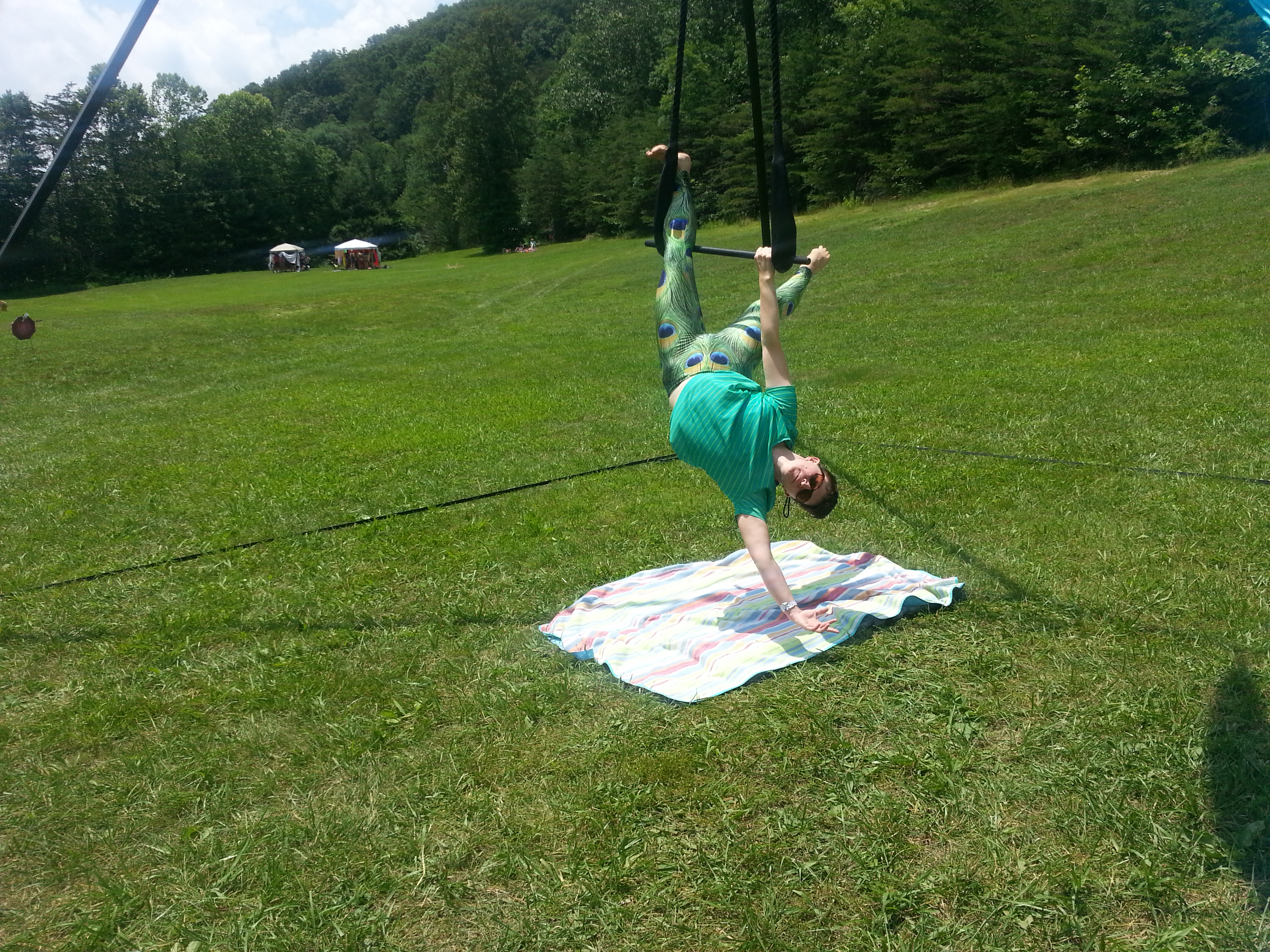
Or, like, these tights.
When you open your mouth, things tend to get quiet. They tend to stay quiet until you’re done talking (and, if you’re me, and you have difficulty using a small number of words to say a thing, that can take a while).
If you’re not paying attention, you might just assume everyone thinks that what you’re saying is really awesome, and they really want to hear it — when, in fact, there’s this weird cultural thing where women are very much conditioned not to interrupt men.
Even scrawny little gay dudes in silver tights.
That doesn’t mean that women don’t really want to hear what you have to say, but it does mean that there’s a barrier, for them, when it comes to grabbing some talk-time for themselves.
Not that they physically can’t, of course.
I grew up in a highly-intellectual, debate-crazed Yankee family, and let me tell you — women can interrupt and drone on and talk over you just as well as men, provided — and here’s the critical thing — that their cultural backgrounds allow for that possibility.

A typical dinner-table chat in my childhood home. (Image: Lee Hawkins [CC BY 2.0 (http://creativecommons.org/licenses/by/2.0)%5D, via Wikimedia Commons)
The thing is, for a lot of women — I would even say for most women (in the United States, at least) — that’s not the case.
Just like a lot of women of a certain generation would never have imagined that they could swing a kettle bell or out-judo the guys or run marathons. Like, it wouldn’t have occurred to them to even think that there was a thing out there that they could do that they weren’t doing. It wasn’t in the realm of possibility.
Worse, even if the concept of running into the verbal lists a-swingin’ that verbal mace exists in the realm of possibility, for a lot of women, it’s something they’ve been taught to see as insufferably, unbearably, abominably rude. (I agree that, at times, it can be.) Worse still, it’s something that many of the same women have been taught to tolerate in men, but not in themselves.
And it’s something a lot of men take for granted (meaning, we don’t even think about it; we don’t even know it’s there) as a right for ourselves, and will accept as simple repartée from other guys, but about which we feel immensely affronted when women do it to us.
So, culturally speaking, while sisters are, in fact, entirely capable of doing it for themselves, it really helps if dudes make a little effort (and if we don’t, like, wall them into a cultural oubliette, and stuff).
Like, we can help by learning to shut up sometimes and let someone else talk, and by learning to notice those cues that say “Hey, I am about to open my mouth and say some stuff that I think is important, or at least I would if you would shut the hell up for a second*.” Amazingly, it’s not even that huge a pain in the ass (which is to say, it’s hard, especially if for those of us who have trouble processing verbal and non-verbal information at the same time, but you don’t really lose anything except the chance to hear yourself droning on and on all the time like a complete jerk).
I say all this as a preamble to another discussion entirely: that of the question of gender, and of gender identity, and of the problems that have cropped up around the Caitlyn Jenner issue.
These are waters in which I tread lightly, because my experience is, well, weird. (What, me, weird? That never happens!)
As an intersex person, I am acutely aware of what it’s like to live in a body that (in some ways) doesn’t match my internal sense of identity, and (in other ways) doesn’t match other people’s expectations of who and what I am and wouldn’t no matter how I identified.
I am also aware that it’s painfully difficult to try to express why I identify as I do.
As a neuroscientist-in-the-making, I’m acutely aware of the complexities of the human brain and of the problems that tend to crop up when people who don’t have even the fairly minimal degree of expertise that I have try to make statements about causation**.
As a social-justice wonk (and, again, as an intersex person), I am acutely aware both of the problems with living in a world that demands that people’s bodies conform to pretty strict ideas of which parts go with which label and of honoring the experiences of people, especially people who have experienced real oppression, where questions of identity are concerned — whether or not those experiences have anything to do with transgressing broadly-accepted norms.
There’s a lot of noise being made right now about Jenner’s declarations about having always wanted to be able to do things like wear nail polish and participate in “girls’ night” and about her choice to reveal her post-transition self in an ultra-conventionally-feminine photoshoot.
A lot of people have (rightly) pointed out that being a woman isn’t about wearing nail polish, corsets, and frilly clothes.
Part of the problem, though, is that while we’re really good at defining what being a woman or a man isn’t about, we’re actually terrible at defining what either of those things is about.
Some of the answer, of course, involves shared cultural experience: most assigned-at-birth women have, unfortunately, cultural experiences of oppression that many transwomen don’t experience before transition.
Some transwomen, for example, know what it’s like to have lived their entire lives with the constant fear of being attacked or raped if they venture out on the streets at night (this is a thing that also happens to people who are perceived as male, especially if they are perceived as transgressing against normative conceptions of masculinity) — but many won’t know that fear until after they transition, and some will never know it at all.
Some transwomen, likewise, have been treated with less respect by peers prior to transition: hell, I’m not a transwoman, or any flavor of woman, and I am still routinely perceived as less intelligent simply because I am perceived as feminine — not female, just feminine, effeminate, whatever***.
However, I wouldn’t remotely begin to argue that my experience is comparable to that of, like, most women in our culture (maybe a few, who have grown up in more-progressive enclaves and not been exposed to too many idiots, I guess?).
The flavor of my experience is different; so is its relative ubiquity (broad swathes of gay men may automatically assume I’m an air-headed twink, but a lot of people might unconsciously assume that an “Asher” is going to know more about brains than an “April.“).
In the overall context of my life, the impact is smaller. There’s less crap, and there’s more cushion.
Likewise, women bear the burden of our guilt-ridden reproductive-rights mess, which, as a whole, isn’t really a thing for transwomen in our era (they can be allies, of course, but will never have to worry about the burden of deciding how to handle an unplanned pregnancy).
But any ask any woman if she thinks those are the only things that define what it is to be a woman — if oppression and struggle are the sum total of Woman.
Go ahead.
I’ll be here with an ice pack for you when you get back from having some sense knocked into you 😉
After you recover, go ask a woman about the good parts of the definition of “woman.” Then ask a few more women, and a few more.
I suspect you’ll get a lot of different answers — and that a lot of them will be applicable to what it means to be a man, too, when it really comes down to it.
A lot of them, probably most, will be just as applicable to people who can’t bear children (for whatever reason) as people who can (by whatever means). The vast majority of them will have absolutely nothing to do with genitals.
…Which, it turns out, kind of becomes a problem for anyone who is ever pressed to explain why they identify as one gender or another.
This is absolutely a question I’ve been asked, by the way — even by other gay men, who I would expect to have at least some concept. Like, seriously, “Why would you choose to live as a gay man, when you could just be a woman instead?”
Well, gosh, Kevin — I dunno. Maybe just because? The fact that my genitals are sufficiently ambiguous that I could legitimately check either box really has nothing to do with it. (To be fair, this is not a question that I’ve ever heard from someone who had known me for more than about five minutes; it’s really one of those questions you tend to reserve for imaginary people.)
I don’t, by any means, “choose” (if you can even put it that way) to live as a man because I like monster trucks or Hooters girls or sportsball.
Okay, so I am capable of appreciating monster trucks from time to time (primarily, I’ll admit, as vehicles of irony), and I’ve known a few Hooters girls who were really cool people: but that’s beside the point. As for sportsball … meh. Who wants to sit down long enough to watch that stuff?
I used to like playing lacrosse, though, because I was good at it and could smack the crap out of people with sticks. Does that count? Oh, wait, girls can like that stuff, too.
And my sister is a huge American football fan, so there’s that.
Likewise, I don’t like Mauy Thai, neuroscience, or big honking boots because I think guys should like them. Kicking people in the face is fun, neuroscience is fascinating, and big honking boots are both sexy and functional (and, on someone like me, delightfully transgressive and occasionally ironic).
And, obviously, that whole ballet thing, and my fondness for tights and glittery stuff and sparkly things … those just kind of throw spanners into the works, don’t they?
So why do I identify, and live, as a male?
Who the hell knows?
Our culture kind of requires you to pick a box. That’s the box that feels better for me.
Sure, I break its “rules” all the time, because conformity for conformity’s sake is boring, and the vast majority of the “rules” in question are fairly arbitrary cultural diktats (seriously; there are plenty of places in the world where tons of dudes wear pink, and entire countries where guys wear skirts, and so on and so forth ad nauseam).
I would say that I abide by some of them: be bold but courteous, respect the elderly, protect the young, hold the door, don’t hit anyone weaker than yourself unless you really have no other choice — but those aren’t just rules for men, now, are they?
Likewise, I recognize that the mere ability to break the rules reflects its own kind of privilege. I would take a lot more flak for flouting the rules if I came from a different background, lacked education, if I wasn’t skinny (okay, so I’m crossing the streams of social problems, here), or if my skin was less pale.
In the end, I’m only able to make these observations about privilege and about the elusive substance of gender because my background framework allows it: I have been doing this for long enough, have been answering and examining these questions for long enough, that I’ve realized that most of the answers which most of us give are basically crap.
Which is, by the way, what you get when you ask a crap question.
That’s basically the first rule of code: Garbage In, Garbage Out.
I rather doubt that Caitlyn Jenner chose to transition because she thinks liking nail polish and sparkly things makes her a woman. I will own that I haven’t devoted as much time to poring over her story as, apparently, most of my compatriots — but I do seem to recall that Jenner tried the alternative where you keep living as a dude but sometimes don frilly clothes and so forth.
Likewise, it’s deeply unlikely that she’s just all that burningly curious about the hallowed sanctum of the ladies’ room (there are easier ways to be a creeper than spending thousands of dollars on surgery and having to put up with crap from every quarter of your nation’s culture about it), or whatever else people assume about transwomen these days (curiously, one never hears the argument that transmen just want to gain access to hallowed male spaces so they can ogle our underage sons, even though it’s much easier to ogle people in the gents’, where we are expected to conduct the greater part of our business without walls and doors).
Chances are, like most of us, Jenner isn’t great at articulating the why of the whole thing.
That’s something that’s still a mystery. That doesn’t mean it’s an invalid experience (nor does it mean that Caitlyn’s experience of being a woman will be anything like it would if she had been born with a female body).
If you’d asked me, when I was a little kid, whether I felt like a boy or a girl, I would’ve said, “Boy.”
If you’d asked me why, I would’ve shrugged.
That’s still pretty much my answer. To be honest, it’s about the same answer you’d get from just about any non-trans, non-IS person if you asked them.
Little kids are pretty up front about it. Conversations tend to be like:
“Why do you want to be a girl?”
“I dunno, because I am. *shrug* Can I go on the slide now?”
Or even:
“Why do you want to be a girl?”
“I am a girl, silly! Boys are stupid! Wanna watch me jump off the high dive?”
Requiring a better “reason” from trans people (and, by extension IS people, because we are always in a freaking awkward spot — locus of both relative sympathy about our “right” to identify one way or another and of parental and medical panic about our unique bodies) is, in short, a double standard.
It’s just one that can exist because most people never have to think about their own sense of gender in that way.
In short, it’s a privilege****.
By the by: the one thing that does really sort of drive me crazy about the whole Jenner thing is that nobody seems to be commenting on how Jenner’s existing privilege has allowed her to do things that, frankly, would very likely get a lot of transfolk killed, like transitioning in Really, Really Public Public; how her existing privilege and fame will continue to provide a cushion of privilege on which she’ll be able to float, shielded from the staggering array of crap that the average trans person will have to deal with from moment to moment on any given day.
Yeah, twenty years ago or more, she wouldn’t have been able to do what she’s doing now, and that’s cool; likewise, it’s cool that she’s increasing visibility for tans folk and that a cultural conversation is happening that was only kind of marginally happening before … but there are still problems with Jenner as an icon of trans experience.
Treatment: A Series About What I’m Doing And Why
This title should really come with a long caveat: I’ve taken meds for both ADHD and bipolar in the past, so what I’m talking about here, in part, is why my treatment approach prioritizes the medical management of ADHD over the medical management of bipolar.
I initially meant to just write a post about my treatment protocol; about what I’ve chosen to do (for now) and why. When I started writing, I realized that this is going to have to be a series.
It seems like a good idea to begin with an explanation of what, exactly, I am doing treatment-wise.
I believe deeply in the power of complementary medicine: that is, harnessing both medical (including evidence-based naturopathics) and non-medical treatments.
The difficulty with complementary medicine is that it’s not easy — or, rather, it involves the investment of research and time.
By its nature, a sound complementary approach must be carefully designed to suit the needs and circumstances of any individual patient. Many doctors and patients are hard-pressed to find the time to do that; moreover, not all of us are in positions that allow us to.
It also really helps, as a patient, to have (or to be able to acquire) the background in scientifically-sound research practices that makes it possible to tell a sound study (and, thus, pretty reliable data) from an unsound one.
This, by the way, is one area in which I am eternally impressed with the overall community of mental health patients — perhaps because our conditions are still stigmatized and still, in many cases, under-researched and under-publicized, we tend to be very proactive about doing our homework. Likewise, those of us with solid academic research backgrounds tend to act as advocates and guides for those of us who don’t have as much experience, and I think that’s awesome.
In that same vein, though, complementary medicine tends to require a lot of participation from each individual patient.
It’s not a great solution for someone who just wants or needs to take a pill (or a few pills) and forget about it.
Historically, I’ve been kind of judgmental about that — but the reality is that, for a lot of people, being able to just take a pill (or even a handful of pills) is what is most workable.
Each of us has the right to do what’s most workable, and it isn’t fair for me to make judgments about what makes things workable or not workable for other people (unless they ask me to, and give me information from which to make sound inferences, and so forth!). Ultimately, it’s all about quality of life. If the medication-first approach is less onerous and provides better quality of life, that’s absolutely the right way to go!
What works best for me — that is, what strikes the best balance between usability, disease-management, and quality of life — isn’t going to be the same as what works best for someone else. That’s okay.
That’s one of the cool things about human beings: we’re all different. Sure, sometimes it makes life complicated, but it also makes life interesting.
Likewise, especially where bipolar is concerned, mood-stabilizing meds are an essential first-line therapy for a great, great many people.
Moreover, as with some antipsychotics in the treatment of schizophrenia, mood-stabilizing drugs (a class in which I’m including, for this discussion, both classic mood-stabilizers and also atypical antipsychotics) can prevent some of the brain changes associated with the disease and decrease the long-term likelihood of dementia.
This is something that Denis and I discussed very seriously when we were deciding how to manage things from a medical angle. The research that could determine whether other therapeutic approaches prevent this stuff hasn’t really been done yet. That’s a risk that, for now, I’m going to have to take (to be fair, it’s a reasonable one: there is absolutely no history of dementia in my family, even in the folks who had bipolar or bipolar-like symptoms).
I have had very serious problems with mood-stabilizing drugs in the past, which I’ll outline in my next post — problems which make taking them more debilitating than not taking them.
For me, mood-stabilizing drugs amount to a non-cure that’s worse than the disease, though if it ever gets back to a point at which it’s use them or die, I have given Denis the power to make that call for me (since, by that point, I wouldn’t be in any position to make that kind of decision for myself).
Moreover, they haven’t worked very well for me, and the side-effects (loss of equilibrium, loss of dexterity, tremors, and mental fog, in particular) kept me from doing the things that do work.
Thus, for me, the goal is to avoid mood stabilizers for as long as possible, which means (if I want to keep my brain in one piece) doing a metric crap-ton of research and using every other tool I can lay hands (or toes) on to keep it together … and still accepting that a day may well come on which I will have to go back to taking mood stabilizers anyway.
Each approach comes with benefits and challenges: more medication-focused approaches tend to bring more side-effects into the picture, while a less-medication intensive complementary approach involves a lot of effort, a lot of management, and no small amount of risk. For me, the drawbacks of the more medication-focused approach (debilitating side-effects) outweigh those of the less-medication-intensive approach (a heightened risk level; reduced day-to-day stability).
As an adult in a stable, mostly financially-secure relationship with no children, the risk is something I can afford.
I might feel differently about it if there were kids — especially small children — in the picture.
I grew up with a father whose volatile mood swings were so terrifying to me that, at one point, I opted not to participate in overnight visits for several years. To be fair, his alcoholism greatly exacerbated the problem. After he stopped drinking (and started using mindfulness and other tools to manage his moods), my Dad became someone I enjoyed being around — but little kids, especially, need predictable worlds to live in, worlds in which actions and consequences are linked in ways that make sense as frequently as possible.
I know that, even with my relatively-successful treatment model, there are still moments that the chain of reasonable reactions breaks. I may not be inclined to become abusive towards people or anything, but it’s still scary to be a kid and have no idea why your parent is foaming at the mouth in the general direction of the refrigerator. Likewise, it’s scary to be a kid whose parent goes from cucumber-cool to stark-raving-furious with no apparent transition time. That’s a thing I’m working on, but some of it’s the result of brain chemistry. Mood-stabilizing drugs could combat that tendency.
I might also feel differently about it if I had to be the primary breadwinner: if, tomorrow, Denis developed some kind of illness that prevented him from practicing, I wouldn’t be able to be as selective about the work I do and so forth, which would in turn expose me to many more destabilizing forces and stressors that I currently avoid through lifestyle management. Mood stabilizers might become pretty important in that sort of situation.
So what, you might wonder, does my particular complementary approach look like?
First, I do take fish oil as a mild mood stabilizer, an approach that has seen empirical support in academic research settings. It does seem to help in my case. It’s not perfect, but it’s a good compromise.
Second, I take the generic form of Adderall IR (the immediate-release version), which both helps to manage the executive-function function problems that come with my ADHD and actually, very much to my surprise, helps keep my moods on a much more even keel.
…So much so, in fact, that I’d really like to do some research into the question of whether other people with both rapid-cycling Bipolar I and the “predominantly-hyperactive type” subset of ADHD experience similar effects (I’m also curious about the biochemical differences between those of us with predominantly-hyperactive ADHD and those with the predominantly-attentive flavor).
I really didn’t expect that effect. Adderall is a psychostimulant, and psychostimulants are absolutely capable of precipitating mania in people with bipolar disorder (I have certainly experienced that effect with caffeine). When I started taking it, I was entirely prepared to have to stop for exactly that reason; likewise, my doctor started me out on a pretty low dose to avoid that eventuality.
However, for me, Adderall’s IR formulation behaves in a really interesting way: it both keeps my mood more level (in short, prevents emotional perseveration) during its effective period and makes me freaking tired as all heck when it wears off.
I have a literally lifelong history of insomnia — I slept little as an infant; in preschool, my pediatrician decided that I should be prevented from napping (not that I was sleeping during nap time anyway) in hopes that I would sleep at night; all through childhood and adolescence, I rarely fell asleep before 2 AM; etc. I still find the notion that my 7-year-old nephew just turns off like a light at bedtime absolutely incomprehensible.
The only reliable solution to my insomnia, historically, has been sheer physical exhaustion — which is pretty hard for me to achieve (and was essentially impossible to achieve when I had a desk job). It’s also a diminishing goal post: the more you exercise, the more exercise it takes to achieve exhaustion.
Adderall, bizarrely enough, does the job nicely. It wears off, and I feel tired — often, tired enough to get to sleep at an hour that resembles the hour preferred by the vast majority of my fellow humans. Considering that my brain, left to its own devices, wants to sleep from 2 AM – 10 AM or from 3 AM to 11 AM, that’s no small accomplishment.
Sleep, in turn, is critical to preventing mania for me (this is why any of the extended-release ADHD meds are off the table for me, as far as I’m concerned: fortunately, the generic form of Adderall IR is about the cheapest option going).
For me, sleep deprivation tends to lead very quickly into mania (this is true for most people with bipolar disorder). The less I sleep, the more hyperactive and manic I become, until suddenly I’ve been awake for nine days (yes, seriously, that’s my record) and I think I can conquer the universe, or whatever.
Thus, something that keeps my moods a bit more level during the day and actually allows me to sleep goes a long, long way towards preventing the largest peaks and valleys.
Denis says he does still notice fluctuations in my mood, but their amplitude is significantly smaller. I tend not to notice my upswings (except for the really black ones; dysphoric, agitated mania is very, very hard to miss), so I can’t really speak to that, but I do find that my depressions are less severe and less persistent: my brain just plain doesn’t get “stuck” in low spots as easily.
Likewise, the ability to get more done in the day and just keep my crap together a bit better (the ultimate goal of ADHD meds for most of us who take them) reduces stress, which in turn reduces emotional instability. Stress is huge destabilizing factor for me.
Third, I exercise. A lot.
“A lot,” for me, doesn’t generally mean thirty minutes a day, five days a week. I’m talking about hours every week — a typical Wednesday morning involves a thirty minute bike ride, a ninety minute ballet class, and another sixty-minute bike ride. I also spend much of my time on my feet, doing stuff, when I’m at home. I do all this stuff because I like doing it. I am happiest when I’m moving.
“Exercising a lot” used to mean just riding the bike a lot (like, upwards of two hours a day, in addition to the time I spent running errands and commuting), but I learned a couple of summers back that too much “just riding the bike a lot” can lead to waaaaaay too much sun exposure, which can lead to dizzying manias followed by really, really black depressions.
Now I dance. Getting back into ballet has been immensely helpful. I still get a ton of exercise, but the amount of sun exposure is controllable.
I don’t think ballet by itself would manage my mood, but I think it is, to an extent, the key piece in the whole puzzle — or, if you will, the lubricant in the machine.
Without dancing, the system doesn’t exactly break down right away. For a while, it chugs (and then creaks) along — and then, eventually, it fails.
Fourth, and perhaps most importantly: I am in a position that lets me make choices that in turn allow me to avoid stressors which precipitate episodes of mood destabilization.
This is a privilege. I am absolutely aware of that. It shouldn’t be one, but it is.
I wish every single person living with serious mental illness had the same privilege, because it makes a world of difference for me.
There are entire career paths that I look at and just say, “Nope, that flavor of stress is a huge trigger; not worth it.” Likewise, I’m in a position to consider the relative flexibility of various career paths.
Almost as importantly, I can say no to social invitations when I’m in a spot where the excess stimulation might send me up-spiraling, and I don’t feel obligated to take on social obligations that might get in the way of taking care of myself during difficult periods.
Likewise, it is, ultimately, the real crux of my whole system. It’s the reason that I hesitate to tell anyone else, “You should try what I’m doing!”
I am only able to do this because I’m lucky.
I get that.
Fifth, I pay attention to how things I put in my body affect my mood, and I try to respond accordingly.
Bipolar disorder is a disease of emotional regulation in the brain. The brain has trouble sticking with a nice, stable, basic mood; meanwhile, it all too easily gets stuck in low or high spots. When it’s going up, it doesn’t know how to stop until it hits some critical threshold; then it tends to crash all the way back to the abyssal depths.
The things we eat and drink can help or hinder the brain’s efforts to regulate itself.
Alcohol, for example, is a central nervous system (CNS) depressant. It may make you feel giddy and happy when you’re using it (then again, it may not), but from a biochemical perspective, it’s the opposite of a stimulant.
Under normal conditions, I can have a drink or two without worrying too much about it — but that’s it. Any more upsets the balance of my biochemical apple cart — and it can take days or weeks for my brain to recover its equilibrium; days or weeks in which I experience hellish depression. For me, it’s not worth it.
Caffeine, meanwhile, is a CNS stimulant.
It’s one I seem to have a beastly time processing, as well: an Adderall IR tablet taken between noon and 2 PM will wear off and leave me ready to sleep by 10 or 11 PM; not so much a Diet Coke or a cup of coffee.
Between sleep disruption and stimulant effects, more than a little caffeine quickly begets mania — and it seems that there’s a threshold beyond which there’s no backing down, for me. Up to a point, the conflagration can still be prevented; beyond that point, the flames are going to engulf the entire house before they die back.
Needless to say, I try to manage my intake of both caffeine and alcohol pretty carefully. The alcohol part isn’t hard — Denis and I are barely even social drinkers. Most of the things I do socially (ballet, cycling, creative stuff) don’t usually involve alcohol.
I say “usually” because our longest bike rides often end with a celebratory beer, and some of the more casual ones begin with a celebratory beer — but on rides that begin with a beer, more than one or two isn’t an option anyway. I wouldn’t be able to ride after that.
The caffeine part, historically, has been harder, because caffeine is so ubiquitous.
If you’re out for lunch, for example, and you want a drink that has flavor but not sugar, your options are generally iced tea or diet cola, both of which come with a fairly sizeable caffeine hit. Likewise, for me, the impact of one delicious cup of coffee is disproportionately strong relative to that of one delicious post-ride beer.
When possible, at restaurants, I order plain soda water with a twist of lime or lemon (at home, we drink mostly decaffeinated tea, plain soda water, or just plain water).
There are some foods with which I like plain, still water; beyond that, though, I simply accept that sometimes I’m going to drink some unsweetened iced tea or diet coke, and I try to plan accordingly. (Sugared beverages — including 100% juices, which are still basically liquid sugar — tend to screw with my blood sugar levels, so I avoid them almost all the time. The exception is the rare bottle of Mexican Coke during a lunch break on a long — like 50 miles or longer — bike ride.)
Beyond that, I just eat what I like — so a lot of fresh vegetables, raw spinach, raw cabbage, carrots, quinoa, all the tomatoes, eggs, and so forth, but also smoked white turkey hot dogs (which I prefer to regular ones), chorizo, pizza, and a little ice cream here and there. When I get a rare chocolate craving, I go for it; likewise, when I’m craving salt, I go find something salty — my body wastes salt, so in my case I’m usually craving it because I actually do need it.
For some people, certain foods screw with brain chemistry; beyond the blood-sugar issues that lead me to mostly avoid high-GI foods, I’m fairly lucky in that department. I do count calories, but more often than not it’s to make sure I’m eating enough.
Sixth, my half-baked mindfulness practice.
Like most people with ADHD, I am not a master of meditation. I am pretty good, though, at living in the present moment (this may be the sole benefit of living in Golden Retriever Time: while I’m capable of worrying about the future and obsessing about the past, I can’t while I’m doing anything else, especially anything physical), and the ability to think about my thinking that Adderall has afforded me has allowed me to reflect on what I’m thinking and feeling in ways that I haven’t been able to until now.
That’s a pretty cool development.
Adderall allows me to monitor my moods in ways I haven’t been able to in the past, which lets me check in with Denis about them when I think things are getting out of whack. That, in turn, means we can take action to try to mitigate any manic fires before they get out of control and to use whatever means are necessary to haul me out of a depression before it gets too deep.
Adderall also facilitates both those processes.
Initially, I felt weird about this “Adderall-as-mindfulness-tool” thing: specifically, it kind of felt like cheating. Then I realized that it basically boils down to the fact that, for most people, learning mindfulness is kind of like seeing over a fence that’s just at eye-height; it isn’t automatic, but it can be done with a bit of effort (and a little releve!). Me? I’m standing in a hole. Sometimes I can jump and get a glimpse over the fence, but that’s it. Adderall gets me to ground level. I still have to make the effort once I’m there.
I can’t claim any formal daily meditation practice, but I use mindfulness techniques frequently in daily life, and they help.
Seventh, I try not to be too obsessive about rules.
There are a few that I know don’t offer much leeway: sleep, for example. I really do have to be pretty rigid about sleep.
Beyond that: if I screw up, if things go off the rails … well, that’s part of life. I grew up riding horses, and we accepted falling off sometimes as part of the deal. That didn’t mean that we didn’t work to become the best riders we could, and to hone our abilities to reduce the likelihood of falling off — but it’s a thing that happens.
I build wiggle room into my diet.
I accept that sometimes I’m going to forget to take my Adderall.
I recognize that once in a while I’ll bang my toe coming off the lyra and have to take a few days off from ballet and cycling.
I understand that sometimes I’m going to overdo it being a social butterfly and sometimes I’m going to avoid the entire human race for far too long when I shouldn’t.
I accept that I really actually like diet cola and sometimes I’m going to drink it; I accept that I really actually like beer (hello, Koshihikari Echigo Rice Lager), and sometimes I’m going to drink that, too. I accept that I like the occasional glass of wine with dinner (though not at home; we don’t drink enough to make buying bottles worthwhile).
I accept that my current treatment modality may be only for now; that somewhere down the road, mood-stabilizing drugs may become necessary.
I’m not sure what I’ll do if that happens: like I said before, I don’t take them now because my quality of life with them was worse than it is without. I hope that I could adapt; that I could learn to live with them, but I don’t honestly know.
I accept that, too. It’s uncomfortable, but being upset about it isn’t going to change anything. Sometimes reality is uncomfortable, and while often we can do something about that, sometimes we can’t.
I accept that this current equanimity is a result of the fact that I’m experiencing the longest period of relative (though still bumpy) euthymia I’ve ever experienced, and that I will feel differently at times.
One Last Note
I realize this probably all sounds like a lot of effort. If it was a program that was being prescribed to me, at least, I would think that it did!
In truth, though, this approach mostly takes advantage of my own basic nature; the rest has been implemented a little at a time.
It’s kind of like counting calories: it sounds onerous, but that’s not how I experience it at all. It’s just a habit, a thing that I do. If you’d told me, five years ago, “You’re going to try to note down every single calorie you eat for the next five years,” I would almost certainly have mentally kicked you in the shins. Taken as a whole, that task sounds impossibly huge. Taken in itty-bitty pieces, though, it’s amazingly doable: “Present doughnut, only doughnut.”
Likewise, sometimes I forget, but the fact that I can see that as no big deal and just get back to it when I think of it really helps.
In some ways, the fact that my system of treatment has a number of different parts is a good thing for someone like me. It’s more flexible: when, inevitably, I forget to do one piece on a given day, the rest keeps on going pretty smoothly. I have to either forget one piece for several days in a row or forget several pieces all at once for things to fall apart completely.
Excepting exercise, no one part of this system really requires sustained effort — and exercise is a kind of effort I enjoy. If “sitting behind a desk for 8 continuous hours per day” was part of the system, it probably wouldn’t work as well for me.
Now that I’m pretty familiar with my own individual stress tolerances, stress-related decisions are fairly momentary. My last few semesters in school, I made a lot of decisions based on that premise: can I handle these three classes together? What if I add this one? What if I also do this other thing? The consequences of those decisions may have taken months to unfold, but the decisions themselves were momentary.
If you told me, “YOU CAN NEVER HAVE CAFFEINE AGAIN!” I might actually cry. Well, probably not, but I’d definitely give you a swift mental kick in the shins, and then I’d sulk. Not so much because I love caffeine so much (I can take it or leave it), but because never is a difficult word (and also because you’re not the boss of me, nyah, and you’re not so big :P). On the other hand, on any given day, at any given present moment, choosing not to drink coffee or cola or whatever is no big deal.
I don’t think about not drinking Diet Coke forever; I just think about what I’m drinking right now.
Obviously, that sort of thing is harder where actual physiological addictions are concerned (which is another reason I’m careful with caffeine — I have had to wrestle a serious caffeine addiction a couple of times already; not looking forward to doing that again). For me, in that department, an ounce of Keep That Stuff Away From Me is worth a pound of Betty Ford. It just helps not to think of it as, “I’m not doing this ever.” Because “ever” is a really freaking long time.
Anyway, so that’s the basics. Sorry this is so ridiculously long. I have a lot more thoughts about this topic, and I could keep on writing for hours (growing less and less coherent with each keystroke), but I think this about gets it down.
Next time (whenever that is, because Golden Retriever Time), I’ll write more specifically about my choices with regard to meds.
Future Installments:
Drugs
My experiences with mood-stabilizing drugs have been, in a word, awful. There are a lot of ways in which they interfere with critical parts of my well-being; likewise, there are ways in which they interfere with critical parts of my treatment plan — and they don’t work terribly well for me.
Behavioral Neuroscience
Some thoughts about why things might work for me; maybe also some thoughts about why the things that work for me might not actually work for everyone.
Life: A Little Reminder from the Universe
Sometimes the Universe steps in and reminds us where we’re supposed to be going.
On Thursday last week, I finished my first aerial hammock class and said to Denis on the way back to our camper, “That makes me feel really happy.”
He said, “You always feel happy when you’re moving.”
This meshes nicely with last week’s (umptillionth) heretofore-unannounced revision to my long-term plan, in which I first discovered that one does not necessarily have to effectively complete a second master’s if one first completes a stand-alone master’s program and then goes for a doctorate, then decided that maybe doing a DMT Master’s (or a counseling or clinical psych Master’s with concurrent DMT cert) first would be a good idea after all, rather than diving directly into a doctoral program and attempting to do the alternate-route certification concurrently.
PlayThink was yet another reminder of the things that make DMT such an ideal fit for me: I love moving; I love helping other people connect with themselves through movement; I don’t want to sit behind a desk; I don’t want to have to wear normal clothes (seriously, if you’re choosing a career path, that’s something worth thinking about: Do I want to spend my entire day in khakis and a tie, or in lycra? As much as I like getting dolled up in a sharp suit, I’m happiest in dancewear).
There’s another point, though, that I didn’t quite get until this morning. I’m going to take the long way ’round to explain it, because words.
Last night, I was pondering and feeling strange about an experience I had at PlayThink; about how a guy (Brandon, if I didn’t hear him wrong) who I barely knew embraced me and just held me for a long moment with a singular intensity and, strangely enough, it didn’t freak me out (that was the part I felt strange about — the not-freaking-out part). I’m still, generally speaking, quite protective of my own body, but for whatever reason, in that particular moment, I was able to just let go and experience and enjoy that physical connection, that closeness (for which, if you ever happen to stumble across this blog, thank you, Brandon!).
I wanted to talk to Denis about it, but was struggling with how to explain all the feels (in fact, I still can’t really articulate how I felt or still feel about that particular experience). I said, “I want to talk about something, but I’m having a hard time explaining it.”
Denis smiled and said, “I always kind of think it’s funny when you say that, because it’s always hard for you to explain things.”
I laughed, then, because he was right: I really struggle to explain anything (even my blog posts get a lot of revision, most of the time), especially abstract concepts.
Feelings are the hardest. I have trouble figuring out how to describe them using the abstract vocabulary of emotion — but I can dance about them … and, oddly enough, often moving my body helps me figure out which words to use.
Moreover, moving with people makes me feel connected to and comfortable with them in ways that nothing else does. The sense of instantaneous trust I felt towards Brandon resulted at least in part from our participating together in an activity that involved movement, cooperation, and spontaneity. It reminds me of nothing so much as the first group improvisation warmup that we did in Linnie Diehl’s Intro to Dance-Movement Therapy intensive last November at the ADTA conference!
I suspect that connection, that sense of trust that stems from moving together, may be one of the greatest tools that DMT can offer. For those of us who struggle with language and for those of us who struggle with trust, there’s a profound potential there.
That trust is a sacred one. In a way, that same sacred trust suffeses the work of dancers, of aerial artists, of acrobats. There’s a connection that runs deeper than words that we can find when we move together.
It all sounds very mystical, but even mystical experiences occur in the realm of neuroscience (and, in fact, the domain of the liminal, mystical mind is one in which neuroscience as a field is very interested!).
I don’t know, yet, precisely where my journey is taking me, but that is ground I very much hope to explore: first, in the experiential sense, connecting with other dancers, with other artists, and someday with other DMTs and with DMT clients; second, in the scientific sense, trying to understand how our experience of that physical, movement-based connection which bypasses words takes place on a neurobiological level.
DMT as a modality is a good one for me to practice because it takes advantage of my own native language: I’m a physical being first and a cerebral one second, and that’s okay. I realize that this is a huge part of why I am much more confident and social in the ballet studio; why I felt so confident and social at the 2014 ADTA conference; why, at the end of PlayThink this year, I didn’t hesitate when more than one near-stranger bypassed my proferred handshake and went in for a hug.
As for the present tense: maybe I’ll stop trying to describe my experience with Brandon and, instead, I’ll try to dance about it.
A Very Tardy Update
Last Wednesday, I wrote out my usual class notes but never got around to posting them because we jetted off to PlayThink Movement and Flow Arts festival right after class.
To summarize: I made it through all of class last Wednesday; mostly kept my proverbial waterfowls in a linear array during barre; managed some rather nice center adagio; did rather well going across the floor to the right and somehow lost the combo going left (qv: threw in an en dedans turn where there should have been an en dehors turn and my brain clicked on and proceeded to hose me up completely — I repeat: THERE IS NO THINKING IN BALLET); nailed some entrechats quatres; and didn’t get the medium allegro combination down (in case you’re wondering: when you’re tired, it’s a good idea to mark the combo, because your brain alone might not catch it).
While we were in Florida, I did a lot of tendus, frappes, and degages in the water, as well as some grand battement. That made a big difference to my speed during petit and medium allegro last week. It would be awesome to have regular access to a pool in order to work on that stuff!
At PlayThink, my goal was to gain some more exposure to aerial apparatus. Terri and Cindy from Turners were back again this year, and they’re both great teachers (Terri, in particular, reminds me of Brienne :D).
Last year, we only got to try stationary trapeze because of timing issues. This year, we got to try:
…aerial hammock:

Cindy led a great aerial hammock class. Here, she’s showing me how to get into a forward balance (once you get to this point you take your hands off the hammock; I don’t have a picture of that, though). I didn’t get pictures of the coolest parts, since Denis was in the other group on one of the other rigs at the same time.

Denis points out that it looks like Cindy is doing a stage magician’s levitation trick with him, here 😀
…lyra:

Mermaid with a slightly-broken line: I should’ve brought that arm up just a tad higher
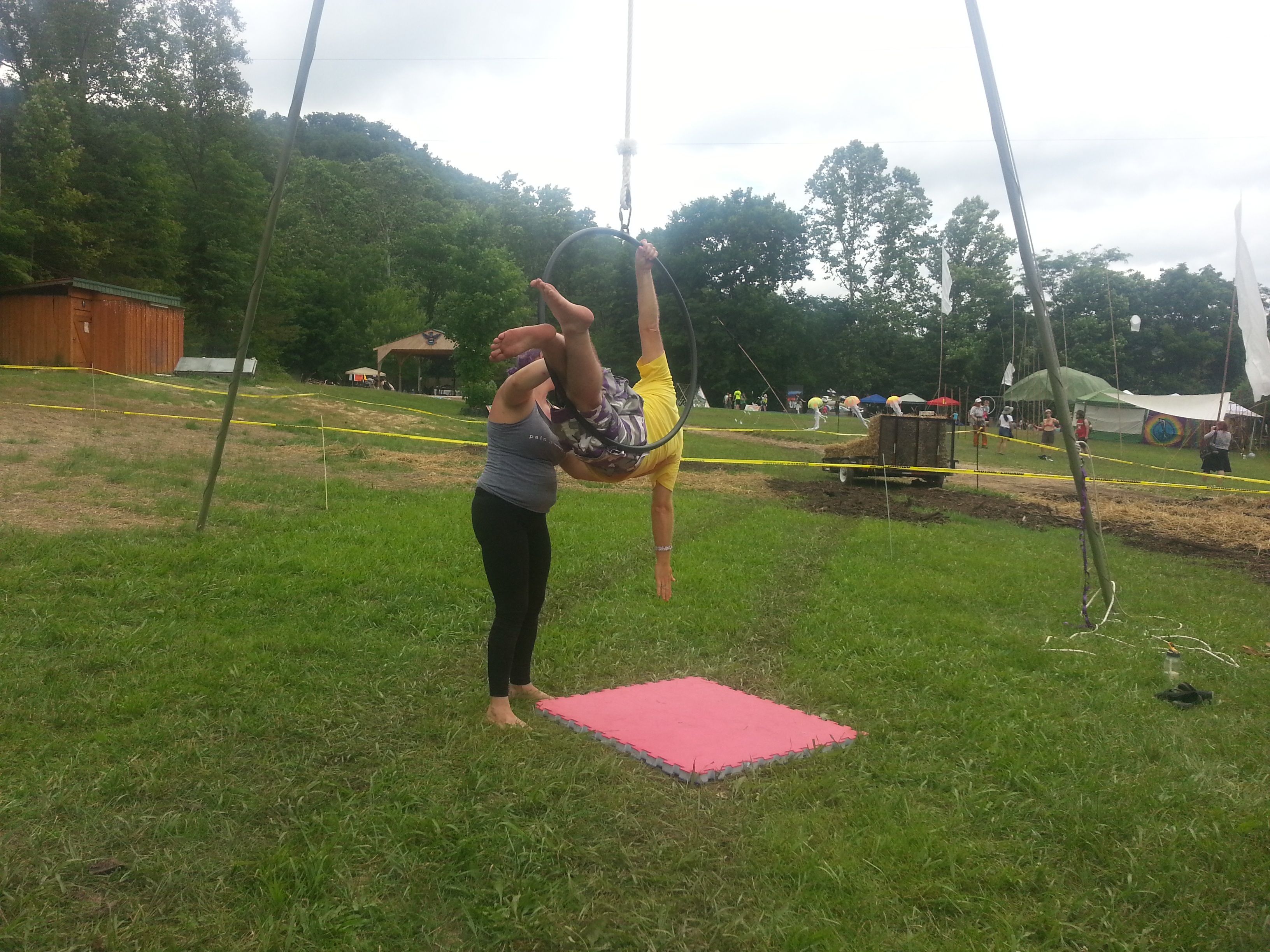
Denis gets his mermaid on
…and static trapeze:
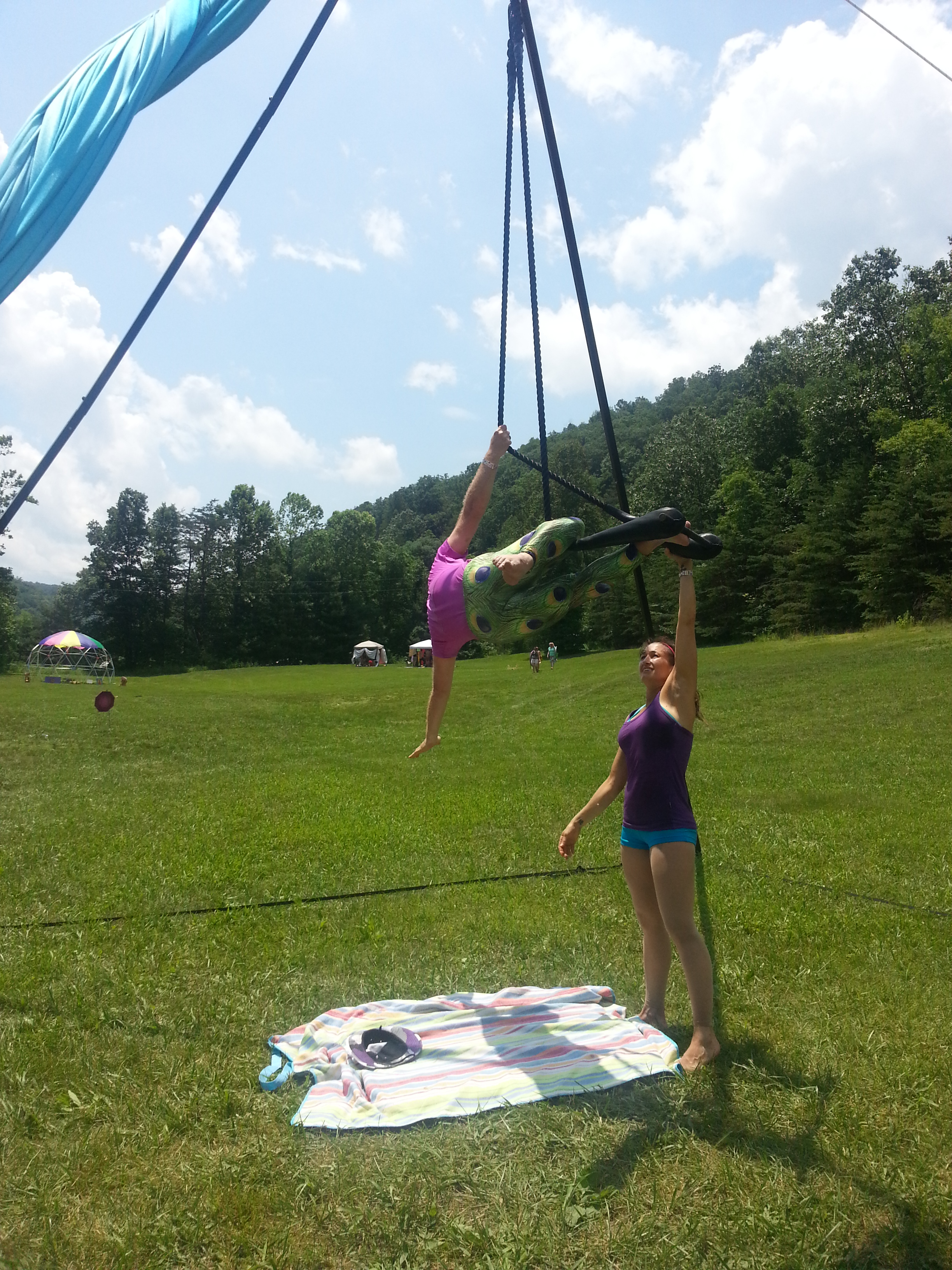
Denis on the trap: just call him “Susan.”
The sunglasses just sell it. *snrk*
And then, because we had the opportunity, we played on the trapeze a bit more:

I need to practice this one more. I tend to set up too low. Terri got me sorted, leading to this rather lovely moment.

…and this one.

Denis is more nervous on the trapeze than I am, but he still got both hands off the ropes.
The trapeze was set about 2 meters up during our second session, and I wasn’t sure I’d be able to get up there, but it turned out to be very doable.
Of all the apparatus, I think I enjoyed the hammock most (which, by extension, probably means I’d also really love silks; we missed the intro silks class, though, since Denis had to work on Wednesday morning). I’m pretty flexible, and hammock takes advantage of that in a particularly cool way.
Things I learned this weekend (besides new moves on the aerial apparati):
- My lower-core strength is great.
- I need to work on the uppermost core muscles, as well as shoulder-girdle and arm strength.
- I really, really love aerials (this should come as no surprise).
- I should be more confident about life in general.
Both Terri and Cindy teach locally, and Terri will be teaching at the new aerial arts studio that’s opening (which is in a really convenient spot and offers a very reasonable price structure), so I’m hoping to add some aerials to my rotation. I think they’ll be pretty compatible with ballet, and the class times won’t conflict.
First, though, I need to get some income happening 🙂
Danseur Ignoble: Ballet Bonque 2: This Time, It’s Personal
I think I’ve written about the phenomenon of “ballet bonk” once before,
but since bonking makes the old brain a bit foggy, I’m not going to try to find that entry and link it.
So what, you might ask (since not all of you are endurance athletes as well as dancers, and I’m too cooked to link), is “ballet bonk?”
In short, it’s the almost completely avoidable phenomenon that occurs when your muscles run out of fuel. in an endurance sport context, it’s just “bonk” or “the bonk,” sometimes with various adjectives (dreaded is a good one). When it happens in ballet class — which it only will if you are, as I am, a complete idiot — it seems fair to call it “ballet bonk.”
The physiological explanation for bonk is that the muscles have depleted their “reserve tank” — the glycogen stores that they tap when you make them do things like run or ride a bike or fondu. Normally, at that point, they switch over to using the fuel you’ve recently added in the form of caloric intake, but (and here’s where the “idiot” part comes in) not if you have grossly under-eaten and there’s basically no fuel for them to tap.
When that happens, your muscles will firmly and politely refuse to do frack-all until such time as you top up. Unfortunately, unless you can afford to take a break of a couple hours, a full-on bonk spells the end of your race or brevet — or, in this case, your ballet class.
The chief symptom of bonk is that your muscles just say no. They don’t usually stop responding entirely, of course — but you can kiss speed and alignment and power good-bye. On the bike, your legs will make occasional, pathetic efforts to turn the cranks; in ballet class, meanwhile, your grand battement week suddenly be less than grand. All your efforts will feel inconceivably weak. You will wonder what is wrong with you.
And then you’ll figure it out, and graciously bow out after barre (which, today, was an hour long), and go eat some food. Or, at least, that’s what I did.
I should point out that there are contributing factors, here.
Derp the first: I am having the usual summer uptick, which makes falling asleep very difficult, and Denis keeps leaving the shades drawn, which makes waking very difficult. Thus, I woke up today with fifteen minutes to get out the door. That’s plenty of time to brush my teeth, get dressed, and grab a water bottle, but not enough time to make food.
Derp the second: I didn’t eat enough yesterday, so I was already starting from behind.
Deep the third: I over-estimated how long it would take to ride to the bus stop and, as a result, rode too hard and fast, using up more energy than I should have. At an easy pace, the ride in question burns about 300 calories. At molto prestissimo, of course, it burns more.
Derp the herp: for some reason, at the bus stop, I ate the little 90-calorie snack thing I’d packed instead of the 190-calorie one. I couldn’t eat both because we have already established that it is a bad idea to ingest 40% of your day’s fiber RDA in one sitting half an hour before class … a very bad idea.
Add to all this the fact that A) Brienne’s class is always demanding and B) it was really hot in the studio, so my body was working overtime to cool itself, and you’ve basically for the perfect storm, so to speak.
The worst part is that bonk is not something you can work through. You can get stronger, you can build endurance: but bonk is bonk, a lack of available fuel is really kind of an insurmountable problem. Sure, you become more efficient through training — but no matter how fit and efficient you are, of you don’t plan well, you can set yourself up for a bonk.
Thus, I quit while I was behind to avoid hurting myself … or, for that matter, anyone else; nobody needs a bonking flailer (flailing bonker?) crashing into — or worse, onto — them mid-adagio.
So how, one might wonder, can ballet bonk be avoided?
That, friends, is (fortunately) simple.
Eat.
In endurance sports, you avoid bonk by eating-on-the-run (or on the bike), taking feed breaks at regular intervals, etc.
In ballet, of course, that’s not really possible: fortunately, most people can handle about 90 minutes of sustained activity before they deplete their glycogen stores, and most ballet classes are about 90 minutes long. Dancers can avoid bonking simply by, like, remembering to eat, and remembering to take into account how much energy getting to class requires if they use “active transportation” like cycling or walking.
I would have been fine if I hadn’t ridden the bike this morning and/or if I’d fueled appropriately. Instead, having taken in only 90 high-fiber (and thusly slow-digesting calories), and having already burned upwards of 300 on the bike, and having started the day with an energy deficit in the first place, I set myself up for a bonk.
So there you have it, gentles: remember to eat. Then you won’t bonk during barre.
And if you do ever experience The Dreaded Ballet Bonk, consider ducking out after barre so you don’t injure yourself.
That’s it for now. Remember: eat food and avoid the bonk!
Today’s message brought to you by the letter B and the number glaaaaaargh.
Danseur Ignoble: My Ideal Home
Last night, I couldn’t sleep, so I did some plies and tendus and practiced a couple of combinations from Saturday (isn’t that what everyone does 2 AM?).
This was frustrating, because they were very travel-y combinations, and I quickly found that I had to practice them in the round, because there is not a single room in my house that will let me squeeze in more than two sets of sauté arabesque – chasse gallop, or so much as one really all-out tour jete (I can squeeze a conservative tour jete into the diagonal of the living room, if I first move our collection of giant ottomans).
So I would B-plus in mid-kitchen and complete a given run in either the living room (going right) or the dining room (going left), carefully negotiating all the obstacles en route while wondering whether Denis would mind if I sold three-quarters of our furniture.
I rather suspect that he might.
Anyway, I have come to the conclusion that the obvious solution is to sell our house and move into a converted barn or warehouse wherein I can install a spring floor and not really bother with interior walls. We can put the bedroom in what used to be the hay loft, or that stereopticon-type room from which the supervisors watch what’s going on in the warehouse.
We could also empty our basement and hire a bunch of guys with jackhammers to dig the floor two (or, ideally, four) feet deeper, but that sounds expensive and like it’s certain to lead to floods and other disasters. It would, however, prevent me from cracking my arms on the ceiling when practicing jumps.
Am I alone in fantasizing about moving into the gymnasium of a disused high school, a converted barn, a refitted warehouse — or, better yet, a house with a proper ballroom (and, ideally, not much else, because who has time for all that when there’s somewhere to dance?)?
These all seem like very reasonable ideas when I’m trying to dance at home.
Danseur Ignoble: That Feel When You Figure Out That You’ve Leveled Up
…Not to say, that at a really good school, you’re ever making a mistake by stepping back a level or two. You can use those classes to perfect your technique.
But it’s really cool to do Beginner Class and realize, Hey, I really actually do belong in Intermediate Class, even when you’re returning after an injury. That’s pretty cool.
I think when I first started doing Intermediate Class, I was reaching more than I’m reaching now: realistically, I was a fairly strong advanced beginner, maybe, and I think the stretch was good for me. I feel like I’m pretty squarely in the Intermediate camp at this point (part of which is being able to figure out what I’m doing wrong, where, and why, and to correct it myself).
There’s been a part of me that has been iffy about my decision to jump right back into Intermediate class. Yesterday I stayed home to do a whole boatload of work that needed doing, so today I did Beginner Class at noon (for the past few weeks, I’ve been doing Intermediate Class and Essentials).
I felt very on top of it — confident and effective, with a few minor exceptions: some of my allegro and adagio were less than awesome, but they were less than awesome in that “I am reconditioning after an injury and haven’t done this since February” kind of way, not in an “Erhmagerd, I don’t know these steps!” kind of way or an “Abort! Abort! We’re going down!” kind of way.
My petit allegro is still slow, but I’m okay with that right now. Speed will come back. My ballet homework now involves doing tendus, degages, and frappes in the water while I’m Florida. Slice, slice, slicing away in the pool, in the ocean, wherever. And then doing flips because they’re fun, per Claire’s orders 😀
I feel like I should probably download the Rocky Theme Song so I can create my own Getting Stronger montage which, I guess, should logically end with a sequence of Petit Allegro That Doesn’t Suck?
Also, my flexibility was 100% there. Full splits both sides, no sweat; pancake to center. Nice to have that back; my right thigh has been tight for the past few weeks. I’ve been stretching after riding the bike (and while riding the bike, which I’m sure looks very bizarre to everyone who does not ride bikes and/or dance).
This coming week, however, I’ll basically just be doing Brienne’s Wednesday class and possibly Margie’s Friday class (depends on what Denis wants me to do), and then we’ll be heading off to Florida. We don’t have class on Monday because of Memorial Day (which I somehow thought was next week; I am eternally so confused about time).
In other news, Amazon Music’s Show Tunes channel is faaaabulooooous!
That’s it for now. Off to level up in doing the finances…
Living the Dream, Dance Camp for Adult Dancers
The 109th Bead posted a couple of great interviews with staff and a student from Sun King Dance Camp. If you’ve been thinking about going, read on for a taste of the experience!

Ever thought about going to dance camp? It does sound like great fun for us grown ups to be able to take a week and live the dream. Although I haven’t had the ability to do so myself, I had the fantastic opportunity to talk with the folks from Sun King Dance Camp and ask them a few questions about the hows and whys of dance camp for grown ups. This is the first installation of that interview. I hope this provides you all with some wonderful information and maybe a little bit of inspiration.
I also have the great privilege to personally know a few dancers who have attended Sun King Dance Camp. Below the Sun King interview is a featurette on an adult dancer who has attended camp. This week I get to feature my good friend Lisa Gallo. I’ve been really fortunate to train along side Lisa…
View original post 1,133 more words


 danseur ignoble
On Reading The Comments*
May 26
Posted by asher
Once upon a time, back in the day, etc., I was an avid reader of and participant in The Comments. I’m not sure whether I was braver, dumber, or just a lot more bored (probably some of each?), but I sort of had this notion that Someone Has To Speak Reasonably (yeah, yeah, typical Angry Young Man stuff).
Let’s not even get started about the privileged assumptions behind that kind of thing — I know, I know. Not that I ever really strolled around the internet swinging my electronic gold watch chain and telling people that they were half-witted imbeciles, old boy, and that their backgrounds deprived them of the ability to respond rationally, but part of me almost certainly kind of felt like that on some level.
I tried to write rationally and logically and politely and sanely, but I also believed that a lot of people were Wrong On The Internet and that I should Lead By Example (how embarrassing).
I think some benighted part of me seriously (but unconsciously, or at any rate no more than hemi-semi-demi-consciously) believed that if I just kept calm and demonstrated what civil discourse “should” look like, I could somehow save either the internet or civilization or something.
Barf.
Anyway.
At some point, I realized that A) I was actually, in my own way, kind of being an ass (to whit: a lot of the people who say stupid crap in the comments are just having bad days; the ones that are actually jerks, meanwhile, are just going to go on being jerks, no matter what) and B) you can’t take the wind from the maelstrom, or whatever. Comments gonna … um … com?
I figured out that even to read the comments was basically a form of swimming upstream, that you can’t reason with irrational people or even with rational people who are having irrational moments (who, of course, are the ones who I was, for a long time, most likely to attempt to engage with my reason and coolness and politesse, &c.).
In short, The Comments became a giant energy sink, and I said to myself, “Wait, I don’t even have to read these! I can just pretend they’re not there! And if I really, really feel the need to comment on a particular newsworthy item, that’s part of why I have a blog.”
Since then, I’m happy to report, I’ve been largely unflustered by The Comments (and the world has not, as far as I know, ended — except perhaps in an Alternate Timeline). The Comments and I now have a great relationship: I leave them alone, and they leave me alone.
Every now and then, though, I venture back into the fray (though, outside of WordPress, I pretty much never say anything).
Sometimes it happens on purpose — I guess when I’m really, really bored and all the dishes are clean and I have done the day’s thousand tendus or what have you and I’m also feeling a bit masochistic.
Usually, though, it happens by accident: I’m idly scrolling through the aggregations of links related to the article I’ve just finished, looking for another way to
avoid doing work andoccupy myself, and then suddenly, Boom! I’m in The Comments, and I don’t even realize it ’til it’s too late.The problem is that I’m an auto-reader: put text in front of my face, and I will read it (or, if it’s in a language and/or alphabet and/or syllabary and/or pictographic system I don’t know, I’ll attempt to read it). I suppose we all have our weaknesses.
So by the time that I really grasp the fact that I’m in The Comments!!!!111oneone, it’s too late, because I’m already reading them.
Usually, I pull myself out before any damage occurs.
Once in a while, I start reading, am filled with horror, revulsion, and/or frustration, and yet I find myself fascinated, and must apply all of my fearsome might to tear myself away before I become lost.
Once in a great while, something different happens: I read the comments, get sucked in, and swiftly receive a reminder that the human race is, in fact, actually kind of doing all right — that there are good people, that we can be reasonable, and that the world probably isn’t going to end today.
Probably.
It’s weird how bracing that feels: to see two people disagree, and to expect Fighting On Teh Intarwebz, only to be startled by a breakout of humane, civil discourse that leads not to an escalating firestorm of trollery, but to a really admirable agreement to disagree or — better still — the serendipitous discovery of unexpected common ground.
Once in a great while, I’ll even discover that someone out there disagrees with my own cherished beliefs in a way that makes me realize that they’re just that — beliefs — and that they’re full of holes and flaws like everybody else’s.
So, anyway. That happened today: I was reading The Comments on, of all things, an article on Queerty, and a little conversation happened between two people who disagreed, and then talked about it like civilized beings, and I was impressed and led to think, “Hmm. Have I really been looking at this situation as objectively as I can?**”
So, there we have it. Out of the depths, a moment of light and clarity. A happy surprise from the universe, found in an unlikely place.
This doesn’t, of course, mean that I intend to start regularly reading The Comments. Oh, helllllll, no.
I may be inspired, I may even be a little bit crazy — but I’m not an idiot.
…But maybe just a peek, now and then.
Share this:
Posted in life
2 Comments
Tags: happy surprises, life, serendipity, the comments