Author Archives: asher

Danseur Ignoble: The Elephant in the Room — On (Not) Talking About Diet In Ballet

First, though, a quick question for my fellow bloggies:

How do you manage ideas? Like, when you come up with a good idea for a post, and you really want to write about it, but you don’t have time to address it just now, what do you do with it? Do you add it to a list? Start a new post, pop your idea in there, and save it as a draft?

In short, right now, I’ve got lots of ideas, but also a rather strangely large number of things to accomplish, and I’m not sure I’ve hit on a good idea-management strategy. Right now, I seem to be using the “start a draft” approach, but I’m not sure whether that’s wise. For whatever reason, my list of unfinished drafts actually sort of fills me with dread. Go figure.

~~~~~

Okay, now for the sensitive stuff.

In the Default World, as it were, there’s an ongoing conversation about body size and weight, about food as a source of pleasure and as a source of fuel — and while it’s still largely dominated by voices of what one might imagine as the Body Establishment, we’re starting to hear a lot more from other corners — for example, from fat activists like Ragen Chastain at Dances with Fat and Kath at Fat Heffalump, from members of the medical community who are saying, “Hold on, maybe we’re looking at the wrong parameter; maybe we can’t directly measure health by measuring body size,” and even from plain old regular people who are tired of all the hoopla and just want to figure out how to enjoy their lives and be as happy and healthy as they can.

However, in the Ballet World, we’re still not really talking about it much, and we’re really, really not talking about food.

I should stipulate: professional companies tend to have advisors that address these issues, as do pre-pro schools. However, those of us in the Adult Amateur Ballet Community At Large, the area — especially where diet is concerned — is still largely Verboten. Like, we all acknowledge that, in ballet, Body Size is A Thing, but we also don’t want to give anyone a complex about it; meanwhile, we’re terrified that any specific thoughts we share about eating will spawn a rash of anorexia diagnoses.

We’re all very aware of some of the problems that can and do arise around the question of weight in the Ballet World. We’re all very aware that, for whatever reason, the modern Western world doesn’t beget too many people who fit the current Classical Ballet Body Type mold. We’re all very aware of the temptation to use drastic means to squeeze into that mold. We’re all afraid of accidentally pushing vulnerable people over the line and into those drastic means.

And yet, as a result, we also find it difficult to discuss the very measures that might, for a great many of us, act as prophylaxis against resorting to drastic measures: we find it difficult to discuss fueling strategies, difficult to discuss the challenges that different body types bring to the studio or the stage (and I’d argue that there are unique challenges associated with almost any body type, including the one currently enshrined as the Classical Ballet Ideal), and difficult to discuss how to cope with those challenges (whether they be joint strain, risk of osteoporosis, or just possessing a set of knobtastic knees that sometimes seem like they won’t get out of the freaking way — oh, wait, I might be projecting, there).

I suspect that we’ve developed a sense that acknowledging the challenges unique to a given body type sort of delegitimizes that body type as a vehicle for dance. There are too many stories out there of people being told they should simply quit dance because they weren’t blessed with the right body for it — people who loved dancing, who wanted to keep dancing, but who too often weren’t able to find a place where they could continue.

We’re all afraid, I think, of touching those nerves. For adults, ballet is already a counter-cultural pursuit. It’s neither “useful” in the purely-practical “this is going to make me lots of money” sense (though, in fact, ballet offers immense health benefits for dancers of any shape), nor is it casual (with rare exceptions). It tends to turn into a life-consuming passion, one for which non-dancers kind of look at us askance. Somehow, to them, watching TV for ten hours a week doesn’t seem strange, but dancing for ten hours a week does.

To be fair, part of the argument in favor of TV is that you can do it at home with your family at relatively little expense — I get that. But the long and short of it is that, as adult dancers, a lot of us already feel like we’re always fighting an uphill battle to prove to the universe that we have a right to belly up to the barre.

When we start addressing some of the problems of body type, we’re already coming from a defensive posture. We’re already fighting against a societal claim of illegitimacy — one that comes from both outside the studio and sometimes from within, as well.

On one hand, from the outside, we get the message that we have no business dancing at our age, whether that age is 19 or 95, unless we’re professionals. On the other, from the inside, sometimes we get the whole “you’re not a real dancer” thing — especially if we’re truly raw beginners with absolutely no experience or if we diverge too widely from the standard Classical Ballet Body Type. This makes the whole idea of saying, “Hey, I have this body type, and I’ve noticed that people with my body type have this specific challenge in the studio…” exceedingly uncomfortable. It’s just a shade too close to that old message, “People who are built like me shouldn’t dance.”

~

Bike racing shares a few characteristics with ballet.

First, if you do it as a hobby, people think you’re nuts. To be fair, this is a label that most serious bike racers pretty much embrace publicly in a way that amateur dancers often don’t (though we do, within the confines of the Ballet World, acknowldge at regular intervals that We’re All Mad Here).

I suspect that, in the US at least, that particular flavor of Crazy is more broadly accepted if it involves competitive sports. While cycling isn’t as warmly embraced in the US as it is in much of the world at large, it’s still clearly a competitive sport, one with well-defined competition opportunities for people of all ages (and one in which people in the higher age brackets are often formidable competitors). Nonetheless, cycling as a sport is still fringe-y enough in the US that people are shocked to learn that you spend twenty hours a week like, you know, riding a bicycle? And you don’t get paid for it?

A few years ago, people felt similarly awkward around amateur MMA or Muay Thai enthusiasts (I know, because I was one at the time; I loved Muay Thai and wouldn’t mind taking it up again, if the day were only, like, six hours longer); now that everyone’s doing P90x (which seems to be somehow loosely associated with the world of combat sports), tough mudders, and so forth, a fanatical embrace of combat sports has gained a kind of legitimacy.

It doesn’t hurt that it’s something you do in a community: we learn MMA and Muay Thai skills in classes at organized schools, and the best part is that we can usually bring our spouses and kids along for their own classes. Like cycling, meanwhile, combat sports also offers plenty of competition opportunity for adult amateurs. Sure, it’s expensive and time-consuming: but you can win, like, a trophy or a belt buckle or something! To the American mind, that kind of makes it all make sense, I suspect.

Meanwhile, ballet is fringe-y without offering any overarching structure by which adult amateurs can measure our achievements. We don’t have our own Prix de LAAusanne (see what I did there? AA for Adult Amateur?). We don’t even have the equivalent of the weird competition-dance circuit that those of us in the High Art World of Ballet (myself included) kind of love to hate. We might walk away from our hours in the studio with exceptional poise and grace, and sometimes even with very lean and fluid bodies — but we don’t get “ripped” in the way that people who go to the gym and lift weights for fun do.

And, just like in cycling, we spend what the rest of the world perceives as an inordinate amount of time in the studio. Ballet is a harsh mistress, but we love her so. That’s suspiciously close to the way cycling aficionados tend to describe their bikes.

Second, cycling culture has powerful, deeply-ingrained standards about body type. Professional cylicsts, like professional dancers, tend to be extremely lean. Amateur cyclists — racers especially, but also those who don’t race — are subject to a sort of inherited pressure to be lean.

Seriously, in no other American sub-culture are you likely to hear someone kvetching about his arms being too muscular. The demands of training at anything beyond the entry-level both select for and produce lean bodies; in very competitive areas, even the most rank Cat 5 amateurs tend to be far leaner than their non-cyclist peers (seriously; hit up a cyclocross race in the freakishly competitive Ohio Valley Cyclocross Series, and you’ll see what I mean).

Combat sports enthusiasts, meanwhile, don’t have quite the same problem: yes, weight is a legitimate concern (since competitions are organized by weight category), but the hard-and-fast upper limits are still very much in line with people of average build, and how your body’s shaped matters a whole lot less in the gym than how much ass you can kick with the body in question. Or, at least, that was my experience.

Meanwhile, competitive bike racers really are kind of expected to cap out at around 170 – 180 pounds, and the selection pressures only increase as you progress through the ranks. A lot of high-end racing equipment isn’t designed to handle riders heavier than that. The idea is that the lighter the total weight of bike, rider, water bottles, kit, and whatever else you might need to have on hand, the easier your job as a racing cyclist will be. Moreover, the slighter you are, the less wind resistance you’re going to create — and simply pushing through the air is actually where you do the vast majority of your work as a cyclist.

Third, bike racing culture is a niche culture within a niche culture: just as there’s dance culture, and then there’s ballet culture, so there’s cyclist culture, and then within it, racer culture. A lot of non-racing cyclists think all racers are arrogant, jerk-faced wankers (to be fair, some racers regard all randonneurs as grade-A weirdopaths and all commuters as dirt); some non-ballet dancers seem to think all ballet dancers are uptight, arrogant, jerk-faced wankers (to be fair, some ballet dancers regard those ballroom-dance types as plebian socializers and all modern-dance aficionados as wannabes whose technique couldn’t cut it in ballet).

In short, to the outside world, both amateur bike racers and amateur dancers are the Weird of Weirds. You’re not just weird, you’re an especially devoted, obsessive flavor of weird that owns a lot of suspiciously fancy stuff and uses a lot of foreign words. Mon dieu!

Lastly, both cycling and ballet share high energy demands and a history of disordered relationships with food.

The major difference, as far as I’ve seen, is that bike racing culture is really pretty free to discuss food and diet, and does so constantly, sometimes in nauseating detail. There is, perhaps, less sense of illegitimacy imposed upon individual riders — and, as such, less risk of being cast out of the circle if one admits that one is a few pounds (or even many pounds) heavier than one would like to be, or that one resents one’s muscular arms. The discussion of how best to fuel for training, for performance, for recovery, for the off-season, for the pre-ride, for the post-ride — that discussion never, ever, ever, ever ends. Food may be the only thing cyclists talk about more often than bikes.

Dancers, meanwhile, also need to think about how best to fuel their bodies — but forums for discussing how to do so are almost impossible to find. Some of the best online communities for adult amateur dancers have explicit rules against talking about diet, for fear that the discussions in question will devolve into “How To Starve Yourself And Still Keep Dancing.” The standard answer is more or less, “Eat a balanced diet and bring your specific concerns to your health-care providers.”

That’s a very legitimate approach, I think, to dealing with nutritional questions from adolescents in pre-pro programs. In short, the nutritional needs of growing dancers are immensely complex, and most of us have no business trying to advice them; likewise, adolescent dancers are just as subject to the immense pressures to maintain the Classical Ideal as adult dancers, but generally less-equipped to cope with those pressures. They are more likely to lack the resources and experience to make well-informed decisions about whose advice to follow; they may not yet have acquired the critical-thinking skills that will later help them distinguish between a sustainable plan for healthy eating and what amounts to a quack diet, but they are more likely to have people in their lives to help them with these decisions.

Meanwhile, amateur adult dancers (who my very unscientific analysis suggests tend to be self-possessed individuals with pretty good minds) are less likely to have people in their immediate lives who have both the time and expertise to offer any kind of insight into fueling their bodies, but are more likely to have critical thinking skills to help them distinguish between sound fueling strategies and wacky starvation plans.

Perhaps part of the problem is that ballet is an art first, an athletic endeavour second. As an erstwhile half-baked bike racer, I’d go so far as to say that bike racing is an art, but I’d be remiss if I failed to state plainly that it’s an athletic endeavour first. Dancers are encouraged to think of themselves as artists; cyclists as athletes.

Athletes are free to regard their bodies as machines and to think about them accordingly.

Artists? Well, maybe not so much. We are invited to transcend the limitations of our mortal frames: but we are not explicitly invited to examine those limitations, especially not as adult amateurs who must already combat the idea that we’re not “real dancers,” and therefore not “real artists.”

Perhaps it follows from there that we can’t freely discuss what is, ultimately, an immensely important topic: what kind of fueling strategy will help us feel the best in the studio, on the stage (if we’re so lucky), or after class? What works? What doesn’t work? What works for some, but not others? Flatly put, how much should we be eating, anyway, when we’re dancing six or ten or sixteen hours each week?

Inevitably, some of us will want to trim down a bit; others might want to build some muscle or fill out our curves. It would be good if we could talk to each-other about these things: in part because sometimes it’s that very possibility that allows people who are slipping in to the realm of Drastic Means — of disordered eating — to get help before the problem gets out of hand.

It would be good to know that there was a forum where we could ask what might seem like stupid food questions (“Okay, I just did two hours of class. It really is okay for me to have an ice cream cone, right?”) and ask about other dancers’ strategies (“Guys, do you find you get less sore if you eat after class?”) or even to figure out who to talk to about specific questions that might need input from a professional (“As a male dancer who spends two hours a day dancing and does a fair bit of throwing other dancers around, who do I ask about making sure I’m getting enough protein? Dietitian? Family doc? Personal trainer? Wizard?”).

One of the strengths of the bike-racing community is the way it handles questions like these. There’s a huge aggregated knowledge-base out there pertaining to fueling strategies for racers at all levels, and bike racers are free to talk about it all they want. They even talk about eating disorders (which kind of makes sense in a sport that has itself more than once been described as “a very expensive eating disorder”) and reach out to help members of the community who struggle.

I think we, as adult amateur dancers, are mature and wise enough to do that for each-other. True, dance-specific nutritional strategies are less broadly-studied than sport-specific nutritional strategies — but a lot of us in the Adult Amateur Ballet World are pretty good researchers. We are capable of putting our peer-reviewed journals where our mouths are (though, guys, just so you know: there are better fueling strategies than eating peer-reviewed journals, and besides, they tend to be kinda dry and dense).

The question is, where do we start talking about this, and how?

Danseur Ignoble: How Will I Survive??!!!!111oneoneoneoone

(Okay, yes, I’m making fun of my own internal histrionics, but seriously.)

Today I discovered that (perhaps unsurprisingly, given that The Mother Ship — AKA IU Bloomington, AKA IU Prime — has an excellent ballet program) we not only have access to an extensive library of books about ballet, but that most of them are available online, for free … as long as you’re an IU student.

Needless to say, I wish I’d thought to look earlier. Because, seriously. SO MANY BOOKS. SO LITTLE TIME. Where do I even begin?

I will be the first to admit that I’m both completely stoked about graduating and also kind of, like, “Yeah, but, seriously … not be a student for, like, a year and a half? HOW???? HOW WILL I LIVE WITHOUT ACCESS TO ENDLESS SUPPLIES OF PEER-REVIEWED DATA AND FREE SOFTWARE AND ZILLIONS OF BALLET BOOKS AT MY FINGERTIPS?!”

And now this.

You guys, I just don’t think I’m gonna make it.

Go on without me.

I’ll be fine.

:::sniffle:::

In related news:
#firstworldproblems

Meds: Yup, Still No Disney Spirits, But I Think I’m Okay With That

In my most recent post about medication, I mentioned that Disney Spirits did not magically apparate and undo all my recent mistakes as soon as I took my first dose of Adderall.

Well, I can confirm that they still haven’t, so it looks like that really is definitely not how things work — but that’s okay. I didn’t actually expect that*.

*Though, you know, if all you birds and and your friends from Cinderella want to come over and help…

I have, however, gained a couple of insights.

One of the things that finally made me not just willing to get back on ADHD meds, but willing enough to do something about it, was completely missing an assignment in my entomology class. I switched its due date with that of an online exam, and since it was a short assignment, when I logged into OnCourse (IU’s legacy online-class system; we’re currently using Canvas as well) to hand it in, I discovered that I was one day too late.

Oy vey.

At least I got the exam done early?

Fortunately, the assignment in question was only a 10-point jobber, and since I’m otherwise doing really well in that class, I decided that I would just take it for the wake-up call that it was and opt not to grovel to my professor about it (especially since this was only a few weeks into the semester).

I immediately created an assignments note (two, actually — one for Entomology; one for Buddhism) in Google Keep, thinking that would solve the problem.

Our most recent assignment, meanwhile, spanned two weeks from initiation to completion — which is to say that I recorded the due date in my assignments note before I started taking Adderall. Have I mentioned that Adderally dramatically increases my capacity for attention to detail?

You can probably see where this is going.

This time, fortunately, my initial misunderstanding was only off by a few hours — the assignment — a PowerPoint presentation and a brief Word document — was due at 5 PM, but I wrote down 8 PM. I was done with it well before 5, then decided to make a couple of structural changes to the PowerPoint and add an audio track. When I logged in to submit it at 6 PM, I discovered my mistake. The online assignment inbox was closed.

Since I’d worked really hard on this assignment and was really proud of it, I overmastered my Immense and Crushing Feelings of Woe (apparently, Adderall does not eliminate the nauseous sensation that comes with discovering I’ve missed an assignment deadline), emailed my files to my prof, Dr. Hunt, and explained the situation. He graciously accepted* my assignment.

*By the way, kids: if you’re looking for another sound reason to be a good student, work hard, and develop good relationships with your professors, this is a it. If you’re a good student, you demonstrate that you’re making an effort, and you treat your professors with respect, they are much more likely to be forgiving if and when something like this happens.

The cool part isn’t so much that I found a solution, though. I usually do … sooner or later.

The cool part is that I was able to keep my head together and make decisions about how to handle this without first having an Epic Meltdown of Self-Directed Rage (you guys, I might be just a little overcommitted to this whole Best Student Evar thing). I mean, I wasn’t happy with myself, but I wasn’t flagellating myself, either. I was upset, but able to function. I didn’t have to go Be Angry In The Kitchen for an hour before I figured out what to do.

So while Disney Spirits did not go back and undo that whole thing where I spent two whole weeks being convinced that the assignment was due three hours later than it was, I do think the meds played a role in helping me to make good decisions in a more-timely-and-less-exhausting way than usual.

That has, perhaps, been the surprising part of this experience for me. You guys, I seriously didn’t expect taking, like, amphetamines to improve my frustration tolerance and help me stay more level-headed about things. However, the meds do seem to be doing exactly that.

To some extent, I feel that as a student of neuroscience, I should “grok” this more than I do. Frustration tolerance and emotional volatility are mediated by some of the same processes and structures responsible for reducing impulsivity and increasing focus — all that fancy frontal-lobe stuff. This (well, this and relative inexperience) is why teenagers are worse at all these things than adults.

The fact that medication makes it easier for me to hold a thought in my head, think about things before I do them, and have a conversation with … okay, well, with less interrupting (interrupting is a cultural norm where I’m from, so that’s gonna take some time and work) means it should also help me not asplode when I reach frustration saturation.

Here’s the thing: most of the time, without medication, I experience the emotion of frustration very physically and as a sudden, immense explosion that I really can’t seem to stop — and it happens suddenly, like sublimation in chemistry.

After the explosion, I can eventually make decisions about how to respond to the problem at hand. Sometimes way after; sometimes so long after that making a decision is no longer relevant or even possible.

Medication seems to kind of grant me some wiggle room — it’s like a catalyst that changes the process so now, instead of sublimating straight from solid to gas, I pass through a liquid phase first. Frustrating things happen, but I don’t immediately blow a fuse. It’s like medication provides a buffer that preserves my ability to make decisions when I’m frustrated (in addition to simply making it easier to make them in the first place).

So my meds aren’t going to undo my past mistakes for me, but they can help me make decisions about how to fix things. They also allow me to actually sit still for a while and to read course materials without having to re-read every paragraph fifteen times because my mind went walkabout in the midst of sentence 3 but I didn’t notice until sentence 5 of the next-plus-one paragraph. They allow me to do a better job at weighing the pros and cons related to the decision at hand, and maybe allow me to do so for a little longer (so I maybe won’t just weigh the factors for one minute and then go, “Screw it, this is too hard, I’mma go do the fun option!”).

This isn’t to say that there’s not room in the world for impulsivity. I take risks that I otherwise might not because I’m usually already halfway in before my brain has a chance to say, “This might not be a good idea!” And since the human brain is great at thinking things are dangerous when they aren’t (like jumping into the front group in ballet class), this means many of the risks I take pan out pretty well.

I don’t want to lose that spontaneity entirely. Fortunately, I don’t think I will: at the current dose, my meds don’t make me not me, they just kind of turn the volume down a little bit. The idea is to balance my impulsiveness with a shade more restraint; my creativity with a little more follow-through.

So that’s it for now. I’m not saying that medication is a miracle cure, but it does seem to be helping in ways that years of immense effort haven’t. I have great coping mechanisms, but there are gigantic holes in them that no amount of effort seems to fix. Medication helps to patch those holes.

This isn’t to say there aren’t side-effects — my ADHD meds do kill my appetite (scheduled eating helps), and I do get dry mouth — but at this dose, the side-effects are tolerable.

So the Disney Spirits aren’t waiting in the wings, but so far this little experiment is working out pretty well.

Anyway, that’s it for now. More soon. I’m out of class tonight in an effort to make one last push at finihsing last year’s finances so I can get back to focusing on the important stuff, like turnout and plies and brisees and cabrioles 😀

Danseur Ignoble: Summer Intensive — It’s Not Too Late! (Maybe.)

If you’re a dancer, an adult (or adult-esque … or, at any rate, at least 18 years old), and you’ve always wanted to do a Summer Intensive but have never had the chance, take heart!  A small but slowly growing cadre of programs offer SI experiences for you!   (And, I hope, for me!)

While this year is a non-starter for me (I’m scheduling a surgery over the summer, and by the time I’m recovered, we’ll be off to Burning Man, where I’m apparently running what we’ll call a “Summer Relaxive” — I’ll cover that in its own post), I’m planning to attend and review as many of these as I can in coming years.   For now, though, if you have some vacation time coming your way and haven’t already made plans, here are a couple of links to get you started.

These programs can fill up fast, but you might still have time to grab a spot.

I’ll continue to update this list as I find reputable programs.

Summer Intensives for Adult Dancers

Boston Ballet
When: August 3 – 14
Where: Boston, MA
Duration: 2 Weeks
Schedule: Evenings,  6:30 – 9 PM
Housing: Make your own arrangements
Tuition: Unknown; will try to find out
Performance Opportunities: Unknown; will try to find out

Boston Ballet’s program could be a great option for anyone who wants to combine a ballet camp experience with a New England vacation adventure.   Since classes take place in the evening, you’ll have the daytime hours free to explore historic Boston and the surrounding area.   This might make Boston Ballet’s program a good fit for dancers who need to combine ballet camp with a family trip.

Boston Ballet’s Program would also be a great choice for people who live in the Boston metro, of course.

Pros:
Affiliated with an established company with a strong pre-pro school.
Hours of instruction allow dancers to combine vacation adventures with Intensive ballet training.
Two weeks’ practice, 2.5 hours per day, offers an excellent opportunity to create lasting improvements in technique

Cons:
You must make your own housing arrangements.
Two weeks in Boston could theoretically be expensive!
Not everyone will be able to take two whole weeks off in a row.

Sun King Dance
When: Varies
Where: Richmond, VA; Saratoga, NY; Vancouver, WA; Waldorf, MD
Duration: 5 – 7 Days
Schedule: Days, approximately 9 AM –  6 PM; varies with individual program and track chosen
Housing: Sun King makes group-rate arrangements with nearby hotels and provides roommate-matching
Tuition: $730 –  $1025; varies by program and track; lunch included.   Housing not included.
Performance Opportunities: Yes, except Waldorf program

Sun King is the Grand Matriarch of adult summer intensives. 

Now in its fourteenth (fifteenth?) year, Sun King has built an excellent reputation and offers several different programs.  Dancers can choose short-day, all-ballet, or full-day tracks.   The short-day options offer a few more free hours in the afternoon for dancers who might like to get out and explore, while the full-day option adds restorative sessions and additional stretch classes.

Curriculum includes a number of elements that adult dancers often miss out on, like character dance, pas de deux (my tablet’s autocorrupt really wants this to be “pas de derp!”) , and men’s technique.

Perks include rate agreements with local hotels, roommate-matching (optional; you can room solo if you wish), lunch included with tuition, and the real highlight for me — a chance to perform (or, at the Waldorf program, a chance to see a world-class performance).

Pros
Well-established program with an excellent reputation
Roommate-matching makes housing more affordable
Lunch included (dancers gotta eat!)
Performance opportunity!

Cons
Not as family-trip friendly (you can bring your non-dancers, but they’ll have to fend for themselves!)
Only one week long (le sigh!)
Spaces are limited, so you need to register early!

Danseur Ignoble: Music for Dancers, Music for Movies

When my sister and I were very small, our parents bought a copy of the London Symphony Orchestra’s seminal recording of Holst’s The Planets, recorded under the masterful baton of Sir Colin Davis. We immediately established it as our preferred improvisational dance music: so much so that we regarded it as ours, not as theirs.

When it came with us to Mom’s new house after the divorce, the capacious living room allowed us the freedom to improvise wildly theatrical “performances,” most of which took place when Mom was out. We would dance our way through the whole thing, incorporating every shred of ballet training we had (and making up the rest from whole cloth).

There was something in that music that really spoke to us. It was magic: old, wild magic.

Imagine, then, my shock and dismay when I hit up Prime Music for the recording and found the old, wild magic gone!

I found myself questioning my musical memory (which is very, very accurate). Had my child’s brain imagined the expression, the passion? Had the playing always been this, well, bland? Where were the dynamics, the shifts in tempo that lent such expressive elan to the LSO’s work?

And then “Jupiter, Bringer of Jollity” came on, and I got it: This wasn’t the same recording. Couldn’t be.

And, in fact, I was right: in my late-evening fumblings, I’d tapped the wrong album — the recording I had been listening to was produced as a movie soundtrack (it appeared right next to the London rendition on my tablet’s screen; evidently, my aim was untrue).

Of course!

It all made sense. Movie soundtracks, by necessity, can’t always be as expressive as the London rendition. They’d upstage the action on screen if they were. Their purpose is to help to move the story along without getting in the way of the words spoken by the actors (and to surge, when called upon, in sorrow or triumph — or in order to facilitate a montage).

I stopped the recording, fired up the London version: yes, there it was, in all its glory, exactly as I remembered it. Dynamics, tempi, and all.

There’s a lot of dance implicit in that music — and that’s missing from the blander soundtrack rendition.

The London recording is music for dancers (well, really, for musicians, but it comes out the same in the final analysis): it can afford to be expressive. Dancers feed on that.

It can afford to pay with tempi, with fermatae, with caesurae (if you’re not a musician, those are all modes of expression related to timing); it can afford to swell through mighty crescendi and ebb through delicate diminuendi. Like orchestral music, dance is more interesting when the timing is dynamic; dancers, meanwhile, enjoy a symbiotic relationship with changes in volume dynamics.

Dance performance depends on counting, of course, and technique — but, in the end, the dancer’s ability to feel and interpret music is what makes or breaks a performance. We can forgive the cavalier for not quite making that lift if we believe him; Odile can miss a few fouettées if she makes us believe.

That belief is founded in expression.

Holst isn’t everyone’s cup of tea (who is?) — but he wrote dignified, playful, magnificent music; the kind that, in the hands of a good orchestra, lays a great foundation for ballet. It’s voluble; it’s expressive.

In the end, that and a good beat are what most of us look for in music for any kind of dancing. Maybe not so much in music for movies — but for a ballet, an East Coast swing, or even just a good old-fashioned booty shake, that’s it.

To borrow a phrase from a movie: Kinda makes ya feel like riverdancin’.

Meds: The New Frontier…? (This One Is Loooong. Also: Explicit Lyrics Warning, Because Apparently I Haz A Feelz)

Yesterday, after an entire adventure that should’ve had its own laugh track, I finally picked up my new (generic) Adderall* prescription. As I said to WeDoBallet, it sometimes seems like they specifically design the ADHD-Rx pickup process to be as difficult as possible for people with ADHD!

*Technically, my prescription is for “mixed amphetamine salts,” which is the generic formulation for Adderall. But, frankly, you guys, I can’t say that with a straight face. I just picture walking into the pharmacy and walking out with a 5-pound sack of Mixed Amphetamine Salts (white, of course, with bold black lettering, and maybe some XXXs) with the instructions: “Sprinkle on salads, soups, and entrees as needed.”

Yeah, my imagination is a weird place to live.

Getting back on meds for ADHD has been a tough decision for me — less because I wanted to prove I Can Do It My Own Self! (seriously, I really kind of hit rock bottom with that once I started dancing again; more on that in a sec) than because I’m an old-fashioned Yankee, and we’re all about Independence and Self-Reliance (and also about frugally recycling our neighbors’ discarded Windsor chairs) and it’s just a knee-jerk habit. It persists long after we realize it’s not rational.

Also a little bit because there’s a risk of ADHD meds (which are stimulants) kicking off manic episodes and because I have a history of anorexia and I wasn’t sure I trusted myself (more on those in a sec, too). And also, also because I’m just plain paranoid about meds. I’ve had bad, bad experiences with side effects, you guys.

WRT mania: I have a really good doctor, Dr. B: I feel like I can talk to her, she “gets” me, etc. She’s been Denis’ doc for years, and I’ve been seeing her since 201…3? I think? Anyway, for a while.

I started seeing Dr. B during my most recent IM’MA GO TO MED SCHOOL AND SAVE DA WORLD! phase, and she knows that I know what I’m about (and also knows when I don’t know what I’m about but think I do), so we have a really good working relationship.

She also knows that I know how to do research and have access to scads of peer-reviewed research resources through school**, so she expects me to come in well-briefed on everything and acts accordingly. She also doesn’t freak out when I, say, stop taking a daily allergy medication and switch to only taking it on the days I need it the most: in short, she trusts me to generally make pretty good decisions, and knows Denis will steer me right if I don’t.

**Speaking of which, I am probably going to lose my mind next year during the interlude between undergrad- and grad school! No academic database access! What will I do with myself! HOW WILL I EVER SURVIVE??!!!1!11oneoneone

Likewise, Dr. B hasn’t steered me wrong yet in terms of medication options. So, basically, I trust her to make sound calls when prescribing. She’s starting me off at an Adderall dose that’s on the lower end of the middle of the dosage spectrum. I’m cool with that.
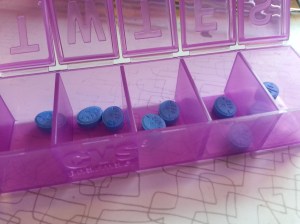
Adderall IR, 10 mg. ...Mostly because I figured apost this long could use some pictures, and I couldn't come up with an excuse to put a picture of Sergei Polunin or David Hallberg here.

Adderall IR, 10 mg.
…Mostly because I figured a post this long could use some pictures, and I couldn’t come up with an excuse to put a picture of Sergei Polunin or David Hallberg here.

Which brings me to the bit about mania: stimulants can tip off manic episodes in people with bipolar disorder.

Look, a header!

Mania

The whole stimulants-kicking-off-manic-episodes thing has certainly happened to me, though normally it happens as a result of a sort of insomnia cascade effect, which goes like this:

  1. I decide to chug a little coffee or Coke Zero to help me focus on something (or just because I’m out for dinner; I’m dumb like that)
  2. The focusing effect wears off too quickly so I chug a little more.
  3. Later I can’t sleep because my brain won’t STFU, but I still have to get up in the morning, so I wind up sleeping for 2 or 4 hours or whatever.
  4. The next day I have to function (seriously, if you think I’m distractible and impulsive on a normal day, you should see me when I’m sleep-deprived! … so I suck down more caffeine.
  5. Then I can’t sleep again.
  6. The next day, EVEN MOAR CAFFEINE!!!

…and then BOOM! I’m in ManicLand, because (for me) lack of sleep is like an express train to Electric City.

So I was worried about that, but it Dr. B prescribed the short-acting version of Adderall, which should help reduce the likelihood of sleep disturbances.

For what it’s worth, this might be an upside of the whole Insurance Disaster related to acquiring my meds.

Here’s how that went down:

First, Dr. B prescribed Concerta, a long-acting methylphenidate formulation.

For whatever reason, my insurance plan only covers short-acting methylphenidate. You have to take it, like, four times a day.

Dr. B and I agreed that four pills per day is probably more than I can remember to take (and definitely more than I want to carry around with me). Likewise, a longer-acting agent is less likely to wear off just when I need it.

I hunted through Humana’s formulary to see what was covered, and it turns out that Adderall is, and that the generic form — while shorter-acting — is only $20/month (the longer-acting form is still under patent, and thus would run me $200/month for the first three months).

Dr. B felt that this would be a reasonable choice, and we swapped out the prescriptions (further hilarity ensued as I learned that my local CVS pharmacy doesn’t keep my prescription in stock, though — thankfully — the one near ballet class does).

At this juncture, I’m thinking that the short-acting version might actually be a better fit for me: I’ll still only have to take it twice per day, and I suspect it will be less likely to lead to insomnia … which, in turn, will reduce the likelihood of going Full Manic Jacket or what have you.

Likewise, while it’s called “instant release,” the effective half-life is much longer than that of caffeine — so I won’t be constantly topping-up over the course of the day (though I will either have to get used to drinking plain water at restaurants that don’t have seltzer/soda water/club soda — I like plain, still water fine, but not so much with food). In short, I will be adding a lot less stimulants to my system and doing so in a way that will be more even-handed and consistent, which should help ward off the danger of the manic spiral.

Obviously, careful symptom-monitoring is still called for, especially since I really can’t take most of the mood stabilizers currently on the market (that’s a post for another time). I’m willing to try one of the newer ones if push comes to shove, but given my history of serious side-effects, I’m really hoping it won’t. Fortunately, Denis is an exceptional spouse — very able to help me monitor my moods, and both willing and able to notify me when I’m heading for a derailment.

So, in short, with good monitoring and some help from Denis, I’m actually pretty optimistic about avoiding Adderall-induced mania.

I am, however, a touch more worried about (oh, look, another header!)…

Anorexia

I don’t talk about my history with anorexia all that often. There are any number of reasons for that: it’s sort of a Forbidden Topic for dancers; it’s an ongoing struggle that I’m not sure will ever end; sometimes it’s just One More Thing***. I mention it in passing from time to time, usually when I’m touching on points about what it’s like to have lived all over the BMI spectrum. But I rarely discuss it depth.

***In fact, like ADHD, eating disorders occur at disproportional rates in people with bipolar disorder. So it isn’t necessarily “just one more thing” so much as it’s “just one more part of the same thing.”

I guess the other thing about anorexia is that it doesn’t stay contained. It touches every single corner of my life, and sometimes that frankly pisses me off.

And, then, there’s the fact that I’ve had good treatment and I largely have the behavioral end of things basically under control (I don’t starve myself anymore, generally speaking, though I do still do some of the other behavioral things that are associated with anorexia. It’s been a long time since my BMI was <18.

None of this means that the thought process is gone. It just means that I have tools to fight it.

Ballet, curiously enough, is one of those tools — and yet, at the same time, it’s a complicating factor.

On one hand, you can starve yourself and dance — but not for very long, and especially not as a male dancer who is expected to command explosive jumps and sooner or later pick up other dancers and haul them around and stuff. You can only perform so long before your body just says, “Fuck you, no.”

On the other hand, as a dancer, you spend a lot of time looking at yourself in mirrors, and a lot of time looking at other dancers. Even if you don’t already have serious body-image problems, you’re going to wind up thinking about your body, comparing it other bodies, and so forth. If you do have serious body-image problems, chances are good that sometimes that’s going to exacerbate them.

I’m walking a fine line, right now, between performance and obsession. In short, my leg muscles are pretty hypertrophic, so extra fat on my legs can interfere; likewise, while my legs are very capable of adapting to the load required of them, weighing less makes their job easier — it’s easier to launch 160 pounds than it was to launch 174, which means higher, cleaner jumps****.

****Let me point out that muscle adaptation would’ve led to higher, cleaner jumps regardless. You don’t have to be skinny or even slender to dance well and beautifully; I see proof of that every day. For me, a lot of this is fine-tuning, and a lot of it is not strictly necessary. This probably also deserves a post of its own someday.

The thoughts that could lead to excessive restriction are still there. Fortunately, dancing is hungry work; so is cycling. I’ve pretty much managed to stay on top of maintaining a balance, but there’s a part of me that wants to obsess, that wants to restrict.

There’s a voice in my brain that argues against the rational, sane one that tells me to eat enough to sustain my strength and so forth; that voice still tells me I’m weak and undisciplined when I don’t do all the behavioral stuff I used to do when I was surviving on 600 calories a day (which was my target for several months when I was 19) and you could count every rib and vertebra in my body.
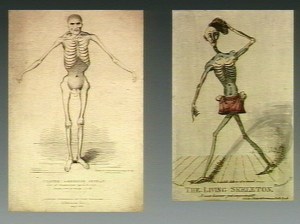
Seriously, looking like this does not help you dance better. Source: This file comes from Wellcome Images, a website operated by Wellcome Trust, a global charitable foundation based in the United Kingdom.  Licensed under Creative Commons 4.0.

Seriously, looking like this does not help you dance better.
Source: This file comes from Wellcome Images, a website operated by Wellcome Trust, a global charitable foundation based in the United Kingdom. Licensed under Creative Commons 4.0.

Here’s the thing: stimulants are appetite-killers, and I’m a tad concerned that it’s going to be too easy to take advantage of that. Like, “Oh, I’m not hungry, I don’t really have to eat.”

Denis doesn’t think I’ll fall prey to that: he trusts me to be rational about it and remain cognizant of the fact that ballet requires fuel.

I hope he’s right.

I think the problem is subtler than that, because I know myself pretty well. In the past, my pursuits always required fuel: but I would do this thing where I would figure up what the daily caloric requirements were, then shave it back a little, then (when, inevitably, my body didn’t immediately implode) I’d shave it back a little more, and so forth. It was an insidious process.

I realize that by saying all this I’m kind of building a framework for letting myself off the hook if this does go down: but I’m also making an effort to be frank about this and sort of keep it in front of my own face.

Like, I’m saying, “I know this is a Thing. I know I need to pay attention to it.”

And, honestly, I’ve figured out at this point that between dancing, school, my household responsibilities, and work, I really, really do need help. My coping mechanisms are awesome, but they only let me handle a very limited amount of responsibility at a time — and that’s kind of how I got here.

(Look, one more header!)

About Hitting The Bottom

I’m gonna go ahead and admit it: I’ve trotted out my ADHD high horse once or twice in the past (though not in a long time).

I struggled unsuccessfully through most of my primary and secondary education, then I figured out how to be a good student in the last two years of high school. (I’ve written a bit about this before.)

Somehow, I thought that meant I had ADHD licked: like, I had it all figured out.

Never mind that once I left home, unless I was living alone in an environment I could completely control, my house was always in chaos. Never mind that I had terrible trouble making appointments and dealing with the vagaries of Grown-Up Life. Never mind that I couldn’t handle having more than three or four bills. Never mind that planning things like shopping and budgets was, like, completely beyond me, or that I would completely lose all the important stuff I needed to keep track of (wallet, keys, phone) if I didn’t set it down in Exactly. The. Same. Place. every time I came home.

I was able to remain in denial pretty well because I did fine when I lived alone and lived very simply — but that’s the thing. When I lived alone, I could choose to live as simply as I wanted — so I had almost no furniture, minimal clothing, minimal dishes, and so forth. I had only one income stream.

I even kept the bills to a minimum — I had one credit card for things that might require such a thing, and other than that it was just rent (which, happily, included water), gas/electric, a pre-paid phone, and cable internet (but not cable TV). My ideal apartment would’ve included all utilities in the rent, just to make things even simpler. I used cash for most purchases, so I was able to track my finances in my head: I just kept a running total, subtracting as needed, and checked my balance online once a day to make sure I was on track.

Grocery shopping for myself was easy: I know what I like, and I don’t mind eating the same thing day after day. $50 was more than enough to feed me very well for a week, and (unless I felt like going on a shopping adventure) I could do my marketing on the way home from work.

Once a week, I’d treat myself to a dinner out, and going home was always nice because my apartment was always impeccable. When you live alone, you don’t watch TV, and you don’t have a lot of furniture to navigate around, it’s actually pretty fun to sweep and mop and so forth. I didn’t have any carpet or a lawn to worry about. I did have a nice, deep bath tub and my own water heater so I could read in the bath all I wanted.

All of that made it possible for me to manage. It was actually a really nice way to live, and it’s totally how I’d choose to live now if the choice was mine alone — but living with other people, even one other much-adored person, really complicates things unless that person is willing to live the same way.

Predictably, as someone who needs to live an incredibly minimalist lifestyle in order to maintain, well, order, I married a self-professed slob with mild hoarding tendencies and complicated finances (as a self-employed healthcare professional, he has a zillion income streams; you guys, that turns budgeting into a straight-up nightmare). Said self-professed slob had also already been living in the same house for twenty years, so he’d had time to accrue lots of stuff.

Suddenly, there were tchotchkes, nicknacks, and bills (oh, my!). Turns out I hate tchotchkes, and I really hate having to move them to clean around them. But it would take me a while to figure that out.

In my naievete, I offered to take over managing the finances, because Denis hated doing it. I also naively assumed that because I’d been great at managing my apartment by myself, I’d be great at managing the housekeeping around here.

Um, oops?

It turns out that clutter fills me with nerve-shattering despair. It also turns out that I find it distracting as hell. It turns out that people with ADHD have trouble tidying up after self-professed slobs. It turns out that I have trouble putting stuff away when I have to move other stuff to do so, partly because WTF, but also partly because that involves more working-memory resources than I normally have for that kind of thing.

In short, it turns out that I’m, like, horrible at everything I signed up for.

And then I added school.

There was chaos. The bills got paid on time, the finances got reconciled (eventually), and the house stayed … well, sanitary, more or less, and would get de-cluttered a couple times each semester.

And then I added ballet.

And then I stepped up the ballet schedule.

And then everything went to hell in a hack (though I was much, much happier than I’d been for a while, because, hello, ballet!).

Then I realized I wasn’t managing anymore. Not even close.

I’ve been making noises for a while about needing meds for ADHD before — there’ve been a number of times that I felt like I was hanging on by the skin of my teeth.

Last semester, I managed to totally screw up the paying-the-bills, tracking-the-finances, keeping-the-house-livable part of my job.

I also accrued the first non-A grade I’ve taken in my post-secondary education: a B- in precalc. I could have done much better, but I had a hard time focusing, getting the homework started when I should have, getting in enough practice, and keeping my head together on exams. It was like grade school all over again (I didn’t wind up with a D because at least I have coping mechanisms now).

I did, at least, succeed in pulling down an A+ in senior seminar, which is kind of a big deal — and at the time I sort of took that as evidence that maybe, somehow, I could still arrange my waterfowls in a linear array under my own power.

You guys, I tried hard. I really did. Sometimes you try all you can, and you still find out that you just can’t. Sometimes the best coping mechanism in the world, applied with discipline and diligence, only gets you so far.

Enter the meds.

Medication isn’t going to make my ADHD magically go away. Nor will it solve all my problems by itself. I still need my coping mechanisms. Medication isn’t magic.

It is, however, a tool. It’s like having a little electric assist for your bike if you have some kind of condition that means your legs can’t build strength very well: you want to be able to ride with your friends, so your electric-assist bike lets that happen. It doesn’t ride the bike for you. You still have to pedal; you still have to steer; you still have to think about what you’re doing. It just lets you keep up with your friends.

I am hoping the meds will help me handle all the stuff I’ve got on my plate right now.

Having taken my first dose this morning, I do feel like my mind feels more settled; more able to focus on the task at hand. I don’t feel like all of the WARNING! klaxons are constantly going off because of the clutter around me (which will really help when I get to work de-cluttering). I feel more able to, you know, keep a thought in my head (working memory is a huge, huge problem for me).

Edit: I’m also much, much more able to sit still. I learned last Friday that the uncomfortable, dysphoric feeling I get when I have to sit down for more than ten minutes a time is, in fact, a symptom of ADHD. I knew I was way out there on the hyperactivity scale, don’t get me wrong, but I always assumed everyone experienced that sensation.

Task-switching is easier (also a huge, huge problem for me): Denis came home to take care of a fashion emergency; a tech from the utility company came over to re-light all our pilot lights after doing some work that required them to shut off the gas to the neighborhood; I got up to do some laundry — I was able to do all of these things without enormous difficulties in returning to the main task I’m doing right now (which is writing this post).

These might seem like minor things, but the time I lose switching tasks adds up enormously over the course of any given day (especially since I sometimes lose the narrative thread entirely while doing so).

So, basically, my “mixed amphetamine salts” aren’t going to magically make everything okay for me. The house is still in chaos; the finances are still a mess. (Amazingly, when I took my first dose this morning, Disney Spirits did not appear and fix all that for me! THE MOVIES LIE, YOU GUYS.)

The difference is, I feel like the meds might actually help me both get caught up — which is literally impossible for me, otherwise: that was the first lesson I learned about how to be a student with ADHD — never get behind. EVER. They should also help me keep on top of things once I’m caught up, even though there’s a lot going on in my life right now, and even though there’s going to be even more going on in the near future (ballet! work! grad school!).

Speaking of which: this post is now officially long enough.

In future posts, I intend to write about:

  • Treatment decisions (why we’re treating ADHD as the primary disorder, rather than bipolar, even though bipolar is arguably the more dangerous of the two)
  • Mechanisms of action
  • Anorexia (because I suppose eventually I do need to get around to that)
  • How my ADHD meds impact ballet

…and similar related stuff.

I’ll also keep you posted on how the meds are working — in other words, not mechanism of action (literally how the meds work), but what kind of differences they’re making in my life, both the good and the bad (because it’s unrealistic to expect a medication to be perfect).

That’s it for now.

Today’s to-do list (I guess I’ll strike these off as I complete them; I’ve also added a few that I forgot before):

  • Entomology homework.
  • Clean catbox.
  • Take out trash.
  • Fold ballet laundry.
  • Wash and fold other ballet laundry.
  • Invite Eric and Larry to Commencement.
  • Create a resource to use for SI tomorrow.
  • Reconcile the November bank statement (yeah, I told you it was bad).
  • Start sorting the dining room.
  • Make dinner.
  • Work on choreography.
  • Watch that one Sergei Polunin video 6,000 more times. Oh wait, did I say that out loud?

…Not necessarily in that order.

Danseur Ignoble: Weaksauce

We failed to eat dinner tonight (long story involving the complications of filling ADHD prescription), and my blood sugar tanked somewhere in the middle of barre.  I held it together almost to the end of class, but my chaînes weren’t great.

I should know myself well enough by now to prevent this from happening: energy bar in the dance bag; juice if a real crisis occurs.  Failing to plan is planning to fail.

Figured out I’ve been cheating during barre stretch: not doing anything wrong, just not working the rotation and flexibility as hard as I can.  So I worked on that.

I am definitely not a Squid anymore.   The arms are Doing Their Thing.

Now, if the brain will just follow suit…

Danseur Ignoble: Dialing Down The Intensity

I spend a lot of time thinking about turns, because I think they’re probably the thing that I’m kind of struggling with right now — like, that transition from having a solid, reliable single to having solid, reliable doubles and beyond.

I’ve been trying to quantify what it was that I found so unique about Baryshnikov’s turns when I watched The Turning Pointe the other night,and I just realized that it’s this: he dances with immense intensity, but before every turn, it’s like he dials it back, just for a second, and finds a still point from which to turn.  His preparation is vividly obvious, but he uses it and makes it beautiful — if he was a boxer, he’d get knocked out every time, but he’s win on style points alone (you know, if there were points in boxing for artistic expression!).

I tend to do everything with the intensity dialed up to 11 all the time.   This week, I’m going to work on cribbing Baryshnikov’s still place; on dialing it back and doing it beautifully.

Danseur Ignoble: The Challenges of Choreographing for Non-Dancers

Right now, as a dancer, I’m just sort of an intermediate student; a returner — but I’m pretty good at it, and I have an amazing relationship with my body: I can ask it to do things with a fair degree of confidence that it’ll do them, or at least approximate them. In short, I trust it in a way that a lot of people haven’t had the opportunity to come to trust theirs. Gymnastics and ballet have been part of my life for so long that all that stuff is really deep in my bones.

Which is a long way of saying that I really don’t have a very clear sense of what it’s like to be a pure, raw beginning dancer with no conceptual framework for dance — and I really, really can’t conceive of what it might be like to be a very verbal thinker — someone whose brain is better at thinking in words than at thinking in movement — and trying to learn to dance.

…Which is why I am so, so very glad that my dear and lovely husband has gamely jumped feet-first into my choreography project, becoming at once a sounding board, a test pilot, and an idea generator.

The most useful insight he’s offered me so far?

It’s this: most people dance with their feet.

People who aren’t dancers tend to think of learning dances in terms of learning steps — not lines, not pictures, not even in terms of sequences of movement: just in steps. Right foot and left arm forward, left foot and right arm back; left foot and right arm forward, right foot and left arm back (I’m pretty sure I just described what some of us call “The White Boy” and Denis calls “The Rock ‘Em-Sock ‘Em Robot”).

At the very most basic level, it’s even possible that those steps can only involve the feet/legs or the arms — that trying to move both at once might be too much.

Here’s what I’m discovering: you can model the “pictures” that occur between movements with the whole body, but it’s a good idea to transmit the transitions between those pictures with care.

Here, we do some port-de-bras, described clearly and demonstrated. Here, we keep the arms where they finished the port-de-bras component and we take three steps forward. The next “picture” is a little bit of fondu, but I’ll have to find some other way to describe it, lest people worry that they don’t have any of those little long-handled forks. Then we rise (releve optional) with arms coming to fifth: gonna have to ask Denis how to describe that, for the verbal thinkers in the room.

Watching new students in class, I’ve realized that focusing intensely on technique isn’t going to work for this project: instead, I’m going to try to focus on feeling. Adults get really hung up in the idea of doing it “right,” and they get in their own way a lot at first. I’m hoping to avoid that roadblock in this context.

My goal here, obviously, isn’t to create professional dancers — it’s to invite people to dance, and to help them see what their bodies can do when they’re given some space to swing them around and play.

Technique, if you’re a dancer, is important. It’s immensely important. A solid foundation in good technique is the basis of long-term progress as a dancer.

However, technique takes time. If you’re totally new, and you’re hoping to learn a couple of dances in the span of a week so you can show them off a little at the end, you can approximate: there’s a difference, after all, between good approximation and bad technique.

Little kids in our pre-ballet classes learn rhythm, balance, and freedom of movement and so forth; there’s no reason adults can’t do that. We can focus on feeling the music and letting it move us. That’s going to be a lot harder with the Philip Glass part of the program (which, for those who aren’t musical/spatial thinkers, will involve counting like crazy: fortunately, the structure of the music makes that fairly easy) than the anthemic pop part, but that’s where demonstration and modeling come in.

This has all made me think really hard about how to put things together, and that’s been a pretty interesting experience. It’s an exercise in the meta-cognition of movement: I’m thinking about how I think about movement. That’s hard for me to do, because movement is, for me, both a natural language and one in which I’ve been formally schooled since I was but a wee bairn, so to speak. This process forces me to slow down and figure out how to explain what I’m thinking; how to translate movement to words in a basic and effective way.

In a way, this all hearkens back to a conversation with JustScott in the comments on my class-notes post from yesterday: how we (at least, before we study ballet) tend to think of ballet as something you do with your legs and feet, when in fact arms and heads are really important.

Learning to really use port de bras and epaulement and so forth has actually made it much easier to feel the music, and in turn to use all the music and finish my movements (which, by the way, is a huge pet peeve of mine: it drives me crazy to see someone dancing full-out with solid technique but basically truncating every single movement). My dancing looks way better for it, but the really cool part is that it feels way better.

Anyway, I should really stop here, because I’m currently avoiding my household responsibilities and the dryer is buzzing at me. I have more thoughts about this forthcoming. We spent last night working through some choreographic problems and some teaching-dance problems, and I think we’ll probably do more of that tonight.

So that’s it for now. Happy March, everyone … Spring is just around the corner.

I hope.

Danseur Ignoble: Saturday Essentials Class With New, Improved Arms!

I love ballet for any number of reasons, not least the magical thing that happens when all the wiring you’ve been installing suddenly fires to life and, holy cow, you get it (thanks, neuroplasticity!).

Today was one of those days: in Essentials, everything was easy, and my arms were fluid and graceful and coordinated. 

Margie asked me to demonstrate the sauté (arabesque) – chassee combo going across the floor, and I was able to do it on both legs.  I kept it low and easy, though, and I’m sure Denis would appreciate that.

We had a new student who said she hasn’t danced in about 20 years, but she must have had excellent training.   Her arms were lovely and she followed all the barre and center combinations like a champ.  I hope she’ll come back!

No specific corrections today (except a note about making sure to get back to sauté-ing instead of Sissone-ing when my leg is done healing; I am still favoring that leg a bit, so often I do little Sissones instead of proper sautés) and a reminder (rather than a correction) to get my heels down between jumps.