Category Archives: balllet

Some Days, You Like What You See
Yesterday, I crammed in two acceptable ballet classes and a fantastic acro workshop with a guy who’s here with Cirque du Soleil’s Corteo.
We expected partner acro, but it turned out to be basically floor exercise. As it turns out, a lot of my floor exercise repertoire is still very much intact. I got as far as back handsprings before I had to jet off to ballet. Aleks seemed pleasantly surprised (even impressed) with my technique and power, so I left his workshop floating on a cloud of happy.
I was, in fact, as happy as my cat in an empty bathtub. Also rather better at floor exercise.
Perhaps that’s why I spent today feeling pretty decent about myself. I’m occasionally floored by the capability of my body—simultaneously like, “Wow, cool!” and like, terribly grateful at my body will apparently do almost anything I ask of it.
Either way, during modern class I found myself staring into the mirror and kinda liking what I saw. I was wearing a racerback tank that makes me look as much like a gymnast as I do a dancer (and leaves acres of skin exposed to stick to the floor in modern class). For a few minutes what I saw was a broad-shouldered, graceful boy; strong and lean and vital; gleaming with a light sheen of healthy sweat. I saw an athlete; a rather magnificent animal, close-coupled and powerful. I saw, I suppose, what men sometimes see and admire in me. I was reminded of the time that I asked Denis what he saw in my calves, which he all but fetishizes though I have almost always disliked them, and he said one word: “Power.”
Last night, when I was feeling uncertain about doing round-off front handspring on our rather short mat, Aleks said to me, “You can do this. You have power.” It was exactly what I needed to hear: I gave the sequence more vertical punch and less horizontal travel, and there it was, just like when I was ten or thirteen or sixteen.
G-d alone knows what I’ll see when I’m staring down the barrel of the barre tomorrow morning. But it was refreshing to see what I saw tonight.
In related news, I evidently failed to inform my cirque company that I tumble, and they teased me (pleasantly) about that throughout the whole workshop. They were also impressed with how clean, graceful, and powerful my tumbling skills are. Needless to say I’ll likely be using those in upcoming cirque shows 😛
I continue to be terribly grateful that I can still do all this stuff.
Sometimes my body, like all bodies, is a giant jerk—but more often of late it seems like an old friend who’s just been waiting for me to drop by; one who has kept all my favorite games and can remember all the places I like to run and bike and walk. When I dust off a physical skill that I haven’t tried in years, it’s always with a sense of homecoming mingled with a sweet relief.
But looking at myself tonight was something else: the experience of having seen, bit by bit, a thing I somehow missed for many years, and then suddenly seeing it whole for just a moment.
Also, I’d rather forgotten how good it feels to launch yourself into a dead sprint, punch down into the center of the earth, and soar. (I mean, I that in ballet, too, but it’s in a different way.)
It’s good to have that back.

“Adagio,” Revisited
A few years ago I wrestled with composing a solo piece about grief set to Barber’s “Adagio for Strings.”
At nearly 8 minutes, it’s quite long for a solo, and I don’t think I had the choreographic wherewithal to make it work back then. I’m still not sure I do. I set it on the back burner, figuring maybe I’d come return it sooner or later.
I’m not sure, at this point, that I ever will. Instead, I’m setting a piece for seven dancers about being alone and unseen amidst the bustle of humanity to the “Adagio.”
The title of the original piece was “Shadowlands”–a reference to the film about C.S. Lewis and Joy Davidman, which is itself an exploration of grief, but also in reference to Lewis’ phemonenal book, A Grief Observed.
I might retain the original title. The new piece as it has evolved comprises seven dancers: the Four Sisters, the Lovers, and the Outsider.
The Outsider is consigned to the shadows at the edge of human connection, and often shadows the others.
That said, I’m leery of using that title, as it’s too close to Pilobolus’ Shadowland, which I hadn’t even heard of at the time I created the original solo piece.
The first draft of this piece will be shown at the June 1st meeting of Louisville Movement Exchange, a nascent choreographers’ workshop and dance-community connector. I won’t have a heck of a lot of time to set and rehearse the piece, but it doesn’t need to be polished (or even finished).
I’m trying to do as much development as I can beforehand, though I will very likely have to modify things based on the set of dancers I’m working with. I think I’m much better at imagining choreography than I was a few years ago—not least in terms of envisioning how to use the stage.
Given the exceedingly-limited rehearsal time at hand, I’m debating whether to concentrate on setting the first half and taking things from there, or just dive straight into the second half.
The advantage of beginning with the first half, of course, is that if we miraculously bash through it, we might get to the second half anyway … and, to be honest, it’s the part I feel less sure about.
The advantage of beginning with the second half is that I have a really strong, clear vision of it, and I’m pretty sure it’s going to be quite good.
I suppose, ultimately, my dancers will determine how I approach the piece: the whole thing builds to a group overhead press-lift, and I plan to try to set that first, since it’s the thing that’s most likely to be uncomfortable for them. Most of them will never have done that sort of thing before. It’s not actually very hard (it’s literally six people doing the lifting, and they’re lifting one person), but it can be daunting.
I also kind of need to decide if I want to be in this piece if I have enough dancers that I don’t need to be. But I’ll cross that bridge when I come to it. I would, in fact, love to perform this piece, but setting a piece and learning it at the same time can be problematic, since it’s harder to adjust things on the fly when you can’t see what’s happening until you watch the video.
~
I’m also back to slowly sorting out problems with Simon Crane.
I think I might set the “Bolero” for a later meeting of the Movement Exchange. I’m not 100% sure it’ll make the final version of the ballet, but I really, really want to set it, and it can stand on its own.
I’m also fiddling with the score still: I’m now fairly certain that the third act will be set to Rachmaninov’s 2nd Symphony (E minor).
I’m still not entirely sure what to do with the first act.
I would, however, like to finish this ballet before I die (not that I plan on doing that any time soon), so at some point I’m going to just force myself to make a decision about Act I. So I guess it’s back to listening to Romantic/Impressionist music and seeing what fits the story arc.
As regards Act III, I am deeply fond of Rachmaninov’s “Isle of the Dead,” but by itself it’s a bit on the short side, and it doesn’t afford quite enough range to really develop the story. I’d love to use it for something someday—maybe something that doesn’t even have an underlying story or concept—but trying to force-fit that with some other piece of music for the third act of Simon Crane isn’t going to work.
Saint-Saëns’ cello concerto will continue to anchor the second act; indeed, if I leave out the “Bolero,” it will be the entire second act.
So that—and the little piece I’m building for PlayThink, which is rather a lot of fun—does it for choreography projects for now.
More on the PlayThink piece later, of course.

Technique: Grand Battement Comes From Your Back
L’Ancien often uses stories to illustrate key lessons. Today, he told us about a dancer who came to South Africa (where L’Ancien was dancing at the time) after the Chernobyl disaster because the world’s best research center for radiation sickness was there. This dancer from Kiev joined the company, and for six months L’Ancien watched his beautiful grand battements, mystified by how he was doing what he was doing.
And then one day it became clear: this man from Kiev, a principal dancer in his home country, initiated his grand battement from high in his back.
It didn’t begin, as all too horribly often it does, in the hip. It didn’t begin in the heel, or in the middle of the pinkie toe of the free leg (which is definitely NOT where your grand battement should begin).
It began in his back. The impetus pushed down from just below the shoulder blades, which both lent great energy to his legs and kept his back high and open.
Study this in second, L’Ancien told us, as he always does, Study everything in second; the en dehors and the balance are already there, so you never have to think about them.
Try it a couple of times, he said.
So we did.
It’s amazing what simply thinking about something a little differently can do. When you begin by sending your impulsion down through your back, not only does your chest stay high and free and open, but you don’t do abominable things with your pelvis.
~
I’ve realized I often short-change my own jumping power by dumping my pelvis and allowing my lower back to turn into a slinky, which absorbs some of the force that should drive me into the atmosphere. If I can jump pretty high whilst jumping that badly, I should be able to hit the ceiling if I just freaking well do it right.
I suspect that the same principle applies: begin with your back.
Now that I think about it, this reminds me of a principle in classical horsemanship: a horse can’t properly collect himself if he doesn’t know how lift his back.
We often think of this as bringing the hindquarters underneath, but it begins in the long muscles parallel to the spine, around the ribs, and in the core. In order for to collect his hindquarters beneath him (and to lighten his forehand and eventually lift it off the ground), a horse must lift his spine just a little—not so much he arches like a cat, but enough to make room and connect his whole body into a single piece.
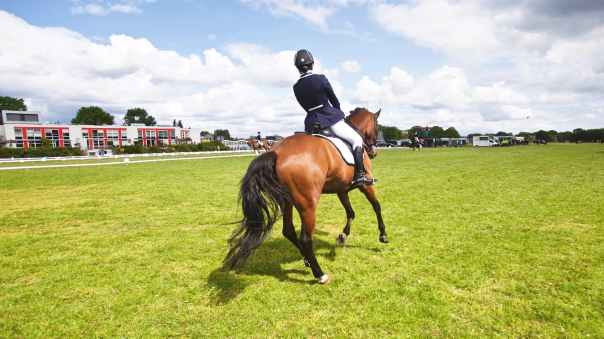
Collection and Impulsion: necessary for horses and for dancers. (Via Pexels)
In ballet, if we want our legs to go up, we must first send the impulse down through the back and through the heel.
~
I’m going to try to remember to ask L’Ancien about this next week—that is, whether I’m correct in guessing that this concept is also applicable to turns and jumps. Ballet is modular like that.
It’s an exciting thing: something that feels like a key to a few of my stubborn ballet problems (double tours, I’m looking at you).
Today L’Ancien said my posture is much better. That’s a huge step in the right direction.
Sometimes I feel like his goal as a teacher is to take us all apart, shake out the extra screws and pieces of gum and paperclips that accumulated while we were initially being assembled, and put us back together as more perfect dancers.
I, for one, am totally down with that.
Have I mentioned that this is a man who has been dancing for more than 50 years? He’s been dancing for more than 50 years.
To L’Ancien, we’re all beginners.

How Much Do You Stretch?
I get this question a lot.
That and, “How long did it take you to get your center split?”
The answers are, in short, “Very little, in any formal sense,” and, “About two seconds.”
There’s an assumption among dance students that work is the great equalizer.
That assumption is largely correct—and yet it doesn’t mean that individual variations in innate ability do not occur, or that enough work will overcome all of them.
Most human beings will never achieve a center oversplit. This isn’t because they won’t work hard enough, but because they have normal human pelvises that don’t allow it.
Many human beings will never achieve a even a full center split, in fact.
The center split may be the least malleable feat of flexibility. Unlike the front splits, which simply extend the natural range of motion of the average human hip joint complex, it is enormously dependent on genetics. Even early training exerts only a small degree of influence, as far as I can tell. A full center split requires both soft-tissue flexibility and unusual hip sockets. One is amenable to training; the other might possibly be very slightly amenable to rigorous training at an age at which most children’s parents are much more concerned with basic skills than with the potential eventuality of flat center splits.
I don’t think the group of human beings who have center oversplits is very large. Even though I move in ballet and cirque circles, I can count the examples I know personally on one hand with fingers to spare. And that’s counting myself.
In short, the same characteristics of the hip socket that give us the required range of motion also make us unusually prone to hip dislocations (upright bipedalism a harsh mistress).
Back in the day, a dislocated hip was almost certainly a good way to get eaten by the nearest predator (or otherwise eliminate yourself from the gene pool), thus greatly reducing the likelihood of passing on the genes that allow for extreme hip flexibility. In short, center oversplits are maladaptive in an evolutionary context, and thus exceedingly rare even though we’ve largely decoupled ourselves from natural selection pressures (though it would be interesting to see where we stand in another hundred thousand years or so).
~
So often in Western culture, we equate talent—that is, raw, innate ability —with virtue.
This tendency may be at its most visible in the movement arts: professional training selects for people who both possess innate ability and who work hard, but it’s the innate ability that the average person-on-the-street cites: “Wow, she’s so talented!”
The phenomenon of TV talent shows hasn’t helped. So often, the word talent is right there in the title: America’s Got Talent. It’s too easy to conflate the rocket-to-stardom modality with the myth of talent.
From Algeria to Zimbabwe, successful …Got Talent competitors work their butts off (or, in the case of dancers, on) to make the most of whatever measure of innate ability they have—but we see only the five minutes or so that they command the stage in each episode, unknowns to the public at large. They appear to emerge fully-formed, replete with the armor of their art, from the foreheads of the judges.
It’s too easy to ignore the work and sigh, “If only I was that talented!”
But it’s also too easy to fall into the opposite camp, which discounts innate ability entirely.
~
There’s a familiar impasse that one encounters if one sticks around long enough as an adult ballet student to reach a fairly advanced standard of training.
Newer students admire your talent and/or your work ethic—and then they ask you how they can learn to do the thing you’re doing with such ease (or, at any rate, apparent ease).
Most often, you can truthfully answer, “Work your tuchas off, take class with these three instructors, make three classes per week your bare minimum, and you’ll get there sooner than you think[1].” You can even gently guide the ones who want the results associated with setting ballet on the front burner without having actually done so. Sometimes this means helping them discover for themselves that they love dancing, but are really just there to have fun, and aren’t actually going to prioritize it enough to make the kind of progress they want (at least, not in the timeframe they’re imagining). Sometimes it means helping them give themselves permission to front-burner ballet.
- This last bit is pretty specific to adult students, who mostly seem to expect everything to take longer than it actually will. Kids can be very much the opposite.
Yet, sometimes, you’re forced to formulate on the fly an answer that gently conveys the idea that no matter how hard they work, their feet aren’t going to look like yours, because your feet are the result of a serendipitous confluence of genetic traits polished by work, or that they’re probably never going to nail a flat center split because their hips aren’t arranged in a way that allows for it. To say, in short: “I don’t have these feet because I’m a professional dancer. I’m a professional dancer because I have these feet … or, well, partly, anyway.”
The challenge, then, is figuring out how to explain the complicated ratio of talent to hard work—that, for the most part, hard work matters much more. It’s mostly at the highest levels (particularly in companies with very specific ideas about how dancers’ bodies look) that both hard work and talent matter almost equally: to dance for ABT or the Royal Ballet or the Kirov, one needs both in almost superhuman doses. Talent alone is certainly not enough, but hard work alone won’t do it, either.
And, then, even at the highest levels, dancers acknowledge that talent is distributed capriciously. Nobody gets it all, in part because some of the genetic gifts associated with success as a dancer (qv, those incredibly mobile feet and ankles everyone wants) actually make technique harder. Every dancer with beautiful feet can point to some other part of her body and say, “Yeah, but…”
~
As kids, we’re often given the impression that talent is everything. American culture is flush with fictional stories of raw, undeveloped talent that is miraculously discovered and immediately transported to the upper echelons of artistic success. That model sells, and fits in the with fairytale mode of instant transformation that colors so much of the media we market to children.
The downside is that, too often, this means talented people feel like they don’t have to work that hard. Vexingly, there are even some points at which this is true: I don’t really work on flexibility, for example[2].
- I work on its opposite: strength. A couple weeks without calf raises, and the mobility of my ankles makes one-foot relevé balances beastly hard.
Worse, it can create the impression that a lack of exceptional talent means one shouldn’t bother. This is also fundamentally untrue. The world is full of professional dancers who began with average measures of everything but the motivation to work (not to mention their sublimely-talented peers whose motivation led them to leave ballet). They may not be dancing at the Kirov, but they’re certainly dancing in your local company.
Although the ballet world is full of talented late-starters like Copeland and Hallberg, none of them owe their success to talent alone or even primarily. They are, to a person, incredible workers first and foremost. BW came to ballet very late—but his success owes in no small part to the fact that he does sixteen turns after every class, trains in ankle weights, attends to every detail fastidiously, and simply works like the world depends on it.
And yet: he’s tall-but-not-too-tall, physically beautiful, and gifted with hip mobility equal to mine.
His work is devoted to improving what is already a very fine instrument. His work will probably take him farther than mine does—in part because he actually does work harder than I do, but also because he’s taller than I am (but not too tall). Perhaps it shouldn’t matter, and perhaps at some future time it won’t—but right now it’s a matter of course that ultimately a principal dancer is by default a prince, and we imagine that the prince should be tall and regal. Someone of my middling height and middling talent (as compared to the range of professional dancers, rather than to the population at large) might be Seigfried at Backyard Ballet Theater, but never at PNB or ABT, even if I hadn’t taken a long break from dancing.
~
I should say that I’m not bitter at all about this. I would never in a million years complain about being asked to dance Seigfried or Albrecht or Cavalier (though, like, couldn’t he have a name, y’all?), not least because I love partnering and the princes get almost all the most tender, most beautiful pas de deux.
But give me, any day, the fireworks of the Russian dance, the simmering sensuality of Arabian, the aerial grace of Bluebird, or the wild abandon of Le Corsaire’s famous slave. Give me the corps part I danced last year in Orpheus: a mad, sensuous, pyrotechnic demon of the shadowy depths. Give me the ridiculous athleticism of the peasant pas in Giselle (two very, very long passages of balls-to-the-wall balletic redlining jammed into a lively pas de deux).
It is to these peripheral roles that I’m best suited both by temperament and by physical aptitude. I don’t begrudge the lack of lofty height that will mean I only ever dance Prince What’s-His-Name at summer programs and if all of the taller guys at Podunk Ballet simultaneously come down with flu.
Ultimately, part of becoming a dancer is accepting your limitations.
BG will be the first to tell you he has biscuits of the highest order: but then he’ll show you his carriage, his élan, and his ballon.
BW explained to me the downside of our shared extreme hip mobility: we work twice as hard doing turns in second, for example, because we have to use our muscles to hold ourselves together where other dancers can rely on their bones to do much of the the work. My flexibility, in fact, means I’m prone to dancing like a slinky.
In the grand scheme of things, whether or not you have a center split means less than whether or not you know how to work with what you’ve got.
I don’t stretch very much because the last thing I need, as a dancer, is looser joints. I have a center oversplit because I’m a mutant with an unstable pelvis.
I’m not a dancer because of either of those things. I’m a dancer because the only thing I really want to do is dance, and because I’m lucky enough to be in a position that allows me to apprentice myself as I’m doing now in professional jobs that pay only intermittently. I’m a dancer, in short, because I dance.
This isn’t to say that I my body is not an advantage. It is. I do no one any service by saying otherwise.
But in the end, it’s top-dressing.
If I’m auditioning and my only competition is a physically-similar dancer with the same degree of training and the same work ethic but a body that’s not quite as purpose-built for ballet, there’s a fair chance I’ll come out on top. Give that other dancer a year or two more training or a work ethic comparable to BW’s, though, and my edge vanishes.
Which is all a long-winded way of saying this:
Don’t worry too much about your center split. You might never have one.
If you want to dance, that’s almost never the deciding factor.
Worry instead about your training and your work ethic. If you’re feeling unmotivated, figure out why and how you can hack your motivational system to work around it (concrete goals work for me; an upcoming show works better than anything).
Ask yourself, in the words of the British rowing team, “Does it make the boat go faster?” If it doesn’t, find a way to put it aside. Come back to it later, maybe: but know that later on it might not seem so important.
Know your weaknesses, and work on them within reason: but not at the expense of knowing and honing your strengths.
Ballet is too hard to spend time and energy making it harder.

Thursday Night Notes
I got back to aerials today. Worked on rope for the first time since Intro class (so very, very long ago, that seems!) and realized, holy heck, I like rope. We did some trapeze, too, and I learned a new sequence that works for my bendy, snaky body.
After, we chatted about the personality of the apparatuses. Ultimately, we decided that rope is like that big, kinda rough punk kid who maybe doesn’t shower enough but will stop and help you change a tire in the rain, while silks are totally Mean Girls (pretty, but bitchy as hell and complicated, and they’ll drop you like a hot potato if you set a foot wrong). Trapeze, which we didn’t discuss, strikes me as a little aloof and superior. Probably a bit kinky, too. Dance trap is definitely kinky.
After, L and I set a new phrase for my incredibly complicated acro-ballet-ball piece.
Tonight in class, my body remembered how to ballet (though my right quad decided to involve itself in an relevé lent devant one, which was weird and annoying and promptly made it cramp right up the rectus femoris o_O). We were a little boisterous, but still BW gave us some challenging combinations and some good corrections. I did the petit allegro as if I was, like, actually decent at petit allegro. Go figure.
I have, at most, a few more classes with him. I’ll miss him rather more than I care to admit.
At the same time, I’m trying to look forward and plan the next phase of my training. I’ve had a stellar mentor in him, and while hope we’ll keep in touch a bit, it makes sense to build that kind of connection with someone local. I think Killer B might be a good fit. Did I say that already? Predictive Text seems to think so.
Oh. Lastly, I submitted my proposal for a piece for the next choreographers’ salon thingy. Now I need to round up my dancers and get to scheduling. I’ve decided to set the piece for seven dancers, and I think I have enough victims volunteers, but whether I can lay hands on all of them at once remains to be seen.
technical notes: devil turns again
I mean chaînés, of course. Everyone loves chaînés sooooooooo much, amirite?! They are The Actual Best[1]!
- At least I assume that’s why everyone goes, “uuugghhhhhh, whyyyyyyy” when it’s time for chaînés. Because that’s the sound of joy … right?
I’ve spent the past year or two trying to make peace with chaînés. It has, in fact, largely worked. Two things—learning that dudes usually don’t piqué into chaînés and that it’s fine to do your chaînés in fifth—led to some dramatic improvements.
However, somewhere along the line, I started losing all my momentum going into any run of chaînés.
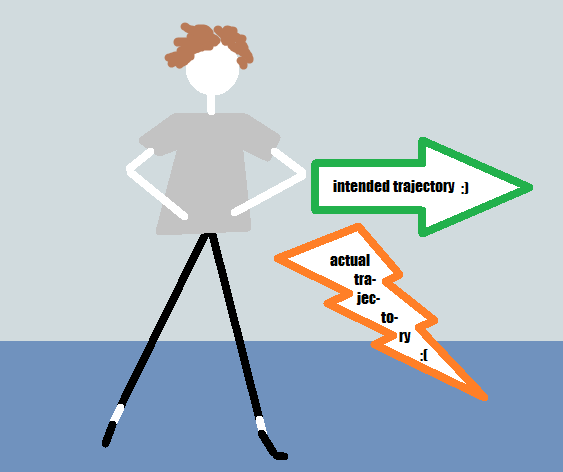
Chaines: Scourge of the Universe (you guys, I can’t believe how weirdly applicable this is, given that I made this graphic in like 2015 2014)
Not cranking the turnout-brakes (read: that thing you do to halt your momentum if you have to finish a soutenu turn in sous-sus) helped, as in it prevented me from actually grinding to a halt after one turn, but it didn’t solve the problem entirely.
Today, though, Killer B fixed the remaining bit of the problem: she said, “You can piqué or chassée into your chaînés, whichever works better for you … but right now you’re tombé-ing in, and it’s killing your momentum.”
So I tried the chassée–chaîné approach, and HOLY CRAP GUYS IT WORKED. Made my chaînés about twice as fast, in fact. (Which is good, because sometimes they were embarrassingly slow.)
Anyway:
AHHHHHH!!!! You guys, how did I go so wrong?!

basically applicable to my entire life at all times
Like, I remember BW giving me a lesson on chaînés as pertains to Men’s Technique, and that he taught me to not piqué into them … but at some point I decided explicitly that tombé was the One True Way.
(Evidently it is a correct approach, but not one that works particularly well for me: I tend to tombé into a deep demi-plié way over my front leg as if preparing for a sauté arabesque or something. Ultimately, that means that my momentum can go straight up or back the way it came, but not really forward except through pas de bourrée … I guess it would be useful if I needed to change directions straight into a series of chaînés, though.)
The waltz combination today was:
balancé (r)
balancé (l)
chaîné-chaîné-petit developpé to pas de bourrée
chassée 4th
turn en dehors
fourth
turn en dehors (land 5th, right foot front, or coupé through)
balancé (r)
balancé (l)
petit developpé to pas de bourrée
chassée 4th
rotation (fouetté à terre)
fourth
turn en dedans
I’m trying to figure out if I’m leaving out some waltz turns somewhere, or if they were in something else and I’m conflating my memories[2].
- very possible; this morning was a horrible slog through the swamps of badness: the struggle was all the way real[3].
- I even hosed up a simple sissone combination at the end of class, though at least I made it to the end of class without actually dissolving into a gibbering zombie. I almost checked out after the warm-up jumps, but I didn’t, because some part of my acknowledges that I work in dance now, which means there will be days that I have to get out there onstage even though I just can’t even.
Regardless, the chassée–chaîné approach is a freaking lifesaver.
I was going to drop a YouTube video that shows this in here, but my exhaustive* one-minute long search hasn’t found one, so it’ll have to wait.
*yeah, okay, totally not exhaustive
Anyway, there’s today’s gem from class.
Guys: if an approach via tombé is sending your chaînés to an early grave (get it? tomb … é … early grave … harhar), try chassée instead.

things you realize
…when you poke through your kindle library at 3 AM
I just finished reading Howard’s End, which is both beautiful and vexing, as Forster’s novels can be.
Since I have to be downtown at eight for a couple hours’ circusing, and I’m not feeling sleepy, and I’ve decided to simply accept this facet of my nature for the moment instead of railing against it, I’ve been poking around for something else to read.
Anyway, I’m trying not to buy any books right this second, so I’m looking through my library, and it dawns on me that my Kindle library stands as a record of my thoughts, in a way, since a bit before I began at IUS. And many of those thoughts were me trying to figure out where to put myself; about who I was and how I should be in the world.
And I realize, now, that for all my sense that I’ve been sort of ducking the bit of adult life, I have in fact been settling into it instead. It’s just that it has happened while I wasn’t looking–that is, while I was dancing, and because I was dancing.
This would be positively ruinous to my marriage if D had imagined that he was getting a finished article. Fortunately, neither of us expected that. We’ve moved so, so far from what I first expected that we haven’t yet sorted out how it all works. My schedule is implacable and impossible and my world is terrifyingly rich and full of other people, and somehow in the midst of all this we are trying to figure out how to actually be together sometimes, and not simply under the same roof occasionally.
When we met, the idea of dancing, of being a dancer, was latent in me. Now it’s simply the air that I breathe. It’s not as important to define what you are when you’re busy being.
To be a dancer is to do dance. To work as a dancer is to live a life consumed by dance. I would say that I don’t think it’s a life one sticks with long if it doesn’t fit, but I’m probably wrong. If it fits, nothing else will work.
So it seems that while I’ve been busy just working, just undertaking this mad project, my life has sort-of gelled. Not that I mistake this for permanence: as a dancer is made of dancing, so a life is made of living. Every step moves forward, forward into the unknown.
But I feel, finally, like I’m trying to move towards things instead of away from things, and to be as I am instead of remaking myself perforce in an image that perhaps doesn’t fit. Not to say that I don’t chafe at my own shortcomings: I will probably never be BW, who apologized for making pies (from scratch) ahead while in the thick of rehearsals for Swan Lake, and who is gentle and temperate.
But I’m more willing, maybe, to work with what I’ve got than I was in 2010. Dancing forces you, eventually, to countenance your own limitations (my turnout is good but my fifth position depends deeply on keeping myself lean because I’m muscly; I’m swaybacked; sometimes it seems my arms will be a trial forever…).
When you find your strengths, your weaknesses stop scaring you so much.
Little by little I’m finding my way.
I suppose it’s worth mentioning the card that my favorite high school English teacher gave me was a cut-out swan in which she’d written, simply: “Find your way.”
I think about that often.
That, and the fact that sooner or later, ballet always involves some manner of enchanted swan.

halp
Saw Giselle last night.
Pros: really good performance, and the hops-en-pointe section didn’t seem random and wtf-y. Which, tbh, sometimes it does.
And as silly as ballet mime feels sometimes (I may have leaned over to my friend L during the second act as Mirtha mimed at Albrecht and whispered, “Make me an omelet, mortal!”), Giselle’s mom in Act 1 flat-out ripped everyone’s heart out with it during the death scene.
Cons: one of my favorite people was the guy in the peasant pas (he was lovely), and between that and the fact that I learned the male variation a couple years back, I was all kinds of paying attention, and now the music is STUCK IN MY HEAD FOREVER.
You guys, I would much rather have Tchaikovsky stuck in my head, for reals. Adam is so … errrrrgghhhh.
It’s that class of ballet music that’s fine as long as there’s a ballet to go with it, but nigh unlistenable on its own. (I should note that the male peasant pas is fairly inoffensive … the first two or three times.)
Also, to be honest, I don’t feel like Adam quite understood the story. Like, seriously, listen to Albrecht’s variation. Then ask yourself whether it sounds like the kind of music that goes with the concept these angry dead ladies are trying to dance this guy to death.
To be honest, it sounds more like, “Jovial wine merchant announces his engagement,” or something.
But we accept it, partly because the choreography is awesome and possibly also because by the time the second act begins many of us have had a drink or two.
Maybe it works better when they play Albrecht as a philandering jerk who just kinda vaguely feels bad about stuff (now that it’s Much Too Late)? Then we’re all on the side of the Wilis, and maybe they think it’s funny.
Though, to be entirely honest, I suspect that Giselle’s BFLF[1], Mirtha, didn’t even think anything was funny even before she became a Wili. Definitely not as she was played last night. There were some seriously fearsome vibes rolling up off the stage.
- Best Frenemy Literally Forever
~
In other news, I’m horribly swamped with dancing stuff right now, which I suppose is a good problem to have.
But alas, BW is leaving us for bigger things, so I’m also all kinds of moping about that. I’ll miss him as a ballet mentor, but also as a friend. That said, he won’t be so far away that I can’t go watch him dance once in a while.
I’m glad we have L’Ancien teaching advanced class, but my relationship with him is very different. I had BW entirely to myself for months, and he understands my body better than anyone (better, in fact, than I do) where ballet is concerned.
So until he departs, I plan to make the most of every class with him. I mean, not that I didn’t plan to in the first place. But you know what I mean.
Anyway, it’s late and I’m exhausted, so off to bed with me.
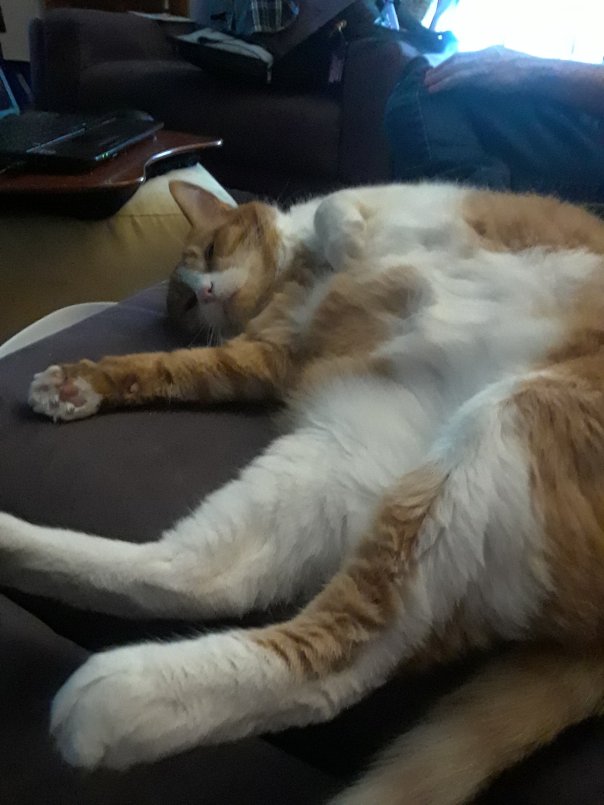
Mr. Merkah demonstrates how I feel right now
Well
After a week of Levofloxacin, which I finished on Thursday, I’m basically back to normal … which is all for the best, since my schedule is about to get complicated.
I took two classes today. BG’s advice: when taking two classes in one day, approach each with a different goal.
My original goal was to focus on technique in the morning and artistry in the evening, but JMH gave us a rather athletic class, so I wind up ultimately just focusing on endurance this evening 😛
On the other hand, I did a billion royales and entrechats, so I’ll be ready for BW’s class on Thursday, though he’ll probably be in rehearsal, so I’m not sure whether we’ll have a substitute or what.
Other things are also looking up. K is trying to organize a partnering class (yaassssssss!), I seem to have a contemporary ballet gig incoming, and the first piece for Culture of Poverty is more or less done. Oh, and I have two named roles in upcoming shows, which is awesome.
Also, my extensions were crazy high today, probably because we had a (visiting? new?) boy in class who was quite good and something in my psyche decided it was important to impress him? But my petit allegro was mediocre. And my adagio was … mixed. And my centre tendu was bleeding awful.
So there you have it. I’m not dead yet.
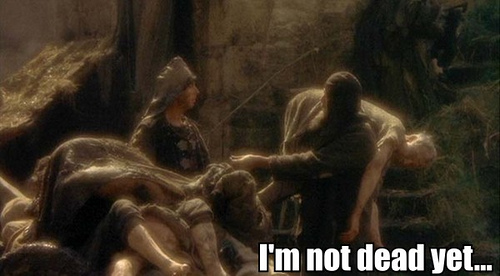
I’m feeling much better!

Reveille*
(n) An advanced step in which—after falling catastrophically out of a turn, jump, or lift—one rises from the ground with such an air of grace and mastery that the audience (ideally, even the choreographer) believes the whole disaster was part of the original choreography. Example: “Mistaknov’s glorious reveille left us questioning whether Seigfried’s variation was not, in fact, actually supposed to open with a glorious saut de chat followed by a fluid, cat-like tuck-and-roll to the knee. Indeed, we wondered if we’d ever seen it done right before.”
I am definitely recovering. Yesterday, I still woke up feeling fairly exhausted, but by late afternoon some of the fog and fatigue had begun to lift.
Every time I do this to myself, I’m stunned by how thoroughly a fairly minor illness can sap one’s energy (or, at any rate, mine). When you know you’ve got a sinus infection but you let it go for several weeks because you know the antibiotics you’ll take to get rid of it don’t play nicely with ballet and you’ve got a show coming up, you lose track of what “normal” feels like.
Anyway, today I feel almost like a human being, which means that by the end of the week I’ll probably be my usual hyperactive self.
Tonight, I’ll be back in class—I’ll do barre and see how things sit.
There was a brief period in this whole process in which I thought, “I wonder if this is what ‘normal’ feels like.” I wasn’t yet overwhelmingly exhausted, but I could sit down for more than five minutes at a time and could also fall asleep easily without having to spend eight hours furiously dancing first.
It lasted maybe a week. It was nice, in a way, but it wasn’t quite like being myself.
Maybe someday when I’m older I’ll find my way back to that place and it’ll feel like home.
Maybe I won’t: we tend to measure ourselves by our peers, and I’ll probably always be a bit of a live wire by that yardstick.
*not an actual ballet term … BUT IT SHOULD BE


 danseur ignoble