I don’t know what’s happening here, but my butt looks good?
Category Archives: balllet

A Few Thoughts On Being Un Danseur
One of the things that I really, really appreciate about my amazing array of ballet teachers is that all of them have, in one way or another, taken it upon themselves to mentor the living daylights out of me.
At my birthday party, whilst being predictably extra for the camera (because I am the world’s biggest ham), I did one of those dive-to-the-knee moves that dudes do all the time in ballet, like this thing:

…only more dynamic, of course.
There are several of these in the choreography for this year’s Showcase piece (though I’m actually on the opposite line, open to the audience instead of closed).
BG said something like, ‘That reminds me! Be bolder about going to the knee.” And then we had a chat about that, and about why.
At one point, he said to me:
“No matter who you are in your daily life, on stage and in the studio, you should be the man every woman wants and every man wants to be.”
We went on to talk about what that means: about the genteel, elegant, graceful masculinity that remains a staple of the art of classical ballet, and how to embody it.
This was not, by the way, in any way intended to disparage my own particular way of being an androgynous kind of boy the rest of the time, or even the role of that kind of ambiguity in other sectors of dance. It was, rather, a question of the ideals of the classical form.
The example we talked about was actually L’Ancien, who is a lovely, very slender man, deeply genteel—but classical ballet is packed with examples. David Hallberg, who manages for all his lithesome beauty to perfectly embody every fairytale prince in the history of fairytales; Mikhail Baryshnikov, who is tiny[1] and not, at first glance, what one typically imagines when one imagines Prince Charming, but who does the same; Rudolf Nureyev, a prince among princes for the whole of his career regardless of his late start, his fiery temperament, and reputation for obstreperousness…
- Like, he’s 5’6″. He’s smaller than I am, and I’m not tall. I kinda vaguely want a t-shirt that says, “Taller Than Baryshnikov” ;D … in case you’re wondering, it’s a quote from a conversation I had with one of my ballet girls ages back. I almost made it the tagline for this blog, but figured it was a bit too obtuse for that.
Anyway, the classical ideal of the danseur entails strength collected under the hand of gentility, fire cooled by courtesy, and boldness tempered by grace. It acknowledges raw, animal power—that’s what gets your grand allegro off the ground—but yokes it with beauty. It couples force with tenderness.
Regardless of one’s gender identity, that seems like a pretty good ideal.
At the end of the day, while you show off your strength in moments of bravura, you must also know how to use it in the service of your partner. Without the latter, the former won’t get you very far. And if you’re a dick, nobody wants to partner you, no matter how good you are[2].
- This directly informs my answer to the question, “Should boys be exempted from dress code requirements in ballet schools?” My answer is an unambiguous NO. If the girls are required to adhere to a dresscode, the boys should do them the courtesy of doing so as well (if nobody has a dresscode, then this is entirely irrelevant). This may be the very first lesson any danseur learns in the art of courtesy: yeah, you’re special because you’re a boy in ballet, but part of what you should do as a boy in ballet—an essential part of the job—is to treat every girl in ballet like she’s the specialest girl on earth. Besides: without every girl who loves the ballet, whether from the stage or from the audience, ballet would die a pretty swift death. The first lesson every danseur should learn is respect.
In an article that I wrote for an academic anthology, I observed that ballet has shown me the kind of man I want to be and is teaching me how to be that man. I said the same to BG the other night. He smiled: that smile that says, Cool, you get it.
One of the things I like immensely about BG, by the way, is that he lives that ideal. He may be his own kind of Extra; he may be a little crazy—but he approaches the world with strength, magnanimity, and grace. He believes in justice and stands up for it without resorting to coarseness or mudslinging. He’s the kind of person who takes the time to ask how you’re doing when you look a little off. Also, he stands up straight (that’s him in the green shirt in the photo above, by the way: you can pick him out pretty easily, since he’s the only other guy :D). He’s definitely on the list of people I’m glad to have in my corner.
All of this reminds me of an exchange I had with K while working on a partnering bit: after we ran it once, she said, “Give me more strength.”
I realized I’d been too soft—a little timid, actually. Not that I was afraid of her: rather, I was afraid of shoving her over or something. The next time I engaged a little more, and the whole thing went better on each subsequent run (except for the time that I came in at a weird angle and offered her the wrong hand: she managed anyway, incompetent partner or no).
On one hand (HA!) I love partnering; on the other hand (HA SQUARED!) it scares the hell out of me a little, because RESPONSIBILITY OMG. But, like, that’s part of The Thing.
In other words, part of being a danseur is understanding that you both literally and metaphorically hold others up.
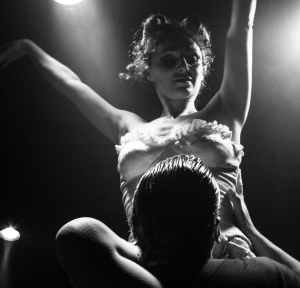
No pressure. (via Pexels)
There’s also knowing when to hold yourself together and when to let go. In that vein, I’m taking a rest day today. The next day off in my calendar is a week from Friday, and while I love Monday night class, I have a long show and two auditions this coming weekend in addition to the usual array of classes, so a day off seemed like a good idea. I’ll probably take class Friday morning to make up the gap.
Which reminds me of the other bit of mentoring BG did the other night. On our second drink, he explained an important rite of passage for professional dancers: taking class with a hangover. Also the universally-understood hand gesture that says, “I’m gonna keep it at a simmer to save the marley.”
Fortunately, I really don’t get hangovers, so while I wasn’t at my very best in class on Sunday morning since I was running on 5 hours of sleep, I at least didn’t find myself praying to Bilious all through class.

A Gem from L’Ancien
“The dance is in the stillness between the steps.”
—L’Ancien
I’ve been trying to think of a way to think about this ever since I returned to dance.
That’s it, guys. Right there ^^
Without the stillness, dance is just chaos. In modern, sometimes chaos is the goal—but even in the most chaotic moment in the most chaotic ballet, you’re always showing the audience a series of living stillnesses.
This is why, even at the barre, the moment of full extension in tendu is important, but so is the moment when you stand in fifth.
The stillness between the steps is where ballet lives and breathes.
Incidentally, this is why my group had to do the first grand allegro twice: we didn’t really show the arabesque in the air in our temps-levée arabesque.
We thought we were getting there, but we weren’t. We were still moving through from point A to point B instead of reaching through the stillness of the arabesque as we soared
We also got called out for not really jumping: I have begun to suspect that L’Ancien would rather see me really jump and be a little late than not really jump and be exactly on time. I’m built for big jumps. I should really use them.
Anyway, we fixed ourselves on the repeat. I have no idea what my TLA looked like because, for once, I was using my eyes correctly.
After class, L’Ancien said to us, “You’re completely different dancers than you were even two weeks ago.”
And then he said these three beautiful words:
“Very, very good.”
That is the best possible way to close out a ballet class on your birthday.
This afternoon and evening: trapeze class, audition, dinner, party.
Everything Is About To Be In Rehearsals
And I am going to explode. Also I am clearly going to need more colors of pens.
Also, modern was good tonight. I’m delighted by the occasional overlap of Modern and L’Ancien’s class, in which Get Taller As You Close is a recurring theme.
Also, it sometimes makes me nervous partnering girls who don’t come from the Wonderful World of Ballet (where everybody understands that it’s better to accidentally grab some side-boob than to drop someone when you’re learning to catch things like a roll down from Bluebird lift or, worse, fish drive from Bluebird lift ). Not that anything bad or weird has happened recently. Just one of those things you ruminate about when you’re a dude and your work life sometimes involves catching girls you don’t know very well.
Also, last night, I got to use pas de chat Italien in a grand-allegro zig-zag, and whilst it proved immensely successful, I’ve decided I should probably work on some other jumps.
I’m not Catholic, but I suppose I could give it up for Lent?

The Value of Video
Sometimes, when he takes class with us, BG stops after barre or skips the repetition of an exercise and sneaks in some video recording.
Some of us grumble about it—generally, folks who don’t want to see themselves on the program’s Facebook page (BG is very conscientious about honoring their wishes)—but I’m grateful for the videos.
The thing is, no matter how hard you try, you can never really watch your own turns (by way of example: the same can be said for entrelacés and so many other things). At best, you snatch glimpses of them. It’s hard to really get a sense of how things look so that you can correct accordingly—and how things look often differs considerably from how things feel.
Likewise, video allows a real sense of progress: you can compare last year’s video, last week’s video, this morning’s video and see where you’ve improved, where you really haven’t, and where perhaps you’ve picked up a bad habit[1].
- Dancers, like horses, catch “vices” from one-another sometimes.
Anyway, BG posted a couple of videos yesterday that I found very useful.
In the first, L and I are doing soutenu turns at the beginning of an exercise. It was surprising to see how much more vertical the axis of my turn has become.
BW has given me so many soutenus; it was in his class that I first noticed that I was allowing my shoulders to fall backwards (or, really, that I was arching my back away from the turn). I’ve been working on that very consciously for months, so it was nice to see how well it’s paid off.
I think I’m still just a shade behind the vertical, but that’ll come.
The second video is a waltz: T, L, and I—generally the more advanced segment of this class—dancing together in a lovely little triad.
I’m much happier with my balancé than I was even a few months ago, though I think T’s épaulement is prettier than mine. Same goes for the waltz turn: I think one of my arms looks a little wonky in this video (I failed to carry my elbow), but I’ve managed to pull a lot of slack out of my spine, which allows me to reach through my legs more effectively.
My turns, on the other hand, are a bit Meh. I prepare with too much slack in my lumbar spine and my free leg slightly less than fully turned out, which means I’m doing extra work to pull the turn up on its axis. This is a profoundly useful bit of intel, as it explains one of the reasons I don’t have reliable triples back yet: my core isn’t quite there—or, at any rate, my use of my core isn’t.
This exercise ends with piqué arabesque, and BG managed to capture the moment when I remembered L’Ancien’s physical correction to my arabesque in our adagio. It’s funny to watch: I remember recalling L’Ancien’s question and pulling myself together, and that it made me late exiting the arabesque but felt good.
In the video, I don’t manage to get my leg and my back as high as I did in L’Ancien’s adage, but it’s a cool thing to remember a mental self-correction and to see it after the fact.
I’m not sure this will work, but here are the videos:
(Gave it a test run. You don’t have to log in to Facebook to watch these, though the dialogue sort of implies it. Just tap or click the video itself to hit play. I’m not sure if they’ll be viewable outside the US; international permissions can be weird.)
Anyway, class tonight, but today I’m basically taking it easy until then. Just going to wash some dishes and cook some food.

Simon Crane, Revisited
After Pilobolus intensive, I semi-intentionally put Simon Crane on a back burner for quite a while. I had discussed it with a couple of people whose insights made a lot of sense, and I wanted to let their wisdom percolate for a while.
I meant to get back to work on it in a month or two, but life being life, I kept feeling that it wasn’t time yet.
Anyway, today it resurfaced on its own, with a very clear thought about Acts I and III.
Specifically, there’s a very explicit transition in Act I from the world of the marsh, which follows one set of (magical) “rules” to that of the city, where the “rules” at least seem more prosaic (I think cities have their own magic, but that might be a different ballet). This is part of what allows the arrival of The Flock, with its wild magic, to be threatening in Act II, even though The Flock believes it is acting in the best interests of its own lost member (that is, Simon).
The connection I had failed to make, though, was that the reverse should also be true. The journey of the Naturalist in search of his lost/stolen beloved must explicitly be one that involves the transition from the Naturalist’s world, in which he feels that he understands the “rules,” to that of the Marsh, where he does not.
This thought makes it easier to structure Act III: before, I wasn’t entirely sure how to frame to Naturalist’s journey, or to explain his trepidation even to myself. I don’t want him to be a swashbuckling hero (as much as I love a good swashbuckling hero/ine)! I want him to be a very human man caught up in something he doesn’t understand, doing his best to cope because that’s what you do when you love someone.
The other thing I’m contemplating is “Bolero.” I love the dance in my head, and I’m going to set it sooner or later either way—but E at PSW pointed out that the music already has a powerful life of its own, both as music-qua-music and as a famous ballet. It wouldn’t be wrong to use it, but it might overshadow the rest of the work.
I’m still thinking about that: I might be standing too close to the problem; it might also be that the “Bolero” section of Simon Crane really is strong enough to work.
Lastly, I think I’m going to revisit the score. I’m very unsure about Satie for the opening dances. I’ll have to listen to it again, and see what’s what. Act III might also need to be reset.
Class today was sound, given that I’m tired and sore from a very long Saturday. It took me til centre to really wake up, but once I did some decent work happened.

Week 3 With L’Ancien
I’ve fallen in love with L’Ancien’s teaching style. Today he did a lot of pulling us up short and making us start over, but always with a very specific point.
We corrected, and several times got a “Good!” or, “Oh, that’s so much better!” or even the coveted, “Beautiful!”
My extensions are returning. My supporting leg is getting through tours lent. At one point, L’Ancien stepped in and reshaped my arabesque: free leg well above 90; back pulled way up, in the midst of our adagio.
I didn’t believe I could hold it myself—and yet I did, and I made it through the tour lent, and through the rest of the lovely adagio.
Last week I felt as if I couldn’t remember a combination to save my life, and as if I was constantly pulling my body back together. I was coming down with the thing that knocked me flat for a few days, but didn’t know it yet.
Today I felt, once again, like a dancer working on learning his trade. It’s been a while.
After, I went to an advanced acro workshop and got to throw people and get thrown, and then finally made it to Trapeze class, where I nailed half-mill to half-Russian with no difficulty at all, even though the last time I did it was probably a good year ago, and I struggled with it because my arms are short.
Tonight, I’m performing at our opera company’s gala, and then I hope to fall into bed and sleeeeeeeep.
Honestly, I’ve missed using my body this much. A day like today reminds me that this is why I do the work that I do. At the end of the day, there is a deep satisfaction in using my body to do the things that I’ve done today.
~
I had a lovely conversation with L’Ancien after class. I stopped to thank him again for teaching is, intending to tell him that I’d been thinking a lot about something he’d said, but I immediately blanked on whatever it was (probably because it was everything).
He told me a bit about his early days as a dancer: he started at fifteen, with three years to learn nine years’ worth of material, knowing nothing. His teacher told him, “Don’t worry about what anyone else can do; just think about yourself.”
He passed that thought along to me, with the coda: You’re here because you love to dance.
I’m glad he can see that, even when I’m struggling in his class (though today there was much less struggle).
Anyway, I hope he’ll stay with us for a good while. I feel like I can learn a lot from him.
This is a man who’s been dancing for significantly longer than I’ve been alive.
Also clearly a man who loves to teach.
I’m glad he has come to teach us. Immensely glad.

Today’s Post, Take 2: BOSU Arabesques
I tried to write a post this morning.
In fact, I wrote a post this morning. Like, 1,500 words’ worth of post.
And it was, honestly, probably a little boring.
I mean, it was exciting to me. I wrote about the fact that I seem to be getting over this sinus thing now (huzzah!). I wrote about last night’s class (great correction for my arms: elbows in front of shoulders; fixes things a lot, w00t!). I wrote about last night’s rehearsal (BG set more of our dance! I get a cool solo bit!).
I wrote about this weird ballet dream I … actually, there’s no way I’m going to compress Post-Apocolyptic Warehouse Summer Intensive and the ensuing Dance Belt Crisis into a parenthetical phrase. I think that’s probably an entire post in and of itself, but I’m not writing that one right now.
See, I realized that I really wanted to get around to writing about some BOSU videos, and my earlier draft was just WAY TOO LONG, even for me. So it will very possibly languish in my Drafts box forever, and in its stead, here’s the post I promised you with some BOSU arabesques.
This video begins with a very slow rise at coupé.
It’s not terrible: my elbows could stand to be a little more lifted, and my chin is drawn back a little—in short, I’m drawing back into myself as I fight for my balance instead of drawing up and forward.
If you give it a pause at 0:16, you can see this. I’ve just started to sort of get with the program, press forward, and lift the back of my neck a little bit, but my my jaw is still drawn back.
I’m lifting my arms, here, in a way that draws my shoulders forward, which pushes my sternum back. There’s definitely room for this particular movement pathway—but it’s in modern dance, rather than in ballet, and you use it when you want to contract rather than lifting.
Because my weight is distributed in a kind of weird, snaky pattern, I can’t bring my free leg up slowly and with control.
This costs me when I begin to unfold around 0:22. Between 0:22 and 0:24 I’m forced to redistribute my weight rather abruptly. As such, this phase takes about half as long as it should: I kind of throw my leg and catch it, instead of carrying it smoothly. My arms can’t keep up without unbalancing me, so they’re late to the party, sweeping through to first arabesque when the free leg has, in effect, already arrived.
At 0:26 – 0:28, however, I sort myself out fairly substantially. My right arm is a bit far back and a bit high, but I manage to carry my sternum forward, untuck my chin, lift the crown of my head, and the free leg floats up just above 90 degrees.
The interesting thing about this recovery is how effectively it restores control. I’m able to recover my weight evenly and return to and hold a the first arabesque at 45 degrees on relevé. As I reach to allongé, though, I lift my gaze by lifting my head back, which unbalances me. It doesn’t exactly knock me off my leg, but I do think the close and dismount could have been better-controlled had I lifted my gaze up and forward instead.
This all illustrates one of the really important points L’Ancien frequently mentions: your head is one of the heaviest parts of your body. Its placement matters immensely to the success of your balances.
There’s more wiggle room, so to speak, in first arabesque at 90 degrees because of the way your weight is distributed. In fact, it can be helpful to pull the upper body back a bit when you’re working at 90 degrees en relevé. This particular arabesque is successful because I’m drawing my back and my leg towards one another, allowing the leg and body to pivot freely around the hip of the supporting leg.
This is the result:

A nice, stable arabesque a little above 90 degrees. Two quibbles: my releve could be stronger, and I’d still need to get my back a little higher to carry this into a deep penche.
Progress from here on arabesques will depend, for me, largely on figuring out how to engage my core and back in such a way as to allow more freedom to lift my sternum.
Progress on balances in general—especially those that aren’t counter-balanced—will require me to keep working on carriage of my head, arms, and chest.
This second video is shot from a slightly different angle and involves a different approach: I step into coupé derièrre, then immediately begin to rise to retiré.
My placement looks a little better here: if you watch my arms, you can see that I begin by rotating the humerus—in other words, lifting the elbow—without disengaging my lats. My neck, sternum, and back remain lifted and open. After 6 seconds floating in retiré, I begin to extend.
This is where things fall apart a bit. I start to carry my knee back, but then I lose control of my turnout and the knee briefly dips.
If you pause the video at 0:20, you can see part of the cause of the problem: my right shoulder is no longer connected to my left hip, so to speak. Instead, I’m extended along a long diagonal that begins to pull my weight towards the outside of my supporting leg. The free leg scoops downwards, then lifts again, in an attempt to compensate.
The resulting balance (though it’s really pretty) is really looks more like the middle of a reversé: I suspect that if I drew my knee in to attitude, the balance would be forced to pivot.

On the other hand, that releve looks pretty nice.
On the upside, I’ve done a much better job keeping my back up, here, Partly, that’s because I was “warmer” in this video; but it’s partly also the result of experience. I’d been experimenting with these for roughly half an hour when I shot this, as opposed to maybe five or ten minutes when I shot the first one.
Because of the angle of my back, the arabesque in this video looks a prettier than the one in the first video. That said, I’m not entirely sure it’s actually a better balance. I thought it was until I sat down and really looked at these in depth.
Now, I’ve concluded that the first one, though it’s more awkward at the outset and never quite matches this one in terms of beauty, is probably technically better: in short, my control is better through the latter half of the exercise.
So there you have it: my nitpicky examination of a couple of BOSU arabesque videos. What did I say I’d do next, fondus?

Adulting Secrets #1; Technique Analysis #1*
*Now with music!
When you’re a kid, you might experience adults as mostly functional, mostly giant walking disasters, or some combination of the two—but you probably don’t experience them as people quite the same way you experience yourself and your friends as people[1].
- There are some exceptions: my riding instructor was one of those rare adults who are phenomenal at connecting with kids on a very human level without being a total wishy-washy pushover, which you can’t be when you’re teaching 50-pound 7-year-olds how to handle half-ton beasties front-loaded for panic.
There’s nothing wrong with this. Nothing at all. It so happens that kids and adults in most of the Western world move in fairly separate spheres, and that the developmental worldview of childhood tends to be a bit solipsistic for entirely developmentally-appropriate reasons.
But, anyway, the upshot of this is that an awful lot of us reach adulthood without having the faintest idea how to, like, adult.
…Which is evidenced by the fact that “adult” is now a verb as well as a noun.
I think maybe this wasn’t always the case. Like, up until pretty recently, people were pretty explicit about training up a child in the way he (or she) should wash the ding-dang-darn dishes for crying out loud (and turn down that racket).
Then my generation came along, close on the heels of Gen X but a bit more computer-y, learning from day one that we were supposed to, like, Follow Our Dreams and self-actualize our unique snowflakitude, but also learn math and science a whole lot, and how to do things with technology, and also how to ballet or football/soccer or handegg or violin or speak seventeen languages or be a Mathlete and a representative in the Model UN or pwn all the Mock Trials.
In short, we were so busy getting a First-Class Education and becoming (in many cases, anyway) Well-Rounded that we never had time to absorb some of the critical secrets to Adulting.
Like, to be honest, COFFEE.
I’m just gonna admit up front that even my Mom will tell you she’s almost never sick. I think germs are just way too scared of her. I remember her being actually sick exactly once during my childhood, and it was totally miserable for about a week, and she confirms the same.
HOWEVER. Given that she worked a billion hours a week and sang in at least one choir at any given time and was (for several years) also working on a Master’s degree and somehow found time to design, plant, and maintain an absolutely lovely garden and did at least some of the carting around of a ridiculous kid who somehow thought it was a good idea to jam ballet and horses and gymnastics and choir and skiing and ice skating and the violin into any one week … anyway, what I’m trying to say is that my Mom was almost certainly crazy tired at least part of the time (though she also has the “can sleep any time, anywhere” super power).
And, somehow, I never quite grokked how spectacularly helpful coffee can be in those circumstances.
At least, not until now, when I’m definitely ill but probably on the mend, and I can’t stand the fact that there are three days worth of dishes piled up in the kitchen, but also not sure I can just plain stand long enough to wash them, because frankly one of the major symptoms of Whatever I Have (probably yet another sinus infection) is knock-you-on-your-keister fatigue.
Enter COFFEE.
I don’t usually drink COFFEE after noon, because frankly it’s a terrible idea if you’re already a night owl but you’re also a dancer and you regularly have to be able to function in class at 9 AM. In fact, I usually drink exactly one coffee per day, in the morning, less for the caffeine (though that helps when I’ve had to take a sleeping pill, because see above re: night owl) than for the ritual of it.
However, when one is definitely not well enough to go to class (blargh) but also not ill enough to remain in bed without going crazy, one cup of coffee will help one wash some dishes.
So there it is. COFFEE is tasty, but—used judiciously—also one of the secrets of adulting.
I feel like I really should’ve figured this out before.
It’s probably not a secret at all to vast legions of people my own age and younger than my own age who are simply less, like, insular. I am also the kind of idiot who insists on using a hand-cranked kitchen mixer partly because the electric ones are fecking loud, partly because my inner hipster finds it satisfying, and partly out of sheer cussedness, so draw your own conclusions.
But, anyway, I guess this is a thing I know, now. If you need just a little help adulting, a cup of coffee might do the job. So there you have it.
~
Anyway, if you came for teh balletz but you’ve had to sit through my long digression into the magic that is COFFEE, my apologies. Anyway, here comes the bit with teh balletz in.
A couple weekends back, I shot a bunch of video of balances on the BOSU balance trainer at Suspend. I posted a couple of them to the Instas, then promptly failed to get around to uploading them to the YouTubes so I could toss some music in and easily post them here and critique my own technique.
Belatedly, I have now uploaded a handful (which is to say, three) videos and slapped a little music on them. The actual soundtrack of gleeful cackling from people working on stuff nearby was pretty amusing, but also pretty distracting.
Now they’re running loose on the Tubes. Sort of. (Okay, so they’re currently unlisted, because people like to be mean—by which I do not mean ‘critical, but fair,’ but instead ‘douchy jerks’—in the comments, and I’m mean enough to myself for about five people, thanks).
Anyway, without further ado, here’s the first one:
…This one hasn’t been on the Instas yet.
Here, I’m working left, which is currently my stronger side balance-wise—which is to say that my right leg is better at the “supporting leg” role and my left leg is better at the “free leg[2]” role.
- L’Ancien favors these translations from the Russian over the usual English “supporting leg/working leg” dichotomy: he points out that the supporting leg, really, is the one doing most of the work, and says things like, “And which leg do you imagine flamingos think about?”
If you watch closely, when I first step onto the BOSU trainer (and then promptly step off), you’ll notice one of my most constant and worst ballet habits: I lead with my freaking hips, like I think I’m on a catwalk in Milan or something.
Ballet is not a catwalk in Milan, you guys.
The shirt I’m wearing (half my costume from Death Defying Acts) makes it hard to see, but at the very beginning my sternum is behind the point of my hip. This is so problematic (and, on the BOSU trainer, so bleeding obvious) that, at 0:05, I step back down so I can basically fix my entire approach.
If you pause the player at 0:07, you’ll notice that I’ve corrected pretty reasonably. I haven’t really turned on my turnout yet (it’s easier to mount the BOSU trainer, then turn on the turnout), but I’m much more squarely balanced over my supporting leg.
At the same point in time, you can also see that my knee is roughly over the arch of my foot: I’m shifting my weight towards the ball of my foot on the supporting side by shifting through the entire leg as well as my body. This allows me to keep my hips level from side to side (at 0:10, I actually tap them with my hands to remind myself to stay level and pull up).
Given that I’m still working in kind of a half-baked turnout, the passé balance that follows is pretty decent. You can see me actively resisting the urge to pull up and back (one of the things that makes passé easier for me than coupé is that you typically bring your arms up to third/en haut, which—as long as you keep your elbows lifted—helps keep your weight forward).
I also correct the height of my passé in the midst of the balance—it still wouldn’t be high enough for BW, and neither would my relevé, but in this video I’m still getting used to the BOSU trainer, here, so I’ll give myself a pass on those. It’s high enough for just about any application, anyway, and lifted correctly from behind and beneath, allowing for increased height without a hip-hike.
It’s when I begin to extend that things go a bit pear-shaped.
The legs themselves are rather nice, I think: I carry the working knee up and out, as one should, and though I lose a couple of degrees and wind up at full extension just a little above ninety (for a split second), the overall mechanical process is fine.
Except.
I totally fail to adjust my upper body to counterbalance the weight of my leg, which is considerable (the average human leg apparently weighs 40 pounds, which is nearly 1/3 of my entire weight). This actually has a lot to do with the loss of elevation on my extension: any extension requires a fair bit of counter-balancing, and those above 90 degrees require quite a bit more counter-balancing than we tend to realize.
Usually, we effect the counter-balance by shifting the weight away form the free leg. Often, this means performing the complex ritual of simultaneously pulling towards the free leg (to engage the muscles that will help it stay up) and away from the free leg (to counter-balance its weight).
In this video, I do absolutely nothing to counter-balance my free leg. I’m thinking too hard about keeping my weight forward, and so I fail to shift it back just a little. As soon as my free leg begins to move through croisée, I am powerless to resist the pull of gravity, and it “knocks me off my leg,” as we say.
In this case, I should have allowed my shoulders to open slightly in opposition as my arms transitioned to allongé. This is accomplished, more or less, with the breath: you breathe in and allow the breath to lift your sternum until it can’t go any higher, so it has to go back a bit, and while this happens you stay engaged so you don’t turn into a sway-backed cow.
Instead, I kept them exactly as they were.
While, to be honest, I find that fairly impressive in and of itself (I’m forever doing crazy stuff with my upper body and actively, rather than passively, putting it where it shouldn’t be), it’s not very effective if you want to balance that extension.
So there you have it.
Also, rather a nice sustained passé balance (or, well, technically retiré, since I’m not really changing my leg from back to front; it seems that way, but really it’s an artifact of mounting the BOSU).
What works best, here, is the lower-body transition into the extension: I keep the hip open as I extend, rather than allowing it to turn in, then extending from parallel. Also, it blows my mind how flat-out steady I am through much of this. Placement: it works.
What doesn’t work is the failure to counter-balance the extension, which in turn costs me both the height of the extension (which I begin to lose immediately) and the duration of the extended balance. Also, my free-side hand:

WAT. JUST WAT. (But dat leg tho.)
I do finish my rather graceful emergency dismount with a nice, deep, turned-out, knee-over-toe plié, at least, though I immediately let go of my turnout as I swing my right leg around and step toward the camera.
Oh, well.
Next time: a comparison of two first arabesques, followed by a comparison of two penchés (one that kinda works; one that kinda knocks me off the BOSU).

A Good/Bad Weekend
No class Thursday night because BW had a show, and Friday is currently my day off, though in this case I spent it driving D around.
On Saturday, my second class with L’Ancien was profoundly mixed. I got a “Good!” at barre once, which was really nice, but I was a total disaster at jumps. Like, all the jumps.
L’Ancien gave us a warm-up jump combo that went:
first, fifth, changement, entrechats quartre, trois, cinq
Only, for some reason, what I kept actually doing was:
first, entrechat quatre, changement, wtf, oh no, where even am I, jeté battu?
L’Ancien came over after and stood directly in front of me and made me mark through the steps by myself while he talked me through them. I still had trouble with it, but didn’t figure out til I left class that part of the problem was not knowing where I was supposed to close fifth the first time.
I knew the trois was supposed to finish in back, and was constantly doing mental math to try to make that happen. I thought about it in the car, I thought about it whilst making dinner, and I’m still thinking about it.
L’Ancien did preface that exercise with, “This one’s for your brain.” Which it was.
I think I’m going to ask BW to let us do that exercise on Thursday this week. Also to review odd-counted entrechats, which I’ve had to do twice in the past week-and-change, but haven’t done prior to that in more than a year, if memory serves.
I also flailed through grand allegro. It started with chassée, and I realize now that I was doing tombé instead. At one point I even tried to add the chassée, but didn’t subtract the tombé. You guys, what the actual?
I realize now that it may simply have been the opening salvo of whatever illness has knocked me onto the ropes. I am definitely thinking with far less clarity than usual right now.
That said, Saturday’s show, “Death Defying Acts,” was really very good.
DDA was based on a book of poetry, and the author came for the second show. Fortunately, our intrepid director chose not to tell us that the author was in the house the until the show was over.
Even I would’ve found it a bit nerve-wracking to, in the closing performance, interpret a poet’s character knowing that the poet was right there! (It would be totally different if the poet/author was involved in the rehearsal process, of course—the challenge in this context is that of not knowing if you’re fitting their vision, or at least interpreting in a way that they find satisfying.)
After, the poet told me she was in awe of my Zorada, which meant the world to me. I also got a couple of nice mentions in facebag reviews, one of which described me as a “graceful dementor”—which is rather exactly what I was going for.

Here I am, gracefully dementing with my friend AM, who played a very leonine lion.
I also literally didn’t drop the ball (except when I was supposed to) and while I think I’ve actually done the piece better in rehearsal a couple of times, I think my performance was entirely acceptable even by my standards.
Yesterday, I woke up with a sore throat, a headache, and a fever. I opted out of class, but did go to see “Chicago” (a friend of mine gave tickets) which was awesome even with a really terrible headache. We did hightail it out of there after the first curtain call, though, even though the orchestra plays a fun little set after. My head was ready to explode, and I just wanted to buy some DayQuil and lie down.
After that I went home, ate a chicken pot pie, went to sleep, and, excepting a brief period in which I woke up and read for a little while, I stayed asleep until this morning, when I had to get up to take Denis to work. I would probably still be asleep if still being asleep was an option.
D kindly let me sleep until about 15 minutes before we had to leave, which I appreciate. It takes me basically no time to throw on some warm-ups and make a cup of coffee, and that gave me about 45 more minutes of shut-eye while he showered, shaved, and so forth.
I’m skipping class tonight so I won’t give whatever I have to everyone else (and also because I’ll probably be asleep). I’m hoping that my intensive rest plan will have this licked before tomorrow evening’s modern class, or before Wednesday’s evening class and rehearsal at the outside.


 danseur ignoble