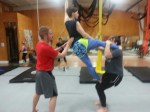
This gallery contains 4 photos.
Fish-hook with A from acro tonight. Denis got his straddle inversion on Lyra today. Also bird’s nest.
(Also highly relevant to dance, btw.)
I’ll start with a caveat.
As we are very fond of saying at the studio:
…Which is a long way of saying that “Can’t” is okay.
As a dancer, gymnast, and equestrian, I’ve experienced a lot of that “No such thing as can’t” conditioning — I still wrestle with it frequently, though for me, it’s usually on a mental-health level or a neurological-weirdness level rather than on a physical-performance level.
Aerials have taught me that, really, the proportions of my body — which are great for dance and for most things in aerials — make some skills really hard, even potentially impossible. It’s also teaching me that, you know, that’s probably okay.
I haven’t hit a skill yet that’s really, truly impossible, but I can tell you that T-rex arms make doing a half-Russian out of a half-mill pretty freaking hard. I may or may not ever find a way to make it happen smoothly; I may have to work on it until my body finds its own special way of doing it.
That’s okay, though. Half-mill into half-Russian is one skill out of a zillion. There are other skills I can use instead.
That’s not quite a true can’t, but it’s an indication that part of me is willing to move towards a world where can’t is as okay for me as it is for other people.
We’re allowed to have can’ts. In fact, we probably should have can’ts. If we were all equally good at everything all the time, maybe there wouldn’t be room to appreciate artists, spectacular surgeons, and for those people who are amazingly gifted in the realms of the heart.
There’s some real truth to the idea that the shadows allow us to appreciate the light (and vice-versa), and while some of the can’ts in our lives hurt too much to think about them this way, others sting a lot less when we come to see them that way. (That doesn’t mean, though, that it’s wrong to fight to overcome your own personal can’ts. Probably the middle road, some of each, is the healthiest approach.)
Basically, everyone has a can’t somewhere, and that’s okay.
~
That being said, there is something I love so very, very much about aerials, and it’s this.
Every now and then, there’s this magical moment when something that used to be a can’t suddenly transforms into a can.
Of course, that’s not really how it happens.
What really happens is that you practice that skill, or other skills that train the same muscles and build related neural pathways, and then a moment arrives when, Boom! It all comes together, and it seems like a miracle.
Or, like, maybe it just is a miracle. Empiricism is great and all, but it isn’t everything.
Anyway, I had one of those moments today in mixed-apparatus class. We were doing vine climb to crescent moon (here’s an image [opens in new tab]).
This, by the way, is one of the skills that are more challenging for me because of the way I’m built. The last time I tried it, my body basically didn’t “get it,” and I haven’t done it since (not on purpose; it’s just how things have shaken out).
Today, it just happened brilliantly, beautifully. I was able to sail right into crescent moon effortlessly (and did a straight-leg variation that apparently impressed the hell out of everyone; I’m going to have to get a picture of this).
I haven’t really practiced these skills; I’ve just practiced related skills enough that it came together today — and that felt amazing.
Suddenly, this thing that used to be a can’t had magically become a can.
And that felt so good.
This is one of the things I love most about aerials (and about dance). I love those moments when things that felt like I would just never, ever be able to do them magically transform into things I can do and do well.
Those moments only happen, of course, if you stick with it — and I think that this may well be the greatest lesson that aerials and dance can teach us.
When we experience those moments in which can’t becomes can, we begin to think of ourselves differently. We begin to regard ourselves as people who are capable; as people who succeed.
Likewise, we watch other people experience that same transformation, and we begin to see them the same way.
We learn to feel this way in spite of our can’ts; in spite of those other areas in our life in which we continue to be less than able.
If we are fortunate, we learn to see past those areas; we learn to see that they are not barriers to a kind of overall can.
For what it’s worth, I think this is the same knowledge that good support services for people with disabilities imparts.
I used to think of myself more as someone who couldn’t: someone whose neurology stood in the way of success. A lot of parts of day-to-day life are hard for me in ways that can be really frustrating and even demoralizing, and for a long time I internalized the hell out of that. I felt like I had to fight with everything in me to wrestle that set of can’ts into the ground; to be as “normal” as possible, no matter the cost.
Dance and aerials have taught me that my strengths lie elsewhere — and that they’re considerable.
They’ve taught me to regard myself as someone who is profoundly capable, but in ways that are maybe kind of different and not entirely compatible with the usual 9-to-5 (or 6:30, or 8:30) world.
They’ve taught me that those ways of being capable are good, and valuable, and actually pretty awesome.
That opportunity should be available to everyone.
Not that everyone has to reach it through aerials or dance — some people reach it through math, or the study of history, or organizing (seriously, this is probably the most under-appreciated gift in the whole of the Western world), or homemaking, or knitting, or bringing people together, or through an uncanny ability to navigate the difficult waters of the human heart.
I hope that, in time, we’ll grow into a culture that appreciates every one of these gifts (and all the others that I haven’t listed; we’d be here for the rest of forever if I tried).
One of Denis’ great gifts in working with his clients (adults with intellectual and developmental disabilities) is helping them transform their can’ts into cans; helping them reach their moments of can.
He believes in people with a kind of unshakable faith, and he helps them believe in themselves.
I have seen aerials do the same thing for so many people now — so many people come in saying, Oh, I’ll never be able to do that or I’m too weak or (as I once said) I don’t have the upper-body strength for that.
As our trainers are so fond of saying, “That’s why you come to aerials class.”
That, and to reveal the vast treasury of your undiscovered can.
Yesterday (Monday) began not-so-well and ended brilliantly.
Modern class was, on average, more or less a wash. I had trouble waking up, and while my floorwork was good, I simply couldn’t remember much of the across-the-floor sequence.
I suspect some of that was sleep- and medication-related. I have been having trouble sleeping for … well, for reasons that I hope are sorted now via some very blunt communication with our housemate (in summary, “Yes, I sleep that lightly; no, I cannot afford to stay up later at weekends, so Quiet Hours After 10 PM really, really means just that, or I will eat your face, kthxbai). My circadian rhythm had crept back to its natural 2-or-3-AM-is-bedtime pattern, so I finally just knocked back an Ambient on Sunday night.
I got some much-needed sleep, but I don’t think my brain was 100% online until after lunch.
That said, a post-lunch choreography session went really well (once I wrestled technology to the ground, anyway) and produced some useful material — and the extra edition of Killer Class (Mme B subbed for M BeastMode) went brilliantly.
First of all, I did all the freaking turns the right freaking way. There were no backwards turns. There were no just l-plain-failed-to-turns.
I was not channeling Derek. Zoolander.

Don't be this guy. (Shamelessly stolen via teh Googs.)
Second, I adaged like a boss.
I was pleased with that, because the strength of my legs is uneven at the moment (though improving every day), which mostly translates to left-supporting-leg balances being wobbly. (Y’all, it is so frustrating to pull off a really long attitude balance on the right, then barely manage one at all on the left because your hip is all loosy-goosy).
Third, I did do part of the petit allegro incorrectly on the last repeat, but only because my brain skipped over the easy part in order to get to the less-easy part.
Also, my left split is back, now that my sacrum is no longer jammed on the opposite side.
Even better, after nearly four hours of dancing, I felt sufficiently tired to sleep without pharmaceutical guidance.
Today, I played on the lyra and got stuck in the silks in Mixed Apparatus Lunch Meeting Class. The silks thing was kind of hilarious. We were practicing figure-8 foot locks one at a time up the fabrics, and (because my legs are super-strong and flexible because ballet) I climbed right up to the ceiling … Where I proceeded, somehow to get my left foot tangled while stepping out of a foot-lock.
At ground level, this is merely embarrassing. You hop around on the free foot as you extract yourself.
Fifteen feet in the air, it’s a little more complicated.
I should simply have put my right for into a foot-lock, but by the time I realized that, I’d been desperately hanging there, alternating between single short-arm hangs, until I’d already exhausted my arms. I was, at that point, freaking out not about the prospect of falling, but about the prospect of being caught by that one tangled foot and breaking or straining something.
My brain was like, “NONONO, WE NEED ALL OUR FEET FOR DANCING.”
So instead I called to Denis for help, and he reached way up and flapped the tail of the silk around until we managed to free my foot.
Silks, you guys. Sometimes, the struggle is really real.
Incidentally, I now enjoy a much healthier sense of empathy towards fishing-industry by-catch.
This miniature disaster was mitigated by a very enjoyable Flexibility & Mobility class tonight — it turned into the equivalent of a knitters’ Stitch-n-Bitch (complete with off-color jokes) as we foam-rolled ourselves into oblivion.
After, in open fly, Denis & I worked on the timings for our performance and ran through the piece several times. I ran mine on both sides, just because — it works well either way, so I can adjust as needed according to how the apparati are set up.
I’m still just really excited about the fact that I can make it through several successive runs of my trapeze routine in a row, even with the timing changes that force me to hold gravity-defying positions for ages.
I’m also happy that I feel confident running my routine on the second-highest of our traps (the ropes on the highest one are too short for the iron cross segment).
FWIW, I’ve now practiced this piece, or sequences from this piece, on four of the five trapezes that are most often rigged in our studio. Woot.
Tomorrow, it’s my usual Killer Class, so I hope the fact that I took my Ambien early will help reduce the duration of the “hangover” effect. Then I’ll be working around the house until it’s time to go to Trapeze class.
Speaking of Ambien, mine has decided that I will sleep now — so I’ll close this here.
So Denis totally shot this last Tuesday, and I am definitely pretty tardy in posting it. We’ve been having some internet connectivity challenges that have made larger uploads (and downloads) difficult.
I think I look pretty tired in this video, as I’d just run through this routine four times in a row, but all of the choreography is there. Next, I’ll work on adding timings (synchronizing the routine to the music) and polishing the movements to add musicality and elan.
That is, once I’m allowed to get back on the trapeze 😛
The voice in the background is Aerial K, one of our instructors, who was working with one of our friends on the lyra.
Update: Oh, and the little thing where I flap my feet to find the bar after coming down from the Iron Cross/Egg/Stag/Switch sequence is pretty hilarious.
*Insofar as I am capable of ever being serious about anything, ever, because I am a focused person, a dedicated person, an all-of-that-kind-of-stuff person, but serious? I’m not sure that’s the best descriptor, really, where I’m concerned.
So, yeah.
I am thinking about injuries, and my history of accumulating them, and being like, “Ha! Ohai! I haz hurted myself again,” and then basically making jokes about it because that’s way easier than actually admitting that I’m hella pissed at myself.
But, like, I am.
Pissed at myself, that is (for my Brits: I don’t mean I’m drunk at myself, I mean I’m mad at myself … this time … which you probably already knew from context because you’re smart, but somehow my inner Smart-Alec just wouldn’t let me not say it).
Or, well, I was.
And then I realized that I’m looking at this incorrectly.

Denis recommends a change in perspective.
I have a habit of injuring myself mildly, which just happens in Teh Ballets and in life at large sometimes, because humans can be careful but can’t be perfect.
Injuring myself mildly from time to time wouldn’t be a big deal in and of itself.
The problem is that I also then have a problem of doing things that exacerbate minor injuries and turn them into major ones, like I did this week.
I’ve been mad at myself because I was like, “That’s just careless.”
Except, it’s not. Carelessness isn’t the problem.
The problem is that I don’t perceive pain normally and I’m stupidly hypermobile (okay, and my drive to do things like dance and aerials often exceeds my limited supply of common sense).

Shamelessly stolen from Monty Python by everyone ever.
So, basically, parts of me don’t start hurting when they should, then stop hurting before they should. The level of pain I experience does not accurately reflect the severity of any given injury, nor do they reflect how much it has healed.
Theoretically, the deep muscle in my “thut” (that’s thigh-butt; you can thank my aerials instructors for that one!) that I could barely use yesterday should be causing a shedload of pain today, but it actually doesn’t hurt at all**.
**Maybe it would if I tried to do the things I’m not supposed to do. Maybe it wouldn’t. I don’t plan to find out the hard way. At any rate, it should at least be sore.
Note to self: THIS DOES NOT MEAN THAT EVERYTHING IS FINE.

Everything is fine. (Shamelessly ganked from heroviral.com.)
Likewise, parts of me stretch in ways that increase the likelihood of injury under certain circumstances. This is partly due to associated abnormalities in proprioception and pain perception (see above) and partly due to the fact that greater flexibility often correlates with reduced strength.
Not that I’m not strong; I’m just not necessarily strong in the places that will prevent me from doing things like yoinking the crap out of my turnout muscles.

Seriously, there is absolutely nothing wrong here, guys. Everything is definitely under control.
I haven’t been treating this seriously. I’ve been too busy being delighted about the things that my abnormal pain perception and hypermobility let me do to be willing to countenance the fact that they also predispose me to injuries that I could better avoid if I was, basically, less weird.
As they say: “You take the good with the bad.” And I’ve been trying only to take the good, without accounting for the bad.
This past week, I turned a minor strain into a major one and bought myself several days off dancing and a term of about six weeks to full recovery (with appropriate management).
I wasn’t being careless. Things just didn’t hurt, so I carried on as usual. My leg was a little stiff and sore in the morning, but felt okay enough by the time class rolled around, and really quite okay indeed by the time trapeze class rolled around — so I proceeded with business as usual.

Business as usual (actual video to follow … eventually).
This is the same approach that bought me a layoff of a couple of months last year, followed by a long reconditioning period.
Obviously, a rate of one serious injury per year is quite a bit higher than is really sustainable.
So, in additional to healing, I plan to spend the next several weeks learning how to prevent injuries to my specific body. Clearly, this will mean developing both better awareness of what’s going on in my body and a greater willingness to turn to my live-in Physio (AKA my husband, Denis) when I think I have a minor injury and follow his advice.
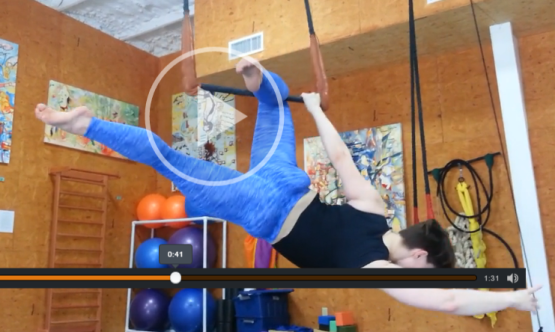
This is me, not following advice (because I hadn’t asked for any). For the record, yes – that *is* the leg I strained, though this is not how I strained it. Bizarrely, that involved neither aerials nor ballet. In other news: yup, I am still pasty.
And, of course, because I like to write about everything (if nothing else, it serves as a kind of external backup drive), I’ll probably be writing about this process here.
So there you have it. Some insights about injuries that I don’t think I really had before.
Also a terrifying picture of my butt. Holy chromoly. Who stuffed ‘roid-raging weasels down my tights?!
I tried to post a video of my trapeze choreography (which is now memorized, so I’m on to working timings and applying polish!), but it failed for some reason, and then I derped out on posting class notes yesterday.
I’ll get the video up ASAP, though I think I might have to go the “Upload to YouTube > Embed to Blorg” route.
Yesterday’s Killer Class was pretty excellent, albeit hampered by the Groin Pull That Will Not Die (Why can’t I wait until the day before a week-long vacation to injure myself?! Seriously, you guys, I have a whole week in October scheduled for that kind of thing.).
The Pull didn’t like turns, so I did very few of them on the left supporting leg. I had doubles on the right (technically the left), though, so go me? Still not as good by any means as Company B’s.
Company B is a beautiful dancer, and I watch the crap out of him every time he’s in class, because I find it educational (okay, and also because OMG he’s just freaking “fearfully and wonderfully made”). Watching him yesterday, I had a huge light bulb moment that made a drastic improvement to my ballotté. I did one run-through of the final petite allegro to get that update installed, so to speak, even though I’d ducked out after the warm-up jumps.
Trapeze class was pretty good; still can’t get smoothly from half-mill to half-Russian (T-rex arms: the struggle is real!). I’m now forbidden to work on them for at least a week, anyhow, while this groin injury heals. Life is hard when you sleep with your physiotherapist.
I’m on full-time rest for the next couple of days, which is less annoying than it would be if this wasn’t Derby Weekend, which makes getting into or out of my neighborhood a nightmare and this reduces the angst factor. I definitely exacerbated the existing injury yesterday.
Best to take the rest now and heal so I will be in shape for our show and for the Cinci intensive.
And then ,no more injuries until October!

Okay, one of these days, I really need to take an actual weekend.
I cleaned the bejeezus out of the bedroom on Friday (we were supposed to go to a party, and then drinks after said party, and then the party was cancelled and, as a result, so were the drinks).
Saturday, I did juggling and ballet class (which was something of a disaster, y’all, and I have no excuse, except maybe the lack of breakfast), got costuming details sorted, showered, then ran back out the door to do dinner, a Cirque show, and drinks afterwards with my cirque peeps (we resolved to do the “getting together for drinks” thing again some time soon).
Also, YOU GUYS, I SHOWERED. The fact that this feels like an accomplishment suggests to me that I may be overscheduled*.
*To be fair, I do bathe pretty often, but that’s more like physical therapy than washing up.
We got home around 2AM, managed to get to sleep by 4AM, then got up again at 8AM to go do Acro, Open Fly, and the Sunday dance class.
Though we both did quite well with the dancing and the teaching, both Aerial A and I were defeated repeatedly by technology during class. I chalk this up to sleep deprivation, you guys. Because, seriously, we were both like, “OMG WHAT IS THIS THING I HAVE NEVER USED THIS BEFORE” as our phones trolled us. They were like, “Tendu music? Imma let you fi-NO I’M NOT!!!! HAHAHAHA!”
I gave my Sunday class a rond de jambe combination with that lovely fondu-rond-allongé thing. To be honest, I was kind of expecting at least one person to fall over, and nobody did, which was pretty impressive. I should reiterate that these guys are doing all this without a barre. Fortunately, aerialists already tend to have strong core muscles and to know how to use them.
What we’re working on, in this case, is lines: using turnout through the full range of motion in order to maintain a beautiful line. (In case you’re wondering: hands on is the best approach, here. Rond de jambe definitely really benefits from poking and prodding, not to mention grabbing and rotating and pulling and guiding.)
This is really very relevant to performing on aerial apparatus — I use rond de jambe all the time on trapeze, lyra, and silks. Right now, it’s especially handy in my trapeze choreography to transition from gazelle on the right leg to horse on the left leg.
Oh, and then I started in on the Handstand Challenge. Gentlefolk of the internet, here is how you do not do a handstand for more than 8.4 seconds:

Three words: HOLLOW BODY POSITION. That is how you hold a handstand for more than 8.4 seconds. This is not that. Also, my upper body is officially skinny, I guess?
I’m home now and in the process of making dough for French rolls and cheesebread (breakfast of champions?).
After we turn them into meatball sandwiches and stuff them in our faces, my big plan is to collapse into bed and SLEEEEEP.
…And then tomorrow it’s Monday again, so modern class.
I feel that, as a kid, this is what I was probably imagining when I imagined what weekends would be like when I was An Adult. Like:
“DO ALL THE THINGS! ESPECIALLY THE AWESOME THINGS! Then fall down and sleep!”
So there you have it. My weekend.
Jeez, guys, I need a break**.
**Not really complaining, here; also, totally aware that this whole post is like FIRST WORLD PROBLEMS OMG.
Posted a day late, again. Posted two days late, because apparently I am increasingly able to remember complex modern dance combinations involving crazy nameless movements, but I can’t remember to change the status of a single post from “Draft” to “Publish.”
Oy to the gevalt.
ANYWAY. Here you go:
It seems as if, every week, Wednesday Class gets bigger.
As far as I’m concerned, that’s excellent. I really think it makes us focus down and work. Likewise, it tends to bring out a really good collective vibe.
That last bit sounds a tad hippy-dippy, but if you’ve participated in group-based physical activities, you’ll know what I mean. Dance classes, aerials classes, group rides, runs, group horseback riding excursions (and quadrilles) — I’ve experienced this sensation in all these settings. I chalk it up to the fact that humans are social animals and subject to a kind of social synergy.
Today, though I was working with a pulled groin and the iliosacral joint weirdness that has happened as a follow-on, class just felt good.
Barre was reasonable (mediocre extensions notwithstanding), and everything went fairly well at centre and beyond, basically.
The only bizarre thing was that, for some reason, I kept forgetting about chaînes whilst going across the floor. Like, no matter where they were in the combination, I would just basically forget they were there. If I got one set, I’d forget the next. Oy vey.
So, basically, we had this combination:
Balancé
Balancé
Sous-sus turn (arms in fifth)
Chaînes x4 (arms in that kind of demi-2nd thing)
Tombé
Pas de Bourée
Fourth
Double turn
Fourth
Something I’m forgetting maybe?
Chaînes x4
Attitude Balance
Run away!
Easy, right?
… Except I kept somehow forgetting the chaînes, then remembering them a half-beat too late and having to either leave one out or rush them to catch up. Feh.
I can’t really complain, though, because much of the rest was pretty respectable dancing, and I pulled off some very nice attitude balances.
I made myself redo the left side so I could finally get it right. I honestly don’t recall whether that succeeded, though.
I also couldn’t seem to remember the pas de bourré in our petit allegro combination, which was:
Glissade jeté
Glissade jeté
Glissade temps levée
Temps levée
Temps levée
Coupé balloné
Coupé balloné
Pas de bourré
Entrechat quatre x2
(Or that-ish: the counts seem slightly off in that write-up.)
I was like, “… Coupé balonné, coupé balloné, oh crap forgot my pdb again, straight into entrechats because I am awesome, maybe no one will notice :P”
Our last combination had elements from one of the fairy variations from Sleeping Beauty, which was cool, though now I can’t remember which one.
In trapeze class, I made up for my balletic shortcomings (or, as autocorrupt would have it, “Balrog Zirconia”).
Our choreography involved inversions in the ropes and I got to do them on the high trapeze (though not on the highest one, because the ropes aren’t long enough for the inversions we were doing). That’s a vote of confidence — it’s too high for spotting, so Aerial M. needs to feel pretty confident to let you do inversions up there.
We also did half-mills (which I can do in my sleep) and half- Russians (which are hard for me because, proportionally speaking, I have t-rex arms). Aerial M have me some pointers on those, but they’ll need more work than anything else I’ve done on Trapeze thus far. I look forward to working on them 🙂
Anyway, my love affair with trapeze continues apace.
To be honest, before today, I would have told you I wasn’t strong enough to straddle up into and inversion on the ropes, since that depends entirely on upper-body strength (including abs). There’s no jumping into it.
I would have been wrong.
Sometimes it’s nice to be wrong.
But first, a few thoughts on teaching.
I gave our Sunday class an exercise with temps-lie (in open fourth) today, and they rocked it out.
There are a billion reasons to love and to use temps-lie — it’s great for teaching how to transfer balance, it helps students figure out how to use their feet, it feels dance-y, etc, etc. Today, though, I discovered one that I’d never thought of: it helps you spot students who are struggling with turnout.
Temps-lie in fourth with turnout is an unusual motor pattern.
In parallel, it’s actually a pretty common kind of movement — you’ve probably done something similar balancing yourself on a moving bus, train, or boat, for example, or reaching for something on a high shelf.
In second, even with turnout, it’s still not terribly unfamiliar.
The combination of turnout and open fourth, however, can make for a really challenging kind of movement. Suddenly, a student faces the potentially brand-new problem of shifting weight through their center of mass while continuing to rotate the hips open.
Students who are still developing the ability to maintain turnout from the rotators and intrinsic muscles at the tops of their legs tend to start to turn in, particularly on the leg that’s passing the weight along — that is, in temps-lié avant, the back leg may tend to turn in as the body is carried over the front leg, for example.
Those who are doing a little better but still not quite on top of the turnout problem will tend to roll the arches of their feet as their knees travel out of alignment. Their thighs may not appear to turn in much, but the rolling arches are a dead giveaway. (The turnout issue becomes more readily apparent when you look at these students from the side.)
Hands-on corrections can make a huge difference in both these situations: first, to indicate which muscles a student should activate to keep turnout going; second, to gently guide the movement of the knees so they track correctly.
Some students may initially feel like passing through temps-lié in fourth without rolling in at the knees is impossible, but it’s not (as long as they work within the purview of their natural turnout). Gentle hands-on guidance can usually solve that problem pretty quickly.
Some of our Sunday students are still finding their turnout, period, which is fine. Given that they’ve only been at this a few weeks, for the most part, I think they’re coming along rather swimmingly.
Next: Choreography Workshop #1
Today, most of us who have submitted acts for the Spring Showcase met to discuss our ideas, get a better sense of how getting-to-the-Showcase will proceed, and so forth. Denis brought his printed spreadsheets of our act, which more than one person found impressive. Heck, I’m still impressed.
After the group discussion, we broke out and worked on our pieces. This was the first time I got to try most of the sequenced choreography for my part.
I must say, I’m quite impressed with the work Denis has done: not only do the moves hang together well (there’s only one spot where the transition isn’t essentially automatic, and I worked out a graceful solution today), but there’s a natural coherence to everything. Incidentally, the moves also sync with the music really nicely, which is a bonus, since Denis’ only music-specific concern was trying not to make the whole thing too freaking long.
Evidently, I also look good doing my part of the act, which is nice. There was a conversation going on about my lines that culminated in someone asking me how long I’d been dancing. That was pretty cool 🙂
I ran through the core of my routine about a dozen times or so — enough to really make the choreography start to gel, since I probably won’t be at the aerials studio again until Tuesday.
All told, between dance and trapeze, I spent about two and a half hours doing physical stuff.
For some reason, I seem to be very hungry. Hmm. Wonder how that happened.
Apr 21
This gallery contains 4 photos.
Fish-hook with A from acro tonight. Denis got his straddle inversion on Lyra today. Also bird’s nest.


YouTube: BOSU Balance Series


 danseur ignoble