Category Archives: modern

In Which We Make A Spectacle Of Ourselves
You guys! We have graphics (stolen from the Facebook event) and everything!

I’m in this, and stuff? (Poster design by Erik Underwood.)
…Here’s a plain text linky, too:
https://www.facebook.com/events/715635038638570/?ti=as
In other news, D and I started working on our PlayThink piece this weekend. I might have forgotten that he’s not accustomed to basing fish-hooks with danseurs who got dat grand allegro booty. I kept discombobulating him and, as such, he kept dropping me :O
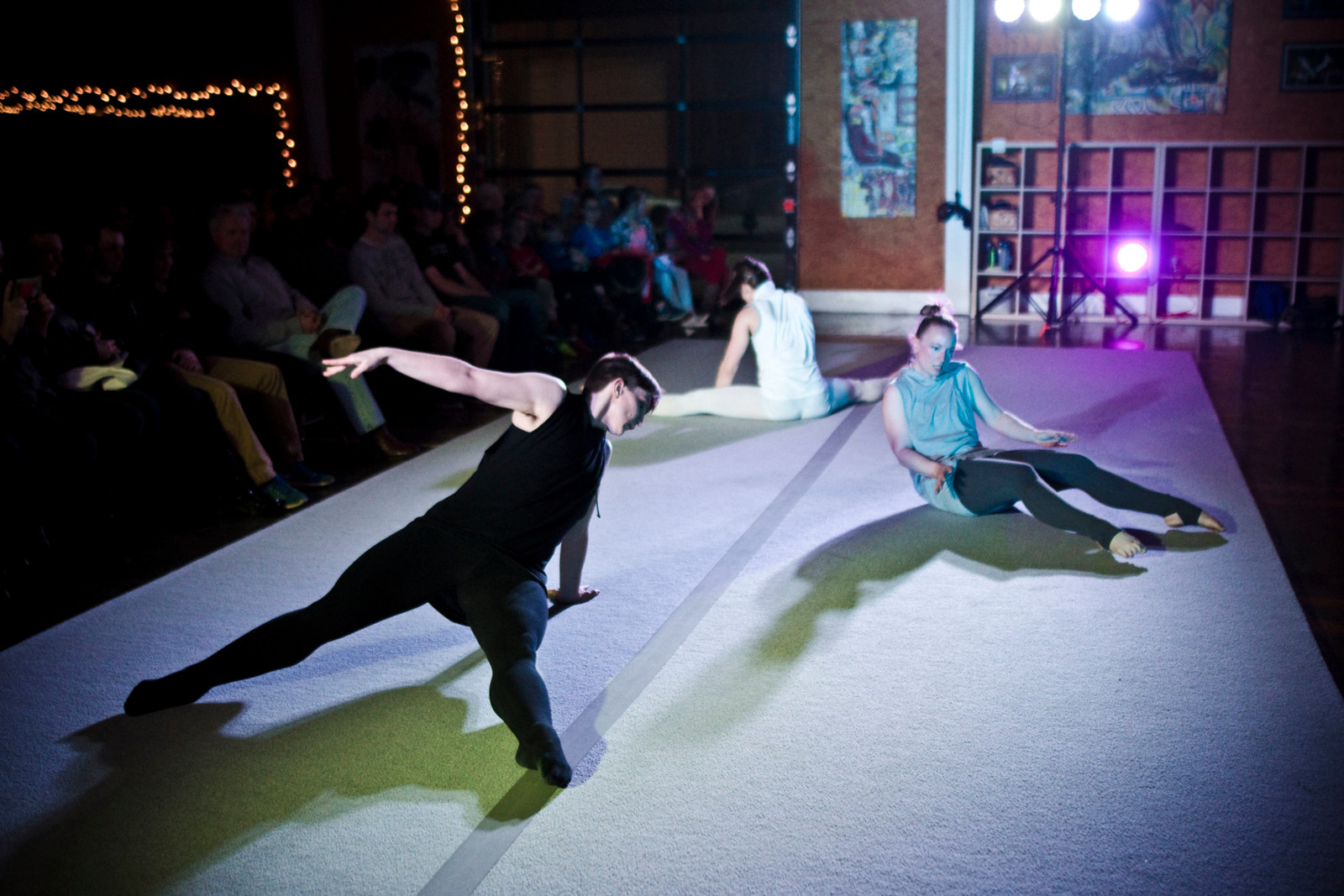
Kevin Spalding has officially documented the heck out of my thunderous grand allegro-enabling hindquarters. These legs got powerrrrrrrrr. Also, people look hella weird in modern-dance freeze-frames.
Regardless, we got the first two verses sketched out. I just need to resurrect the ballet choreography from whatever room corner of my mental Dance Attic it’s crammed into.
I promise that this act is all kinds of silly and definitely not knock-you-on-the-head-political like “Fade to White.” Instead, it’s fun and light-hearted, and if you’re in the area you should to PlayThink and see it.
But mostly you should to PlayThink because it’s like everything you secretly hoped adulthood be like when you were 5, and that’s amazing.

Memories … In the Corners of My Mind
Here’s how I memorize ballet:
- The Mark: Okay. Okay. Oh, crap! Wait, what? Okay. Maybe this? Okay. And okay!
- The First Run:Okay. Okay. Okay. Wait, what? Okay. Maybe this? Okay. And okay!
- The Second Run: Okay. Okay. Okay. Wait, what? Okay. Okay. Okay. And okay!
- The Third Run: Like a Boss, Like a Boss, Like a Boss, Like a Boss, etc.
- Next Rehearsal:Like a Boss, Like a Boss, Like a Boss, Like a Boss, etc.
Here’s how I memorize modern*:
- The Mark: WTF, even how, but what, can I just-, where do I, how do I, what do I, WTF
- The First Run: okay, even how, but what, can I just-, where do I, okay, what do I, WTF
- The Second Run: WTF, okay, but what, can I just-, okay, how do I, what do I, okay
- The Third Run: okay, okay, can I just-, where do I, okay, what do I, okay
- The Next Rehearsal: okay, okay, okay, where do I, okay, what do I, okay
- The Rehearsal After That: “Are we sure we learned this dance already?”
Modern: the struggle is real.
(Also: Autocorrect: the struggle Isreal.)

“And then she was like, ‘No, it’s up, flick down, swirly, and contract!’ and I was like, ‘I can’t even remember my own name right now.'”
*Okay, so I’ll own up to a little hyperbole, here.
Wednesday Class: Add X
Don’t worry, I’m not going to make you do algebra, even though I love algebra.
I’m talking about a different kind of “adding X.” Specifically, adding X-rolls—the modern dance kind—to improve your ballet.
Today, BG substituted for Killer B because it’s Spring Break. The unofficial topic-of-the-day was using contralateral diagonal connections to drive movement in ballet: like, thinking of your tendu front on the right beginning, more or less, from your left shoulder.
If you’re familiar with X-rolls in modern dance, this will feel very familiar.
If you’re not, here’s a nice little introduction:
Really, contralateral connectivity should feel familiar to everyone in ballet, since it’s basically just a different way of explaining ballet technique … but since nobody ever said to to me in quite that way before, I never made the (AHEM) connection, so I never really thought about it before.
X-rolls and their relatives are great for learning to feel connections between, say, the right toes and the left fingertips via the core and limbs.
When I thought about it that way at center, my tendus and turns suddenly looked lovely: present (if that makes sense), intentional, and clean. Also, my arms were far less inclined to be lazy and/or stupid.
The difference was subtle: my tendus don’t normally look bad. They just looked better. More alive. My turns, meanwhile, are usually a mixed bag: sometimes they’re beautiful; sometimes they’re just giant whirling handbaskets of WTF. Thinking about this kind of diagonal engagement made them reliably look (and feel) nice.
I’m going to have to keep working on this. I suspect that it is, for me, one of those “version update” things: an element that will move my technique from Ballet 2.0 to Ballet 3.0, or whatever I’m on now (honestly, I really wish I’d thought of this metaphor right at the start, so I could use it more effectively >.<).
I’ll also have to bring this with me to BW’s class next week (we don’t have class this week because of Spring Break).
Last week, he analyzed my turns via an exercise that went: tendu, fourth, plié, double from fourth, finish to lunge in fourth, rélèvé, plié, double from fourth, finish to lunge in fourth, rélèvé, plié, double from fourth, finish to lunge in fourth, rélèvé, plié, and so on and so fourth forth and sorted some of the other stupid things I do when doing turns from fourth.
Stupid things like finishing in a freaking enormous lunge(1), then not bothering to pull it in a little before launching the next turn, so I’m basically forcing myself to either jump into my turn or, like, climb into my turn.
- My fourth likes to be a borderline lunge all the time, if it can get away with it. I have heard the phrase, “Maybe a slightly smaller fourth,” sooooooo many times…
The purpose of the rélèvé was, of course, to force me to pull myself back in. A couple of times, I just did this crazy lunge-en-rélèvé instead. What even is that?
I’m afraid that this is really why my demi-pointe is crazy strong(2). I am constantly doing insane things with it. If I stop doing them, I hope my feet won’t be like, “Oh, cool, we can relax now.”
- Okay, not really. What makes my demi-pointe strong is a combination of mobility and, like, actual strength. My ankles and feet are incredibly mobile, which makes it possible to get up into a super-high demi-point. The downside, of course, is that I never, ever, ever get away with half-assing my demi-point(3), even when everyone else in class does.
- This also goes for just straight up pointing my toes. Amongst the many reverse-printed t-shirts I need to make, there is definitely going to be one that just says TOES! I can’t get away with half-assing that, either. My point is fierce, and every single one of my teachers knows that and corrects accordingly. There are days that counts for Thursday class basically go, “And one and TOES and three and TOES and five and TOES…”(4)
- Come to think of it, I am officially setting a goal for myself: get through one entire class without half-assing my toe-point so BW does not develop nightmares about desperately shouting “TOES!” into a cold and uncaring universe.
This week, then, is all about the x-connection, overhead pull-downs to get the lats back in order (because my right shoulder has been all creepin’ on my ear when working left at barre lately), keeping the sternum up and the transversus abdominis engaged, and … hell, I don’t even know. That’s enough to worry about for one week.
I realized today that some of the things I’ve been working on with BW are quickly becoming habits. I think that’s the upside of doing class several times per week. I don’t have time to forget the important corrections from the previous class, and each class involves practicing them countless times.
That means—whether for better or for worse—that habits build quickly.
So there we go. For better ballet, add X.
Too Tired to Write an Entire Post

… So please enjoy this screenshot of a screenshot of “Fade to White.” 😉
More soon!
Modern, Rehearsal, Thursday Class, Shadowy Cabal Ops
Modern today felt good. It was just me, and LF gave me a cool visualization thing to start with. We did lots of floor work and work with using weight and the head-tail connection to move through space. Very cool stuff.
At first my legs were like, “NO. NO, NO, NO. Nope. Screw you, buddy.” I’m experiencing the kind of achy, fatiguey weirdness that I have when my hormone levels are more out of whack than usual (read: when I’m essentially running on empty), which probably explains it. Seeing an endocrinologist is definitely in the plans for … meh, some time this year.
That said, the legs got over themselves by the of class, and I feel it was a good class overall. I finally admitted to LF that I get stressed out about remembering modern choreography, and she told me not to worry so much about it. On the last run of our final combination, I didn’t. Oddly enough, I remembered way more of it than I thought I would.
Dance Team was awesome today. They did some really good and really original work, and AS and I were really impressed. My own rehearsal also went well.
Ballet with BW was partly a private class—one of the owners of studio was with us much of the time, but had to pop out now and then to take care of admin things. Such is running a business!
Class was very intense—in a good way, as always. Interestingly, I got the exact same physical correction from BW tonight that Killer B me yesterday (or, well, one of them…). Obviously, my shoulders, neck, and chest are a hotbed of ballet problems right now.
I’ve realized that, too some extent, this grows out of a deeply internal focus. When I’m working hard, I to draw into myself mentally—and, it would seem, physically. I’m working on it, though!
Curiously, though, my legs had overcome the morning’s meh-ness … which is good, because I would have died of the rond de jambe combination alone, never mind the fondu and the grand battement, if my legs had continued to suck. The fondu/adagio, in particular, was challenging: slow fondu, slow relevé, slow fondu, extend avant then fondu attitude, hold forever, extend, sus-sous, continue pattern inside leg back, etc. The pace was what made it hard—it’s that combination of precision, restrained power, and grace that makes your blood boil at adagio tempo.
Speaking of grand battement, I realized that I haven’t been leading with the heel when closing from the back. It starts that way, then gets lazy in the last inch or two, which is no good. It makes for a lazy fifth and, over the course of the combination, works the supporting leg loose. I mentioned that to BW, and he gave me an extra set to the back only (though still finishing with plié-passé-attitude devant) to sort it.
We also did the dreaded Kneewhacker Turns, which went better than usual. Interestingly, I did whack my knee quite resoundingly once. It didn’t particularly hurt, but startled the heck out of me. I didn’t do it again, that’s for sure 😀 And, in fact, The Kneewhacker Turns that followed were whack-free.
At center we tendued (with turns) and then drilled double turns from fourth and second. BW had many thoughts my turns, all of which tie into problems I’ve been attempting to solve. My spot wasn’t as slow as it was the other day, except when I was being afraid of the Kneewhacker.
I called it a night after a nice waltzy combination across the floor. My toe had started complaining a little, so I decided to take the conservative route. Little jumps Saturday, maybe, and we’ll see how it goes from there.
After class I my fellow Bike Commuter Cabal operatives for a drink and a late supper. Ben and Jenn Folsom were in town, a rare treat for all of us. It was good to catch up with my bike peeps!

D took one look at this and said, “No one would ever guess which one of you is a dancer!” 😀
A Quick Break So My Head Doesn’t Asplode
Still working on the Great Data Restoration of 2017.
I wish I knew what our desktop PC had done with its backup files, because Jiminy Cricket, this is ridonculous.
From now on, I’m going to upload backups of our backups to The Great Cloud In The Æthers so this will NEVER HAPPEN EVER AGAIN.
Anyway, I’m still working on this. I expect to finish it by … I’m not sure. Tomorrow morning at the latest. It would be tonight, but rehearsal. THE SHOW MUST GO ON, amiright?
In the process of doing this relentless desk-bound and detail-oriented job, I have discovered that I will do almost anything to avoid sitting at a desk and futzing about with financial datas, including cleaning the house. “Oop, can’t enter the datas right now, our friend who’s in massage therapy school is coming over to work on us!” (Speaking of which: OMG. You guys. Evidently I have needed a legit massage for like 17 years or something.)
Anyway, one of my Avoidance Strategies this morning was to come up with a set of cards for an improv game that I’m going to try with our Dance Team, which is divided into Kids Who Grok Improve and Kids Who Are Like, “Wait, What Steps Am I Supposed To Improv?”
There are three sets of cards, as such:
Animal
- cheetah
- elephant
- falcon
- lion
- snail
- trout
Movement
- crawl
- glide
- run
- skip
- stand (yes: in dance, standing is a movement)
- walk
Feeling
- angry
- bored
- confused
- joyful
- sad
- thoughtful
The idea is to give the kids something a little more concrete around which to improvise movements.
Here’s how it works:
- Choose an Animal card (these are orange in my set). Think about how that animal is shaped and how it moves. Think about how it might feel to be that animal. Are you heavy or light? Are you relaxed or focused? Do you live on the land or in the water, and can you fly? If you live in the water, do you live in lakes, rivers, or oceans? If you live on land, do you live on the plains, the mountains, or the forest? Is it hot there? Cold? It’s okay to start out moving in ways that look like the animal in question, but ultimately you should try to move your body in ways that feel like the animal in question. Explore this for at least one minute; at most, five minutes.
- Choose a Movement card (these are green in my set). If you draw “Elephant” and “Glide,” think about how a glide would look and feel if an elephant were doing it. Try to capture that movement with your body. Is there more than one way an Elephant can Glide? How would a Falcon Skip if it were by itself? What about five Falcons together? Explore this for at least one minute; at most, five minutes.
- Choose a Feeling card (these are blue in my set). We tend to associate certain movements with certain feelings, but we can mix them up. What would an Elephant Angrily Gliding look and feel like? What would a Snail Joyfully Standing look and feel like? Is there a difference between one Cheetah Thoughtfully Walking and three Cheetahs Thoughtfully Walking? Explore this for five minutes, to give yourself time to connect all the parts.
I plan to couple this with the classic North, South, East, West flocking exercise. I’ll run them through the flocking exercise first, though, so they get a sense of how flocking works before adding weird stuff.
Next time, I might add in “vegetable” and “mineral” categories. How might sad seaweed skip? How might a confused granite cliff-face crawl?
And now, back to our regularly scheduled strugglecast day.
Modern: The Side Successions Succeed
…Sort of.
I learned to love side successions in Cinci last summer. They are so the opposite of ballet, but when they work, holy crap, they’re beautiful (and they feel really good; like your body kind of massages itself while you’re also stretching).
Yesterday we worked on side successions a lot, especially a little traveling side succession thing that has been doin’ me a heckin’ bamboozle during a combination we worked on Tuesday and today, à la “Ballet Squid Goes Modern.”
I wasn’t thinking of it as a travelling side-succession. I was thinking of it as … I dunno, a more vertical washing machine(1) with wavy-gravy arms?
- To whit: “washing machine” might not even be the standard Modern Dance People name for the thing I call a “washing machine,” which is basically a squatty kind of chaîné in 2nd en tournant that you do en manège … yeah, I pretty much always wind up describing modern in ballet terms.
In fact, it’s a side-succession coupled with a chassé and a little turn-under.
We did a bunch of these across the floor to some super-cool flamenco music (if I had time for another dance form in my life right now, I’d go straight for flamenco).
Overall, a fairly successful class: I got frustrated at the end because I was struggling to remember bits of a long bit of choreography and I was All By Mysee-e-eeelf, so I couldn’t crib off someone else for the missing parts.
Curiously, I think I remember most of the choreography now ._. I am sorta cursed with that thing where the choreography consolidates on the way home.
Anyway, now I’m going to go try to wrangle the finances. Apparently, at some point, our Quicken restored a backup file (and apparently lost the newer ones?), and I’m basically having to re-do the reconciling for all of 2016. Not happy about that at all.
Where’s Your Head At?
So, it turns out that—believe it or not—modern is not ballet (or, if we’re going to put that in programming terms: modern != ballet). Or, well, it’s not ballet most of the time. So, basically, modern is not ballet, except when intermittently it is ballet.
Jeez.
Anyway.
Today in modern class, we were doing those swirly arm things that result from making circles from high contraction to side curve through high release through the other side curve.
If you don’t modern, this probably makes exactly no sense to you. If you do modern, though, there’s a good chance that you know what I’m talking about. Basically, you don’t really move your arms; you move your sternum and upper back, and that moves your arms.
Anyway! They were sort of the Topic of the Day, and early on they appeared in a nifty tendu/rond-de-jambe/travely combination.
I was having trouble with it. Not with the legs, not with the arms, not with the body or shoulders, but with the head.
No matter what I did, it wanted to point the wrong way. That made the whole thing just feel … eeeee.
Then S, my classmate, figured it out: my body was busily trying to ballet when it was supposed to modern. Or, well, my head was.
Later, my body also rebelled against the entire concept of this sort of side-curve/under-curve chassé thing we were doing. It kept turning into an arabesque. Needless to say, this made for an awkward transition to the next step, which actually was an arabesque (albeit a modern one).
In both cases, once I understood what was happening, I really had to concentrate to correct it, which was challenging—but correcting the glitch in question made the whole movement easier.
I think this explains some of the difficulties I consistently encounter in modern dance. I failed to account for the power of the ballet wiring; the wiring that says when your arm is doing this, your head does this.
Since all of the ballet stuff is pretty much automatic, I don’t even notice that I’m doing it … which is fine, when I’m supposed to be doing ballet.
Ballet—especially classical ballet—has pretty specific rules about how the head and the body go together. These rules result in the establishment of motor patterns: this is how technique becomes more automatic over time.
Modern uses those patterns, too, but it also uses other patterns. Some modern motor patterns are essentially the opposite of patterns that are essentially hard-wired into anyone who has accumulated years of ballet training.
The funny part is that I still tend to think of my head as having no idea what to do with itself in ballet, but that’s not exactly true. For the most part, my head does what it’s supposed to these days, with a few glaring exceptions. When it’s doing what it’s supposed to do, I just don’t notice it. I only notice it when it’s doing something wrong and weird, because usually that either screws up my lines or throws off my balance.
Since the body tends to follow the head, if your head is pointing the wrong way in a given combination, there’s a fairly reasonable likelihood that you’re going to do the combination backwards in some way or another. I feel that I’m rather amazingly good at getting things backwards in modern class, and this gives me a bit of insight into why.
Anyway, so that was today’s Insight of the Day: if things are going wrong, check and see what’s going on with your head.
In case you need something to help you remember, here:
Just A Quickie Before Rep
Two things: first, I’ve had plentiful occasion this week to reflect upon how radically dancing has altered my life.
Three years ago, I had a tiny handful of local friends and didn’t really really feel connected to anything or have any overarching vision guiding me.
Now I’m increasingly knitted into this strange, tiny, amazing world of dance and aerials people as my life furiously churns (ohai, unintentional modern dance pun) towards some kind of future in which dance and aerials are central.
I am stunned and awed and grateful every time I think it.
Second … Well, crap, I’ve forgotten what the second thing was. Honestly, it was probably about class this morning and still feeling like a space cadet whilst struggling against allergies.
So that’s me: an allergic spaceman.
If I was Matthew Bourne, I’d almost certainly write a ballet about it.


 danseur ignoble