I don’t know what’s happening here, but my butt looks good?

Simon Crane, Revisited
After Pilobolus intensive, I semi-intentionally put Simon Crane on a back burner for quite a while. I had discussed it with a couple of people whose insights made a lot of sense, and I wanted to let their wisdom percolate for a while.
I meant to get back to work on it in a month or two, but life being life, I kept feeling that it wasn’t time yet.
Anyway, today it resurfaced on its own, with a very clear thought about Acts I and III.
Specifically, there’s a very explicit transition in Act I from the world of the marsh, which follows one set of (magical) “rules” to that of the city, where the “rules” at least seem more prosaic (I think cities have their own magic, but that might be a different ballet). This is part of what allows the arrival of The Flock, with its wild magic, to be threatening in Act II, even though The Flock believes it is acting in the best interests of its own lost member (that is, Simon).
The connection I had failed to make, though, was that the reverse should also be true. The journey of the Naturalist in search of his lost/stolen beloved must explicitly be one that involves the transition from the Naturalist’s world, in which he feels that he understands the “rules,” to that of the Marsh, where he does not.
This thought makes it easier to structure Act III: before, I wasn’t entirely sure how to frame to Naturalist’s journey, or to explain his trepidation even to myself. I don’t want him to be a swashbuckling hero (as much as I love a good swashbuckling hero/ine)! I want him to be a very human man caught up in something he doesn’t understand, doing his best to cope because that’s what you do when you love someone.
The other thing I’m contemplating is “Bolero.” I love the dance in my head, and I’m going to set it sooner or later either way—but E at PSW pointed out that the music already has a powerful life of its own, both as music-qua-music and as a famous ballet. It wouldn’t be wrong to use it, but it might overshadow the rest of the work.
I’m still thinking about that: I might be standing too close to the problem; it might also be that the “Bolero” section of Simon Crane really is strong enough to work.
Lastly, I think I’m going to revisit the score. I’m very unsure about Satie for the opening dances. I’ll have to listen to it again, and see what’s what. Act III might also need to be reset.
Class today was sound, given that I’m tired and sore from a very long Saturday. It took me til centre to really wake up, but once I did some decent work happened.

Week 3 With L’Ancien
I’ve fallen in love with L’Ancien’s teaching style. Today he did a lot of pulling us up short and making us start over, but always with a very specific point.
We corrected, and several times got a “Good!” or, “Oh, that’s so much better!” or even the coveted, “Beautiful!”
My extensions are returning. My supporting leg is getting through tours lent. At one point, L’Ancien stepped in and reshaped my arabesque: free leg well above 90; back pulled way up, in the midst of our adagio.
I didn’t believe I could hold it myself—and yet I did, and I made it through the tour lent, and through the rest of the lovely adagio.
Last week I felt as if I couldn’t remember a combination to save my life, and as if I was constantly pulling my body back together. I was coming down with the thing that knocked me flat for a few days, but didn’t know it yet.
Today I felt, once again, like a dancer working on learning his trade. It’s been a while.
After, I went to an advanced acro workshop and got to throw people and get thrown, and then finally made it to Trapeze class, where I nailed half-mill to half-Russian with no difficulty at all, even though the last time I did it was probably a good year ago, and I struggled with it because my arms are short.
Tonight, I’m performing at our opera company’s gala, and then I hope to fall into bed and sleeeeeeeep.
Honestly, I’ve missed using my body this much. A day like today reminds me that this is why I do the work that I do. At the end of the day, there is a deep satisfaction in using my body to do the things that I’ve done today.
~
I had a lovely conversation with L’Ancien after class. I stopped to thank him again for teaching is, intending to tell him that I’d been thinking a lot about something he’d said, but I immediately blanked on whatever it was (probably because it was everything).
He told me a bit about his early days as a dancer: he started at fifteen, with three years to learn nine years’ worth of material, knowing nothing. His teacher told him, “Don’t worry about what anyone else can do; just think about yourself.”
He passed that thought along to me, with the coda: You’re here because you love to dance.
I’m glad he can see that, even when I’m struggling in his class (though today there was much less struggle).
Anyway, I hope he’ll stay with us for a good while. I feel like I can learn a lot from him.
This is a man who’s been dancing for significantly longer than I’ve been alive.
Also clearly a man who loves to teach.
I’m glad he has come to teach us. Immensely glad.

Today’s Post, Take 2: BOSU Arabesques
I tried to write a post this morning.
In fact, I wrote a post this morning. Like, 1,500 words’ worth of post.
And it was, honestly, probably a little boring.
I mean, it was exciting to me. I wrote about the fact that I seem to be getting over this sinus thing now (huzzah!). I wrote about last night’s class (great correction for my arms: elbows in front of shoulders; fixes things a lot, w00t!). I wrote about last night’s rehearsal (BG set more of our dance! I get a cool solo bit!).
I wrote about this weird ballet dream I … actually, there’s no way I’m going to compress Post-Apocolyptic Warehouse Summer Intensive and the ensuing Dance Belt Crisis into a parenthetical phrase. I think that’s probably an entire post in and of itself, but I’m not writing that one right now.
See, I realized that I really wanted to get around to writing about some BOSU videos, and my earlier draft was just WAY TOO LONG, even for me. So it will very possibly languish in my Drafts box forever, and in its stead, here’s the post I promised you with some BOSU arabesques.
This video begins with a very slow rise at coupé.
It’s not terrible: my elbows could stand to be a little more lifted, and my chin is drawn back a little—in short, I’m drawing back into myself as I fight for my balance instead of drawing up and forward.
If you give it a pause at 0:16, you can see this. I’ve just started to sort of get with the program, press forward, and lift the back of my neck a little bit, but my my jaw is still drawn back.
I’m lifting my arms, here, in a way that draws my shoulders forward, which pushes my sternum back. There’s definitely room for this particular movement pathway—but it’s in modern dance, rather than in ballet, and you use it when you want to contract rather than lifting.
Because my weight is distributed in a kind of weird, snaky pattern, I can’t bring my free leg up slowly and with control.
This costs me when I begin to unfold around 0:22. Between 0:22 and 0:24 I’m forced to redistribute my weight rather abruptly. As such, this phase takes about half as long as it should: I kind of throw my leg and catch it, instead of carrying it smoothly. My arms can’t keep up without unbalancing me, so they’re late to the party, sweeping through to first arabesque when the free leg has, in effect, already arrived.
At 0:26 – 0:28, however, I sort myself out fairly substantially. My right arm is a bit far back and a bit high, but I manage to carry my sternum forward, untuck my chin, lift the crown of my head, and the free leg floats up just above 90 degrees.
The interesting thing about this recovery is how effectively it restores control. I’m able to recover my weight evenly and return to and hold a the first arabesque at 45 degrees on relevé. As I reach to allongé, though, I lift my gaze by lifting my head back, which unbalances me. It doesn’t exactly knock me off my leg, but I do think the close and dismount could have been better-controlled had I lifted my gaze up and forward instead.
This all illustrates one of the really important points L’Ancien frequently mentions: your head is one of the heaviest parts of your body. Its placement matters immensely to the success of your balances.
There’s more wiggle room, so to speak, in first arabesque at 90 degrees because of the way your weight is distributed. In fact, it can be helpful to pull the upper body back a bit when you’re working at 90 degrees en relevé. This particular arabesque is successful because I’m drawing my back and my leg towards one another, allowing the leg and body to pivot freely around the hip of the supporting leg.
This is the result:

A nice, stable arabesque a little above 90 degrees. Two quibbles: my releve could be stronger, and I’d still need to get my back a little higher to carry this into a deep penche.
Progress from here on arabesques will depend, for me, largely on figuring out how to engage my core and back in such a way as to allow more freedom to lift my sternum.
Progress on balances in general—especially those that aren’t counter-balanced—will require me to keep working on carriage of my head, arms, and chest.
This second video is shot from a slightly different angle and involves a different approach: I step into coupé derièrre, then immediately begin to rise to retiré.
My placement looks a little better here: if you watch my arms, you can see that I begin by rotating the humerus—in other words, lifting the elbow—without disengaging my lats. My neck, sternum, and back remain lifted and open. After 6 seconds floating in retiré, I begin to extend.
This is where things fall apart a bit. I start to carry my knee back, but then I lose control of my turnout and the knee briefly dips.
If you pause the video at 0:20, you can see part of the cause of the problem: my right shoulder is no longer connected to my left hip, so to speak. Instead, I’m extended along a long diagonal that begins to pull my weight towards the outside of my supporting leg. The free leg scoops downwards, then lifts again, in an attempt to compensate.
The resulting balance (though it’s really pretty) is really looks more like the middle of a reversé: I suspect that if I drew my knee in to attitude, the balance would be forced to pivot.

On the other hand, that releve looks pretty nice.
On the upside, I’ve done a much better job keeping my back up, here, Partly, that’s because I was “warmer” in this video; but it’s partly also the result of experience. I’d been experimenting with these for roughly half an hour when I shot this, as opposed to maybe five or ten minutes when I shot the first one.
Because of the angle of my back, the arabesque in this video looks a prettier than the one in the first video. That said, I’m not entirely sure it’s actually a better balance. I thought it was until I sat down and really looked at these in depth.
Now, I’ve concluded that the first one, though it’s more awkward at the outset and never quite matches this one in terms of beauty, is probably technically better: in short, my control is better through the latter half of the exercise.
So there you have it: my nitpicky examination of a couple of BOSU arabesque videos. What did I say I’d do next, fondus?

Adulting Secrets #1; Technique Analysis #1*
*Now with music!
When you’re a kid, you might experience adults as mostly functional, mostly giant walking disasters, or some combination of the two—but you probably don’t experience them as people quite the same way you experience yourself and your friends as people[1].
- There are some exceptions: my riding instructor was one of those rare adults who are phenomenal at connecting with kids on a very human level without being a total wishy-washy pushover, which you can’t be when you’re teaching 50-pound 7-year-olds how to handle half-ton beasties front-loaded for panic.
There’s nothing wrong with this. Nothing at all. It so happens that kids and adults in most of the Western world move in fairly separate spheres, and that the developmental worldview of childhood tends to be a bit solipsistic for entirely developmentally-appropriate reasons.
But, anyway, the upshot of this is that an awful lot of us reach adulthood without having the faintest idea how to, like, adult.
…Which is evidenced by the fact that “adult” is now a verb as well as a noun.
I think maybe this wasn’t always the case. Like, up until pretty recently, people were pretty explicit about training up a child in the way he (or she) should wash the ding-dang-darn dishes for crying out loud (and turn down that racket).
Then my generation came along, close on the heels of Gen X but a bit more computer-y, learning from day one that we were supposed to, like, Follow Our Dreams and self-actualize our unique snowflakitude, but also learn math and science a whole lot, and how to do things with technology, and also how to ballet or football/soccer or handegg or violin or speak seventeen languages or be a Mathlete and a representative in the Model UN or pwn all the Mock Trials.
In short, we were so busy getting a First-Class Education and becoming (in many cases, anyway) Well-Rounded that we never had time to absorb some of the critical secrets to Adulting.
Like, to be honest, COFFEE.
I’m just gonna admit up front that even my Mom will tell you she’s almost never sick. I think germs are just way too scared of her. I remember her being actually sick exactly once during my childhood, and it was totally miserable for about a week, and she confirms the same.
HOWEVER. Given that she worked a billion hours a week and sang in at least one choir at any given time and was (for several years) also working on a Master’s degree and somehow found time to design, plant, and maintain an absolutely lovely garden and did at least some of the carting around of a ridiculous kid who somehow thought it was a good idea to jam ballet and horses and gymnastics and choir and skiing and ice skating and the violin into any one week … anyway, what I’m trying to say is that my Mom was almost certainly crazy tired at least part of the time (though she also has the “can sleep any time, anywhere” super power).
And, somehow, I never quite grokked how spectacularly helpful coffee can be in those circumstances.
At least, not until now, when I’m definitely ill but probably on the mend, and I can’t stand the fact that there are three days worth of dishes piled up in the kitchen, but also not sure I can just plain stand long enough to wash them, because frankly one of the major symptoms of Whatever I Have (probably yet another sinus infection) is knock-you-on-your-keister fatigue.
Enter COFFEE.
I don’t usually drink COFFEE after noon, because frankly it’s a terrible idea if you’re already a night owl but you’re also a dancer and you regularly have to be able to function in class at 9 AM. In fact, I usually drink exactly one coffee per day, in the morning, less for the caffeine (though that helps when I’ve had to take a sleeping pill, because see above re: night owl) than for the ritual of it.
However, when one is definitely not well enough to go to class (blargh) but also not ill enough to remain in bed without going crazy, one cup of coffee will help one wash some dishes.
So there it is. COFFEE is tasty, but—used judiciously—also one of the secrets of adulting.
I feel like I really should’ve figured this out before.
It’s probably not a secret at all to vast legions of people my own age and younger than my own age who are simply less, like, insular. I am also the kind of idiot who insists on using a hand-cranked kitchen mixer partly because the electric ones are fecking loud, partly because my inner hipster finds it satisfying, and partly out of sheer cussedness, so draw your own conclusions.
But, anyway, I guess this is a thing I know, now. If you need just a little help adulting, a cup of coffee might do the job. So there you have it.
~
Anyway, if you came for teh balletz but you’ve had to sit through my long digression into the magic that is COFFEE, my apologies. Anyway, here comes the bit with teh balletz in.
A couple weekends back, I shot a bunch of video of balances on the BOSU balance trainer at Suspend. I posted a couple of them to the Instas, then promptly failed to get around to uploading them to the YouTubes so I could toss some music in and easily post them here and critique my own technique.
Belatedly, I have now uploaded a handful (which is to say, three) videos and slapped a little music on them. The actual soundtrack of gleeful cackling from people working on stuff nearby was pretty amusing, but also pretty distracting.
Now they’re running loose on the Tubes. Sort of. (Okay, so they’re currently unlisted, because people like to be mean—by which I do not mean ‘critical, but fair,’ but instead ‘douchy jerks’—in the comments, and I’m mean enough to myself for about five people, thanks).
Anyway, without further ado, here’s the first one:
…This one hasn’t been on the Instas yet.
Here, I’m working left, which is currently my stronger side balance-wise—which is to say that my right leg is better at the “supporting leg” role and my left leg is better at the “free leg[2]” role.
- L’Ancien favors these translations from the Russian over the usual English “supporting leg/working leg” dichotomy: he points out that the supporting leg, really, is the one doing most of the work, and says things like, “And which leg do you imagine flamingos think about?”
If you watch closely, when I first step onto the BOSU trainer (and then promptly step off), you’ll notice one of my most constant and worst ballet habits: I lead with my freaking hips, like I think I’m on a catwalk in Milan or something.
Ballet is not a catwalk in Milan, you guys.
The shirt I’m wearing (half my costume from Death Defying Acts) makes it hard to see, but at the very beginning my sternum is behind the point of my hip. This is so problematic (and, on the BOSU trainer, so bleeding obvious) that, at 0:05, I step back down so I can basically fix my entire approach.
If you pause the player at 0:07, you’ll notice that I’ve corrected pretty reasonably. I haven’t really turned on my turnout yet (it’s easier to mount the BOSU trainer, then turn on the turnout), but I’m much more squarely balanced over my supporting leg.
At the same point in time, you can also see that my knee is roughly over the arch of my foot: I’m shifting my weight towards the ball of my foot on the supporting side by shifting through the entire leg as well as my body. This allows me to keep my hips level from side to side (at 0:10, I actually tap them with my hands to remind myself to stay level and pull up).
Given that I’m still working in kind of a half-baked turnout, the passé balance that follows is pretty decent. You can see me actively resisting the urge to pull up and back (one of the things that makes passé easier for me than coupé is that you typically bring your arms up to third/en haut, which—as long as you keep your elbows lifted—helps keep your weight forward).
I also correct the height of my passé in the midst of the balance—it still wouldn’t be high enough for BW, and neither would my relevé, but in this video I’m still getting used to the BOSU trainer, here, so I’ll give myself a pass on those. It’s high enough for just about any application, anyway, and lifted correctly from behind and beneath, allowing for increased height without a hip-hike.
It’s when I begin to extend that things go a bit pear-shaped.
The legs themselves are rather nice, I think: I carry the working knee up and out, as one should, and though I lose a couple of degrees and wind up at full extension just a little above ninety (for a split second), the overall mechanical process is fine.
Except.
I totally fail to adjust my upper body to counterbalance the weight of my leg, which is considerable (the average human leg apparently weighs 40 pounds, which is nearly 1/3 of my entire weight). This actually has a lot to do with the loss of elevation on my extension: any extension requires a fair bit of counter-balancing, and those above 90 degrees require quite a bit more counter-balancing than we tend to realize.
Usually, we effect the counter-balance by shifting the weight away form the free leg. Often, this means performing the complex ritual of simultaneously pulling towards the free leg (to engage the muscles that will help it stay up) and away from the free leg (to counter-balance its weight).
In this video, I do absolutely nothing to counter-balance my free leg. I’m thinking too hard about keeping my weight forward, and so I fail to shift it back just a little. As soon as my free leg begins to move through croisée, I am powerless to resist the pull of gravity, and it “knocks me off my leg,” as we say.
In this case, I should have allowed my shoulders to open slightly in opposition as my arms transitioned to allongé. This is accomplished, more or less, with the breath: you breathe in and allow the breath to lift your sternum until it can’t go any higher, so it has to go back a bit, and while this happens you stay engaged so you don’t turn into a sway-backed cow.
Instead, I kept them exactly as they were.
While, to be honest, I find that fairly impressive in and of itself (I’m forever doing crazy stuff with my upper body and actively, rather than passively, putting it where it shouldn’t be), it’s not very effective if you want to balance that extension.
So there you have it.
Also, rather a nice sustained passé balance (or, well, technically retiré, since I’m not really changing my leg from back to front; it seems that way, but really it’s an artifact of mounting the BOSU).
What works best, here, is the lower-body transition into the extension: I keep the hip open as I extend, rather than allowing it to turn in, then extending from parallel. Also, it blows my mind how flat-out steady I am through much of this. Placement: it works.
What doesn’t work is the failure to counter-balance the extension, which in turn costs me both the height of the extension (which I begin to lose immediately) and the duration of the extended balance. Also, my free-side hand:

WAT. JUST WAT. (But dat leg tho.)
I do finish my rather graceful emergency dismount with a nice, deep, turned-out, knee-over-toe plié, at least, though I immediately let go of my turnout as I swing my right leg around and step toward the camera.
Oh, well.
Next time: a comparison of two first arabesques, followed by a comparison of two penchés (one that kinda works; one that kinda knocks me off the BOSU).

A Good/Bad Weekend
No class Thursday night because BW had a show, and Friday is currently my day off, though in this case I spent it driving D around.
On Saturday, my second class with L’Ancien was profoundly mixed. I got a “Good!” at barre once, which was really nice, but I was a total disaster at jumps. Like, all the jumps.
L’Ancien gave us a warm-up jump combo that went:
first, fifth, changement, entrechats quartre, trois, cinq
Only, for some reason, what I kept actually doing was:
first, entrechat quatre, changement, wtf, oh no, where even am I, jeté battu?
L’Ancien came over after and stood directly in front of me and made me mark through the steps by myself while he talked me through them. I still had trouble with it, but didn’t figure out til I left class that part of the problem was not knowing where I was supposed to close fifth the first time.
I knew the trois was supposed to finish in back, and was constantly doing mental math to try to make that happen. I thought about it in the car, I thought about it whilst making dinner, and I’m still thinking about it.
L’Ancien did preface that exercise with, “This one’s for your brain.” Which it was.
I think I’m going to ask BW to let us do that exercise on Thursday this week. Also to review odd-counted entrechats, which I’ve had to do twice in the past week-and-change, but haven’t done prior to that in more than a year, if memory serves.
I also flailed through grand allegro. It started with chassée, and I realize now that I was doing tombé instead. At one point I even tried to add the chassée, but didn’t subtract the tombé. You guys, what the actual?
I realize now that it may simply have been the opening salvo of whatever illness has knocked me onto the ropes. I am definitely thinking with far less clarity than usual right now.
That said, Saturday’s show, “Death Defying Acts,” was really very good.
DDA was based on a book of poetry, and the author came for the second show. Fortunately, our intrepid director chose not to tell us that the author was in the house the until the show was over.
Even I would’ve found it a bit nerve-wracking to, in the closing performance, interpret a poet’s character knowing that the poet was right there! (It would be totally different if the poet/author was involved in the rehearsal process, of course—the challenge in this context is that of not knowing if you’re fitting their vision, or at least interpreting in a way that they find satisfying.)
After, the poet told me she was in awe of my Zorada, which meant the world to me. I also got a couple of nice mentions in facebag reviews, one of which described me as a “graceful dementor”—which is rather exactly what I was going for.

Here I am, gracefully dementing with my friend AM, who played a very leonine lion.
I also literally didn’t drop the ball (except when I was supposed to) and while I think I’ve actually done the piece better in rehearsal a couple of times, I think my performance was entirely acceptable even by my standards.
Yesterday, I woke up with a sore throat, a headache, and a fever. I opted out of class, but did go to see “Chicago” (a friend of mine gave tickets) which was awesome even with a really terrible headache. We did hightail it out of there after the first curtain call, though, even though the orchestra plays a fun little set after. My head was ready to explode, and I just wanted to buy some DayQuil and lie down.
After that I went home, ate a chicken pot pie, went to sleep, and, excepting a brief period in which I woke up and read for a little while, I stayed asleep until this morning, when I had to get up to take Denis to work. I would probably still be asleep if still being asleep was an option.
D kindly let me sleep until about 15 minutes before we had to leave, which I appreciate. It takes me basically no time to throw on some warm-ups and make a cup of coffee, and that gave me about 45 more minutes of shut-eye while he showered, shaved, and so forth.
I’m skipping class tonight so I won’t give whatever I have to everyone else (and also because I’ll probably be asleep). I’m hoping that my intensive rest plan will have this licked before tomorrow evening’s modern class, or before Wednesday’s evening class and rehearsal at the outside.

A Few Dance Pix
I needed a new headshot, so I asked my friend Christina, who’s a photographer, to shoot some for me. She agreed and asked if I wanted some action shots as well, and I thought that sounded awesome. Anyway, we went out on a grey afternoon with temperatures in the 50s (fahrenheit) and worked for about an hour.
Even though it was hard to get sufficiently warmed up, Christina managed to snag some great shots … and a couple that I asked her to keep because, frankly, they’re kind of hilarious. So here are a few: one funny one, one that’s a great picture of something that’s not very good ballet (but might be pretty good action-movie Kung Faux!), and one that’s just plain beautiful.
So here they are:
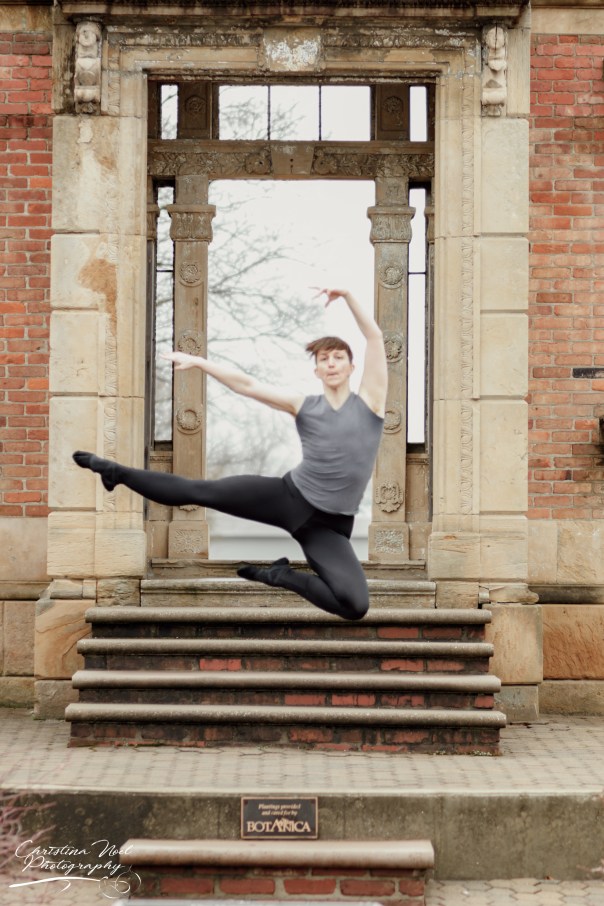
Hilarity Ensues. (c) Christina Noel Photography, 2018.
You know that effort face I keep talking about? Well, THIS IS IT. This is the face that I CONSTANTLY MAKE during petit allegro and also, apparently, whilst attempting to do grand allegro outside in the cold with my shoulders swallowing my neck.
Also, just noticed I have developed a terrible case of Starfish Hand in this one.
TEACHERS: TALK TO YOUR DANCERS ABOUT STARFISH HAND BEFORE IT’S TOO LATE.
One more thing: I learned in this process that even if you know you’re going to destroy your shoes by wearing them to a damp outdoor dance shoot in the middle of a drizzly Kentucky winter, you should STILL WEAR SHOES THAT FIT.
First, dancing outside in the cold is hard enough without worrying that you’re going to slide out of your shoes when you launch or when you land.
Second, if you actually do get ’round to pointing your toes, oversized shoes make your beautiful dolphin feet look like bricks anyway.
Mad props to Christina for making this shot look beautiful even though I did my best to make everything look ridiculous 🙂
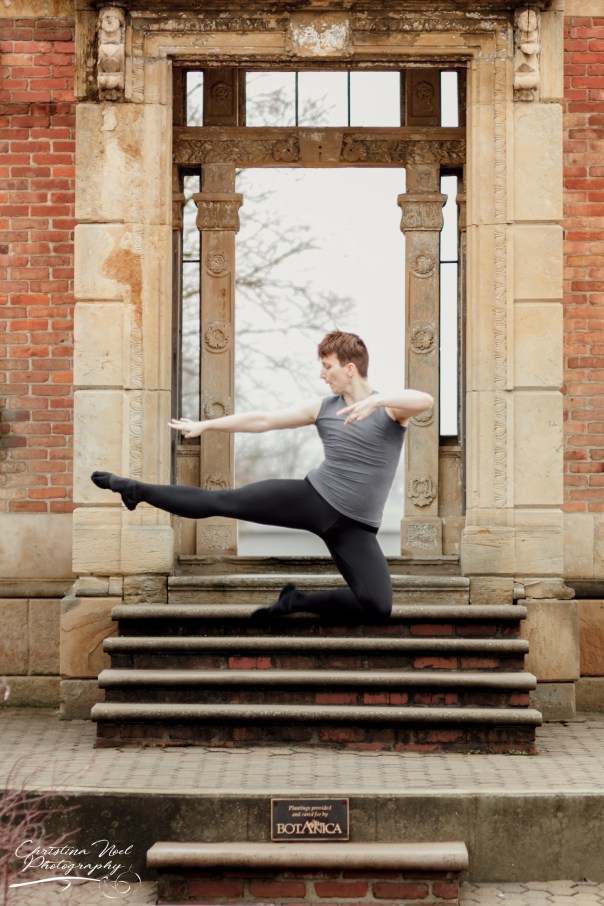
Pas de Fu! (c) Christina Noel Photography, 2018
Nobody ever posts their Pas De Don’t moments: you know, those times when only one leg is turned out, only one foot is trying to be pointed (to be fair, the bottom one hasn’t had time to get there yet in this shot), you’re making A+ For Effort Face, and the jump you’re doing is great if it’s either modern dance or Kung Faux, but not so great if it’s supposed to be Pas de Chat Italien and actually ballet.
For the good of humankind, then, here’s another of mine.
My épaulement is janky as heck in this shot—and while that makes for some heckin’ awkward ballet, it makes for some really cool Kung Faux, so I’ll take it. Besides, you never know when you might need exactly the right photo to go with your audition application for an international spy thriller ballet.
Christina spotted this one in the mix and kept it for exactly this reason—it totally looks like an action-movie still (presumably from some weird action movie about a random ballet boy just trying to get home from class after all of his street clothes were stolen by ninjas or something). I kind of love it, to be honest.
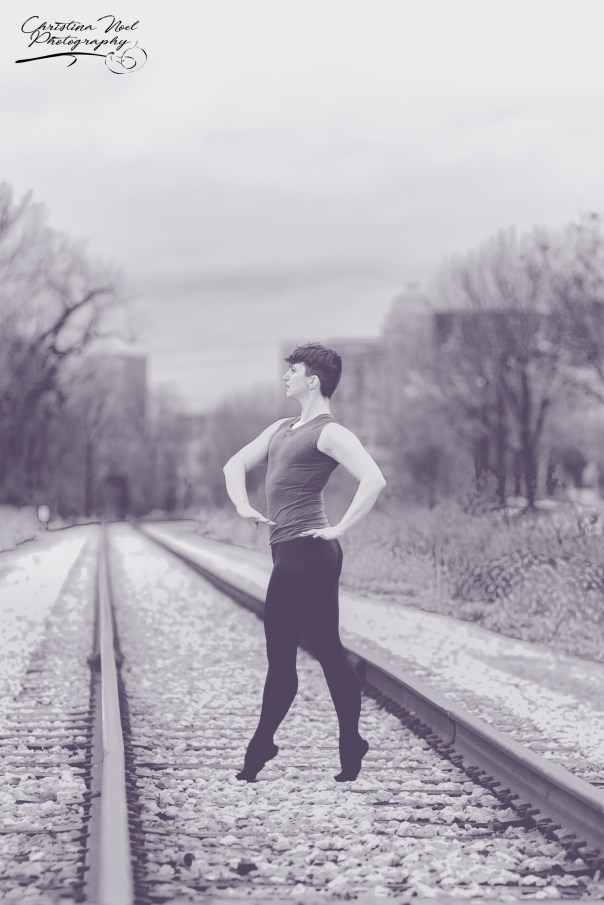
Dem Legs, Tho. (c) Christina Noel Photography, 2018.
Y’all. Can I just say that I freaking love this?
The pose is from the piece BG is setting on us right now, only we use parallel fifth instead of parallel fourth. Between the surface and the wind, parallel fourth was hard enough to manage; parallel fifth was … umm, yeah. But we both liked the parallel fourth version better anyway.
Never mind the fact that I’m still working off my, ahem, “winter coat.” (That is, the extra coating of insulation that you get when you go visit your parents house and there is no class and your Mom keeps stuffing food down your gullet and you were already still getting back in shape from your last break … oy.)
Never mind the fact that it’s cold and I’m tired as all heck in this picture. I look like I know what I’m about. And I kinda think I look pretty good. Like, if this was a FumblR picture or whatevs, I’d swipe right.
Or … you know, whichever way you’re supposed to swipe if you think someone looks good.
There’s also a color version of this pose shot against the backdrop of the same facade[1] as the first two…
- …All that remains of an historical house whose name escapes me at the moment; I’ll fix that some time when I’m not trying to get to bed.
…that I like quite a lot, so I’m going to slap that down here, as well, even though I was only going to post three shots.
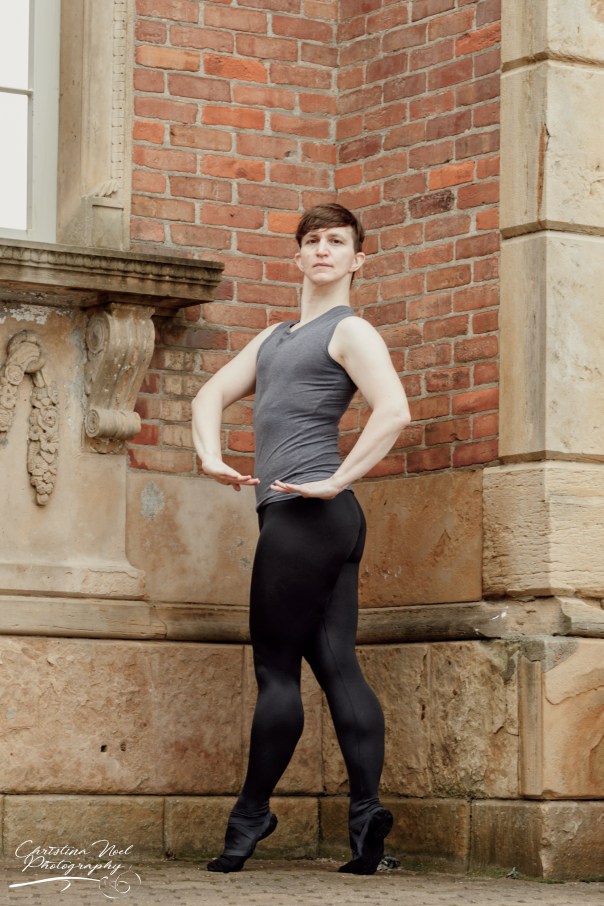
Et Voila. (c) Christina Noel Photography, 2018.
There’s a version of this in which I’m not staring directly into the camera, but I like this one better, so here you go. If you know me well enough you can tell by my eyebrow that I’m basically about to dissolve into a fit of laughter. I almost pulled off the Imperious Gaze, but was borderline slap-happy by this point.
Also, I really need to learn to do this port de bras without hyperextending my fingers, because that looks kinda weird. Though it may not actually be entirely possible for me to do that: my third (ring) finger on both hands only seems to offer “bent” and “hyperextended” as options. Oh, well.
But most importantly, my feet look pretty bangin’ here, even with the oversized shoes.
I think I’m probably going to badger Christina to do a shoot of the same basic jumps and poses and so forth in about three months, when the weather is awesome and I’m in peak shape.
So, brief recap. Here’s what I learned doing this photo shoot:
- If it’s cold, bring something warm to wrap around yourself between shots. Also probably a thermos full of something hot and possibly alcoholic, unless you have to drive or are underage in your region or whatevs, in which case skip that alcoholic thing.
- WEAR SHOES THAT FIT
- WEAR SHOES THAT FIT
- FOR THE LOVE OF ALL THAT IS HOLY WEAR SHOES THAT FIT (you can thank me later)
- You will look weird giving yourself a barre and so forth in the middle of the street in the middle of the afternoon. Do it anyway, even if it means getting there early. I didn’t because I was actually really fracking depressed the morning of the shoot and didn’t get there early enough (or at all), and I regretted it for the entire shoot, but especially when I was doing the eleventy-ninth pas de chat from a standstill 😛

The Piece Evolves; I Also Evolve
We added a new segment tonight. It’s got a really cool bit of partnering-by-eyeball. Hard to explain it: my partner and I don’t touch here, so the connection is all in the eyes. It’s super cool when it works! (Which it did, beautifully, once the pieces were in place).
We have another boy, though he’s tentative about being in the Piece. He’s a ballroom dancer, though, so I think he’ll be fine. It’s very tango-influenced, and BG is really good at fitting his choreography to the strengths of his dancers.
In other news, I’ve now registered for a couple of auditions, and I’m looking into a third. The third is for a ballet SI, so it’ll depend on timing and cost. My schedule is about to go plaid through the middle of June, more or less, when I’ll catch my breath for a week or so before summer things really get started.


I’m really rather floored, now and then, by the knowledge that somewhere along the line I somehow became someone who dances professionally. I mean, that was always a goal, but honestly one that seemed distant and possibly unattainable and maybe a little pie-in-the-sky.
And then, boom, I’m confronted with the evidence: people pay me actual money to dance; I audition for dance things more or less as a matter of course, more and more often without asking whether I’m really good enough to be thinking about it. I find myself having to consult my planner thingy to figure out whether I can commit to a dance thing because I might be committed to some other dance thing.
I simultaneously do and don’t understand how this all happened. This I grok: I had good early training; I continue to train with excellent teachers; I have devoted myself to the study of dance; I have been given a body that is suitable for the discipline. That it has all come together like this still seems strange and dreamlike (merrily, merrily, merrily, merrily…).
Perhaps most importantly, though, I feel more and more capable as a dancer. There’s a kind of joy that I first tasted as a wee little kid that comes with trusting your body. When I dance, I feel whole and strong and capable for minutes at a time, but in a way that’s un-self conscious. To dance, sometimes, is to enter the stream of being a little more fully.
I feel perplexed and grateful about all this, which I suppose is as good a way as any to feel.
In Which We Do Ourselves A Heckin’ Bamboozle
Tonight literally half the class (including me!) promenaded the wrong way in the adage at the same time. Like, the entire stage-left half. And once we’d started, we realized our error, and looked around at each-other in horror, but couldn’t actually stop or reverse.
I’m pretty sure this is a sign of the impending apocalypse. It might even have been some kind of (shameful) world record.
Also, T momentarily forgot how to glissade, and I kept turning a pas de bourré at barre into something more like a pas de burrito or something (to be fair, it was counter-intuitive in a number of spots—like an en dehors turn when you’re expecting an en dedans) and adding extra steps at centre.
Other than an outbreak of mass hysteria in the form of a complete inability to retain combinations accurately (everyone screwed up constantly), though, class wasn’t bad. I did two completely random entrechsts six more or less as a joke while marking the petit allegro (also fit one in once running the combo, which I ran like six times because evidently I’m insane). And when I wasn’t completely doing the wrong thing, I occasionally managed to look like I was dancing.
Threw back a beer with the Beastie Clan after. I think we all earned it!
Such is life. Next class will be better. Sometimes, you just have to be wrong together and laugh about it.

First Class with L’Ancien; A Few Words About Grieving
First, my apologies for being way behind in on blorg in general and on my Leibster post specifically. This week has been less hectic than last week, but still pretty hectic, and when I’ve been home, I’ve been burying myself in Neil Gaiman’s American Gods[1], Two Dots, and Dots & Co[2]. Some of this has been a function of trying to wrap my head around the fact that an old friend of mine died recently. I hadn’t seen him in a long time, but we kept in touch, and it’s a weird thing.
- …Another book I waited way too long to read because soooo many people were like YOU HAVE TO READ THIS! which always makes me go nooooooooooo lalalala I can’t hearrrrrr you until finally I read whatever THIS! is and it turns out that I’ve been an idiot about it for ten years or what have you.
- Addictive phone games.
Then, grief is always weird. I have done enough of it that I’ve learned to expect it to be different every time, which is about the only thing you can expect, except for the basic elements of grieving (which will show up entirely on their own schedule).
Too often we’re taught to think of the “stages of grief” as a process of passing through discrete checkpoints on a one-way path. Anyone who has ever experienced actual grief (which, in time, will ultimately be everyone) will be comforted to know that Ross and Kessler never intended their “stages of grief” framework to be understood this way. They’re not unidirectional; heck, they’re not even necessarily discrete: rather than a one-way train track with stops at Denial, Anger, Bargaining, Depression, and Acceptance, they’re more like a transdimensional TARDIS trip in which one might simultaneously visit, for example, Denial and Anger whilst shuttling back and forth between bargaining and depression, or what have you.
In short, it’s bigger on the inside; also, confusing and muddled. On the upside, if you miss your stop at Anger and don’t get your ticket stamped, you don’t have to ride back to the contrôle in the fog at four AM with a stiff rear derailleur and … I have now completely jumped ship into randonneuring analogies. Then, anyone who has ever logged so much as a single populaire understands that cycling can, at times, be remarkably like grief. Only you burn off all the extra food you shove in your mouth rather faster.
I suppose the same can be said for ballet: in fact, the learning of ballet involves the same sort of transdimensional weirdness, wherein you might simultaneously be good and horrible at ronds de jambe[3].
-
- …Which, as L’Ancien confirmed this morning, much to my smug satisfaction, are the most important thing we do at the barre. Probably, though, it’s not just because I like them the most[4].
- This is relatively new. It used to be that grand battement was my favorite part of barre—not because it’s last, but because you get to show off how well you can kick yourself in the face, and I’m strong, flexible, and a giant show-off by nature.
Class this morning was much like that: at one point, I was thinking so hard about what I was doing with my hands, eyes, arms, and weight that I forgot to change my facing … which was the first step in the exercise o_______o (The worst part is that I did this on both sides.)
But, ultimately, it was so profoundly good-bad because L’Ancien, as he shall heretofore be known, is a phenomenal teacher (you guys, he might even be a better teacher than BW o.o’).
He is, in fact, not terrifying, even when he’s horribly disappointed, because he approaches his moments of disappointment with humor.
Also, he doesn’t let us get away with all of the bad habits we normally engage in just because We’re Grown Folk Now, like noodling (even if it’s in an effort to better understand a correction) or not being already prepared on the and or not actually finishing the exercise with the music (WE HAD A REAL PIANIST, YOU GUYS!).
In fact, at one point, L’Ancien asked our pianist, J, to play the final chord again and just sit on the pedal and made us get back into a lovely fifth, stand, and wait ’til J took the pedal off.
That was instructive. I’ve realized, lately, that I have rather a bad habit of “clocking out” at the end of an exercise: I hit a nice fifth (or first, depending), hold it for a heartbeat or two, and then let everything fall apart. That doesn’t fly, does it? You’re supposed to let the music tell you when you’re done, not just go, “Meh, I’m good,” and break for coffee.
So I concentrated on not doing that, until I got too busy concentrating on other things. I hope I didn’t revert to clocking out, but who knows? I had hands and eyes and fingers and a neck to worry about, and that’s just the beginning. Except, of course, the goal really was to not worry about things—more to find the way to do them without thinking about them.
Which is, of course, how it ought to be done.
L’Ancien also called me out on my habit of starting class with my eyeline somewhere around, oh, my navel. I don’t know when or why I developed this habit, but at the beginning of class, especially when facing the barre, I tend to look at my feet.
As the song says, “Your feet are going to be on the ground.” You don’t really need to look at them to figure out what they’re doing (though sometimes I have trouble feeling what’s going on in my hips, since my body is crazy). If you do look at your feet, it will make your whole body sort of curl up like you’re a salad shrimp, and you’re basically gonna have a bad day (or your teacher is going to come over and physically grab hold of your head and fix it).
This is really more a bar exercise than a barre exercise, tbh. (Via Pexels.)
So, L’Ancien is very into the physical corrections, which is great by me, as I find them extremely memorable. He fixed both my foot and my head on the first side of the very first exercise, and we continued from there.
We also had a lovely chat after class when I stopped to thank him for teaching; this one specifically about my head and how I might fix it. Among other points, he mentioned (justly) that he thinks it’s a question largely of where I rest my eyes—something I’ve noticed in my quest to improve my balances.
He also pointed out that I have very square shoulders, which is interesting. Like, it’s something I’m aware of, but I don’t think I’ve literally ever thought about it in a ballet context before. Rather, I’ve thought about not letting my shoulders creep into my ears, or collapse in on themselves, or do that weird thing where they get behind my body in bizarre ways—but never, really, “I have very square shoulders; what does this mean for me as a ballet dancer?”
But, obviously, this is not something you think about in the studio. Rather, it’s something to know about yourself, when you sort of visualize your body, so that you can use your body to its best advantage.
Anyway, this is long enough, and I have to dash off to a trapeze class.


 danseur ignoble