Today my ear was screwy and my brain didn’t want to work — so of course today our AD dropped by to watch my class while I was screwing up the most basic combination ever. #FML
Blog Archives
Thursday Class: You Know What They Say About A Guy With Big Knees(1)…
I’m sure the I’ve mentioned my gigantor knees before.
They are at once the scourge of my balletic existence and evidence of my best asset as a dancer. I’ve got huge knees because I’ve got huge thighs, and I’ve got huge thighs because I can fly (or, well, I can fly because I’ve got huge thighs, but it sounded better the other way).
Anyway, in his ongoing and exhaustive tune-up of my technique, Company B took me to task about sus-sous last night. I’ve been working on approaching it differently, but I still hadn’t really been getting my feet tight. I still kind of thought I couldn’t — and then CoB called me out on it, and suddenly my legs figured out how to do it(2).
It’s amazing what being in a tiny class with an instructor who you admire rather ardently can do for you (true story, though: he keeps having to correct my port de bras avant at barre because I keep looking at the wall instead of turning my head towards the outside outside arm — I get kinda shy around him sometimes).
After class, I took a moment to ask him about my issues with maintaining my turnout. I showed him where it is (basically a legit 180 in first with a solid knees-over-toes plié; he remarked, “That’s really good!”) and explained the difficulty I’ve been having — I tend to lose it in fifth because my knees get in the way(3).
Be asked me to show show him my fifth, then asked if I could bring my front foot back (to nestle fully against the back foot) if I plié-ed. It took me a minute to figure out what he was asking, but I was in fact quite able to do so. Once stretched, though, I felt like I using a ton of muscle just to stay there once I pulled my legs up straight.
Turns out he has the same problem: big knees, muscular thighs (unsurprisingly, we’re both jumpers). He suggested that I soften my knees just a hair in fifth (and leave them that way) and noted that he can’t get his quite straight in a tight fifth, either.
So, basically, it’s not a question of strength or inadequate turnout; it’s just the cost of being a dancer with really well-developed thighs. I’ll take that.
I’ll take that.
He also suggested that I really focus on getting a tight sus-sous position in my tours and that I play around with when to change my feet. Right now, I think I’m changing at the end, which is what works for CoB — but, honestly, I’m not sure what I’m doing. I’ve never thought about it before; it didn’t occur to me to do so.
Truth be told, I have had almost no instruction in tours. I figured out how to do them as a little kid and then it was, like, since I knew how how to do them well enough, nobody felt it necessary to explain them to me until recently (Jake in Lexington and now CoB). I should probably mention that to CoB.
My first teacher was quite good, but a discrete men’s class wasn’t an option; there weren’t enough boys in the school. The same challenge persists in my current dance life. Basically, I’ve more or or less acquired most of the bits of proper men’s technique that I have by a process involving observation, reading, and osmosis. Excepting variations in Lexington, I have literally never been in a proper men’s class in ballet (except once, but accident, on a day when no ladies turned up).
My turns were mostly good last night, as they often are in CoB’s class. I should keep that in mind, because it’s direct evidence of the fact that the difficulty I have with inconsistent turns is mostly a question of psychology. CoB is an exceptionally good instructor for me in part because he relaxes me. Since I tend to attack life with the intensity dialed up to 11 all the time, this is a Very Good Thing.
Anyway, for some reason, I dreamed about tour-jetés all night, which is weird, since I didn’t do any yesterday.
- Neither do I, but what they should say is is that he should soften his knees in fifth.
- EF produced a a similar change in my attitude arrière a couple weeks ago: I was like, “Welp, guess this is about right,” and he was like, “I KNOW YOU CAN GET THAT KNEE HIGHER SO GET IT HIGHER” and I was like, O____O’ *cranks working leg into impossibly-high attitude*
- Isn’t there a song about this? Oh, wait, no — it’s words, not knees. Right.
Wednesday Class: Body Not So Good Without Brain
I hope I wasn’t a disappointment to l’ancien directeur-artistique today!
I’ve been spending a lot of time thinking about and applying his note about my supporting leg, and it’s coming along.
That said, I had absolutely no brain this morning, and was having trouble remembering combinations, and instead of just being like, “Meh, whatevs, I’ll do the part I do remember and maybe I’ll catch up,” I got rattled.
So there’s that.
In other news, I went to Ye Olde Local Dance Shoppe today in search of MOAR LEGWARMERS (and maybe some suspendery-tights) and, while I didn’t find any of those, I did come home with a new dance belt.
It’s a WearMoi, and apparently they’ve recently redesigned them. It’s really similar in conception and execution to the BodyWrappers M006/M007 (though it splits the difference in terms of waistband-width, coming in at 3″ instead of 2″ or 4″).
Thus far, it seems pretty legit. It’s going to Trapeze 3 tonight, which is a pretty good trial if you ask me (not quite as good as Lyra or Albrecht’s variation, but still pretty good).
Update: I forgot we had lyra class tonight. The WM belt performed admirably in trap 3 (AKA advanced adventures in knot-tying) and in lyra!
Lyra is a heartless breaker of the dreams of dance belts, so this is no small matter.
That’s it for now. Further update to follow. Full initial review pending a good dance class (maybe Company B tomorrow?).
Time To Get Serious*
*Insofar as I am capable of ever being serious about anything, ever, because I am a focused person, a dedicated person, an all-of-that-kind-of-stuff person, but serious? I’m not sure that’s the best descriptor, really, where I’m concerned.
So, yeah.
I am thinking about injuries, and my history of accumulating them, and being like, “Ha! Ohai! I haz hurted myself again,” and then basically making jokes about it because that’s way easier than actually admitting that I’m hella pissed at myself.
But, like, I am.
Pissed at myself, that is (for my Brits: I don’t mean I’m drunk at myself, I mean I’m mad at myself … this time … which you probably already knew from context because you’re smart, but somehow my inner Smart-Alec just wouldn’t let me not say it).
Or, well, I was.
And then I realized that I’m looking at this incorrectly.

Denis recommends a change in perspective.
I have a habit of injuring myself mildly, which just happens in Teh Ballets and in life at large sometimes, because humans can be careful but can’t be perfect.
Injuring myself mildly from time to time wouldn’t be a big deal in and of itself.
The problem is that I also then have a problem of doing things that exacerbate minor injuries and turn them into major ones, like I did this week.
I’ve been mad at myself because I was like, “That’s just careless.”
Except, it’s not. Carelessness isn’t the problem.
The problem is that I don’t perceive pain normally and I’m stupidly hypermobile (okay, and my drive to do things like dance and aerials often exceeds my limited supply of common sense).

Shamelessly stolen from Monty Python by everyone ever.
So, basically, parts of me don’t start hurting when they should, then stop hurting before they should. The level of pain I experience does not accurately reflect the severity of any given injury, nor do they reflect how much it has healed.
Theoretically, the deep muscle in my “thut” (that’s thigh-butt; you can thank my aerials instructors for that one!) that I could barely use yesterday should be causing a shedload of pain today, but it actually doesn’t hurt at all**.
**Maybe it would if I tried to do the things I’m not supposed to do. Maybe it wouldn’t. I don’t plan to find out the hard way. At any rate, it should at least be sore.
Note to self: THIS DOES NOT MEAN THAT EVERYTHING IS FINE.

Everything is fine. (Shamelessly ganked from heroviral.com.)
Likewise, parts of me stretch in ways that increase the likelihood of injury under certain circumstances. This is partly due to associated abnormalities in proprioception and pain perception (see above) and partly due to the fact that greater flexibility often correlates with reduced strength.
Not that I’m not strong; I’m just not necessarily strong in the places that will prevent me from doing things like yoinking the crap out of my turnout muscles.

Seriously, there is absolutely nothing wrong here, guys. Everything is definitely under control.
I haven’t been treating this seriously. I’ve been too busy being delighted about the things that my abnormal pain perception and hypermobility let me do to be willing to countenance the fact that they also predispose me to injuries that I could better avoid if I was, basically, less weird.
As they say: “You take the good with the bad.” And I’ve been trying only to take the good, without accounting for the bad.
This past week, I turned a minor strain into a major one and bought myself several days off dancing and a term of about six weeks to full recovery (with appropriate management).
I wasn’t being careless. Things just didn’t hurt, so I carried on as usual. My leg was a little stiff and sore in the morning, but felt okay enough by the time class rolled around, and really quite okay indeed by the time trapeze class rolled around — so I proceeded with business as usual.

Business as usual (actual video to follow … eventually).
This is the same approach that bought me a layoff of a couple of months last year, followed by a long reconditioning period.
Obviously, a rate of one serious injury per year is quite a bit higher than is really sustainable.
So, in additional to healing, I plan to spend the next several weeks learning how to prevent injuries to my specific body. Clearly, this will mean developing both better awareness of what’s going on in my body and a greater willingness to turn to my live-in Physio (AKA my husband, Denis) when I think I have a minor injury and follow his advice.
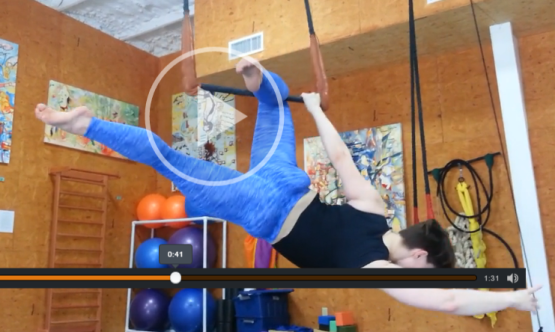
This is me, not following advice (because I hadn’t asked for any). For the record, yes – that *is* the leg I strained, though this is not how I strained it. Bizarrely, that involved neither aerials nor ballet. In other news: yup, I am still pasty.
And, of course, because I like to write about everything (if nothing else, it serves as a kind of external backup drive), I’ll probably be writing about this process here.
So there you have it. Some insights about injuries that I don’t think I really had before.
Also a terrifying picture of my butt. Holy chromoly. Who stuffed ‘roid-raging weasels down my tights?!
Choreography Workshop #1
But first, a few thoughts on teaching.
I gave our Sunday class an exercise with temps-lie (in open fourth) today, and they rocked it out.
There are a billion reasons to love and to use temps-lie — it’s great for teaching how to transfer balance, it helps students figure out how to use their feet, it feels dance-y, etc, etc. Today, though, I discovered one that I’d never thought of: it helps you spot students who are struggling with turnout.
Temps-lie in fourth with turnout is an unusual motor pattern.
In parallel, it’s actually a pretty common kind of movement — you’ve probably done something similar balancing yourself on a moving bus, train, or boat, for example, or reaching for something on a high shelf.
In second, even with turnout, it’s still not terribly unfamiliar.
The combination of turnout and open fourth, however, can make for a really challenging kind of movement. Suddenly, a student faces the potentially brand-new problem of shifting weight through their center of mass while continuing to rotate the hips open.
Students who are still developing the ability to maintain turnout from the rotators and intrinsic muscles at the tops of their legs tend to start to turn in, particularly on the leg that’s passing the weight along — that is, in temps-lié avant, the back leg may tend to turn in as the body is carried over the front leg, for example.
Those who are doing a little better but still not quite on top of the turnout problem will tend to roll the arches of their feet as their knees travel out of alignment. Their thighs may not appear to turn in much, but the rolling arches are a dead giveaway. (The turnout issue becomes more readily apparent when you look at these students from the side.)
Hands-on corrections can make a huge difference in both these situations: first, to indicate which muscles a student should activate to keep turnout going; second, to gently guide the movement of the knees so they track correctly.
Some students may initially feel like passing through temps-lié in fourth without rolling in at the knees is impossible, but it’s not (as long as they work within the purview of their natural turnout). Gentle hands-on guidance can usually solve that problem pretty quickly.
Some of our Sunday students are still finding their turnout, period, which is fine. Given that they’ve only been at this a few weeks, for the most part, I think they’re coming along rather swimmingly.
Next: Choreography Workshop #1
Today, most of us who have submitted acts for the Spring Showcase met to discuss our ideas, get a better sense of how getting-to-the-Showcase will proceed, and so forth. Denis brought his printed spreadsheets of our act, which more than one person found impressive. Heck, I’m still impressed.
After the group discussion, we broke out and worked on our pieces. This was the first time I got to try most of the sequenced choreography for my part.
I must say, I’m quite impressed with the work Denis has done: not only do the moves hang together well (there’s only one spot where the transition isn’t essentially automatic, and I worked out a graceful solution today), but there’s a natural coherence to everything. Incidentally, the moves also sync with the music really nicely, which is a bonus, since Denis’ only music-specific concern was trying not to make the whole thing too freaking long.
Evidently, I also look good doing my part of the act, which is nice. There was a conversation going on about my lines that culminated in someone asking me how long I’d been dancing. That was pretty cool 🙂
I ran through the core of my routine about a dozen times or so — enough to really make the choreography start to gel, since I probably won’t be at the aerials studio again until Tuesday.
All told, between dance and trapeze, I spent about two and a half hours doing physical stuff.
For some reason, I seem to be very hungry. Hmm. Wonder how that happened.
Two for the Road
On Monday, M. BeastMode drilled us all about conservation of motion. Since I seriously need to work on that — I’m all about the attack, but sometimes at the expense of letting myself sort of fall apart — that was a very welcome topic.
Anyway, today, while catching up with the Tweeters after literally months of trying really hard not to look at Twitter ever because, seriously, it’s like being kidnapped by some secret spy agency; you go in and then you wake up and it’s three days later and you don’t know what happened and it feels like someone hit you in the head with a brick.
Okay, maybe minus the part about the brick, except when eyestrain occurs.
ANYWAY.
So today I saw this fantastic tiny video from Miami City Ballet, and I went, “HOLY CRAP. THIS IS IT.”
It’s in time-lapse, and that’s what makes it work. Here are these dancers, and their arms and legs are like all over the place, and their bodies DO. NOT. MOVE.
This, people, is how you use your core. This is conservation of motion. This is what will make your turns a thousand times better and your renversés and balances all Balan-shiny. This is what Ms. B picks on me about now that my pelvis seems to be more or less reliably sorted 😉
So, here you go. Watch (you may have to click through; I’ve never tried to embed a Twitter video before) and absorb, and then the next you’re in class, install and run this mental image. I am dead certain that this will help me, and pretty sure it will help almost anyone.
Tonight we perform NY premieres of @Justin_Peck's "Heatscape" and Liam Scarlett's "Viscera!" #MCBSpringTour2016 pic.twitter.com/wkrAwCvBw5
— Miami City Ballet (@MiamiCityBallet) April 15, 2016
Friday Morning Variables; A Really Good Contact Form Tutorial
First, the ballet:
Today, I finally got back to class. I was again assisting in Friday class, and we had one brand-new student. He let us know that he was uncomfortable with any kind of hands-on correction, so I spent much of the class contemplating best practices for verbally imparting elements of basic placement and so forth that are easiest to demonstrate by physically placing someone’s arms or what have you.
I’ll be thinking about this for quite a while, I suspect.
In other news, I’m building a PHP-driven contact form for Denis’ website, and being as my PHP skillz are more than tad rusty, I decided to play it safe and hunt up a tutorial (especially since I’ve never hand-coded PHP into a WordPress-driven site before).
I found a great one — it’s going gangbusters, thus far, so unless I hose something up (in which case I’ll just say, “Screw this,” and copy the code from the thoughtfully-provided repository ;)), I think it’ll work.
The best part is that it’s well-written: clear, concise, and direct.
Here’s a link, if you’re into this kind of stuff:
https://premium.wpmudev.org/blog/how-to-build-your-own-wordpress-contact-form-and-why/
I initially started doing this the e my WP install is wonky and I can’t actually install plugins, but since I prefer actually doing many things by hand, this appeals to my crankety old-fashioned tastes.
I cut my teeth on old-skool HTML as a kid before WYSIWIG editors were really a thing (and definitely before good ones that didn’t produce code that looked like something a cat might disgorge after a hard night on the town), and developed my initial abilities the same way everyone did back then, through the magic of View Source. This fostered in me a deep appreciation for clean, well-commented code, and the tutorial above is a fantastic example of what that should look like.
For maximum laziness irony, of course, I am writing this entry in the WP’s “Visual” editor.
Anyway, that’s it for now. Oh, or, well — I have a research idea percolating for my ballet peeps, but I’ll get to that in another post. This is mostly a reminder to myself, so there we go. STICKY NOTE!!!!
À bientôt, mes amis!
Ballet Lessons: Don’t Neglect the Transitional Steps
When I talk about transitional steps, I often devolve upon the example of the floor exercise in women’s competitive gymnastics.
It’s a handy example, because most of us have watched gymnastics at one point or another (even if only in the heat of Olympic fever) and floor exercise is, in some regards, the easiest apparatus for the uninitiated observer to understand.
What isn’t as easy for the uninitiated observer (or even for many experienced observers and extensively-trained gymnasts) to understand is why some gymnasts just look so much better than others — so much smoother and more polished.
More often than not, the secret is in the transitional steps.
Historically, American gymnastics training programs have focused on training skills and little else. The skills themselves may be brilliantly executed, technically precise, and powerful: but technically perfect skills alone do not make a beautiful, exceptional routine.
For beautiful, exceptional routines, the Russians tend to lead the world: and there’s a reason for that.
The Russians train the bejeezus out of the skills, but they also dance.
When you watch a top-notch Russian gymnast doing her floor exercise, it isn’t a series of tumbling runs, balances, and isolated skills loosely linked by half-hearted shimmies. It’s a single, coherent entity from start to finish: a choreographed dance that happens to feature explosive, difficult, highly-technical gymnastics skills.
The difference, in short, is the linking steps: all of those apparently non-essential moments that take the gymnast, judges, and audience from Point A through Point Z.
Even in moments of stillness, the best Russian gymnasts continue to dance — just as ballet dancers are dancing even when they’re standing in B-plus for fifteen minutes while Odette gets her swan on.
So much of ballet happens in the transitional steps: the ones that carry the dancers from pique arabesque to entrelacé, or from tour lent to dèveloppé ecarté avant.
For the dancer (or gymnast), transitional steps serve important preparatory roles: think of precipité and failli, which essentially never appear on their own outside of the lesson, but which precede so many important moments in performances.
For the audience, transitional steps serve as the visual links that join the more dramatic steps of the dance into a cohesive whole.
As such, they’re extremely important: but often, as dancers, we neglect them in preparation.
One of the reasons — in fact, I would argue, the main reason — that great Russian gymnasts’ floor exercise routines look so beautiful is that they don’t neglect the transitional steps.
Russian trainers don’t treat dance as an afterthought; they school their charges in using transitional steps and maintaining line throughout their movements. As a result, the Russians’ floor exercises continue to be gorgeous (and they essentially own the sport of Rhythmic Gymnastics, which depends even more heavily on dance than does floor exercise in Artistic Gymnastics).
One of the reasons that American gymnasts’ floor exercises, even when technically perfect, are rarely as beautiful is that American trainers do tend to treat dance as an afterthought. Many gyms, in fact, don’t actually teach dance as a discrete element at all. Instead, they do their best to “work it in” when teaching routines.
As a result, their gymnasts’ performance suffers.
The same goes for dancers: so often we devote all our time to learning what we think of as the big, important steps — at the expense of the transitional steps that link everything together into dance.
We do this in life, too.
So often, we’re so eager to get on to the Next Big Thing that we fail to adequately prepare. With our eyes on the far horizon and our feet moving forward in the now, we stumble over pebbles and fumble through our preparations.
Often, the Next Big Thing suffers as a result — it may succeed, but perhaps not as well a it would have if we had paid attention to our preparation; if we had learned the transitional steps and used them well.
As dancers, when we learn choreography, we do well to focus on ingesting and interpolating that transitional steps — not only will they allow us to execute our big, technical steps with elan, but they help us remember the dance. Each transitional step becomes a cue; common transitional phrases (tombe-pas de bourreé-glissade…, for example) become “hooks” we can use to get ourselves back into the dance if we get lost.
A good glissade or chassé allows us to gather momentum, place ourselves, and load our springs (via plie) in order to execute those high, brilliant, explosive jumps we all love.*
*Worth noting: Sometimes, choreography starts with transitional steps.
The past two weeks, we’ve been working a combination in Ms. B’s Killer Class that nominally starts with temps de flèche, but really starts with a coupé tombé that transfers the weight and loads the springs, allowing us to blast the temps de flèche off like we were launching from Cape Canaveral.
An effective tombé to fourth or second makes a square, quiet place from which to launch a turn, or three turns, or five turns.
These are basic steps, mostly learned in the first year of class: but, like everything else, they are critical, essential, and never perfected.
Wise dancers continue to work on transitional steps as long as they continue to dance.
We can all take a page from that book: the same principle applies to life in general. We should pay attention to our transitions; work on them; prepare them.
In the end, they’ll make our big moves smoother, cleaner, and more brilliant.
~
Today’s post is inspired in part by my own tendency to neglect the transitional steps in favor of the big ones, my attendant quest to freaking well stop doing that, and the fact that I’ve realized I’m in a transitional period in my own life right now and should be paying attention to the transitional steps instead of just going, “Man, when do I get to the part where I get to do coupe jeté en tournant en menage?”
Or, you know. The life-outside-ballet equivalent.
The Show Goes On
Last night, I wrote about how sometimes living with bipolar feels like walking a tightrope; how the only way to survive is to keep your eyes up and keep moving forward.
Ballet is the thing that makes me able to do that.
This morning, getting up was a complicated, but I did get up, and I made it to class.
..And I’m glad we did, as we had four new dancers (new to class, not new to ballet), all of whom were quite good, and two of whom were guys.
Barre went well except for the double-rond-de-jambe-and-frappe combination, which went badly at first because I apparently brain-dumped it right at the start. I remembered it before we started the second side, though.
I also miraculously remembered how to sissone (though my turns … oy vey … my turns) and did the assemblé-sissone-chassé-jeté combination fairly well (after the first time, during which I failed to put my working foot down between the sissone and the chassé and turned it into some kind of awkward saut de chat).
In case you’re wondering, by the way, I think the entirety of that combination went:
assemblé (à droit, R foot back, no change)
sissone (avant)
chassé
jeté
assemblé (à gauche, L foot back, no change)
sissone (avant)
chassé
jeté
assemblé (à droit)
jeté
jeté
jeté
assemblé (à gauche)
jeté
jeté
jeté
…though I may be combining it with the other petit allegro combination we did (glissade-assemblé-jeté-hold; glissade-assemblé-jeté-hold; etc) come to think of it. Regardless, it was something very much like that.
In short: not difficult, but a mild brain teaser, since you have to get the directions of your feet right and there’s a little change of direction entailed in the sissone. It was also a nice-looking combination, and one of the new girls did lovely little battus on all the jetés on our first run.
It no longer feels weird to start a combination with assemblé
There is definitely a part of me that likes to show off or something in the presence of other male dancers (particularly when they are not so much better at dancing than I am as to make me look patently ridiculous). Today, it worked — my dancing was better overall than it was at any point last week, and although my turns were a tad wild and sloppy, they weren’t as horrible as they might have been.
It’s weird (if unsurprising) how much what’s going on in your head can influence your dancing. Saturday, even before the disaster with my ear, I was tired and achy and didn’t feel like I was going to acquit myself respectably, so I didn’t.
Today, I wasn’t thinking about any of that. Instead, it was like I had a little Japanese grade-school kid from some monster-battle anime series in my head saying, “Let’s do our best!” (“Jeté battu, I choose you!”)
Bizarrely, that worked. And we got to do saut de basques, which I lurve. And my assemblé looked good — high and suspended and not afflicted with horrible kraken arms or an unnecessarily curvilinear torso. So, huzzah. I suppose once I’ve had that nailed down for a couple of weeks, I should tried to put a beat back into it.
Because we do oceans of beats in advanced class, I’m really focused on using my inner thighs during barre, closing every tendu, degagé, and jeté by pulling the inner thigh muscles together instead of pushing in with the quadriceps (as if I was pedaling a bike or something).
When one uses the inner-thigh muscles, one tends to automatically engage both, maintaining alignment and placement; likewise, getting to a solid fifth between jumps is much easier.
Think: glissade to fifth, giant plié, brush out from plié, grand assemblé, for example. The working leg is carried by the momentum of the initiating brush, then the quadriceps (and some other muscles) in the supporting leg provide the spring; both legs are collected inward by the engagement of the inner thighs; the plié tension-loads the spring again; then a second brush (from the bottom of the plié) carries the working leg out and up, the quads (and related muscles) in the supporting leg push through to activate the spring; and the inner thigh brings the second leg up to meet the working leg.
Without the collecting movement from the inner thighs, a solid fifth position is unlikely; without a solid fifth, the grand assemblé is unlikely to be as … well … grand.
When one uses the quads, the body tends to shift towards the working leg, which pulls the balance away from the ball of the supporting foot. “Things fall apart, the center cannot hold,” &c.
As in cycling, the quads should be used mostly for pushing down; you need them to give you explosive power during jumps. When you pull in, you use the inner thighs; when you lift into passé, the impulsion comes from under the thigh and buttock. Incidentally, this also prevents that thing where your leg grips itself into a horrible spasm as you développé.
All this actually makes it much easier both to keep my knees straight and to maintain my turnout. It also makes maintaining balance and placement easier. I did the first set of fast degagés sans barre (7 each way x2; then pliés to relevé), though I did take the barre for the second set, which was really, really fast.
I guess I also need to get back to focusing on carrying my upper body directly atop my hips. This really imparts a surprising amount of lightness. I found myself doing this today as a function of not trying to look like a dork in front of the new dancers, and as a result, my work at center and going across the floor looked pretty good.
Aerials should help with that, as part of the problem is an imbalance between my back muscles (those “arabesque muscles” again) which are ridiculously strong (because I have spent a ridiculous amount of time cultivating a beautiful arabesque and a lovely, controlled penché), and my core muscles, which are not as strong (because I am lazy).
In short, this is what happens when we focus more on our strengths than our weaknesses … the weaknesses get weaker. Because I’m flexible and can get into a really nice arabesque as a result, I seize every single opportunity to use my arabesque.
Need a teacup on a high shelf? Arabesque. Need to hand something to Denis when he’s standing a half-meter or so away? Arabesque. Collecting Denis’ empty glass when he’s sitting on the sofa? Arabesque penché.
But do I work my core muscles anywhere near as much?
Hahaha. No.
Aerials are all about the core, though, so that will get fixed.
In other news, on the way home from class, I learned that David Bowie had died.
It was startling, in a way, because I was just listening to some of his stuff from Blackstar last night and thinking about how cool it is that he’s still creating and innovating in his late 60s.
Bowie contributed a great deal to the cultivation of popular music, and it says a great deal about his work that he will be sorely missed across several generations.
I don’t have much more to say about that right now, though. What do you say when an icon falls?
Someone I know on facebook said it best: Imagine the ticket lines in Heaven for the Bowie-Mercury reunion show!
At the Opening of the Year: On Failure, Success, and Sustainable Change, Part 2
Yesterday, I wrote about my successes, both unqualified and qualified, in 2015.
Objectively speaking, some of my so-called “qualified successes” could also have been called “failures.” I’m okay with that. Though failing is often hard when you’re doing it, it’s rarely the end of the world, and you can usually learn something from it.
I should mention that it’s not always easy to do that — there are few cultural phenomena as spectacularly annoying as the phrase, “Turn that frown upside-down!”
Frankly, sometimes you need to frown for a while. Sometimes you can’t just “turn [it] upside down.” Sometimes you need to feel what you’re feeling, get mad at yourself, or sad or hurt or whatever you feel. Sometimes you need to sit down in the middle of the pathos of human existence and weep, or howl, or scream your fury down the throat of the universe.
After, or sometimes even while you’re still there, you snatch whatever lessons you can from the jaws of defeat and move forward. In the words of Chumbawumba, “[you’ve] got no job, but [you’re] an opera fan.”
Wait, that’s not it. It’s: “[You] get knocked down, but [you] get up again.*”
*Somehow, it seems terribly appropriate that I’m citing a song about being too drunk to walk to the bogs without falling on your face. Egads, what an analogy.
Anyway! Moving right along.
Motivation and sustainable change are among my major research interests — because, while we talk a good game, we really still don’t understand them too well, and they’re enormously important in things like public health and personal growth.


 danseur ignoble