Category Archives: balllet

Class Notes, 03.03.2020

My penmanship is in “pretty, but not terribly legible” mode today.
“May +/ or August”
Possible masterclass dates.
“UP != BACK! CHOOSE UP!”
We did a lovely cambré, and after recovering I left my ribs a little too open and my sternum in a bit of a high release.
This does not improve one’s turns or one’s balances … Particularly not à la seconde.
Notes about back leg turnout (mostly relevant to barre and things like tendus, poses, etc—not helpful for turns, particularly):
- Recover it all the way*
- FAVOR it over front leg**
- STAY OFF THE HEEL/ON THE BALL
*I tend to be lazy about bringing my back leg fully into turnout when I close to fifth, because my specific combination of mild hyperextensions and huge calves makes it a bit more of a chore than is usual.
**By “favor it,” I really mean actually think about it. My front leg will take care of its own turnout reliably; I need to work on the back leg.
“Bring your tailbone (fouetté to arabesque).”
A lot of us were guilty of finishing a simple piqué fouetté without really bringing the pelvis with us today. I was over of them at least half the time.
“Hunger Arinn & Sefter Plié.”
This actually says, “Longer Arms & Softer Plié,” but you know. Looling for spit, etc.
“& still bring your head.”
It is always a good idea not to leave your head behind. This is especially true in ballet. That thing is heavy, yo, and since your brain’s in it you can’t just, like, take it off and leave it by your water bottle.
“Gliss no change x2, jeté pas de bourré x2, jeté assemble enrechat quatre x2.”
Mathematically speaking, I should really clarify that combination with some parentheses:
“(Gliss no change)*2, (jeté pas de bourré)*2, jeté assemble (entrechat quatre*2).”
I actually did this petit allegro right a couple of times. I mean, it’s not that complicated; it was just fast.
I’m getting better at keeping my legs under me so I don’t gallop off with myself (or over myself).
Anyway, that’s it for today’s class notes. My rehearsal notes are mostly about character development, since we’re mowing through Snow White wow effectively and I actually have time to think about that at this point.

Class Notes, 02.28.2020

Lest anyone think my class notes are always informative and useful: sometimes it’s just me kvetching into the void.
When you’re struggling, know that someone somewhere is struggling along with you 💜

This Is Me Now
The process of becoming an artist isn’t that complicated. You do art. You are an artist.
The process of learning to see yourself as an artist, on the other hand, comprises an apparently-endless array of subtle layers.
(I’m not sure if it’s an onion or a lotus blossom: like, its roots definitely reach down into the muck of life, but sometimes it makes you cry, so…? Whatever. It can be both.)
Tonight, after closing A Midsummer Night’s Dream with a show that felt like the strongest in my career to date, I had this moment in which I was thinking about something related to work, and it didn’t even occur to me to feel a sense of disbelief, or like I’m not worthy, or anything. I was just thinking about a work thing: a piece to add to the puzzle to make me better at my job.
Only later did it even occur to me to think, “Hey, that’s cool, that my imposter syndrome didn’t even get a look in.”
Every now and then I think back to a conversation I had a few years ago with my friend BB—one in which she said, “…You have your [ballet] career to think about,” back before I was at all certain that any such thing was really going to materialize. At the time, I felt like I should, like, cross my fingers or something. Somehow signal that I wanted it to be true, but maybe didn’t quite think it was.
And yet, here I am.
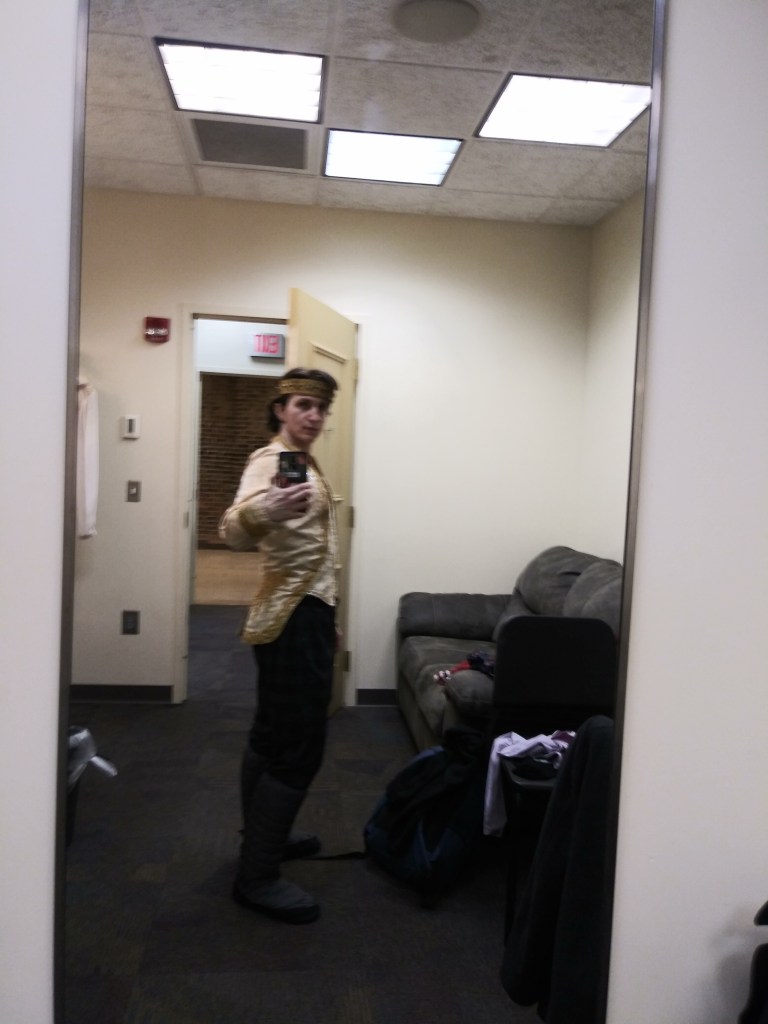
I’m sure I’ve written before about this process, but I’m equally sure that, a year ago, I wouldn’t have believed I’d be quite as blasé about it as I am now, in part because a year ago I wasn’t sure I’d ever be doing the things I’m doing now.
I’m lucky to have friends who can see things more clearly, and whose words have helped immensely in the moments in which this has all seemed the most unreal.
Their belief has helped to form the foundation of my own, like a builder’s forms shape the concrete walls in a building’s basement.
They helped me believe—even believed for me—so I could do a thing that is almost absurdly unlikely. And the longer I do it, the stronger my own belief becomes.
So this is me, now. I’ve begun, bit by bit, to feel that I have something to offer to my chosen profession.
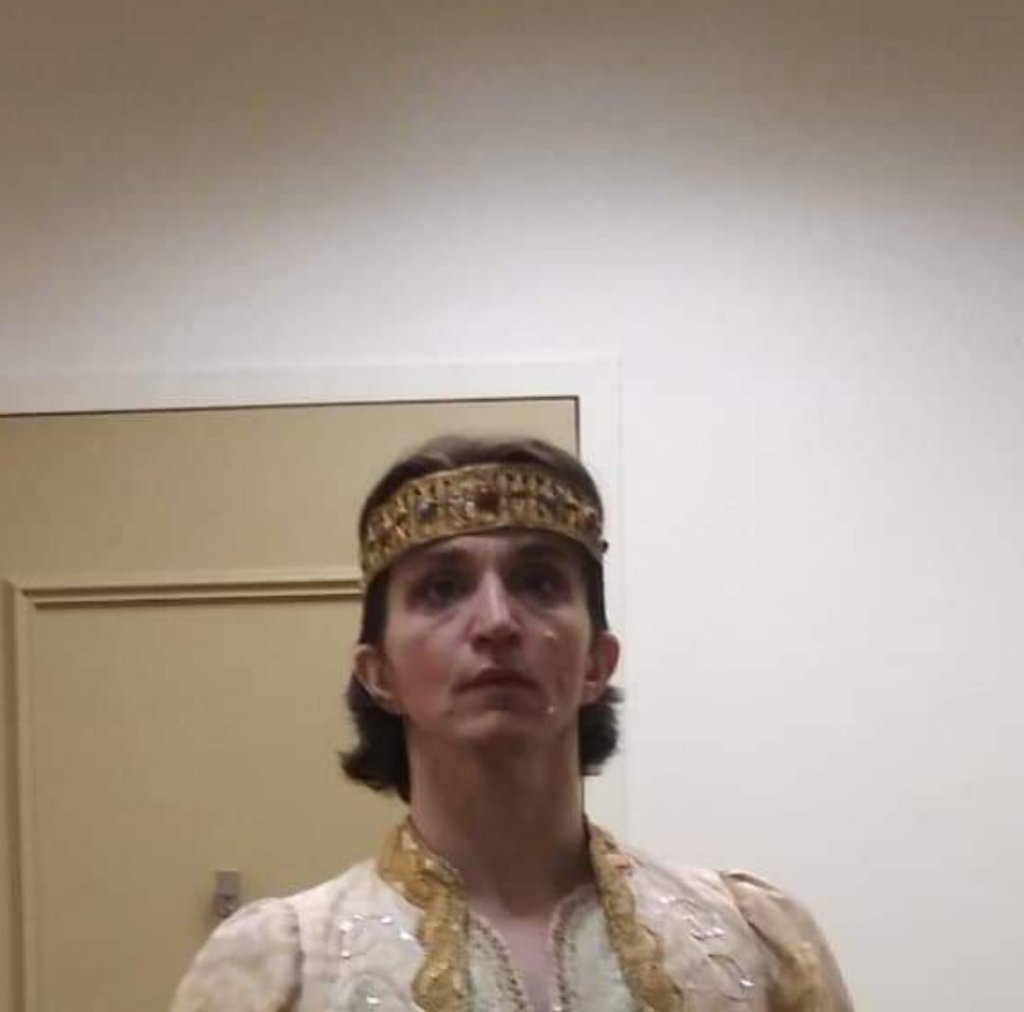
I’m not sure yet what that thing is, or how to define it. I think that’s harder to do in ballet than in a lot of artforms … like, in ballet, as a dancer, you’re both artist and medium, and another artist is generally responsible for using the pallette of dancers on hand to create work.
You don’t always know what it is that you, specifically, bring to the easel. You don’t know whether you’re magenta or cobalt or red ochre to the choreographer or AD who selects you.
But it doesn’t really matter to me. My goal is to be serviceable: to be a serviceable dancer, one who is good enough to be a credit to the artform and to honor its history. Anything more than that is a bonus.
There’s still a lot I have to learn; a reasonable smattering of holes I need to fill before I can feel like I’ve really got enough of the toolkit to be a whole package—but I’m learning those things, and I’m filling those holes.
Speaking of which: my Petit Allegro is improving again. The keys, for me, are always:
- …keep your legs under you (in other words, constrain your travel, no matter how much you love to travel)
- think about the *down* and the *up* will take care of itself.
So that’s it for now. Or, well … One last thing.
I hope that becoming comfortable with the mere fact of my existence as an actual professional dancer will never make me less grateful for it.
If it does, you can come to dinner with me and kick me under the table as a reminder or something.

*Lunching Intensifies*

Four of these run less than $4 at Aldi.
Coupled with a tortilla or flatbread, one of them makes a nice utensil-free main course at lunch. You can dump the chicken salad straight onto the tortilla and then use the edge of the tortilla to scoop out any that doesn’t dump.
I would say my goal is to eat a healthy, balanced lunch, but really right now it’s just to shove enough food in my face so I don’t eat everything that holds still long enough when I get home (I’m not currently feeling epic salads, for some reason).
So there you go. These and a pack of Aldi’s flatbreads gets you a decent main course for less than $2/lunch. Add Greek yogurt (low sugar for me; too much and I’ll be cranky an hour later) and maybe some store-brand Grape Nuts and you’ve got a decent, inexpensive meal to get you through the afternoon.

Rough
This week, on Thursday, we began work in Act II of A Midsummer Night’s Dream.
It is, to say the least, a baptism by fire in terms of partnering. Act II is basically all about the “We’re all getting married and happiness is restored even in the fairy kingdom,” and here I am like, “Feck, well, guess I’m going to learn to not suck so much at partnered turns now.”
But, holy hell. The amount of new material I’ve crammed into my head and body in the past two days is … Erm. It’s a lot.

I’ve been frustrated with myself for not picking some things up as well as I could. I think just not having time to review last night was part of it, and of course just being kinda stressed makes learning harder, which makes you more stressed, etc.
Anyway, I have 3 weeks to look like I know WTF I’m doing, and I’m going to effing well make it happen.
But for now it’s rough, and today I was stressed out and generally mad at myself for the entire day.
So tomorrow will be better. And the day after that will be better. And in three weeks, I will have this down, and I hope I’ll be a partner worth dancing with.
Until then, I’ll try to remember to post my class notes from time to time, but it’s about to get real up in here.


Class Notes, Mid-January 2020
Today, for the first time in my life, Mr D called me up to demonstrate a combination in company class. I managed not to hose it up, even! (Thank goodness.) But that’s neither here nor there.
Anyway, I meant to post more notes last week, but got distracted, so here are some from the 10th and from the 14th:

It’s not like this concept is new, but…
My turns in 2nd can be … Erm. A little wild? My spot, for some reason, likes to wander when I’m doing these.
I’ll spot front, then off to the left corner, then back (BACK! As in, I somehow spot THE BACK WALL 😶), then who even knows where, then nowhere, then front again.
Turns in 2nd give you all the chances to spot the wrong things.
I think, honestly, it’s that I’m nervous about turns in second, and I’m usually busy concentrating on keeping my free leg engaged in a position that A] is a valid second and B] is possible to hold while turning.
(Clause B], btw, is the drawback to having crazy flexible hips. They don’t lock neatly into place; instead, you have to work your butt off to hold them steady.)
Anyway, the drawing on the bottom reiterates a point I’ve been working on FOREVER.
When it comes to turns, your body is one piece. If the linkage between hips and shoulders is anything but solid, you’ll have to work harder, and your outcome won’t be what it could be.
The shoulder and hip have to travel together … And that means the rest of each side does, too.
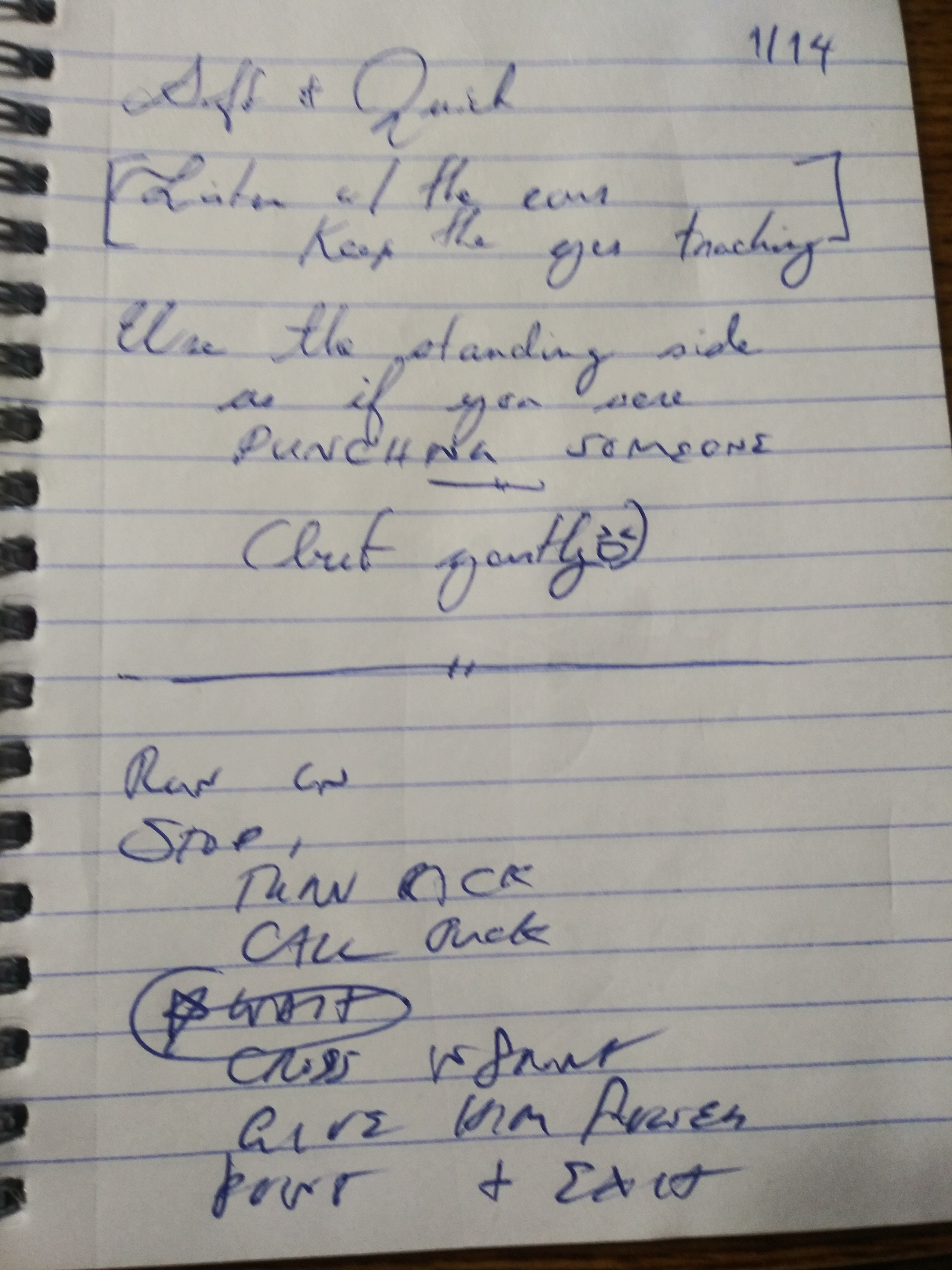
“Soft and quick … as if you’re punching someone … but gently” 🤔
Okay, so “Soft and quick” was actually a correction for petit allegro … I think.
It definitely wasn’t for the Grand pirouette, which is what we were doing when I observed that Mr D’s demonstration of using the standing side of the body was, in short, kind of like the way you throw a solid punch.
I mean, he actually literally did an air-punch with that arm. (It looked hella metal, tbh.)
The power in a solid punch doesn’t just come from the arm. It’s the whole side of the body in one chain. The hip is heavily involved.
In Muay Thai, we learned to bring the hip as part of the strike. I say “strike” because the idea was critical to powering kicks as well: it’s a little different for striking with the leg (which is to say, the shin and the top of the foot) than with the fist, but the end result is the same: the entire side is engaged and acts as one unit.
I suspect that many of us don’t think about that with turns: or, rather, we don’t think about the standing side.
We should. It really significantly improves the quality of our turns, even if we don’t immediately see an increase in quantity.
If we’re already thinking about the free-side hip and shoulder coming around, thinking about the standing side as well should help us initiate the diagonal, contralateral activation pattern in the core that keeps body and soul … or, well, shoulder and hip … together.
Though you may have already guessed that I added it as an afterthought, the “…but gently” is also important. Since we’re not trying to knock anyone out in a ballet—or, not literally, anyway—there is such a thing as too much force.
Too much force can knock you off your leg or simply make it hard to stop turning at the right moment (and while facing the correct direction … just refusing to turn your neck again because you have to move on to the next step doesn’t actually kill your turn’s momentum very effectively).
Likewise, you need a kind of sustained explosion. You can’t just go, “BOOM!” and let the body take care of things.
Instead, you need something more like one of those really long rolls of distant thunder: maybe not L O U D, but strong the whole time. Steady.
Like, as Mr D said today (assuming I even heard this right) drinking a McDonald’s shake.
That’s probably a whole separate post, though.
In case you’re wondering about the bracketed note at the top (“[Listen with the ears … Keep the eyes tracking]”), it’s specific to a thing I noticed during a waltz combination. Mr D was giving me some corrections, and I totally fell apart.
This led to a lovely flash of insight in which I realized that when I’m trying to listen to something while dancing, I turn (or try not to turn!) my head in ways that wreak havoc upon my aplomb and last waste to my spot (and with it, my turns).
D’oh!
I have trouble processing language anyway, so I tend to stiffen up when I’m trying to listen to spoken words. I also kind of back-burner my vision when I’m listening to speech—it just takes a lot of clock cycles, so to speak. (Anyone who’s ever tried to speak to me when the TV is on or when I’m engaged in a visual task will know exactly what I mean.)
I’ve known both these things for most of my life, and yet I never realized how very specifically they apply to ballet classes until yesterday.
One last thing: in case you think my handwriting is usually as nice as it seems in my notes at the top of the second image, check out the bottom.
The notes at the top were written at a very leisurely speed. The ones at the bottom were my rather frantic attempt to record some of Oberon’s stage business.
Sadly, they’re actually fairly legible compared to my everyday handwriting … Basically, if I have to write quickly (which is to say, at a normal note-taking rate), it’s not going to be legible.
Ah, well. You can’t have everything, and if I’m forced to choose between legible handwriting and better turns, I’ll take the turns.

Class Notes, 07 January 2020
I’ve been thinking for a while about trying to make a habit of posting my class notes.
Sometimes they’re silly, and often they’re impossible to read, but I try to write down my corrections and other points that seem really helpful.
In that vein, here’s today’s:
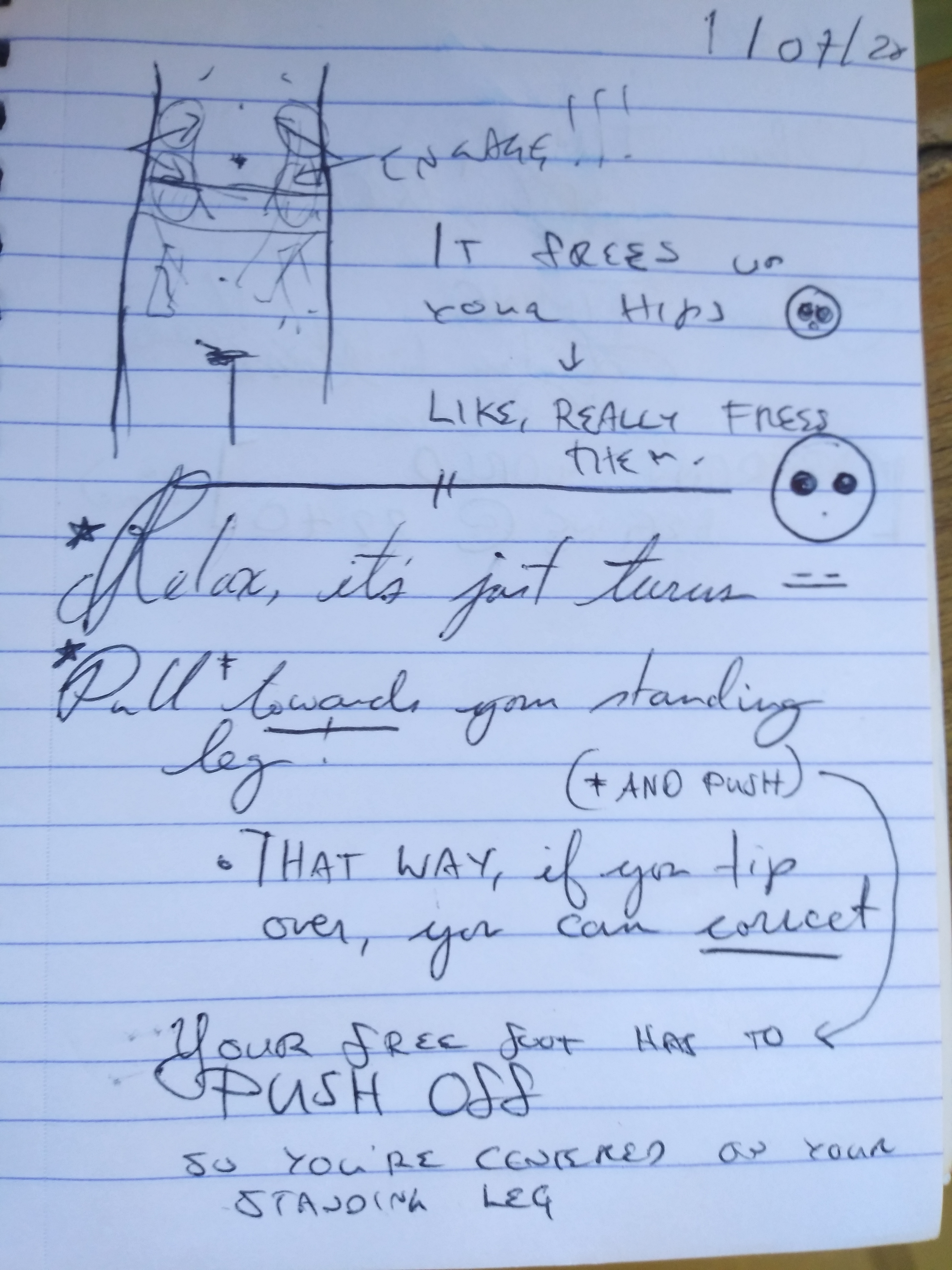
A transcription (which I probably won’t include every time):
- Engage! (Those arrows are pointing at the muscles to either side of the rectus abdominis. My friend SF pointed out that it looks like they’re pointing to the kidneys 🤣)
- It frees up your hips 😶
- Like, really frees them. 😲
- Relax, it’s just turns 😑
- Pull (and push) towards your standing leg!
- That way, if you tip over, you can correct
- Your free foot has to PUSH OFF so you’re centered on your standing leg
On that last note: you would think I knew that already!
And, I mean, I do. I did. I have. And yet!
I just realized I haven’t really been actively using the soon-to-be free foot as much as I should when initiating turns, so I’m not always pushing myself onto my standing leg as effectively as I could.
My focus at the moment is staying on my leg (or legs, as applicable) and really using the floor.
And also not allowing my arms to do ridiculous BS like they did today during our medium allegro, because ffs, arms 😑

Ballet Lessons: Stay Together
Have you ever seen the entrance to the Kingdom of the Shades (from La Bayadere, one of the “White Ballets” of the classical cannon)? Or the first breathtaking appearance of the swans in a large-scale production of Swan Lake? Or the Snow scene from Nutcracker?
I mean, that’s probably a given. You’re reading this blog, and that means you have internet access and are probably at least a little bit interested in ballet, so that means you can at least watch them on YouTube, probably. (If you came via one of my bike posts, hi! and I’ve got a couple for you, too: a big group ride sweeping around a corner or a tight paceline swapping pulls).
These are some of the best-known scenes in ballet, and with good reason: they display the fundamental truth that there’s immense power in a group of individual people working together.
The entrance of the Shades might be the keenest example.
The dancers enter one by one, in a long line that will eventually double back on itself. They perform the same simple (not easy: simple), repetitive phrase over and over: arabesque (penché, in most versions), temps lié to posé tendu devant, step step, repeat.
They are not massed in a cloud, as the corps so often is. They are not aggregated in attractive little clusters, or in coruscating diagonals, or in opposing echelons. At least, not at first.
Instead, each of the Shades is essentially alone—and yet she’s also part of a whole.
The repeating phrase is nice enough on its own, but nothing you’d necessarily be transfixed by for minutes on end (or, indeed, for one minute on end, unless you’re busily analyzing technique, I guess).
The repeating phrase performed by an ever-lengthening (and eventually redoubling) line of dancers, on the other hand, is mesmerizing. It’s kaleidoscopic.
It evokes an ethereal, otherworldly atmosphere even (or perhaps most effectively) when performed against a plain backdrop, with no set except a ramp upon which the advancing shades descend.
This simple phrase, without a single iota of elaboration, becomes a symphony. But it only works if the dancers stay together.
Indeed, it works because the dancers stay together.
At the height of the sequence, the redoubled chain of dancers (still executing the same phrase on the same leg) becomes … Oh, I don’t know: a restless sea; a moonlit, windblown fog racketing between two unseen hills; the very breath of the audience.
Choose whichever metaphor suits you: either way, it becomes one thing; one thing made up of a staggering array of smaller things.
But only if the dancers stay together.
~
This is where I am in my life. I spent so much of my life standing apart that I came to believe, on some level, that it was somehow better.
Participate, I thought, but don’t join.
Or, join, but not because it’s inherently good to be part of something.
Join because it’s how this thing works: but retain a measure of reserve about the very idea of joining. Remain aloof.
If you remain aloof, the unacknowledged subtext would have read, you can’t be caught off guard and hurt when, inevitably, you’re rejected. (Lessons learned in childhood die hard. When enough people have told you, no one really likes you and no one will ever like you, you come to believe it.)
And yet, as the company has transformed into a place where I feel welcome, bit by bit I find that I want to belong.
That the more I begin to feel that I want to be part of this group—that I like the people in it and the group itself and not just the work we’re doing together—the better I actually seem to dance.
When bikes were my life, I loved—loved—the incomparable symbiotic feeling of sweeping around a curve in a flock of bikes traveling at speed.
As a singer, I have always loved choral harmonies more than anything.
Even as a dancer, I love those moments of pure synchrony, especially in grand allegro (here are four separate bodies flinging themselves violently through space, and yet we are one thing because we are all doing this together!) or in partnering (the best moments, for me, are the ones in which each move seems to flow logically, even inevitably, from the last).
Why, then, am I still surprised to want to be part of something—to want, dare we breathe the word, to belong?
Ironically, I know I shouldn’t be surprised (my aloof, proud, defensive side feels downright affronted: “Of course I know that, man, what are you trying to say?!” …. to be surprised is to be less than omniscient; is to be vulnerable). Humans are social animals, and though I’m not always great at being a human, I am one anyway. Neurologically speaking, even I am wired for belonging.
Of course I want to be part of something, even if the something in question is so obscure that a great many people literally don’t understand that it exists.
(Seriously: there are a lot of people, right here in the First World, who have no idea that a professional ballet company is a thing; that we don’t just clean out the barn, rehearse a couple of times after work, and set up ticket sales).
But it surprises me anyway.
Not least, the knock-on effects: when you start cracking open the door to let people in a little—because, here’s the thing, that’s how you do The Belonging—you find that you try new things that the other people in The Thing to which you’re learning to belong like. It’s transitive almost: I like A and A likes Lizzo, therefore maybe I will also like Lizzo.
You discover music you’ve never really given a second glance before (or you discover who makes music that you’ve low-key liked for a long time but haven’t known who to ask about it). You take a risk and wear something ludicrously silly on Pajama Day—like a hoodie with a sparkly pug with antlers on it (I’ll have to get a picture; I can’t even begin to explain this one).
You say hi first once in a while.
You begin to listen without feeling like you might, at any moment, have to defend yourself.
You begin to talk. Just a little: but then one day you realize you’re having, like, a whole conversation. OMGWTFBBQ, IKR?
And you begin to learn that it feels good to be even a little bit on the inside of something.
You begin to realize that it’s okay to want to feel that. That being on the inside isn’t the same as being one of the people who, back in the day when you were a kid, did everything to ensure that people like you stayed out.
You begin to want to stay together because although you by yourself are just fine, the group is another thing, and it’s a really cool thing.
You begin to realize how much it helps to be a unit.
That (apologies to Kipling) the strength of the corps is in the dancer, and the strength of the dancer is in the corps.
I mean, not that it’s all roses and sunshine, etc. But this, for me, is a new feeling. Realizing that part of merging into the group is being willing to merge; is wanting to merge.
Just like the dancers in the Entrance to the Kingdom of the Shades, we do not surrender our individual strength to join the group.
Instead, we continue to dance on our own legs.
But we dance on our own legs together.

Last Studio Saturday
I’m still stunned by how different this year has been compared to last year. When she launched class this morning A said, “Last studio Saturday guys, can you believe it?”
And, of course, it got me thinking.
By this time last year, the season already felt like an interminable battle; a kind of bitter survival slog.
I did my best to stay positive and keep that to myself, but it was hard. I was lonely and anxious and felt like an outsider and like maybe I shouldn’t be trying to do what I was trying to do.
And here we are this year, and it’s basically a full 180° difference.
I’m still pretty sure I’m the worst dancer in this company, but I’m okay with that.
And part of that is that this year I’m the worst dancer in the company, instead of this weird anxious appendage. Instead of being a stressed out and dejected assemblage of people, we’re a unit in a way that I don’t think we were last year at all, and it’s such a cool feeling to be part of that.
Besides, I’m improving.
The thing about being a professional dancer is that you never get to say to the audience, “I’m sorry, I’m usually better than this; I’m having a really bad day.”
Your worst day still has to be good enough.
So when your AD casts a show, she’s thinking about that, and trying to put you in a role that’ll play to your strengths even on your worst bad day.
And when you’re taking class every day, you’re working on making your worst bad day better and better and better.My worst bad days probably aren’t really 100% “ready for prime time,” but they’re getting better. Part of it is just improving technique, of course—but some of it’s also leaning how to laugh it off when I do something utterly bone-headed, and to make my mistakes look good (or, at any rate, less bad).
And that’s all down to confidence. As a dancer, you live and die by the belief that you have the right to be standing where you are, whether in the studio or on the stage.
Or, well … Okay, sometimes you really have to fake it (laughing at yourself helps).
When I’m having a rough time remembering combinations or whatever, I try to remember what L’Ancien says to me whenever he sees me retreating into myself:
“Remember: you are a prince.”
It’s worth noting that he doesn’t say, “Act like a prince” or “imagine you’re a prince” or even “be a prince.”
He always says are.You are a prince.
Which is to say, it’s there, inside you. You evoke something that already is.
I think we’ve all seen random people—some lady on the bus with four kids and her hair up in a messy Mom-bun; some old gent sitting on a park bench; whoever—who just look regal. Princely. Royal.
I think that’s there in all of us.You reach inside and set your feet on the ground at the heart of a quiet, graceful strength, and you square your shoulders and lengthen the back of your neck and you catch sight of yourself in the mirror and there it is:
Remember. You are a prince.
And then you still add an extra tour jeté and almost leave out that pesky balancé dessous and maybe there’s a moment when you suspect that you might just flat out fall out of your turn.
But you do it with your head high and when you’re done you roll your eyes and laugh at yourself.
So that’s it. That’s where I am.
Next week we’re in the theater for Nut, and then we’re off for three weeks, and then it’s on to the rest of Midsummer Night’s Dream and the rest of the season.
Be kind to each-other, and if there’s a weird oddball loner in your company or class, maybe try to reach out and see if you can draw them into the loop, because they might just be too afraid to try to do it themselves.
Oh, and here’s a shot of my back, just because 😁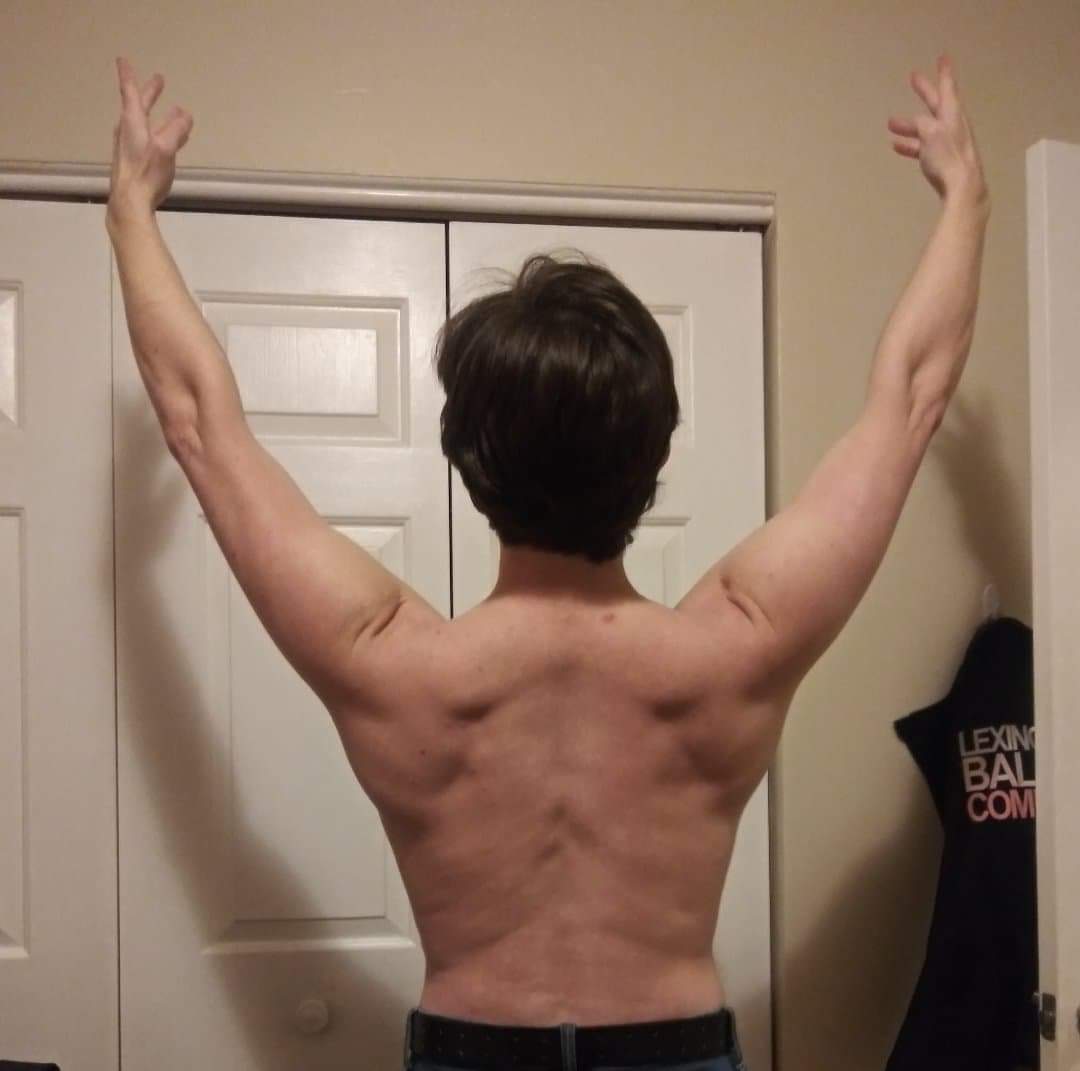

Reflections On Almost Half A Season
The past two weeks, while stressful due to lack of days off, have likely been the best in my career.
It’s hard to explain what’s happened, because I don’t entirely understand it myself. in short, I’ve begun finding confidence again, and the more confident I am, the more I’m able to improve.
Two weeks in a row, Mr D has commented on how much I’m improving. As dancers, we live for those moments, so that’s everything. He’s also started giving me.a ton of corrections in class (a sign,in ballet, that your work is paying off and that your work ethic is showing), not to mentiom notes in rehearsal geared towards making the roles I’m learning and revisiting really sparkle.
The better I do, the better I want to do, and the harder I work. Success breeds success.
Yet, at the same time, my focus continues to be so different than it once was.
It’s weird. At this juncture, there are still steps I don’t know (there are always steps you don’t know: Ballet has had 400 years to invent stuff for us to not know how to do, after all), but learning them is neither as daunting a prospect nor as urgent a goal as it once was.
You reach a point at which you begin to feel that if you need a certain step for something, you’ll pick it up. You find yourself doing steps you’ve never learned and learning how to ask for help if something doesn’t click.
This week Mr D threw revoltades at us again, but I didn’t quite see what he was showing and thought it must be some variant of an assemblé en tournant. I tried it and it worked just fine, and then I thought, “Wait, that’s revoltade, is what that is.”
Anyway, it turns out that if you want to do revoltade, all you do is pretend you’re falling down drunk and then do assemblé en tournant.
Who knew?
So, anyway, learning new steps isn’t the main focus. Every day, I work on aplomb, on.feeling my body, and on control without tension (so, basically, I work on standing up straight, actually managing my limbs and core, and getting out of my own way). I work on what L’Ancien would call “organizing the bones.”
This, in turn, improves everything else.
A couple of years ago, BW gave me the specific goal of maintaining demi-pointe balances on one leg for eight seconds at a go. Some time between them and now, I got there.
Some time between last year and now I learned to walk powerfully and gracefully, with presence: to say with my walk, without executing a single actual ballet step, “Look at me:I am a dancer.”
Some time between the beginning of this season and now, I stopped being afraid to ask my fellow company dancers when I’m.unclear aboit things.
I stopped being afraid to work on pas de deux and variations in the back even though I might never do them. I stopped being afraid to throw myself in when someone’s missing in rehearsal (as a result, I know all of Flowers now 😁).
I can’t put a finger on the specific moment when any of these things happened (though I can identify the day Mr D tricked us into learning revoltade). But they have happened, and that’s a very good thing.
Earlier this week, with my balance all awry thanks to a sinus infection, I knocked myself off my leg hard in the middle of a turn (too much force, too much internal leveling mechanism failure) and recovered by automatically transforming the failed turn into a spinning jump. I didn’t think about it at all: it just happened. I kind of let go of the ground, landed smoothly, and on I went.
This is what I missed so desperately when I didn’t dance. That deep trust in my body; the knowledge that it’ll figure things out. I missed not even having to think about it.
The jump that resulted from the equilibrium failure wasn’t the step Mr D gave us (it actually does have a name, but I can’t seem to summon that name right now o.O) but it was cool and graceful and I think it actually looked pretty good.
I can’t express how helpful that experience was.
So much of confidence is knowing how to bail out gracefully, and knowing that if you fail, you’ll still be okay. I don’t know if I’ve ever felt like that in my life before now.
We’re on break this week, then we return with two weeks until Nutcracker. I feel good about this year’s production: last year, I was learning what seemed like this vast and complicated rôle, and constantly afraid I’d forget something or miss a cue generally make an was of myself.
This year I’m fleshing it out, playing with it, enjoying myself. I still screw up, of course, but now I mostly laugh it off.
It’s amazing what feeling accepted does for a person. It’s amazing how you can blossom once it’s safe to come out of your shell.
I look at myself now and I still, of course, see the mistakes and the missing bits of technique and the occasional complete brain failure, but I also see—really see—the potential that Mr D must’ve seen when he asked me.to come and dance.
Once in a while, I even see a powerful, graceful danseur: I may not be the finished, polished article yet (spoiler alert: I don’t think any of us ever feel that we are, anyway), but sometimes I can see how that polished article will look.


 danseur ignoble