Category Archives: learning my craft

A Gem From The Joyce
Every year, P7—the seven dancers that make up the core company of Pilobolus—does a residency at the Joyce in NYC, and for the past two years I’ve had the privilege of seeing them during Pilobolus’ SI.
It’s an incomparable experience, and if you can make it happen, it’s worth going (and I’m not just saying that bc I’ve been a Pilobolus Stan since I was 3 and I have two friends in P7 rn).
This year, after the show, Molly Webster from Radiolab (one of my all time fave podcasts/NPR shows) sat down with Renée Jaworski and Matt Kent in an installment of the Joyce’s Curtain Charts series.
We had the option to stay for that or go chat with the dancers.
I found myself terribly torn, but ultimately decided to stay for the chat, and I’m glad that I did for so meant reasons, but not least because Matt and Renée articulated something I’ve been reaching for.
During the discussion of how Pilobolus resurrects pieces, they described it as something like “stepping into a lineage.”
You’re not trying to become the dancer who originated the given role (or in the case of Pilobolus, roles); you’re learning what has been transmitted from them, possibly through several other dancers, and setting it on your own instrument.
The steps may be essentially the same, but your way of moving is yours, and that’s where serendipity enters in and what could be a moribund attempt to resurrect the dead (again, metaphorically; most of Pilobolus’ dancers are still around) instead breathes be life into the work.
Inevitably, Matt and Renée expressed this so much better than I’m doing now, but the point is this: when I create choreography, this is what I want for it.
I don’t want it to be exactly the same every single time, because that’s not how dance is in the first place and because I’d much rather see dancers take something I’ve made and breathe their own life into it.
Pilobolus has always been collaborative; collective. The voices of its dancers have always influenced the creation of its dances.
Thus, pieces evolve and grow richer (except occasionally, when everyone sort of quietly agrees to lock them up in the dustiest corner of the archive, and good riddance).
I don’t think it’s necessarily wrong for choreographers to work from a place of crystalline, singular vision, in which future recreations must be as close as possible to the original rendition.
I do, however, honestly think it’s kinda boring when we do.
Anyway, I love this idea of dancing as part of a lineage; of creating dance with the knowledge that it can and will and should change over time.
And now I have a better way to explain it, even though I don’t do it as well as Renée and Matt.
PS—I’m home for a week to let my foot heal, then it’s back to Pilobolus Camp 😁

Pilobolus, Revisited (Again)
I keep coming back to Pilobolus’ summer intensive, and not only for the dance technique.
…Not that you can really separate the technique we learn and build here from everything else that makes this experience so resonant.
And that’s so much of it: so much of why I came the first time, and so much of why I keep coming back, even though my work as a professional ballet dancer looks, at first glance, like it must be a completely different animal.
I keep thinking: so much of what I’ve learned about how to be a dance artist, I’ve learned here.
Not the steps—the steps don’t make the artist (and Pilobolus’ whole approach isn’t really about “steps,” per se).
Rather, I’ve learned so much here, from the very beginning, about being vulnerable, about finding what’s there, about connecting with other people, about using my body to speak to someone’s soul. About speaking my own soul through my body.
This is never the same experience twice: every time I come, I’m a different person (you can’t cross the same stream twice, etc). But because it’s in the same place, using the same basic frameworks for connecting with each-other, for moving together, for creating together, it very vividly calls memories back to my conscious mind, and that’s like having a different kind of window into myself.
I remember what things were like; what I was like, and sometimes I think, “Wow, this is so much less scary now,” and other times I laugh at myself and go, “Welp, still bad at that.”
Here, it’s profoundly okay to be bad at things. It’s profoundly okay to screw up. In fact, some of the best stuff comes from the biggest blunders. Grace rushes in at the most unexpected moments.
Also, I always wind up crying. Usually, I make it to Wednesday, at least, but this time a moment in a piece one group made this afternoon—Monday, Day One—caught me right under the sternum.
It is a gift to be able to cry in a room full of people who were, a few hours ago, complete strangers.
And now I’m in bed, reading, reflecting, with my fan humming and blowing a cool breeze over me, and I can’t help but be so staggeringly grateful that in the midst of a rocky stretch, here is this incredible gift.
Here is this place of grounding, where—if I’m lucky—I will come for many more years, and every time I’ll have just as much to learn as the first time
It isn’t a stretch to say that Pilobolus played a huge role in my path to becoming a professional dancer: I began to learn to really trust myself and to feel my own power in Pilobolus’ masterclasses several years back [•]
- This was in the Before Times, so it honestly feels like half a lifetime ago.
It also isn’t a stretch to say that my first Pilobolus Summer Intensive cracked open my soul in a way that it desperately needed.
This season of healing in which I currently live began, in earnest, here.
That healing, too, has been central to my work. To be a dance artist, it helps to be able to be vulnerable. It helps to be able to forge a connection to other human beings—to come open-hearted to pas de deux; to come to the audience with whatever truth the role before you asks you to carry. This is as true in ballet—possibly the most artificial species of concert dance—as it is in the gym at Woodhall, where we strip off our layers of training and Just. Fucking. Move.
Part of what we do here is just learning to get out of our own way. To try to step out of self-judgment and do stuff; to move from the inside out instead of thinking about the eyes watching our outsides.
Somehow, that’s incredibly healing.
This year, I almost didn’t come: we’re still hypothetically buying a house in an historically terrible market for buyers, and although this is professional development, I didn’t know if I could justify even its very reasonable expense.
Mom offered to pay half my way, so I signed up for one week.
Another year, perhaps, I’ll do three.
But for now this week is enough. An island of deep healing in the midst of a life that’s full of both healing and struggle right now.
So I’ll be here and breathe here, and thank G-d I’ve come back again, to this touchstone place, where so much began for me.

Season’s Recap
I found my way back into life as a full-time professional ballet dancer last fall, in late September of 2023, which somehow seems both like it was last week and also like it was forever ago.
I enjoyed SPDC’s contemporary choreography, but I did miss ballet intensely, and it was good to be able to return to my first love.
It was also scary. NEBT is a new company, and I’m the only guy who’s there full-time, so I was pretty much immediately catapulted into the principal dancer category. I don’t know if I said this at the time, but I was definitely afraid of falling short.
In the ensuing months, though, I’ve begun to find my feet both as a dancer and as a senior company member.
My AD has paired me up with two fantastic partners, and we’ve done some pretty challenging stuff together. O and I did some staggeringly hard stuff in “Silver” and worked really hard on getting Act II of Midsummer nailed down and smoothed out (Act I, by comparison, was a walk in the enchanted fores—I mean, in the park).
M and I have delved deeper and deeper into the nuance and tenderness of “Noir.” The relationships that have come out of that work mean a great deal to me.
I’ve also had both opportunity and guidance to really begin tuning up steps that are hard for me.
I love having room to learn as a ballet dancer in a place where nobody yells at me for still needing to learn. That might be the strongest lesson NEBT has offered: that ballet doesn’t need to feel like a pressure cooker; that artists flourish when artistic rigor is detached from the traditional environment of fear.
At the same time, I still love my teaching job. I love how much the kids enjoy learning the choreography I’m creating for them, and seeing that choreography come together. I love watching them master new skills. More than anything, I love seeing their love of dance grow stronger and deeper. I love just watching them be themselves.
It occurred to me tonight, while I was looking through my camera reel, that I’ve reached a point in my life that I never expected to reach.
I never expected to find a career that I love, and that feeds my soul, and yet at this point I’m lucky enough to have two—dancing and teaching—in which I’m learning and growing.
I’m happy have a bit of a break coming down the pike this summer, but I’m also very much looking forward to next season.
Back when I began this journey—back when I was still in school and just returning to class—I didn’t know what it looked like to live life as a professional dancer, but I felt called by the dance and by the structure of the dance.
I didn’t know that my working life as a danseur would help me figure out how to be a grown-up me in the world, but I do feel like that’s exactly what’s happening.
And I never imagined that this life would grant me the ineffable gift of feeling like I belong somewhere in the way that I feel I belong at NEBT: that is, I feel accepted and valued as a member of this small community of dancers in a way I’ve never quite experienced before.
I have been hesitant, in my life, to picture staying in touch with almost anyone for very long—but the thought of remaining connected to the people I know at NEBT is a lovely thought.
I know we can’t predict the future, and that all of this lies beyond our control—but at the same time, it’s nice to think about remaining part of this tapestry that Ms. Rachael and all of our mutual love of ballet has woven.
I’m not sure what else to say.
This first season has been good. Hard at times—I definitely experienced an enormous crisis of faith in myself early in the rehearsal process for Midsummer—but good. I’m leaving it with far greater confidence in my ability to learn and to live up to the brief I’ve been handed than I had when I arrived.
My ballet goals this summer are to keep improving my partnering skills, to polish my pirouettes, to nail down double saut de basque, and to upgrade my grand pirouettes from “okay” to “good” on the left and from “WTF” to “okay” on the right.
That should be plenty to keep me busy until fall.

Remember: You Are A Prince
Tonight we premiered three new works.
I danced a principal role in two of them, with two excellent partners.
I made a tiny mistake in my first piece that the audience didn’t see (my brain skipped ahead and my partner saved me from myself right away ^-^’), and an angel press didn’t quite get all the way there because I let a wardrobe malfunction distract me (my trousers ripped — good thing I kept my tights on under them!), but other than that it was quite possibly the best performance I’ve ever given as a dancer.
I felt confident. I felt strong. I felt connected to each of my partners, to the music, to the corps, and to the stories we created with our movement.
In short, I felt good. I felt present.
~
Afterwards, I had this moment that felt like a little series of windows in time had opened up.
For a heartbeat, I caught a glimpse of a long-ago me from a terrible time in my life; a me that couldn’t believe that he would ever dance at all, let alone like this. A me that politely demurred when someone suggested auditioning for the dance program at Academy (the arts magnet that I did attend, although I didn’t major in dance) because the thought of not making the cut felt like a knife twisting in my heart.
A me that honestly didn’t believe I’d make it to the age I am now. A me that didn’t even really believe that I’d make it to my next birthday.
For a heartbeat, I saw a slightly older me — the me who couldn’t follow up on a friend’s suggestion that I drop in at a local ballet company’s school. I still couldn’t let myself hope. I still believed both that you cannot return, once you leave the country of Ballet, except as a tourist, and that I probably wasn’t really good enough — that I had the physical aptitude, but not the brains.
For an eyeblink, I saw myself, raw and just a little bit hopeful, a college student finally setting foot in the studio again, cradling in my heart of hearts the dimmest hope that somehow, maybe, I might find a way to dance, even just a little.
For a breath, I saw the dancer that I was towards the end of my first year as an apprentice at Lexington Ballet, stubborn and determined, but also frustrated and so, so afraid I’d never figure it out.
I wanted to reach back and say to them — to all those iterations, all those past selves, so to speak — Even now, we’re making it. We’re getting there.
A couple of years ago, my friend BG told me, “You will dance, and you will do great things.”
And tonight I danced, and tonight I think my company made something great and beautiful.
Tonight I danced a pas de deux that ends with me carrying my partner off the stage, and as we vanished into the wings, the audience responded resoundingly. I heard a voice shout, “Bravo!”
That’s no small thing, on a Thursday night in a city where people don’t see a lot of ballet, and really don’t see a lot of contemporary ballet. (That pas was in the closing ballet, which is quite contemporary.)
Reader, none of that is the main reason that I dance: I dance because dancing is where my soul, or whatever you want to call it, thrives. It’s where my heart feels whole.
But I’d be lying if I said that it was anything less than amazing to know that you’ve captured this room full of strangers and brought them with you on your journey and actually moved them.
~
At the end of the day, besides the dancing itself, it blows my mind that I am part of this company: that I’m valued and wanted; that I have friends at work; that I get to spend my working days creating art with these vibrant, singular people.

It blows my mind that I’m living this life.
The sense of gratitude is impossible to articulate. So much of my life right now is a prayer of thanksgiving that, even in the hard and dark and troubled times we’re living through, somehow there’s room in the world for art and for artists, and somehow I’m one of them.
This night is a golden night. My heart and soul keep thrumming with a deep kind of contentment.
I think: so this is how it feels to be in the place where, not too long ago, you hardly dared to dream that you might someday be.
Right before I went on for the first time tonight, standing in the crossover behind the stage, I took a deep breath and repeated something that L’Ancien told me time and again in class. Simply: “Remember: you are a Prince.”
He would say this to me when I was struggling and getting into my head and getting in my own way. Just, “Remember: you are a Prince.”
Tonight, I was a classical prince in foofy Regency-revival sleeves and a velvet waistcoat and tights and a contemporary prince in 50s (60s?) Greaser gear, with my t-shirt sleeves rolled up and black trousers (that almost made it to the end of the show).
What links the two is the decision to believe, for this moment, that you deserve to be here.
That and my hair, because 10 minutes isn’t really long enough to un-shellac your hair and turn a buttoned-down Edwardian ‘do into a passable DA.

PS: Counting the five in the Noir finale, there are about 20 lifts distributed between the pieces I did tonight (10 in the main Silver pas; five in each finale). And excepting the angel press that didn’t quite make it (see above) they all went well by any measure, be it metric, Imperial, or SAE.

Perspective
Sometimes, new experiences shed light on past experiences in ways that change how we understand them.
Sometimes, that helps you understand your own journey in ways you didn’t know you needed.
Ballet Trauma: It’s A Thing
As a ballet dancer, I began my career at The Lexington Ballet Company in Lexington, Kentucky.
I will always, always be grateful for the risk LexBallet took in picking me up out of their summer program. At the time, I didn’t have much history as a performer, and I was missing pretty significant chunks of the training that professional ballet dancers are expected to have when we begin our careers.
My first year was rocky, and the source of that rockiness (bullying by a senior company member) wasn’t handled well — but that doesn’t change the fact that, in my time with LexBallet, I learned so much as a dancer that would’ve been difficult to learn if I wasn’t dancing thirty hours per week. I learned how to function in a ballet company, I gained invaluable performing experience, and I eventually began building friendships that remain with me to this day (including AK, who I ran into again at NEBT because the ballet world is terrifyingly small).
I had some great mentors there, and very solid examples both of how to be a sound member of community that is a professional ballet company and, perhaps just as importantly, how not to be.
This isn’t to say that everything was perfect.
It wasn’t. Ballet has historically been sort of infamously problematic, and LexBallet didn’t entirely escape that legacy.
There were problems. Some of them were pretty significant. Some of them were worse than I realized at the time, not least because male ballet dancers are considered magical unicorns that might bolt at any moment and tend to be handled with much greater discretion than are female ballet dancers. Some didn’t fully come to a head until after I had moved away.
When I was there, I often said of LexBallet, “We’re a family — a dysfunctional family, but still a family.”
I still think that’s a pretty apt description: members of dysfunctional families often care deeply about each-other, and they can accomplish amazing things together, but they also share common wounds. Likewise, people within dysfunctional families can care deeply about their fellow family members while still causing them very serious harm.
That said, things were more dysfunctional than I understood at the time (LexBallet is currently in the process of taking some major strides to address those things, by the way, and I think that’s really cool and amazing).
Some of this I just plain didn’t see (again, magical unicorn), and some of it I kind of saw, but didn’t see enough to understand what I was seeing, either because it was consistent with my prior experiences and therefore felt normal-but-not-good, or because I was only witness to parts of what was going on, so I couldn’t get beyond, “This thing I’m witnessing seems kind of wrong but I’m not sure why.”
There were, of course, also the traditional, established traumas of the Ballet Cinematic Universe: though it wasn’t said in so many words, there was still the sense that nobody’s body was right. Some of the artistic staff treated us less as fully-realized artists who were working very hard than as interchangeable Dance Production Units who were never functioning quite as specified. There was, to be honest, kind of a lot of yelling.
We company members sometimes discussed things amongst ourselves, but I don’t think any of us really believed we could do much about it, in no small part because I don’t think we really believed things could actually be different. Things were just as rocky for almost everyone else we knew at other companies.
It turns out, in fact, that there’s a lot of this in the Ballet Cinematic Universe. Is anyone surprised by this?
Not really.
The surprise, I think, is how many of us have felt like things at our own companies are fine, because they’re not as awful as whatever’s happening at some other company.
A Bit of Unpacking
The audience of this blog is basically Bunheads and a few people who’ve been reading my stuff for years, so this might go without saying, but: ballet people kind of live on a different planet. Ballet has its own, deeply-immersive, very powerful culture, and because dancers spend so much of their time immersed in the Ballet Cinematic Universe, we might as well be living in a different country than that in which our next-door neighbors live.
Moreover, the culture in question propagates itself through selection. While ballet is famous for selecting for a very narrow range of body types and excluding everybody else, those outside the artform may not realize that it also selects for a specific temperament — one that is conscientious, cooperative, and obedient.
Historically, ballet has been the most hierarchical of the streams of dance. Its traditions belong to a Europe that has pretty much ceased to exist in every other sphere, and among those traditions, writ large, are hierarchy and obedience.
Ballet students in traditional programs learn from the very beginning to obey those in charge of us. As children between six and eight years old, just beginning serious ballet classes, we’ve historically been expected to place our hands on the barre, close our mouths, and follow instructions.
Those who aren’t naturally inclined to do so tend, very quickly, to drop out of training.
Those of us who continue — even those of us who take a circuitous route out of and back into ballet, as I did — learn both implicitly and explicitly that we should be quiet in class and rehearsal, take instruction obediently, only ask questions for clarification, and accept criticism gladly and quietly.
We also learn that our bodies are instruments on which our teachers and choreographers and directors create art.
We learn that hierarchy is to be respected, even at great cost.
We also tend to learn to internalize responsibility: when things are difficult, we must be the problem; we must be doing something wrong.
We also learn that we are replaceable. That if we don’t like the way things work, there are a thousand other dancers waiting to take our place.
So while the average 21st-century American might find it difficult to understand why we’d put up with a lot of the conditions that are considered pretty normal within the professional ballet world, we have difficulty understanding that other conditions could exist. Most of us are very intelligent, so we can understand that they should, in a philosophical sense, be able to exist: it’s just hard to make the jump to imagining what that would be like.
Likewise, we can find it difficult to imagine that we can pursue those conditions while continuing to work within the artform to which we’ve dedicated our entire lives (see above with regard to believing that we are replaceable).
But Maybe?
I’ve just finished up my first month with New England Ballet Theatre, and it’s wild how different the vibe is than almost anywhere else I’ve worked, including places that weren’t within the Ballet Cinematic Universe.
A part of me is really kind of afraid to keep repeating it out loud, because somewhere deep in my soul I’m extremely superstitious, but NEBT is built different, and it’s built different by design.
I didn’t write much about my audition at NEBT, but the fact that I felt welcome and comfortable during the audition, rather than stressed out and frightened, should really have been my first clue. I assumed that was just because I was auditioning outside of the normal audition season, at the same time as a good friend — but, in retrospect, a lot of it had to do with how both Rachael, our AD, and the existing company members welcomed both T (my friend) and me.
Since then, I’ve been slowly realizing that NEBT feels like home because Rachael is making a concerted effort to build a different kind of company: one in which we dancers are not eternally-malfunctioning Dance Production Units, but in which we are people and artists first.
This, in turn, is helping me to see the scars I carry from earlier experiences. Sometimes that’s uncomfortable, but healing isn’t always comfortable.
Likewise, this isn’t to say that life at NEBT completely stress-free. Ballet, as an artform, is stressful: we live on this knife’s edge, on which we pursue a perfection that we know cannot be achieved, but for which we’re still willing to work our tuchases off.
But I think, maybe, I’m finally beginning to understand how good stress — that is, the kind that facilitates creativity and growth — looks and feels in a work environment.
What feels so unique is that our AD handles that stress in a very different way. I have literally never heard her raise her voice, and when we’re not getting it, she takes a beat to figure out why, instead of just assuming that A] we’re not listening and B] we’re, in the British sense, thick.
We screw up. That’s just part of being human.
But, because the culture of the company has been built with the knowledge that mistakes happen and don’t have to be the end of the world, when someone screws up, it doesn’t feel like the end of the world.
Like, seriously, the first time I was suppose to run my opening solo for The Red Shoes, my brain went blank like 30 seconds in, and rather than screaming at me when I said, “I swear I knew this a second ago!” Rachael said, “Don’t worry, I don’t remember it either right now!” and we laughed about it.
To clarify: Rachael didn’t laugh at me. I laughed because I felt safe, and she laughed with me, because to be honest it really was pretty funny (especially since the first 30 seconds were great). Then I went and glanced at my notes, got my head back together, and ran the piece again.
When an overhead press lift[1] didn’t come off the first or second or fifth time in a rehearsal for an upcoming piece, nobody yelled at me or stomped around looking like they couldn’t believe that any professional dancer could fail so abysmally. Instead, we kept going. Eventually, I got the lift to work during rehearsal. We’re still two weeks out from the show that piece is in, so my partners and I will spend time perfecting the lift itself so we’ll be able to do it reliably by curtain.
- Overhead press-based lifts are roughly 25% strength and 75% timing, so nailing one down with a new partner almost always takes a minute, in my experience.
What I’m Trying To Say Is…
There’s an immense power in being safe to fail; in knowing that not being perfect the first time (or even the fifth time) won’t lead to a tongue-lashing or worse.
There’s an immense power in being valued as a human being and as an artist.
Largely because of this, we’re managing to carry off successful shows in a timeframe that I would’ve thought impossible when I was dancing at LexBallet — and I’ve turned out to be a more useful dancer than I ever believed I would be.
Four weeks from raw concept to opening night is absolutely wild: even in rep, when you’re dusting off a ballet that everyone already knows, four weeks is a pretty short lead time.
We put The Red Shoes up in a month. The audiences loved it. We got good reviews. The parts I got to watch from the house in Dress and Tech looked great.
More importantly, we’re creating a company where people want to stay.
If things continue in this vein, I can very much imagine remaining with NEBT for the rest of my career.
NEBT looks a lot like what I imagine when I’m imagining the future I want for ballet. The rigor is there; the traditions are respected — but not at the expense of respect for the human beings who are, after all, both medium and artist.
Because we are safe to fail, we are safe to try.
For me, that feels revolutionary. I think a lot of us who’ve lived our lives within the Ballet Cinematic Universe would agree.
The other day, someone drew a diagram on our whiteboard representing the difference between how we imagine skill-building progress — a straight line rising like an arrow along the axis representing time — and how it really works — a jagged zigzag that wiggles crazily around, but with an overall upward trend.
This is, in and of itself, a powerful representation of Rachael’s philosophy. Failures and missteps are expected parts of the process. We are safe to fail, so we’re safe to learn. (We’re also safe to call in sick, to have bad days, and to give injuries time to heal.)
Right now, there are eighteen of us in the company, and we talk regularly about how healing an environment it is.
Part of that healing, sometimes, is recognizing the things that have been harmful, that maybe you didn’t entirely see before. Sometimes that’s difficult in its own way.
But healing is like that, and that’s okay.
I can’t adequately express how much it means to find this oasis; this island of healing. That isn’t to say I expect it to be perfect, of course — ballet companies are run by human beings, and human beings are imperfect — but the atmosphere of grace at NEBT means, I hope, that we’ll also feel safe to work on those things together, too.
For that and for so many reasons, I hope NEBT will succeed and continue to grow. And I hope I’ll be there to be part of it for a very long time.
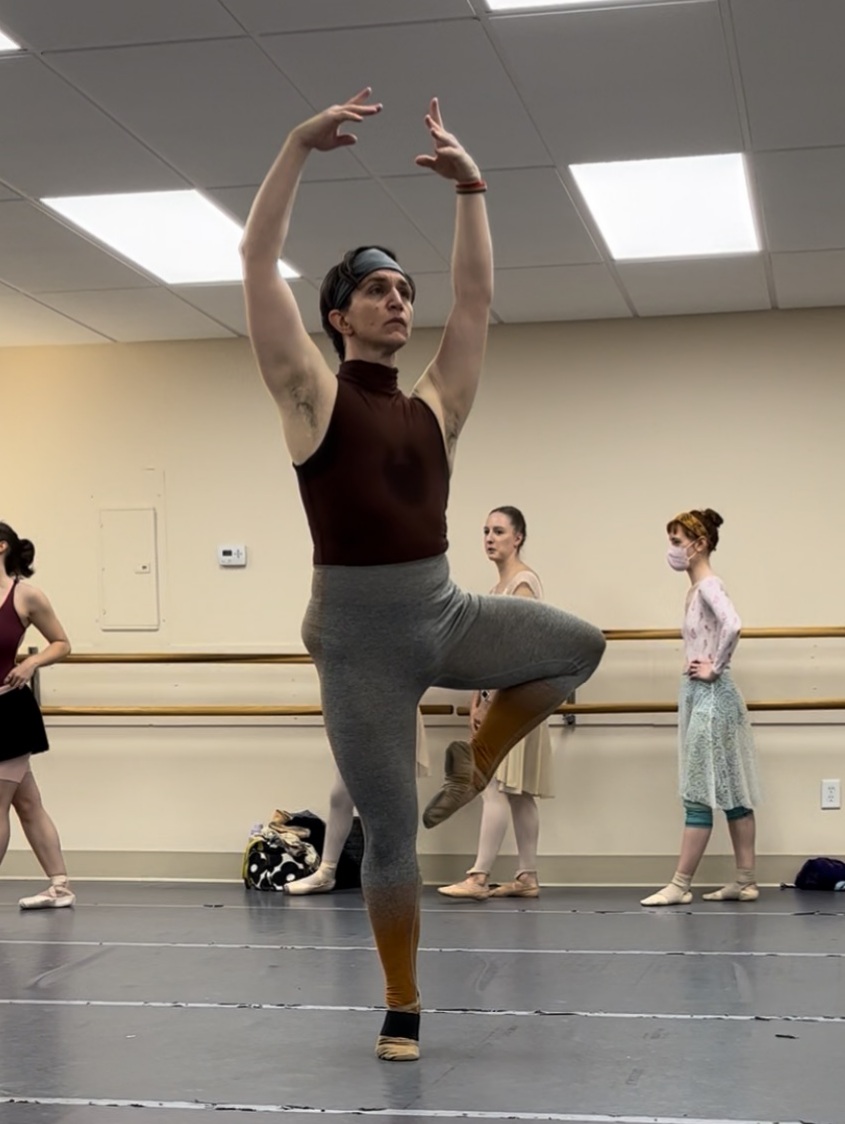

Home
So: when last we checked in, D was sick, I was sleeping on the couch, I was stressing out about an audition email I’d just sent, and my cat was awaiting surgery for his insulinoma. Oh, and I was having trouble feeling like I was allowed to exist anywhere.
Since then:
My Cat Had Surgery (And He’s Doing Pretty Well)
When he was first diagnosed in the vet ER, it looked like the location of Merkah’s primary tumor might very likely make it inoperable. When his oncologist looked at the scans, though, she thought there was a shot, and the head of surgery agreed.
Flash forward (okay, crawl forward, because first I got sick at SI and then D got sick) to last Tuesday. Merkah went in for surgery and the surgical team was able to remove the two masses from his pancreas (it sounded like it was a challenge getting the main one, but the kind of challenge surgeons like).
While they were in there, they biopsied his liver and other areas of his pancreas just to check. The biopsies both came back with only benign changes.
Merkah came home on Friday with an e-tube for feeding, since he wasn’t into eating (cats are like that, and even though he thinks he’s a dog, Merkah is being a cat this time). He’s recovering fairly comfortably, although his medications make him pretty sleepy.
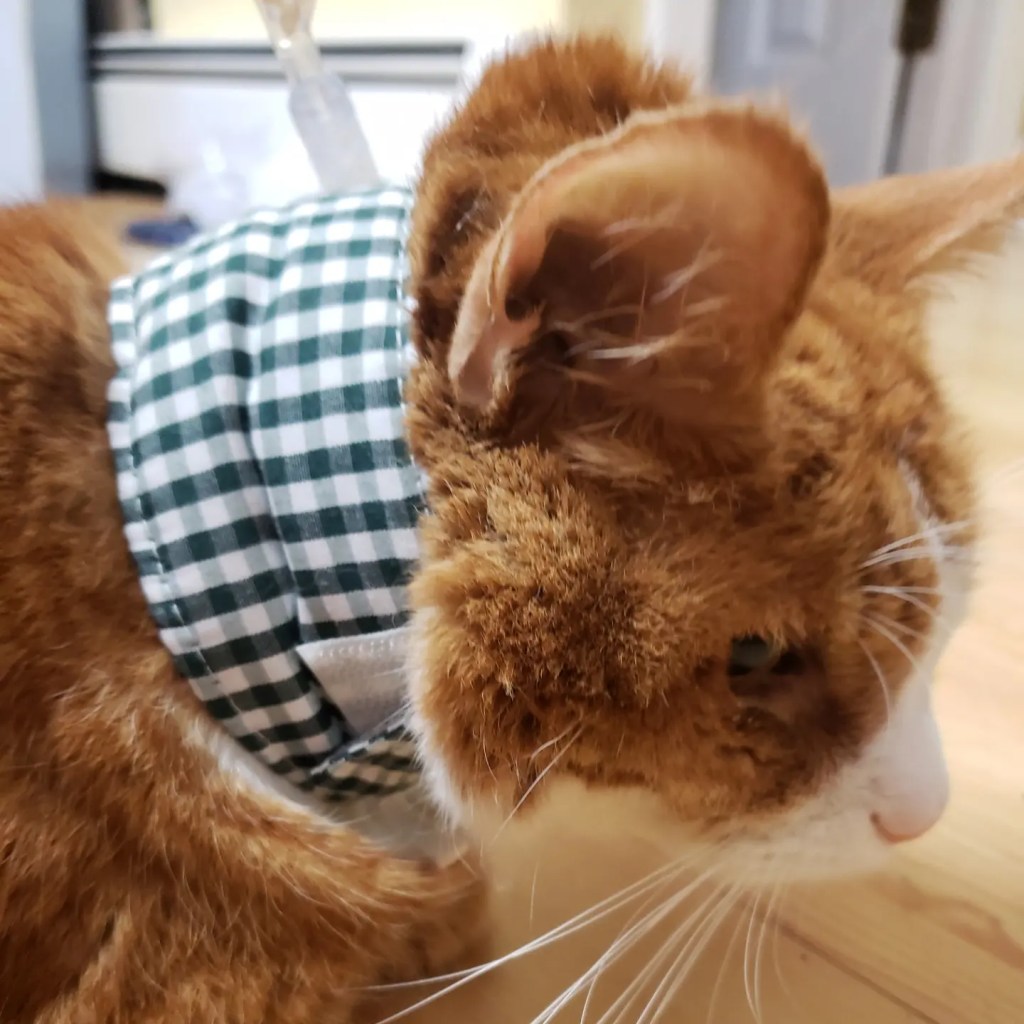
The surgeons think they got all of the insulinoma, and Merkah’s blood glucose has remained stable over the past week, so things are looking up for him.
At the end of the day, he’s 15 years old, which is definitely in Senior Citizen territory as cats go, but since housecats can live to be into their twenties, it seemed worth trying. My biggest concern was that he wouldn’t survive anaesthesia, but he came through that just fine.
If they survive surgery (which most do), the worst-case outcome for cats with insulinoma is simply that the insulinoma either proves too difficult to extract or comes back, and then you just go back to managing quality of life for as long as possible and/or trying chemotherapy.
Overall, though, in the sample of cats who’ve undergone surgical treatment for insulinoma, there’s been a pretty high rate of good outcomes, in which the surgery resolves the problem and the cats live for another two or more years (most cats who get insulinomas are older cats, so that often places them towards the end of their life expectancy).
We’ve got a follow-up coming up with some further x-rays and scans to check for any possibility of recurrence or metastases that weren’t yet visible earlier in treatment, so I’ll keep y’all posted.
It’s still early days, but things look hopeful for Mr Mu to be with us for a while longer. I know he won’t be around forever, but I’m glad to have a bit more time with him.
Everyone Recovered
D got better, and Mom managed to not catch COVID. It felt weird moving to the couch for like ten days, then equally weird moving back to the bedroom, but things are back to normal now, for values of normal, etc.
I Did The Audition
After much internal panic, I was invited to come take company class, observe rehearsal, and chat about things with the AD of the company where I was auditioning.
The tone of the email was overwhelmingly positive, so I went into the audition feeling confident and excited and…
I Got It!
This is huge for me.
This isn’t the first dance job I’ve auditioned for, but it is the first ballet audition I’ve done: I didn’t actually have to audition at LexBallet, because Mr D sort of just plucked me out of a summer program.
Moreover, I’m coming into this job as a full company member, which – NGL – feels amazing.
So as of this week I’m officially a Company Artist at New England Ballet Theatre.
My picture is on the website and everything! ^-^
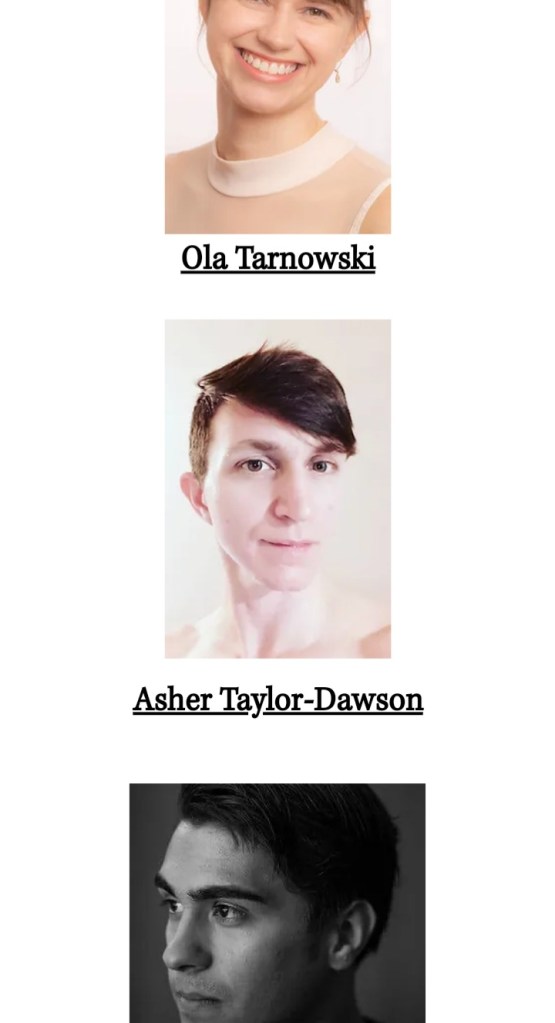
My first performance with NEBT will be in the role of The Shoemaker in The Red Shoes. Léonid Massine originated the rôle in the 1948 film, and I’m excited to be taking it on in my first outing with the company.
More importantly, though, is this: from the moment I walked in to take class on my audition day, I felt welcome and, in fact, at home in the studio.
Like LexBallet, NEBT is a small company with strong dancers and big dreams. Like SPDC, our AD is a woman with a strong creative vision.
She’s also the most chill AD I’ve ever met, which is great. The vibe of the company overall is lovely. I mentioned that on Tuesday as I was gathering my stuff to head home, and we had a longish chat about it.
If I hadn’t felt so strongly from the first that NEBT is a good place, our AD[•]’s efforts to make sure SPDC was treated equitably under the circumstances would have gone a long way to convince me. Yes, the dance world is small and you don’t want to make waves unnecessarily, but Ms R has been incredibly fair and flexible, and that means a lot.
- We’ll call her Ms R, since it feels weird to refer to a ballet company AD by their first name in writing; I’ll have to sort that bit out for myself later ^-^’
As someone who kind of fumbled his way into a ballet career, it means the world to feel like I’m a dancer that the company wanted, and not just one that the company settled for.
SPDC was the first place I felt like that, and I hope to continue my relationship with them as a teaching artist and an intermittent guest artist for the foreseeable future.
If it weren’t for the fact that commuting back and forth to NYC just isn’t going to work at this point in my life, I would gladly have remained a member of SPDC, but as things stand, I’m immensely grateful for the time I’ve had there, and also incredibly grateful to T for sending me NEBT’s audition notice and to NEBT for offering me a contract.
It’s nice to feel at home in the studio. It’s nice to feel like I belong and like I fit. It’s also remarkable how much it does for you to feel comfortable and safe in class: I’m still getting my legs back under me a bit, but I’m dancing better than I expected to during my first week back as a full-time ballet dancer.
It’s early days, but I think NEBT feels like somewhere I’d really like to stay and grow as an artist. I like the other dancers, I like Ms R, and I like the way Ms R thinks both in a creative capacity and in terms of how she’s running day-to-day company operations.
Yea Verily, The World Be Smöl
One of the best things to come out of this entire situation is that my friend and OG Nutcracker Grand Pas Sugarplum, AK, from LexBallet is dancing at NEBT, which I didn’t realize until after I auditioned.
She’s one of my all-time-favorite partners, so it’s good to be reunited with her.

My friend T is also joining the company, and it’s awesome to be coming in with two existing friends (both of whom are also neurospicy ^-^).
So that’s it for now. The past year has been a gigantic adventure, and I look forward to more adventures coming up.
For now, keep the rubber side/contact patch down (unless you’re doing contemporary choreography, in which case, roll with gusto and wear your bruises with pride)!
PS I will come back and add alt text to the pics, but I’m almost to my train station

DuCon, Summer 2023
First, I wish I’d tracked down the dates for this year’s DuCon before I scheduled the SI that I teach, because I would have loved to have been here for both weeks.
Second, I got sick, so I couldn’t attend classes today and won’t be able to perform tomorrow, but even still it’s been entirely worth the investment.
First, the instruction is excellent. The instruction offered by not only Mr. Du, but his entire teaching staff, is worth the price of admission, and the other dancers in attendance have been uniformly kind, generous, and incredibly hard-working.
For me, at this point, a lot of what I need is refinement of what already exists, and I’ve received a ton of that over the course of this week.
I’ve also had the opportunity to learn three variations, a pas de deux, and a lot of character dance elements (which is great, because character dance is now the biggest missing piece in my ballet skill-set).
Learning that much choreography is huge. I’ve often struggled to pick up while working with SPDC. Presumably, that mostly comes down to the difference in vocabulary and our struggles to stabilize a regular rehearsal schedule, but I’ve secretly worried that maybe I’d somehow lost my ability to pick up.
It took about 30 or 45 minutes to learn the pas de deux, some details notwithstanding. We learned two variations on Monday and a third on Tuesday, and I didn’t feel like I was at sea in the least.
So, in short, my balletic brain is still working. Likewise, my body is still willing and able to do the work.
Likewise, I’m feeling pretty solid in terms of partnering skills.
Mr Du paired me with a dancer from Alaska for pas de deux, and she’s been a delight to work with. We’ve danced well together from the word “Go,” which always feels like a lovely gift from the universe, but which also says a lot about us as dancers.
Partnering is entirely relationship-based. You can know how to execute the steps, but if you don’t listen to your partner, that doesn’t mean a thing.
So the thing I’m happiest about is that my PDD partner thanked me for being a good partner, because that means the world to me. She has been a great partner, and I really hope we’ll get a chance to work together again.
When I began dancing with LexBallet, I was missing a lot in terms of partnering skills and experience. I think knowing that was helpful: when you know how much you don’t know, it’s easier to take instruction and learn.
Every dancer I’ve partnered since then has taught me a lot, and I’ve been lucky to have some great coaching, and every time I have the opportunity to partner somebody, I try to live up to the gift that my coaches and partners have given me.
It’s wild to look back on my earliest efforts, which in the grand scheme of things were only a few years ago (adjusting for Pandemic Time, since pas de deux was less accessible during the height of the pandemic), and realize how far I’ve come.
Partnering, it turns out, is the thing I enjoy most in all of ballet. I’m forced to admit that I might even enjoy it more than grand allegro.
I’m immensely grateful to find that I’m becoming rather good at something I love so much; that I’m evolving into someone who my fellow dancers regard as a trustworthy partner.
A couple weeks before I headed to DuCon, my friend T and I were playing around in the studio, improvising and inventing weird contemporary partnering stuff. They wore pointe shoes through much of this and trusted me with all kinds of weird and unusual lifts and weight-shares and melds.
A from Alaska trusted me, en pointe, with some big lifts and a tricky sequence involving a series of chaînes directly into an attitude promenade that in turn went directly into a penché in which I employed a sliding arabesque à terre to make room.
It’s hard to explain how sacred it feels to be given that trust.
A dancer’s body is both their precious instrument and the locus of their artistic voice, and to be trusted to care for another dancer’s body through difficult and complicated partnering steps is an ineffable gift.
It feels amazing to be considered worthy of that gift. It feels amazing to have confidence in one’s own ability in this way.
I’m not a world-class dancer in the sense that I’m never going to make the cut for one of the big companies like ABT or PNB or NBC[1].
- That’s National Ballet of Canada, not the TV network.
But I don’t actually care about that.
Fame and renoun have never been my goals. I just want to work in dance, and I’m doing that. I like working in small companies, and I like the sense of camaraderie that grows between dancers who work together.
But I do want to be a good partner; maybe even a world-class partner. I want to be a good enough partner that, somewhere down the line, I’ll be remembered that way. I want to be good enough to deserve the trust of my fellow dancers.
I’ve also made some new friends and I suspect some creative projects might just coalesce out of this group of kind, vivid, and brilliant dancers, along with others I’ve met at other intensives and through my work as a dancer and teacher.
On our last day of high school, my AP English teacher gave everyone in my class a card.
Each card was different and chosen specifically, individually, for the student who received it.
Mine was in the shape of a swan. Inside, my teacher wrote, simply, “Find your way.”
I kept that card for a long time, though I’ve since lost it. But I think about it a lot.
Anyway, I’m incredibly grateful to Mrs. Wachtelhausen for those words of immense wisdom at a time when I was still pretty lost.
And, in short, I think, little by little, I’m finding my way.
A Tangled Skein of Thoughts
This year has been a whirlwind.
I don’t want to delve too deeply into family stuff, but we’ve been through some major transitions with my stepdad, and it’s been a difficult process with a couple of major setbacks. Things seem to be on the right path, now, and it feels like there’s starting to be breathing space again.
A few weeks ago, Merkah (my lovely catto) was diagnosed with an insulinoma, a cancer that’s vanishingly rare in cats (it’s more common in dogs, though still fairly rare, in dogs). At the moment he’s responding well to palliative treatment, and our first meeting with his oncologist offered some encouraging results. It’s early days, still, so we’ll see what happens, but the main thing is that he’s got good quality of life right now. I’ll probably write a bit more about that in another post, assuming I actually get my butt in gear and do some more regular posting some time soon.
Between these two huge things and the vagaries of that #DancerLife, my bandwidth has been pretty much tapped out for a long time. I keep thinking, “I could write about this,” and then not doing it. And now it’s July and I basically haven’t posted in six months.
Anyway, things have now calmed down enough that I’ve got a little bandwidth available, so here I am. I make no promises of regular posts, but I’m not giving up the … ghost? bhlost? bloghost? … just yet.
Sunday, I’m off to Pilobolus’ summer intensive for the week. I’m really looking forward to that, since my life has a dancer has been a bit all over the place for the past couple of months.
I’m still considering the path forward, career-wise. I’ve enjoyed the challenge of working in a different dance idiom than the one in which I’ve taken most of my training, but I still miss working in a ballet company. Likewise, my current company’s rehearsals have shifted to mostly taking place in NYC, which means a 3 to 3.5-hour commute twice on each rehearsal day.
I made a decision in the spring to stick it out for another season with SPDC and see what happens, but also (given that we’ve been rehearsing on a part-time, project-based schedule) to look for chances to guest with local ballet companies and/or figure out how to start working more seriously on some of my own projects.
I’m not a dancer who would rather be a choreographer: I’m still a dancer who very much wants to dance and feels comfortable taking direction. That said, there are pieces I do want to create and, like, they’re not going to create themselves?
Teaching continues to be the most stable part of my work life, and I’ve come to really enjoy working with my students at Danceworks.
Teaching in a commercial dance setting, even as strictly a ballet teacher, is a very different vibe from teaching in a ballet-focused program — like, you get a different set of students, and they’re largely used to coming at dance from the opposite approach to the kind of students who self-select into ballet programs.
I found this challenging at first, because as a ballet nerd, I’m intrinsically motivated by ballet itself: doing six million tendus, carefully listening to my deep rotators, and honing my conditional ecarte are very much my jam.
Some of my current students are right there with me, but a lot of them aren’t, and that’s okay. They want to get to the “good stuff” faster — that is, center, terre-a-terre, allegro, and learning choreography.
A lot of them want to try difficult steps that, really, in terms of pure ballet technique, they’re not entirely ready to learn.
At first, I balked hard at the idea of throwing difficult steps at these kids. Like, everything in my own training screams “NOOOOO!” at the very idea, and not just because Ballet Is Ballet And We’ve Always Done It This Way[1], but because we don’t want to teach ineffective motor patterns (AKA “bad habits”) that our students later have to un-learn.
Then I got annoyed, thought, “Fine, I’ll give them some really hard steps and see how they like it” and … erm … actually they liked it, and it worked.
Which reminded me that, although ballet training is crafted from the inside out and founded upon the idea of building bigger skills by working to perfect the small ones, dance can also be approached from the outside in: try a big step, keep what works, discard what doesn’t.
Like: slosh and refine[2].
Which, I guess, is also a good reminder that, when it comes to dipping a toe into the waters of dance-making in a more serious sense, I can probably slosh and refine there, too.
In fact, part of the reason that I love my students is that I’ve learned so much from them.
One of the things I’ve learned is that it’s okay to let your approach to important things evolve.
And that brings me to my last thought, for now.
When I started writing this blog, it was as a young adult returning to dance — an adult student writing for my fellow adult students.
At the time, my aspirations to a professional career were still unspoken, because honestly I didn’t really think they’d come to fruition.
Then they did.
I still feel an immense affinity for my fellow adult students. I still feel that I belong as much to the community of adult students as that of professional dancers (and that there’s no reason that the overlap of those Venn diagrams should be so small).
As such, I’m trying to figure out where to focus this blog, right now.
Also I’m doing most of my class notes over on Mastodon, so I’m trying to figure out how to import those, since I think they’re a useful part of this blog.
More soon, I hope. Ideally with pictures.
It’s been a long road, but it looks like there’s daylight ahead.
- There’s something to be said for the Great Tradition, but Sainte Agrippina herself was an innovator who actively broke with the traditional approach to teaching ballet, and as both artists and technicians we owe so much to the innovations of companies like The Australian Ballet, which have looked at the biomechanics of ballet technique and said, “Yo, dawg, if we do it this way instead of that way, we won’t just stil be able to walkwhen we’re 50, we’ll still be able to dance.”
- Not that we don’t do our share of sloshing and refining even in the strictest ballet setting — we just build a framework for the slosh first, so we don’t have to refine as much later on. Someone has probably executed a perfect en dehors turn from fifth on the very first try, but most of us have to work on most things.
First Class
Today I took my first class with my company’s ballet teacher. She’s fantastic.
I particularly like her focus on strengthening the elements that are really essential to technique (her approach is very Vaganova-based; I think Ste. Agrippina would approve)
She also has a fantastic eye for the small-but-important elements that really solidify technique.
When we finished, she asked us what specific things we were going to remember from today’s class. Here are mine:
- *Really* connect the retiré, and connect it a little closer to the kneecap (I’ve been connecting mine about a cm or 2 too far towards the inside of the knee, which functionally means that a lot of the time I’m not really connecting at all, even though I THINK I’m connecting). Also, send the knee all the way to the side, and be a revolving door.
- In petit allegro, using pas de bourée en l’air can help you keep your legs contained. Basically, you tombé and close the back leg in a little assemblé, then do the “side, front” bit of the PdB. This gathers your power under you instead of sending you forward.
- In exercises battu, think about whether the beat changes or doesn’t change. If you pay attention to this when receiving the combination, you won’t find yourself desperately doing FeetMath en l’air
These are really elemental things—things that as dancers who’ve been dancing for years and years, we probably think we’re doing already.
It’s remarkable how much difference it can make when someone gives you an effective correction on one of these things.
Anyway, that’s it for today.
I am, of course, planning to steal these ideas and bring them to my students tonight, because part of becoming an effective teacher is cribbing things directly from other teachers who are themselves highly effective.

Quickie
I’ve been thinking a lot about this contract that I landed, and about the (overwhelmingly positive) language my new AD used when she called me up to make the offer.
I’ve been thinking about it because I walked into my last contract as a trainee—basically with the knowledge that I was the dancer in the company with the least experience and that I had the most to catch up on in terms of technique and skills.
In some ways, that was great! It meant I felt safe in the knowledge that I had a lot to learn and was gonna struggle sometimes, and overall being able to think about it that way helped me stay a little calmer about things when I did struggle.
However, I’m now doing this thing where I’m walking on in kind of the opposite position—a full company member beginning the season with a pretty big role in a pretty important show.
And it’s made me re-evaluate my feelings about myself as a dancer.
Like, at first, I was like, Holy heck, what if I’m not really as good as SP thinks I am?
And then I thought: No. She’s seen me in ballet class; she’s seen me in company class already [1]. Also, she’s been doing this for THIRTY YEARS. I’m guessing she knows what she’s about.
- Once again, y’all: if you can ever take company class a time or two before you audition somewhere, DO IT! Also, should I ever actually get Antiphon off the ground, I think I’m going to do open company class for exactly this reason
And thinking that, knowing that I’ve been given a pretty intense brief, I’m like, Okay, in going to try to see myself as the dancer she sees.
And although giving myself the grace of being a trainee helped in the beginning of my career, I wonder if it didn’t also hold me back. There were definitely times that I felt like, Oh, I shouldn’t ask for x or y, or try this or that; I’m just a trainee.
Admittedly, some of this came down to the culture of the specific company: it was very traditional, and thus very top-down. In many ways, that was good for me, but it definitely made me more hesitant to speak up.
Anyway, that mindset stuck and even after I started to realize I was seriously growing as a dancer. I think maybe D is right and I under-valued my own ability and value as a dancer, possibly by quite a bit.
So now I’ve got this new role in my life as a dancer to step into. And that’s really cool, and really challenging, and it’s forcing me to regularly say to myself, No. You’ve got this. Stop thinking of yourself as “not really that good” and work on being the dancer SP saw in the audition
So there it is.
I guess this is a normal thing that happens when you make a big step forward in your career? But I never thought about it because honestly I never imagined having a career until I stumbled into my professional dance career.
I never imagined being able to do anything long enough to get promoted, really (even though I’d actually been promoted in two jobs by then; neither were jobs I could imagine doing for a decade or longer).
Anyway, here we are.
Oh, one last thing: our first show is in the first theater where I ever saw ballet. So this is really like coming full circle and coming home, and I am HERE FOR IT.


 danseur ignoble