Category Archives: #dancerlife

Unstrung
It’s funny: when we speak of someone being “unstrung,” we typically mean it in the sense that a harp or a piano that has been unstrung is usually having a pretty bad day.
We don’t typically mean it in the other sense—that a bow (the old-fashioned kind made from wood and/or horn and/or bone) should be unstrung regularly, lest the tension of the string ruin its strength.
I think I’m experiencing a bit of both right now.
It’s deeply unpleasant to miss a week of class. By day three, I begin to suffer from the sneaking suspicion that I’m losing my figure if I eat at all (please note, if you’re new to this blog: this a criticism I apply solely to myself—I’m not generally prescriptive about dancers’ bodies, unless the dancer in question is me). My history of anorexia is still, essentially, history … but I’d be lying if I failed to admit that its voice speaks louder when I’m forced to sit down for a while.
This is complicated by the fact that my internal mirror, my mental representation of my body, is updating slowly: that I’m starting to see myself as this rather athletically-built kind of boy, possibly the sort that runs to fat by current professional ballet standards (though perhaps not by any saner standard in the world).
Likewise, I begin to feel frustrated: I know I’ll have to work back into my body a bit; that ballet in particular is an art that demands constant practice. If I miss class for six days, I, my director, the audience, and even the spiders in the stairwell will know. And I’ll really, really know. My deep rotators are, by this point, slowly morphing back into deep potaters (though I am at least feeling well enough to do simple turnout exercises now, provided I do them lying down or in small batches).
And yet it would be impossible and unhealthy to dance through the illness I’ve had this week—I might have milked a few more classes out of myself, but it’s probable that for every hour I strained to charge forward, I’d pay back a day in interest. The show must go on, but at the same time it’s stupid to feck about with a fever and an aggressive infection that has already colonized your upper respiratory system and is eyeing your lungs. If you have to do a show and you don’t have a second cast, you do it; if you’ve got a slow week of class and rehearsals, for goodness’ sake, just take a minute and heal.
Now is no time to get sick—at least, not sicker than I have been. If there’s a good week to take a hit from North Tonsilia, for that matter, this was it: next week is PlayThink, then it’s tech week for Weeds. This week we had fewer rehearsals than usual, and none that were unusually demanding. There was time to sleep and recover.
Time to sleep and recover also means time to review video of Tenebrae and think about work and consider how to move forward.
It’s still a little weird to think about myself as a professional dancer and as a nascent choreographer. It’s really weird in this way that it’s not as weird as it once was. I’m starting to think about the long game; to consider strategies for working as much as I can for as long as I can. It doesn’t seem as ludicrous, anymore, to think seriously about choreographing projects and so forth.
In that light I should think about trying to avoid, say, choking to death. I sliced up some steak to eat with a salad today (now that I can eat salad again :P), but I failed to account for being pretty much unable to breathe through my nose, still. I wound up aspirating a longish piece of steak in the process of trying to bite through it, and D had to perform the Heimlich maneuver. Obviously, it worked: out came the steak, and after a few minutes I was able to go eat my lunch, which I’d literally just started.
Still, it gave me pause. I’ve managed to choke on things before, as one does, but never so badly that I couldn’t sort it out myself. It was less scary than one might expect: like, the initial feeling was, “Oh, I’m choking, I should sort this out,” followed by futile attempts to somehow dislodge this strip-o-steak, um, psychically or something?
The problem being that by the time I staggered into the living room where D was, I was kind of redlining and started to panic as I realized I couldn’t remember the universal sign for “choking,” which apparently is not instinctive :O
That said, I was still able to make a faint gurgling hiss somehow: apparently that, combined with the usual hand-waving that I do when I can’t find words, prompted D to realize that I was choking.
The actual experience of being Heimlich-ed was interesting: there was a moment of, “This isn’t worki—” and then all at once it had worked and I was holding a disgusting, slimy strip of meat in one hand. Weird. After that there was a brief episode of the physical rage that’s my universal response to physical threats, but in a particularly helpless-feeling fashion that made me sit down on the floor and say some colorful words.
And then I realized it was just that—the same reflex I always have—and that I was fine and D had basically just saved my life by correctly reading a particular form of interpretive dance that I do when my language coprocessor crashes.
Which, in retrospect, is really rather funny. So now I have another amusing story to tell at dancer parties, which are basically the only parties I attend, about how interpretive dance saved the day.
You guys, I swear my life is not normally this interesting.
You may now proceed with the obvious jokes related to choking on huge meat, biting off more than I can chew, etc.
Attack of the Tonsils
Last night I kept choking on water (and tea, and everything else). That should’ve told me something.
Here’s a quick recap of this week!
Sunday:

It’s fine. Everything’s fine. It’s just allergies. With a fever. Because that happens all the time.
Monday:
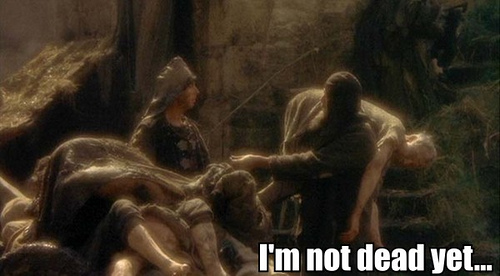
…I’m feeling much better! (Hack, wheeze.)
Thursday:

That word, “Better.” (INCONCEIVABLE!)
Thursday Night:

Also, that part where I said I wasn’t running a fever? Yeah, well, I was wrong.
Today:
Dr. B ordered a shot of prednisone and a round of antibiotics. I was actually still running a fever this morning, and was apparently a thermonuclear reactor last night when I was sleeping. Hmm.
Evidently, that repeatedly-choking-on-water thing is sometimes a sign that your tonsils have decided to annex the greater portion of your nasopharynx in the name of Prussia.
Goshdarn imperialists!
On the upside, my lungs (though fairly annoyed by the repeated coughing fits induced by my tonsils’ aggressive assault on South Pharyngia) have chosen to remain diplomatically neutral. Which is to say that they’re slightly wheezy, but we caught this before “slightly wheezy” could develop into “a goop-filled colony of Upper Tonsilia.”
Also on the upside, the medrol injection has started doing its job, which has both reduced the pain in my throat and made breathing, coughing, and drinking easier.
Provided, of course, that I don’t attempt to do all three at the same time.

Yaaaaaaaaay!

Probleme
So it turns out that my stiffness and disorientation on Saturday was the prodrome of some kind of aggressive respiratory infection. Like, mostly functional on Sunday morning, fever of 101F and raging headache by 9 PM Sunday evening kind of aggressive 

The recycled status of this picture does not make it any less accurate a representation of my current health state (so, zombie with a side of gay? or…?)
As such, I haven’t been in class all week, though I did go to a tech session for Weeds last night. We were shooting video for projections, though, so there was no serious dancing involved … mostly we hung out on various street corners looking mildly threatening, but definitely more threatening than a dance number from West Side Story[1].
- You guys, I love West Side Story, of course, but can we agree that some of the gangland dance numbers are, well, less than intimidating?
I am almost certainly skipping class tonight as well, because frankly nobody needs to try to dance when they can’t actually stand up, and none of the people in class who remain able to stand up need my germs.
C’est la vie. Sometimes you win; sometimes the microbes win.

Basically me at the end of rehearsal on Sunday. (Photo by Pixabay on Pexels.com)

Pas De Probleme
Si vous parlez français, mes chers lecteurs, and/or if you speak Ballet, you know that “pas de problème” can mean either “no problem” or “problem step.” It’s one of of those puns that never gets old, as far as I’m concerned.
Anyway, class this morning began as an ongoing pas de problème in the latter sense, since I was still semi-disoriented (I probably should have skipped the sleeping pill last night) and oddly stiff.
Eventually, my body decided to bring itself online, although my brain lagged behind and kept asking stupid questions like, “Are you sure this Sissone travels right?!”
(Yes, Brain. It begins left foot back and travels sideways. Which way do you think it’s going to go? I mean, it could be a Sissone under … BUT IT’S NOT.)
Regardless, it wound up being a semi-acceptable class, which was good, because it was packed and a significant portion of the company came today. I wasn’t at my best—my body never quite finished organizing itself—but I wasn’t at my worst, either.
I’m debating whether HRT means I should actually devote some time to intentionally stretching on the daily. I’ve felt tighter the past week or so than I’m used to feeling, but I’ve also just returned to serious aerial training and done some serious sitting down in the car (we drove to Saint Louis again, this time for a fantastic dance festival).
I suppose it couldn’t hurt to be more intentional about mobility, anyway—especially going forward, with more partnering and so forth on the agenda.
After the Jessica Lang show, D mentioned to me that he thinks I should start strength training with an athletic or personal trainer who understands dance precisely for the purpose of partnering—especially lifting other guys. He rarely makes suggestions about how I should approach my life as a dancer, but when he does he’s usually right, so I’m contemplating how to move forward in that regard. Señor BeastMode is an obvious choice, if he has time in his completely crazy schedule to take on a client right now.
On a broader level, I’m experience the weird cognitive landscape specific to once again having to acclimate my mind to changes in my body. Obviously, I’m trying to work to avoid hypertrophy as much as possible, since I don’t need to be bigger, but at the same time the influence of hormone therapy is changing the overall shape of my body.
Sometimes I’m okay with that, sometimes I’m not. I’m trying to really internalize the idea that it’s okay to be someone who is a dancer, a bottom, and also rather athletically built.
Obviously, this is a refinement of my ongoing body-image weirdness … but it’s such an oddly-specific refinement, I guess. The dancers in Jessica Lang’s company (Jessica Lang Dance, ou JLD) made me feel a little less alien, since there are several guys in JLD who are small, rather pretty, and built like the proverbial brick …. houuussse (da-na-naaa-na … they’re mighty, mighty).
I felt that this occasion called for some Commodores. You’re welcome.
Given that JLD’s choreography skews strongly towards ballet (albeit contemporary ballet[1]), and that ballet is my preferred idiom, it was nice to see boys whose bodies resemble mine (only better trained, I am forced to admit) working in a major professional company.
- …Which is fine, because it turns out that I lurve contemporary ballet.
I realize that, as far as work is concerned, this continues to amount to First World Ballet Problems. Several people who know me have pointed out that my body is not out of line with the standard for male ballet dancers; I’m on the small end and rather powerfully built, but not to such a degree that you don’t see similar guys in ballet in general. Mine is, K suggests, a Bolshoi body rather than a Balanchine body. I’m down with that. I like the Bolshoi better anyway 😉
On a different level, though, the way my body has changed, is changing, is forcing me to redefine my understanding of myself in accordance with my sexuality. I’m not a waifish little twink anymore, but evidently the kind of guys I find interesting (including my husband) are not interested only in waifish little twinks.
I don’t write a great deal about my sexuality, in part because this blog is really more or less about dancing at this point, and in part because my difficulties with it are sort of, like, Queer 452 difficulties instead of Queer 101 difficulties. This may not be true for any of you who read this on the regular or who are reading it right at this very moment, but I suspect that a lot of people who are less familiar with queer issues might not quite grok the source of my internal conflict (well, a significant portion of men might not: female aerialists, who sometimes wrestle with essentially the same problem of the disconnect between their outer Aerial Beast and their inner Dainty Girl, are likely to get it in one, so to speak).
At the same time, I get that it’s aggressively First World Problems-y to be like, “O, woe is me, I have grown up to be this ripped little mesomorph instead of a dainty little ectomorph.” Like, yeah, I get that there are bigger, more problematic problems by far.
And yet, we live with what we live with.
I should note that this isn’t a question of consciously hanging on to some kind of ideal that I know isn’t going to work with me. It’s a question of some really outdated conditioning disrupting what might otherwise be a very natural process of being like, “Oh, okay, this is where my body is going, and this is the stuff I like to do with my body, here’s where I fit. Cool.”
I feel like ultimately it will take a while and a kind of re-conditioning … maybe even some very conscious de-conditioning. That’s going to be a challenge, since the source of the conditioning in question remains my life’s most significant trauma and one that I’m still working to address.
Either way, I should stipulate that I’m grateful for my body and what I can do with it.
I should also stipulate that I’m encountering some of the typical, boring adolescent problems: acne and, um, errr, ahh, wow, there are an awful lot of very freaking hot guys in the world, did you know that? (Actually, just, like, hot people in general.) Seriously. HOW DO PEOPLE ACTUALLY LEARN ANYTHING IN SCHOOL between the ages of 13 and 18, or what have you???? Thank goodness ballet requires so much focus it’s like wearing blinkers (except sometimes, between exercises, when you’re standing there watching and your brain drifts off and is like DAMN HE LOOK GOOD, WHERE YOU GET THOSE CUTE TIGHTS BOY, oh crap was that piqué-piqué-rond or what?).
I’m not sure how to address the latter problem, and today I was really disappointed when I went to the ONLY STORE IN TOWN that reliably stocks Queen Helene’s Mint Julep Mask, which is what I use to address the former problem (acne), and discovered that they were fresh out. I got some other mask that is reasonably acceptable, but it turns out that Amazon carries Queen Helene, and it comes in a tub. The tube version is fine, but a little hard to manage one-handed when you’re languishing in the bath with a good book, so since the price is right and so forth I think I’m just going to order it from Amazon from now on.
On the upside of the whole acne thing, my skin has decided to be way oilier than it used to be, and not to be as ridiculously dry as it has been for basically my entire life. That is a welcome change, to say the least.
oh h*ck
Somehow, I had become convinced that the LexBallet intensive was in June (even though it has always been in July) and that PlayThink was in July (even though it has always been in June—my sister’s birthday coincides with it every year), and EVEN, even though I made widgets for this very blorg that list the dates.
Needless to say, knowing that The Time Is Almost Upon Us has me, as they say, a little shook.
Mostly because, for the first time, I’m teaching a workshop, and I haven’t even given said workshop a test drive like I meant to (because Golden Retriever Time, y’all).
![How can it simultaneously be both NotNow and Now????!!!!! [Photo by Tookapic on Pexels.com]](https://i0.wp.com/danseurignoble.com/wp-content/uploads/2018/05/animal-dog-golden-retriever-9716.jpg?ssl=1 "animal dog golden retriever")
![Wasn't it just Christmas like 5 minutes ago???!?!!?!!111oneoneone [Photo by Leah Kelley on Pexels.com]](https://i0.wp.com/danseurignoble.com/wp-content/uploads/2018/05/pexels-photo-776373.jpeg?ssl=1 "golden retriever")
Anyway. I think it’ll be okay, but my Imposter Syndrome is off the charts with regard to teaching. I’m like, HOW CAN I TEACH, I DON’T ACTUALLY KNOW ANYTHING??!11

Except what a foot is. I can identify a foot.
I’m sure everything will go just fine and nobody will die. And if anybody does die it will probably because Kentucky is ridiculously hot and humid in June and not because I’m a horrible, incompetent danseur and should never be allowed to teach anything, ever. But I hope nobody dies even then because that would really probably put me off teaching for a while (because I’m horribly superstitious deep in the cockles of my heart).
Regardless, I have a Plan (and not just a Goal) for the workshop and a 2-hour window in which to accomplish that plan, so I’m pretty sure it’s going to be okay. I’ll just, as Señor Beastmode likes to say, Stick To The Plan. Unless the Plan proves completely useless, in which case I’ll throw it out the window.
In case you’re wondering, the exercises I’m planning to use will be sequenced as follows:
- The Little Dance
- Invisible Catch
- City Streets (Solo Version)
- City Streets (Eye Contact Version)
- City Streets (Touch Version)
- Flocking (North, South, East, West)
~ - Mirroring (into Touchless Partnering)
- Leaning In
- Leaning Out
- Weight-Share Shape-Building
- Lean Tag
- Basic Dynamic Weight-Sharing
~ - 5-Minute Dances
- 5 minutes to draft a dance
- Brief showing (music: random)
- 20 minutes to revise
- Final Showing (music: random or dancers’ choice)
A lot of this is stuff I’ve learned from Pilobolus—stuff that I feel very comfortable doing, but possibly not like I have the earned authority to teach it. …Which is hilarious, because I’ve taught all of this at various points, with the exception of 5-Minute Dances, which is something you more facilitate than teach.
Ironically, I feel least qualified to teach in the dance idiom I practice the most (ballet) and most qualified to teach in the one I practice the least (modern partnering improv).
I would say that I’m not sure what that says about my faith in my practice, only I am: what it says is that ballet is a highly-technical, rigorously codified idiom, and teaching it incorrectly can really screw someone up. When I talk about the technical aspects of ballet, people routinely tell me I should teach—but I think it’ll take a few more years of learning, performing, and choreography…ing before I feel qualified to teach ballet.
I also need to start rehearsing “…Lover Boy” in earnest, because I haven’t really given that enough time.
Lastly, I need to NOT TAKE ON ANY MORE PROJECTS RIGHT NOW. I’m booked to the gills all summer, which came as something of a surprise even though in retrospect it seems fairly obvious that that’s what happens when you take two contracts and then load freelance gigs on top of them 😛
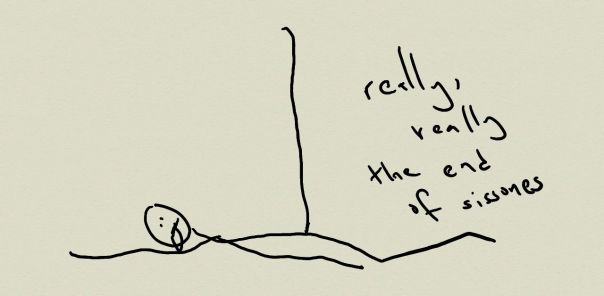
How I’m going to feel by the end of summer.
Not to say I won’t take a ballet job if someone hands it to me, because, you know, ballet.
But still.

Lean In. No: More.
I mean, like, literally.
I’m talking about weight-sharing, here.

Weigh(t)ing in on the question of relationships?
When you weight-in, you pour your weight into your partner, who pours their weight into you. Ideally, you should find equilibrium: you’re not pushing Terry* over, and Terry’s not pushing you over.
*Our gender-neutral partner du jour
When you weight-out, it works the same way, except instead of pushing, you’re pulling.
This is the lovely thing about weight-sharing: it’s a style of partnering that depends on both partners carrying their share of the weight. If you’re distributing the load equally, you can do all kinds of crazy things that way.

Like this thing, which we’d be doing better if we were weighting-in correctly.
The piece I’m setting to Barber’s “Adagio for Strings” (I’m kicking around the idea of calling it “Tenebrae”) combines traditional ballet partnering and weight-sharing, which makes for some interesting transitions: early in the piece, we fold from a shared arabesque en fondu through a moment of weight-sharing into a ballet-standard supported arabeqsue.
The challenge for K, as a ballet dancer who hasn’t worked in a weight-sharing modality before, is surrendering her weight into me at moments that it feels really counter-intuitive. She has the hard part of that move: basically, all I have to do is reach back with my free leg, set the foot on the floor, and get my arms to the right place at the right time so she can use them for leverage at one point in her end of things.
She’s tasked with the bizarre challenge of yielding her weight to me as I recover from the arabesque, rolling into my lap without bringing her working leg down, then fouettéing back into an arabesque.
She pretty much got it from the word go, which blows my mind. At first she wasn’t quite getting enough of her her weight down into me in the middle of all this, but it’s getting better and better. The fact that she springs right back into the traditional ballet mode with no difficulty is amazing.
Regardless, the more she pours her weight into me as we sit back together, the easier the transition is for both of us.
Anyway, the piece is going well. We’re well into the third minute of the dance. I’m not sure about the exact time because the last run we were behind the count and I left out a phrase that I’m pretty sure I want to keep. Regardless, given that we’ve put in about 2.5 hours, I’m very happy with how much we’ve built.
There will, of course, be some rebuilding involved once I start setting this with a larger cast—not least because right now we have the entire stage, and we use the heck out of it[1].
- Though, in fact, I need to dial back my travel … the space in which we’ll be showing it is smaller than the studio where we’re rehearsing, and there’s one point at which I’m not only off the stage but probably outside the actual building XD
We’ve started taking video of basically everything, because I have this habit of finishing the part we’ve already worked and starting right into the next section, and it can be hard to remember what, exactly, I did sometimes. Most of the piece is pretty clear in my head, but where it’s vague, I tend to just let the music drive and I, like, forget to remember.


Couple more for posterity 😉
This week I have one more rehearsal for this piece, plus one for Thursday’s show (ArtWorks) and about a million for Weeds, in addition to the usual class schedule.
Class, overall, is going well: I’m working on relying more on my inner thighs, working from my back down through the floor, and trusting my balances.
Oh, and also not doing dumb things with my hands or letting my shoulders creep into my ears when things get complicated. That, too.
Progress
On Monday night, JMG said to us, “Bring your back with you!” as we launched a waltz terre-a-terre. This clicked right into L’Ancien’s note from a couple Saturdays back, and the combination made for a really lovely run: the kind on which even I caught sight of myself in the mirror and thought, “Okay, this boy looks like a dancer.”
I also found the heck out of my inner thighs during that combination, which had a bunch of soutenus that finished in long sous-sus balances. They just basically cranked on automatically without the glutes overpowering them, which was lovely and yielded a hella steady sous-sus.
Last night, during modern class, I worked on continuing to use my inner thighs in relevés, especially when working in turnout. It’s making my balances quite a bit more stable.
Today we had JMG again, since Killer B is away with some of the kids at the SERBA Festival right now. We had a fairly large, lively class: my favorite kind.
I wasn’t on my A game—I somehow managed to make it out of the house without taking either my nasal decongestant or my Adderall, which should give you a general idea of where my head was (or wasn’t?)—but I was, at any rate, on my B game. I didn’t feel as strong as I did Monday night, but I did feel reasonably strong. I didn’t add beats to anything, but I did throw out an awfully nice saut de chat during the grand allegro.
Regardless, it all felt like progress: like my fitness is finally almost back where it needs to be, especially where endurance is concerned. I feel stronger. My turns were stable and my jumps were light and high (except when I was busy hosing up the second petit allegro because, for some reason, I blanked on the world’s simplest combination: glissade, jeté, glissade, jeté, coupé over to chassée, chassée, chassée-assemblée.
Like, seriously, how do you even get lost in that combo[1]???
- I’ll tell you how: you THINK. I was busy thinking about my arms, and things got weird in legtown, and I failed to change the orientation of my hips on first side/first run, and everything went to Baby Giraffeland for a hot minute.
Some of the gains in fitness and strength almost certainly have something to do with the fact that I finally started hormone replacement therapy three weeks ago, and that’s probably starting to make a difference at this point.
I’m taking a fairly low dose, so it’s not going to result in Superhuman GAINZ!!! (which I don’t want: I am muscly enough, thanks)—the goal is basically just to be pretty much normal, instead of functioning with effectively no sex hormones at all. The upshot, however, is that it should somewhat increase my red blood cell count, which is useful for oxygen transport, which is useful for ballet (and for dance in general).
It will probably also make me a bit stronger, which is also useful for ballet (and for dance in general). I’m not sure how much stronger, though, to be honest: I’m not training for massive gains in strength—gaining strength has never been particularly difficult for me. I intentionally chose a low dose in hopes of avoiding unnecessary hypertrophy. I already put muscle on really easily, which isn’t necessarily helpful in many dance contexts (Pilobolus and its relatives are exceptions: compared with a lot of Piloblus’ guys, I’m a slender little wisp of a boy).
Speaking of Pilobolus, it turns out that my rehearsal and performance schedule this summer means I won’t be able to do most of Pilobolus’ summer intensive after all. I’m planning to go up for teacher training, however, since it’s a single weekend and scheduled when I don’t happen to have any shows.
Speaking of progress, it still really utterly blows my mind that I’m doing all this stuff at this point.
It’s amazing what the combination of focus and opportunity can create.
In May of 2016, I was in the middle of a post-baccalaureate redirect.
Last May, I was involved in my first professional work: just one full-scale show and a piece for PlayThink, but every career has to start somewhere.
This year, I’m doing all kinds of crazy stuff.
To an extent, this happened because I’m focused and dedicated and have a reasonable degree of natural aptitude for dance. Mostly, though, I’ve had amazing opportunities.
Focus doesn’t mean anything if you can’t afford to take class; if you can’t find good teachers who believe in you; if there aren’t any professional gigs to audition for or if your life prevents you from taking jobs if you audition successfully.
I’m blanking on who it was, but not long ago I was listening to a podcast in which a successful actor talked about how she got where she is. She recounted moving to LA (or was it New York? Argh, I’m horrible at this) as a young adult—in short, going where the opportunities in her field were—but offered this extremely-sage advice: “Move to LA, but have a sponsor—someone to pay the phone bill while you’re working your way up.[2]”
- I’m sure I’ve hosed that quote up pretty well. Sorry 😦
Her sponsor was her mom. My husband has been my primary sponsor—but I can’t overlook the fact that Pilobolus gave me a scholarship; that Suspend has offered me a substantial discount from early in my training; that LBS created a flat-rate tuition plan that lets me take every single class in the open division program.
BG has consistently given me feature choreography in our Showcase pieces. Killer B and BW have dusted me off when I’ve come back from auditions with a bruised ego. K and BB have believed in me when I wasn’t yet ready to believe in myself. M bumped me up to Trapeze 3 when I’d only been training for six months or so.
I’m grateful for all of that sponsorship, direct and indirect, tangible and intangible.
There’s another piece of magic involved, there, also: when so many people have invested in you, whether tangibly or intangibly, you feel a responsibility to rise to the level of their belief.
That helps you keep moving forward when things get sticky.
I’m looking forward to seeing where the next year takes me: that, too, will depend on a combination of my own efforts (gotta go hit those auditions, amirite?) and others’ willingness to invest in me.
Impostor Syndrome is less of a problem than it was a year ago. I hope that as I continue to move forward, it will continue to fade. I’m sure I’ll always feel a little bit like an impostor, especially given that I’ve taken a wildly nontraditional path towards a career in dance—and I hope that I’ll never let it really stop me.
I mean, yes, it gets in the way: but it’s like a lot of forces in the universe. Gravity is a jerk, but you ride your bike up big hills anyway, even as your legs insist that you can’t.
Impostor syndrome is a jerk, but you go out and audition and create dances and teach anyway, even as your brain insists that you have no right doing so.
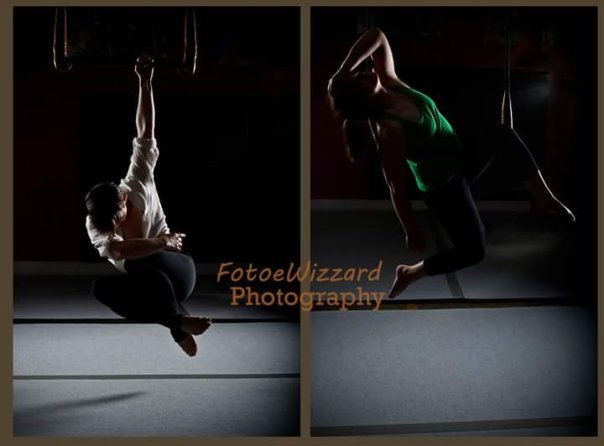
Gravity is a jerk, but in the end we win. A little preview from Monday’s session with Kevin Spalding of fotoewizzard photography: “Solitude,” (c) 30 April, 2018. That’s my friend Amy on the right, btw.

shows and stuff and things
On Saturday, a bunch of us from only weeds will rise in winter descended upon Churchill Downs’ opening night Fund for the Arts gala to perform excerpts from the show in pop-up form.
It went well (though I was a complete disaster on Sunday because I got dehydrated :P). We were a tad awkward at first, but as the night went on we got things nailed down and started tacking on a long-form improv after the set choreography. That just got better and better: the last round was awesome, even if almost no one was left to see it!
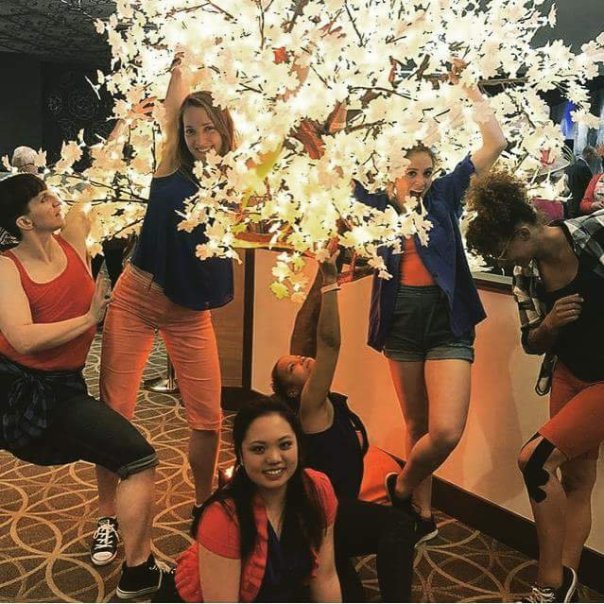
We also demonstrated that modern dancers don’t have to be so hecking serious allataimz.
Anyway, I’m feeling more and more confident about weeds, even if I was a complete PITA[1] to our choreographer-director on Sunday (sorry, AMS!).
- I was having an exceptionally difficult time with receptive language processing, but didn’t realize it ’til after rehearsal was over, so I was constantly screwing things up and being mad at AMS about it. Ugh.
In other news, I’ve started working on choreography for my PlayThink piece, and I think it’s going to be quite cool indeed. A friend of mine might be joining me, which would be even cooler. There are parts of it I can’t do very effectively in my house (too many obstacles!!!), but the performance takes place at an outdoor venue that doesn’t have a fancy floor, so now that it’s warm I can practice it in my back yard.
I’m hoping to have settled a group of dancers for shadowlands or whatever I’m calling it soon, because SUDDENLY IT IS ABOUT TO BE MAY WTF.
I am so not good at recruiting people, and really really not good at recruiting people when I have no idea where I’m going to take them to rehearse. Blargh.
On the other hand, L and I have come up with some really solid choreography for the CL/UofL collabo show, so that’s going quite well.
We also just launched rehearsals for the SPA show, which is going to be amazing.
Obviously, my schedule is completely wack right now, and I’m trying to learn how to eat and sleep in the midst of it. What works best food-wise, of course, is simply to cook a couple of huge batches of whatever when I happen to have time. Sleep-wise, on the other hand … eek, who knows?
So that’s it for the moment. Class notes later probably?
Topless Boys Live: Seven(?) Months Later
So it’s been, heck, like seven months or whatevs, and I haven’t updated the Topless Boys Live series in a bit.
Anyway, here’s where things are, with the new glasses as well (no special reason, just hadn’t put my contacts in yet).

Evidently I was bored with life this afternoon? Also, this angle makes my head look tiny.

These scars act like a warm-up indicator: they show more when I’m cold. They’re fairly faint on this side, now, except that weird little fold under my arm where the drain was.

They don’t show much under direct light, either.

Because dancers gonna dance.

I didn’t mean to include only my right side. I just like how my shoulders look in this one.

There are two little spots on the left side where I got itchy, scratched off the tape early on, and wound up with irritation that led to a slightly different scar type. These are still kinda pink right now, but they’re my usual hypotrophic scars. They’ll eventually turn white. I’m not worried about them.
I am also finally getting some definition back after several months of feeling podgy.
The most interesting thing about these scars is that the scars themselves are now thin, whitish lines–healing of some kind is still going on simultaneously alongside them, so my skin is a little pinkish there, especially when I’m cold.
I’m used to the way my body feels, but maybe not to liking the way I look. It still surprises me how much I do like how I look most of the time.
Long day tomorrow: class, rehearsal, different rehearsal, performance, different performance. Class starts at 9 AM; second performance ends at 11:30 PM.
Tonight, though, I’m going to go review choreo for an hour or so, then come home and crash.

How Much Do You Stretch?
I get this question a lot.
That and, “How long did it take you to get your center split?”
The answers are, in short, “Very little, in any formal sense,” and, “About two seconds.”
There’s an assumption among dance students that work is the great equalizer.
That assumption is largely correct—and yet it doesn’t mean that individual variations in innate ability do not occur, or that enough work will overcome all of them.
Most human beings will never achieve a center oversplit. This isn’t because they won’t work hard enough, but because they have normal human pelvises that don’t allow it.
Many human beings will never achieve a even a full center split, in fact.
The center split may be the least malleable feat of flexibility. Unlike the front splits, which simply extend the natural range of motion of the average human hip joint complex, it is enormously dependent on genetics. Even early training exerts only a small degree of influence, as far as I can tell. A full center split requires both soft-tissue flexibility and unusual hip sockets. One is amenable to training; the other might possibly be very slightly amenable to rigorous training at an age at which most children’s parents are much more concerned with basic skills than with the potential eventuality of flat center splits.
I don’t think the group of human beings who have center oversplits is very large. Even though I move in ballet and cirque circles, I can count the examples I know personally on one hand with fingers to spare. And that’s counting myself.
In short, the same characteristics of the hip socket that give us the required range of motion also make us unusually prone to hip dislocations (upright bipedalism a harsh mistress).
Back in the day, a dislocated hip was almost certainly a good way to get eaten by the nearest predator (or otherwise eliminate yourself from the gene pool), thus greatly reducing the likelihood of passing on the genes that allow for extreme hip flexibility. In short, center oversplits are maladaptive in an evolutionary context, and thus exceedingly rare even though we’ve largely decoupled ourselves from natural selection pressures (though it would be interesting to see where we stand in another hundred thousand years or so).
~
So often in Western culture, we equate talent—that is, raw, innate ability —with virtue.
This tendency may be at its most visible in the movement arts: professional training selects for people who both possess innate ability and who work hard, but it’s the innate ability that the average person-on-the-street cites: “Wow, she’s so talented!”
The phenomenon of TV talent shows hasn’t helped. So often, the word talent is right there in the title: America’s Got Talent. It’s too easy to conflate the rocket-to-stardom modality with the myth of talent.
From Algeria to Zimbabwe, successful …Got Talent competitors work their butts off (or, in the case of dancers, on) to make the most of whatever measure of innate ability they have—but we see only the five minutes or so that they command the stage in each episode, unknowns to the public at large. They appear to emerge fully-formed, replete with the armor of their art, from the foreheads of the judges.
It’s too easy to ignore the work and sigh, “If only I was that talented!”
But it’s also too easy to fall into the opposite camp, which discounts innate ability entirely.
~
There’s a familiar impasse that one encounters if one sticks around long enough as an adult ballet student to reach a fairly advanced standard of training.
Newer students admire your talent and/or your work ethic—and then they ask you how they can learn to do the thing you’re doing with such ease (or, at any rate, apparent ease).
Most often, you can truthfully answer, “Work your tuchas off, take class with these three instructors, make three classes per week your bare minimum, and you’ll get there sooner than you think[1].” You can even gently guide the ones who want the results associated with setting ballet on the front burner without having actually done so. Sometimes this means helping them discover for themselves that they love dancing, but are really just there to have fun, and aren’t actually going to prioritize it enough to make the kind of progress they want (at least, not in the timeframe they’re imagining). Sometimes it means helping them give themselves permission to front-burner ballet.
- This last bit is pretty specific to adult students, who mostly seem to expect everything to take longer than it actually will. Kids can be very much the opposite.
Yet, sometimes, you’re forced to formulate on the fly an answer that gently conveys the idea that no matter how hard they work, their feet aren’t going to look like yours, because your feet are the result of a serendipitous confluence of genetic traits polished by work, or that they’re probably never going to nail a flat center split because their hips aren’t arranged in a way that allows for it. To say, in short: “I don’t have these feet because I’m a professional dancer. I’m a professional dancer because I have these feet … or, well, partly, anyway.”
The challenge, then, is figuring out how to explain the complicated ratio of talent to hard work—that, for the most part, hard work matters much more. It’s mostly at the highest levels (particularly in companies with very specific ideas about how dancers’ bodies look) that both hard work and talent matter almost equally: to dance for ABT or the Royal Ballet or the Kirov, one needs both in almost superhuman doses. Talent alone is certainly not enough, but hard work alone won’t do it, either.
And, then, even at the highest levels, dancers acknowledge that talent is distributed capriciously. Nobody gets it all, in part because some of the genetic gifts associated with success as a dancer (qv, those incredibly mobile feet and ankles everyone wants) actually make technique harder. Every dancer with beautiful feet can point to some other part of her body and say, “Yeah, but…”
~
As kids, we’re often given the impression that talent is everything. American culture is flush with fictional stories of raw, undeveloped talent that is miraculously discovered and immediately transported to the upper echelons of artistic success. That model sells, and fits in the with fairytale mode of instant transformation that colors so much of the media we market to children.
The downside is that, too often, this means talented people feel like they don’t have to work that hard. Vexingly, there are even some points at which this is true: I don’t really work on flexibility, for example[2].
- I work on its opposite: strength. A couple weeks without calf raises, and the mobility of my ankles makes one-foot relevé balances beastly hard.
Worse, it can create the impression that a lack of exceptional talent means one shouldn’t bother. This is also fundamentally untrue. The world is full of professional dancers who began with average measures of everything but the motivation to work (not to mention their sublimely-talented peers whose motivation led them to leave ballet). They may not be dancing at the Kirov, but they’re certainly dancing in your local company.
Although the ballet world is full of talented late-starters like Copeland and Hallberg, none of them owe their success to talent alone or even primarily. They are, to a person, incredible workers first and foremost. BW came to ballet very late—but his success owes in no small part to the fact that he does sixteen turns after every class, trains in ankle weights, attends to every detail fastidiously, and simply works like the world depends on it.
And yet: he’s tall-but-not-too-tall, physically beautiful, and gifted with hip mobility equal to mine.
His work is devoted to improving what is already a very fine instrument. His work will probably take him farther than mine does—in part because he actually does work harder than I do, but also because he’s taller than I am (but not too tall). Perhaps it shouldn’t matter, and perhaps at some future time it won’t—but right now it’s a matter of course that ultimately a principal dancer is by default a prince, and we imagine that the prince should be tall and regal. Someone of my middling height and middling talent (as compared to the range of professional dancers, rather than to the population at large) might be Seigfried at Backyard Ballet Theater, but never at PNB or ABT, even if I hadn’t taken a long break from dancing.
~
I should say that I’m not bitter at all about this. I would never in a million years complain about being asked to dance Seigfried or Albrecht or Cavalier (though, like, couldn’t he have a name, y’all?), not least because I love partnering and the princes get almost all the most tender, most beautiful pas de deux.
But give me, any day, the fireworks of the Russian dance, the simmering sensuality of Arabian, the aerial grace of Bluebird, or the wild abandon of Le Corsaire’s famous slave. Give me the corps part I danced last year in Orpheus: a mad, sensuous, pyrotechnic demon of the shadowy depths. Give me the ridiculous athleticism of the peasant pas in Giselle (two very, very long passages of balls-to-the-wall balletic redlining jammed into a lively pas de deux).
It is to these peripheral roles that I’m best suited both by temperament and by physical aptitude. I don’t begrudge the lack of lofty height that will mean I only ever dance Prince What’s-His-Name at summer programs and if all of the taller guys at Podunk Ballet simultaneously come down with flu.
Ultimately, part of becoming a dancer is accepting your limitations.
BG will be the first to tell you he has biscuits of the highest order: but then he’ll show you his carriage, his élan, and his ballon.
BW explained to me the downside of our shared extreme hip mobility: we work twice as hard doing turns in second, for example, because we have to use our muscles to hold ourselves together where other dancers can rely on their bones to do much of the the work. My flexibility, in fact, means I’m prone to dancing like a slinky.
In the grand scheme of things, whether or not you have a center split means less than whether or not you know how to work with what you’ve got.
I don’t stretch very much because the last thing I need, as a dancer, is looser joints. I have a center oversplit because I’m a mutant with an unstable pelvis.
I’m not a dancer because of either of those things. I’m a dancer because the only thing I really want to do is dance, and because I’m lucky enough to be in a position that allows me to apprentice myself as I’m doing now in professional jobs that pay only intermittently. I’m a dancer, in short, because I dance.
This isn’t to say that I my body is not an advantage. It is. I do no one any service by saying otherwise.
But in the end, it’s top-dressing.
If I’m auditioning and my only competition is a physically-similar dancer with the same degree of training and the same work ethic but a body that’s not quite as purpose-built for ballet, there’s a fair chance I’ll come out on top. Give that other dancer a year or two more training or a work ethic comparable to BW’s, though, and my edge vanishes.
Which is all a long-winded way of saying this:
Don’t worry too much about your center split. You might never have one.
If you want to dance, that’s almost never the deciding factor.
Worry instead about your training and your work ethic. If you’re feeling unmotivated, figure out why and how you can hack your motivational system to work around it (concrete goals work for me; an upcoming show works better than anything).
Ask yourself, in the words of the British rowing team, “Does it make the boat go faster?” If it doesn’t, find a way to put it aside. Come back to it later, maybe: but know that later on it might not seem so important.
Know your weaknesses, and work on them within reason: but not at the expense of knowing and honing your strengths.
Ballet is too hard to spend time and energy making it harder.


 danseur ignoble