Blog Archives
Danseur Ignoble: It Helps If You Can Breathe
12:15 class today with Ms. T. I haven’t done her class in ages (Claire used to teach the noon class on Saturday), so it was a new experience. I also haven’t done the 12:15 Saturday class in over a month, so that was cool.
While the 12:15 class is billed as a beginner class, like most it gets adjusted based on who shows up; today, we skewed towards the intermediate level, particularly at the barre/
I’d say that our work at center and across the floor was more advanced-beginnery — which is to say that we didn’t do 360-degree promenades in attitude or arabesque, anything with pas de Basque or balanceé as linking steps (you guys, I absolutely and irrationally love pas de Basque; it’s one of those steps that just feels like dancing), or any combinations with different flavors of turns.
Anyway, I forgot to tape my toes and forgot to take my nasal spray. The latter of these was the worse oversight: my nasal spray keeps my whole nosapharynx open, and my allergies are on high alert today, so breathing became a challenge towards the end.
Barre was iffy at first (my plies felt inelastic, and it took me a while to get my head in the game), but the last half of barre was pretty good, and I felt pretty solid at center and going across the floor.
We did some nice adagio at center (with promenades at passé, which are comfortingly easy at this point) and then a really pretty traveling combo in waltz time that went:
Prepare (B+, port des bras);
Tombe
Pas de bourré
Plie fourth;
(Long) Passe balance
Tendu back;
Tombe
Pas de bourré
Plie fourth;
Single (slow) turn en dedans
Tendu back;
Tombe
Pas de bourré
Plie fourth;
Double turn en dedans (or triple if you were that one guy with the awesome turns);
Pivot
Soutenu turn to fifth
Plié;
Chassee to 1st arabesque en releve
Allongé
(Faille implied.) Run away!
I wanted to say that the tempo was fairly moderate, so there was lots of room for expression, but when I tap it out on my mobile metronome it’s about 130 BPM, which is squarely allegro.
Maybe it felt slow and easy because we did a really fast grand allegro combo on Wednesday. I mean, like, we ran it first at a tempo that was also squarely allegro, and then at about twice that speed. Woof.
Anyway, today it felt like we had plenty of time and room going across the floor and weren’t rushing to get from one step to the next.
I was on the rear point of a triangle with its front line made up of two people who were shorter than I am, so I kept having to moderate my travel so as not to gallomph into them or become unsynchronized. That’s a useful exercise, though, as being able to maintain spacing in a squadron of differently-sized dancers is an essential skill.
That said, triangles usually go point-first in ballet, don’t they?
I got through the first set of little jumps before my toe started to feel iffy. I skipped the second set, which made me sad — dangit, I wanted to do entrechats! I also skipped grand allegro today, just in case.
Not being able to breathe very well didn’t help. Everything feels about twice as difficult when your air intake is clogged.
It’s mostly, I think, that when you get even a little winded, it’s hard to get enough air to recover properly.
Instead of getting a little winded, recovering, getting a little winded again, and recovering again (which is a normal pattern during certain parts of class), you get a little winded, get more winded, then get even more winded. By the time you make it to the end of the first set of little jumps, you sound like a freight train and feel like your head and/or heart are going to explode.
That said, it’s not like this is a new thing for me. I have had nasopharyngeal issues as far back as I can remember — I’m just usually better at making sure I’ve dealt with them before class.
So, yeah. Nice reminder today about why I take my nasal spray before class.
I think next week I’ll swing for all three intermediate classes (M,W,F) and the 12:15 class on Saturday, which Brienne is teaching, though I may do evening class on Monday (Brienne is teaching that, too).
Brian is back to teaching the following Monday, which will be awesome. On the 14th, Wednesday AM class will be taught by the instructor who teaches advanced classes, so I’m rather looking forward to that as well.
Anyway, that’s it for today.
Never underestimate the importance of breathing 🙂
Danseur Ignoble (Again!): A Teaching Tip I’m Totally Going To Steal
Tonight, I went and rocked out Ballet Essentials (even though The Divine Ms. M playfully scolded me: “What are you doing in this class? You should be in the other class!” I explained I was saving my toe against Wednesday’s Intermediate class).
We had a raft of new dancers and a lovely, simple barre. At center, we worked the basic port-de-bras and positions of the feet, then did chassees (a droit, a gauche, et avant), then did a little combination in two versions: a simple “chassee avant right, chassee avant left” for the really new folks or a swift-traveling polka for those who had been dancing for a while.
You guys, I love polka (if you’re wondering, here’s a basic example: chassee avant right, hop [kind of a saute passe, really], chassee avant left).
Here’s the thing, though, that I’m going to steal: after everyone had traveled across the floor, Ms. M asked even the newest students to try the polka step — and then she said, “Imagine that you’re Clara in the party scene of the Nutcracker — or, for the gentlemen, that you’re Fritz. Get into character!”
At the same time, she demonstrated the characteristic steps for each part.
Suddenly, everyone had permission to play, to perform — and we did.
When you’re teaching adult beginners, especially, there’s a kind of play barrier that you have to knock down. Adults feel as if they must master technique, and they focus on it so hard that they forget to play and have fun and pretend to be Clara or Fritz.
You guys, I have to tell you — everyone in that room looked a hundred times better immediately once they jumped on that bandwagon. Even me.
I got my Fritz on. I thought about the character, about embodying that spirit of Sassy, Irritating Little Brother-ness (because, frankly, that’s a role I know pretty well; I’ve only been working on it all my life) and about how sometimes when you’re a little sibling, you do this thing where you both mock your big sib and show off at the same time. And then I danced that, and it looked cool.
You guys, it was fun, and I think we all enjoyed it.
So I’m going to remember that, and I am going to steal the heck out of it. Talk about “one easy trick!” It’s a nifty workaround to get adults to lighten up and enjoy themselves.
Which, of course, leads to better-looking ballet, for all the reasons I mentioned earlier today.
Danseur Ignoble: Regaining Lightness
I am still ruminating on Saturday’s class, even though I am planning on getting off my butt and going to Monday evening class in a little while.
I mentioned doing flying chassees and sautes at the end of class. What I didn’t mention was the feeling of those chassees and sautes: light, airy, bounding, nimble, mobile. Bouyant. Even when I glanced at myself in the mirror (and in spite of the fact that I was obediently doing them hands-on-hips, since it was Cultural Pass day and we had a bunch of completely new dancers in class and I didn’t want to confuse anyone), they looked fluid and graceful and light.
You know.
Like dancing.
A lot of that came from the moment at which I suddenly realized, “Oh, hey, I can do this again!” I felt free.
I’ve been struggling, lately, with feeling like my dancing is heavy, leaden — like I’m making it happen instead of letting it happen.
On Saturday, I somehow miraculously was able to let those passes across the floor happen, and so they happened beautifully.
So there’s a reminder: you can’t regain lightness by forcing it. You can’t capture lightness by grabbing it with your hands and dragging it down. Instead, you have to let yourself spring into its air.
I once heard someone say that the hardest part of flying is letting go of the ground. I think that’s probably true in ballet: dancing is a limited form of flight, and the hardest part is achieving ballon (okay, and grace, expression, musicality, ligature, and aplomb).
The rest is just technique (Ha! Record this as the day that I used the phrase “just technique,” would you?)
The thing is, without ballon (and all those other, less-effable things), technique itself is inert. We do not pack the house to watch people do dance steps — we pack the house to watch dancers dance.
If someone flubs the technique a little, but carries it off and makes it look good, most of us will never now (the exception, of course, being those of us who know that variation, or that specific dance, by heart).
If someone executes perfect technique but lacks grace, ballon, and expression, watching loses some of its savor.
If you want an exceptional example that’s not ballet-specific, watch the womens’ artistic gymnastics floor exercises from the London Olympics back in 2012. The Americans brought some stellar technique to the floor, but the Russians — whose training places much more emphasis on the importance of dance — looked a thousand times better.
Why? The Americans simply moved from trick to trick; their dance elements looked like afterthoughts. The Russians combined the whole shebang into coherent choreography; their linking movements (for which they receive almost no points) were as important to them as the individual technical fireworks that scored the points.
In short, and in ballet terms, the Russian gymnasts had élan; the Americans didn’t. The Americans had great technique — an American won, because gymnastics is not ballet — but the Russians were simply captivating.
So. Yeah. This actually wasn’t supposed to be a screed about the relative importance of technique and expression, or what have you, but there it is. As someone who enjoys precision, it’s something I need to revisit from time to time.
Precision is important, but it isn’t the soul of ballet.
Homemaking: Kacy Is Your Friend
…And she’s awesome.
Five years ago, author and blogger Kacy Faulconer wrote a great post called “Obvious Tips For Not-Very-Good Homemakers.”
Tonight, I read it … and then its sequel … and then the sequel to its sequel.
The tips themselves are great (if, yes, sometimes pretty obvious: but, honestly, even if they’re things you already know, it’s pretty validating to know you’re not the only adult who occasionally calls upon the power of Pigs in Blankets) in a way that will make perfect sense to anyone who thinks a cookbook called Cooking with ADHD is a good idea — but it’s Kacy’s tone of acceptance and cameraderie that really makes it work.
It’s like a friend or a sister or a cousin saying, “Okay, guys and gals, we’re in this together. We kind of suck at this, but we’re doing it anyway, and it’s okay.”
…And also:
He didn’t become Gandalf the Citrus Moderne Dot, did he?
— Kacy Faulconer
Because, seriously, he didn’t. Because he knew he was going to have to get orc blood off dat shizzle, and you can, as Faulconer points out, bleach white.
My own education as a half-baked homemaker has been very much about giving up on visions of making my own laundry detergent and growing my own vegetables, then embracing my limitations (and strengths) and learning to work with them.
I may not grow my own vegetables, but I turn vegetables that we buy into a mean set of no-sugar-added breakfast muffins every single week, because I not only know how to do that, but like doing it (because I do it well, so it makes me feel good, so I do it more, which makes me even better at it, etc.).
I may not make complex gourmet meals every single day, but just about every evening I do cook a meal that my husband enjoys (fortunately, he is a man of simple tastes, and doesn’t object to a regular rotation of variations on Freezer-Marinated Chicken with occasional forays into Things Made From Ground Beef).
I may use a lot of workarounds, but little by little I’m learning to get stuff done.
That’s the spirit that Faulconer’s blog embraces, and I feel like it’s a spirit whose time has come. So go read her!
Oh, yeah — in other news: did Essentials yesterday morning; was able to crack out the flying chassees and a couple of sautes without my toe falling off or swelling up like a ball of bagel dough. This definitely feels like progress. It also didn’t give me any real trouble today, just the generic “Hey, I’m still healing a little” soreness that has become its temporary new normal (for a while, it was fiercely sore the day after class even if I didn’t do releve work or jumps).
We’ll see how it goes tomorrow.
My mood is hanging in there, somewhere in the neighborhood of the Upper Doldrums. It’s not approaching “good” yet, but it’s at least more tolerable. I am more able to ignore Bad Thoughts (admittedly, by playing Bubble Wars or baking, but still…) when they arrive (but they’re still arriving).
The upside of my current mood? Holy cow, I have never been this productive in the kitchen. I mean, I have reached a point in life at which my kitchen is basically under control (I’ve even started weeding out unnecessary kitchen things and relocating or offloading them). I like being there, I like working there, and our dishwasher died, so now I just wash the dishes by hand and everything stays sorted.
The downside?
I don’t know. Is it bad to have 24 carrot-pineapple-coconut-raisin muffins hanging around?
Back … ish.
(That wasn’t actually intended to be a play on the title of the TV series Black-ish, though that seems to be a fairly thoughtful sitcom, as sitcoms go, from the tiny bits I’ve seen of it.)
So I’m back on my meds (huzzah!) as of this afternoon and, as such, improving in terms of overall function … which is good, because the drain in our kitchen sink chose tonight to explode, and I would have had a flat-out meltdown about that if it had happened yesterday. Fortunately, I married McGayver, who can fix that kind of thing.
I’m doing the job applications thing and it’s going well — had an interview this morning for a position that sounds like pretty much a lock (unless I’ve been convicted in absentia for some kind of crime I committed in my sleep?), though it turns out there are no seasonal positions open ’til September. I could have started next weekish as a permanent employee, but it wouldn’t be terribly convenient for the company, as I’d have to run off for two solid weeks for Burning Man.
Unless I find something that’s really relevant to my studies and/or sounds really compelling, I’ll probably take that job in the fall. It sounds like a good fit for what I want right now — an active, rather than a sedentary, workplace; decent pay; hours that mesh nicely with ballet. Shouldn’t hurt the fitness bit, either.
I’ll need to finally get an actual driver’s license, since the job in question may potentially involve actually driving, but that’s in the plans anyway.
I’m still working for Denis’ Burning Man project and feeling ever-more-useful in that regard. Tonight I set us up with a G+ page, even though I still feel kind of iffy about social media as a marketing platform. For this project, though, since it’s primarily a do-gooder collectivist kind of gig, I don’t really mind 🙂
On Glassdoor this morning, I spotted a listing for a web developer with some knowledge of WordPress and Drupal, as well as some command of your general web languages (HTML, PHP, CSS). I’m kind of kicking around the idea of applying for that. The upside is that the pay would very likely be pretty nice; the downside, of course, is that most development jobs are desk jobs, and I’m not really super into that whole idea. Been there, done that, decided it wasn’t for me.
Our finances are on the mend. Since it took about two solid years of complete and utter miscommunication to blow them up, it’ll probably take a few months to get them 100% back on track. Until then, we’ll be wearing our dance belts a little tighter* 😉
My toe is healing. I’m still on the fence about Saturday class. Tomorrow’s out; it’s definitely not ready for Intermediate, and Essentials is cancelled tomorrow. I was able to ride the bike a bit today without driving the toe crazy, but I’d rather let it really heal before I try to push it.
I’ve noticed that Fusion Fitness Dance is back on the calendar, so maybe I’ll give that a whirl at some point, too. That depends on the finances, though. If we’re going to be tight enough that I can only do class two or three times per week for the next while, I don’t want to add a non-technique class.
I guess I’m also going to try not to spring back too quickly from this depression. I tend to decide that “feeling somewhat better = feeling 100% better,” then overtax myself and crash even harder. I hope maybe I’ve learned that lesson by now.
I’ve also learned that, while I now know that there is not, in fact, a famous band called Holland Oats, Harlan Oats, or Haulin’ Oats, I still don’t really know from 80s music. Did you know that “Danger Zone” was a Kenny Loggins song? I sure didn’t until just now. Thanks, Amazon Prime Music.
So that’s it for tonight.
Stay out of the Danger Zone.
You know, unless that’s where you want to be, in which case, carry on.
Peacock Tights
People keep asking where I (or, rather, Denis, technically) found my excellent peacock tights, and I finally remembered to ask him for a link, so I’m going to post it here:
If your browser or WP app is being screwy, here’s a verysion you can copy-and-paste:
http://www.ebay.com/itm/221766259117
I’m having a random tough week. The fact that I slept for fourteen hours last night and keep wheezing makes me think I’m coming down with something. That said, it’s been quite a while (by my standards, anyway) since I’ve been sick enough to be more than a nuisance, so I guess that’s something positive.
Anyway, I may drop off the radar for a bit while I’m trying to get over whatever this thing is, for which I apologize. I hope to be back soon with the first installment in my my much-promised and much-procrastinated-over Cooking With ADHD series.
That’s it for now.
Enjoy the tights!
Danseur Ignoble: Saturday Class with Claire and a Turf Toe
I banged my toe at PlayThink last Saturday, optimistically assumed that it would be Just Fine by Monday … then Wednesday … then yesterday.
Perhaps unsurprisingly, it wasn’t. Today, though, it was okay enough to get through barre, adagio, and a bit of across-the-floor. Claire forbid me to do any work en releve, which was a good call. (I also opted out of jumping.)
You guys, it turns out that when you’re used to having free access to releve, remembering not to use it is, well, disconcerting.
Nonetheless, I barred and adagio-ed and semi-gracefully made my way across the floor, substituting where I could, otherwise just leaving stuff out.
…Okay, and occasionally stumping around like an old-fashioned pirate with a peg-leg, yarrrr (you guys, I don’t think that’s what they meant when they named that one ballet “Le Corsaire”). Because apparently attempting to avoid using that one foot in those specific ways just makes me do weird things sometimes.
![Le Cors-arrrrrrrr. (With apologies to By Fanny Schertzer (Own work) [GFDL (http://www.gnu.org/copyleft/fdl.html) or CC BY-SA 3.0 (http://creativecommons.org/licenses/by-sa/3.0)], via Wikimedia Commons)](https://danseurignoble.com/wp-content/uploads/2015/06/le-cors-arrrrrrrrrrrr.png)
Le Cors-arrrrrrrr. (With apologies to Fanny Schertzer (Own work) [GFDL (http://www.gnu.org/copyleft/fdl.html) or CC BY-SA 3.0 (http://creativecommons.org/licenses/by-sa/3.0)%5D, via Wikimedia Commons)
It was interesting. Some parts were great. Some parts? Frankly awful.
Still, I got to focus on my upper body more than usual, and that was cool.
Today’s primary correction was a refinement of the ever-present “fix your chest” thing. I’ve got the “lift the sternum” bit; now, I’m working on keeping the whole column of my body together.
I’m better at this at some times than I am at other times. When I remember it, my turns are much better.
I couldn’t do turns on the left (supporting) foot today, but I could on the right, and they were good. Also, fun. And I didn’t do any of them the wrong way (though, to be fair, we didn’t do any combinations that involved both turns en dedans and turns en dehors).
The highlight of today, for me, was the work we did on using pique arabesque in combinations more gracefully. That was particularly cool, because it’s a thing I’ve been thinking about and (before I screwed up my foot) working on at home.
I nailed that a couple of times on the right supporting foot; I kept running into a mental block on the left because I had to do it flat.
Today I noticed one more useful thing: I need to stop looking at the freaking mirrors, because I throw myself off. Not all the time, but often enough. I have heard tell of whole companies where they rehearse with drapes over the mirrors for exactly that reason, so at least I’m not alone 😉
That’s it for today. If you have the chance, do some extra balances and turns for me!
Treatment: A Series About What I’m Doing And Why
This title should really come with a long caveat: I’ve taken meds for both ADHD and bipolar in the past, so what I’m talking about here, in part, is why my treatment approach prioritizes the medical management of ADHD over the medical management of bipolar.
I initially meant to just write a post about my treatment protocol; about what I’ve chosen to do (for now) and why. When I started writing, I realized that this is going to have to be a series.
It seems like a good idea to begin with an explanation of what, exactly, I am doing treatment-wise.
I believe deeply in the power of complementary medicine: that is, harnessing both medical (including evidence-based naturopathics) and non-medical treatments.
The difficulty with complementary medicine is that it’s not easy — or, rather, it involves the investment of research and time.
By its nature, a sound complementary approach must be carefully designed to suit the needs and circumstances of any individual patient. Many doctors and patients are hard-pressed to find the time to do that; moreover, not all of us are in positions that allow us to.
It also really helps, as a patient, to have (or to be able to acquire) the background in scientifically-sound research practices that makes it possible to tell a sound study (and, thus, pretty reliable data) from an unsound one.
This, by the way, is one area in which I am eternally impressed with the overall community of mental health patients — perhaps because our conditions are still stigmatized and still, in many cases, under-researched and under-publicized, we tend to be very proactive about doing our homework. Likewise, those of us with solid academic research backgrounds tend to act as advocates and guides for those of us who don’t have as much experience, and I think that’s awesome.
In that same vein, though, complementary medicine tends to require a lot of participation from each individual patient.
It’s not a great solution for someone who just wants or needs to take a pill (or a few pills) and forget about it.
Historically, I’ve been kind of judgmental about that — but the reality is that, for a lot of people, being able to just take a pill (or even a handful of pills) is what is most workable.
Each of us has the right to do what’s most workable, and it isn’t fair for me to make judgments about what makes things workable or not workable for other people (unless they ask me to, and give me information from which to make sound inferences, and so forth!). Ultimately, it’s all about quality of life. If the medication-first approach is less onerous and provides better quality of life, that’s absolutely the right way to go!
What works best for me — that is, what strikes the best balance between usability, disease-management, and quality of life — isn’t going to be the same as what works best for someone else. That’s okay.
That’s one of the cool things about human beings: we’re all different. Sure, sometimes it makes life complicated, but it also makes life interesting.
Likewise, especially where bipolar is concerned, mood-stabilizing meds are an essential first-line therapy for a great, great many people.
Moreover, as with some antipsychotics in the treatment of schizophrenia, mood-stabilizing drugs (a class in which I’m including, for this discussion, both classic mood-stabilizers and also atypical antipsychotics) can prevent some of the brain changes associated with the disease and decrease the long-term likelihood of dementia.
This is something that Denis and I discussed very seriously when we were deciding how to manage things from a medical angle. The research that could determine whether other therapeutic approaches prevent this stuff hasn’t really been done yet. That’s a risk that, for now, I’m going to have to take (to be fair, it’s a reasonable one: there is absolutely no history of dementia in my family, even in the folks who had bipolar or bipolar-like symptoms).
I have had very serious problems with mood-stabilizing drugs in the past, which I’ll outline in my next post — problems which make taking them more debilitating than not taking them.
For me, mood-stabilizing drugs amount to a non-cure that’s worse than the disease, though if it ever gets back to a point at which it’s use them or die, I have given Denis the power to make that call for me (since, by that point, I wouldn’t be in any position to make that kind of decision for myself).
Moreover, they haven’t worked very well for me, and the side-effects (loss of equilibrium, loss of dexterity, tremors, and mental fog, in particular) kept me from doing the things that do work.
Thus, for me, the goal is to avoid mood stabilizers for as long as possible, which means (if I want to keep my brain in one piece) doing a metric crap-ton of research and using every other tool I can lay hands (or toes) on to keep it together … and still accepting that a day may well come on which I will have to go back to taking mood stabilizers anyway.
Each approach comes with benefits and challenges: more medication-focused approaches tend to bring more side-effects into the picture, while a less-medication intensive complementary approach involves a lot of effort, a lot of management, and no small amount of risk. For me, the drawbacks of the more medication-focused approach (debilitating side-effects) outweigh those of the less-medication-intensive approach (a heightened risk level; reduced day-to-day stability).
As an adult in a stable, mostly financially-secure relationship with no children, the risk is something I can afford.
I might feel differently about it if there were kids — especially small children — in the picture.
I grew up with a father whose volatile mood swings were so terrifying to me that, at one point, I opted not to participate in overnight visits for several years. To be fair, his alcoholism greatly exacerbated the problem. After he stopped drinking (and started using mindfulness and other tools to manage his moods), my Dad became someone I enjoyed being around — but little kids, especially, need predictable worlds to live in, worlds in which actions and consequences are linked in ways that make sense as frequently as possible.
I know that, even with my relatively-successful treatment model, there are still moments that the chain of reasonable reactions breaks. I may not be inclined to become abusive towards people or anything, but it’s still scary to be a kid and have no idea why your parent is foaming at the mouth in the general direction of the refrigerator. Likewise, it’s scary to be a kid whose parent goes from cucumber-cool to stark-raving-furious with no apparent transition time. That’s a thing I’m working on, but some of it’s the result of brain chemistry. Mood-stabilizing drugs could combat that tendency.
I might also feel differently about it if I had to be the primary breadwinner: if, tomorrow, Denis developed some kind of illness that prevented him from practicing, I wouldn’t be able to be as selective about the work I do and so forth, which would in turn expose me to many more destabilizing forces and stressors that I currently avoid through lifestyle management. Mood stabilizers might become pretty important in that sort of situation.
So what, you might wonder, does my particular complementary approach look like?
First, I do take fish oil as a mild mood stabilizer, an approach that has seen empirical support in academic research settings. It does seem to help in my case. It’s not perfect, but it’s a good compromise.
Second, I take the generic form of Adderall IR (the immediate-release version), which both helps to manage the executive-function function problems that come with my ADHD and actually, very much to my surprise, helps keep my moods on a much more even keel.
…So much so, in fact, that I’d really like to do some research into the question of whether other people with both rapid-cycling Bipolar I and the “predominantly-hyperactive type” subset of ADHD experience similar effects (I’m also curious about the biochemical differences between those of us with predominantly-hyperactive ADHD and those with the predominantly-attentive flavor).
I really didn’t expect that effect. Adderall is a psychostimulant, and psychostimulants are absolutely capable of precipitating mania in people with bipolar disorder (I have certainly experienced that effect with caffeine). When I started taking it, I was entirely prepared to have to stop for exactly that reason; likewise, my doctor started me out on a pretty low dose to avoid that eventuality.
However, for me, Adderall’s IR formulation behaves in a really interesting way: it both keeps my mood more level (in short, prevents emotional perseveration) during its effective period and makes me freaking tired as all heck when it wears off.
I have a literally lifelong history of insomnia — I slept little as an infant; in preschool, my pediatrician decided that I should be prevented from napping (not that I was sleeping during nap time anyway) in hopes that I would sleep at night; all through childhood and adolescence, I rarely fell asleep before 2 AM; etc. I still find the notion that my 7-year-old nephew just turns off like a light at bedtime absolutely incomprehensible.
The only reliable solution to my insomnia, historically, has been sheer physical exhaustion — which is pretty hard for me to achieve (and was essentially impossible to achieve when I had a desk job). It’s also a diminishing goal post: the more you exercise, the more exercise it takes to achieve exhaustion.
Adderall, bizarrely enough, does the job nicely. It wears off, and I feel tired — often, tired enough to get to sleep at an hour that resembles the hour preferred by the vast majority of my fellow humans. Considering that my brain, left to its own devices, wants to sleep from 2 AM – 10 AM or from 3 AM to 11 AM, that’s no small accomplishment.
Sleep, in turn, is critical to preventing mania for me (this is why any of the extended-release ADHD meds are off the table for me, as far as I’m concerned: fortunately, the generic form of Adderall IR is about the cheapest option going).
For me, sleep deprivation tends to lead very quickly into mania (this is true for most people with bipolar disorder). The less I sleep, the more hyperactive and manic I become, until suddenly I’ve been awake for nine days (yes, seriously, that’s my record) and I think I can conquer the universe, or whatever.
Thus, something that keeps my moods a bit more level during the day and actually allows me to sleep goes a long, long way towards preventing the largest peaks and valleys.
Denis says he does still notice fluctuations in my mood, but their amplitude is significantly smaller. I tend not to notice my upswings (except for the really black ones; dysphoric, agitated mania is very, very hard to miss), so I can’t really speak to that, but I do find that my depressions are less severe and less persistent: my brain just plain doesn’t get “stuck” in low spots as easily.
Likewise, the ability to get more done in the day and just keep my crap together a bit better (the ultimate goal of ADHD meds for most of us who take them) reduces stress, which in turn reduces emotional instability. Stress is huge destabilizing factor for me.
Third, I exercise. A lot.
“A lot,” for me, doesn’t generally mean thirty minutes a day, five days a week. I’m talking about hours every week — a typical Wednesday morning involves a thirty minute bike ride, a ninety minute ballet class, and another sixty-minute bike ride. I also spend much of my time on my feet, doing stuff, when I’m at home. I do all this stuff because I like doing it. I am happiest when I’m moving.
“Exercising a lot” used to mean just riding the bike a lot (like, upwards of two hours a day, in addition to the time I spent running errands and commuting), but I learned a couple of summers back that too much “just riding the bike a lot” can lead to waaaaaay too much sun exposure, which can lead to dizzying manias followed by really, really black depressions.
Now I dance. Getting back into ballet has been immensely helpful. I still get a ton of exercise, but the amount of sun exposure is controllable.
I don’t think ballet by itself would manage my mood, but I think it is, to an extent, the key piece in the whole puzzle — or, if you will, the lubricant in the machine.
Without dancing, the system doesn’t exactly break down right away. For a while, it chugs (and then creaks) along — and then, eventually, it fails.
Fourth, and perhaps most importantly: I am in a position that lets me make choices that in turn allow me to avoid stressors which precipitate episodes of mood destabilization.
This is a privilege. I am absolutely aware of that. It shouldn’t be one, but it is.
I wish every single person living with serious mental illness had the same privilege, because it makes a world of difference for me.
There are entire career paths that I look at and just say, “Nope, that flavor of stress is a huge trigger; not worth it.” Likewise, I’m in a position to consider the relative flexibility of various career paths.
Almost as importantly, I can say no to social invitations when I’m in a spot where the excess stimulation might send me up-spiraling, and I don’t feel obligated to take on social obligations that might get in the way of taking care of myself during difficult periods.
Likewise, it is, ultimately, the real crux of my whole system. It’s the reason that I hesitate to tell anyone else, “You should try what I’m doing!”
I am only able to do this because I’m lucky.
I get that.
Fifth, I pay attention to how things I put in my body affect my mood, and I try to respond accordingly.
Bipolar disorder is a disease of emotional regulation in the brain. The brain has trouble sticking with a nice, stable, basic mood; meanwhile, it all too easily gets stuck in low or high spots. When it’s going up, it doesn’t know how to stop until it hits some critical threshold; then it tends to crash all the way back to the abyssal depths.
The things we eat and drink can help or hinder the brain’s efforts to regulate itself.
Alcohol, for example, is a central nervous system (CNS) depressant. It may make you feel giddy and happy when you’re using it (then again, it may not), but from a biochemical perspective, it’s the opposite of a stimulant.
Under normal conditions, I can have a drink or two without worrying too much about it — but that’s it. Any more upsets the balance of my biochemical apple cart — and it can take days or weeks for my brain to recover its equilibrium; days or weeks in which I experience hellish depression. For me, it’s not worth it.
Caffeine, meanwhile, is a CNS stimulant.
It’s one I seem to have a beastly time processing, as well: an Adderall IR tablet taken between noon and 2 PM will wear off and leave me ready to sleep by 10 or 11 PM; not so much a Diet Coke or a cup of coffee.
Between sleep disruption and stimulant effects, more than a little caffeine quickly begets mania — and it seems that there’s a threshold beyond which there’s no backing down, for me. Up to a point, the conflagration can still be prevented; beyond that point, the flames are going to engulf the entire house before they die back.
Needless to say, I try to manage my intake of both caffeine and alcohol pretty carefully. The alcohol part isn’t hard — Denis and I are barely even social drinkers. Most of the things I do socially (ballet, cycling, creative stuff) don’t usually involve alcohol.
I say “usually” because our longest bike rides often end with a celebratory beer, and some of the more casual ones begin with a celebratory beer — but on rides that begin with a beer, more than one or two isn’t an option anyway. I wouldn’t be able to ride after that.
The caffeine part, historically, has been harder, because caffeine is so ubiquitous.
If you’re out for lunch, for example, and you want a drink that has flavor but not sugar, your options are generally iced tea or diet cola, both of which come with a fairly sizeable caffeine hit. Likewise, for me, the impact of one delicious cup of coffee is disproportionately strong relative to that of one delicious post-ride beer.
When possible, at restaurants, I order plain soda water with a twist of lime or lemon (at home, we drink mostly decaffeinated tea, plain soda water, or just plain water).
There are some foods with which I like plain, still water; beyond that, though, I simply accept that sometimes I’m going to drink some unsweetened iced tea or diet coke, and I try to plan accordingly. (Sugared beverages — including 100% juices, which are still basically liquid sugar — tend to screw with my blood sugar levels, so I avoid them almost all the time. The exception is the rare bottle of Mexican Coke during a lunch break on a long — like 50 miles or longer — bike ride.)
Beyond that, I just eat what I like — so a lot of fresh vegetables, raw spinach, raw cabbage, carrots, quinoa, all the tomatoes, eggs, and so forth, but also smoked white turkey hot dogs (which I prefer to regular ones), chorizo, pizza, and a little ice cream here and there. When I get a rare chocolate craving, I go for it; likewise, when I’m craving salt, I go find something salty — my body wastes salt, so in my case I’m usually craving it because I actually do need it.
For some people, certain foods screw with brain chemistry; beyond the blood-sugar issues that lead me to mostly avoid high-GI foods, I’m fairly lucky in that department. I do count calories, but more often than not it’s to make sure I’m eating enough.
Sixth, my half-baked mindfulness practice.
Like most people with ADHD, I am not a master of meditation. I am pretty good, though, at living in the present moment (this may be the sole benefit of living in Golden Retriever Time: while I’m capable of worrying about the future and obsessing about the past, I can’t while I’m doing anything else, especially anything physical), and the ability to think about my thinking that Adderall has afforded me has allowed me to reflect on what I’m thinking and feeling in ways that I haven’t been able to until now.
That’s a pretty cool development.
Adderall allows me to monitor my moods in ways I haven’t been able to in the past, which lets me check in with Denis about them when I think things are getting out of whack. That, in turn, means we can take action to try to mitigate any manic fires before they get out of control and to use whatever means are necessary to haul me out of a depression before it gets too deep.
Adderall also facilitates both those processes.
Initially, I felt weird about this “Adderall-as-mindfulness-tool” thing: specifically, it kind of felt like cheating. Then I realized that it basically boils down to the fact that, for most people, learning mindfulness is kind of like seeing over a fence that’s just at eye-height; it isn’t automatic, but it can be done with a bit of effort (and a little releve!). Me? I’m standing in a hole. Sometimes I can jump and get a glimpse over the fence, but that’s it. Adderall gets me to ground level. I still have to make the effort once I’m there.
I can’t claim any formal daily meditation practice, but I use mindfulness techniques frequently in daily life, and they help.
Seventh, I try not to be too obsessive about rules.
There are a few that I know don’t offer much leeway: sleep, for example. I really do have to be pretty rigid about sleep.
Beyond that: if I screw up, if things go off the rails … well, that’s part of life. I grew up riding horses, and we accepted falling off sometimes as part of the deal. That didn’t mean that we didn’t work to become the best riders we could, and to hone our abilities to reduce the likelihood of falling off — but it’s a thing that happens.
I build wiggle room into my diet.
I accept that sometimes I’m going to forget to take my Adderall.
I recognize that once in a while I’ll bang my toe coming off the lyra and have to take a few days off from ballet and cycling.
I understand that sometimes I’m going to overdo it being a social butterfly and sometimes I’m going to avoid the entire human race for far too long when I shouldn’t.
I accept that I really actually like diet cola and sometimes I’m going to drink it; I accept that I really actually like beer (hello, Koshihikari Echigo Rice Lager), and sometimes I’m going to drink that, too. I accept that I like the occasional glass of wine with dinner (though not at home; we don’t drink enough to make buying bottles worthwhile).
I accept that my current treatment modality may be only for now; that somewhere down the road, mood-stabilizing drugs may become necessary.
I’m not sure what I’ll do if that happens: like I said before, I don’t take them now because my quality of life with them was worse than it is without. I hope that I could adapt; that I could learn to live with them, but I don’t honestly know.
I accept that, too. It’s uncomfortable, but being upset about it isn’t going to change anything. Sometimes reality is uncomfortable, and while often we can do something about that, sometimes we can’t.
I accept that this current equanimity is a result of the fact that I’m experiencing the longest period of relative (though still bumpy) euthymia I’ve ever experienced, and that I will feel differently at times.
One Last Note
I realize this probably all sounds like a lot of effort. If it was a program that was being prescribed to me, at least, I would think that it did!
In truth, though, this approach mostly takes advantage of my own basic nature; the rest has been implemented a little at a time.
It’s kind of like counting calories: it sounds onerous, but that’s not how I experience it at all. It’s just a habit, a thing that I do. If you’d told me, five years ago, “You’re going to try to note down every single calorie you eat for the next five years,” I would almost certainly have mentally kicked you in the shins. Taken as a whole, that task sounds impossibly huge. Taken in itty-bitty pieces, though, it’s amazingly doable: “Present doughnut, only doughnut.”
Likewise, sometimes I forget, but the fact that I can see that as no big deal and just get back to it when I think of it really helps.
In some ways, the fact that my system of treatment has a number of different parts is a good thing for someone like me. It’s more flexible: when, inevitably, I forget to do one piece on a given day, the rest keeps on going pretty smoothly. I have to either forget one piece for several days in a row or forget several pieces all at once for things to fall apart completely.
Excepting exercise, no one part of this system really requires sustained effort — and exercise is a kind of effort I enjoy. If “sitting behind a desk for 8 continuous hours per day” was part of the system, it probably wouldn’t work as well for me.
Now that I’m pretty familiar with my own individual stress tolerances, stress-related decisions are fairly momentary. My last few semesters in school, I made a lot of decisions based on that premise: can I handle these three classes together? What if I add this one? What if I also do this other thing? The consequences of those decisions may have taken months to unfold, but the decisions themselves were momentary.
If you told me, “YOU CAN NEVER HAVE CAFFEINE AGAIN!” I might actually cry. Well, probably not, but I’d definitely give you a swift mental kick in the shins, and then I’d sulk. Not so much because I love caffeine so much (I can take it or leave it), but because never is a difficult word (and also because you’re not the boss of me, nyah, and you’re not so big :P). On the other hand, on any given day, at any given present moment, choosing not to drink coffee or cola or whatever is no big deal.
I don’t think about not drinking Diet Coke forever; I just think about what I’m drinking right now.
Obviously, that sort of thing is harder where actual physiological addictions are concerned (which is another reason I’m careful with caffeine — I have had to wrestle a serious caffeine addiction a couple of times already; not looking forward to doing that again). For me, in that department, an ounce of Keep That Stuff Away From Me is worth a pound of Betty Ford. It just helps not to think of it as, “I’m not doing this ever.” Because “ever” is a really freaking long time.
Anyway, so that’s the basics. Sorry this is so ridiculously long. I have a lot more thoughts about this topic, and I could keep on writing for hours (growing less and less coherent with each keystroke), but I think this about gets it down.
Next time (whenever that is, because Golden Retriever Time), I’ll write more specifically about my choices with regard to meds.
Future Installments:
Drugs
My experiences with mood-stabilizing drugs have been, in a word, awful. There are a lot of ways in which they interfere with critical parts of my well-being; likewise, there are ways in which they interfere with critical parts of my treatment plan — and they don’t work terribly well for me.
Behavioral Neuroscience
Some thoughts about why things might work for me; maybe also some thoughts about why the things that work for me might not actually work for everyone.
Life: A Little Reminder from the Universe
Sometimes the Universe steps in and reminds us where we’re supposed to be going.
On Thursday last week, I finished my first aerial hammock class and said to Denis on the way back to our camper, “That makes me feel really happy.”
He said, “You always feel happy when you’re moving.”
This meshes nicely with last week’s (umptillionth) heretofore-unannounced revision to my long-term plan, in which I first discovered that one does not necessarily have to effectively complete a second master’s if one first completes a stand-alone master’s program and then goes for a doctorate, then decided that maybe doing a DMT Master’s (or a counseling or clinical psych Master’s with concurrent DMT cert) first would be a good idea after all, rather than diving directly into a doctoral program and attempting to do the alternate-route certification concurrently.
PlayThink was yet another reminder of the things that make DMT such an ideal fit for me: I love moving; I love helping other people connect with themselves through movement; I don’t want to sit behind a desk; I don’t want to have to wear normal clothes (seriously, if you’re choosing a career path, that’s something worth thinking about: Do I want to spend my entire day in khakis and a tie, or in lycra? As much as I like getting dolled up in a sharp suit, I’m happiest in dancewear).
There’s another point, though, that I didn’t quite get until this morning. I’m going to take the long way ’round to explain it, because words.
Last night, I was pondering and feeling strange about an experience I had at PlayThink; about how a guy (Brandon, if I didn’t hear him wrong) who I barely knew embraced me and just held me for a long moment with a singular intensity and, strangely enough, it didn’t freak me out (that was the part I felt strange about — the not-freaking-out part). I’m still, generally speaking, quite protective of my own body, but for whatever reason, in that particular moment, I was able to just let go and experience and enjoy that physical connection, that closeness (for which, if you ever happen to stumble across this blog, thank you, Brandon!).
I wanted to talk to Denis about it, but was struggling with how to explain all the feels (in fact, I still can’t really articulate how I felt or still feel about that particular experience). I said, “I want to talk about something, but I’m having a hard time explaining it.”
Denis smiled and said, “I always kind of think it’s funny when you say that, because it’s always hard for you to explain things.”
I laughed, then, because he was right: I really struggle to explain anything (even my blog posts get a lot of revision, most of the time), especially abstract concepts.
Feelings are the hardest. I have trouble figuring out how to describe them using the abstract vocabulary of emotion — but I can dance about them … and, oddly enough, often moving my body helps me figure out which words to use.
Moreover, moving with people makes me feel connected to and comfortable with them in ways that nothing else does. The sense of instantaneous trust I felt towards Brandon resulted at least in part from our participating together in an activity that involved movement, cooperation, and spontaneity. It reminds me of nothing so much as the first group improvisation warmup that we did in Linnie Diehl’s Intro to Dance-Movement Therapy intensive last November at the ADTA conference!
I suspect that connection, that sense of trust that stems from moving together, may be one of the greatest tools that DMT can offer. For those of us who struggle with language and for those of us who struggle with trust, there’s a profound potential there.
That trust is a sacred one. In a way, that same sacred trust suffeses the work of dancers, of aerial artists, of acrobats. There’s a connection that runs deeper than words that we can find when we move together.
It all sounds very mystical, but even mystical experiences occur in the realm of neuroscience (and, in fact, the domain of the liminal, mystical mind is one in which neuroscience as a field is very interested!).
I don’t know, yet, precisely where my journey is taking me, but that is ground I very much hope to explore: first, in the experiential sense, connecting with other dancers, with other artists, and someday with other DMTs and with DMT clients; second, in the scientific sense, trying to understand how our experience of that physical, movement-based connection which bypasses words takes place on a neurobiological level.
DMT as a modality is a good one for me to practice because it takes advantage of my own native language: I’m a physical being first and a cerebral one second, and that’s okay. I realize that this is a huge part of why I am much more confident and social in the ballet studio; why I felt so confident and social at the 2014 ADTA conference; why, at the end of PlayThink this year, I didn’t hesitate when more than one near-stranger bypassed my proferred handshake and went in for a hug.
As for the present tense: maybe I’ll stop trying to describe my experience with Brandon and, instead, I’ll try to dance about it.
A Very Tardy Update
Last Wednesday, I wrote out my usual class notes but never got around to posting them because we jetted off to PlayThink Movement and Flow Arts festival right after class.
To summarize: I made it through all of class last Wednesday; mostly kept my proverbial waterfowls in a linear array during barre; managed some rather nice center adagio; did rather well going across the floor to the right and somehow lost the combo going left (qv: threw in an en dedans turn where there should have been an en dehors turn and my brain clicked on and proceeded to hose me up completely — I repeat: THERE IS NO THINKING IN BALLET); nailed some entrechats quatres; and didn’t get the medium allegro combination down (in case you’re wondering: when you’re tired, it’s a good idea to mark the combo, because your brain alone might not catch it).
While we were in Florida, I did a lot of tendus, frappes, and degages in the water, as well as some grand battement. That made a big difference to my speed during petit and medium allegro last week. It would be awesome to have regular access to a pool in order to work on that stuff!
At PlayThink, my goal was to gain some more exposure to aerial apparatus. Terri and Cindy from Turners were back again this year, and they’re both great teachers (Terri, in particular, reminds me of Brienne :D).
Last year, we only got to try stationary trapeze because of timing issues. This year, we got to try:
…aerial hammock:

Cindy led a great aerial hammock class. Here, she’s showing me how to get into a forward balance (once you get to this point you take your hands off the hammock; I don’t have a picture of that, though). I didn’t get pictures of the coolest parts, since Denis was in the other group on one of the other rigs at the same time.

Denis points out that it looks like Cindy is doing a stage magician’s levitation trick with him, here 😀
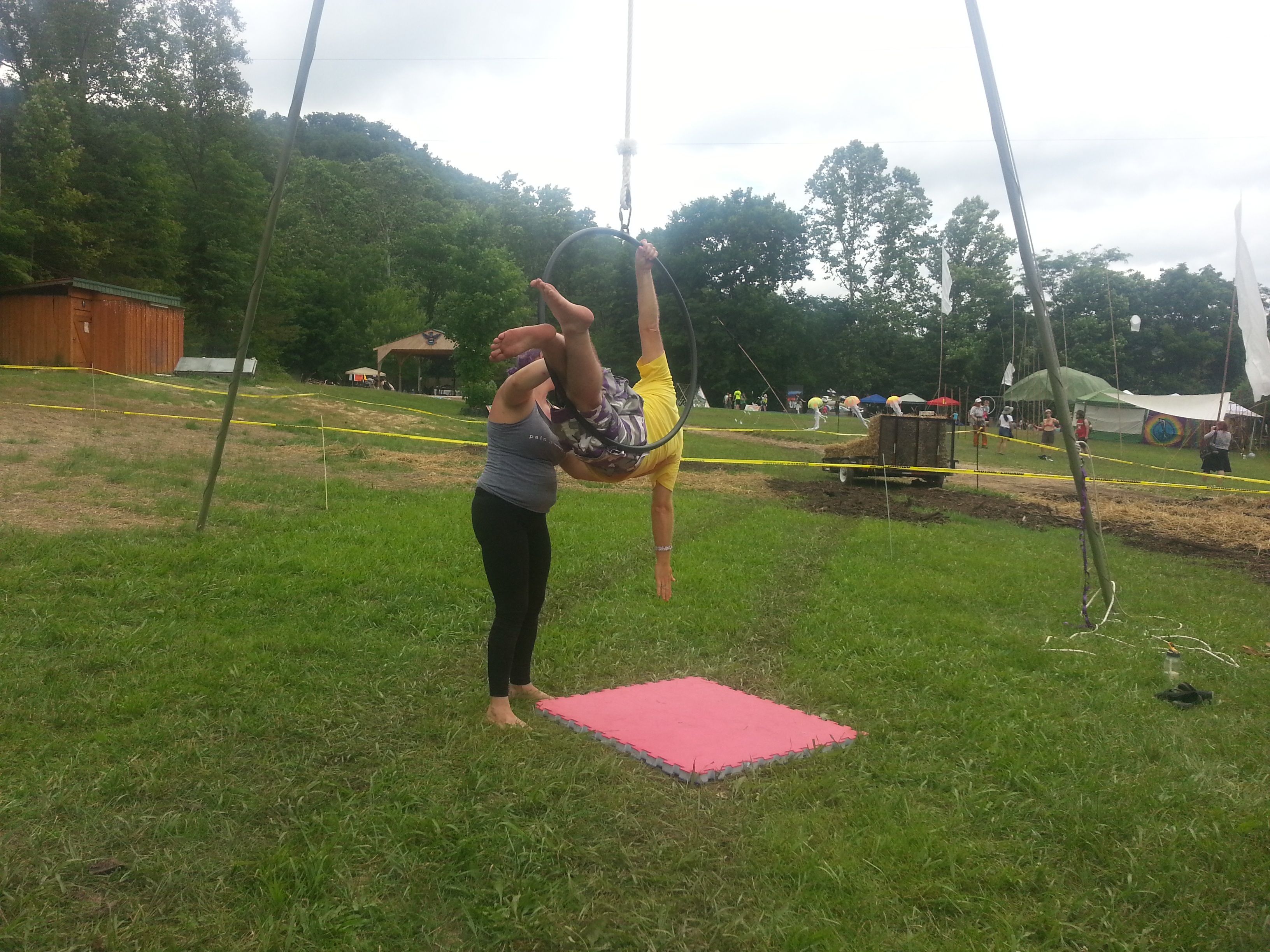
…lyra:

Mermaid with a slightly-broken line: I should’ve brought that arm up just a tad higher
Denis gets his mermaid on
…and static trapeze:
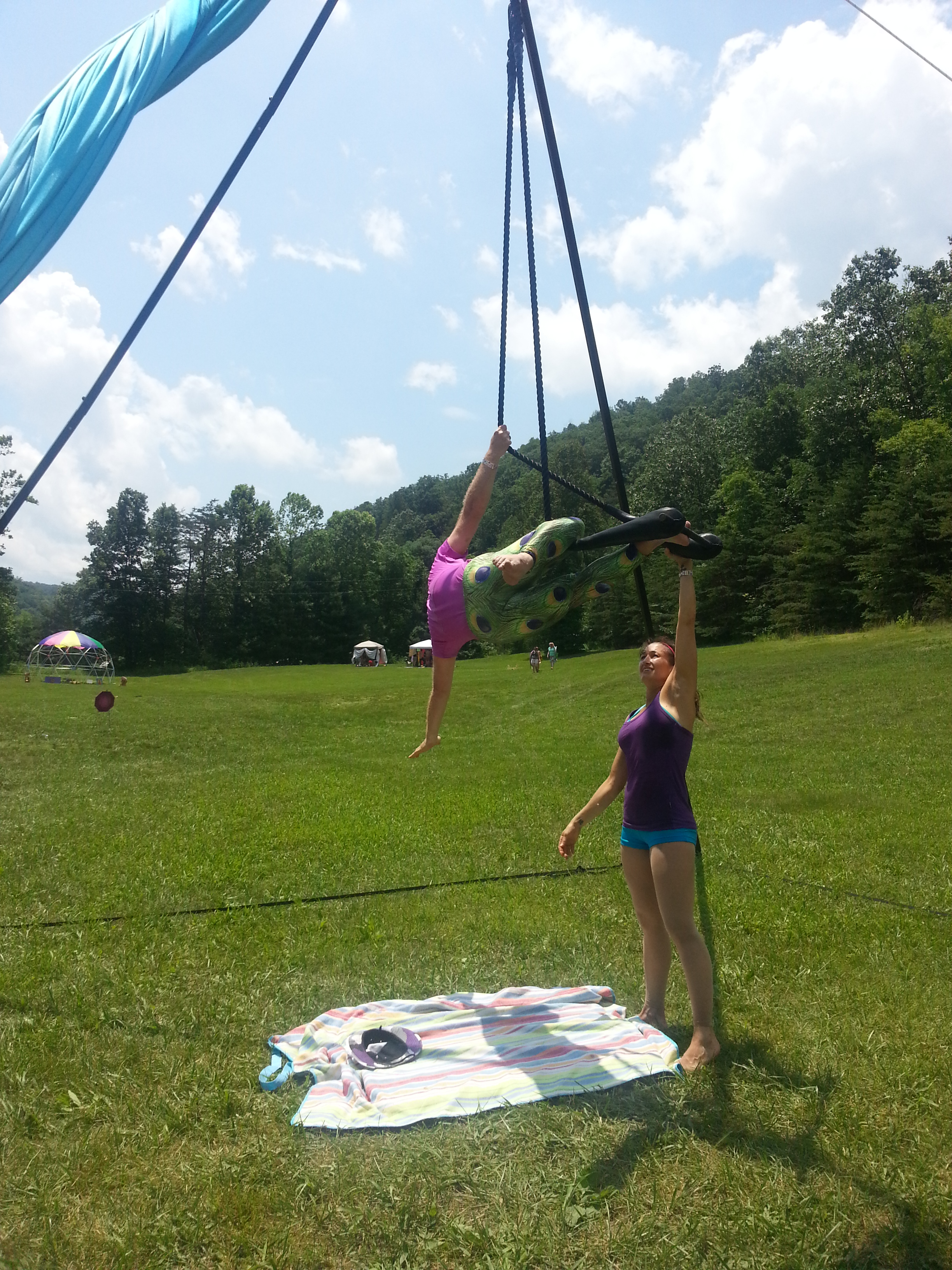
Denis on the trap: just call him “Susan.”
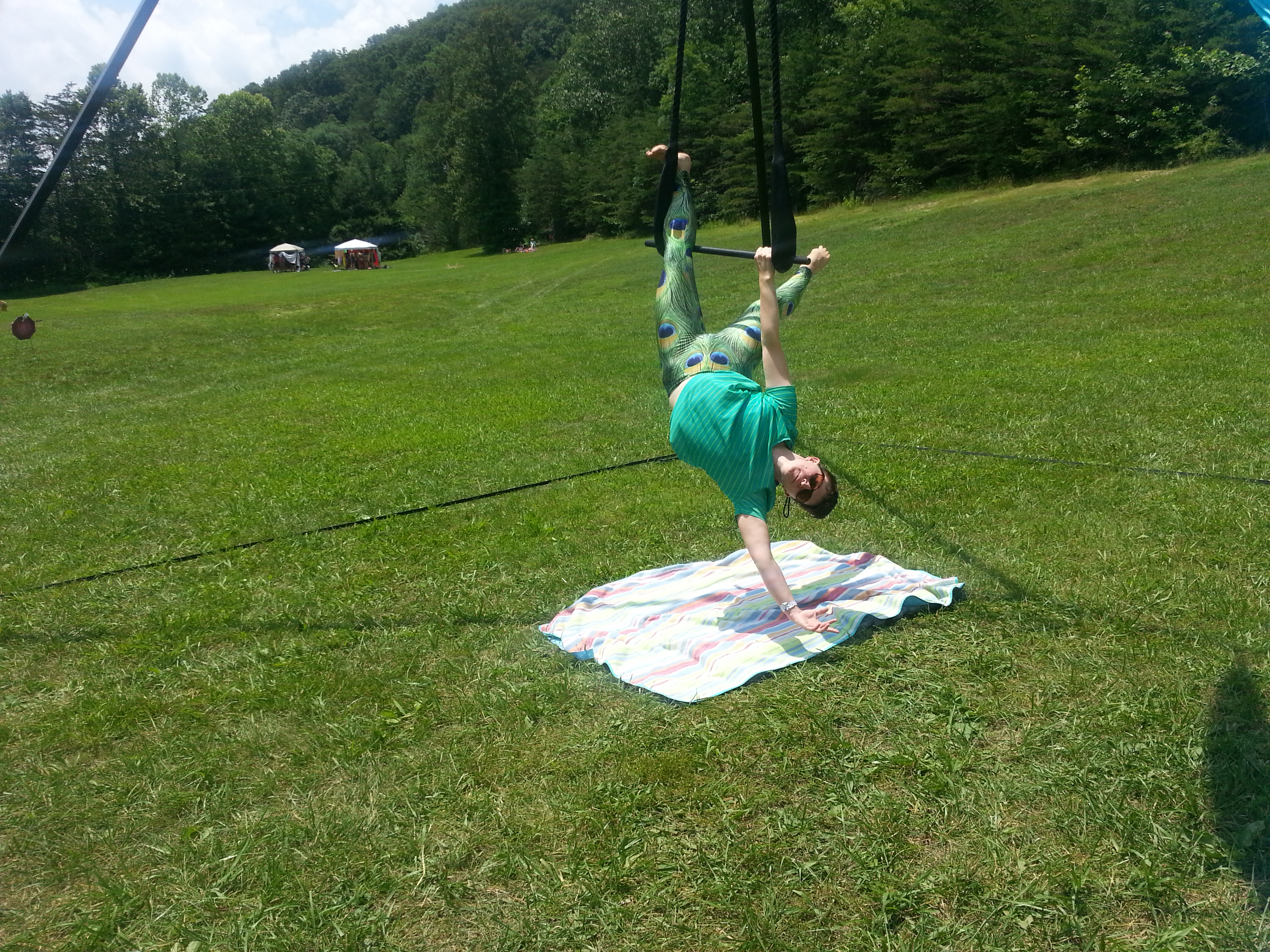
The sunglasses just sell it. *snrk*
And then, because we had the opportunity, we played on the trapeze a bit more:

I need to practice this one more. I tend to set up too low. Terri got me sorted, leading to this rather lovely moment.

…and this one.

Denis is more nervous on the trapeze than I am, but he still got both hands off the ropes.
The trapeze was set about 2 meters up during our second session, and I wasn’t sure I’d be able to get up there, but it turned out to be very doable.
Of all the apparatus, I think I enjoyed the hammock most (which, by extension, probably means I’d also really love silks; we missed the intro silks class, though, since Denis had to work on Wednesday morning). I’m pretty flexible, and hammock takes advantage of that in a particularly cool way.
Things I learned this weekend (besides new moves on the aerial apparati):
- My lower-core strength is great.
- I need to work on the uppermost core muscles, as well as shoulder-girdle and arm strength.
- I really, really love aerials (this should come as no surprise).
- I should be more confident about life in general.
Both Terri and Cindy teach locally, and Terri will be teaching at the new aerial arts studio that’s opening (which is in a really convenient spot and offers a very reasonable price structure), so I’m hoping to add some aerials to my rotation. I think they’ll be pretty compatible with ballet, and the class times won’t conflict.
First, though, I need to get some income happening 🙂


 danseur ignoble