Author Archives: asher
Rep: In Which I Get My Own Posse
(Sort of.)
First, I didn’t make it to Killer Class this morning.
I’ve been wrestling a nastier-than-usual episode of insomnia, but I’ve been trying not to take sleeping pills because they can screw with my mood. Last night, I was exhausted but just plain couldn’t get to sleep, so I finally took a sleeping pill at 3 AM.
When I woke up at 9, I knew within seconds that neither driving nor riding a bike was a good idea. The sleeping pill I took hadn’t worn off enough. So I went back to sleep and did evening class instead, which was actually pretty nice. I made myself do everything on relevé that could be done on relevé, of course, as penance (and also because that’s what I would have done anyway).
I also applied the note that JMG gave me about balancé back on Sunday. For some reason, I’d fallen into the habit of doing this weird up, down, up movement instead of the canonical down, up, up. JMG pointed out that it’s not necessarily wrong (sometimes choreographers want stuff like that), but it’s an alternative approach. I also think it isn’t really as pretty (and it looks weird when everyone’s doing down, up, up and you’re the only one going up, down, up.
Anyway, my balancés looked nicer tonight than they have in a while.
On to rep. We got into the meat of my part tonight. The girls are divided into three groups by height. BG has nicknamed them “Fun Size,” “Sirens,” and “Amazons,” and in this section I’m partnering the Sirens, and they kind of turn into my posse.
I mean, like, a beautiful, balletic posse, of course. Not the kind with pitchforks and torches.
The choreography isn’t hard, but it’s lovely. I’m happy with that: we don’t have a whole lot of rehearsal time before we show this piece to the universe, so I’m glad that BG has put together a dance that we can do well in the time available, but which still looks like legit ballet.
After rehearsal, I told one of the Sirens that they were really looking good, and she said, “I’m glad we’re dancing with you!”
Apparently, she likes the way I dance. w00t! (It so happens that I like the way she dances, too. We make a good team, which is good, because we’re also both sweaty disaster areas and have totally bonded about that.)
I do feel like I’m getting it back for real. I keep laughing at myself, because I say this Every. Single. Class.
I mean, seriously. Class ends, and I’m like:”It’s not 100% yet, but I feel like it’s coming back!”
Anyway, today the turnouts were doing their job, the arms had their waterfowls in a linear array, and I didn’t fall out of my turns (though I did keep proactively spotting, AGAIN).
Likewise, my jumps are regaining their ballon. Especially the sautés Arabesque in the rep piece—they were light and high, and not as “Heil Hitler-y” as they’ve occasionally been in the past.
Which is good, because I don’t want to give the wrong impression, here 😐
I do have to better work out this one part where I dodge between the Sirens. The spacing can make it challenging—they’re all standing in 4th arabesque à terre as I sort of lightly and gracefully run through the line of them in such a way that I wind up at the head of the line facing them in 2nd arabesque à terre. Or, at least, that’s how it’s supposed to work. We need to work on the blocking so there’s a little more room.
At this point, I’m really looking forward to learning the rest of the dance. I’m having no trouble at all remembering my part, which is good, because I can’t exactly follow anyone.
Anyway, I’m pretty tired, so I’m going to call it a night.
The Purchase of Light with Blood
Ballet, like opera, is wonderful because it is monstrous, the hyper-development of skills nobody needs, a twisting of human bodies and souls into impossible positions, the purchase of light with blood.
—Irina Dumitrescu | Longreads | February 2017
Yes, this: especially, “…the purchase of light with blood.”
You can read Dumitrescu’s entire piece about coming to ballet as an adult beginner here:
Swan, Late @ Longreads.
For what it’s worth, this is one of the things that appeals to me about dance and especially ballet: my body is strange, but in the studio is strangeness is an asset. Ballet takes all the elements of potential immanent in this body and makes from them something beautiful not in spite of, but because of, its strangeness.
PS: Modern went well today, even though I came into it sleep-deprived as all hell. Notes later, maybe.
Ballet All The Things
Yesterday, we worked on piqué turns with our Sunday class.
Teaching piqué turns, it turns out (sorry again), is a finicky business.
There are a lot of little details that are actually fairly important—open the whole body, and not just the supporting leg, from éffacé to croisée; don’t fling the baby; bring the hips along with the shoulders; keep the hips level; find the right amount of attack (with adult beginners, I’ve noticed that too little attack is more common than too much); keep the turnouts engaged; etc.
I found myself wondering whether we were overwhelming our students with information, and whether my input wasn’t just sort of making things harder. I sometimes forget, in the moment, that human beings learn ballet in tiny increments that build up over the course of many years.
As we progress as dancers, we get used to absorbing corrections on the fly. We add their content to—or subtract it from—layers of existing information. We build and modify habits over years and years. Now and then, a “eureka!” moment leads to a swift and significant change, but mostly we learn by a thousand cuts; a million steps compounded one atop the other.
We forget what it’s like to be completely new; to be learning not only an entirely new movement vocabulary, but an entirely new language vocabulary.
This is part of what makes teaching ballet hard.
After a while, it all begins to make sense—sure, turnout (for example) began as pure artifice, but ballet technique evolved around it and depends upon it. A good tour lent/promenade depends on the turnouts remaining engaged—as do piqués and chaînes and all those other turns.
You can do turns in parallel, but they’re different. They look different and rely on different body mechanics. They can be nice, but they’re not ballet.
Ballet begins with engaging the turnout—so we harp on about it endlessly.
In the beginning, though, it probably feels arbitrary and baffling (not to mention a bit unnatural).
You don’t really “get” it until you learn to feel your deep rotators well enough to understand, for example, that you fell out of that otherwise-nice tour lent because your turnouts unspooled themselves and destabilized the hip of your supporting leg and everything attached to it.
That can take years.
Our AD Emeritus once called me out on failing to really engage my supporting leg before driving on through Adagio or turns. That moment is a bit of a watershed for me, because it made me really think about how I was using my deep rotators. Prior to that, I accepted turnout as a part of ballet without really thinking about it—which meant that I also wasn’t feeling about it.
I’ve noticed that understanding why helps people remember things. The challenge is to impart the reasoning without drowning students in a frothing sea of information.
It occurs to me that perhaps figuring out how to impart that sense of feeling might help—to set some time aside during each class to consciously work on getting to know the body mechanics of ballet by feel.
Of course, this is ruddy hard to measure: asking students to report back on sensations deep within their hip sockets is inherently subjective and prone to the same kinds of reporting errors that researchers encounter. Perhaps it would be best to ask them to explore their turnout, then describe how it feels at the point at which it’s most correct and solid?
I’m going to have to remember to talk this over with ABM. She’s a gifted teacher, and I think her insights could be helpful.
Arking Bog?
Today’s Notes from AOV BOLLET
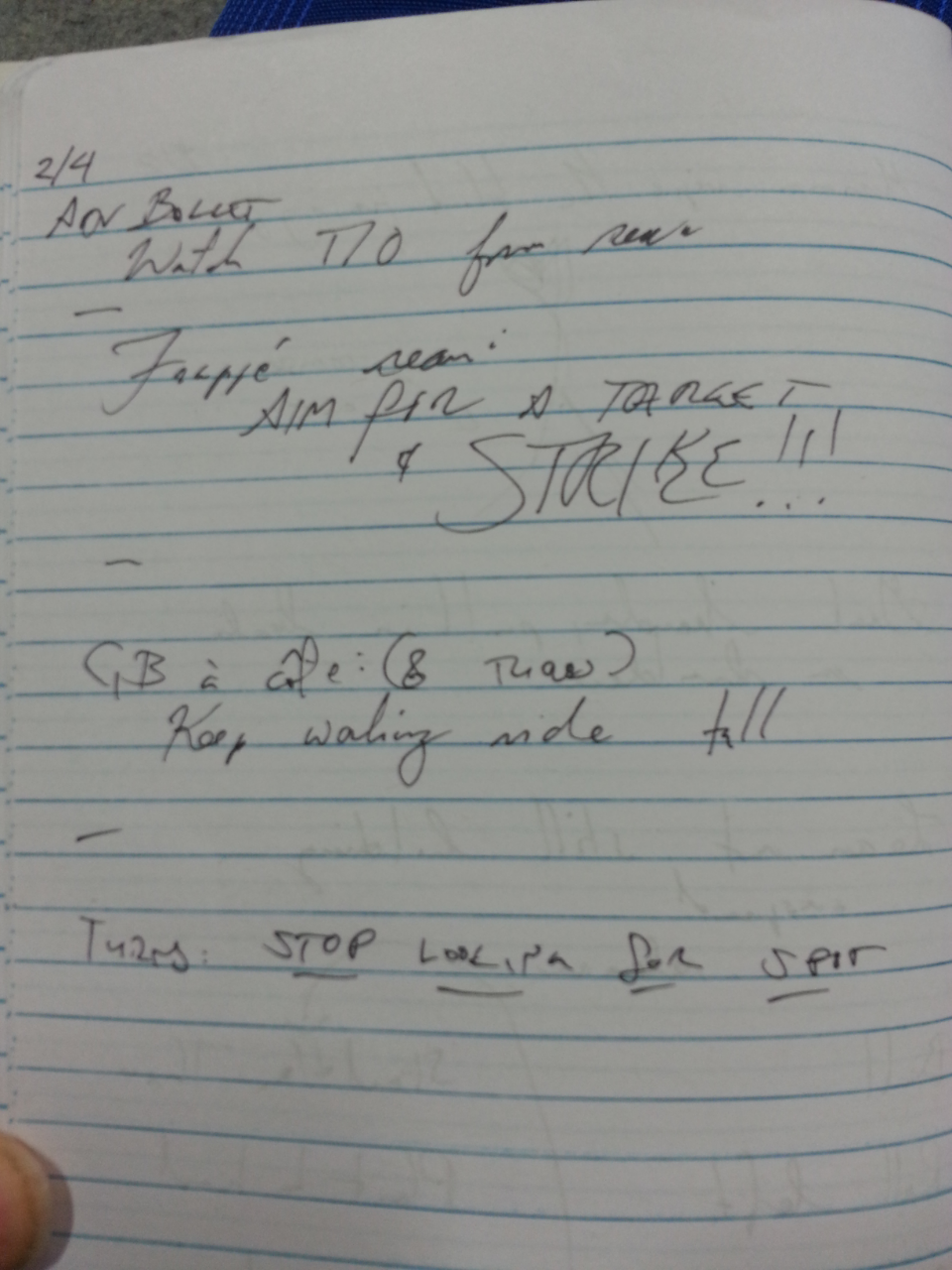
- Watch T/O form seas
- Frappé sean: AIM FOR A TARGET & STRIKE!!!
- GB à cafe: (& TURBS) keep waling ride tull
- Turns: STOP LOOLING FOR SPIT
Yup. Makes perfect sense to me…
(The saddest part: this is more legible than usual. #FML)
Selections from Advanced Class
During terre-a-terre:
Me: I keep adding an extra tombé-pas-de-bourée.
BG: Don’t do that—we don’t get paid by the step!
Notes:
- Think about over-crossing the working leg in Arabesque
- At the barre, don’t let the working foot get lazy (also in Arabesque)
- Corrolary: if you have beautiful feet, use what G-d have ya
- Get your back up and keep it up, but don’t leave it behind when you failli
- Double turns: stop looking for your spot!*
So, in short, all the same things I mostly had sorted before the break.
*Except this. I only recently realized that I’m practicing “proactive spotting” rather then letting the spot happen naturally.
Also, petit allegro was a disaster today, but that was because my brain refused to absorb the combination.
The Illusion of Effortlessness is Just That: an Illusion
Apparently ballet-as-fitness is a thing right now, but some who’ve tried it find that it’s “slower-paced” and possibly not as demanding a workout as their fitness level requires.
To them, I say, “Come try Killer Class, and if you live, we’ll talk it over.”
So, here’s the thing: the ballet classes to which good ballet schools steer true beginners are, out of necessity, introductory classes.
And, under the right teachers, introductory classes aren’t designed as exercise classes(1).
- I’m not commenting on “fitness barre” here—I haven’t tried it. The closest I’ve come was a class at the Joffrey which was labeled “Keep-Fit Ballet” that turned out, in fact, to be essentially Killer Class crammed into one hour.
A good introductory ballet class is designed to teach you how to use your body in a way that is fundamentally different from anything you’re likely to have done with it thus far (unless you’ve had good instruction in ballet in the past).
It’s designed to incrementally strengthen and stretch muscles that likely haven’t been doing much for a while.
It’s designed to impart the basics of sound technique so that when you level up, you’ll be able to learn harder, faster-paced stuff without compromising your technique and injuring yourself.
As such, the pace will by necessity be slow. It’s hard to learn sound technique when your brain is actively on fire and your body is sounding its air-raid sirens.
If you’re pretty fit, you’ll probably make it through barre (or even an entire class) in Intro to Ballet without so much as breaking a sweat.
If you’re using good technique, you almost certainly won’t “feel the burn” in the muscles where you, as a person with fitness experience, expect to feel it(2).
- Pro tip: if your quads are on fire after a développé-heavy Adagio, you’re doing it wrong. If they’re on fire after a long fondu or little jumps, you’re probably okay as long as your deep rotators are also ready to rise up and last waste to their oppressors.
If you stick around long enough to nail down the basics and get green-lighted for Beginner and then Intermediate class, though, you’ll discover that ballet is not by any means all gentle repetition and slow stretchy stuff.
If you stick around long enough, you’ll discover that a good class at an intermediate or advanced level can leave a flotilla of professional ballet dancers—arguably the fittest humans going—drenched in sweat.
See, ballet is all about the illusion of effortlessness—and the only way to achieve that illusion is through sound technique harnessed by a body trained in a highly-specific way. You must do a million tendus because those tendus evolve into dégagés, which evolve into grand battements, which evolve into grand jetés.
(So, basically, ballet is like Pokémon for the human body?)
In short, some of the most crucial muscles in ballet are ones that the average fitness buff probably doesn’t even know about, and that even the most skilled athletes in other disciplines(3) rarely think about at all.
- Notable exceptions: really good huntseat and dressage riders use the deep rotators constantly, which is unsurprising given that a good basic “seat” is essentially a modified plié; figure skaters also use their deep rotators in a very ballet-like way at times. For cross-country skiing, the ol’ turnouts are good for herringbone climbs; downhill, they come in handy in for stem turns and when you eff things up and need to get yourself out of a bind, but not necessarily out of your bindings.
As such, the physical training part of ballet can feel very unlike other forms of exercise, especially when you first begin. The focus isn’t on Mad Gainz; it’s on itty-bitty incremental gainz.
Likewise, the dancer’s long, lean physique isn’t achieved in one hour a week (as a matter of fact, the standard ballet class is 1.5 to 2 hours long by itself), or even in one hour a day.
Professional ballet dancers look the the way they do because they spend five to eight hours (or more) each day dancing—taking class, learning choreography, rehearsing, learning more choreography—and they cross-train via conditioning classes, cardio, and good old-fashioned lifting.
To give you an idea, with a heart-rate monitor keeping tabs, I burned nearly seven thousand calories on my most recent five-hours-of-class day. That’s counting class and everything else, not class alone, but still!
Presumably, this is why I came back from my summer intensives rather spectacularly lean and ripped: I was putting in the equivalent of a century on the bike every single day. I could not physically eat as much as I was burning. I didn’t have time.
Simply put, it’s really hard to shove 6,000+ calories into your face on a schedule that involves eight hours a day of dance. There just isn’t enough time in the day. As such, professional dancers tend to be lean—but do remember that ADs tend to select lean dancers, and that not all dancers are, in fact, Balachinian in proportion.
Likewise, dont forget that professional dancers largely also cross-train for cardio (though some companies and schools of thought still discourage it): six hours of class may turn you into a beast, but it is unlikely to prepare you for the two or four or six minutes of non-stop redlining you’re going to do on stage (seriously, this was one of the astounding things about LINES—long-ass demanding variations in which nobody died).
Dancing a demanding variation is like making the insane choice(4) to big-ring sprint up a long, steep climb to catch the breakaway group. Only, like you can’t even decide halfway through the sprunt that it’s a terrible idea, pop it down a couple of gears, and let your buddies in the flailing group catch your wheel.
- I feel particularly qualified to make this comparison. Insane climbing sprints are kind of my thing on the bike. Albrecht’s variation is pretty much like sprinting up the categorizable climb nearest to my house, including the fact that there’s a little extra “gotcha!” sprunt right when you think you’re in the clear.
You have to keep the hammer down and gogogo, or the whole audience and the whole company and the whole dance world will be like, “WTF?” (More importantly, you have to do this because you’re a dancer and, when you’re dancing, it doesn’t occur to you to do otherwise.)
So dancers cross-train for cardio (and strength!) in addition to all that fecking about(5) in tights.
- “Feck” is a long-standing favorite quasi-curse of mine; more so now that I know its canonical meanings include “throw/toss”—which is often an appropriate description of what we’re doing in class, really (jeté also means” thrown/tossed!”).
This doesn’t mean that the workload of ballet is too light to qualify as exercise—rather, it means that class occupies an unusual hinterland between body-weight strength training and high-intensity interval training. Bike racers who specialize in sprinting also cross-train for cardio: to a dancer, bouncing on a trampoline might be the equivalent of a bike sprint specialist(6) logging her base miles.
- Autocorrupt suggested “bike sprint socialist,” which is now totally the new name of my imaginary band.
Anyway, to sum this all up: if you’re pretty fit, it’s reasonably likely likely that an Introductory-level ballet class probably won’t “feel” like a workout.
Don’t be too quick to dismiss ballet as “too easy,” though—that’s like deciding after jogging a 3k that marathons aren’t hard.
Still the Onliest Boy, But It’s All Good
Performance group is 11 or 12 girls and me. The choreography is really lovely. Mr. BesstMode is driving the train, and he’s got the girls opening with a beautiful little canon.
I come in at the end of it (learned it anyway, because just standing there the whole time would be a legit dick move). Thus far, my part goes:
Wait, wait, waitywaitywaitywait … wait some more, wait, countcount, sauté arabesque!
I’ve got that much memorized 😀
(I get to literally leap into strange, basically. Okay, so technically Sauté Arabesque is a jump, but work with me, here.)
Don’t worry, though. I jokingly said, “I’ve good on my part so far!” and Señor BeastMode replied, “Oh, don’t worry—I’ve got you working!”
The upside of being the only boy is that you essentially automatically get a featured role(1).
- Honestly, even if you’re all doing the exact same thing; ditto for whoever is is the Odd Dancer Out, whether it’s all guys and one girl, or all zebras and one giraffe, or all swans and one very confused velociraptor who has made the kind of questionable life choices that lead to time-travel and its attendant effects.
The down side of being the only boy is that, like, you automatically get a featured role. Fortunately, I am both laughably overconfident and completely impervious to fear of looking like a complete ass(2).
- I really only suffer from that retrospectively, when I watch video and immediately want to crawl under the nearest rock.
I can’t wait to see how this turns out.
One Moar For The Road
In the interest of reminding myself that, yes, I have progressed in the last six months, I cringed my way through the videos from last year’s ballet intensive the other night. Here are some screen shots so we can commiserate or what have you.
First one is definitely from Albrecht’s variation (with Don Quixote hands because #fml); second one is also, I think, but from the opening sequence with the gigantic sissones ouverts of doom, maybe? I think it’s also the part where I’m going, “Oh, shizzle, I’m way down stage from my mark!”
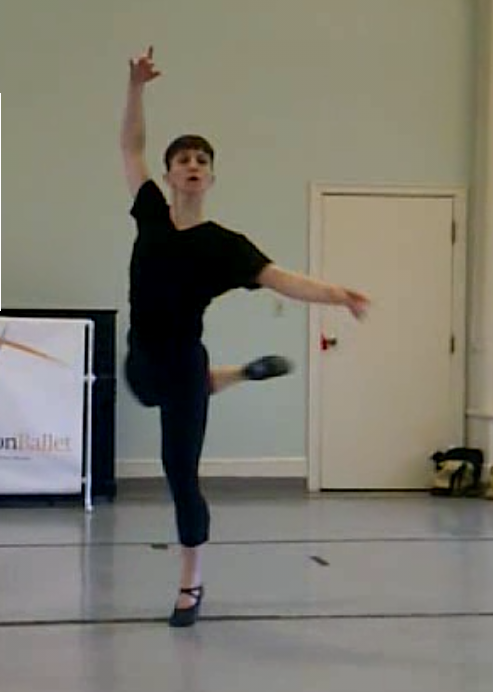
I used up too much of my ballet mojo in class and rehearsal, and my legs were dead (note complete turnout failure and shoulder feckery), but I did manage to swing the straight-pirouette-right-into-attitude-turn bit through sheer force of all our a minor miracle or something. And, yes, I looked 12 years old the whole time. I promise I’m not really 12.

I’m including this one as proof that you REALLY should always pull your tights up until the word “Nutcracker” takes on an entirely different meaning. Dat sag, doh. (Big obnoxious box is a screenshot-process artifact; stupid tablet.)
Off to Rep!
Just A Quickie Before Rep
Two things: first, I’ve had plentiful occasion this week to reflect upon how radically dancing has altered my life.
Three years ago, I had a tiny handful of local friends and didn’t really really feel connected to anything or have any overarching vision guiding me.
Now I’m increasingly knitted into this strange, tiny, amazing world of dance and aerials people as my life furiously churns (ohai, unintentional modern dance pun) towards some kind of future in which dance and aerials are central.
I am stunned and awed and grateful every time I think it.
Second … Well, crap, I’ve forgotten what the second thing was. Honestly, it was probably about class this morning and still feeling like a space cadet whilst struggling against allergies.
So that’s me: an allergic spaceman.
If I was Matthew Bourne, I’d almost certainly write a ballet about it.


 danseur ignoble