The Showcase Piece IS DONE!!!
…And I really like it. Next week we workshop the partnering bits and clean the piece. Pretty exciting stuff.

L’Ancien continues to rebuild us.
Today was not my best dancing day, but it was acceptable at times. Weather fluctuations are leading to mold blooms and so forth that make my allergies crazy. Ears are connected to noses and throats; all three of mine develop problems.
My hearing gets iffy. I miss bits of combinations (L’Ancien delivers his combinations very quietly, which makes us all listen as ahard as we can) and I start to get stressed out and tense, even though L’Ancien tells us over and over again, “Don’t worry if you do the wrong step. This is class. This is an exercise. That’s not what I’m looking for.”
He’s really not. He cares less what you do; more how you do it. An approximation of the exercise done beautifully will make him happier than a perfect log of the steps done without feeling.
But still, sometimes I get nervous when I feel like I can’t hear.
Still, there were good things: the petit allegro combination in which we did fancy pas de bourrees of a kind that none of us (not even Killer B) had learned because evidently almost nobody teaches them(1)—that is, pas de bourrée a quatre pas and –a cinq pas—coupled to entrechats quatres. My entrechats are a thousand times better for L’Ancien’s insistence that we JUMP! and show essentially a second position in the air around the beats.
It’s not just switching the feet: I can do that all day. It’s launch STRIKE! beat STRIKE! land fifth.
Last year, I learned to prevent “flappy feet” by thinking about my beats happening higher up in my legs. L’Ancien is transforming them into something worth looking at.
…Which is good, because apparently my assumption that I’m not built for petit allegro is incorrect.
After class I thanked L’Ancien for reviewing and clearly explaining petit battement. He pointed out that the configuration of my pelvis, which is rather shallow, is good for quick batterie.

I think this shot gives a sense of it. There’s not a lot of distance from the point of my ilium to my pubic symphisis, so I’ve got shorter “cables” to work with and TM or L’Ancien, which makes it easier to move the bones quickly.
I suppose I should’ve figured this out earlier, as I was the first member of my first childhood ballet class to nail down entrechats and so forth.
A few weeks ago L’Ancien mentioned our dancer RS, who does a stellar Bluebird (so much so that when my brain chooses to reboot and I can’t get his name to come to mind, I refer to him as “our Bluebird”), and how his shallow hips and relatively short torso make him well-suited for petit allegro. He said the same thing to me today, about my own body.
This is one thing I really appreciate about his teaching style: he teaches to his individual dancers, and not to some nonspecific imaginary dancer, as much as he can.
It’s worth noting that he does this not only by pointing out our weaknesses, but also by pointing out our strengths. By ballet standards, I’m a muscly kind of boy (which always results in a frisson of cognitive dissonance when I’m moving in cirque or modern dance circles, where I’m borderline dainty).

Are you sick of this screenshot yet? 😉 TM (2nd from left) is built exactly like L’Ancien, to give you an idea.
Too often, as dancers, we find ourselves lamenting what we don’t have (in my case, David Hallberg’s “imperially slim[2]” build, with its endless, beautiful lines) instead of celebrating what we do have (…what K calls “that Bolshoi body,” with the enormous, ridiculous Legs of Power and square shoulders that let you do Bluebird left like it’s NBD).
In the end, we have to learn to work with the bodies we have: to make the most of them. I think I’ve touched on this before.
Up until now, I have been learning technique—building the elements of movement—but perhaps haven’t learned my body as well as I could have.
By way of analogy, this is like painting in watercolors and being frustrated that they don’t behave like oils. I’m rather a good watercolorist, and that’s partly because I understand how watercolors are and I work with them accordingly.
As a dancer, then, I need to begin to understand how my body is and to work with it accordingly.
I suppose that, once again, it comes down to this basic principle: start where you are.
That means don’t force your turnout, but it also means, discover your gifts.
If you only ever know what’s not great about your body, you’ll never optimize your training as a dancer. Quietly, gently, firmly, L’Ancien says to us, Learn what is great about your body. Every body is different. Every body has gifts.
But also start where you are. Know your strengths; know your weaknesses; train accordingly.
I’ll try to remember all this tomorrow at the BDSI audition, though I’ll also try to just have a good class and enjoy the singular pleasure and specific torture of Vaganova technique.
I hope that I’ll make the cut—not so much because it would make me feel good about myself as a dancer (though I’m sure it would), but because I think two weeks of Nothing But The Vaganova, imparted by a roster of master instructors, is enough to make anyone a stronger, better dancer.
And, possibly, a good way to learn to optimize on one’s strengths.

Today I started setting my piece for CL’s upcoming collaboration with University of Louisville.
I tapped my friend L, who was my reader for Death Defying Acts and who I’ve had as a student in the Dance for Aerialists class that I co-taught for a while. I don’t remember exactly where the initial impulse came from, but it was a good one. She has time right now, and I think we work well together.
L doesn’t have a lot of dance training, but she’s an aerialist and she practices yoga, so she has the kind of “educated body” that dancers have.
I had two goals for today’s rehearsal: first, teach her how to Tall Ladies (the easy part!); second, set the first phrase of the dance. Both goals were achieved, and it turned out that L and I make really good collaborators. I put in, among other things, fish lift to fondu arabesque (ganked from BG’s piece :D); she added a sub-phrase developed from triangle pose that played really nicely with my instinctive “next thing.”

This is a variation on triangle pose, I think? But it’s also a really beautiful guy on a really beautiful beach, so it’s possible that I got a little distracted while I was looking for a shot of triangle pose. (Via Pexels.)
Choreographing this dance is going to be an interesting challenge. Since the musicians will be working within an improvisational framework (you’re right, that kinda sounds like an oxymoron), I’m programming a series of phrases that can either be used in a set sequence or mixed and remixed in an ongoing improvisation.
I came into this rehearsal with only the most basic sketch of an idea: start with Tall Ladies, set L down facing the audience, rise, work through a series of smooth, circular movements in which we appear to be working together to manipulate the ball (in fact, she’s doing all the ball work at the beginning of this phrase).
The lift grew organically out of the initial ball path: that was a cool discovery. L’s triangle sequence also came about on its own. She was experimenting to see where her body wanted to go from the arabesque (the ball passes from her hand to mine as she transitions out of the arabesque), and I liked what came out.
This is the first time I’ve actually set a dance that’s explicitly a partnered piece, as opposed to one in which bits of partnering occur incidentally to the greater momentum of the piece. I think I’m going to enjoy this particular challenge.
Coincidentally, this is also the first time I’ve partnered a girl who is significantly smaller than I am. L is legitimately tiny, which is both awesome and complicated. It’s awesome because she weighs next to nothing and is super easy to balance (she’s also great at engaging through her body, which really helps). It’s complicated because, in trying to be a good partner, I’m finding that I have to adjust a lot.
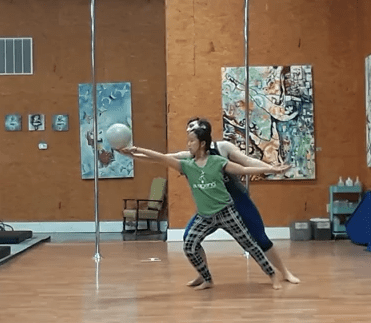
I need to drop my shoulder a little. OTOH, we make nice lines together!
That’s actually really good for me, as a guy who enjoys partnering and wants to do more of it. The first three rules of ballet partnering for guys might be, “Don’t Drop The Girl[A],” but the fourth rule is Pay Attention to What She Needs.
Does she feel like she can get her leg under her coming out of Fish? No? Maybe you need a deeper fondu, then, doofus.

Such fondu. Many lunge. Wow.
Anyway, I think the resulting piece is going to be pretty cool. L and I work well together, and I think we also look good together. That doesn’t hurt, either.
~
A. Appendix 1: The First Three Rules of Partnering
The Showcase Piece IS DONE!!!
…And I really like it. Next week we workshop the partnering bits and clean the piece. Pretty exciting stuff.

Last week, or maybe the week before, I was watching Killer B do turns in class and had this revelation about her back.
I don’t quite know how to explain it: her back, like, goes straight up and down, like the proverbial elevator car that probably everyone’s ballet teacher has harped on about at some point when teaching relevés. Nothing changes. Everything just spins together, lovely and open, on an invisible axis (seriously, she spins like Baryshnikov).
I thought about how that would feel, physically—the back open and traveling straight up and down—and decided to try to work on achieving that feeling.
But what really made me get it, to be honest, was last night’s modern class.
We did and improv at the beginning that was all about different qualities of movement. We began frozen in concrete, wiggled first one part, then another free, then the concrete slowly transformed into thick, heavy, sucking mud. Eventually the mud gave way to buoyant ocean water, where we could swim and float. Then, slowly, we reversed the process.
Later, LWF gave us a visual that related (in a way) back to that: she asked us to imagine holding two heavy buckets of wet sand, and to feel them pulling our arms and shoulders down and open even as we allowed the back-tops of our heads to grow taller.

You could even picture this bukkit, maybe.
This made perfect sense to me, because it’s exactly the way I accomplish that kind of thing in real life. There’s something in my nature that refuses to look downtrodden—so when I’m asked to carry heavy buckets (or suitcases, or what have you), I engage through the lats and traps and so forth but let my chest and shoulders stay open, and I reach for the sky with the place where my occipital and parietal bones come together while keeping my head level.
Anyway, I did that last night (though for some reason, in my mind’s eye, the buckets morphed into suitcases?), and suddenly everything started to make sense.
This morning, Killer B said halfway through our Fondagio®, “Wow, your back is completely different today! What are you thinking about there? Keep doing it!”
I was able to tell her that it was, in fact, her back I was thinking about (and managed to do so without losing track of the combination too badly).
She then said, “You have so much more freedom in your eyes, too!”
And I said, “Oh, that’s Bruce!”
…Which got a chuckle from everyone who’s ever taken class from L’Ancien.
So, anyway: for me, the best answer for my back has been a combination of Killer B’s amazingly beautiful turns, the suitcases-full-of-sand image, and also Señor BeastMode’s instructions to pull up my suspenders (which counters my tendency to stick mah booty out) and to be strong.
I think the suitcases-full-of-sand thing might have a pretty universal utility. We’ve all carried heavy stuff at one point or another.

…Or stolen heavy things from our aquatic friends while dressed as some kind of Seafaring Mario.
The weird part was how strangely observable the difference was.
Usually, you change something critical to your technique, and it’s so infinitesimal that your teacher will only catch if it she’s using that special eye on the back of her head* under the light of a super blue blood moon and walking widdershins around the Grave of Giselle or something. Usually, it’s clear that you’re dancing better, but not quite as clear exactly a how.
So, anyway, there you go. If, like me, you’re a Leaner, a kind of Overaged Teenage Sloper, you might give the suitcases-full-of-sand image a try.
In other news, K and I worked through a partnering thing after class, and since BG was there he gave us some pointers. By the time we got done, it was looking really great.
I also pulled off this beautiful, controlled, super-high developpé à la seconde en relevé completely at random while thinking out loud with my body about a note that BG gave. He looked at me and said, “Just like that!”
I don’t actually do that developpé there, but I think I use it later in the piece, so I’ll have to keep it in my back pocket … Or stuffed into the waistband of my dance belt (wouldn’t be the first thing I’ve kept there :P).
For whatever reason, I feel like I’m growing by leaps and bounds (gahhhhhh, sorry) as a dancer right now. It’s a good feeling, after working so long just to come back from the surgery and regain what I lost while I was on the bench.
*Speaking of this … I’m teaching a workshop at PlayThink this year. Do you just wake up one day with that extra eyeball? Because I might need it.
So here’s how we’re doing on the work front so far this year:

Ohai! It me!
It’ll be interesting to see how rehearsal schedules shake out for all of this stuff.
This weekend, I’ll be jetting over to Lexington for the Ballet Detroit Summer Intensive audition. I have no idea, honestly, if I’ll make the cut, but I can say that last year I wouldn’t have been brave enough to go. A friend of mine from LexBallet SI is also going, so that’s pretty exciting!
I’m trying to go into it with the mindset that, regardless of the outcome, I can learn a lot from the audition process, and in many ways it’ll be a lot like taking a masterclass (only presumably with a number pinned to your shirt :P).
The weird part is that it’s hard to imagine that my first successful audition was last year, and that before then I felt pretty unsure about auditioning for things in general.
One of the general goals I set down for this year was to reduce my impostor syndrome about working in dance. I think that part of that is going out and auditioning for things—taking risks; seeing how things work out—and another part is choosing atleast some of my auditions strategically, based on my own strengths as a dancer and what kinds of dancers are needed in different markets.
Though I am making money as a dancer now, I’ve come to regard what I’m doing this year as a kind of apprenticeship. Not to say that my command of technique is finished—nobody’s ever done learning technique—but I’m learning the elements of artistry; how to approach roles; how to take direction and use it effectively (I try to be biddable, so to speak, but I don’t know if I always apply direction as well as I could).
I’m lucky to have good mentors in the midst of all this stuff. Señor BeastMode, in particular, has given me a lot to think about for our Showcase piece this year. I think last year he was kind of feeling us out; figuring out how much technique he could throw at us, given the compressed rehearsal schedule.
This year, he’s giving me very specific directions about approaching the role I’m playing in this piece—what kind of movement quality he’s looking for, how to use my eyes, etc. I’m learning how to ask questions to clarify points I don’t quite get in ways that get the answer I’m actually looking for (all too often, I’ll ask, “What was the thing at the end of that phrase?” in a way that sounds like, “What was the beginning of that phrase?”).
This is all stuff I can carry into the other jobs I’ll be doing this year—and into every job I land going forward. To some extent, these are also the points that determine what kinds of jobs you land as a dancer. Being able to ask a clarifying question intelligently at an audition isn’t a bad thing and, of course, reputation matters in a community as small as the dance community.
I’ll also, obviously, be spending this year learning to juggle the insane schedule that seems to be pretty much the hallmark of #dancerlife always and everywhere 😛 It may sound trivial (it may not: you guys know me pretty well by now :D), but part of me is like, “Holy crap, I’m going to have to figure out how to cook and eat food in here somewhere.”
So, basically, I’m doing the stuff you do as a company trainee, only I’m working for 2 different companies as a non-trainee ^-^
Anyway, I’m pretty excited about the coming year, busy though it’s likely to be.

Yesterday, D and I met up with some of my ballet girls at a showing of the Norwegian documentary Ballet Boys, which follows three teenage dancers at a critical period in their training—the point at which they’re deciding whether to continue training and possibly to pursue careers as dancers.
One of the three is absolutely all-in. The other two aren’t as certain. One of them mentions the reality that one faces as a dancer in training: that there’s no time for a typical adolescent social life. He walks away, briefly, from dance—but he literally can’t stop dancing, and ultimately he returns.
I was reminded of a conversation I had not long ago with my friend RH: I said something about how working in dance involves a lot of sacrifice, but it’s willing sacrifice, joyfully given. He said something to the effect that he didn’t see how sacrifice came into it.
For a second, I honestly felt kind of angry. I almost responded with anger.
Then I realized that my anger was the knee-jerk response that dancers evolve as a defense against the fact that people who don’t dance haven’t the faintest hint of a clue about how hard it is; how much it demands. They often seem to legitimately believe that we spend all our time riding unicorns and eating cotton candy and swimming in the fountains of money we get paid for it, when in fact our lives are more akin to monastic vocations—we work grindingly hard, often for peanuts, because we’re called to the Work.
And then I realized that, okay, from his perspective, the commitment and sacrifice required probably aren’t visible, let alone obvious.
RH doesn’t dance, but he knows that I love dancing. He knows that dancing makes me unbelievably happy.
He works in technology, and he loves tech—but he doesn’t love his work in the all-consuming way that I love dancing. The work that he does in the tech sector isn’t the work he’d choose to do if money was no object, and it doesn’t always really work for him. Dancing is absolutely the work I would choose to do if money was no object, and it works for me in a way that nothing else ever has.
Perhaps a bit ironically, I’m working in dance in part because, at the moment, money is an object: to dance at the level I want to, I need to make dance pay for itself. But it’s still what I’d be doing if we suddenly received a windfall that would set us up for life.
That doesn’t, however, mean there’s no sacrifice involved.

Great! Only 10,000,000 more repetitions and you’ll almost have it!
~
Every now and then, someone will say to me, “I wish I could do what you’re doing.”
I try to listen and respond with kindness; with an openness to the nuances of meaning that underpin what they’re saying. I try to factor in things like financial challenges and family commitments (kids change everything).
But what I want to say, most of the time, is this: You could.
Part of what people are saying, when they say that, is this: I wish I was talented enough.
Sometimes, the people saying it are more talented than I am. They may not have as much training, but in terms of raw aptitude, they have the goods. They just need the training to use their aptitude.
I have pretty strong aptitude for dance, don’t get me wrong—but talent isn’t really the deciding factor.
Sometimes they mean, “I wish I’d danced as a kid.” There’s an assumption that it’s essential to start before your bones stop growing—especially in ballet.
Early training does exert some influence—but it’s not the deciding factor, either. My bones are constructed in a way that allows for 180-degree turnout; my feet were definitely shaped by my early training. But there are much, much better dancers than I—professionals at major companies with a lifetime of training and still have less turnout and mediocre feet; but also late-starters without great turnout or awesome feet who have gone on to forge careers out of nothing.
Early training isn’t the deciding factor, either.
The deciding factor, at the end of the day, is sacrifice.
Welcome to Dancerlife. By continuing, you agree to commit every waking moment for pretty much the rest of forever.
~
So what, then, do I sacrifice to work in dance?
First and foremost, time.
To work in dance, you have to dance. Dancing eats up oceans of time.
It’s not like training to race bikes as a serious amateur. That you can do around a life that allows some time for other pursuits. You work to develop fitness and riding skills and racing know-how—but a lot it you can do (and ultimately do do) alone, in the interstitial hours around the job that pays for the bike and the racing license and the entry fees.
Dancing requires technique, fitness, and artistry. All of these things, in turn, require a time-commitment that will eat your life. You can potentially fit your training in around another job (and make no mistake, your training is a job), but in so doing you must acknowledge the fact that you will literally have time for nothing else.
I don’t race bikes anymore. I barely ride anymore. I don’t play video games that can’t be squeezed into a few minutes here or there. I’m never up to date on TV shows. I rarely manage to swing a night out, and when I do, it’s almost always with other dancers from the class or rehearsal that ends right before said night out.
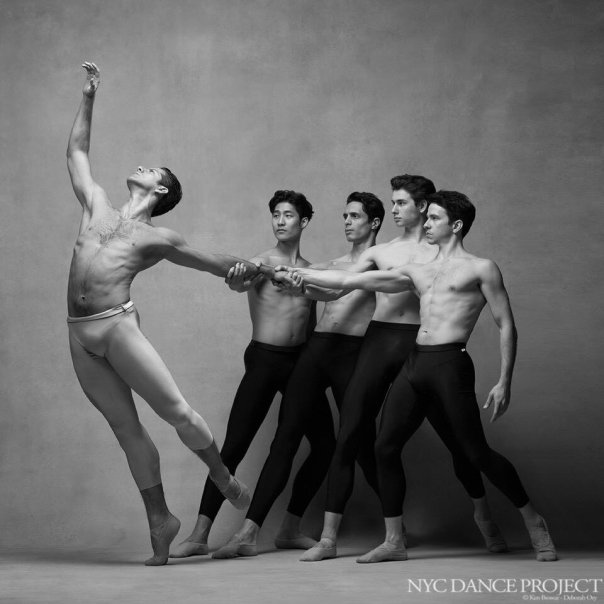
I thought this was a choreography still, but actually it could totally be a depiction of dancers trying to have a social life (via the amazing NYC Dance Project, via…erm…Instagram?).
I schedule my “life” around dancing. Even my occasional bouts of paid non-dance work are subject to the demands of class and rehearsal schedules. I give up weeks of the summer, when sane people are enjoying cookouts or canoeing, to sweat my ass off with other dancers in the interest of professional development (but also because I love dancing more than anything else).

SI: not, “Are you going?” but “Where are you going?”
I rarely manage to snag an evening alone with my husband. Fortunately, he’s okay with that. We make the most of whatever time we can grab.
If he wasn’t okay with that? To be honest, I’d still choose dance.
My time belongs to dance, and it will for the foreseeable future.
As a function of time, I’m also sacrificing money. I could land a job tomorrow that would pay thirty times or more the amount I made as a dancer last year. It might even allow me time to dance as a hobby. It would, in one fell swoop, make us very secure, financially-speaking.
It would also mean giving up the career, such as it is, that I’m building now.
Dance is a demanding muse.
I have back-burnered every other interest except circus arts, and circus arts make the cut only insofar as they allow me to function within them as a dancer and don’t interfere with actually dancing.
I still write, but I do my writing in shreds of time snatched at the ends and beginnings of my days. I often fall asleep while writing in bed.
I know it’ll take me longer to finish the projects I’m working on, but I don’t care.
These are a handful of the things that I’ve cast into the fire in the name of dance.
I don’t mind. They’re joyfully given. I would do all of it again in a heartbeat. If you forced me to live my life over, I’d even do it sooner.
But a sacrifice is a sacrifice, willing or not. That’s the one and only thing that separates me from my friends who would like to do what I’m doing[1].
~
Sometimes, the same people who say they wish they could do what I’m doing are the ones who skip class to just chill, or who opt not to take rep class because it would conflict with game night, or what have you.
I restrain myself from saying, “You could do what I’m doing if you chose dance over everything else.”

I can’t play this lute! I have rehearsal!
Most of the time, I don’t say it.
I recognize that I wouldn’t have understood, back before I started dancing again and realized, finally, that dancing was the only thing I had ever really wanted to do. Either you step into the studio one day and know beyond a shadow of a doubt that you would and will shove everything else off the table to keep dancing, or you don’t.
Both ways of being are valid, good, and necessary—but only one usually leads to working in dance.
~
As humans, we are great at wanting to want things.
I want to want to paint more often.
I just actually want to dance.

This doesn’t need a caption, does it?
As dancers, we face the generally unconsidered, usually unspoken, and often unconscious assumption that a sacrifice isn’t a sacrifice if you do it to achieve something that gives you joy; that helps you to be a whole.
And yet we recognize the sacrifices of medical students, many of whom pursue their calling for exactly same reason that dancers pursue dance.
As dancers, our calling places tremendous strictures on our time and finances; on our relationships and our personal lives. Just because we’re making art, rather than medicine, that doesn’t make our sacrifice less worthwhile.
Doctors, when they’re skilful and lucky, save lives by cracking open chests to work on hearts.
Dancers, when we’re skilful and lucky, save lives by cracking open hearts.
Sometimes, those lives are our own. Sometimes, they’re other lives.
Regardless, at the end of the day day, the life of a dancer—like any other dedicated life—is one of sacrifice.
Because of that, however, it is also one of transcendence.
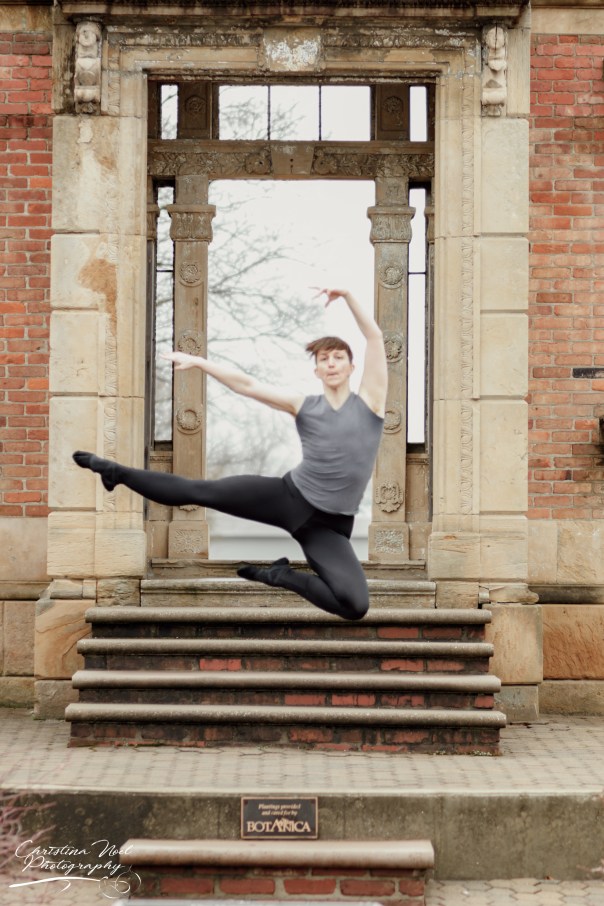
Or, well … close enough.

L’Ancien is away this week, so HD made a guest appearance in Advanced Class.
I let her know early on that I wasn’t 100% sure I’d make it through class, but I would probably at least get through barre.
In fact, I hung in there until it was time for jumps, when I chose to call it a day. I’m much, much better, but I’d say that I’m really at about 60% of my typical capacity, and with the BDSI audition and the start of rehearsals for the Culture of Poverty piece looming next weekend, it made sense to start getting tuned in again but also not to risk injury.
Speaking of the Culture of Poverty, I made B cast, which is great. I don’t think I would’ve made the cut for this piece last year: stylistically, AS is a very different kind of dancer than I am, and while I’m confident that I’ll absorb the movement style and vocabulary over the course of the rehearsal process, I know that in auditions I still have a tough time setting aside the mantle of ballet.
Anyway, back to class notes. At barre I found myself reflecting on a thing.
Background info: I’m a little taller than Killer B (when I stand up straight 🤔) and a few inches shorter than TM, who stands behind (and then in front of, and then behind…) me at barre.
My legs, meanwhile, are about as long as TM’s, so he’s quite a bit longer in the torso than I am. Killer B’s proportions are much like mine. Both that said, both Killer B and I have higher extensions than TM (who is quite a beautiful dancer and doesn’t actually need to be able to scratch his ear with his toes; he’s naturally princely and looks a lot like Steven MacRae).

Steven MacR—I mean, TM (2nd from left) and me. Also R, who often dances with us and makes us look like total n00bs. PS: yes, I’m watching myself in the mirror because I’m a bad boy and should be punished.
I think it harkens back to something L’Ancien said a few weeks ago: you work with the body you have, and every body has different strengths. Like L’Ancien, TM has deep hip sockets[1], which means that high extensions and the quick, fluttering beats that make petit allegro sparkle don’t come as readily to him.
Meanwhile, I—with my irrefutably square shoulders and profoundly elastic back—will have to think harder about how to create a lovely, unbroken line through my upper body and arms. Oh, and will spend the rest of my natural life quietly muttering, “Pull up your suspenders,” since that analogy makes me stop swaybacking like a retired dairy cow.
Which is a round-about way of saying this: in ballet, almost everything can be a blessing or a curse.
My feet are what EMM (who has finally joined advanced class!) calls “roundy feet,” which means that both my feet and my ankles are extremely mobile. They can do profoundly beautiful things to the lines of my legs, and ultimately they’re really good for banging out solid balances … once I’ve managed to stack all those piddly little bones correctly, and if the muscles agree to do their job.

Case in (ahem) point: technically, I’m *still* not fully pointed through my toes, here.
But I will be challenged for my entire life to keep them strong enough to counter their natural elasticity, and the beauty of my arches is a completely moot point if I’m not quicker in petit allegro than my friends with less “roundy” feet.
A half-baked point is a half-baked point, and getting feet and legs like mine fully straight and pointed is actually rather a lot of work.

Technically, I am *still* not all the way over the ball of my foot here—you could get in there and shove my calcaneus forward a few more degrees. If you wanted to get kicked in the head, anyway.
TM’s feet are nice, if not quite as fancy as mine, and he consistently makes them look good. At the end of the day, that’s really what matters.
It’s not about having the perfect body for ballet: there’s probably not a single asset that comes without a price (my thighs, y’all—they might make my grand allegro pop, but they also make my 5th position suck sometimes).
It’s about making the most of what you have.
True, there are some traits that seem to be perpetual winners in the ballet world (TM’s incredibly graceful shoulders; my “roundy feet”). But for every working dancer with an aristocratic neck and feet like bananas, there’s a stocky little dude with biscuits who has learned to make the most of what he’s got.
In fact, probably ten, because ballet ultimately belongs to those who work the hardest, and often those who work the hardest are the ones who feel that they have something to overcome.
~
One last thing. Today, it occurred to me to think about why we move slowly, painfully through fondus even though we still have to get there and show the world that moment of breathing stillness (the “picture,” as it were).
What we’re doing is building strength and endurance.
Yes, you can piggyback on momentum and flash-developpé your leg to the level of your eyebrow—but that doesn’t matter in that moment when you emerge from a soutenu through a graceful, elastic fondu developpé into a balance effacé devant and must then hooollllddddd for a rubato breath before you dive into tombé-pas de bourré-etc.
If you try to throw your leg there—that is, to simply harness momentum—you will find it difficult to muster control, and either you’ll fall out of the balance or you’ll fall into the tombé and make yourself late.
I can’t say I didn’t already know this, exactly? I mean, I know we’re not supposed to just throw our legs—even a jeté requires connection and control.
But somehow today it occurred to me that I need to remember the feeling of the balance between control and momentum; that I am eternally training my body to do things it would probably rather not do with muscles that would probably rather do something else (regardless of the fact that my body is both very biddable and highly suitable for ballet, ballet insists on using muscles and joints and bones in rather creative ways).
L’Ancien often makes us do grand battement with slow counts on the down: half a count to hit the apex and show the free leg, then a full count down—controlled all the way, through tendu. It’s the classic, “And ONE! And two. And THREE!…” in which the entire action of the upstroke happens in the blink of an eye. You could, in fact, count it faster and make it, “And ONE! two, three, four and TWO! two, three, four and THREE!…” but almost nobody counts like that in ballet because it would make our heads explode and screw up the phrasing•.
Anyway, back to ballet-standard counts. So in this slow-descent exercise, the first “And” is just a breath. The free leg shows at its apex a split second later. The rest of the count is spent carrying the free leg back down, rotating the supporting leg against it the entire way.
The descent is infinitely important: it strengthens all the things; it teaches us to counter one leg with the other. It allows us to really figure out how to lift out of our hips so we can close in a clean fifth.
It also looks really cool. There’s something superhuman about an entire ballet class snapping their feet up to face level, then thoughtfully returning them to the ground.
In aerials, when we’re not yet strong enough to overcome gravity doing a skill going up, we practice the reverse skill—that is, the same skill coming down.
Can’t do a smooth pullover mount on trapeze? No problem. Drape yourself over the bar, fight your way into a handstand, and roll down as far as you can before you just drop. Each day, you’ll get a little further. Soon, you’ll find that when you try your pullover mount, you’ve nailed it.
Barre is basically the same kind of thing. Every time you close with control or choose a slower, smoother (and possibly lower) developpé, you’re making yourself stronger.
Full disclosure: sometimes it’ll hurt more when you’re doing it, and sometimes it’ll hurt a lot the next day.
But that’s ballet for you.
It takes a lot of grueling work to become a magical bluebird that flits weightlessly through the air, y’all.

…Literally.
It’s super easy!
Just get yourself a nice case of food poisoning or a really aggressive gastrointestinal bug. If you can arrange for it to take hold around the time you go to bed, all the better–by the time you wake up and find that you can’t even keep liquids down, you’ll already have gone hours without eating or drinking!
…
Don’t worry. I do not, by any means, intend this as actual advice.
I was just really startled when I stepped onto the scale today and discovered that the roughly sixteen hours that I could neither eat nor drink yesterday–that is, the sixteen hours that it took me to remember that I had some really effective anti-nausea meds on hand–coupled with the profoundly minimal amount I have eaten and drunk since then has added up to a literal five pound drop in my weight.
Obviously, most of that’s water weight. That doesn’t make it any less startling as a demonstration, though. Dehydration is for reals.
Also, the wicked dehydration headache (unless the headache is part of whatever led to the, erm, gastrological pyrotechnics) is, you know, kind of 0/10 Do Not Recommend.
Fortunately, between the Ondansetron and my immune system having time to work on whatever this is, I’ve now regained the ability to drink and to eat dry, crunchy stuff like saltines (I’m still afraid to try anything else, thus far, though I literally had a very involved dream about chocolate milk).
I did grit my way through my endocrinology appointment yesterday (though I was very, very grateful for the single-user restroom, and was profoundly nauseated on the way home). Based on my previous labs, Dr. P prescribed a moderate dose of Androgel, which is kind of what I was hoping for. It should prevent the overdosing thing that happened last time I tried HRT.
I didn’t make it to either class or to rehearsal, and I find it absolutely hilarious that earlier in the day I imagined I actually would, somehow, at least make rehearsal. In fact, during the time that I would’ve been at evening class and rehearsal, I was asleep (though I was pretending to listen to podcasts).
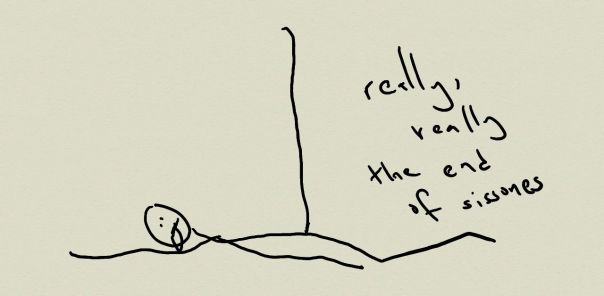
Pretty much how I’m feeling, minus any actual sissones.
I was particularly sad to miss this session, as KW from the company–AKA my Ballet Spirit Guide, since I inherited his tights last year–came in to teach class and do some cleaning and polishing of The Piece.
I hope the girls were okay without me.
Except possibly for the bits with C, I think it’s not too hard for them to mark through the partnered sections.
Meanwhile, I’m not usually very important to their spacing, while their spacing is critical to my ability to do my part. I’m forever running through flocks of girls in this piece, so if their spacing is off, it starts to look a bit like sportsball-sans-ball.
Anyway, while this was certainly the second-worst gastrological upset I’ve had (the worst, bar none, was the time I ate some bad shrimp when I was eighteen), I realized yesterday whilst contemplating my fate at the foot of the porcelain throne that it’s actually been quite a while since anything made me puke.
Also, despite being fairly dehydrated, my resting pulse yesterday clocked in at 53, which is pretty nice, and my blood pressure was 100/60, which is about typical for me. I figured my vital stats would be all over the place, but they were fine.
So that’s it for now. I’m planning to attempt to eat some yoghurt, after which I’ll probably resume “listening to podcasts,” also known as sleeping. BW’s class is cancelled tonight, conveniently for me, so I feel no great pressure to attempt ballet heroics.
I … think? … I’m done with auditions for the rest of the month, at this point.
Yesterday’s was actually rather a soaring success, except for my usual habit of forgetting some bit of the modern combination and faking my way through that part so I could get to the next bit, then remembering it right after … but there are two thoughts that cheer me up.
First, nobody had the combo down cold. We all missed bits and pieces.
Second, that’s one of the skills they’re looking for at dance auditions. What happens when you fall off the script (because it happens even to top-tier dancers)? Do you freeze like a deer in the headlights, or do you roll on just as if you’re doing exactly what you’re supposed to? (Bonus points if you can fake your way through well enough to make it look like everyone else was wrong. I don’t think I accomplished that, yesterday, but I didn’t freeze, either.)
The dance improv bit was, of course, a blast, because I love improv.
The trapeze bit went pretty well despite the fact that apparently whatever demiurge manages music for trapeze auditions believes it’s great fun to mess with mine. I recovered from that and had to improvise a fair bit, but it turned out rather well. And, of course, I didn’t fall off the trapeze this time[1].
Once again, at this audition, they’re not necessarily looking for a polished cirque-style act: they’re looking for expression, musicality, and the ability to command the audience’s attention (and also sound technical elements, obviously). The piece that I showed is one I’m slowly working on set to the Indigo Girls’ “Kid Fears,” and it’s intentionally struggly, so it probably didn’t really hurt anything that I was, in fact, wrestling with my own choreography (much of which I didn’t apparently remember).
The acting part was flat-out awesome, and reminded me how much I actually really like acting, my anxiety about struggling to memorize scripts notwithstanding. Maybe what I really like is cold reading. Who knows? Anyway. I really liked the part they handed me, and ran with it.
Today’s audition was also lovely. Almost nobody showed up, so it was really just three of us mostly doing some improv stuff. I already know that our AD likes the way I improvise, so that was just pure fun. I showed the bits of my piece that I could, given my lack of a partner, and described the idea as a whole. Both our AD and the guy from U of L whose group we’re collaborating with liked it, so it looks like it’s a green light there.
My next audition is a couple of weeks away, and I’m happy to have a bit of a breather. The stretch from the past couple of gigs through now has been pretty intense.
Not that I’m complaining. The other night I was kvetching about some company-related annoyance and suddenly though something like, “Oh, hey. I’m complaining about work because that’s what we do. If it wasn’t a pain in the *** sometimes, it wouldn’t be work.”
And that actually felt, in its own way, rather lovely: like, this is my work, and it’s work that I love. And I think I’m becoming rather good at it. Maybe not world-beatingly good or anything but, you know, serviceable. Which has, to be honest, always been the goal. As a ballet boy I’m smallish and muscly and I bounce like a rubber ball, which puts me squarely in the demi-character camp, and I’m fine with that. Not everyone always has to be the prince (and, honestly, there are a lot of ballets in which the prince never gets to do anything cool outside of the pas de deux). As a circus artist, I’m reliable, adaptable, and versatile: not a specialist, but a generalist, and the kind of generalist who can pinch-hit almost anywhere.
I feel like that’s a good thing to be. I’m not here for glory: I’m here because I love to move; because I can’t not move.
And if sometimes that means I’m stressed out and hounded from pillar to post … well, that’s part of it. That and Auditioning for Poverty are pretty much hallmarks life as a dancer, or indeed as any kind of performing artist, or indeed possibly as any kind of artist.
You do the Work because the Work is what moves you … sometimes more literally than other times.

“Dear heavens, it’s 8 AM already,” he said.
Or, at any rate, he tried to. What came out, instead, sounded more like, “Mrrrghghhhh.”
*****
You’ve probably guessed that today wasn’t the best day I’ve ever had in class. I don’t think it’s so much the getting in at 1:30, which isn’t the end of the world really, or the getting up at 8 on slightly less than 6 hours of sleep.
I suspect that it was the combination of NyQuil (taken to fend off a sinus headache and extra congestion brought on by dry air and so forth: not sleeping was not a viable option) and getting up at 8 on slightly less sleep than it would’ve taken to give the NyQuil time to wear off.
Possibly adding Adderall, a further decongestant, and a cup of coffee to the mix this morning wasn’t the greatest idea.
On the other hand, I made it to class without dying, killing myself, or forgetting my shoes, so there’s that.
At any rate, I wasn’t alone. In one way or another, everyone was heroically Living The Struggle this morning, including L’Ancien, who was mysteriously detained (he apologized profusely).

I searched Pexels for “struggle” and this was the only result. Close enough.
I do think, however, that I was the sole member of the class who began barre with legs that trembled like the voice of an ancient soprano on Easter morning.
Even standing in fifth was, erm, challenging. I mean, standing in fifth is inherently challenging, and some days your body does it better than other days … but I can’t remember any other specific day on which the challenge in question involved, like, vibration.
So that pretty much alerted me to the fact that it was going to be an interesting class.
By the time we got to the section of our highly-compressed barre that I’ll call “fondu de rondu,” the trembling had stopped. I was grateful for that, and because frankly it was, in fact, a little frightening: imagine balancing, for example, at passé in the midst of a rolling earthquake, for example.
However, the end of the tremors and the lovely high extensions that showed up out of nowhere (and with no conscious effort on my part) conspired to lull me into a false sense of security.
I should’ve realized it when I could tour lent in the mark, but not in the actual run. Obviously, something was rotten in Denmark.
Still, I bulled my way through the adage, through some not-great turns, and through the little jumps (in which I made L’Ancien a little happy by actually jumping, which his the one thing I can do reliably, almost (see below).
And then came the grand allegro. It was simple: pique, chassé, entrelacé, failli, tombé, pas de bourré, glissade, grand jeté, then four more grand jetés just for the hell of it, en manège.
Except when L’Ancien gave us the combination, somehow my amazing brain decided that the first phrase (pique, chassé, entrelacé) was performed left, and that it changed directions via a fouetté or something.
Evidently that wasn’t at all correct, and I can now tell you that it’s quite alarming to fund that you are unexpectedly grand-allegroing yourself towards the person on the next corner and yet, simultaneously, that you can’t seem to make yourself stop…?
That’s not where the mystery comes in, though.
The mystery is that we ran it again, and I did the same thing.
I DID THE GRAND ALLEGRO BACKWARDS TWICE, YOU GUYS.
So, all told, far from the best class I’ve ever had. Not quite Depths of Despair quality, just a whole lot of WHAT IS WRONG WITH ME THIS MORNING?.

I have only two questions: Why me? Why now???
To which the answer is obvious. I’m cooked, and perhaps too many drugs. In short, the equivalent of taking class with a hangover, minus the headache.
At any rate, I’ve managed to eat some lunch and now I’m thinking about having a lie down before my audition (though, at present, only thinking, because I’m horrible at taking naps and I’d really rather just power through and get it behind me).
Here’s hoping that things will go a little better this afternoon. We’ll see, eh?


YouTube: BOSU Balance Series


 danseur ignoble