Category Archives: partnering

Remember: You Are A Prince
Tonight we premiered three new works.
I danced a principal role in two of them, with two excellent partners.
I made a tiny mistake in my first piece that the audience didn’t see (my brain skipped ahead and my partner saved me from myself right away ^-^’), and an angel press didn’t quite get all the way there because I let a wardrobe malfunction distract me (my trousers ripped — good thing I kept my tights on under them!), but other than that it was quite possibly the best performance I’ve ever given as a dancer.
I felt confident. I felt strong. I felt connected to each of my partners, to the music, to the corps, and to the stories we created with our movement.
In short, I felt good. I felt present.
~
Afterwards, I had this moment that felt like a little series of windows in time had opened up.
For a heartbeat, I caught a glimpse of a long-ago me from a terrible time in my life; a me that couldn’t believe that he would ever dance at all, let alone like this. A me that politely demurred when someone suggested auditioning for the dance program at Academy (the arts magnet that I did attend, although I didn’t major in dance) because the thought of not making the cut felt like a knife twisting in my heart.
A me that honestly didn’t believe I’d make it to the age I am now. A me that didn’t even really believe that I’d make it to my next birthday.
For a heartbeat, I saw a slightly older me — the me who couldn’t follow up on a friend’s suggestion that I drop in at a local ballet company’s school. I still couldn’t let myself hope. I still believed both that you cannot return, once you leave the country of Ballet, except as a tourist, and that I probably wasn’t really good enough — that I had the physical aptitude, but not the brains.
For an eyeblink, I saw myself, raw and just a little bit hopeful, a college student finally setting foot in the studio again, cradling in my heart of hearts the dimmest hope that somehow, maybe, I might find a way to dance, even just a little.
For a breath, I saw the dancer that I was towards the end of my first year as an apprentice at Lexington Ballet, stubborn and determined, but also frustrated and so, so afraid I’d never figure it out.
I wanted to reach back and say to them — to all those iterations, all those past selves, so to speak — Even now, we’re making it. We’re getting there.
A couple of years ago, my friend BG told me, “You will dance, and you will do great things.”
And tonight I danced, and tonight I think my company made something great and beautiful.
Tonight I danced a pas de deux that ends with me carrying my partner off the stage, and as we vanished into the wings, the audience responded resoundingly. I heard a voice shout, “Bravo!”
That’s no small thing, on a Thursday night in a city where people don’t see a lot of ballet, and really don’t see a lot of contemporary ballet. (That pas was in the closing ballet, which is quite contemporary.)
Reader, none of that is the main reason that I dance: I dance because dancing is where my soul, or whatever you want to call it, thrives. It’s where my heart feels whole.
But I’d be lying if I said that it was anything less than amazing to know that you’ve captured this room full of strangers and brought them with you on your journey and actually moved them.
~
At the end of the day, besides the dancing itself, it blows my mind that I am part of this company: that I’m valued and wanted; that I have friends at work; that I get to spend my working days creating art with these vibrant, singular people.

It blows my mind that I’m living this life.
The sense of gratitude is impossible to articulate. So much of my life right now is a prayer of thanksgiving that, even in the hard and dark and troubled times we’re living through, somehow there’s room in the world for art and for artists, and somehow I’m one of them.
This night is a golden night. My heart and soul keep thrumming with a deep kind of contentment.
I think: so this is how it feels to be in the place where, not too long ago, you hardly dared to dream that you might someday be.
Right before I went on for the first time tonight, standing in the crossover behind the stage, I took a deep breath and repeated something that L’Ancien told me time and again in class. Simply: “Remember: you are a Prince.”
He would say this to me when I was struggling and getting into my head and getting in my own way. Just, “Remember: you are a Prince.”
Tonight, I was a classical prince in foofy Regency-revival sleeves and a velvet waistcoat and tights and a contemporary prince in 50s (60s?) Greaser gear, with my t-shirt sleeves rolled up and black trousers (that almost made it to the end of the show).
What links the two is the decision to believe, for this moment, that you deserve to be here.
That and my hair, because 10 minutes isn’t really long enough to un-shellac your hair and turn a buttoned-down Edwardian ‘do into a passable DA.

PS: Counting the five in the Noir finale, there are about 20 lifts distributed between the pieces I did tonight (10 in the main Silver pas; five in each finale). And excepting the angel press that didn’t quite make it (see above) they all went well by any measure, be it metric, Imperial, or SAE.

DuCon, Summer 2023
First, I wish I’d tracked down the dates for this year’s DuCon before I scheduled the SI that I teach, because I would have loved to have been here for both weeks.
Second, I got sick, so I couldn’t attend classes today and won’t be able to perform tomorrow, but even still it’s been entirely worth the investment.
First, the instruction is excellent. The instruction offered by not only Mr. Du, but his entire teaching staff, is worth the price of admission, and the other dancers in attendance have been uniformly kind, generous, and incredibly hard-working.
For me, at this point, a lot of what I need is refinement of what already exists, and I’ve received a ton of that over the course of this week.
I’ve also had the opportunity to learn three variations, a pas de deux, and a lot of character dance elements (which is great, because character dance is now the biggest missing piece in my ballet skill-set).
Learning that much choreography is huge. I’ve often struggled to pick up while working with SPDC. Presumably, that mostly comes down to the difference in vocabulary and our struggles to stabilize a regular rehearsal schedule, but I’ve secretly worried that maybe I’d somehow lost my ability to pick up.
It took about 30 or 45 minutes to learn the pas de deux, some details notwithstanding. We learned two variations on Monday and a third on Tuesday, and I didn’t feel like I was at sea in the least.
So, in short, my balletic brain is still working. Likewise, my body is still willing and able to do the work.
Likewise, I’m feeling pretty solid in terms of partnering skills.
Mr Du paired me with a dancer from Alaska for pas de deux, and she’s been a delight to work with. We’ve danced well together from the word “Go,” which always feels like a lovely gift from the universe, but which also says a lot about us as dancers.
Partnering is entirely relationship-based. You can know how to execute the steps, but if you don’t listen to your partner, that doesn’t mean a thing.
So the thing I’m happiest about is that my PDD partner thanked me for being a good partner, because that means the world to me. She has been a great partner, and I really hope we’ll get a chance to work together again.
When I began dancing with LexBallet, I was missing a lot in terms of partnering skills and experience. I think knowing that was helpful: when you know how much you don’t know, it’s easier to take instruction and learn.
Every dancer I’ve partnered since then has taught me a lot, and I’ve been lucky to have some great coaching, and every time I have the opportunity to partner somebody, I try to live up to the gift that my coaches and partners have given me.
It’s wild to look back on my earliest efforts, which in the grand scheme of things were only a few years ago (adjusting for Pandemic Time, since pas de deux was less accessible during the height of the pandemic), and realize how far I’ve come.
Partnering, it turns out, is the thing I enjoy most in all of ballet. I’m forced to admit that I might even enjoy it more than grand allegro.
I’m immensely grateful to find that I’m becoming rather good at something I love so much; that I’m evolving into someone who my fellow dancers regard as a trustworthy partner.
A couple weeks before I headed to DuCon, my friend T and I were playing around in the studio, improvising and inventing weird contemporary partnering stuff. They wore pointe shoes through much of this and trusted me with all kinds of weird and unusual lifts and weight-shares and melds.
A from Alaska trusted me, en pointe, with some big lifts and a tricky sequence involving a series of chaînes directly into an attitude promenade that in turn went directly into a penché in which I employed a sliding arabesque à terre to make room.
It’s hard to explain how sacred it feels to be given that trust.
A dancer’s body is both their precious instrument and the locus of their artistic voice, and to be trusted to care for another dancer’s body through difficult and complicated partnering steps is an ineffable gift.
It feels amazing to be considered worthy of that gift. It feels amazing to have confidence in one’s own ability in this way.
I’m not a world-class dancer in the sense that I’m never going to make the cut for one of the big companies like ABT or PNB or NBC[1].
- That’s National Ballet of Canada, not the TV network.
But I don’t actually care about that.
Fame and renoun have never been my goals. I just want to work in dance, and I’m doing that. I like working in small companies, and I like the sense of camaraderie that grows between dancers who work together.
But I do want to be a good partner; maybe even a world-class partner. I want to be a good enough partner that, somewhere down the line, I’ll be remembered that way. I want to be good enough to deserve the trust of my fellow dancers.
I’ve also made some new friends and I suspect some creative projects might just coalesce out of this group of kind, vivid, and brilliant dancers, along with others I’ve met at other intensives and through my work as a dancer and teacher.
On our last day of high school, my AP English teacher gave everyone in my class a card.
Each card was different and chosen specifically, individually, for the student who received it.
Mine was in the shape of a swan. Inside, my teacher wrote, simply, “Find your way.”
I kept that card for a long time, though I’ve since lost it. But I think about it a lot.
Anyway, I’m incredibly grateful to Mrs. Wachtelhausen for those words of immense wisdom at a time when I was still pretty lost.
And, in short, I think, little by little, I’m finding my way.

Something’s Happening!!!
You know those soundbytes that your brain makes from experiences in your own life and then plays back every time you hear some kind of trigger word or phrase?
“Something’s happening!!!” is one of mine. My friend Mal, who is one of the most amazing people I’ve ever known, once shouted this during a particularly complicated group acro thing, and it so beautifully summed up the moment: like, “Something is happening! Is it the right thing? WHO CARES!!! IT’S A RESULT!!! YEAHHHHHHHHH!!!”
If I remember correctly, what was happening was, in fact, the thing we were trying for, so that’s also awesome, but the best part was just the sheer excitement that ANYTHING was happening ^-^
Anyway, it was just one of those really great moments.
As is this.
Yes, COVID-19 is still a thing. We’re still dancing in masks in most circumstances and so forth. People are still getting sick and dying, and I don’t want to make light of that.
But, at the same time, the world of the performing arts and of the movement arts is slowly, cautiously resuming operations.
This week, I’m taking the Louisville Ballet School’s second-annual Adult Summer Intensive. Thus far, it’s been flat-out amazing. I’ve hella missed starting my day with class in a room full of dancers, then spending the whole day at work in the studio. It’s so good to be doing it now, and it’s a great group this year–14 of us doing the full-day program, plus an additional handful doing the half-day version.
Next week, on the 11th, I’m teaching a workshop for aerialists (and other movement-based performers who might not have a strong dance background) specifically on What To Do With Your Hands. Honestly, given my history as a Ballet Squid, I’m both deeply moved that people actually asked me to teach that specific topic and also deeply amused. Honestly, though, the fact that hands have historically been a biiiiiit of a problem for me is one of the reasons I actually feel qualified to teach this.
I am not, for example, all that well well placed to teach flexibility, because my entire approach would be, “IDK LOL MY BODY JUST DOES THAT *shrug*”
But since I’ve actually had to work at making my hands not do stupid and ridiculous things ALL THE TIME, I think I can actually offer some useful insights–like, “your hands will be more graceful if you think of them as extensions of your arms,” for example.
On the 13th, our preview production of Leigh Purtill Ballet Company’s CIRCUS OF WORLDLY WONDERS goes live (or semi-live). The show will have both pre-recorded and live segments, and there will also be a raffle and other cool fundraising stuff.
On the 17th, it’s PLAYTHINK TIME!!! I’ll be teaching my usual workshop, Move And Be Moved, at 6:30 PM on Thursday and performing an original piece with my friend Emma in the main-stage Flowcase, which begins at 8:30 PM on Friday.

Emma has, by the way, been a fabulous partner. She came into this with no real partnering experience, but has been incredibly game about trying everything. We also take regular breaks to act like a couple of five-year olds, which is super important to the partnering relationship IMO.
In July and possibly August, I’ll be teaching at Summer Intensives, and beginning rehearsals for LPBC’s next show, Sweet Sorrow: A Zombie Ballet, in which I get to be a werewolf (AWOOOOOOOOOO!!!).
I also have a bunch of short gigs with Turners’ Smile Parade, which is an awesome sort of pop-up circusette that visits nursing homes, schools, birthday parties, and so forth, and I’m hecking excited about those, because frankly they’re SUPER fun ❤
I may or may not find a way to jam another SI into my summer, though who knows? Right now, I’m feeling pretty booked, and like perhaps I shouldn’t add anything because I need to leave room to, like, actually breathe and relax and put my feet up before I dive into what is somehow the THIRD YEAR of my ballet-teaching career and the … fourth? year of my ballet career.
Tonight, though, I’ll be sliding into the bathtub for a little R&R before I crawl into bed. My body feels great (if a bit tired) right now, but 6ish hours of dancing, followed by an hour pushing the lawn mower around, can take a toll, and a bath will help put things right.

We’re Kinda Back?
We’ve still got a long way to go before we can say the Pandemic is really under control, but little by little life is finding a way[1]. I’ll be adding things to my calendar soon (possibly tomorrow, though it’s our anniversary, so who knows?).
- Ahhhhh … 90s Kid references.
So, anyway, I’m doing some things—some live-in-person, some virtual.
One of those things is this great little ballet that Leigh Purtill of Leigh Purtill Ballet Company is creating on a group of dancers spanning the North American continent, “Circus of Worldly Wonders.”
Since my own career spans the continents of ballet and circus, I’m all in for a circus-themed ballet … And so I created this little video exploring a bit of the entwined histories of circus and ballet:
I hope you’ll enjoy viewing it as much as I enjoyed making it! 💖

Remedial Partnering: Strategies
I have no qualms about stating up front that my partnering skills are, well, roughly at the level that would, if this was a university class, require one of those 094-level classes (I can see it now: “Partnering 099: It’s Always The Boy’s Fault”).
I’m good enough at this point that I wouldn’t have to take “Partnering 088: Whatever You Do, Don’t Drop Her!” … but I’m definitely still rough around the edges.
Anyway, in the interest of offering some help to my fellow Remedial Partner…ers, here are some strategies that do and don’t work:
DON’T
- stand too close
- stand too far away
- get nervous and slowly collapse closer and closer, drawing your partner into your collapse like the heavier star in a binary system, leading to a cataclysmic supernova
- panic about every single turn, every single time
- panic about any turn, ever, for that matter
- trust me panicking really doesn’t help
- go walkabout mid-promenade because your eyes are pointing the wrong way (I know this is groundbreaking info but amazingly a promenade should be a circle, not a square)
- fail to communicate … partnering is basically sustained communication, ideally with fewer words but, you know, better to speak than to do something dumb
- panic about penchés
- panic about steps you were doing fine yesterday
- fall into weight-sharing mode … weight-sharing is great, but it doesn’t work for a lot of ballet things
- panic about … anything, really
DO
- REMAIN CALM
- feel out a good distance for various steps
- learn how to be there on time
- let your partner do her end of things
- talk through your dances together
- mark through your dances together
- walk through your dances together
- run all the things until you can’t get it wrong
- but make sure to stop before you both get super tired
- REMAIN CALM srsly it’s better to be Prince Valium than Prince Panic
- be willing to swap a step out for something simpler if you’re on a deadline and you’re having a rough time—it’ll build confidence, and eventually you’ll get the harder step, but that way you’ll know you’ve got something you can take to the stage
- COMMUNICATE! today we both kept going, “Okay that felt weird” from time to time, and discovered that what felt weird to one felt weird to the other (we’re also getting better at sorting out the why)
- ask for help … we’ve been super lucky to have not one, but two very experienced coaches step in to help because they want to see us succeed. Asking for help is scary, but it’s such a good idea.
- believe that you can do it … like horses, ballerinas can sense fear 😅
- and, of course, REMAIN CALM
That’s it for today. I have still neglected to take any photos, so I’m sticking in a screenshot for the featured image 😅

Partnering: It’s Ballet, Asher
For the longest time, the number one correction I got in any dance context other than ballet was, “It’s not ballet, Asher!”
Now, I’ve finally come full circle.
After rehearsal, L and I have been working on partnering stuff together, since we both want to get better at it. This has led me to realize that the sheer volume of non-traditional partnering I’ve done has been tripping me up in a ballet partnering context.
A lot of modern partnering is based in weight-sharing. You can share weight concentrically or eccentrically—in short, by pouring towards or away from your partner or partners—but either option involves a kind of nonverbal negotiation of balance.
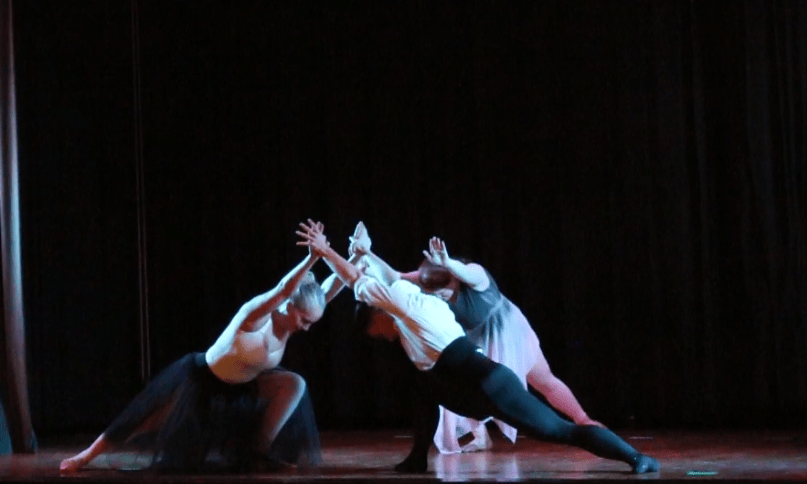
Unless you know your partner really well and you’ve developed a strong rapport, you begin slowly.
If you’re “weighting-out,” you tentatively pour yourself away from your partner, feeling for an equal and opposite pull.
If you’re “weighting-in,” you tentatively pour yourself towards your partner, feeling for an equal and opposite push.
It’s this push-pull dynamic that gives partnering based in weight-sharing its beautiful fluid quality. As partners learn to work together, they practice conversing in a language of shared gravity—moving smoothly and silently from “weighting-out” to “weighting-in” and vice-versa.
As they learn to trust each-other and to know each-other’s weight and movement styles, the negotiation process can become so fast and smooth that it becomes invisible to the audience, but it’s always there and it’s always the same.
This is not how ballet partnering typically works.
In ballet partnering—and please note that I’m referring to the traditional, gender-specific roles for clarity, here—the girl isn’t looking for the boy to answer her weight with equal weight. She’s looking for him to be a rock-solid foundation; a kind of balletic buttress.

If you’re used to weight-sharing, you answer lightening with lightening: when your partner gives you less of her weight, you give her less of yours. Likewise, you enter into a pushing dynamic gently: it’s easy to pour too much weight into someone too fast and to knock the whole structure over.
In a ballet context, if your partner feels that you’re supporting her too lightly she tends to respond by taking her weight out of your hands to protect herself. If you’re used to weight-sharing, you’ll automatically respond by lightening and softening your contact, because that’s the typical process of negotiation.
The thing is, that’s not how ballet partnering works at all.
In ballet partnering, the girl offers her weight with the expectation that it’ll be met firmly—as if you, her partner, are a living barre.
Chances are good that if she hasn’t worked with you before, she’ll be light in your hand, so to speak: it is in her best interest not to rely too heavily on you until she’s sure that you’re up to the job.
So, basically, the least useful signal you can send in that moment is exactly the one you’re most likely to automatically send if the vast majority of your experience has been in weight-sharing.
If you respond to the lightness of her touch by offering light support, because the instincts developed through weight-sharing make you feel like you’re going to knock her over otherwise, she’ll won’t feel secure, and withdraw. If her withdrawal leads you to automatically lighten even more, she’ll also withdraw further.
It won’t take long to reach a point at which you’re not a support, but an obstacle: something she’s trying not to whack with her knee or her leg when she turns, for example, but which isn’t actually helping her turn. Needless to say, if that happens, you won’t be able to accomplish much together.
Be steady and firm, and she’ll give you more weight, so she can do the cool stuff that ballet partnering allows. She’ll also be more likely to trust you when you lift her.
Once you get past the negotiation bit, of course, things work pretty much the same way: you don’t want overpower your partner[1]. You just want to be steady and lend her just enough of your gravity and (where appropriate) your momentum or force.
- Even in lifts: you can lift another human using only your own strength, but most ballet lifts work best if you work together.

The real difference is that in weight-sharing, every movement or sequence of movements begins with and depends on a negotiation that equalizes gravity between the partners.
In ballet partnering, there is an initial negotiation, but it’s a different one. The girl silently asks, “Can I trust you to hold me up?” and the boy must answer, “Yes, I’m here,” or things aren’t going to work.
The remaining negotiation process in a ballet context is, as far as I’ve experienced, more about figuring out the physics of your specific bodies. How do you get yourself out of the way of her knee? How much liftoff does she need to help you get her into an overhead press lift? Where is her center of gravity? How does she compensate for your short li’l t-rex arms?
So, anyway, that was the breakthrough of the week for me. It’s one of those things that seems like it should be bindingly obvious—and yet I had grown so accustomed to the process of weight-sharing that I didn’t realize I was doing this unhelpful thing until this Friday.
I don’t know if any of this will be all that helpful to anyone who doesn’t share a similar set of circumstances to mine—but I hope it’ll be at least somewhat useful.

Rough
This week, on Thursday, we began work in Act II of A Midsummer Night’s Dream.
It is, to say the least, a baptism by fire in terms of partnering. Act II is basically all about the “We’re all getting married and happiness is restored even in the fairy kingdom,” and here I am like, “Feck, well, guess I’m going to learn to not suck so much at partnered turns now.”
But, holy hell. The amount of new material I’ve crammed into my head and body in the past two days is … Erm. It’s a lot.

I’ve been frustrated with myself for not picking some things up as well as I could. I think just not having time to review last night was part of it, and of course just being kinda stressed makes learning harder, which makes you more stressed, etc.
Anyway, I have 3 weeks to look like I know WTF I’m doing, and I’m going to effing well make it happen.
But for now it’s rough, and today I was stressed out and generally mad at myself for the entire day.
So tomorrow will be better. And the day after that will be better. And in three weeks, I will have this down, and I hope I’ll be a partner worth dancing with.
Until then, I’ll try to remember to post my class notes from time to time, but it’s about to get real up in here.


Ballet Lessons: Stay Together
Have you ever seen the entrance to the Kingdom of the Shades (from La Bayadere, one of the “White Ballets” of the classical cannon)? Or the first breathtaking appearance of the swans in a large-scale production of Swan Lake? Or the Snow scene from Nutcracker?
I mean, that’s probably a given. You’re reading this blog, and that means you have internet access and are probably at least a little bit interested in ballet, so that means you can at least watch them on YouTube, probably. (If you came via one of my bike posts, hi! and I’ve got a couple for you, too: a big group ride sweeping around a corner or a tight paceline swapping pulls).
These are some of the best-known scenes in ballet, and with good reason: they display the fundamental truth that there’s immense power in a group of individual people working together.
The entrance of the Shades might be the keenest example.
The dancers enter one by one, in a long line that will eventually double back on itself. They perform the same simple (not easy: simple), repetitive phrase over and over: arabesque (penché, in most versions), temps lié to posé tendu devant, step step, repeat.
They are not massed in a cloud, as the corps so often is. They are not aggregated in attractive little clusters, or in coruscating diagonals, or in opposing echelons. At least, not at first.
Instead, each of the Shades is essentially alone—and yet she’s also part of a whole.
The repeating phrase is nice enough on its own, but nothing you’d necessarily be transfixed by for minutes on end (or, indeed, for one minute on end, unless you’re busily analyzing technique, I guess).
The repeating phrase performed by an ever-lengthening (and eventually redoubling) line of dancers, on the other hand, is mesmerizing. It’s kaleidoscopic.
It evokes an ethereal, otherworldly atmosphere even (or perhaps most effectively) when performed against a plain backdrop, with no set except a ramp upon which the advancing shades descend.
This simple phrase, without a single iota of elaboration, becomes a symphony. But it only works if the dancers stay together.
Indeed, it works because the dancers stay together.
At the height of the sequence, the redoubled chain of dancers (still executing the same phrase on the same leg) becomes … Oh, I don’t know: a restless sea; a moonlit, windblown fog racketing between two unseen hills; the very breath of the audience.
Choose whichever metaphor suits you: either way, it becomes one thing; one thing made up of a staggering array of smaller things.
But only if the dancers stay together.
~
This is where I am in my life. I spent so much of my life standing apart that I came to believe, on some level, that it was somehow better.
Participate, I thought, but don’t join.
Or, join, but not because it’s inherently good to be part of something.
Join because it’s how this thing works: but retain a measure of reserve about the very idea of joining. Remain aloof.
If you remain aloof, the unacknowledged subtext would have read, you can’t be caught off guard and hurt when, inevitably, you’re rejected. (Lessons learned in childhood die hard. When enough people have told you, no one really likes you and no one will ever like you, you come to believe it.)
And yet, as the company has transformed into a place where I feel welcome, bit by bit I find that I want to belong.
That the more I begin to feel that I want to be part of this group—that I like the people in it and the group itself and not just the work we’re doing together—the better I actually seem to dance.
When bikes were my life, I loved—loved—the incomparable symbiotic feeling of sweeping around a curve in a flock of bikes traveling at speed.
As a singer, I have always loved choral harmonies more than anything.
Even as a dancer, I love those moments of pure synchrony, especially in grand allegro (here are four separate bodies flinging themselves violently through space, and yet we are one thing because we are all doing this together!) or in partnering (the best moments, for me, are the ones in which each move seems to flow logically, even inevitably, from the last).
Why, then, am I still surprised to want to be part of something—to want, dare we breathe the word, to belong?
Ironically, I know I shouldn’t be surprised (my aloof, proud, defensive side feels downright affronted: “Of course I know that, man, what are you trying to say?!” …. to be surprised is to be less than omniscient; is to be vulnerable). Humans are social animals, and though I’m not always great at being a human, I am one anyway. Neurologically speaking, even I am wired for belonging.
Of course I want to be part of something, even if the something in question is so obscure that a great many people literally don’t understand that it exists.
(Seriously: there are a lot of people, right here in the First World, who have no idea that a professional ballet company is a thing; that we don’t just clean out the barn, rehearse a couple of times after work, and set up ticket sales).
But it surprises me anyway.
Not least, the knock-on effects: when you start cracking open the door to let people in a little—because, here’s the thing, that’s how you do The Belonging—you find that you try new things that the other people in The Thing to which you’re learning to belong like. It’s transitive almost: I like A and A likes Lizzo, therefore maybe I will also like Lizzo.
You discover music you’ve never really given a second glance before (or you discover who makes music that you’ve low-key liked for a long time but haven’t known who to ask about it). You take a risk and wear something ludicrously silly on Pajama Day—like a hoodie with a sparkly pug with antlers on it (I’ll have to get a picture; I can’t even begin to explain this one).
You say hi first once in a while.
You begin to listen without feeling like you might, at any moment, have to defend yourself.
You begin to talk. Just a little: but then one day you realize you’re having, like, a whole conversation. OMGWTFBBQ, IKR?
And you begin to learn that it feels good to be even a little bit on the inside of something.
You begin to realize that it’s okay to want to feel that. That being on the inside isn’t the same as being one of the people who, back in the day when you were a kid, did everything to ensure that people like you stayed out.
You begin to want to stay together because although you by yourself are just fine, the group is another thing, and it’s a really cool thing.
You begin to realize how much it helps to be a unit.
That (apologies to Kipling) the strength of the corps is in the dancer, and the strength of the dancer is in the corps.
I mean, not that it’s all roses and sunshine, etc. But this, for me, is a new feeling. Realizing that part of merging into the group is being willing to merge; is wanting to merge.
Just like the dancers in the Entrance to the Kingdom of the Shades, we do not surrender our individual strength to join the group.
Instead, we continue to dance on our own legs.
But we dance on our own legs together.

Shea Butter Deodorant!
I’ve been babying a minor ankle sprain so it won’t turn into something worse before the Gale Force show at the end of the month, but it’s starting to feel a bit better, so yesterday I did some dishes and made some deodorant.
Why deodorant?
A] As previously established, I’m a sweaty beast, and using deodorant is simply the polite thing to do if your job involves manhandling[1] other humans. It allows my partners to work with a merely sweaty beast instead of a sweaty, stanky beast.
Nobody … or, well, almost nobody wants to dance with someone who smells like an entire disappointment[2] of teenage boys. Or, at least, not in this context.
- In case you’re wondering, this was an actual direction for a dance I’m learning right now: “Just really manhandle her” 😁 Apparently my natural partnering style is quite gentle 🤔
- I’m not sure what the right aggregate noun is, but I bet any number of parents would agree that “a disappointment of teenage boys” sounds about right … Or maybe a disagreement?
B] There’s a brand of deodorant that I really like that uses the same set of ingredients … But it costs $10/tube and I’m a bit skint, as it were. (America really needs to adopt the use of the word “skint.”)
C] It looked really easy, and I needed to accomplish something because I’ve been struggling of late. Like WM says, don’t even bother with a double-boiler. I made my batch right in a jelly jar.
I followed Wellnessmama’s recipe for share/coconut oil deodorant fairly exactly … which is to say that I was a bit cavalier with my measurements in that I didn’t obsessively level the shea butter or coconut oil.
Apparently I haven’t decided whether I want to smell French or Australian, because I added lavender and eucalyptus essential oils. That said, I kept the amounts very small, because strong scents are deeply unwelcome in the dance studio.
Anyway, here’s the end result:

Shea Butter/Coconut Oil deodorant, version 1.0
It turns out that this formulation won’t stay solid in this climate (at least, not in a house without central aircon), so I’m going to remelt it and add more shae butter so I can transfer it to a deodorant dispenser tube.
That said, I tried it yesterday, and it works a treat. This is a deodorant rather than an antiperspirant, but I haven’t noticed that I’m any sweatier using this than I am using my usual commercial antiperspirant.
I might stay dryer using a “clinical strength” antiperspirant, but of late they tend to give me hives, which leaves me rather disinclined to use them.
I’m now wondering:
- Can I make deodorant out of cacao butter?
- If yes, will it just make me crave chocolate all day?
So that’s my next bit of DIY deodorant research.
I’ve got some reusable deodorant tubes that I’ll be using to make a portable final product, and I ordered some smaller-size tubes as well so I can make portable Shae butter bars and cacao butter bars to give away at Burning Man.
Shae butter is a fatty acid with lovely soothing qualities, but it remains solid even at pretty high ambient temperatures, which makes it the perfect antidote for Playa Foot, which is caused by the extremely alkaline dust of the dry lakebed that is the Playa.
I haven’t tried using cacao butter on the Playa, but I suspect it’ll be great, too. It stays harder than shae, however, so I might need to blend it with something like coconut oil to lower the melting point a little.
That said, cacao butter will happily melt if you leave it in a hot car, so maybe I’ll maybe some pure cacao bars so people can leave them in their hydration packs with less danger of creating a permanent chocolate-scented oilstain. Hmmm.
I’ll have to think about that one.

Onward and Upward
Thing the First: I’ve submitted my contract for next season with Actual Ballet Company. It’s going to be interesting, as it looks like the roster is changing quite a bit. I’m not sure how many boys we’ve got for next season.
Thing the Second: last week I had a very nasty surprise cold. It completely knocked me flat for several days, but I seem to be better now. Yay?
Thing the Third: I’ve begun work on my piece for PlayThink and my solo piece for GFD. My friend DS kindly agreed to be my partner for the PlayThink show, since I apparently traumatized Denis by making him improvise last year and he doesn’t want to do it this year 😀
I’m actually quite happy to be working with DS, because she’s a fabulous dancer and, more importantly, loves performing as much as I do.
She also is totally fearless about partnering and she taught me a new lift yesterday:

It’s possible that my arm (the one you can see) is supposed to go over her leg, though.
Just in case you’re wondering, I don’t always partner in a mask. There’s a reason I’m wearing the mask, but IT’S A SECRET so you’re just going to have to cope. Time reveals all, or at least mostly all.
I don’t actually know what this lift is called. It’s kind of an over-the-shoulder-whirly lift, but I’m sure that’s not its actual name.
It worked the first time we tried it, after which DS said to me, “You’re really strong!” That was a lovely surprise, as I’ve been sadly neglecting core and upper body work for a while (though I’m back to working on it now). I think part of it is that I’ve just had really excellent teachers when it comes to lifting things, especially people. The whole “lift with your legs” thing comes in really handy, especially when your legs are used to launching 160 pounds of strapping lad[1] into the air about a million times a day.
I’m also becoming, well, less bad at partnering promenades in passé, though I still think I look stupid[2] doing them. OTOH, I have almost a month to improve them.
I had some thoughts on technique that I wanted to drop in here, but they’ve apparently evaporated out of my brain, so I’m going to call it a day.
Notes
- I am trying to accept the fact that “strapping” is pretty much the adjective that best describes my build at this point.
- One might argue that as long as my partner doesn’t look stupid, I’m more or less getting the job done.


 danseur ignoble