Category Archives: healing

Things Left Unsaid

A long time ago, my Step-Dad said to me, “You won’t be able to keep eating like that when you get older.”

At the time, it pissed me off. I was like, What does he know? Who is he to tell me how I can and can’t eat?

And, in point of fact, there were a lot of things he didn’t know — which, if we’re really honest with ourselves, is pretty normal even for parents who live with their kids, and my Step-Dad wasn’t living with us yet at the time (in fact, he wasn’t even officially my Step-Dad yet, though he’d been in my life for several years by then). Kids are independent beings — the more so they older they get — and while it’s important to know the important stuff, it’s impossible to know all the stuff.

Anyway.

If I remember correctly, I was working my way through an entire stack of Saltine crackers, rabbit- (or possibly typewriter-)style: gnawing my way horizontally across the cracker, then back the other way, until each cracker was gone.

Basically that’s what I lived on during the day — Saltines, ramen noodles, Chunky soup, sometimes hot dogs, the occasional grilled cheese sandwich(1).

  1. True story: it took me until I was like 18 to figure out that if you put butter in the pan or on the outside of the bread, your grilled cheese sandwich will taste a bazillion times better. I persisted in not understanding this even though I regularly ordered clam rolls or hot dogs at Friendly’s largely because I loved what they did with the buns. Apparently, I imagined that this was some kind of unknowable Restaurant Magic. Seriously, childhood self: WTF?

I mean this, by the way, more or less literally. This was during a long stretch (read: my entire life) during which I found it nearly impossible to fall asleep before 2 AM and thus rarely woke up with enough time to eat breakfast; during which, to compound matters, I found most of the offerings of my school’s cafeteria singularly inedible (okay: in fact, I had never found school cafeteria food at all edible). Had it not been for the deli cart that sold little sandwiches on Kaiser rolls, I would have eaten literally nothing during any given school day.

So, basically, I would come home and shove Saltines (or ramen, or Chunky soup, or hot dogs, or… and almost always or rather than and, by the way) into my face because I was more or less starving. But, of course, my Step-Dad didn’t know that. He came from a world in which kids eat breakfast at home and lunch at school and maybe a snack in the afternoon. He had no way of knowing that one of those things wasn’t happening at all and the other was happening, but inadequately.

And I had no way of explaining any of this, because it was all just normal to me. I didn’t think there was anything weird about the fact that I never managed to fall asleep before 2 AM, for example — that’s just how it had always been. Your own normal is your own normal, and as a kid it’s not always easy to tell when your normal, like, maybe isn’t.

Normal, that is. It’s still yours.

Anyway. I digress.

So, basically my immediate response, because I’m a hot-headed little prick and frankly it tends to be my go-to, was anger. I did not welcome what felt like unfair and undue criticism from someone who still, at the time, seemed like an interloper(2).

  1. This wasn’t, by the way, his fault: I think he did a very reasonable job, under the circumstances, trying to integrate into a family in which it is both fair and actually pretty accurate to say that the kids had more or less been raised by cats up until then. In case you’re wondering, cats don’t do a great job teaching you how to human. I love cats, but in some ways they make lousy humans. Anyway, my sister and I weren’t having any of it.

In fact, all I heard was unwelcome criticism. I didn’t hear the part that went unsaid: that this guy, in fact, actually cared about me.

The content of the message, of course, is debatable in 2016, in a world in which we’re beginning to see the question of body diversity very differently than we did when I was 12 or what have you … though I suppose a steady diet of Saltine crackers is probably less than ideal from a nutritional perspective, at any rate.

Even in the last few years, we’ve really begun to rethink the way we approach nutritional issues with kids (if not, sadly, so much with adults). We recognize that, in a world already rife with soul-destroying messages about size and weight, we have to be really thoughtful about how we talk to them about food and body size and everything in that whole arena.

So surely there could’ve been a more body-positive way to have that conversation — one with a little more “Hey, Saltines are great, but you could probably use some hummus or something to go with them so you don’t get scurvy, because scurvy is going to make gymnastics/skiing/horsebackriding/dancing pretty hard,” and a little less, “Whoa, there, buddy — you’ve gotta learn to slow down, or you’re going to get fat when you’re older,” with all its unspoken implications about the validity of fat bodies.

But, at the end of the day, cultural baggage notwithstanding, there was that other, more important message — the one that’s so hard to hear, so much of the time, when the people who love us offer what they very sincerely intend as constructive criticism.

It’s the message that goes, “Hey, I want you to be healthy and happy, because I care about you, and I want you to avoid these pitfalls that I’ve fallen into myself.”

~

Things have changed a lot in the intervening years. My Dad died when I had just turned eighteen. My Step-Dad was an unexpected ally: he understood my hurt, my anger, and why I wandered around wearing my Dad’s Air Force jacket all the time. My Mom and Step-Dad married when I was nineteen (like so many other important events in my life, including my own birth, that involved a major blizzard: does anyone wonder why I scheduled my own wedding for May?). My sister and my Step-Dad reached a detente, then an accord.

I realized, most importantly, that my Step-Dad makes my Mom happy, and that they work well together, and that, in the long run, that’s what matters.

We are still a family that talks in ellipses; a family in which so much is left unsaid. After a while, you learn to kind of hear between the lines. You figure out that, sometimes, “Hey, you should put something warmer on,” really means, “I love you; don’t get frostbite.” That, sometimes, the Yankee stiff upper lip makes it hard to pronounce the words.

Not to say that everything’s perfect now. On our trip to Marco Island, I was kvetching about my eternal nasal congestion and how it makes sleeping difficult, and Step-Dad piped in with, “Especially when you get older, you should make sure to get checked for sleep apnea.”

From somewhere in the depths of my psyche, my preteen self awoke and bristled and almost said something like, “OMG DAD SRSLY?!!!”

And then I took a breath and realized that I was missing, once again, the thing that went unsaid: “Hey, I’ve had a couple of friends who’ve really suffered with this thing. I care about you, I worry about you, I don’t want you to have to go through that.”

I’m not sure if I gracefully said, “Oh, thanks, yeah, good idea, I will.” I think I said something more like, “Oh, yeah, I know a couple people with sleep apnea, it sucks.” I don’t actually remember, because I was really kind of busy being annoyed at myself for being annoyed in the first place.

But I hope that, whatever words made it out of my mouth, that my Step-Dad heard the things I left unsaid.

That he heard, “Thank you. I love you, too. That means a lot.”

For Peace

Right now my country is in a welter of anger, fear, pain, and (too often) recrimination. I don’t know what words to say about it; as with the Orlando shooting, I think other people have already said what needs to be said better than I could here.

Back in the 13th century, though, Saint Francis of Assissi wrote a prayer that encapsulates a lot of what I’m feeling right now. I first encountered it as a singer, and along with Tich Nhat Hanh’s simple breath-following meditation from Being Peace, it it one of the things that swims into my mind at difficult times like this one.

Even for those whose worldview is entirely secular, it says a great deal about how to be a force for peace in the world — not by giving money to organizations (which is okay, too) or agitating for change (which is also okay), but simply by being in the world. Anyway, here it is.

Saint Francis’ Prayer for Peace

Lord, make me an instrument of Thy peace;
where there is hatred, let me sow love;
where there is injury, pardon;
where there is doubt, faith;
where there is despair, hope;
where there is darkness, light;
and where there is sadness, joy.

O Divine Master,
grant that I may not so much seek to be consoled as to console;
to be understood, as to understand;
to be loved, as to love;
for it is in giving that we receive,
it is in pardoning that we are pardoned,
and it is in dying that we are born to eternal life.

Amen.

Live Broadcast from a Sinkhole?

Today I was going to write about choreography, but instead I’m going to write about depression again.

In fact, I have an entire post about choreography almost ready to go, but I don’t feel up to finishing it.

So here we are.

This morning I woke up, which is to say that I finally and begrudgingly relinquished my grasp on a 10-hour sleep marathon, in a bad way.

Not that I’ve exactly been in a great way, so to speak — though I keep sorta faking it on facebook and in other areas of my life where it doesn’t make sense to let the depression leak on too many things, as one does.

It’s just that the sheer calibre of this particular depression has shot from “fairly mild” to “crushing” overnight.

By way of analogy, it reminds me of a thing that happened a couple of years ago. One day I was riding my bike up to the Highlands for one reason or another and was flabbergasted to discover that, literally overnight, an enormous sinkhole had swallowed someone’s front yard, a mature full-sized tree, and about a quarter of a fairly large intersection. (Fortunately, no one was hurt.)

Needless to say, it was a shock. I had ridden past the same spot the day before, and everything was normal. This happens here, from time to time, thanks to a highly-porous limestone substrate and lots of underground water.

That’s kind of how this thing is going for me. Like the forces of whatever have been gnawing away at me from underneath, silent and unseen, and at last the surface has given way. So now I just wait it out, I guess.

The upside is that I wouldn’t say that it’s quite reached the “crippling” point. I am still capable of getting up and going to class and dancing. I thought I was supposed to teach today, but it turns out we didn’t have class because my co-teacher is in Massachusetts (should’ve known that; didn’t think to offer to teach class by myself — that’s probably okay).

I spent this morning at Open Fly making dances: one to Adele’s “Hello,” one to Jeff Buckley’s stellar cover of Leonard Cohen’s “Hallelujah,” one of the few covers that I like better than the original artist’s version or, in this case, versions. The dance-making went well (if less modern and more ballet-influenced than I intended). I could move. I could balance. I could create. I could write stuff down, which I did a bit at the end. For a little while, I felt rather more … I don’t know, alive?

It’s weird how that works. The depression makes my body not want to move (which, btw, is the way you can tell when something is really, definitely, seriously wrong with me). Even speaking is hard right now. Dancing brings the body back to life for a while.

It’s like depression rolls a thick slab of glass across my experience of the world, and dancing pushes it back. As long as I dance, the glass stays gone. When I stop, it returns.

To be clear, though, dancing doesn’t eliminate the haze of pain that is forefront in my emotional experience. It’s just that I’ve learned that you can dance from the heart of pain the same way you can dance from the heart of joy.

And then, perhaps, sometimes you should dance from the heart of pain.

After, Denis collected me from the outdoor bench where I was slowly dissolving into inarticulate tears and took me out for brunch. While he was using the men’s room, I wrote myself a note:

When there’s joy, create from joy. When there’s pain, create from pain.

It’s not a profound thought, just kind of a reminder. Both joy and pain can be fuel.

I find all this comforting. Last night I was busy worrying if bipolar is going to derail my efforts to work in dance; if I am, in fact, a poor investment for any company, no matter how small.

But I think I can do this.

I can’t go work a desk job when I’m here (and definitely not if that desk job involves phone-based technical support … eee). But I can get up and make my body work; I can get up and be nice to the humans who dance with me and the humans who direct me as a dancer; I can get up and make art, somehow, with my body.

I can plumb the depths of my despair for dances the same way I sweep them from the heights of my joy.

And I can feel this without fighting it; without resisting.

In the car on the way to Open Fly, I think I apologized to Denis for falling apart or something like that.

He said it was okay; that maybe a huge part of the problem is that I work too hard to hold it all together. He said something similar the other night (last night? the night before?), when I couldn’t stop crying on the way home from a movie — that he loves my feelings, that he’s glad I have feelings.

I’m not always glad I have feelings, and I don’t entirely appreciate the fact that my feelings are all about the guerrilla warfare. On the other hand, maybe he’s right: maybe if I would just let go a little more often, there wouldn’t be so much of that.

For what it’s worth, dancing helps with the letting go. It’s hard to imbue your dancing with any kind of real emotional presence if you’ve got your emotions sealed up in some kind of sous-vide container and locked up in a freezer somewhere.

Hell, maybe they don’t call it “release technique” for nothin’, eh?

Anyway. So that’s what’s up, over here. Part of me feels like this is basically so much emotional exhibitionism (but, erm, if that’s so, then what the hell is basically all of modern dance?); another part of me feels like I’m still writing this at arm’s length because being entirely human in so public a context still basically freaks me the feck out.

So, yeah. Not sure if this makes even a modicum of sense. It’s just stuff. But, on the other hand, like Denis always points out: “If they were rational, we wouldn’t call them feelings.”

Soundtrack for My Depression:

Adele, “When We Were Young,” from 25
Adele, “Hello,” from 25
Jeff Buckley, “Hallelujah,” from Grace
Jeff Buckley, “Corpus Christi Carol,” from Grace
Leonard Cohen, “Bird on a Wire”
Leonard Cohen, “If It Be Your Will”
Leonard Coehn,”Who By Fire”
Hozier, “Take Me To Church”
Hozier, “Work Song”
The Beatles, “Julia”

…Oh, and basically the whole of Faure’s Requiem, but that’s a playlist unto itself.

…And also, if you haven’t heard Buckley’s version of “Corpus Christi Carol,” OMG, go listen to it. He sang most of it in an exquisite falsetto, clear and  expressive and breathy only in exactly the right moments and sometimes tremulous; the rest in the upper part of his range, beautifully raw. Listen to his cover of “Hallelujah” while you’re at it, because holy. The man was a treasure.

And also, I so need to add “If It Be Your Will” to the contemporary ballet project I’m semi-secretly working on.

Edit: and “Who By Fire.”

On Bipolar, Ever-Evolving

I have, as is my habit, been fighting a depression that wins a little ground each day. My strategy, generally speaking, is to put a brave face on it in hopes that nobody will notice, and then, when I can no longer manage that, to beat a hasty retreat into the nearest isolated cave, emerging only to dance.

I’ve decided to pop the rest of this behind a cut, both because of strong language (“He said a-hole, Mom!*”) and because of subject matter that maybe could be a little on the triggery side for those of us currently wrestling mood disorders.

Read the rest of this entry

Chiaroscuro

Working Out The Kinks

…By which I don’t mean taking a certain band to the gym 😉

I think it’s fair to say that I’ve done a bunch of injuring myself in the past two years.

I think it’s also fair to say that I’m getting better at managing injuries and recovering from them — at reasonable share of which is learning, through trial and error, what “rest” means in relationship to various injuries if you’re a dancer and/or an aerialist (and, for that matter, what “rest” means in general as someone that my physiotherapist spouse defines as “an extreme athlete” — read, if you’re a serious dancer or aerialist, that’s you! Hi!).

Perhaps unsurprisingly, then, I’ve found myself doing a fair bit of reflection on why I’m injuring all the things and how I might, you know, stop that. (Or at least mostly stop.)

I’ve concluded that there are three major components:

  1. REST!
  2. Balance.
  3. Learning when to say “when.”

Let’s start with Point the Third: Learning When to Say “When.”

Like most dancers, I take pride in my ability to listen to my body in certain regards.

I know when I’m hungry, and I know when I’m full. I know when I should eat all the salty pommes frites and when I shouldn’t. I know when I need a freaking salad. I know that I should not have more than one beer when I have class the next day (so, basically, ever; we’ll address that under the heading of REST).

I more or less know when I’m really freaking tired and should just Go the F**k to Sleep (hint: I realize that I’m acting like a poorly-socialized two-year-old; shortly thereafter, I put my cranky behind to bed).

I know … okay, I almost know … how to not spend all my money on dance and aerials (I really did need that fourth dance belt; there might not be even one laundromat in Cincinnati, and more importantly, I might be too tired to bother! Also, it is totally important to have twenty pairs of tights and three pairs of ballet shoes and special socks that you basically only use for modern class and … okay, maybe I’m not that great at this one yet).

But when it comes to classes, I’m not great at knowing when I just plain need to STAHP.

Or, at least, I wasn’t.

Recently, I’ve tried a slow-and-steady approach to getting back into class after an injury. Amazingly, just as every physiotehrapist and exercise scientist and coach and trainer and ballet instructor on earth would’ve predicted, it worked!

I didn’t completely forget how to dance. My legs did not fall off. I did not lose my single knee-hang on both sides (though I’m still working back into it on the left, because when you basically completely disengage your adductors for a couple weeks, they detrain pretty fast).

I’m now working out the series of kinks (not injuries so much as low-level irritations) that I accumulated while compensating for my most recent injury: weirdness in my back; knee and calf fatigue on the opposite side. My right calf was a wee bit sore by the time we finished petit allegro on Wednesday, but not so much that it felt like I should skip grand allegro. I rolled the dice and it worked out, but I’ll probably need to think carefully about that tomorrow, too.

And every other day, for the rest of my life.

Okay. So that covers the whole “know when to say when” thing. On to Point the Second: Balance.

While this isn’t quite how things work in the real world, it’s usually more or less functionally accurate to acknowledge that when you increase strength, you reduce flexibility.

This is a problem for normal people, but it’s a huge problem for hypermobile people.

In short, if you don’t pay attention to muscle balance when you train and/or you don’t stretch adequately (or you overstretch, or — worst of all, if you do some of each), you can throw your whole body out of whack.

That goes double if your body isn’t strung together very securely in the first place (that is, if you’re hypermobile).

I would like to show you a picture.

Here:

Group-Candlestand-3

Top Row: Janie, Me. Bottom Row: Amy, Courtney. Both Rows: COMPLETELY FREAKING AWESOME. Also, I am astoundingly modest today, amirite?

On the face of it, this just looks like a really cool acro-balancing pile (and, for the most part, that’s completely accurate).

However, ballet wonks will notice that my eyes say Armand (from La Dame Aux Camélias) while my hands say OMG DON QUIXOTE!!!!!1!!oneone

Which is what they say ALL. THE. TIME. unless I pay a ton of attention to what I’m doing with them.

I hear about this in essentially every class ever, unless I pay a ton of attention to what I’m doing with them.

All this is more or less the result of muscle imbalance. I don’t always stretch adequately after aerials classes, nor do I do much to counteract the effects of working on aerial apparati in terms of strength balance — so unless I think very hard about making my hands soft and graceful, they do this*.

*Okay, it might also partly be a personality trait: as a dancer, I tend to operate in one of two default modes — I have no idea what I’m doing right now or I am such a cocky little badass, depending. The fact that it was specifically the Russian dance in Nutcracker that made me want to take up ballet probably tells you essentially everything you need to know.

Anyway, until I started being really conscious about stretching my hands after trapeze, silks, lyra, and mixed apparatus, this was making my hands hurt, because things were pulling on other things in unbalanced ways.

The whole disaster with my pelvis started more or less the same way. I neglected to train the bottom third of my abdominal muscles, and things pulled other things out of whack — and since my connective tissue is unusually stretchy, they got really, really out of whack.

So, in short, things that train strength need to be balanced with things that train flexibility and vice-versa. Likewise, when you train the crap out of your adductors, you should also do some work on your abductors. And so on.

And, of course, training needs to be balanced with every dancer’s favorite four-letter word:

Point the First: REST.

The process of getting stronger is essentially one of creating tiny tears in your muscles, then letting them heal.

Guess what makes them heal?

REST.

Likewise, the process of accumulating explicit knowledge requires rest. A great deal of memory consolidation, as far as we can tell, takes place during sleep.

Also, the brain itself gets tired. The brain needs rest, too (and not just sleep: sometimes the brain just needs to, like, kick back and sit on its cerebral porch and watch the world go by).

And ballet, modern dance, and aerials need the brain.

Moreover, all kinds of injury-preventive functions, from equilibrium to coordination to proprioception to decision making, are compromised by fatigue and sleep-deprivation.

You know what one weird trick combats fatigue and sleep-deprivation?

Say it with me:

REST.

(Also, sleep.)

I also need a fair amount of rest when it comes to that whole Being Around Humans thing.

I am very much an introvert in the sense that I recharge by being alone: like, really alone. Like, “Don’t bust up in my kitchen on one of my designated Leave Me Alone days and start chatting with me and expect me to be anything other than a complete b1tch” alone.

So, basically, I’ve done a piss-poor job giving myself adequate rest. Even on the days that are supposed to be my days off, for the past several weeks, I’ve had to go out and get things done and be among humans, which has more or less literally been making me insane (seriously, sobbing-on-the-floor-in-the-kitchen-at-9-PM-on-Monday, snapping-at-my-best-friends-for-no-reason insane).

So, yeah. That’s part of injury prevention for me, too: first, because I get really, really tense, which makes the tight muscles tighter and increases the likelihood of strains and so forth; second, because I have enough trouble sleeping without being, as my old roommate used to say, “outside my mind;” third, because it keeps me from eating people’s faces, which is definitely a kind of injury, just more for them than for me. Heh.

So here’s another picture:

WIN_20160527_13_42_04_Pro

Remember the Sabbath day and keep it whole-ly, even if you have to move it to Sunday because you have a Cube Workshop on Saturday afternoon. Also, sorry it’s fuzzy.

Please notice the dark circles under my eyes. They are what happens when I don’t sleep (also when my allergies are going crazy).

Please notice also the bold text and giant circle around it, reminding me that:

THIS REST CRAP IS IMPORTANT.

So, basically, I’ll be scheduling my rest days much more strictly (and, it appears, emphatically) in the future. I’ve also opted for one less-physically-demanding class on Tuesday and Thursday at the Cinci intensive in order to build in a little more rest.

I don’t know about you, but my long-term goal is to to be (as my trapeze instructor is) completely, mind-bendingly awesome at trapeze when I’m 50; to still be dancing when I’m 90.

It would also be great if my legs don’t fall off long before I reach either of those milestones, because I’ve got a pretty long way to go, frankly.

Paying attention to moderation, balance, and REST are probably the keys, really, to making that happen.

So that’s what I’m going to do, even if it kills me.

…Wait, no that’s not quite what I’m going for. In fact, to some extent, that’s what I’m trying to avoid.

Let’s try this again:

So that’s what I’m going to do, so all this doesn’t kill me.

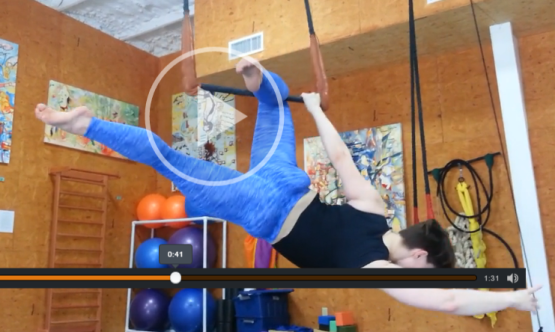
Edit: Lastly, a very short clip of the juggling-while-Rola-Bola-ing bit,complete with juggling-club videobomb 😀 This was before I figured out I could plié on the Rola-Bola, pick up the balls, and start juggling without falling off.

Time To Get Serious*

*Insofar as I am capable of ever being serious about anything, ever, because I am a focused person, a dedicated person, an all-of-that-kind-of-stuff person, but serious? I’m not sure that’s the best descriptor, really, where I’m concerned.

So, yeah.

I am thinking about injuries, and my history of accumulating them, and being like, “Ha! Ohai! I haz hurted myself again,” and then basically making jokes about it because that’s way easier than actually admitting that I’m hella pissed at myself.

But, like, I am.

Pissed at myself, that is (for my Brits: I don’t mean I’m drunk at myself, I mean I’m mad at myself … this time … which you probably already knew from context because you’re smart, but somehow my inner Smart-Alec just wouldn’t let me not say it).

Or, well, I was.

And then I realized that I’m looking at this incorrectly.

Denis-02-28-2016-PointYourGolDarnToesDenis

Denis recommends a change in perspective.

I have a habit of injuring myself mildly, which just happens in Teh Ballets and in life at large sometimes, because humans can be careful but can’t be perfect.

Injuring myself mildly from time to time wouldn’t be a big deal in and of itself.

The problem is that I also then have a problem of doing things that exacerbate minor injuries and turn them into major ones, like I did this week.

I’ve been mad at myself because I was like, “That’s just careless.”

Except, it’s not. Carelessness isn’t the problem.

The problem is that I don’t perceive pain normally and I’m stupidly hypermobile (okay, and my drive to do things like dance and aerials often exceeds my limited supply of common sense).

but-a-scratch

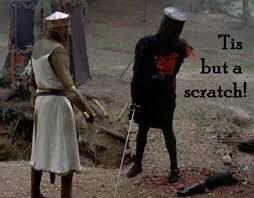
Shamelessly stolen from Monty Python by everyone ever.

So, basically, parts of me don’t start hurting when they should, then stop hurting before they should. The level of pain I experience does not accurately reflect the severity of any given injury, nor do they reflect how much it has healed.

Theoretically, the deep muscle in my “thut” (that’s thigh-butt; you can thank my aerials instructors for that one!) that I could barely use yesterday should be causing a shedload of pain today, but it actually doesn’t hurt at all**.

**Maybe it would if I tried to do the things I’m not supposed to do. Maybe it wouldn’t. I don’t plan to find out the hard way. At any rate, it should at least be sore.

Note to self: THIS DOES NOT MEAN THAT EVERYTHING IS FINE.

pets-stuck-696x362

Everything is fine. (Shamelessly ganked from heroviral.com.)

Likewise, parts of me stretch in ways that increase the likelihood of injury under certain circumstances. This is partly due to associated abnormalities in proprioception and pain perception (see above) and partly due to the fact that greater flexibility often correlates with reduced strength.

Not that I’m not strong; I’m just not necessarily strong in the places that will prevent me from doing things like yoinking the crap out of my turnout muscles.

O-Turns-Why

Seriously, there is absolutely nothing wrong here, guys. Everything is definitely under control.

I haven’t been treating this seriously. I’ve been too busy being delighted about the things that my abnormal pain perception and hypermobility let me do to be willing to countenance the fact that they also predispose me to injuries that I could better avoid if I was, basically, less weird.

As they say: “You take the good with the bad.” And I’ve been trying only to take the good, without accounting for the bad.

This past week, I turned a minor strain into a major one and bought myself several days off dancing and a term of about six weeks to full recovery (with appropriate management).

I wasn’t being careless. Things just didn’t hurt, so I carried on as usual. My leg was a little stiff and sore in the morning, but felt okay enough by the time class rolled around, and really quite okay indeed by the time trapeze class rolled around — so I proceeded with business as usual.

bidness

Business as usual (actual video to follow … eventually).

This is the same approach that bought me a layoff of a couple of months last year, followed by a long reconditioning period.

Obviously, a rate of one serious injury per year is quite a bit higher than is really sustainable.

So, in additional to healing, I plan to spend the next several weeks learning how to prevent injuries to my specific body. Clearly, this will mean developing both better awareness of what’s going on in my body and a greater willingness to turn to my live-in Physio (AKA my husband, Denis) when I think I have a minor injury and follow his advice.

bad-idea

This is me, not following advice (because I hadn’t asked for any). For the record, yes – that *is* the leg I strained, though this is not how I strained it. Bizarrely, that involved neither aerials nor ballet. In other news: yup, I am still pasty.

And, of course, because I like to write about everything (if nothing else, it serves as a kind of external backup drive), I’ll probably be writing about this process here.

So there you have it. Some insights about injuries that I don’t think I really had before.

Also a terrifying picture of my butt. Holy chromoly. Who stuffed ‘roid-raging weasels down my tights?!

More Writing About Writing

… A little literary navel-gazing today.

I’m making some adjustments to Strangers, but also trying to figure out the answers to some writing questions.

Specifically, Toby and Phinny are co-protagonists, and it’s clear to me what Toby is after, as a character: he really wants to understand a dark, painful, and muddled period in his past so he can, like, move on with his life or something (okay, yeah, that sounds pretty vague). He also wants Phinny.

Phinny continues to be a bit of a problem child: I don’t know exactly what he wants in the story. To an extent, I suppose he wants to avoid the exact confrontation with his past (that is, his and Toby’s mutual past) that Toby wants and needs, but that avoidance thing serves Toby’s story better than it serves Phinny’s. Likewise, he is attracted and even a bit drawn to Toby, but not with the singularity of intention that draws Toby to him.

Beyond that, he is mostly a guy who has what he wants in the world: he’s spent his life preparing to become a dancer and has done so with no small success; he has grown up in a loving-if-somewhat-distracted family and maintains a good relationship with his parents and his kajillion brothers and sisters; he has good friends within his company; he likes traveling and as such enjoys the fact that I Travesti spends most of the year touring. He certainly wants love in the romantic sense, but I don’t think he feels any pressure about it — he is focused, instead, on dancing.

This doesn’t mean he’s a well-adjusted “whole person” — he absolutely isn’t, and in some ways he has constructed his entire so he never needs to deal with the trauma of his past. He never stays in any one place very long; he lives a secure, cloistered life in which he is almost never alone with his thoughts, let alone with a potential romantic partner; his relationship with Peter is at once primary, quasi-romantic, and asexual (Peter is basically the straightest man who has ever made a living by performing classical ballet in drag); he is at once aware of his own desirability and protected from its consequences by the people around him.

So getting to grips with his own past is a thing Phinny needs to do (or will, someday, need to do), but also a thing he feels no pressure to do, as he has carefully crafted a life that prevents situations in which he might feel said pressure.

Likewise, he doesn’t suffer from Toby’s central problem, which is a nagging guilt. Toby’s as driven by a need for absolution as he is by a need to understand what the frack actually happened; they are faces of the same coin. Phinny’s damage is more abstract (possibly because, ironically enough, the Bad Things in his history are more concrete — though also because he avoids it all so effectively).

So there’s that question: What is Phinny after, if he isn’t just a passive vehicle in this story? And, of course, does he reach whatever his goal is?

None of these difficulties get in the way of actual writing, of course — I’m a “Write first, ask questions later” kind of guy — but they will, sooner or later, come to bear on the novel as a whole.

Since I’m Taking A Couple of Days Off, I plan to spend a bit of time with Toby and Phinny and see what comes of it.

In other news, this injury means keeping work in turn-out to a minimum for a bit, and my inner Ballet Wonk is busy throwing a fit about that. I mean, in the long run, it’s important — the muscle I’ve managed to injure (which was secondary to the Groin Pull of Doom) is one of the major turnout muscles, and if I want to keep my turnout in the long run, I need to let it heal. But FFS, how do you ballet when you can’t turnout? Bleh.

(Yeah, I know — #FirstWorldBalletProblems)

I have also decided that I need to educate myself on how to manage minor injuries so I don’t turn them into major ones. Abnormal pain perception has its advantages, but it also has its disadvantages, and this is one. Things don’t always hurt when they should (especially once my muscles are warm), so I wind up exacerbating injuries or adding new ones.

The groin pull wouldn’t have been a terribly big deal by itself, but I wound up injuring another muscle because of the way muscles compensate for one-another, and that’s the kind of thing I need to learn to avoid.

On the upside, I managed to prevent myself from sleeping in a face-down turned-out left retiré (seriously, I sleep that way most of the time, or in the butterfly/frog position — I mentioned this to B, and she said, “No wonder your turnout is so good!”), so I at least woke up far less sore than I have been.

Anyway, onward and upward, what what.

Herp de Derp

I tried to post a video of my trapeze choreography (which is now memorized, so I’m on to working timings and applying polish!), but it failed for some reason, and then I derped out on posting class notes yesterday.

I’ll get the video up ASAP, though I think I might have to go the “Upload to YouTube > Embed to Blorg” route.

Yesterday’s Killer Class was pretty excellent, albeit hampered by the Groin Pull That Will Not Die (Why can’t I wait until the day before a week-long vacation to injure myself?! Seriously, you guys, I have a whole week in October scheduled for that kind of thing.).

The Pull didn’t like turns, so I did very few of them on the left supporting leg. I had doubles on the right (technically the left), though, so go me? Still not as good by any means as Company B’s.

Company B is a beautiful dancer, and I watch the crap out of him every time he’s in class, because I find it educational (okay, and also because OMG he’s just freaking “fearfully and wonderfully made”). Watching him yesterday, I had a huge light bulb moment that made a drastic improvement to my ballotté. I did one run-through of the final petite allegro to get that update installed, so to speak, even though I’d ducked out after the warm-up jumps.

Trapeze class was pretty good; still can’t get smoothly from half-mill to half-Russian (T-rex arms: the struggle is real!). I’m now forbidden to work on them for at least a week, anyhow, while this groin injury heals. Life is hard when you sleep with your physiotherapist.

I’m on full-time rest for the next couple of days, which is less annoying than it would be if this wasn’t Derby Weekend, which makes getting into or out of my neighborhood a nightmare and this reduces the angst factor. I definitely exacerbated the existing injury yesterday.

Best to take the rest now and heal so I will be in shape for our show and for the Cinci intensive.

And then ,no more injuries until October!

A Freight Train Called Depression

In terms of ballet and in terms of aerials, 2016 has been a good year.

I am a far better dancer now than I was at this time last year. In fact, I’m a far better dancer than I was six months or so back, when I auditioned a piece for a show in Cincinnati. It wasn’t accepted* but the act of auditioning changed how I thought about myself as a dancer and a choreographer: which is to say that without even realizing it I began to think of myself, unequivocally, as a dancer, and as someone who works in the ephemeral medium of dance. It made me buckle down and really focus on learning my craft.

*Which is fine: looking back on it, now, I can see that it was deeply unready, and while it would’ve probably been a decent piece by February, it wouldn’t have been the piece it should be; more on that later.

The hard thing, the really hard thing, is that life being a thousand times better than it once was — while it helps — doesn’t stop bipolar disorder in its tracks.

Mania still leans on the throttle, sending the whole thing charging wildly into the unknown, fired by over-stoked engines.

Depression still roars out of the night and crushes me under its wheels. I still live a life in which, at times — more times than I care to admit — I’m clinging by the skin of my teeth; by the tattering shreds of my nails.

There are still too many days on which getting out of bed seems unthinkable; on which feeding myself is a chore I’d rather not bother with; on which even going to class (the one thing that I know will reliably lift me into the light, if only for a little while) is almost unbearable.

In some ways, I think of this in the same terms that I think of ballet.

Ballet is like bike racing: it doesn’t really get easier. You learn more and more steps; they become part of you — but the physical demand increases apace with your command of the physical vocabulary of ballet and your ability to use that vocabulary beautifully and expressively.

Just as the rigors of bike racing are absolutely, irrefutably worth it when you’re descending a gravel track at 30+ miles per hour with the wind in your teeth and no hope of any victory except the one over the voice that has so often told you, “You can’t,” the rigors of ballet are absolutely, irrefutably worth it for those moments when everything comes together, when the steps and the music and the soul all move as one, and suddenly you are the music and you can fly.

I do not expect ballet to get easier, so I’m not disappointed when it doesn’t. Like most dancers, I find a specific thrill in tackling challenging steps and I revel in hard classes; even spectacular failure in the service of attempting something difficult has its own charms.

Bipolar isn’t quite the same — I suppose there’s something to admire in the tenacity with which all of us, medicated or un-, hang on through its fits and starts, in the face of its slings and arrows, but there isn’t some beautiful craft to master at the end of it all (except insofar as the craft is life: but that’s a thing we all share, bipolar or not).

But it is hard; sometimes, in long stretches, unstintingly hard. And while the manias can hard — particularly the black, dysphoric ones — the depressions are probably harder.

So I write from the rails of a depression in which I am suddenly paralyzed by potent self-doubt; suddenly more than half convinced that I have no business pursuing the calling of my heart, that I am a deluded try-hard who will never do anything meaningful (even noting that I apply the term “meaningful” on a scale that has nothing to do with money or fame), and that I should just lie down and die.

I write from beneath the wheels of a freight train that, for reasons beyond understanding, wants to undo me — or perhaps simply from the wheels of one that has lost its brakes. Again.

I write not to ask for sympathy (which I usually find kind of annoying) or to fling my misery out into the world so others can be just as miserable as I am, but because sometimes the most powerful response I have found to just this thing is the act of naming it, writing it down, looking it in the face.

Later, when I’m recovering, I’ll come back and look at these words and wonder, How could I ever have thought that? (Just as I wonder now, about my own right to regard myself as an artist, How could I ever have thoughtthat?)

I will try to remember what it felt like to hurt so much for no reason; to not even be sure that “hurt” is the right word, not because of the magnitude of the pain, but because it is so very sourceless and alien — and I will not be able to summon the feeling.

But I will understand why I wrote this: to say, This is what is now, at this moment, and to do so clearly and publicly, to stop it rattling around in my head, so I can go outside and plant a redbud tree that my friend B. brought me from an Arbor Day celebration.

So I can get up and go to conditioning class tonight.

So I can finish cleaning the kitchen, or at least do as much as I can (thinking all the while, “For the love of all that is holy, how long can it take to wash a few dishes?!”).

So I can collect the tatters of my soul and get back to weaving dances with them.

So I can get back to dreaming.

Honesty is the first tool when depression comes thundering in. So this is my honesty. This is my island of grace. This is my song and my banner, though I try, now, not to see any of this as a battle.

But we go into the mission field, too, with a song and a banner, don’t we, to tend to the sick and the wounded.