Category Archives: health

Working Out The Kinks

…By which I don’t mean taking a certain band to the gym 😉

I think it’s fair to say that I’ve done a bunch of injuring myself in the past two years.

I think it’s also fair to say that I’m getting better at managing injuries and recovering from them — at reasonable share of which is learning, through trial and error, what “rest” means in relationship to various injuries if you’re a dancer and/or an aerialist (and, for that matter, what “rest” means in general as someone that my physiotherapist spouse defines as “an extreme athlete” — read, if you’re a serious dancer or aerialist, that’s you! Hi!).

Perhaps unsurprisingly, then, I’ve found myself doing a fair bit of reflection on why I’m injuring all the things and how I might, you know, stop that. (Or at least mostly stop.)

I’ve concluded that there are three major components:

  1. REST!
  2. Balance.
  3. Learning when to say “when.”

Let’s start with Point the Third: Learning When to Say “When.”

Like most dancers, I take pride in my ability to listen to my body in certain regards.

I know when I’m hungry, and I know when I’m full. I know when I should eat all the salty pommes frites and when I shouldn’t. I know when I need a freaking salad. I know that I should not have more than one beer when I have class the next day (so, basically, ever; we’ll address that under the heading of REST).

I more or less know when I’m really freaking tired and should just Go the F**k to Sleep (hint: I realize that I’m acting like a poorly-socialized two-year-old; shortly thereafter, I put my cranky behind to bed).

I know … okay, I almost know … how to not spend all my money on dance and aerials (I really did need that fourth dance belt; there might not be even one laundromat in Cincinnati, and more importantly, I might be too tired to bother! Also, it is totally important to have twenty pairs of tights and three pairs of ballet shoes and special socks that you basically only use for modern class and … okay, maybe I’m not that great at this one yet).

But when it comes to classes, I’m not great at knowing when I just plain need to STAHP.

Or, at least, I wasn’t.

Recently, I’ve tried a slow-and-steady approach to getting back into class after an injury. Amazingly, just as every physiotehrapist and exercise scientist and coach and trainer and ballet instructor on earth would’ve predicted, it worked!

I didn’t completely forget how to dance. My legs did not fall off. I did not lose my single knee-hang on both sides (though I’m still working back into it on the left, because when you basically completely disengage your adductors for a couple weeks, they detrain pretty fast).

I’m now working out the series of kinks (not injuries so much as low-level irritations) that I accumulated while compensating for my most recent injury: weirdness in my back; knee and calf fatigue on the opposite side. My right calf was a wee bit sore by the time we finished petit allegro on Wednesday, but not so much that it felt like I should skip grand allegro. I rolled the dice and it worked out, but I’ll probably need to think carefully about that tomorrow, too.

And every other day, for the rest of my life.

Okay. So that covers the whole “know when to say when” thing. On to Point the Second: Balance.

While this isn’t quite how things work in the real world, it’s usually more or less functionally accurate to acknowledge that when you increase strength, you reduce flexibility.

This is a problem for normal people, but it’s a huge problem for hypermobile people.

In short, if you don’t pay attention to muscle balance when you train and/or you don’t stretch adequately (or you overstretch, or — worst of all, if you do some of each), you can throw your whole body out of whack.

That goes double if your body isn’t strung together very securely in the first place (that is, if you’re hypermobile).

I would like to show you a picture.

Here:

Group-Candlestand-3

Top Row: Janie, Me. Bottom Row: Amy, Courtney. Both Rows: COMPLETELY FREAKING AWESOME. Also, I am astoundingly modest today, amirite?

On the face of it, this just looks like a really cool acro-balancing pile (and, for the most part, that’s completely accurate).

However, ballet wonks will notice that my eyes say Armand (from La Dame Aux Camélias) while my hands say OMG DON QUIXOTE!!!!!1!!oneone

Which is what they say ALL. THE. TIME. unless I pay a ton of attention to what I’m doing with them.

I hear about this in essentially every class ever, unless I pay a ton of attention to what I’m doing with them.

All this is more or less the result of muscle imbalance. I don’t always stretch adequately after aerials classes, nor do I do much to counteract the effects of working on aerial apparati in terms of strength balance — so unless I think very hard about making my hands soft and graceful, they do this*.

*Okay, it might also partly be a personality trait: as a dancer, I tend to operate in one of two default modes — I have no idea what I’m doing right now or I am such a cocky little badass, depending. The fact that it was specifically the Russian dance in Nutcracker that made me want to take up ballet probably tells you essentially everything you need to know.

Anyway, until I started being really conscious about stretching my hands after trapeze, silks, lyra, and mixed apparatus, this was making my hands hurt, because things were pulling on other things in unbalanced ways.

The whole disaster with my pelvis started more or less the same way. I neglected to train the bottom third of my abdominal muscles, and things pulled other things out of whack — and since my connective tissue is unusually stretchy, they got really, really out of whack.

So, in short, things that train strength need to be balanced with things that train flexibility and vice-versa. Likewise, when you train the crap out of your adductors, you should also do some work on your abductors. And so on.

And, of course, training needs to be balanced with every dancer’s favorite four-letter word:

Point the First: REST.

The process of getting stronger is essentially one of creating tiny tears in your muscles, then letting them heal.

Guess what makes them heal?

REST.

Likewise, the process of accumulating explicit knowledge requires rest. A great deal of memory consolidation, as far as we can tell, takes place during sleep.

Also, the brain itself gets tired. The brain needs rest, too (and not just sleep: sometimes the brain just needs to, like, kick back and sit on its cerebral porch and watch the world go by).

And ballet, modern dance, and aerials need the brain.

Moreover, all kinds of injury-preventive functions, from equilibrium to coordination to proprioception to decision making, are compromised by fatigue and sleep-deprivation.

You know what one weird trick combats fatigue and sleep-deprivation?

Say it with me:

REST.

(Also, sleep.)

I also need a fair amount of rest when it comes to that whole Being Around Humans thing.

I am very much an introvert in the sense that I recharge by being alone: like, really alone. Like, “Don’t bust up in my kitchen on one of my designated Leave Me Alone days and start chatting with me and expect me to be anything other than a complete b1tch” alone.

So, basically, I’ve done a piss-poor job giving myself adequate rest. Even on the days that are supposed to be my days off, for the past several weeks, I’ve had to go out and get things done and be among humans, which has more or less literally been making me insane (seriously, sobbing-on-the-floor-in-the-kitchen-at-9-PM-on-Monday, snapping-at-my-best-friends-for-no-reason insane).

So, yeah. That’s part of injury prevention for me, too: first, because I get really, really tense, which makes the tight muscles tighter and increases the likelihood of strains and so forth; second, because I have enough trouble sleeping without being, as my old roommate used to say, “outside my mind;” third, because it keeps me from eating people’s faces, which is definitely a kind of injury, just more for them than for me. Heh.

So here’s another picture:

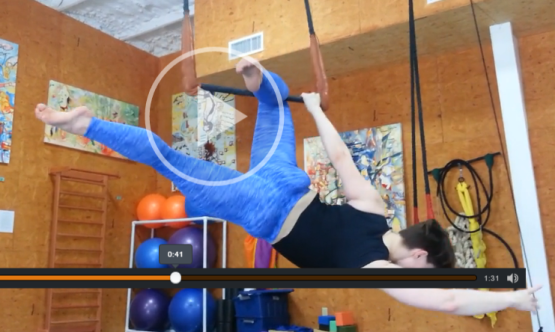
WIN_20160527_13_42_04_Pro

Remember the Sabbath day and keep it whole-ly, even if you have to move it to Sunday because you have a Cube Workshop on Saturday afternoon. Also, sorry it’s fuzzy.

Please notice the dark circles under my eyes. They are what happens when I don’t sleep (also when my allergies are going crazy).

Please notice also the bold text and giant circle around it, reminding me that:

THIS REST CRAP IS IMPORTANT.

So, basically, I’ll be scheduling my rest days much more strictly (and, it appears, emphatically) in the future. I’ve also opted for one less-physically-demanding class on Tuesday and Thursday at the Cinci intensive in order to build in a little more rest.

I don’t know about you, but my long-term goal is to to be (as my trapeze instructor is) completely, mind-bendingly awesome at trapeze when I’m 50; to still be dancing when I’m 90.

It would also be great if my legs don’t fall off long before I reach either of those milestones, because I’ve got a pretty long way to go, frankly.

Paying attention to moderation, balance, and REST are probably the keys, really, to making that happen.

So that’s what I’m going to do, even if it kills me.

…Wait, no that’s not quite what I’m going for. In fact, to some extent, that’s what I’m trying to avoid.

Let’s try this again:

So that’s what I’m going to do, so all this doesn’t kill me.

Edit: Lastly, a very short clip of the juggling-while-Rola-Bola-ing bit,complete with juggling-club videobomb 😀 This was before I figured out I could plié on the Rola-Bola, pick up the balls, and start juggling without falling off.

Modern Monday: Thoughts on Picking Up Combinations; Also on Food

I’ve been working on a strategy for combination-acquisition that Modern T recommended to me, and I really think it’s probably the best way to go.

In short, instead of hand-miming or subtly marking the combo as it’s handed out, you just stand (or, in some cases, sit) there and watch — really watch and ingest; get a good, solid mental video.

Then, if there’s a repeat of the demo or a verbal explanation, you can mime or mark as needed. It also helps to program in the counts (and swing and swing and swing and around, or what have you) on the repeat if you think you’re going to get lost.

This approach prevents you from missing critical points — the direction of a turn; what exactly happens during a change of direction; whether there’s an extra step or a direct weight transfer; what’s happening with arms and necks and shoulders and backs.

I did this throughout most of class today. Sometimes it felt really weird to be standing there just watching while much of the rest of the class was doing the subtle-marking method and my brain cells were firing like crazy, trying to make parts of me move.

On the other hand, it worked.

Throughout much of the class, I had the choreography down about as well as anyone. I felt solid doing it, even though sometimes my body was busy going, “WTF, THIS IS NOT GOOD BALLET, I WANT TO DO GOOD BALLET.” Sometimes my body doesn’t get the memo that modern != ballet.

To be frank, this kind of watching is hard for me. I tend to space out (and then start jiggling) when I’m standing still (thanks, ADHD!) — so this kind of “just watching” involved a very conscious, intentional imbibing*.

*Belatedly, I’ve realized that it’s the same way I watch compelling dance performances (which also explains why I have really good mental “video” of quite a few of them).

I totally failed to apply this lesson going across the floor. I started out with good intentions, but then realized I was in somebody’s way, took a step — and suddenly I was soft-marking along and missing really critical elements (Wait, isn’t there a third triplet? And is that hop-tour lent thing on the upstage leg or the downstage leg? And why am I doing it as if it was an sauté-fouetté?!).

As such, my across-the-floor combination was a straight-up disaster.

I did it wrong, then did it another flavor of wrong, then did it a still another flavor of wrong… Literally every pass (and we did the combination at least four times each way) was a new, unique, and different kind of more-or-less entirely incorrect.

Yeah, I got a bit frustrated, there. Like, seriously, for once in my life, when Modern T said, “Do you want to do it again, or are you guys done?” I was the one who said, “I’m done.” (And then did it twice more anyway.)

But, at any rate, I learned a valuable lesson about how I absorb choreography (and, um, knowing is half the battle, I guess?).

Okay!

Moving right along.

Some thoughts I’ve been kicking around with G+ friends have led me to reflect on my eating patterns, and I’ve realized that I eat quite differently for a strongly dance-based lifestyle than I did when I was training for bike racing.

I’m not at all sure I’m Doin’ It Rite™, but — at any rate — I’ve noticed that dancing doesn’t seem to make me as hungry as cycling (I think I’ve touched on this before) and that my “fueling” strategy is quite a bit higher in carbs than it was for cycling.

Some of this, of course, is sheer disorganization. I have not adapted amazingly well to my current schedule, which often involves dance classes in the morning, a brief break in the afternoon, and aerials or more dance classes in the evening.

Basically, I am not good at changing gears, and thus am not the kind of person who can get much done in the gap — so I do less cooking than I should and more, well, scavenging for anything quick, basically.

I have at least finally managed to mostly get on top of breakfast, for the most part. Breakfast is usually ~113 grams of plain Greek yoghurt, ~70 grams of unsweetened frozen berries (I happen to particularly like the blends that include cherries), and 25 – 30 grams of whatever kind of not-super-sugary granola looks promising.

If this sounds astonishingly precise for me, I promise, it’s really a function of the fact that it’s easier to scoop yoghurt out with a spatula, weigh it, and hit “tare” a few more times as more things are added than it is to shove it into a measuring cup, then transfer it into a bowl or whatevs.

I also have fancy yoghurt bowls that keep the crunchy stuff separate until you’re ready to eat. Using frozen berries means I have to make the yoghurt parfaits ahead of time, which saves me from having to fumble around with the kitchen scale in the morning.

On days that I fail to crawl out of the crypt bed in time to actually eat like an adult (or at least a toddler), I still tend to desperately chug protein shakes on the way to class. For such emergencies, I use Orgain (Creamy Chocolate Fudge) because it’s low in sugar, decent in the fiber department, tastes okay, and isn’t horribly expensive. My base of choice is unsweetened almond milk, but it’s perfectly good with regular milk. I usually add coffee concentrate and a touch of vanilla extract, but it’s acceptable without.

*There is also a fine line between just enough breakfast and too freaking much breakfast, OMG, please stop the sloshing, but I really prefer not to think about the far side of that line. I’d rather err on the side of caution — ’tis better to feel puny in class than pukey.

Dinner is frequently some species of pasta — I’m particularly fond of ziti and penne rigate — because I can make that ahead in huge batches and reheat it later. My sauce of choice comprises an “Italian seasoned” tomato paste, a ton of diced tomatoes (usually canned, because laziness), basil, oregano, garlic, onions (sauteed in a little olive oil and red wine), sometimes mushrooms, and either meatballs (sometimes frozen, sometimes turkey) or sausages.

This makes it sound like I plan better than I do.

If I were really any good at planning, there would be far fewer nights on which we eat dinner at 9 PM when I’ve arrived home at 7:45 :/

Interestingly, I almost never ate pasta when I was racing bikes (except when I was intentionally carb-loading). Training rides tended to make me insanely hungry and I would just go crazy with the pasta; I generally substituted raw cabbage for the actual noodles (the sauce heats the cabbage just enough to be crisp-tender, which is awesome).

I’m much better, now, at figuring out when I’m full, so I actually do eat pasta. I still often add either raw cabbage or raw baby spinach, though (because veggies ftw).

In the past, my breakfasts were also generally lower in carbs than they are now.

Meanwhile, lunch is just a horrible, ongoing, unmitigated disaster of food-on-the-fly right now. How desperate my choices are depends upon how well I’ve walked that fine line between just enough breakfast and way the hell too little breakfast*.

I am not too proud to admit that I lunch has recently featured such stellar choices as a fried chicken sandwich, half a Whopper (apparently, I can’t eat an entire Whopper), or pizza from a gas station’s convenience store.

This doesn’t really seem to be making any impact on my baseline health statistics (if anything, it’s the only thing stopping my blood pressure moving from “low” to “undetectable”), but it probably does significantly impact my ability to not be a horrible, face-eating hypoglycemia monster by the time my evening classes roll around.

So basically, in summary:

When I raced bikes I was hungry all the time, limited my carbs, and was much better at lunch.

Now, my appetite is more manageable even though I burn roughly the same number of calories on any given day (if not more, because I have more upper-body muscle than I used to — so, seriously, wtf), I eat pasta like it’s going out of style, and I am terrible at lunch.

The next step, then, is to figure out how to eat lunch on the fly without spending a gajillion dollars. I mean, obviously, I know how to eat lunch (open mouth, insert foot food), but the question is how to plan ahead and make food to bring with me (because apparently it’s not super safe to just leave a giant bowl of pasta in your car and assume it’ll be nice and hot by the time you get out of class…).

So that’s today’s installment. Not incredibly informative to anyone who isn’t me, I’ll wager, but it has helped me identify a “next step” I wasn’t thinking about (that is, how to handle lunch).

Huzzah!

Today I visited the physical therapist who handles the ballet company.

Denis was pretty happy to hear that this was going to happen because he always feels a bit hesitant about advising dancers and other athletes who don’t really have the option of just not doing whatever the thing is that they do.

Anyway, she ran me through a battery of tests (including rond de jambes en l’air at the barre), did a maneuver to sort out a stuck iliosacral joint, and declared me fit to get back to class, with the caveat that I need to pay very close attention to engaging from the “Gotta Pee” muscle up (and to call her if I run into further problems).

This should also, incidentally, help with the problem of throwing my shoulders back.

So it’s back to class with me tomorrow. The adductor pull is sufficiently healed to work, and having sorted the IS joint should help it so trying to compensate, so I should be in shape for Cincinnati and beyond.

This is good, because not really dancing has been driving me crazy.

Tandem Troubles

Tandem.

That’s two people doing the same thing at the same time, ostensibly together, though often in opposition — intentional or otherwise.

It’s complicated.

Tandem kayaks have earned the nickname “divorce boats;” likewise, “divorce bike” is a not-uncommon term for tandem bikes.

I suppose that’s understandable, given that on a tandem bike, both partners have to work, but only one gets to steer. I’m not sure if that’s better or worse than the situation with a tandem kayak, where both partners can work or slack off and both partners can (attempt to) steer.

Regardless, Denis and I actually do pretty well where both tandem bikes and tandem kayaks are concerned (okay, so I do kind of yell at him on the climbs sometimes on the bike).

Tandem trapeze routines?

That might be harder.

Not that I think we’re anywhere near “divorce trapeze” territory — just, now that we’re into the meat of rehearsal, I’ve realized that he works a lot more slowly than I do.

In fact, that’s true in more than one sense — he memorizes choreography more slowly, but he also works through his movements more slowly.

The memorization part is mostly under control: he’s pretty much got his routine down, so we’re more or less online to actually really run things now.

The movement part — well, that’s a different challenge.

On one hand, it’s kinda cool. It imparts stylistic spice. We’re not two perfectly-matched RoboTraps doing almost the same moves (but in a different order) with exactly the same style. For the purpose of our piece, I think that works.

On the other hand, it’s kinda weird in terms of trying to get everything synchronized.

It makes working out the timings (which falls to me as the musical member of our daring duo) a little more challenging. It means that we’ll definitely need to rehearse the piece together a couple of times, which means somehow finagling a chance to rig two single-point trapezes at the same time.

In case you’re wondering, that doesn’t happen terribly often at our studio. We usually have two double-point traps rigged and at most one single-point; people just don’t use the single-point as much (well, people who aren’t us). I’m not sure why, though it could be a function of the single-point offering some challenges that the double-point doesn’t.

Case in (single?) point: if rigged with a pivot — as ours are — the single-point trapeze can spin.

Likewise, because there’s a significant taper from the bar to the rigging, moves in the ropes can feel quite different on the single-point trapeze than on the double-point (some seem easier; some, harder — the distribution, there, seems to be highly individual).

Don’t get me wrong, though — as a performer, a choreographer, and a problem-solver, I’m rather enjoying this process. As a glutton for punishment masochist trapeze addict aficionado, I like having an excuse to play around on the trapeze more.

Doesn’t hurt that I now know that I can run my routine three or four times back-to-back without feeling over-worked, either.

Anyway, part of the solution for this challenge involves adjustments I need to make anyway — slowing my execution of the individual “tricks” (ye gods, how I cringe at that word) and transitional movements; Using All The Music; adding expression.

Another part of it involves the well-considered use of pauses; that’s fine. I don’t want to create a routine that’s mostly a series of pretty poses, but it seems reasonable to incorporate a few attractive pauses in the interest of giving Denis room (musically-speaking) to work.

We also discovered that, although I have about 1 minute and 30 seconds of actual trapeze wrestling in my routine, the other bits (we have some acro-balancing elements as our mount and our dismount, as well as a tiny, tiny bit of character dance) don’t fill all of the music.

All of this has come together to produce a kind of turn-taking format in parts of the routine, which works into our theme (the piece is called “Duelo Trapecio” — “Trapeze Duel”).

The remaining challenge will be sorting out Denis’ spin tolerance. The highlight of our piece, really, is the executing of a set of moves in the ropes — but his are done in an inversion, which makes him dizzier than it otherwise might.

Since our current final move is a two-man counterbalance that requires him to support my entire weight, that could be problematic!

At any rate, we’ve got a few more weeks to work out the kinks, and I’m pretty happy with the progress we’ve made.

I’ll be even happier when I’ve got clearance to do all the moves in my routine again. Right now, I can’t do the demi-mill roll because of my injury, which makes me haz a sad. (I know: #FirstWorldProblems.)

I shot a brief bit of video tonight, but mostly it’s me faffing around on a spinning trapeze thinking about what to do to fill a time gap in my bit of the choreography, so I’m still on the fence about posting it. OTOH, my iron cross-stag-switch-stag-iron cross looks better than it did in the previous one (I wasn’t less tired; it’s just that watching the previous video helped identify things I need to work on).

And I’m wearing bike-length shorts, so you can see my blazing calves of solid alabaster. Bleh.

Okay, well. This is now about 3 times as longer than I intended it to be, so I’ll shut up.

Eat, drink, and be merry, for tomorrow, we have Killer Class, Trapeze 2, and Conditioning.

Only I won’t actually be doing Killer Class, because #StupidInjury.

Modern Monday: Strangely Enough, Injuries Are Distracting

I think this might not be as true in an improv setting — but working technique, I really wrestled with it.

There was a lot of, “Can I do this?”

Or, well —”Should I do this?”

Can hasn’t been the problem, generally.

So we really focused a lot of, basically, the falling down part of modern — the safety release, wherein you fall through a roll over a sickled foot  and, amazingly, A) your ankle doesn’t break and B) Agrippina Vaganova does not appear in a cloud of sulphur to drag you away to the place where Bad Ballet Dancers go. Mainly because, let’s face it, she doesn’t countenance modern to begin with.

So I managed both to lay down some impressive bruises on the metatarsophalangeal joints of both my feet and to finally lay down some nice safety releases, even in the ones falling from a standing position, which make my inner Russian completely foam at the mouth.

Beyond that, I couldn’t remember a sequence to save my life today, in part because of the ever-present fear of exacerbating my injury (so confuse — very distraction — wow) and in part because, I dunno, wrong phase of the moon, or what have you.

Sadly, even Modern T eventually caught my Sequence Learning Disorder, and we all got pretty confused.

Fortunately for Modern T and my fellow student, R, however, I had to stop before we really worked the final sequence.

Ah, well.

The afternoon’s choreography session became more like a planning session with dancing, and that was fine. It is really hard to remember to turn off the turnout. On the other hand (other foot?) we percolated some cool stuff that involves one dancer in a more modern style (with strong ballet lineage) partnering another who uses a strictly classical ballet style.

It yields an effect like two people speaking two dialects of the same language, sometimes with great harmony and sometimes with miscommunication — which, in turn, really works for the production we’re hatching.

We also made some programming changes, which is fine. Little by little, we’re creating a thing that is coming to have a shape and a structure. Elements of the actual choreography are beginning to gel, so for the next few sessions I’ll be selecting a couple of pieces of music for each so we can begin to create more detailed sketches.

Some will be a challenge to implement because we have two dancers and not six (or twelve) — but we can begin to lay down paths and shapes, and that will be a good start.

I also blood to regard my current injury not as a frustrating in this process, but as the kind of limitation of uses to challenge one’s self.

I need to think, “Okay, I shouldn’t jump right now — what can I do here instead?”

Tomorrow I’m back.to the aerials studio, though with limitations and with and supervision by my charming PT/husband 🙂

Time To Get Serious*

*Insofar as I am capable of ever being serious about anything, ever, because I am a focused person, a dedicated person, an all-of-that-kind-of-stuff person, but serious? I’m not sure that’s the best descriptor, really, where I’m concerned.

So, yeah.

I am thinking about injuries, and my history of accumulating them, and being like, “Ha! Ohai! I haz hurted myself again,” and then basically making jokes about it because that’s way easier than actually admitting that I’m hella pissed at myself.

But, like, I am.

Pissed at myself, that is (for my Brits: I don’t mean I’m drunk at myself, I mean I’m mad at myself … this time … which you probably already knew from context because you’re smart, but somehow my inner Smart-Alec just wouldn’t let me not say it).

Or, well, I was.

And then I realized that I’m looking at this incorrectly.

Denis-02-28-2016-PointYourGolDarnToesDenis

Denis recommends a change in perspective.

I have a habit of injuring myself mildly, which just happens in Teh Ballets and in life at large sometimes, because humans can be careful but can’t be perfect.

Injuring myself mildly from time to time wouldn’t be a big deal in and of itself.

The problem is that I also then have a problem of doing things that exacerbate minor injuries and turn them into major ones, like I did this week.

I’ve been mad at myself because I was like, “That’s just careless.”

Except, it’s not. Carelessness isn’t the problem.

The problem is that I don’t perceive pain normally and I’m stupidly hypermobile (okay, and my drive to do things like dance and aerials often exceeds my limited supply of common sense).

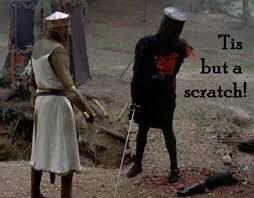
but-a-scratch

Shamelessly stolen from Monty Python by everyone ever.

So, basically, parts of me don’t start hurting when they should, then stop hurting before they should. The level of pain I experience does not accurately reflect the severity of any given injury, nor do they reflect how much it has healed.

Theoretically, the deep muscle in my “thut” (that’s thigh-butt; you can thank my aerials instructors for that one!) that I could barely use yesterday should be causing a shedload of pain today, but it actually doesn’t hurt at all**.

**Maybe it would if I tried to do the things I’m not supposed to do. Maybe it wouldn’t. I don’t plan to find out the hard way. At any rate, it should at least be sore.

Note to self: THIS DOES NOT MEAN THAT EVERYTHING IS FINE.

pets-stuck-696x362

Everything is fine. (Shamelessly ganked from heroviral.com.)

Likewise, parts of me stretch in ways that increase the likelihood of injury under certain circumstances. This is partly due to associated abnormalities in proprioception and pain perception (see above) and partly due to the fact that greater flexibility often correlates with reduced strength.

Not that I’m not strong; I’m just not necessarily strong in the places that will prevent me from doing things like yoinking the crap out of my turnout muscles.

O-Turns-Why

Seriously, there is absolutely nothing wrong here, guys. Everything is definitely under control.

I haven’t been treating this seriously. I’ve been too busy being delighted about the things that my abnormal pain perception and hypermobility let me do to be willing to countenance the fact that they also predispose me to injuries that I could better avoid if I was, basically, less weird.

As they say: “You take the good with the bad.” And I’ve been trying only to take the good, without accounting for the bad.

This past week, I turned a minor strain into a major one and bought myself several days off dancing and a term of about six weeks to full recovery (with appropriate management).

I wasn’t being careless. Things just didn’t hurt, so I carried on as usual. My leg was a little stiff and sore in the morning, but felt okay enough by the time class rolled around, and really quite okay indeed by the time trapeze class rolled around — so I proceeded with business as usual.

bidness

Business as usual (actual video to follow … eventually).

This is the same approach that bought me a layoff of a couple of months last year, followed by a long reconditioning period.

Obviously, a rate of one serious injury per year is quite a bit higher than is really sustainable.

So, in additional to healing, I plan to spend the next several weeks learning how to prevent injuries to my specific body. Clearly, this will mean developing both better awareness of what’s going on in my body and a greater willingness to turn to my live-in Physio (AKA my husband, Denis) when I think I have a minor injury and follow his advice.

bad-idea

This is me, not following advice (because I hadn’t asked for any). For the record, yes – that *is* the leg I strained, though this is not how I strained it. Bizarrely, that involved neither aerials nor ballet. In other news: yup, I am still pasty.

And, of course, because I like to write about everything (if nothing else, it serves as a kind of external backup drive), I’ll probably be writing about this process here.

So there you have it. Some insights about injuries that I don’t think I really had before.

Also a terrifying picture of my butt. Holy chromoly. Who stuffed ‘roid-raging weasels down my tights?!

More Writing About Writing

… A little literary navel-gazing today.

I’m making some adjustments to Strangers, but also trying to figure out the answers to some writing questions.

Specifically, Toby and Phinny are co-protagonists, and it’s clear to me what Toby is after, as a character: he really wants to understand a dark, painful, and muddled period in his past so he can, like, move on with his life or something (okay, yeah, that sounds pretty vague). He also wants Phinny.

Phinny continues to be a bit of a problem child: I don’t know exactly what he wants in the story. To an extent, I suppose he wants to avoid the exact confrontation with his past (that is, his and Toby’s mutual past) that Toby wants and needs, but that avoidance thing serves Toby’s story better than it serves Phinny’s. Likewise, he is attracted and even a bit drawn to Toby, but not with the singularity of intention that draws Toby to him.

Beyond that, he is mostly a guy who has what he wants in the world: he’s spent his life preparing to become a dancer and has done so with no small success; he has grown up in a loving-if-somewhat-distracted family and maintains a good relationship with his parents and his kajillion brothers and sisters; he has good friends within his company; he likes traveling and as such enjoys the fact that I Travesti spends most of the year touring. He certainly wants love in the romantic sense, but I don’t think he feels any pressure about it — he is focused, instead, on dancing.

This doesn’t mean he’s a well-adjusted “whole person” — he absolutely isn’t, and in some ways he has constructed his entire so he never needs to deal with the trauma of his past. He never stays in any one place very long; he lives a secure, cloistered life in which he is almost never alone with his thoughts, let alone with a potential romantic partner; his relationship with Peter is at once primary, quasi-romantic, and asexual (Peter is basically the straightest man who has ever made a living by performing classical ballet in drag); he is at once aware of his own desirability and protected from its consequences by the people around him.

So getting to grips with his own past is a thing Phinny needs to do (or will, someday, need to do), but also a thing he feels no pressure to do, as he has carefully crafted a life that prevents situations in which he might feel said pressure.

Likewise, he doesn’t suffer from Toby’s central problem, which is a nagging guilt. Toby’s as driven by a need for absolution as he is by a need to understand what the frack actually happened; they are faces of the same coin. Phinny’s damage is more abstract (possibly because, ironically enough, the Bad Things in his history are more concrete — though also because he avoids it all so effectively).

So there’s that question: What is Phinny after, if he isn’t just a passive vehicle in this story? And, of course, does he reach whatever his goal is?

None of these difficulties get in the way of actual writing, of course — I’m a “Write first, ask questions later” kind of guy — but they will, sooner or later, come to bear on the novel as a whole.

Since I’m Taking A Couple of Days Off, I plan to spend a bit of time with Toby and Phinny and see what comes of it.

In other news, this injury means keeping work in turn-out to a minimum for a bit, and my inner Ballet Wonk is busy throwing a fit about that. I mean, in the long run, it’s important — the muscle I’ve managed to injure (which was secondary to the Groin Pull of Doom) is one of the major turnout muscles, and if I want to keep my turnout in the long run, I need to let it heal. But FFS, how do you ballet when you can’t turnout? Bleh.

(Yeah, I know — #FirstWorldBalletProblems)

I have also decided that I need to educate myself on how to manage minor injuries so I don’t turn them into major ones. Abnormal pain perception has its advantages, but it also has its disadvantages, and this is one. Things don’t always hurt when they should (especially once my muscles are warm), so I wind up exacerbating injuries or adding new ones.

The groin pull wouldn’t have been a terribly big deal by itself, but I wound up injuring another muscle because of the way muscles compensate for one-another, and that’s the kind of thing I need to learn to avoid.

On the upside, I managed to prevent myself from sleeping in a face-down turned-out left retiré (seriously, I sleep that way most of the time, or in the butterfly/frog position — I mentioned this to B, and she said, “No wonder your turnout is so good!”), so I at least woke up far less sore than I have been.

Anyway, onward and upward, what what.

Saturday Class: Progress is Relative

I can’t say that I was at my best this morning, but I can’t say that I was at my worst, either.

Ballet is funny like that. Progress is always relative.

You have not-so-great days, and you have to remind yourself, “Six months ago, I would have thought this was a great class; I would have been really proud of my adagio and really impressed at how well I remembered the combinations.”

So by my current standard, today was, as they say, “Fair to middlin'” — mostly great Barre (though my mental block about flic-flac continues unabated); fairly good adagio (though there was a little too much “making it happen” on the first run); turns … Eh.

Here’s the combo:
Waltz turn and waltz turn
Pique arabesque
Extend
Down (plie)
PDB
Chassée
Fourth
En Dehors*
Fourth
Relève
En Dehors*
Fourth
Détourner
Chassée
Fourth
En Dedans (as many as you can, obvs)
Pliè
… Repeat until you run out of room.

*These could be singles, doubles, triples — whatevs.

Not a hard combination, but pretty, unless you for some reason keep screwing up your turns.

Little jumps would have been better if I hadn’t switched into a totally different combination halfway through and then gotten scrambled trying to get back into the right one.

This is the danger of strong kinesthetic learning abilities! Your body is all like:

“Cool! I remember this from yesterday! :)”

And your brain goes:
“No, that’s not it! :/”

And your body goes:
“But I thought…? :O”

… And so on.

We ran out of time and didn’t do grand allegro, but that’s probably okay. My lungs are still a little verklempt. Slow and steady heals the lungs.

At the end of the day, my technique is about a thousand times better

Anyway, that’s today. We’re off to the Met Live in HD.

À bientôt, mes amis.

Iron Cross is SRS BZNS!

I’m having WP issues this week. I wrote a dance-related post on Monday, but the editor kept locking up, and I got frustrated and never finished it — so I’m behind on that.

As you can see, I’m something like back in action, though not completely. I did make it all the way through Modern T’s class, which was a little less athletic than the previous two classes (probably because Modern T is also recovering from the Great Plague of 2016).

Today I made it most of the way through Ms. B’s Killer Class, though I had to bow out of medium and grand allegro, because I was too wheezy by the time I finished (or, well, sort of finished) petit allegro. C’est la vie, n’est-ce pas?

This made me sad, because our grand allegro combination was flat-out awesome — so Ms. B let me video it so we can do it at our next class after Spring Break. Yaaaay! (I don’t have permissions from my classmates to share that video, so apologies for that. Also, the camera work sucks :D)

I opted only to do trapeze tonight, and I think that was the right call.

Maybe I Just Have Nothing To Say

Once, in middle school (this must have been in 7th grade; in 8th grade, suddenly everyone was a bit frightened of me because I wore black all the time, heh), some kid was picking on me for being quiet and some other kid said, “Maybe he just doesn’t have anything to say.”

I’m still not sure whether this intended as an insult (I mean, you know, 7th grade, here) or a defense — regardless, the kid who made the latter statement went on later to become one of the few that, by the end of 8th grade, was somewhat friendly, so who knows?

But, anyway, there are times that I notice I’m being quiet because something in my brain feels like I don’t have anything worth saying. (Coincidentally, I didn’t feel like that in middle school; I just didn’t know how to talk to strange humans, and I didn’t really know anyone at school.)

It’s a weird feeling. It’s not fear that other people will reject my words, just some kind of insufferable internal krampus shouting on about how all my thoughts are so much dreck.

I’ve noticed that I get a lot more of this when I’m feeling uncertain about things.

I’ve been sick for the past week, again. A bit longer than that, probably, but I was in denial until Thursday, when I basically didn’t get out of bed till 3 PM and was asleep again by 9:30 PM. Prior to that I just thought I was, you know, legitimately tired — more tired than I expected to be perhaps, but nothing to, like, skip ballet class over (when you’re a dancer, it always comes back to a question of class, doesn’t it). I was also hella cranky, so I’d you’re one of the people I yelled at, apologies.

Friday and Saturday, I did nothing but sleep, consume entire packages of Pine Brothers throat drops, watch both Ghostbusters movies back to back, and have bizarre fever dreams. Sunday I was at least able to read and so forth. Monday I started feeling better but also started having miniature nosebleeds and coughing. Balls.

So basically this is the same thing I’ve had every few weeks for the entire year — starts out with mono-like symptoms (sore throat; fever; swollen glands; spectacular, crushing fatigue), then turns into a sinus infection just when I think I’m getting better.

I suspect that when I say “turns into,” what I’m really describing is the usual way I develop sinus infections — inflammation prevents drainage, bacteria get happy, voilà! Sinus infection.

Anyway, all of this precipitated a massive spell of self-doubt.

There was my internal krampus shouting, “This is why you never make progress! This is why you’re never going to get anywhere! Accept it, you have no business being a dancer, going to grad school, being anything! What do you think you’re trying to do, huh? You think the world is going to accommodate this kind of stuff? Why do you even wanna try, you dumb schmuck?!”

This is Jack’s Imposter Syndrome, eh?

I’m trying to learn to let the krampus have his little fits without buying into them. I was raised to be relentlessly positive in a skin-of-the-teeth kind of way: not to be all chirpy and what have you, but to refuse to accept defeat. That’s not a bad lesson, but I spun it into refusing to acknowledge my fears — and so, krampus.

Krampi gonna kramp. The challenge is letting them kramp, sitting with the krampus-ness and honoring it, then going, “Okay, that was a thing,” and continuing on, rather than being bogged (or bogan-ed?) down and stuck in the krampus’ feelings. (Sometimes, mental illness makes it impossible not to, but not always.)

The challenge is learning from, even honoring the Inner Krampus, while continuing to remain awake and aware, insofar as I’ve learned to be awake and aware at all.

It is possible that, because of some foolish choices when rolling up a character for this life (yeah, maybe I shouldn’t have used CONST as my dump stat*) I will never get anywhere as a dancer, a choreographer, a writer, an artist.

*If this makes sense to you, give yourself like 100 XP.

But that’s only one possibility.

It’s also possible that I’ll learn how to work around this limitation. (Okay, it would really help if I knew what, exactly, this limitation was — like, am I one of those unlucky bastards who actually do have chronic mono that recurs in periods of physical stress? Or did I really just lose in the immune-system lottery?).

It’s possible that I’ll learn how to work with this limitation (assignment: create a dance about being unable to dance).

So, anyway, this is all the stuff I’ve had to say but haven’t said yet. It’s a weird and prickly thing, admitting to the universe what amounts to this gigantic vulnerability. Prickly in particular because I’m allergic to pity and therefore afraid of inadvertently evoking it. I had to let this percolate.

In a way, devolving upon the metaphor of creating a D&D character makes a lot of sense — sometimes it’s worth it to burn up all your points in INT, DEX, and so forth. Sometimes it’s interesting to play a character with a significant weakness. When you’re playing a rôle-playing game, you don’t kvetch about your character having a weak constitution — you know it’s there, and you play accordingly. You regard it as a limitation, yes, but also as a challenge that forces you to play creatively.

To be fair, rolling up a dancer/aerialist character and then giving him a weak constitution might not make a lot of sense, on the surface. But that seems to be what I am right now.

Perhaps it’s about time I started considering that fact and living accordingly.

A while back, I discovered that I’m sort of a virtue ethicist by nature. In short, that means that I’m all about being the best Thing I Am Made To Be that I can; I measure myself by a standard of excellence — a chief virtue; a system of virtues — that governs what I am and what I do.

Take, as an example, Achilles: by other measures, Achilles might seem like, you know, kind of a jerk — but he strives to become the best Achilles-qua-Achilles, rather than the best human being or demigod by some more general measure. Heis maximally ferocious because ferocity is a quale inherent to his being; he chooses glory and an early death over a long and peaceful life because one reflects his essential nature and the other does not. Being a nice person was not central to Achilles’ system of virtues; being a fearsome warrior was (as were, one might add, loyalty and fidelity).

So in my quest to be the best DanseurIgnoble I can become, this — my not-so-great constitution — is a part of my nature I must recognize and account for (my Achilles’ heel, if you will). I don’t think this is necessarily the best way to live, but it seems to be how I’m wired. As such, I should probably think about how to live according to my ethos while still recognizing that limitation, the rôle it plays in my life, and what hidden lessons it might have to teach me.

In other news, as I wrote to my friend B., at least all this lying around has granted me plenty of time to read. So that is its own kind of good, even if it’s not the good that I wanted.