Category Archives: balllet

The Ballet Notes At Midnight(ish) 

Private class tonight. BW gave me a good, hard barre, then we worked on men’s technique mostly.

I asked about a thing I keep doing in my saut de chat, and he offered me a note very similar to the one Ariel Cisneros gave me about grand jeté: specifically, you have to carry the body forward so you don’t leave it behind. 

BW demonstrated this in a split, so I followed suit. If you have a full front split, I recommend it. My saut de chat was about a thousand times better on the second side because of it.

Anyway, tonight’s class was physically quite demanding (moreso because I have a mild cold-basically an annoyance that makes it hard to catch my breath). It was, however, very good. I asked for jumps and turns, so that’s what we worked on. Did tours en l’air last—four each way 

They were okay, though I always sell myself short in terms of elevation on my tours. I think I kept typing my head back, also, which does weird things to tours

I think I’m going to write a tech notes post about saut de chat. Probably also one about turns à la seconde. Probably not about tours yet. 

Argh

TFW you have this beautiful peace of classical music stuck in your head and you really want to dig it up on the innerwebs and listen to it, but you can’t remember what it’s called :/

Never mind; I remembered.

(OTOH, at least least my brain plays full orchestrations.)

Also, I had this very random dream that involved incredibly beautiful miniature dark chocolate cakes. I don’t remember much of the rest of it, but I do remember that I wanted one of those soooooooo badly. The for sale at an open-air market thing at school (and I was a senior in high school, but nothing like I actually was as a senior in high school—and to further complicate matters, the school I was attending was the one I attended in elementary school, which stops at 9th grade). 

Rep: In Which I Get My Own Posse

(Sort of.)

First, I didn’t make it to Killer Class this morning.

I’ve been wrestling a nastier-than-usual episode of insomnia, but I’ve been trying not to take sleeping pills because they can screw with my mood. Last night, I was exhausted but just plain couldn’t get to sleep, so I finally took a sleeping pill at 3 AM.

When I woke up at 9, I knew within seconds that neither driving nor riding a bike was a good idea. The sleeping pill I took hadn’t worn off enough. So I went back to sleep and did evening class instead, which was actually pretty nice. I made myself do everything on relevé that could be done on relevé, of course, as penance (and also because that’s what I would have done anyway).

I also applied the note that JMG gave me about balancé back on Sunday. For some reason, I’d fallen into the habit of doing this weird up, down, up movement instead of the canonical down, up, up. JMG pointed out that it’s not necessarily wrong (sometimes choreographers want stuff like that), but it’s an alternative approach. I also think it isn’t really as pretty (and it looks weird when everyone’s doing down, up, up and you’re the only one going up, down, up.

Anyway, my balancés looked nicer tonight than they have in a while.

On to rep. We got into the meat of my part tonight. The girls are divided into three groups by height. BG has nicknamed them “Fun Size,” “Sirens,” and “Amazons,” and in this section I’m partnering the Sirens, and they kind of turn into my posse.

I mean, like, a beautiful, balletic posse, of course. Not the kind with pitchforks and torches.

The choreography isn’t hard, but it’s lovely. I’m happy with that: we don’t have a whole lot of rehearsal time before we show this piece to the universe, so I’m glad that BG has put together a dance that we can do well in the time available, but which still looks like legit ballet.

After rehearsal, I told one of the Sirens that they were really looking good, and she said, “I’m glad we’re dancing with you!”

Apparently, she likes the way I dance. w00t! (It so happens that I like the way she dances, too. We make a good team, which is good, because we’re also both sweaty disaster areas and have totally bonded about that.)

I do feel like I’m getting it back for real. I keep laughing at myself, because I say this Every. Single. Class.

I mean, seriously. Class ends, and I’m like:”It’s not 100% yet, but I feel like it’s coming back!”

Anyway, today the turnouts were doing their job, the arms had their waterfowls in a linear array, and I didn’t fall out of my turns (though I did keep proactively spotting, AGAIN).

Likewise, my jumps are regaining their ballon. Especially the sautés Arabesque in the rep piece—they were light and high, and not as “Heil Hitler-y” as they’ve occasionally been in the past.

Which is good, because I don’t want to give the wrong impression, here 😐

I do have to better work out this one part where I dodge between the Sirens. The spacing can make it challenging—they’re all standing in 4th arabesque à terre as I sort of lightly and gracefully run through the line of them in such a way that I wind up at the head of the line facing them in 2nd arabesque à terre. Or, at least, that’s how it’s supposed to work. We need to work on the blocking so there’s a little more room.

At this point, I’m really looking forward to learning the rest of the dance. I’m having no trouble at all remembering my part, which is good, because I can’t exactly follow anyone.

Anyway, I’m pretty tired, so I’m going to call it a night.

The Purchase of Light with Blood 

​Ballet, like opera, is wonderful because it is monstrous, the hyper-development of skills nobody needs, a twisting of human bodies and souls into impossible positions, the purchase of light with blood.

—Irina Dumitrescu | Longreads | February 2017

Yes, this: especially, “…the purchase of light with blood.”

You can read Dumitrescu’s entire piece about coming to ballet as an adult beginner here:

Swan, Late @ Longreads. 

For what it’s worth, this is one of the things that appeals to me about dance and especially ballet: my body is strange, but in the studio is strangeness is an asset. Ballet takes all the elements of potential immanent in this body and makes from them something beautiful not in spite of, but because of, its strangeness.  

PS: Modern went well today, even though I came into it sleep-deprived as all hell. Notes later, maybe. 

Ballet All The Things 

Yesterday, we worked on piqué turns with our Sunday class. 

Teaching piqué turns, it turns out (sorry again), is a finicky business. 

There are a lot of little details that are actually fairly important—open the whole body, and not just the supporting leg, from éffacé to croisée; don’t fling the baby; bring the hips along with the shoulders; keep the hips level; find the right amount of attack (with adult beginners, I’ve noticed that too little attack is more common than too much); keep the turnouts engaged; etc. 

I found myself wondering whether we were overwhelming our students with information, and whether my input wasn’t just sort of making things harder. I sometimes forget, in the moment, that human beings learn ballet in tiny increments that build up over the course of many years. 

As we progress as dancers, we get used to absorbing corrections on the fly. We add their content to—or subtract it from—layers of existing information. We build and modify habits over years and years. Now and then, a “eureka!” moment leads to a swift and significant change, but mostly we learn by a thousand cuts; a million steps compounded one atop the other. 

We forget what it’s like to be completely new; to be learning not only an entirely new movement vocabulary, but an entirely new language vocabulary.

This is part of what makes teaching ballet hard.

After a while, it all begins to make sense—sure, turnout (for  example) began as pure artifice, but ballet technique evolved around it and depends upon it. A good tour lent/promenade depends on the turnouts remaining engaged—as do piqués and chaînes and all those other turns. 

You can do turns in parallel, but they’re different. They look different and rely on different body mechanics. They can be nice, but they’re not ballet. 

Ballet begins with engaging the turnout—so we harp on about it endlessly.

In the beginning, though, it probably feels arbitrary and baffling (not to mention a bit unnatural). 

You don’t really “get” it until you learn to feel your deep rotators well enough to understand, for example, that you fell out of that otherwise-nice tour lent because your turnouts unspooled themselves and destabilized the hip of your supporting leg and everything attached to it.

That can take years. 

Our AD Emeritus once called me out on failing to really engage my supporting leg before driving on through Adagio or turns. That moment is a bit of a watershed for me, because it made me really think about how I was using my deep rotators. Prior to that, I accepted turnout as a part of ballet without really thinking about it—which meant that I also wasn’t feeling about it.

I’ve noticed that understanding why helps people remember things. The challenge is to impart the reasoning without drowning students in a frothing sea of information.

It occurs to me that perhaps figuring out how to impart that sense of feeling might help—to set some time aside during each class to consciously work on getting to know the body mechanics of ballet by feel. 

Of course, this is ruddy hard to measure: asking students to report back on sensations deep within their hip sockets is inherently subjective and prone to the same kinds of reporting errors that researchers encounter. Perhaps it would be best to ask them to explore their turnout, then describe how it feels at the point at which it’s most correct and solid? 

I’m going to have to remember to talk this over with ABM. She’s a gifted teacher, and I think her insights could be helpful. 

Arking Bog? 

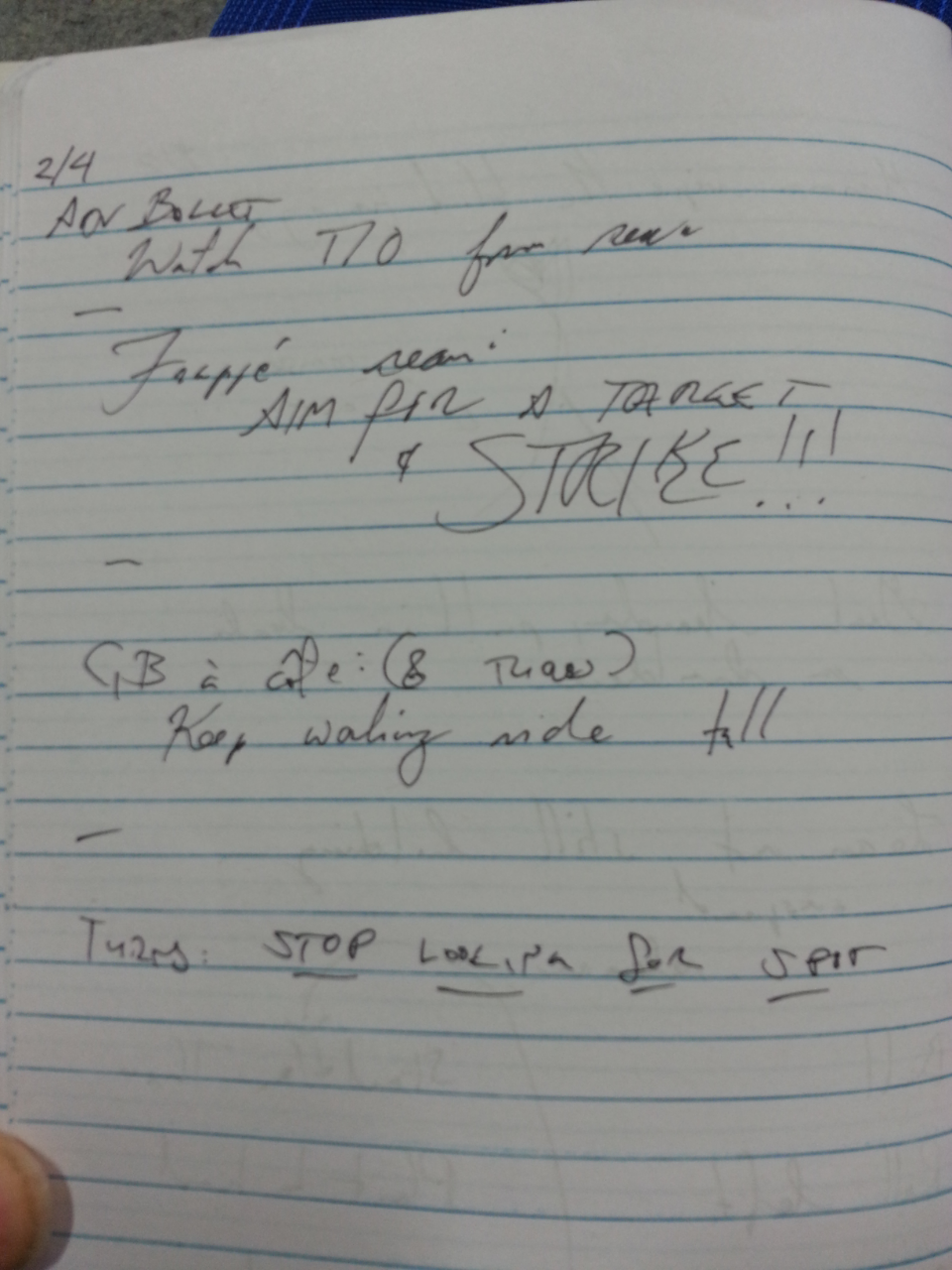
Today’s Notes from AOV BOLLET 

  • Watch T/O form seas
  • Frappé sean: AIM FOR A TARGET & STRIKE!!!
  • GB à cafe: (& TURBS) keep waling ride tull
  • Turns: STOP LOOLING FOR SPIT

Yup. Makes perfect sense to me…

(The saddest part: this is more legible than usual. #FML) 

Selections from Advanced Class

During terre-a-terre:

Me: I keep adding an extra tombé-pas-de-bourée.

BG: Don’t do that—we don’t get paid by the step!

Notes:

  • Think about over-crossing the working leg in Arabesque
  • At the barre, don’t let the working foot get lazy (also in Arabesque)
  • Corrolary: if you have beautiful feet, use what G-d have ya
  • Get your back up and keep it up, but don’t leave it behind when you failli
  • Double turns: stop looking for your spot!*

So, in short, all the same things I mostly had sorted before the break.

*Except this. I only recently realized that I’m practicing “proactive spotting” rather then letting the spot happen naturally.

Also, petit allegro was a disaster today, but that was because my brain refused to absorb the combination.

Invisible Things With Which I Still Wrestle

I was going to write a more positive kind of post. In fact, I couldn’t sleep last last night night to save my life, and wound up writing most of one. But, honestly, I’m not feeling it today. Instead, I’m wrestling with the little corner of my mind that refuses to stop having anorexia. So, erm. 

So, content warnings, I guess? Abuse, anorexia, attempted suicide, body shaming, rape. 


I did not grow up in a body-positive family.

Probably most of us didn’t. Mine was almost certainly no less body-positive than usual—but things were complicated. 

(More behind the cut. This one gets dark before it gets light again.)


My Mom is small and muscular—not Petite Lady muscular, but Closet Bodybuilder muscular; Female Superhero muscular (I honestly think this is kind of awesome, but I still feel weird saying it without asking her first if it’s okay). She also, like many human beings with insanely busy and stressful lives, tended to be a little on the fluffy side. 

As such, she was eternally on a diet. This was before white people learned about beautiful women in sizes greater than 6.

My sister had the face and coloring of Snow White—and a thyroid that basically did nothing from the time she entered grade school, and a legitimately fat-phobic pediatrician who refused to test her for hypothyroidism because he felt that it was “overdiagnosed.” 

Note that we’re talking about a disease that’s empirically measurable, here: a simple test would have revealed—and later did reveal—that my sister’s thyroid level was in the category of “What the actual feck.” But instead of doing his job, our first pediatrician essentially prescribed my sister essentially the same diet that I, years later, would impose upon myself: the one that left me weighing 85 pounds at 5’4″. 

On the other hand, my sis excelled in school, and I didn’t, and as such I felt like our parents (both avid readers and unabashed intellectuals) valued her more. 

I meanwhile, was everything my family didn’t know what to do with: smart, but bad at school; a natural athlete; gifted with a ridiculous set of eyelashes; and, above all, thin.

I seriously thought I was stupid for most of my childhood—but I was lean and strong and could trust my body to do what I asked it to do.

Unfortunately, the only one of these things that seemed to correspond to anything my family cared about was that I was lean. 

Somewhere in my Mom’s house there’s a picture of me at five or six, not in any way the pudgy little kid people expect at that age, but whip-slim and seriously defined. That was noticed, commented on, and reinforced.

It became part of how I defined myself. A big part. 

In fact, for a long time, it was the only way I knew how to succeed. 

~

Is important to note that, in the midst of all this, my family wasn’t cruel about body size—at least, not that I saw. Mom is a good feminist, and tried hard to walk the “you’re beautiful the way you are, but for your health you should lose weight” line for my sis. At the time, that was about as close to body positivity as one was likely to get.

The thing is, actions speak louder than words—and it was clear that the whole situation made Mom wildly uncomfortable, no matter how hard she tried to keep that under wraps. And, in the end, my sis heard more about her failure to shrink to an acceptable size than she did about her incisive mind, her facility with the written word, or her fabulous design sense. 

The same model applied to my failure to function at school: I heard constantly about how I could excel if I just tried harder. I knew that was incorrect, because I was trying so hard I wanted to explode. It didn’t seem to really matter that I was legitimately gifted in dance, music, and visual art—my family embraced the arts, but didn’t seem to regard them as viable career paths. It only seemed to matter that I was an unmitigated disaster in the academic sphere. 

Thus, unconsciously, I picked up on the fact that what I had to offer the world was a nice body and beautiful eyelashes. I was a gay boy who grew up in a house full of women. My role models were young ballet dancers. In my mind, a “nice body”  was thin.

I was thirteen when I spent a summer at a well-reputed gymnastics training program. Ironically, this would be the experience that ended my aspirations as a competitive gymnast: I was light and strong, but everyone else was hitting puberty and I was, essentially, still a kid. I was already taller than both my parents, but reedy in build. In terms of upper-body strength, I could no longer compete.

On the other hand, I returned home with the kind of lean, attenuated physique that one attains by five or six hours a day spent in hard physical training—and suddenly I was very attractive to a certain subset of the male population (read: the kind of assholes that find underdeveloped middle school kids attractive, ugh, but what the hell did I know? I literally didn’t know what what the word “rape” meant.). As a young, socially awkward, queer kid, the effect of this kind of attention was profound.

I fell into a flirtation with one such individual. I thought I could handle myself, until suddenly it was all too apparent that I couldn’t.

I’m not going to discuss the details. The end result was basically a year of hell, a solid case of Stockholm syndrome that would take years to undo, and a conviction that the only, only, only thing that made me worthwhile was my lean, bony, androgynous body. 

I think you can see where this is going. 

I don’t usually tell people this, but this is why I stopped dancing (and also the reason that, when I returned to dance in high school, it was through modern first, no matter how badly I will yearned for the order and beauty of ballet, literally because you can wear looser clothes). This was the reason that I didn’t apply, as a rising freshman, to the dance program at the arts magnet that would later very literally save my life. I no longer trusted my body—and at the same time, I felt it was the only thing of value I had to offer the world.

I believed I was stupid, but I also believed that I was desirable as long as I stayed thin. 

But being desirable also felt dangerous. My whole world was terrifyingly out of control, including the only thing I regarded as an asset. 

So I basically stopped eating. 

Remember the diet my sister’s pediatrician prescribed? It was 800 calories a day. At one point, that was my goal (it later dwindled to 600, which is still the number my brain settles on when things get bad). My sister was forced to count grapes. I counted them myself. 

For a year or more, I could wrap my own hands around my waist. I remained convinced that I was getting fatter. 

I find this almost inconceivable now: I mean, not the delusional sense that I was getting fatter, but the fact that I was that freaking thin.

~

From where I stand now, I can see that a lot of my anorexia was, predictably, about controlling the only thing I could control. I had discovered, terrifyingly, that I couldn’t even control what other people did my body, but I could control its size. I could remain lean and sleek and androgynous—though increasingly I must have just been bony, even cadaverous. 

I convinced myself that I was not, in fact, really anorexic because I thought it was fine if other people were big (in fact, big guys are still kind of at the top of my list, though it increasingly seems that I find the vast majority of adult humans attractive to varying degrees). Clearly, that meant that the problem wasn’t with my perceptions of body shape, but with my actual body. 

Awesome logic, there, amiright? 

In other ways, I retreated into a world of fantasy and delusion for a while. When you can’t talk about what’s happening to you, but you have to offer some account that explains why you aren’t doing your homework and why you never wear shorts or short sleeves, you quickly learn to lie, and to lie well. You learn that people don’t, on the balance, really want to know that things are, in fact, unspeakably bad.

You learn learn to control the two things you can still control: the story the world gets about you, and what you put in your mouth. 

~

I was fourteen when I used a broken pen—the clear, hard-plastic kind that you can literally use to shank a mofo—to drill a hole in my left arm. The intent was to cut a neat little hole into the large blood vessels in each wrist, one centimeter square. The ultimate goal was death.

It seemed like a good idea at the time. 

My Mom wasn’t home. My sister was living with our Dad. My grandmother, who was legitimately gifted with a kind of second sight I can’t explain away, happened to be staying with us (in retrospect, I assume this was because I was such a mess). 

She interrupted me before I could finish the job. We had never been allowed locks on our bedroom doors, and I wasn’t aware you could wedge a door shut with a chair. I had made an effort to jam my door with a heavy bookcase, but I don’t think anything would’ve stopped Gram. She was around eighty by then, but she she was a force of nature, and she loved my sister and me so much.

I told Gram I had cut myself by accident. She didn’t believe me, and I knew she didn’t believe me, but we pretended that she just really needed my company. I don’t remember what else I did that night, but obviously dying wasn’t involved. 

The next day I went to school. Predictably, my arm started bleeding during art class. I tried to hide it, but the girl who shared my table quietly called my teacher’s attention to the problem. 

I was hospitalized before dinner.

Even in the hospital I maintained that I couldn’t possibly have anorexia because the other anorexics thought fat people were disgusting. I liked fat people, so I couldn’t be like them. Again with the logic.

Ultimately, it wouldn’t so much be the actual treatment, but the side-effects of medication that broke the back of that first episode of severe dietary restriction. The medications I was given made me retain water and temporarily destroyed my metabolism. They also disrupted my balance and equilibrium. I had lost control even of my body, so there was little point in trying to control it. 

I’d like to say that cured me, but it didn’t. As soon as I could manage it, as soon as I moved out of my Mom’s house, I starved myself back down down to a BMI of 17.

Since then I’ve struggled intermittently with this thing. Ironically, ballet helps—first because you can’t actually starve yourself and expect to dance well for long; second because it has taught me to trust my body again and to appreciate it for something other than androgynous leanness.

At my “fighting weight,” I’m just a dancer, like other dancers: lean but strong, possessed of a kind of masculine grace I didn’t used to appreciate in myself.

Right now, though, I’m six pounds up, the world is on fire, and I’m struggling with this beast again. 

I recognize that a lot of of it is this: things feel insanely out of control.

My country seems to be steering full steam ahead for for the nearest dangerous rocky shoal. People I care about are standing on precarious slopes. Decisions being made by people in power threaten all kinds of civil liberties for all kinds of people. They also directly threaten D’s livelihood (he specializes in treating adults with developmental and intellectual disabilities, whose Healthcare is government-funded) and mine (I’m an artist; of you crash the economy, artists feel feel it fast). That’s part of it.

But, just as much, the life that I’ve carefully constructed like a divided dinner plate is losing its barriers. People I take class with are becoming friends. My facebook is connected to my Instagram, which isn’t connected to my blog, but since they share a title I’m terrified that my dance peeps are going to roll up in my blog and tell me I’m insane (and be really, really annoyed with me for writing about class).

That’s also part of it.

And this thing with being a performing artist is sort of weirdly taking off,  and that’s both thrilling and terrifying. It’s like stepping out onto a high wire, knowing there might be some asshole on Terra Firma with tin snips and a grudge.  Oh, and then there’s the housework. And the book-keeping. And the fact that I’m still in limbo about surgical correction for the whole Dances with Moobs problem. 

All of that feels pretty out of control.

Likewise, for me, the six pounds makes ballet technique harder: simply put, my thighs are already big enough that a little extra fluff can hose up my fifth. Sure, it’s still pretty good, but I was closing in on reliably perfect. 

And, ultimately, like so many people who  struggle with anorexia, I am by nature and by training a relentless perfectionist.

So that little gap in my fifth? 

It fecking well drives me mad. 

~

Experience has taught me that this, too, will pass. I know my body well enough to know that it’ll get back to its “fighting weight” soon enough.

Just, right now, I’m wrestling the furious frustration of not quite being able to put this anorexia thing to bed once and for all.

I’m not giving in to it. I’m still more or less driving the train. 

But the internal struggle is on; the one between the voice in my head that calmly informs me that if I don’t shed six pounds by Thursday, it’s because I’m weak, and the other, newer voice—a healthy, logical voice that reminds me, “You dance and train like twenty hours a week. Relax.”

For what it’s worth, this—for me—is still about me. Like I said: I like all kinds of bodies: all kinds except the one specific and unique kind that is this body; my body. On somebody else I’d look at it and go, “Hey, he’s cute.”

On myself, though? 

Check back with me in a couple of weeks, when things start to feel a little calmer (or don’t), when I’ve adjusted to the latest subspecies in my ever-evolving schedule.

The Illusion of Effortlessness is Just That: an Illusion

Apparently ballet-as-fitness is a thing right now, but some who’ve tried it find that it’s “slower-paced” and possibly not as demanding a workout as their fitness level requires. 

To them, I say, “Come try Killer Class, and if you live, we’ll talk it over.” 

So, here’s the thing: the ballet classes to which good ballet schools steer true beginners are, out of  necessity, introductory classes. 

And, under the right teachers, introductory classes aren’t designed as exercise classes(1).

  1. I’m not commenting on “fitness barre” here—I haven’t tried it. The closest I’ve come was a class at the Joffrey which was labeled “Keep-Fit Ballet” that turned out, in fact, to be essentially Killer Class crammed into one hour.

A good introductory ballet class is designed to teach you how to use your body in a way that is fundamentally different from anything you’re likely to have done with it thus far (unless you’ve had good instruction in ballet in the past).

It’s designed to incrementally strengthen and stretch muscles that likely haven’t been doing much for a while.

It’s designed to impart the basics of sound technique so that when you level up, you’ll be able to learn harder, faster-paced stuff without compromising your technique and injuring yourself.

As such, the pace will by necessity be slow. It’s hard to learn sound technique when your brain is actively on fire and your body is sounding its air-raid sirens.

If you’re pretty fit, you’ll probably make it through barre (or even an entire class) in Intro to Ballet without so much as breaking a sweat.

If you’re using good technique, you almost certainly won’t “feel the burn” in the muscles where you, as a person with fitness experience, expect to feel it(2).

  1. Pro tip: if your quads are on fire after a développé-heavy Adagio, you’re doing it wrong. If they’re on fire after a long fondu or little jumps, you’re probably okay as long as your deep rotators are also ready to rise up and last waste to their oppressors.

If you stick around long enough to nail down the basics and get green-lighted for Beginner and then Intermediate class, though, you’ll discover that ballet is not by any means all gentle repetition and slow stretchy stuff.

If you stick around long enough, you’ll discover that a good class at an intermediate or advanced level can leave a flotilla of professional ballet dancers—arguably the fittest humans going—drenched in sweat.

See, ballet is all about the illusion of effortlessness—and the only way to achieve that illusion is through sound technique harnessed by a body trained in a highly-specific way. You must do a million tendus because those tendus evolve into dégagés, which evolve into grand battements, which evolve into grand jetés. 

(So, basically, ballet is like Pokémon for the human body?) 

In short, some of the most crucial muscles in ballet are ones that the average fitness buff probably doesn’t even know about, and that even the most skilled athletes in other disciplines(3) rarely think about at all.

  1. Notable exceptions: really good huntseat and dressage riders use the deep rotators constantly, which is unsurprising given that a good basic “seat” is essentially a modified plié; figure skaters also use their deep rotators in a very ballet-like way at times. For cross-country skiing, the ol’ turnouts are good for herringbone climbs; downhill, they come in handy in for stem turns and when you eff things up and need to get yourself out of a bind, but not necessarily out of your bindings.

As such, the physical training part of ballet can feel very unlike other forms of exercise, especially when you first begin. The focus isn’t on Mad Gainz; it’s on itty-bitty incremental gainz. 

Likewise, the dancer’s long, lean physique isn’t achieved in one hour a week (as a matter of fact, the standard ballet class is 1.5 to 2 hours long by itself), or even in one hour a day. 

Professional ballet dancers look the the way they do because they spend five to eight hours (or more) each day dancing—taking class, learning choreography, rehearsing, learning more choreography—and they cross-train via conditioning classes, cardio, and good old-fashioned lifting. 

To give you an idea, with a heart-rate monitor keeping tabs, I burned nearly seven thousand calories on my most recent five-hours-of-class day. That’s counting class and everything else, not class alone, but still! 

Presumably, this is why I came back from my summer intensives rather spectacularly lean and ripped: I was putting in the equivalent of a century on the bike every single day. I could not physically eat as much as I was burning. I didn’t have time. 

Simply put, it’s really hard to shove 6,000+ calories into your face on a schedule that involves eight hours a day of dance. There just isn’t enough time in the day. As such, professional dancers tend to be lean—but do remember that ADs tend to select lean dancers, and that not all dancers are, in fact, Balachinian in proportion.

Likewise, dont forget that professional dancers largely also cross-train for cardio (though some companies and schools of thought still discourage it): six hours of class may turn you into a beast, but it is unlikely to prepare you for the two or four or six minutes of non-stop redlining you’re going to do on stage (seriously, this was one of the astounding things about LINES—long-ass demanding variations in which nobody died). 

Dancing a demanding variation is like making the insane choice(4) to big-ring sprint up a long, steep climb to catch the breakaway group. Only, like you can’t even decide halfway through the sprunt that it’s a terrible idea, pop it down a couple of gears, and let your buddies in the flailing group catch your wheel.

  1. I feel particularly qualified to make this comparison. Insane climbing sprints are kind of my thing on the bike. Albrecht’s variation is pretty much like sprinting up the categorizable climb nearest to my house, including the fact that there’s a little extra “gotcha!” sprunt right when you think you’re in the clear. 

You have to keep the hammer down and gogogo, or the whole audience and the whole company and the whole dance world will be like, “WTF?” (More importantly, you have to do this because you’re a dancer and, when you’re dancing, it doesn’t occur to you to do otherwise.)

So dancers cross-train for cardio (and strength!) in addition to all that fecking about(5) in tights. 

  1. “Feck” is a long-standing favorite quasi-curse of mine; more so now that I know its canonical meanings include “throw/toss”—which is often an appropriate description of what we’re doing in class, really (jeté also means” thrown/tossed!”). 

This doesn’t mean that the workload of ballet is too light to qualify as exercise—rather, it means that class occupies an unusual hinterland between body-weight strength training and high-intensity interval training. Bike racers who specialize in sprinting also cross-train for cardio: to a dancer, bouncing on a trampoline might be the equivalent of a bike sprint specialist(6) logging her base miles.

  1. Autocorrupt suggested “bike sprint socialist,” which is now totally the new name of my imaginary band.

Anyway, to sum this all up: if you’re pretty fit, it’s reasonably likely likely that an Introductory-level ballet class probably won’t “feel” like a workout. 

Don’t be too quick to dismiss ballet as “too easy,” though—that’s like deciding after jogging a 3k that marathons aren’t hard. 

Still the Onliest Boy, But It’s All Good

Performance group is 11 or 12 girls and me. The choreography is really lovely. Mr. BesstMode is driving the train, and he’s got the girls opening with a beautiful little canon.

I come in at the end of it (learned it anyway, because just standing there the whole time would be a legit dick move). Thus far, my part goes:

Wait, wait, waitywaitywaitywait … wait some more, wait, countcount, sauté arabesque!

I’ve got that much memorized 😀

(I get to literally leap into strange, basically. Okay, so technically Sauté Arabesque is a jump, but work with me, here.)

Don’t worry, though. I jokingly said, “I’ve good on my part so far!” and Señor BeastMode replied, “Oh, don’t worry—I’ve got you working!”

The upside of being the only boy is that you essentially automatically get a featured role(1).

  1. Honestly, even if you’re all doing the exact same thing; ditto for whoever is is the Odd Dancer Out, whether it’s all guys and one girl, or all zebras and one giraffe, or all swans and one very confused velociraptor who has made the kind of questionable life choices that lead to time-travel and its attendant effects. 

The down side of being the only boy is that, like, you automatically get a featured role. Fortunately, I am both laughably overconfident and completely impervious to fear of looking like a complete ass(2).

  1. I really only suffer from that retrospectively, when I watch video and immediately want to crawl under the nearest rock.

I can’t wait to see how this turns out.