Category Archives: healing

Do Two Things
I’ve probably come to this conclusion before, so my apologies if this is tiresome.
I make the same mistake over and over again (what was that definition of madness, again?)—deciding either:
- …that I will somehow throw the neurochemical round-house punch to end all neurochemical round-house punches and knock my depression right TF out.
- …that I’m feeling much better and that, as a result, my depression is just about over and I’ll be fine any old minute now.
- …both.
Then I find myself flummoxed when I don’t magically turn into … well, not a normal person (as D always says, “Average was never the goal!”), but a not-depressed person … overnight, or when I overextend myself and just can’t even for the next five days.
As such, I’ve decided to adopt a motto that some might call “strategetic” and others might call “cowardly.” In short:
When all else fails, run away
And live to fight another day.
(Coincidentally, this exact phrasing is the motto of Daniel D’Aeve, a semi-cowardly knight [he doesn’t like loud noises, for one thing] and accidental pirate [he doesn’t like boats, either] and the semi-hero of a musical I’ll probably never finish, but who knows. Miracles do happen.)
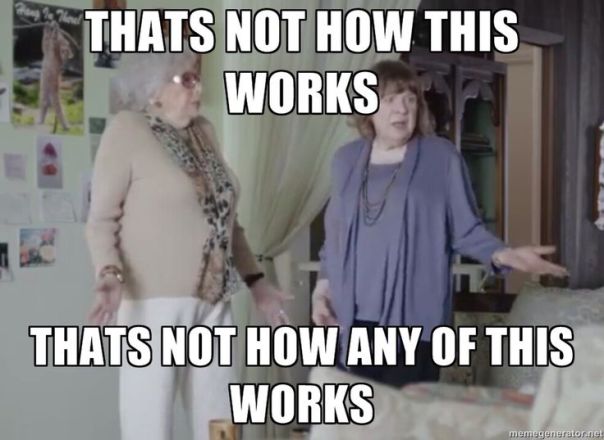
I’m not going to wrestle my depression into submission. That’s not how this works.
Via teh Pinterest-Googs Nexus
If I keep engaging it head-on, this gorilla will always, always wrestle me into the ground. Depression is like … I don’t know, wrestling some kind of mutant alligator that has gained the ability to steal your strength and make it its own as long as you keep fighting. (I feel like there’s almost certainly a Japanese monster movie about this already, but if there isn’t, there should be.)
As such, I’ve decided to adopt a more conservative tack. I know that I’m too impulsive to entirely avoid wrestling the alligator—sometimes I don’t realize I’m doing so until the alligator is already doing death-rolls at the bottom of the pond—but I’m going to try not to, like, walk up and pick fights with the alligator … even if that means letting it live in my house for a while.

Even if it taunts me from my own ottoman, I will try to not to fight the alligator.
In other words, for a little while, I’m going to try not to do as much.
I’m not going to stop doing everything, of course, but I’m not going to push quite as hard for a bit.
Instead, I’m going to revert to the best strategy I’ve ever found for keeping myself afloat in the midst of one of my moderate-but-grinding depressions: Do Two Things.
Oddly, I thought I’d written a post about this strategy before, but I can’t* find it, so I’m writing it now.
*Which is to say, I ran a search, devoted exactly 30 seconds to looking
for it, and then I gave up because I realized that if I kept it up I’d
start reading old posts and never finish this one.
So, in case you’re wondering, here’s how it works.
First, you get depressed. This makes living seem like a tedious uphill grind, and causes you to write poems empathizing with Sisyphus, and generally makes every single little thing that you have to do in order to continue to remain semi-afloat seem like a hideous impossibility.
Second, you own up to the fact that you don’t want to do anything. You don’t feel up to doing anything. You drag yourself to class because some part of you dimly recognizes that things will only be worse in the long run if, on top of recovering from a depression, you also have to get yourself back in performing shape or auditioning shape or what have you in the span of 3.4 days somewhere down the line. But other than that you feel like you just can’t even.
Eventually, you begin to feel slightly better, and then you look around your house and you realize, Holy Hell, it looks like a tornado crashed through a paper mill, a diner, and a thrift store before chugging right through your door. And also the cat has somehow contrived to get maple syrup on his head (which he doesn’t mind in the least, but you do). And you are out of Kleenex.
Some part of you thinks, “I should do something about all this,” while the rest of you just gazes around at the chaos with the proverbial thousand-yard stare and no idea where to begin.
That’s where Do Two Things comes in. You tell yourself, “Okay. There is no way I can do all of this right now, so I’m just going to do two things today.”
Then you turn to the thing nearest thing—or the nearest thing that feels like you have some hope of accomplishing it—and you do that thing.
The whole strategy hinges on this one truth: that sometimes “Do The Dishes” counts as one thing, and sometimes, “I’m going to wash this one dish” does. Sometimes, getting out of bed counts as one thing, and sometimes completely unmaking the bed, rotating the mattress, and remaking the bed counts as one thing.
It doesn’t matter. You judge yourself by the standard of where you are now. You give yourself permission to wash this one dish and that one fork.
The funny thing is that usually once you get started—once you wash the One Dish—you’ll usually find yourself thinking, “Ah, well. I might as well wash this entire stack; it’s not going to take any longer, really, and I already have my gloves on.”
So often Doing Two Things turns into Cleaning the Kitchen—but you have to remember not to look at that fact too directly, or your motivation might catch your scent on the wind and bolt. Wild motivations are flighty like that.
In my worst depressions, sometimes my Two Things are as simple as getting out of bed to get a drink, then eating a bagel while I’m already up.
When I’m well into recovery, they may be as complex as making the dining room ready for company and re-organizing the closets.
Either way, I give myself permission to feel like if I’ve done my Two Things, then I have done enough for the day.
It is, of course, totally okay to do more than the Two Things. It is pretty much impossible to do less: even in the pit of the kind of depression that keeps you confined to your bed or the sofa, it’s fairly likely that you’ll have to use the bathroom at least twice on any given day. If you’ve been in that place, you’ll understand why that counts. You just start with whatever Two Things are in reach.
Do Two Things acts both as an accessible goal and as a limiter.
If I’m having the kind of day that starts with “I am going to wash this One Dish,” then I know that, no matter how significant an uptick I might feel, I probably shouldn’t tackle rearranging the closets (which always sounds like a good idea, but turns into a nightmare because D has lived in this house for 20 years and almost never gets rid of anything).
Even if Washing the One Dish turns into Washing the Dishes, the knowledge that the first of my two things began as “Wash the One Dish” keeps me mindful of the fact that I’m not yet fully recovered, and that I shouldn’t start burning tomorrow’s matches today.
So there we have it. For the time being, I’m going to Do Two Things. This will help me get through the current slog without overwhelming myself (at least, without overwhelming myself as often).
Anyway, I don’t know if this strategy will work as well for anyone else as it does for me, but feel free to try it if you want to. It’s also good for getting started when you just plain feel overwhelmed, whether you’re depressed or not (this is a key feature of Adulting with ADHD).
You Gotta Keep ‘Em Separated
Good class tonight (technically last night, at this point). Back to accidental private class mode, but instead of the pyrotechnics, we focused on the details. This meant a very, very long barre in which I did something like 24 super-slow grand pliés in first whilst BW rebuilt, cleaned, and polished my port de bras and épaulement and the coordination of the same with the legs (which know their job fairly well). I keep forgetting that the Swiss have precision engineering in their blood.
This resulted in me actually looking like the danseur I aspire to be (at least while doing grand pliés in first). BW’s patience and precision are the perfect foil for my impatience and impetuousity. He is not at all afraid to make me do the same thing a million times until I really, really get it.
At one point, he said, “You’ve already got more of this than a lot of people. You’ll notice it when you watch people dance.” That’s quite high praise coming from him, and so indicative of something fundamental about him: he never gloats about his own precision and technical prowess; he seems to be frustrated that not everyone has it. But I love him for that, and for taking the time to impart precision and sound technique upon me.
After, we carried that lesson into a deceptively-tricky rond de jambe (relevé lent devant [“Higher!”] with arm in 2nd, allongé as you tendu, arabesque with arm in 2nd, tendu allongé, 4 ronds without port de bras, allongé, cambré into the barre and down the front, tendu allongé, reverse, cambré in and down the back, tendu plié allongé passé balance, sus-sous, allongé, detourné, second side—not complicated, but he wanted it absolutely precise), a lethally-slow fondue with synchronized port, and even the grand battement.
Amidst all these allongé, I discovered that the bones in my left shoulder are clicking. Later I mentioned it to D. Turns out I’ve separated my left shoulder somehow—mildly, but it also explains the ache in the morning.
I may, for all that, have actually done this to myself in my sleep. It could have happened at literally any point. As such, I’ll be working on shoulder stability (read: pumping up the delts, evidently) going forward. My wonky connective tissue probably played a part in this development, and the answer is always “strength training.”
The right shoulder only grinds when I do certain kinds of push-ups, these days, so I’m sure the left will sort itself out. Curiously, I haven’t noticed the left shoulder grinding during push-ups, so it might not even take much to correct it.

Field Trip; But First: Phases of My Butt
A couple years back I noticed that my tuchas has developed an oddly triangular profile.
Recently, I noticed that it has once again returned to a triangular shape.
Today I realized that it’s a function of conditioning: as I progress from (relatively) out of shape to stage-fit, my butt progresses from “round” through “triangular” and finally to “square.”
Huh. You learn something new every day.
~
In other news, we left at the crack o’ dawn yesterday for Atlanta, checked into our hotel at 3 PM, established a CirqueLouis outpost, then proceeded to regroup with the crew before dinner and Cirque du Soleil’s Luzia.
And speaking of Luzia—you guys, it knocked my socks off.
Luzia is a beautiful show—funny and tender and full of love for a place and for the people k and cacti) who make that place shine, not to mention packed with the high-calibre circus performances that give Cirque du Soleil its stellar reputation.
B on the straps was, for me, the pinnacle—he’s beautiful and performs with ardor and pathos. I don’t really have language to describe his act. It was breathtaking.
We also got to roam around on the stage—which is fecking amazing, you guys; the technology!—and backstage, where the CduS cast trains and gets physical therapy and does everything else and where the giant amazing puppets live.
After we chatted with the cast about circus stuff (and other stuff) over drinks, which was awesome. I tried to do a lot of listening. You learn a lot that way.
There’s much to be said for a life in which a business trip means watching a phenomenal performance and talking shop with phenomenal performers, then conducting a 5-hour long mobile meeting—part post-mortem on their show, part post-mortem on ours, and part spitball session for the next show—on the drive home the next day.
Little by little I feel like I’m starting to understand circus as an art form of its own, discrete from ballet and modern dance and so forth. I really owe that Jordan, our AD, who has been in love with circus all his life, who has built his life around circus, and who is teaching me (the company’s resident ballet boy) to really love circus in its own right.
~
Depression-wise, I’m making it back now, I think. The edges are still raw, and I need to respect that and not push myself off a ledge by diving back into too much at once. This is going to mean very consciously taking rest days, especially as I reset and shift back to a different rest-day schedule.
We’re halfway through November, somehow: I have roughly six weeks til it’s time to start hitting auditions.
When I headed to Florida back in September, January seemed unimaginably far away. Now it’s right around the corner.
BG, Killer B, and BW are rebuilding me as a dancer. Jordan is refining me as a performer. I’m not yet back to the place in which I feel like, Yes, I should go audition for ballet things, but I’m at least in a place where auditioning for cirque things and ballet-adjacent things feels like it makes sense.
I want to say, “Let’s see where I am in six weeks,” but I kind of think that’s giving myself too much room to weasel out.
Anyway. That’s it for now. I’m exhausted and ready to turn my brain off for the night.

A Thing I’m Slowly Figuring Out
I tend to try maintain an aura of ebullient optimism.
I’m aware that I lead a relatively charmed life, in which I’m permitted by circumstance to pursue a fairly impractical set of goals, and to mention that I still struggle seems a bit like spitting right into the face of good fortune.
But I do still struggle, and I’m beginning to understand something, which is this: living a life in which I’m not forced to do work that grinds my soul to powder, in which the work I do is work that I enjoy, doesn’t alter the fact that my mental health is a little fragile and that history and genetics have conspired to place me on a narrow bridge that spans a yawning chasm.
Rather, the life I’m living acts as a kind of safety harness, so that when–not if–I go plummeting off my bridge, I can eventually climb back up, or at any rate be hauled back up by people who love me.
I am capable of periods of immense creative productivity, but they’re interspersed with periods in which merely surviving is still all I can do. Those periods of mere survival are made easier to bear by the knowledge that I won’t have to return, as soon as I’m barely able, to work that will inevitably accelerate the arrival of the next plunge off the bridge.
Because D carries the vast majority of the weight of the financial responsibility of keeping us afloat, I’m able to get up and walk along my bridge for long periods, when in the past I rarely made it beyond the clinging-and-crawling-along-the-edges phase before I slipped again.
I don’t make much money doing what I do, but I usually have enough energy left over to keep our house comfortable to live in and to cook good food.
~

Nine More Days
Yes, I’ve resorted to counting down the days until I’m cleared for all the things.
The problem is that I really want to do handstands for some reason. Like, right now.
Normally, when I want to do handstands, like, right now, I just do them. (Often, when this happens, it’s because I’m trying to think my way through a sticking point in my technique and my nonverbal mind thinks it’s on to something. Sometimes, though, it’s just for fun.)

I dream in grand allegro.
I may have done a few wee petit allegro jumps in my kitchen (which is far too small even for medium allegro) last night. It might have felt good.
I decided I was ready to get back to barre when I found myself doing turns in my kitchen. I don’t think I can justify doing allegro of any kind (excepting the occasional step in my kitchen) until I’m 100% cleared.
So, needless to say, I’m antsy.
But it’s only mine more days.
What I’m really antsy about, though, is being able to take a proper, fully-submerged bath. I haven’t taken any baths at all because I’m afraid I’ll just submerge everything without even thinking about it—but on the other hand I do find baths really helpful on cold mornings (and, as you may recall, we have already established that my standard for labeling a morning “cold” is fairly pathetic).
Maybe I’ll try taking a bath and mindfully not submerging myself. And, of course, if I get really antsy, I can always use one of those medical-grade wound-protector things that they make for exactly that purpose.
In other news, I’m really tempted to wear this thing:

Bondage onesie?
…to class tomorrow, just to make BW and TS giggle. I think if I do, I’ll be forced to shoot some video for posterity.
Cambrés: I Haz Them
Got all my cambrés back. Circular port de bras still requires a modicum of care. Forces me do it thoughtfully though.
Did the Awkward Rotator Exercise before class. L, T, & BG all took class today, too, so the boys were well-represented.
My fondus were better today, but I still had to shelve half the grand battement to keep my heart rate down.

One More Opinion on Surgery
For some reason, it didn’t occur to me before I had my surgery to contemplate why my surgeon suggests the particular protocol[1] that he does with healing nipples (which will now forever be immortalized as “Post-Op Pasties®”).
- Daily from the Great Unrapping through Post-Op Day 21: apply bacitracin, apply Xeroform, apply adhesive bandage (I’ve been using the store-brand version of the 3M Nexcare ones for the most part); after 21 days, you can discontinue the Xeroform if you like, but continue with bacitracin and band-aids for at least another 7 days.
Turns out that if you don’t do something along these lines, they tend to get all weird and scabby and freaky-looking, and wind up being a major source of (not entirely necessary) worry for guys who have this particular surgery.
Keeping them slathered in bacitracin and covered with some kind of dressing both keeps them from drying out and getting terrifyingly scabby and keeps you from having to look at them all the dang time whilst they’re busy going, “WAT EVEN HAPPEN,” which is totally how I imagine them feeling about the process of being essentially evicted from their prior residences and relocated to new ones.

100% medically and scientifically accurate depiction of this process
Likewise, if you’re me, it keeps you from picking at the scabs, which I do compulsively.
So, in short, while the protocol is marginally time-consuming (if you consider “less than 5 minutes per day” time-consuming), I’m really glad that my doc suggests it. I had one little scabby spot on my right nipple, which has since sorted itself, and beyond that there’s just been a little occasional sloughing of dead skin when I removed my dressings.
Much better than having itchy scabs that I’d inevitably pick at, inviting infection.
So, good on Docteur Magnifique for that one, too (even though wrestling the Xeroform was a PITA because our bathroom lacks any kind of flat surface that isn’t the top of the toilet or the precarious edge of the wall-mounted sink).

Two Opinions On Surgery
At this point, I’ve written a fair bit about the surgery that I had to shed my moobs. I’m extremely happy with the results thus far, but that hasn’t stopped me from being extremely curious about the healing processes of basically everyone who has ever had any remotely similar surgery.
This has led to some interesting discoveries. First, there’s evidently a whole lot of controversy of the subject of drains: which is to say, a lot of people don’t want them, and seem miffed when surgeons require them. Second, quite a few of the people who wind up with the exact surgery that I had seem to want their incision lines to be perfectly straight.
I don’t mean to be a jerk about it, but neither of these positions seem terribly well-considered to me.
Here’s why.
Drains
In short, people don’t like drains because they’re uncomfortable. I’m not arguing, there: they are uncomfortable. The only reason I bothered taking any of the opioid painkillers prescribed by my surgery was so I could sleep with the poky-arsed drain lines annoying my intercostal tissues.
Given the minimal amount of drainage I produced, I legitimately could’ve gone without—but I’m glad they were there, just in case.
All too frequently, I run into an argument that goes, “Well, Bob didn’t have drains, and he was fine.”
The problem, there, is that it’s really quite difficult to predict who’s going to be like Bob, or like me, and who’s going to wind up with massive swelling that could’ve been prevented by installing a couple of drains for a week or so.
Surgeons can control their technique. What they can’t control is how our bodies react once all is said and done.
Some, like Imaginary Bob’s and like mine, just go, “Oh, no worries, I’m on this healing thing,” without any major drama.
Others go, “OMFG WHAT IS THIS WHAT HAVE YOU DONE AAUUUGHHHHHH!!!” and promptly kick up an inflammatory tornado, producing great gouts of fluid that can turn into seromas which are also quite uncomfortable, and which then require (you guessed it) drains anyway.
I’m a big believer in the idea that prevention is better than a cure.
I think the path my surgeon took in my particular case was just about ideal. D was hoping we could start for home on Monday evening or Tuesday instead of Wednesday evening or Thursday, so the doc suggested a compromise: if my drainage levels were good (read: minimal), we could have the drains out on Monday. Given that my surgery took place on a Thursday, this seemed like a really good compromise.
As it turned out, I experienced almost no inflammation and drained almost nothing from the word go, and the drains did indeed come out on Monday. Yes, they were annoying while they remained, but let’s be frank: roughly 4.5 days of moderate discomfort is preferable to the risk of epic swelling accompanied by potential weeks of discomfort. (To be fair, pain perception varies tremendously, and the drains might actually be a lot worse for some people than for others—but for most people, they’re basically just an annoyance, and a temporary one.)
Some surgeons (mine included) use drains for essentially everybody. Some decide on a case-by-case basis. Some don’t bother at all. Regardless, when it comes to this kind of thing, it’s worth considering that surgeons undertake a decade or more of specialized schooling to learn their skills—and, especially for cosmetic surgeons, it’s in their best interests to do whatever is going to get the best results.
In short, with a few exceptions, they generally have more insight into what they’re doing than their patients do, and it’s probably in our best interests to give due consideration to their surgical preferences.
Incision Lines
For some reason, a lot of guys seem convinced that curved incision lines scream “BREASTICLES!”
In fact, I don’t think they do, and here’s why: curved incision lines follow the anatomical shadow of the pectoralis major[1]. To the uninitiated, they’re not necessarily going to shout, “Yes, I had breast reduction surgery with removal of extra skin!”
- Exception: the rare cases in which an ill-advised surgeon makes them too curved—but, honestly, my jury’s really out as to whether that actually looks more unnatural than a perfectly straight incision does, since I’ve seen it so rarely even in my endless trawling of post-surgical pix.
Under ideal circumstances, they nestle in the literal shadow of one’s pecs, where they will eventually camouflage themselves as an extra measure of definition. And, of late, as surgical techniques have improved, ideal circumstances occur more frequently than one might imagine.
Perfectly straight incision lines, meanwhile, look unnatural. The human body is not a straight-lines kind of place. Straight incision lines depart rapidly from the anatomical shadow of the pectoralis and advertise themselves as exactly what they are—evidence of surgery.
The human eye is more likely to notice them simply because they contrast so sharply with the curvilinear nature of even the most masculine of human bodies (to wit: none of us are actually built like Minecraft sprites).
Even under ideal circumstances, perfectly-straight incision lines don’t camouflage themselves at all.
My incision lines aren’t straight. I wouldn’t want them to be straight. If anything, I wouldn’t have minded them being just a bit curvier towards their lateral ends—but, once again, my surgeon knows what he’s about. He’s been doing this for a long time.
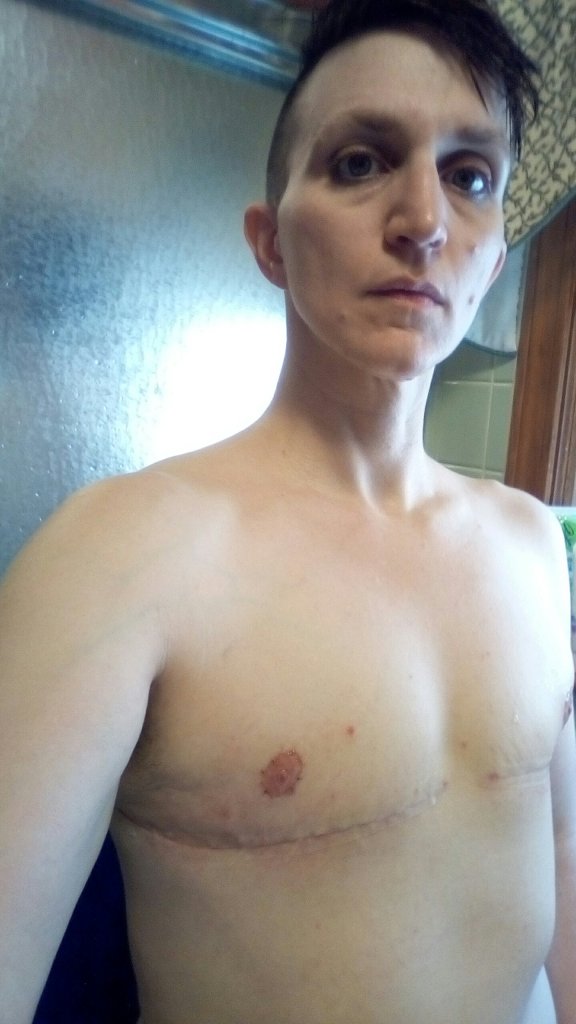
My incisions: maybe not what you’d call curvy, but definitely curved. (With silicone scar strips, which are the best thing since … I would say “sliced bread,” but honestly I don’t think sliced bread is all that great.)
I’m sure there are plenty of folks who will disagree with me on both these points—and, ultimately, I’m not telling them they’re making the wrong choices. People get to make their decisions based on their own bodies and their own long-term goals.
I just hope that, in making these decisions, there’s more to the decision-making process than “drains are uncomfortable” and “male bodies are made up of straight lines.”
Regarding point the first, that’s true, but they’re also temporary, and if they’re too horrible you can have them out early.
Regarding point the second, that’s really not true. Even Arnold Schwarzenegger is made up of a series of curves with varying radii. Ask any artist, or any robot who wants to look more human.
~
A note on all this: I recognize that there’s a pretty strong dose of privilege involved in the fact that I feel comfortable writing this.
I can assume that, while they’re kind of visible now because they’re still pretty pinkish, my curvilinear scars will eventually hide in the anatomical shadow of my pecs because I’m a dancer and an aerialist and a semi-mesomorph who puts muscle on at the drop of a hat. Even after three weeks sitting on my butt(er), and thusly at the least-defined I’ve been since I got back from my illness-and-holidays binge-eating tour of central Kentucky, I still have more definition in my chest than a lot of people will ever have. I get that.
Likewise, my work both demands that I be extremely fit and begets extreme fitness, and at least part of my rapid and unproblematic healing comes down to that. Maybe I would have felt differently about drains if I’d had to cope with them for more than 4.5 days (though, honestly, if you’ve got a lot of drainage, it’s probably a good idea to have drains).
On a different axis, I grew up in an extremely privileged setting which afforded me the opportunity to purchase all the anatomy books and drawing materials my little heart desired, and I have a very visual mind. It’s easy for me to say “scars should be curvilinear because bodies are curvilinear” because I’ve spent my entire life poking around with images and models of what human bodies look like beneath their skin and a brain that happens to be very good at storing and regurgitating that information (but which can never freaking recall a person’s name when I really need it to >.<).
So there’s that, also.
Lastly, a lot of the guys who have this surgery are trans, and every single opinion I have is founded in the fact that, as an intersex person, I face a different set of challenges in life than transfolk—one that overlaps with trans experience in some ways and is fundamentally different in other ways. For one, I may occasionally get misgendered in public, but I don’t have to put up with people constantly questioning my right to identify as a male[2].
- Curiously, exactly twice in my life, someone has asked me, “Why would you choose to live your life as a gay man when you could just be a woman if you wanted to?” Both times, it was another femme-y gay man who asked … and, in both cases, one who had grown up in a part of the United States that is actively oppressive and deeply repressive towards gay men in general and especially towards effeminate gay men. The region in question also tends to do a lot of conflating sexual orientation with gender identity. Neither of these guys had ever seen me unclothed, nor did they possess a clear concept of the fact that being intersex didn’t mean that I had “both sets” until I explained: in my case, it primarily means that I’m an ideal dish for a gentleman who prefers dainty Vienna sausages, so to speak, which isn’t quite the same as being able to just up and declare one’s self to be female even if I wanted to. And now you know way more about my body than you ever wanted to. You’re welcome.
Since transguys comprise a significant proportion of the folks who have this particular surgery, I feel like it’s probably worth acknowledging that I’m operating from a different vantage point, and that it colors my decision-making process. I think the same probably goes for non-IS cisguys: the set of my general experiences with being a guy differs from theirs as well.
There’s an extent, of course, to which everyone’s experience with gender, and with walking around the world as a gendered being, is different. Before it was corrupted as an insult, the phrase “we’re all individual snowflakes” meant exactly that: every one of us is the same in some ways and different in others, just as snowflakes share some basic characteristics and differ wildly and beautifully in other ways.
What I’m talking about, here, are collective experiences that shape the way we see the world: just as my upbringing in a forward-thinking part of the country prevented me from asking myself, “Why wouldn’t I just want to be a girl instead of being gay?” Those options, for me, have always existed on two different spectra.
So, anyway. Those are my caveats. I’m sure things are even more nuanced than that, but I need to wander off and do some errands now, whilst the day is young.
Poco à Poco
Bit by bit, I’m regaining range-of-motion and resuming my “Activities of Daily Living,” as they’re known to PhysioBots® from the future and their human counterparts.
This includes collecting small objects at a street festival whilst everyone else takes down the aerial rig and going to parties, not to mention catching up on the six million loads of laundry that are waiting for me because I was wary of schlepping large loads at first.
Anyway, it’s been surprising to observe my own healing process. Each day, I’m able to move my arms a little farther without yoinking anything, even though I’ve specifically been avoiding moving them beyond a pretty restricted zone. I can now get them into a languid “Romantic 4th,” basically, without irritating anything.
Practically speaking, that means I still can’t reach anything higher than the surface of the second shelf in the cabinet where the dishes live unless I stand on something, but at this time last week I was barely making it to the first shelf, so that’s good progress.
Also, it means I can at least put the plates away, though the soup mugs and pasta bowls will just have to wait a bit longer.
~
This weekend, I also realized how very strictly I avoided actually standing up straight outside of the ballet studio prior to my surgery.
Like most guys with moobs, I used to wander around with my shoulders sort-of rounded in on themselves. It makes you look like defensive and also makes you shorter.
It’s really still very weird for me to realize that when I actually stand up straight, I’m pretty much average in terms of height. Heretofore I guess I’ve known that rationally, but in a practical sense I still thought of myself as a little of the small side.
For what it’s worth, both D and I have found the results of my surgery a little unexpected. He mentioned last night that I look less different to him than he thought I would in some ways; more so in others—mostly that for whatever reason my whole body looks leaner and narrower. He’s not alone, either—other people also keep asking me,”Did you lose weight?”
I can only assume it’s something about the way I’m carrying myself…? Because, in fact, I’ve gained a little weight, as inevitably I do when I have to sit on my butt for a while.
For me, it’s more nuanced. I can’t say that I really expected to perceive my build as kind of rangy and muscular, nor to actually like that about myself.
Anyway, it’s weird. You would think that having this sort of thing done would just result in feeling like, “Okay, cool—that’s just me without moobs.” Maybe that’s been how it does work for some people. For me, though, it’s made me realize that I only ever looked at parts of my body before: I thought I looked at the whole, but now I think I really didn’t. I can’t really otherwise explain how surprising my body is to me when I look at myself in the mirror now.
~
Anyway, I’m back to slowly catching up on the laundry and the cleaning. I’m also counting calories and opting for a low-carb approach to food until I’m clear to Resume All The Things. That seems to be helping to keep my blood sugar levels a bit more steady, as it generally does.
I might stick with it once I’m back in action, but I might not. I’ve made a pact with myself: I’m not going to get hung up on any specific approach to eating, period. My normal schedule burns a lot of calories and makes it quite difficult to eat enough, let alone to eat enough whilst also largely eschewing an entire nutrient category.
On the other hand, the inability to lazily wrap everything in a a tortilla does mean I’m eating even more veggies than usual, since cabbage rolls (and shredded cabbage in place of noodles) are basically the order of the day right now.
Speaking of which, I should go assemble some kind of … brunch, I guess, since it’s 11:30 and I still haven’t eaten anything.

Looking Ahead
Because evidently time and I have a tenuous relationship at best, I realized yesterday that I was beginning, rather than ending, the third week since my surgery, and as such I still face four weeks before I can resume my usual workload. Oops.
On the other hand, that does mean I’m healing very, very well. I’ve been obsessing over reading other people’s accounts of healing from this kind of survey—initially to figure out what to expect, what was normal, and what was cause to panic, and but now because they’re just plain interesting—and it seems that a lot of folks still have a fair amount of discomfort and so forth at this stage. I’m chalking my relatively easy recovery up to a really awesome surgeon and above-average physical fitness.
Anyway, Golden Retriever Timescales[1] not withstanding, I’m starting to make plans for next year.
- I’ve probably used this analogy before: while my sense of immediate time is pretty decent, once I venture beyond that, my perception of time flakes into two distinct categories—the ones you might imagine a not-very-bright Golden Retriever understanding, which is to say say, Now and Not-Now. Anything further than two weeks out, meanwhile, exists in the realm of absurd fantasy. Evidently, this also applies retroactively 😛
I auditioned for more things this year than last year. I expect to continue that trend next year. I’m looking at dance companies (ballet and modern, but mostly ballet), cirque companies, and cruise-line dance-and-cirque companies right now, as well as the usual gig-based auditions.
Ideally, I would love to work in ballet, but I realize that my particular skill-set makes me a good candidate for progressive circus companies. Likewise, while many classically-trained dancers turn their noses up at working for cruise lines, I like the idea of living and working on a self-contained floating city, and cruise-line companies value versatile performers. I suspect that my strong classical dance background and existing aerial skills will place me well (I’m also a pretty good singer, which doesn’t hurt).
That said, my best asset is simply the ability (and willingness) to up stakes and go wherever the work is.
It seems like a good idea, when you’re trying to work in a ridiculously competitive industry, to identify all of your strengths (not just the obvious ones) and seek opportunities where they’ll be useful. Given that I’ve taken a really, really atypical path to working in dance, I plan to use the heck out of that strategy. My goal is to audition as often as possible for jobs that will find my collection of both skill- and non-skill assets highly desirable: in short, to target companies that need people with strong classical (and progressive) dance training, strong aerial arts training, a background in gymnastics, fearlessness, willingness/desire to travel, and flexibility (both physical and mental). Being a ballet-and-trapeze boy who also performs on lyra and fabrics shouldn’t hurt, either.
I’m not operating under the illusion that, should I work for a cruise line or a touring company, I’ll get to see a great deal of the places we visit—but opportunities do arise, and I’m not seeing much of the world from where I am now, either 😛
Anyway, the primary goal next year is to continue training and gain as much professional experience as I can—basically, either to work with a company that rehearses and performs across a regular season for much or all of the year, or to continue to work with a company like CirqueLouis and take every additional gig that I can.
I’m not defining my ballet goals quite yet: I think I’m going to buttonhole Killer B, BG, and BW about those first. I still don’t have an intentional double tour, so I’ll be working on that through the end of the year once I’m cleared.


 danseur ignoble