This gallery contains 3 photos.
Evil Swans. Double Stags. Rowdy Drunks? Oh, wait, no–it’s just Acro 2!
…but don’t now that I’m an adult:
Good thing I wasn’t in any hurry to grow up?

This week, the days seem unbelievably long. I just basically seem to have SO FREAKING MUCH TIME (First World Problems again).
It just occurred to me that there’s a reason for that: last week, there was an awful lot of running off to rehearsal and class and that TV news thing; this week, there’s … well, there’s class?
Class and housework. Some technologizing in the margins.
I’m fine with that. I’m really not complaining. It’s actually pretty nice—it’s just weird and surprising how spacious this week feels after last week’s compressed, frenetic schedule.
You would think I’d have figured it out by now; that I’d have been around this block enough times to be able to predict that, hey, this week is way less busy than last week so it’s going to feel luxuriously slow, but nope. I haven’t figured that out yet, apparently.
My brain is on a break, or I’d try to draw some really intelligent correlation between this kind of experiential relativity and Einstein’s relativity. Like, I feel the germ of an idea kicking around in there, but I can’t quite seem to get hold of it.
Anyway, this morning I did barre and adagio, then made my excuses (foot, as usual >.<). Killer B gave me a correction that made my arms look awesome: keep the shape of the arm as is, but imagine that you’re pressing the whole thing down against something.
Curiously, what this accomplishes is not arms that collapse, but arms that look strong and shoulders that stay open and down and back and all that good stuff (read: all the other stuff BW regularly reminds me to do ^-^).
Basically, it’s like when you’re a little kid in those swimmy things[1] (they still make them—who knew?!) that go on your arms, and you’re using your lats to push them down against the water so they push you up. Maybe normal people don’t do that, but during my Swimmies-wearing phase, I totally did (in my defense, I was 2.5-3 years old) because I liked being able to go Boing!Boing!Boing! in the water, usually whilst my grandparents’ German Shepherd/Alsatian[2] looked on with a heckin concern.
Anyway, here’s a bunch of pictures taken (JUST NOW!!!) with D’s late-90s-era webcam (seriously, this thing is geriatric in tech years, though it still does the job) that more or less illustrate the point:


In case you’re wondering, this is my office/guest room, where I’m in the midst of catching up on the laundry after last week’s scheduling madness.
The really interesting thing is that I didn’t actually change the angle of my arm between the first and second shot in any of the sets: engaging my lats moved my entire shoulder joint.
That said, I don’t think pix 5 and 6 are great illustrations of anything except the fact that engaging your lats makes your neck look longer.
Picture 7, meanwhile, is just silliness for its own sake.
I’ll have to try to get better pictures of this effect next time I’m in the studio. It was hard to get enough of my body in the frame and still be able to click the mouse (I appreciate voice-activation so much more right now, you guys). I would’ve done better just to use my phone and email the pix to myself, but that seemed like too much work.
One of these days, I’ll try to see if I can get D to take a picture of what this looks like from the back, because I really feel it right below the margins of my scapulae/shoulder-blades/wing-bones, and I suspect that it’s probably quite visible.
I am not, however, very good at taking pictures of my own back.
I’m now committed for BW’s masterclass and some of the ML&Co intensive—I remembered that there are one-day passes and 3- or 5-class cards, so I’m planning to take 3 classes during the week and then go for the full day on Friday. It will be a hectic week, but not insanely so.
I also seem to have somehow committed myself to audition for the company at ML&Co’s intensive, so we’ll see how that goes. Erm, onward and upward?
In other news, I learned while I was writing this post that I will indeed be going to Pilobolus’ intensive this year as well! Obviously, that’s pretty exciting! I’ll also be able to visit my Mom and Step-Dad (unless the week that I’m going is the same week in July that they’re out of town; I can’t remember at the moment o.O’).
Yesterday, after I finished writing my post, I ate lunch, decided to read for a bit, and promptly fell asleep on the couch until 9 PM. Later, I slept from 12:30-9:30 AM. I’m not usually much of a napper, and that’s a lot of sleep for one night, so presumably I really needed to catch up!
At any rate, I’m feeling pretty well rested today 😀
We didn’t have modern class today (which let me get a bunch of stuff done around the house), so it’s back to the normal class schedule tomorrow. Modern is moving to a new time-slot, though, so that’ll be a change.
This week, D and I will start really cracking away at our PlayThink piece, which I hope to have finished before Master Class/ML&Co week (June 5 – 9) so we can simply polish it up before the festival.
Since I am, by nature, a giant show-off, I joined a detachment of my fellow ballet peeps in the Pegasus Parade yesterday.
Although the weather was drizzly and blustery, the parade was fun. Even the standing-around-for-three-hours clusterfeck was reasonably fun, since I was standing around with BG, T, C, E, AB (our in-house yoga teacher), and, um, the one girl whose name I for some reason can’t remember (apologies!). We kept each-other entertained with snark, irony, and occasional earnest conversations about what we’re doing with our lives.
After a while, myAdderall wore off because I forgot to my second dose for the day, and I remembered an important equation:
me – Adderall + standing around with nothing to do^(enough time) = idiocy
Fortunately, I did not (seriously) injure anyone with my giant umbrella. I miiiiiiiight have gotten a little too enthusiastic during a bout of umbrella fencing and poked BG in the chest (regarding which: I should probably not be allowed to have a giant umbrella until I learn how to keep a lid on things 😦 ).
The parade itself was 17 blocks of ballet walks, waltz turns, random partnering exercises, spasms of grand allegro, and occasional yoga.
My foot did not make it through without getting sore at all, but it only got a little sore.
After, I booked it to BW’s class.
Have I mentioned that I ate lunch at 11:30 and then completely failed to eat anything until after my haircut, which finished up at 9 PM?
BW’s class, truncated, was an hour of barre, slow but not easy. By the end, my feet didn’t want to point and my left leg basically argued my about brushing into an arabesque above 70 degrees and then folded into attitude on what was supposed to be a an arabesque in plié. BW said, “Let’s callgood it a day and stretch—you probably haven’t eaten since lunch, have you?”
And then I realized that, yes, I knew this feeling. It was Ballet Bonk again. Evidently, BW is great at spotting Ballet Bonk.
So we stretched, and I asked BW to snap some pix for this month’s Suspend Challenge.
It’s Splits Time again, so here you go:

My feet were seriously unwilling to point at this, um, point. Also, my legs aren’t fully extended.
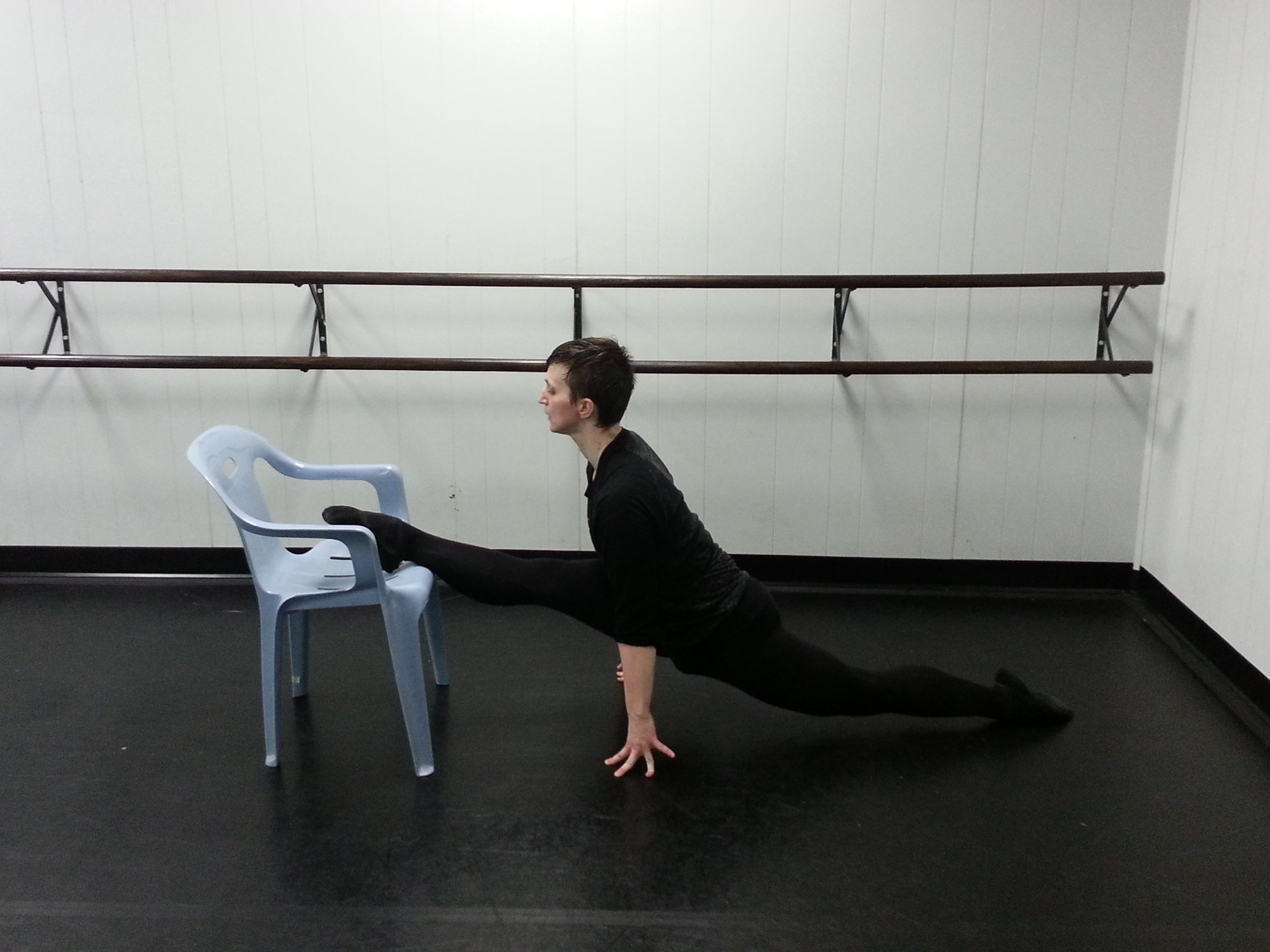
I was having trouble balancing this, and kept letting my left knee bend ever-so-slightly as a result. T-Rex problems.

This one is unintentionally creepy. On the other hand (heh), my butt looks AMAZING.

This is what we were going for, because I’m goofy: should we call this grand jeté a terre?

Pancake time, but it could just as easily be naptime. I was like, “This isn’t even really a stretch?” and BW was like, “You crazy flexible hips person!”

First, something that it never occurred to me to do.
Every now and then I notice that a blogger I’m following will post something like, “1,000 Subscribers! Wow! Thanks!”
I haven’t done that, or at any rate I don’t think that I have … so, um, to all you amazing people out there who follow this blog for whatever reason? Thanks!
It turns out that are more than 2,000 of you. I find that completely baffling, but not in a bad way. I mean, I’d still be writing this blog even no one subscribed (qv: if a hipster blogs in the wilderness and no one subscribes, does it make a sound?), but I’m weirdly delighted by the idea that somewhere out in the world there are people who, for whatever reason, like the stuff I write enough to add it to their feeds.
Special thanks to the handful of you who regularly comment. I live at this odd little nexus of the Ballet Blogger Universe, the Mental Health Blogger Universe, and the Bike Blogger Universe (even though I read bike blogs much more I actually ride right now), and there are folks in all three of those worlds who, even though I know some of you only by your blog handles, feel like friends.
It’s a funny old world, but I’m glad I’m living in it now, in the age of the Innertubes. I’m grateful for this ocean of virtual strangers, this sea of compulsive writers and readers who leave open windows into their lives and who stroll around the virtual block glancing in at windows of others like themselves, pausing now and to wave or chat across the virtual flower-boxes.
~
Bizarrely, the rest of this is really long, so here’s a more tag:
Anyway, onwards.
I’m doing better, lately, mental health-wise. At least on average, anyway.
I suspect that this comes down, in part, to the protective effects of dancing so freaking much.
Like, it’s definitely physically taxing at times (though still nothing compared to last year’s M-L & Co intensive), but for me that’s a good thing. That means I generally sleep better and, in turn, my mood stays more stable.
Add to that the generally-positive effects of exercise, a sense of belonging, and a sense of being good at something (and getting better at it), and you’ve got a nice recipe for better mood.
That said, I’m still struggling a bit with my schedule.
Split shifts aren’t my ideal—but they’re my reality right now, and are very likely to remain as much well into the foreseeable future.
So I’m working on learning how to adapt[1].
Probably the most important thing I’ve learned is that I need one day each week on which I do not schedule anything; on which I can stay home and clean the house and gather my wits about me in preparation for the next sortie.
In the past, I assumed that eventually I would settle into a stable and predictable kind of working life; one in which most weeks would be essentially the same in terms of schedule, if not in terms of content.
That, however, is not the rule for performing artists these days where I live. Indeed, I suspect that it hasn’t been the rule for performing artists almost anywhere, ever.
Had I realized that I was, in fact, doomed to stumble into a sort of career in the performing arts, I might have twigged on to this earlier.
As a dancer, you rather live by the gig unless you’re attached to a company (even then, you still probably need a side-hustle unless you’re either attached to a major company that can afford to pay a living wage or supported by a generous spouse). That makes for an ever-shifting schedule as projects come online, develop, reach fruition, live out their performance runs, and subside.
Most of us have day jobs (even I have a day job: besides being responsible for the housework, I’m still the web lead for D’s business—he just pays me mostly in ballet tuition), so by necessity rehearsals skew towards evenings.
Classes, meanwhile, skew towards mornings—probably in no small measure due to the fact that our teachers are usually also working dancers, directors, or choreographers with own rehearsal schedules, and many of them teach youth classes in the afternoons.
The result is a split-shift reality in which the middle of day becomes “free time”—by which, of course, I really mean the time when we Do All The Things.
This is convenient when it comes to scheduling haircuts, check-up, and shopping trips.
For me, it’s less convenient where getting other things done is concerned. I don’t change gears very well, and I have serious trouble estimating how long any given job will take.
I’m getting used to it, though. These days, I find that when I get home from class in the morning, if I know I’m heading back out in a few hours, I’d rather knock out a few jobs around the house than sit down and read or write—because inevitably, if I start reading or writing, I’ll have to stop at some inconvenient point. Instead, I mostly read or write after I come home in the evening.
Obviously, my day off is an exception.
On my day off, I like to linger in bed, reading or writing, until I feel like doing other things. Then I get up and get going.
~
I don’t think I could manage a schedule like this at a normal job. I need more time recover mentally from working in an office or a retail environment, though maybe that wouldn’t be true if I worked in the bowels of some filing department, retrieving things and putting things away with minimal actual interaction and little changing of gears.
Basically, for me, interacting with people burns a lot of matches—unless I’m dancing. This might be because interactions in rehearsal follow simple patterns: you receive choreography, you learn it, you take your corrections, now and then you might ask a question or advance an idea.
Mostly, you don’t have to talk.
I had a winter-break job at a warehouse once that I thought of as a of live-action video game: 12 hours pper day, 3 days per week (more if I felt like it), orders rolled onto the screen of my scanning gun, and I went on merry quests throughout Warehouse World to fill them. I have a very keen spatial memory, so I was good at it, and I actually liked the work because I never had to sit down and only rarely had to interact with other people. Basically, my day was like one long scavenger hunt, only I got paid for it.
Maybe I could do something like that on this kind of schedule—but it’s hard to say. I suspect that there’s something specific to doing the thing you love most that makes you more willing and more able to jump through crazy hoops do it[2].
Regardless, I would still need one “downtime” day; a day like today on which I can let my brain off the leash—one on which I might still need get things done, but can do them in my own time.
When I worked with horses, even the best schoolmasters and the prospects in the most stringent training got one day off every week to run around in the field just being horses. They needed that.
So do we. So, very much, do I.
~
Some while back I wrote about the weird point at which I realized that I’d come to identify myself as a dancer, and how it had happened sort of under the radar —by the time I realized it, it was already a fait accompli.
This weekend, it dawned on me that a similar thing has happened again. Without noticing it, I’ve come to think of myself as a working dancer; someone who will to continue to go and audition for things and work in dance for the foreseeable future. Someone for whom even going to auditions in the first place is not actually evidence of madness[3].
I mean, there was a definite thrill that came with my first successful audition—I didn’t somehow fail to notice that.
But the intervening period, I’ve evolved a sense of myself as someone who does dance in a kind of official capacity. Like, when someone asks what I do, it no longer feels weird to say, “I’m a dancer.”
Ironically, perhaps, the best tool I have for understanding it is my own Impostor Syndrome.
It’s still around, of course. I don’t think Impostor Syndrome ever entirely goes away in any field that invites the thought, “I can’t believe I’m getting paid to do this!” Rather, one might say that it evolves into a question of degree rather than kind.
As such, I no longer feel like actually working as a dancer is some kind of impossible pipe-dream. I can’t feel like that because I am, in fact, working as a dancer.
Instead, my mind has neatly created a new division; one in which there working dancers and, I don’t know, Working Dancers, and I can call myself one but not the other without laughing.
I am okay with that division. I suspect that, going forward, it will help to keep me humble. Besides, it afflicts every working dancer I know, including BW, who in a recent conversation about cross-training said something about “all the really amazing dancers,” which T and I found terribly charming because it was so unmistakably clear that he does not number himself in that group.
T and I, of course, very much do number BW among those stars. To us, he is a treasure: to himself, he is just him, warts and all. Not that I’m assuming he has actual warts.
Such is life. As dancers, we are keenly aware of our own faults. Even Nureyev was: he fell in love first with Eric Bruhn’s precision, because precision was not his own natural strength, and only later with Bruhn himself.
There is always Impostor Syndrome.
So my Impostor Syndrome no longer makes me afraid that, any day now, I’ll get an email saying, “Oh, sorry, there was a clerical oversight. We didn’t really mean cast you. Thanks for coming to all those rehearsals, though!”
Instead, it’s more of a sense that when I tell people what I’m doing work-wise, I should qualify myself: “I mean, I’m not in a company. I’m freelancing right now, doing local shows, auditioning for stuff.” It’s the thing that makes me add the qualifier “semi-” before “professional,” still.
I still feel like I more or less fumbled my way into this work, but I imagine that I’ll keep on fumbling forward now that I’m here. There will be more auditions and more gigs; more split shifts; more grateful kvetching about the weird reality in which one must decide to eat dinner at 3:30 or at 10 and in which one has difficulty identifying one’s co-workers in their street clothes.
Maybe if I keep at it long enough, I’ll even get to be as good at it as some people seem to think I am.
Of course, by then, my goal posts will have moved again, along with the locus of my Impostor Syndrome.
For now, though, there is a part of me that still thinks, “Huh, wow,” on the occasion that I find myself thinking about where I hoped to go when I returned to dance, or when I applied to Columbia’s DMT program, or when Dr. K told me that for someone like me, “…The sky’s the limit.”
I’m still trying to talk myself into believing that last one. As a dancer, I still feel so raw and so unfinished and like there’s so much I to learn, ballet-wise at any rate.
But I’d be lying if I said that those words didn’t act as a kind of springboard. And here I am, in a place I didn’t really believe I would ever find myself until, rather suddenly, I did.
*Honestly, I’ve lost count, so they’re all to be number 8 from here on out because #dancermath
Anyway.
You might be a dancer if you get home from rehearsal, decide you’re too tired to fold the already-clean laundry, but then put your Ballet stuff in the washing machine and stay up ’til it’s done so you can hang it up (because #priorities).
Apr 26
This gallery contains 3 photos.
Evil Swans. Double Stags. Rowdy Drunks? Oh, wait, no–it’s just Acro 2!
This morning, I opted just to do barre. My foot is finally actually healing now that I’m being extremely conservative with it, and since I have two classes tomorrow, then classes and rehearsals Friday through Sunday, I figured it would be a good idea to take it easy today[1].
Anyway, that was probably for the best. My brain was not on its A-game today. I managed to get almost every combination wrong in new and different ways … especially our fondu, which was supposed to go like this:
balloné, balloné, jeté front front front, balloné, balloné, jete side side side, balloné, balloné, jeté back back back, fondu passé developpé, fondu passé developpé, fondu passé developpé, retiré, fondu attitude, grand rond, fondu attitude
… and then reverse all that shizzle, or something along those lines.
…but quickly turned into this:
balloné, balloné, jeté side, wait, what?! balloné, balloné, jete … side for realz, I think??? balloné, balloné, jete … what the **** am I doing with my inside leg right now??? fondu all the unfoldy legs at the wrong time all the way around, retiré, arabesque, fondu attitude side, what the actual heck am I even doing right now??????!!!!, fondu developpé and HOOOOOLD.
Barring the moments in BW’s class when I sometimes fail to actually intake the beginning of some combination because I’m busy thinking about some fine point of technique and then have nobody to follow, it has been a while since my brain so thoroughly failed at the barre.
I actually asked between sides which way we were supposed to jeté first, and then proceeded to do a completely different set of wrong things on the second side.
>____<
Sadly, I had no problem remembering the adagio and terre-a-terre, even though I didn’t do them (I was stretching and watching BG dance, since he took class with us today).
I don’t know what my problem was, and I don’t think I want to know.
Tomorrow will be better. Until then, here’s a picture of my cat being extra derpy:
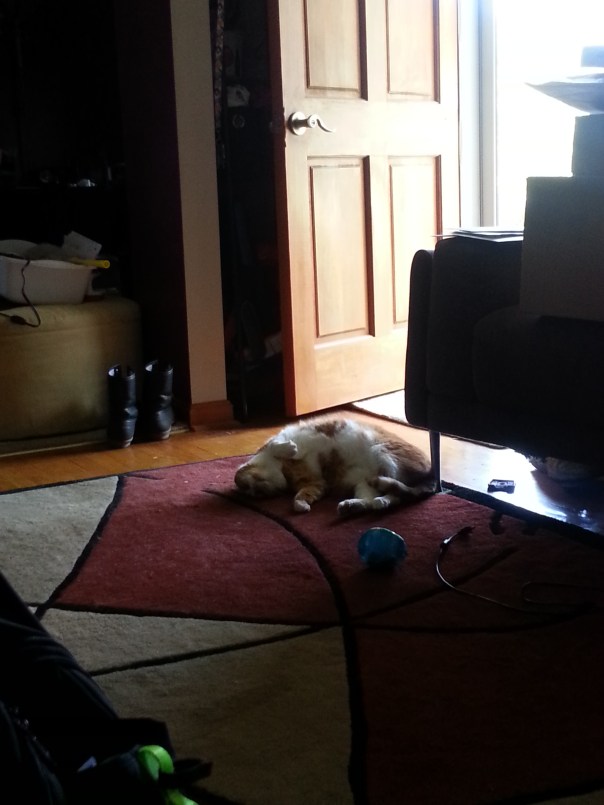
Pretty much how I felt during most of class.

I would be remiss if I didn’t mention from the word “Go” that the place where I take most of my classes is a lot better than many about making it clear that boys and men are welcome.
I take most of my classes at a pre-pro school attached to a company with a complement of fine danseurs, which certainly helps. Moreover, our website isn’t festooned with pink curlicues[1], the posted dress code explicitly includes male students, and a glance at the faculty roster reveals that both women and men are represented.
I’m luckier than many. In most ways, my school is getting it right—making it clear that there’s room at the barre for boys and men.
That said, even they miss something now and then.
Take, for example, the master-class series they’re doing this summer. The only specific skill prerequisite listed is, “At least one year en pointe,” though the course description goes on to note that classes will be taken on flat.
As a male student, it’s not clear to me at all whether this intended as a baseline to imply a certain prerequisite level of expertise or whether the series is even open to boys and men. The course description doesn’t specify.
If I was less pushy and obnoxious confident, I’d probably just hang back and grumble internally about feeling overlooked and about how annoying it is that the dance community spends so much time worrying about its dearth of male dancers, then fails to actually make it clear when we are and are not welcome.
Of course, I’m me, so I just shot a message to our administrator this morning to ask.
This doesn’t mean, of course, that every ballet school’s website should be wallpapered in blue and/or feature pictures of monster trucks (note to self: choreograph a story ballet based on the tragic life of a bush-league pro wrestler…). Rather, if we want guys in dance, we should double-check the language we use, just to make sure we’re not creating the appearance of gender-restricted spaces where no such restrictions exist.
We should make sure that dress codes address male and female students, or at least be phrased neutrally (“Students the Open Division should wear fitted athletic wear or dancewear of their choice, unless otherwise directed in course descriptions.”). Course descriptions should use pointe as a prerequisite only when it’s actually relevant to the course material (hard to do the hops on pointe bits of Giselle, for example, without prior pointe training!) or, at very least, include a phrase like, “…or equivalent experience in men’s technique.”
Explicit gender[2] restrictions should be just that: explicit (“open to ladies at least 16 years of age by permission of instructor,” for example).
Plenty of guys do pointe (Hello, Trocks!), so pointe itself does not an explicit gender restriction make.
Women can do men’s technique, too, though since we don’t really have another name for the subset of ballet that comprises men’s technique, if ladies are welcome, it would help to say so explicitly in the class description. And though it may comprise Balletic Heresy to say so, I’m all for letting the girls play with the boys, at least in the adult open division. The key thing is just putting “men’s technique” on the Open Division schedule in the first place.
Basically, I suspect that implementing a men’s technique class—even one that’s open to anyone of any gender who wants to take it (assuming that they meet the skill prerequisites)—would be a good way to tell male students that we’re welcome and wanted.
The usual model seems to be to preemptively conclude, “We don’t have enough men in the program for a men’s class.”
While that’s probably true in many Open Division programs (and, sadly, in not a few pre-pro program), it’s also probably not going to change if we don’t try doing something a little daring and different.
I suspect that Field of Dreams might have a thing or two to teach us, here: put together a class that teaches men’s technique, put on the calendar, and you might get mostly ladies going, “Hell, yeah! I’ve always wanted to learn double tours!” (which, IMO, could be great) but you might just succeed in bringing in the guys.

This is relevant to my interests.
For what it’s worth, there’s a lesson here for guys, as well.
It can be hard to overcome even unintentional verbal barrier in a place where an invisible-but-real social barrier already exists. It takes uncommon courage and the support of understanding friends and family to step beyond those invisible barriers.
The thing is, hosts of brave women still find themselves climbing over invisible barriers every day—and not just in the STEM fields, where their historical and current contributions are routinely overlooked.
In the arts, we still tend to picture everyone from choreographers, conductors, and composers to painters, poets, and playwrights as men (usually, if we’re frank, white men).
We guys can learn a thing or two from our experiences as the cherished-yet-overlooked red-headed stepchildren of the dance community: what it’s like, for example, not to be the default gender, and what it’s like to have to plead a case for greater inclusion before the powers that be.
We can learn that just using a blanket statement isn’t always enough: that we can and should look a little deeper if we want to help create real change.
~
Edited for clarity, autocorrupt, and that weird thing where SwiftKey decides to delete entire words.


YouTube: BOSU Balance Series


 danseur ignoble